
Economic power in transition: Why Germany and China remain interdependent
Xpert Pre-Release

Available in 27 languages 📢
Prefer Xpert.Digital on GoogleⓘPublished on: April 29, 2026 / Updated on: April 29, 2026 – Author: Konrad Wolfenstein
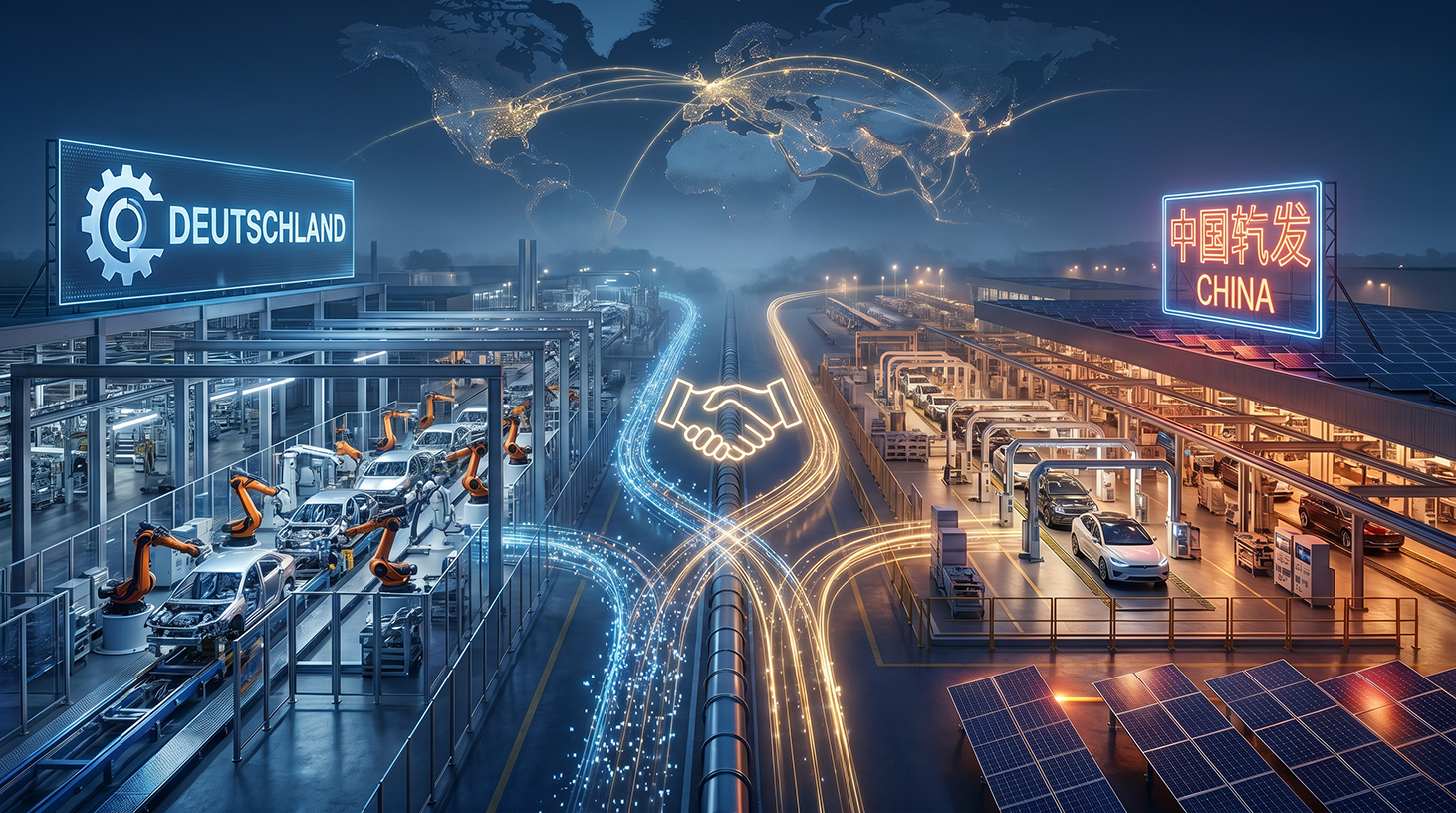
Economic power in transition: Why Germany and China remain interdependent – Image: Xpert.Digital
German precision meets Chinese scalability: The true potential of a controversial partnership
De-risking instead of separation: The surprising truth about the German-Chinese alliance
More than just exports: How business in China secures over one million German jobs
Germany and China share far more than just impressive export figures: it is a deeply rooted economic partnership, cultivated over five decades, that significantly shapes the global economy. Despite increasing geopolitical tensions and the necessary political debate surrounding strategic de-risking, a sober analysis reveals that complete economic decoupling would have disastrous consequences for both sides. Whether in the green energy transition, the development of Industry 4.0, or the safeguarding of over a million German jobs – the symbiosis of German engineering expertise and Chinese scalability offers enormous advantages. This is a frank examination of the structural gains, the asymmetric dependencies, and the question of why the world needs this alliance.
When precision meets productivity: The global economic advantages of German-Chinese business cooperation
The question of what economic advantages arise from German and Chinese cooperation can be answered in one sentence: there are enormous advantages – for both countries, for their trading partners, and for the global economy as a whole. However, this concise answer obscures the complexity and depth of a relationship that has grown over more than five decades and is now under greater pressure than ever from geopolitical upheavals. An honest economic analysis must therefore do both: clearly identify the structural gains and not downplay the risks.
Germany and China are currently the world's second and third largest economies. Their bilateral trade volume reached €251.8 billion in 2025, making China once again Germany's most important trading partner – a position China held continuously from 2016 to 2023 before the US briefly overtook it in 2024. That China reclaimed this position just a year later is no coincidence, but rather an expression of a structural economic interdependence that cannot be resolved in the short term through political decisions. Mutual investment exceeds US$60 billion, and more than 5,000 German and more than 2,000 Chinese companies are active in each other's countries.
Historically grown, structurally rooted: The foundations of the partnership
The roots of the economic relationship reach back to the 19th century, when German railway and mechanical engineering technology gained a foothold in China. Following the establishment of diplomatic relations in 1972, economic cooperation began to develop rapidly. What in 1972 represented a trade volume of US$274 million had risen to €245.3 billion by 2021 – an almost 900-fold increase within 50 years. This growth did not occur by chance, but was the result of complementary economic structures: China needed the technological depth and quality standards of German industry for its modernization; Germany needed the Chinese market as an anchor for growth, as a production base for globally competitive goods, and ultimately as a source of technological innovation.
In 2014, both countries transformed this relationship into a comprehensive strategic partnership. Since then, some 80 bilateral dialogue mechanisms have been established, covering a range of topics from trade and investment to the environment, science, and cultural policy. The government consultations, which have been held at the cabinet level since 2011, symbolize the institutional weight that both sides attach to this relationship. As recently as February 2026, Chancellor Friedrich Merz reaffirmed his desire for deeper cooperation at the German-Chinese Economic Committee meeting and explicitly encouraged Chinese companies to invest in Germany and create jobs.
German engineering meets Chinese scalability: The logic of complementarity
The decisive economic argument for cooperation lies in the structural complementarity of both economic models. Germany possesses a pronounced technological lead in areas such as mechanical engineering, automotive production, chemicals, and precision instruments; China has virtually unparalleled manufacturing capacities, rapid implementation of innovations, a coherent state industrial policy, and a domestic market of 1.4 billion people. This combination creates synergies that neither side could generate on its own.
This is particularly evident in the automotive sector. BMW and Volkswagen, two of Germany's leading automakers, have been involved with Chinese joint venture partners for decades, generating significant revenue there. The cooperation between the two economies in the field of electromobility illustrates this complementarity especially vividly: Chinese companies dominate the global market for electric vehicle batteries with their rapid pace of innovation and state-supported manufacturing infrastructure; German manufacturers contribute engineering expertise, decades of experience in vehicle development, and international quality standards to the collaboration. The result is reduced development costs and accelerated time to market – to the economic benefit of both sides and ultimately, global consumers.
CATL, the world's largest battery manufacturer from China with a global market share of nearly 40 percent, supplies BMW and Volkswagen with battery cells for their electric vehicle models. Volkswagen has extended its partnership with SAIC, a Chinese manufacturer, until 2040 to jointly develop new models. This level of cooperation is not the result of short-term opportunity, but rather the foundation of a medium- to long-term industrial strategy.
Industry 4.0 as an engine of innovation: When factories learn to think
Another key area of cooperation is the digital transformation of industry. The German Industry 4.0 strategy initiative and the Chinese Made in China 2025 initiative have significant overlaps: both aim for the complete networking of industrial production processes, intelligent manufacturing, the integration of artificial intelligence, and the automation of supply chains. In 2015, the economic ministries of both countries signed a joint declaration of intent to promote cooperation in the field of intelligent manufacturing.
Since then, companies, standards bodies, and business associations from both countries have been working in joint working groups to align their reference architecture models, develop common IT security standards, and promote cooperation in predictive maintenance applications. The economic logic behind this is clear: when two of the world's leading industrialized nations harmonize their standards, market access barriers for companies on both sides are reduced, cross-border digital ecosystems emerge, and competitiveness against the US as the dominant player in the digital platform economy increases.
The Hamburg Institute of International Economics has clearly formulated this strategic imperative: It is obvious that Germany and China, the two leading industrial nations, should seek cooperation in this field, as this would allow them to jointly counter the digital market leadership of the USA. Cooperation in Industry 4.0 is therefore not only bilaterally advantageous, but also has the potential to shape global industrial standards and thus offer other countries points of reference for their own digitalization.
The green dividend: Climate cooperation as an economic necessity
Few areas demonstrate the potential of German-Chinese cooperation as clearly as energy and climate policy. Germany, a pioneer of the global energy transition, is heavily dependent on Chinese technology for its green transformation. Over 90 percent of the solar modules installed in the European Union are produced in China, and Germany sources the majority of its photovoltaic cells, wind turbine components, and battery materials from China. This dependence is not a sign of weakness, but rather of rational economic decision-making: China can supply these products at a fraction of the cost of domestic European production.
China, in turn, benefits from German expertise in areas where its own experience is still limited – for example, in developing stable regulatory frameworks for the hydrogen sector, building cross-border hydrogen supply chains, and in the circular economy. In June 2024, the first high-level German-Chinese Climate and Transformation Dialogue took place with the participation of Federal Minister Habeck and the Chinese NDRC Director Zheng Shanjie, initiating concrete cooperation projects: these included collaboration between Jiangsu and Baden-Württemberg, as well as between Sichuan and North Rhine-Westphalia, on the green transformation.
The economic dimension of this cooperation is considerable. China is the world's largest producer of renewable energy and has dramatically reduced the production costs of solar panels, wind turbines, and batteries through massive state investment. Germany, in turn, has co-founded international institutions for renewable energy and possesses extensive experience in institutionally anchoring the energy transition and industrial policy. The combination of these strengths can not only accelerate the energy transition in both countries but also serve as a model for other economies seeking similar transformations.
The emerging cooperation in the hydrogen sector deserves particular attention. The Bosch Hydrogen Powertrain Systems joint venture in Chongqing, which Chancellor Scholz visited in 2024 and praised as an impressive example of bilateral cooperation, exemplifies the transition from mere production cooperation to genuine joint technology development. Experts see considerable potential for China and Germany to jointly establish an international supply chain for green hydrogen, combining China's cost-effective green energy production with German regulatory and infrastructure expertise.
Science without borders: Research cooperation as a silent multiplier of prosperity
Besides direct industrial and trade ties, scientific and technological cooperation forms an often underestimated pillar of the economic partnership. Today, 207 German universities cooperate with 343 Chinese universities; the Higher Education Compass of the German Rectors' Conference lists a total of 1,270 official collaborations between the two countries. In 2023 alone, the Max Planck Society conducted around 128 projects with Chinese partners; with 1,412 scientists, China was the most important country of origin for junior and visiting researchers at MPG institutions that year.
This scientific networking has direct economic implications. Co-publications in international journals, joint patent applications, and technology transfer projects between research institutions in both countries create the intellectual breeding ground from which future innovations emerge. The German Research Foundation (DFG) has been cooperating closely with its Chinese partner organization, the National Natural Science Foundation of China, since 1996. Highly qualified Chinese specialists who have studied and conducted research in Germany contribute to the dissemination of methods, standards, and economic systems knowledge upon their return to China—a knowledge transfer that contributes to higher economic productivity on both sides.
🎯🎯🎯 Sino-Cooperation

Sino-Cooperation is a platform based in China and Germany
Sino-Cooperation is a platform based in China and Germany that promotes exchange and cooperation between German and Chinese companies, especially through events, digital formats and an online cooperation exchange for market entry and partnerships.
More information here:
How German-Chinese cooperation redefines global value creation
More than bilateralism: Global effects of cooperation
The economic benefits of German-Chinese cooperation are not limited to the two countries themselves. They extend far into the global economy. The bilateral trade volume of over 200 billion US dollars directly supports more than one million jobs in Germany and, via Chinese value chains, generates income and employment in supplier countries across Asia, Africa, and Latin America.
A concrete example is triangular cooperation: Since 2020, the German Federal Ministry for Economic Cooperation and Development (BMZ) has classified China as a global partner and conducts joint development projects with China in third countries. Ongoing projects include promoting sustainable production in the textile sector in Ethiopia and carbon-neutral tea production in Kenya. The German-Chinese Center for Sustainable Development (ZNE) actively supports such triangular cooperation and promotes partnerships between the private sector of both countries in third markets, particularly in Africa and Asia.
China's Belt and Road Initiative, which involves infrastructure projects worth an estimated one trillion US dollars in emerging and developing countries, offers German companies opportunities to participate in projects that improve infrastructure, logistics, and industrial development in numerous countries. Eastern European countries, Central Asia, and parts of Africa benefit from infrastructure investments that would not be possible without Chinese capital and the contribution of German expertise. German companies can act as technology suppliers, quality assurance providers, and project partners, thereby gaining revenue and influence in these third-country markets as well.
At the macroeconomic level, cooperation between the two countries has a stabilizing function for the international trading system. China and Germany are both avowed advocates of globalization and free trade. In an environment characterized by growing protectionism – particularly due to the US trade policies under President Trump – their joint voice in favor of open markets and multilateral regulatory frameworks represents a significant economic policy counterweight.
Job security and competitiveness: What the numbers really say
The direct employment effects of this cooperation are remarkably concrete. Around 2.4 percent of Germany's gross domestic product and more than one million jobs are directly dependent on trade volume with China. This figure includes employees in export sectors such as automotive, mechanical engineering, chemicals, and electrical engineering – all sectors that form the industrial core of the German economy and offer above-average wages.
German direct investment in China has stabilized at a high level in recent years: in 2023, it reached a record high of €11.9 billion, representing an increase of 4.3 percent compared to the previous year. A key characteristic of this investment is that it is largely financed by the reinvestment of profits generated locally – demonstrating that the operational activities of major German corporations in China remain profitable. At the same time, Chinese companies are investing in Germany, creating jobs, and contributing to technological integration, as Chancellor Merz explicitly emphasized.
On the Chinese side, cooperation with German companies has been crucial to China's integration into the global value chain. Special economic zones, offering favorable conditions for foreign investors, served as the institutional vehicle through which German capital and know-how flowed into Chinese industrial development. This process has brought millions of Chinese workers into formal employment and skilled industrial jobs.
Mirror-image strengths, complementary weaknesses: An honest assessment
Any economic analysis worthy of the name cannot ignore the asymmetries and risks of this cooperation. In its 2023 China strategy, the German government clearly stated what many business representatives had long preferred not to hear: Germany has become significantly dependent on China, while China, in turn, is becoming increasingly economically independent of Germany.
This asymmetric dependency is evident in several critical sectors. For rare earth elements, lithium batteries, photovoltaic components, and pharmaceuticals – including antibiotics – there is a dependency that makes Germany vulnerable in the event of geopolitical tensions. China controls the entire value chain in these sectors, from raw materials to finished products, creating potential structural bottlenecks for Europe. The German government has therefore adopted the concept of de-risking as a guiding principle: dependencies in critical sectors are to be reduced, while complete economic decoupling is explicitly rejected.
The balance has also shifted on the Chinese side. China's industrial policy, specifically the Made in China 2025 strategy and the Dual Circulation initiative, aims to make its own industries less dependent on foreign technology imports. The decline in German exports to China between 2022 and 2024, particularly pronounced in the automotive sector, reflects this structural change: China is increasingly developing its own capacities in areas where German products were once indispensable.
Experts warn that joint ventures in the Industry 4.0 sector could lead to a massive technology transfer that, in the medium to long term, could backfire on the original German technology providers. The question of who controls and analyzes the data from networked production processes is not only a technical one, but also a strategic and economic one: it determines who identifies and realizes future innovation potential.
De-risking instead of de-coupling: The pragmatic middle ground
The political response to these challenges is the attempt to combine economic cooperation with strategic risk reduction. Chancellor Merz outlined this approach in February 2026 to the Economic Affairs Committee: open and fair trade with China, combined with the determined development of alternatives in critical sectors. The Ulm Chamber of Industry and Commerce (IHK Ulm), which directly represents the interests of regional SMEs, has made it clear in its analysis of the China strategy that this is primarily about reducing dependencies in key sectors – not about a politically motivated decoupling.
This pragmatic approach is economically sound. Leading economists believe that a complete economic decoupling from China would plunge the German economy into a deep recession. For example, dependence on China for solar components has significantly shaped the cost structure of Germany's energy transition – abandoning this dependence would massively increase the costs of green energy and jeopardize the competitiveness of energy-intensive industries. Conversely, without German exports of mechanical engineering products and chemical inputs, China would lose production capacity that cannot be replaced in the short term through domestic development.
In a guest article for Handelsblatt, China's ambassador Deng Hongbo succinctly expressed the Chinese perspective: Over 5,000 German companies are present in China, exports to China secure nearly one million German jobs, and China actively addresses the concerns of German companies regarding rare earths and semiconductors. A German-Chinese economic relationship built on mutual benefit and reciprocal respect for the respective systemic differences offers more stability than a decoupling that ultimately harms both sides.
New areas of cooperation: Where future profits will be generated
The future of German-Chinese cooperation lies in areas that are still in their infancy but promise enormous potential. The circular economy is one such field. In June 2023, a bilateral dialogue on the circular economy and resource efficiency was initiated during German-Chinese government consultations; since then, annual high-level meetings have taken place between the German Federal Ministry for the Environment and the Chinese National Development and Recycling Corporation (NDRC). China understands the circular economy not only as an ecological concept but also as a strategic industrial policy principle – a perspective that aligns well with Germany's export interest in recycling technologies, wastewater management systems, and resource-efficient production technologies.
The hydrogen economy offers another growth area of global scale. Chinese expert Feng Xingliang from Tongji University has outlined what an international supply chain for green hydrogen could look like, combining China's cost-effective green energy production with Germany's strength in hydrogen infrastructure and regulation. North Rhine-Westphalia, as a leading German state in hydrogen technology, would act as an exporter of expertise, while Chinese capacity and state funding would enable scaling.
German-Chinese cooperation potential is also emerging in the areas of digitalization of healthcare, precision farming, intelligent transport systems, and the development of AI-supported quality control systems, but this potential remains largely untapped. The more than 1,270 university partnerships provide the personnel and intellectual foundation from which such collaborations can organically develop.
Geopolitics as a variable: Cooperation under the sign of systemic rivalry
Any economic analysis of German-Chinese cooperation must take the geopolitical dimension seriously. The systemic difference between Germany's parliamentary democracy and China's one-party state is not merely an abstract category, but has concrete economic consequences: on legal certainty for foreign investors in China, on the protection of trade secrets and patents, on the reliability of regulatory frameworks, and on the risk of politically motivated market interventions. A 2025 study by the Atlantic Council analyzed the shift in German China policy from economic optimism to a cautious focus on competition.
This shift is real, but it does not signify a departure from cooperation. Rather, a model of selective interdependence is developing: cooperation where mutual benefits are clear and risks manageable; distance where critical infrastructure, security-relevant technologies, or fundamental human rights are affected. The joint press statement by Merz and Chinese Premier Li Qiang in February 2026 succinctly captured this balance: both sides expressed their willingness to intensify cooperation in their common interest – while simultaneously emphasizing open dialogue, fair competition, and mutually open markets.
Cooperation is worthwhile – with open eyes
The economic history of the last 50 years provides a clear finding: Cooperation between German and Chinese companies has generated significant gains in prosperity – in Germany, in China, and far beyond. Millions of jobs, trillions of euros in trade revenue, an accelerated energy transition, common industrial standards, and a growing scientific community are the tangible results of this partnership.
At the same time, a naive continuation of this cooperation without strategic self-reflection is not possible. The asymmetrically grown dependency in critical areas, technology transfer under structural imbalances, and geopolitical uncertainty necessitate a policy that seizes opportunities and manages risks. The concept of de-risking—risk reduction without decoupling—is not an expression of distrust, but of sound economic judgment.
The future of the global economy will depend significantly on whether the world's second- and third-largest economies find a path to constructive cooperation—or whether geopolitical upheavals destroy even economically rational structures of cooperation. Germany and China both have a fundamental interest in seeing the first option become a reality. And the global economy has an equally fundamental interest in their success.
Your global marketing and business development partner
☑️ Our business language is English or German
☑️ NEW: Correspondence in your native language!

Konrad Wolfenstein
I and my team are happy to be available to you as your personal advisor.
You can contact me by filling out the contact form here simply call me at +49 7348 4088 965. My email address is [email protected]:or
I'm looking forward to our joint project.
☑️ SME support in strategy, consulting, planning and implementation
☑️ Creation or realignment of the digital strategy and digitization
☑️ Expansion and optimization of international sales processes
☑️ Global & Digital B2B trading platforms
☑️ Pioneer Business Development / Marketing / PR / Trade Fairs
📈🔵 Ambidexterity or doom: The only management concept that still works in the triple crisis💡

When proven strategies fail: Organizational adaptability in the digital transformation of ambidexterity - Image: Xpert.Digital
We are currently experiencing a period of economic turmoil that differs fundamentally from previous recessions. A deceptive silence prevails in the boardrooms of European and international companies – broken only by the sound of failing strategies that were considered a guarantee of success just yesterday. This is not merely a cyclical downturn, but a profound structural break. The tools with which companies achieved growth for over two decades simply no longer work.
More information here:





