
Germany's unrecognized superpower: Smart Factory – Why our factories are the best launching pad for the AI future
Xpert pre-release

Available in 27 languages 📢
Prefer Xpert.Digital on GoogleⓘPublished on: August 7, 2025 / Updated on: August 7, 2025 – Author: Konrad Wolfenstein
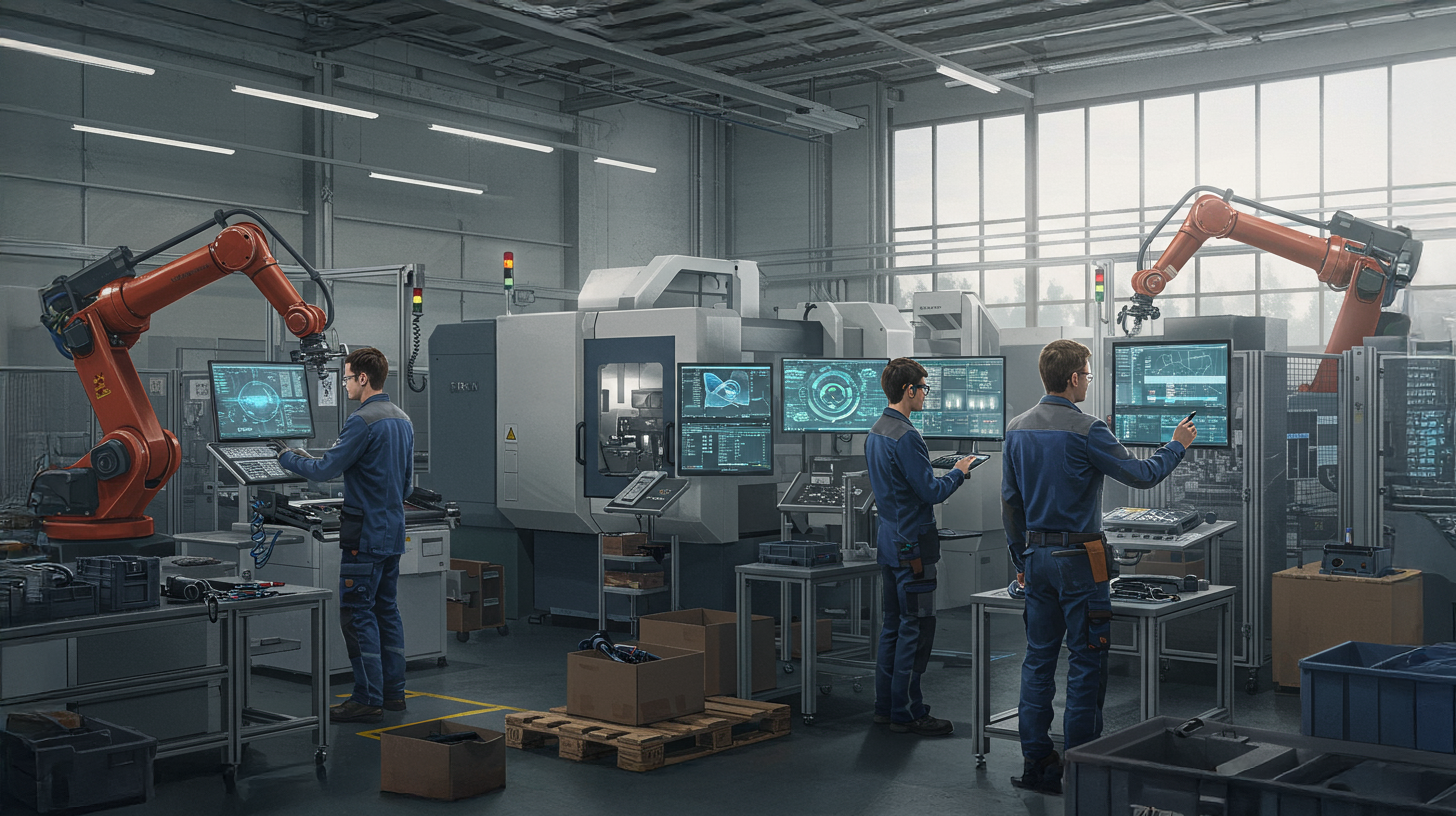
Germany's unrecognized superpower: Smart Factory – Why our factories are the best launching pad for the AI future – Image: Xpert.Digital
California – Germany: Tech giant vs. industrial giant – Who will really win the race for the future?
How industrial foundations determine dominance in the digital age – A comparative analysis of Germany and California
### Silicon Valley's Achilles heel: Why tech giants suddenly have a problem that Germany can solve ### Germany's industrial heart as a data refinery: The secret strategy that will help us survive in the tech competition ###
The digital economy – information technology (IT), cloud services, and artificial intelligence (AI) – fundamentally dependent on a robust physical, manufacturing industrial base for its value creation and monetization. We compare the economic models of Germany, characterized by a strong industrial sector, and California, whose economy is driven by a dominant technology sector. Our article confirms the strategic importance of the industrial foundation, but nuances the initial assumption of one-sided dependence, instead developing a model of profound symbiosis in which both sectors benefit from and are mutually dependent.
The quantitative economic structures of both regions are confirmed: Germany relies on a manufacturing sector that contributes approximately 18.2% to nominal gross value added, while California's technology sector accounts for – % of gross domestic product (GDP), with a significantly smaller traditional manufacturing sector of approximately 11%. A crucial insight, however, is the deconstruction of California's "tech sector," which reveals that a significant portion of its value added and employment comes from high-tech manufacturing, particularly in the areas of semiconductors, computer hardware, and biomedical engineering. The contrast is therefore less one of "industry versus IT" and more one of "traditional heavy industry versus advanced high-tech industry."
This article identifies strategic weaknesses in both models. Germany's Achilles heel is an acute and worsening skills shortage in the IT sector, which forecasts predict could grow to over 660,000 unfilled positions by 2040. This lack of human capital represents the biggest hurdle to the proclaimed rapid catch-up in the digital sector. This is compounded by a relative lag in venture capital investments. California, on the other hand, faces enormous challenges in physical infrastructure. The exponentially growing energy and water demands of hyperscale and AI data centers are colliding with an already strained supply grid and ambitious climate regulations, posing the risk of bottlenecks and stranded assets.
The key strategic conclusion is that Germany and the European Union (EU) possess a unique, yet not yet fully exploited, advantage. The dense, highly specialized industrial base is not just a market for digital services, but a strategic asset – a "data refinery" and "problem laboratory" of invaluable value. It provides the ideal foundation for the development of proprietary, domain-specific AI solutions that can outperform generic applications and represent a new, high-margin digital export.
Realizing this potential requires an aggressive, unified, and well-funded strategy. The recommendations focus on three key areas:
- Completion of the Digital Single Market: Radically removing remaining national barriers to enable European digital companies to scale in a home market of 440 million consumers.
- Human capital offensive: A massive, EU-wide coordinated “Digital Skills Pact” to reskill, upskill, and recruit IT specialists to address the most critical obstacle to growth.
- Promoting industrial-digital ecosystems: Targeted use of policy instruments such as the EU Chips Act to finance deep integration between industrial giants and AI start-ups, thus accelerating the development of “Industrial-Digital Champions.”
Ultimately, the question of whether a factory can survive without the cloud will not determine future economic dominance, but rather which economy most effectively masters the symbiosis between physical production and digital intelligence. For Europe, the opportunity lies in viewing its industrial strength not as a relic of the past, but as an anchor and launching pad for the digital future.
Suitable for:

The Symbiotic Machine: Deconstructing the Interdependence of Physical Production and the Digital Economy
The premise that the digital economy is fundamentally dependent on manufacturing is rooted in a traditional understanding of value creation. While this model captures an important part of economic reality, it falls short of describing the complex, bidirectional relationships that shape the 21st century. A deeper analysis reveals not a one-way dependency, but a symbiotic machine in which the physical and digital worlds are inextricably intertwined and mutually reinforcing.
Rethinking value creation: From supply-side production to demand-side networks
Classical economics, particularly supply-side theory, postulates that the production of goods and services is the primary driver of economic growth. In this model, a factory creates value by producing physical goods. The supply of these goods is the fundamental economic activity that creates demand and generates wealth. This paradigm describes the value creation of the industrial age and forms the conceptual basis for the claim that a factory represents a more fundamental economic unit than a data center.
The digital economy, however, operates according to a different, complementary logic, strongly influenced by demand-side principles and, in particular, network effects. In contrast to the linear value chain of a factory, the value of a digital platform or service increases exponentially with the number of its users. A social network with a billion users is not only twice as valuable as one with 500 million; its value is many times higher, as the number of potential connections and interactions increases dramatically. This phenomenon creates a self-reinforcing cycle: more users attract more users, making the platform more valuable for everyone and creating extremely strong competitive advantages (so-called "moats"). Digital platforms such as Amazon, Google, or Uber create value not primarily through the ownership of physical means of production, but by orchestrating networks and mediating transactions between different user groups. Here, the user base itself – the demand side – becomes the most valuable asset.
The juxtaposition of these two models reveals a false dichotomy. Today's most successful economic models are hybrid in nature. Digital services unlock their enormous value creation through demand-side network effects, but they ultimately require a supply-side economy to flourish. The logic can be understood step by step:
- The initial thesis postulates a dependence of IT on industry.
- However, the analysis of the platform economy shows that digital platforms create value through network effects seemingly independently of physical production, which contradicts this thesis.
- The crucial question, however, is: What do these platforms convey? E-commerce platforms like Amazon require physical goods that can be sold. Cloud services like AWS or Microsoft Azure require companies – including and especially manufacturing companies – to demand their computing power and storage capacity to optimize their own processes. AI applications require real data and problems from industry to be trained and generate economically relevant value.
It follows that the relationship is not a one-way street, but a symbiotic cycle. The physical economy provides the "what" – goods, the services, the data, the problems. The digital economy delivers a highly efficient "how" – marketplaces, the optimization algorithms, the communications infrastructure. Value is created on both sides: Industry becomes more efficient and innovative, while the digital economy provides the platforms for monetizing these efficiency and innovation gains.
The digitalization of industry: A symbiotic, not a parasitic relationship
Digitalization is no longer an external service merely consumed by industry; it has become an integral part of the production process itself. Under the term "Industry 4.0," physical manufacturing and digital intelligence are merging into a cyber-physical system that is fundamentally changing the way value is created.
The integration of digital technologies such as AI, the Internet of Things (IoT), and robotics is driving efficiency, resilience, and sustainability in manufacturing. Companies are using AI-powered forward-looking maintenance to predict machine failures and reduce downtime by – %, which can extend the lifespan of assets by 20%. Digital services enable manufacturers to create entirely new value propositions, such as responsive customer portals with real-time pricing and inventory information or personalized buying experiences that extend far beyond the physical product.
Academic studies support this symbiotic relationship. Research from China demonstrates a complex, U-shaped development in which digitalization initially disrupts existing structures but ultimately significantly promotes the "collaborative agglomeration" of manufacturing and the service sector. This indicates a profound integration process, not a simple customer-supplier relationship. Further studies confirm that the digital economy significantly drives the high-quality development of manufacturing and accelerates the modernization of industrial structures.
These insights lead to a strategic reassessment of the role of a strong industrial base. It is not simply a consumer of generic cloud services from American hyperscalers. Rather, it represents a unique, valuable pool of data and complex problems that can serve as the foundation for the development of specialized, proprietary digital and AI-based solutions. These solutions are defensible and globally competitive. The logic behind this is compelling:
- The initial thesis views the industry as a pure “customer” that monetizes the cloud.
- However, research shows that digital tools create value within manufacturing.
- The most valuable AI and digital services are often those trained on specific, high-quality data to solve complex, domain-specific problems.
- Germany's world-leading automotive, mechanical engineering, and chemical industries generate vast amounts of unique operational data and pose complex optimization challenges.
Consequently, this industrial base is not just a market, but a strategic asset – a "data refinery" and a "problem lab." It provides the perfect conditions for developing and training industrial AI that could be superior to generic solutions. This creates a new layer of high-margin, exportable digital products firmly anchored in physical expertise. This perspective reverses the dependency narrative: The digital sector's most valuable future could depend on deep integration with the industrial sector, not just serving it.
The physical demands of the digital world
The notion of a "virtual" or "intangible" economy is a misleading simplification. The digital world is anchored in a deeply physical reality, with immense and ever-growing demands for energy, water, land, and critical raw materials. Data centers, which form the backbone of the cloud and AI, are industrial facilities of enormous scale.
Hyperscale data centers require an electrical connection capacity of 20 to over 100 megawatts (MW) – to power a small city. AI-specific facilities that rely on energy-intensive graphics processing units (GPUs) drive this demand even higher. Enormous amounts of water are required to cool these massive server farms; a single large data center can consume millions of liters daily. The construction and operation of these facilities requires a robust and highly available infrastructure: powerful power grids, dedicated substations, redundant fiber optic networks, and good transport links. Furthermore, the digital economy itself depends on a physical supply chain for its hardware, from servers and network components to critical microelectronic components. The security of these supply chains is closely linked to the stability of the nation's Defense Industrial Base (DIB) and access to critical minerals.
The claim that data centers can be built "anywhere," while manufacturing facilities are tied to complex location factors, proves to be a fallacy upon closer examination. In fact, the location requirements for digital and cutting-edge industrial infrastructure are converging. A step-by-step comparison of the criteria for hyperscale data centers and modern semiconductor factories (fabs) makes this clear:
- The initial thesis suggests a fundamental flexibility in the construction of data centers.
- However, the analysis of data center site selection shows an intense focus on the availability of massive, stable and increasingly green energy, water access and fiber optic connectivity as decisive criteria.
- The analysis of site selection for semiconductor factories reveals a nearly identical list of priorities: abundant energy and water, a highly qualified workforce, and a stable infrastructure.
This convergence means that regions are entering into direct competition for the same scarce fundamental resources – both for the expansion of their digital and advanced industrial capacities. A region's ability to deploy this infrastructure at scale becomes the primary bottleneck for both development strands. This undermines the notion that data centers are inherently more flexible in their location choices and highlights the importance of an integrated infrastructure and industrial policy.
🎯🎯🎯 Benefit from Xpert.Digital's extensive, fivefold expertise in a comprehensive service package | R&D, XR, PR & SEM

AI & XR-3D-Rendering Machine: five times expertise from Xpert.digital in a comprehensive service package, R&D XR, Pr & SEM – Image: Xpert.digital
Xpert.Digital has in-depth knowledge of various industries. This allows us to develop tailor-made strategies that are tailored precisely to the requirements and challenges of your specific market segment. By continually analyzing market trends and following industry developments, we can act with foresight and offer innovative solutions. Through the combination of experience and knowledge, we generate added value and give our customers a decisive competitive advantage.
More about it here:
Digitalization meets industry: What distinguishes German and Californian models
Two Titans, Two Models: A Comparative Economic Analysis of Germany and California
The comparison of the economic models of Germany and California forms the empirical core of the initial thesis. A detailed, data-driven analysis confirms the structural differences, but also reveals crucial nuances that challenge the common narrative of "industry versus IT" and lead to a more differentiated strategic assessment.
Macroeconomic overview: The starting point
At first glance, the key macroeconomic data support the thesis of two fundamentally different economic structures. Germany, Europe's largest economy, and California, the world's largest subnational economy, are of similar size but exhibit different growth profiles and sectoral focuses.
Germany
Nominal gross domestic product (GDP) amounted to approximately €4.12 trillion in 2023. The German economy entered a phase of stagnation in 2023 and 2024, with price-adjusted declines of -0.3% and -0.2%, respectively. This development reflects the challenges facing a highly export-oriented and energy-intensive industrial nation in a globally uncertain environment.
California
The gross domestic product (GSP) reached approximately USD 3.9 trillion in 2023 and is forecast to reach USD 4.1 trillion in 2024. This would rank California, if it were a state in its own right, as the fourth or fifth largest economy in the world. The Golden State's economy is largely driven by the dynamism of its technology sector.
Comparative Economic Profile: Germany vs. California (2023/2024)
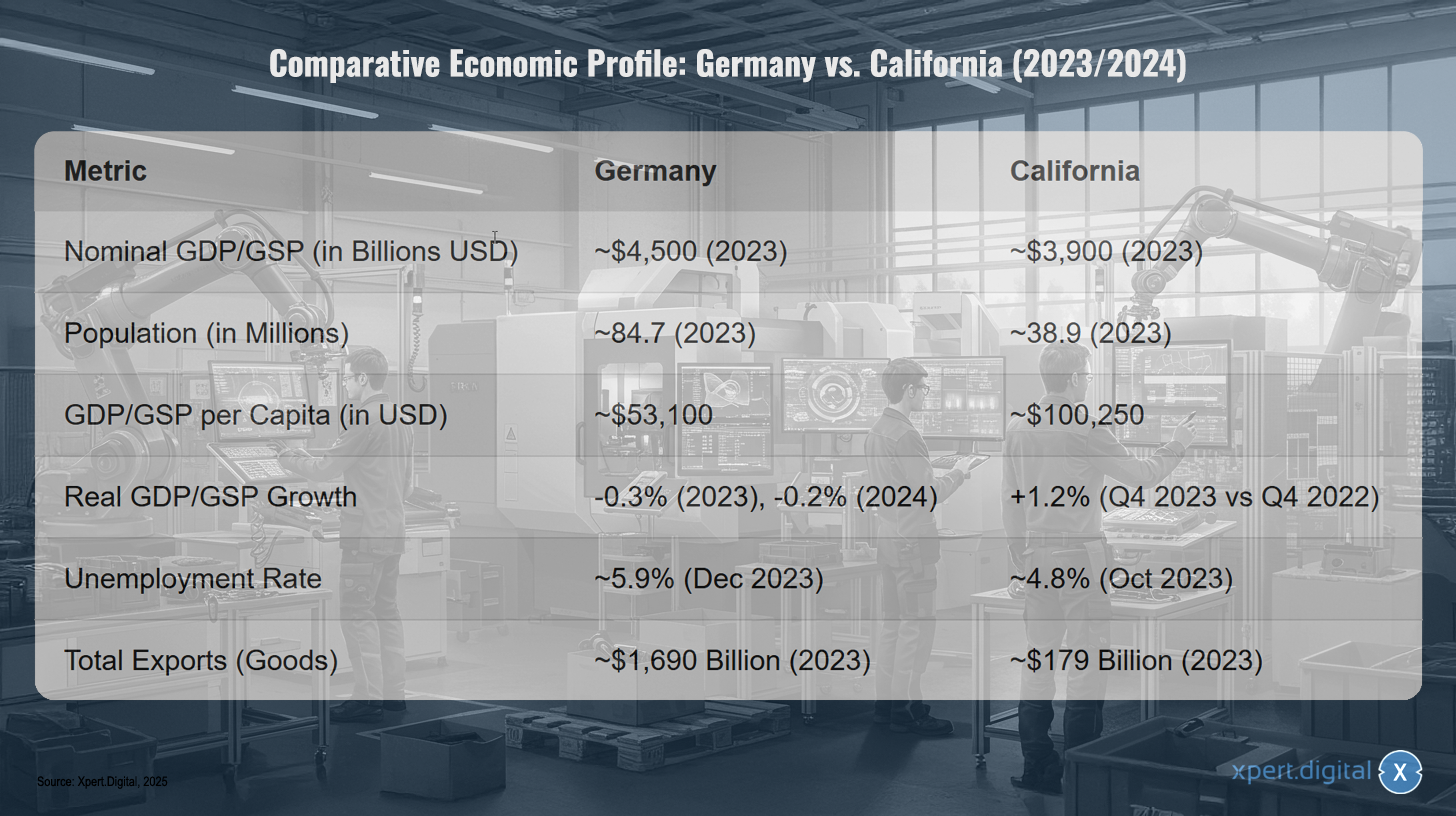
Comparative economic profile: Germany vs. California (2023/2024) – Image: Xpert.Digital
Note: Currency conversions are based on average rates for the relevant period. The data is provided for illustrative purposes.
The comparative economic profile of Germany and California for 2023/2024 shows that Germany will achieve a nominal gross domestic product of approximately $4.5 trillion, while California will reach around $3.9 trillion. Germany has a population of approximately 84.7 million, while California has a population of approximately 38.9 million. Per capita GDP (GSP) in Germany is significantly lower at approximately $53,100 than in California at approximately $100,250. Real GDP growth in Germany is negative, at -0.3% in 2023 and a projected -0.2% for 2024, whereas California will record growth of 1.2% in the fourth quarter of 2023 compared to the fourth quarter of 2022. The unemployment rate in Germany was approximately 5.9% in December 2023, while in California it was around 4.8% in October 2023. In terms of total exports of goods, Germany's value is approximately $1,690 billion, significantly higher than California's $179 billion in 2023.
The German industrial powerhouse: The foundation of value
The strength of the German manufacturing sector is undisputed, forming the backbone of the national economy. The claim of a share of almost 20% of GDP is largely confirmed by the data and underscores the country's exceptional industrial depth by global standards.
A precise analysis of data from the Federal Statistical Office for 2023 results in a nominal GDP of €4,121.15 billion. The nominal gross value added (GVA) of the manufacturing sector amounted to €749.36 billion in the same year. This results in a share of 18.2% of total GDP for manufacturing. This value is very close to the figure cited in the inquiry and is remarkably high compared to other highly industrialized nations such as France (approx. 10.6%) or the USA (approx. 17.5%). Other sources place the share of "industry" at up to 24.2%, although this typically also includes sectors such as energy supply and construction.
The sector's dominance is also reflected in absolute figures: Manufacturing companies generated revenues of around €2.9 trillion in 2024. The structure is shaped by four key industries: the automotive industry, mechanical engineering, the chemical industry, and the electrical industry. Global corporations such as Volkswagen, BASF, and Siemens are flagships of this industrial strength. At the same time, the sector, particularly mechanical engineering, is heavily dominated by small and medium-sized enterprises, ensuring a broad and resilient industrial base. However, recent economic developments also demonstrate the vulnerability of this model: The price-adjusted gross value added of the manufacturing sector recorded a slight decline of -0.4% in 2023 and a more significant slump of -3.0% in 2024, indicating weak global demand, high energy prices, and structural challenges.
Suitable for:

The Californian Tech Colossus: Deconstructing the Digital Economy
California's economy is undeniably dominated by the technology sector. The 17 – -19% share of GSP cited in the inquiry is supported by several sources. An analysis by the California Chamber of Commerce estimates the tech sector's direct contribution at USD 623.4 billion, or 19% of GSP in 2022; when multiplier effects are taken into account, this share rises to almost USD 1 trillion, or 30% of the state's economic output. Other sources cite a direct economic impact of USD 542.5 billion, equivalent to 16.7% of the economy. The immense financial power is also evident in the market capitalization of Silicon Valley's largest technology companies, which reached a record USD 14.3 trillion in February 2024.
At the same time, the manufacturing sector accounts for 11% of the Californian economy, seemingly confirming the theory that California is a less industrialized economy than Germany. However, this simple comparison is strategically misleading, as it overlooks a crucial component of the Californian economy. Analyzing the composition of California's "tech sector" leads to a fundamental reassessment:
The common perception creates a clear separation between Germany (industry) and California (IT/software).
However, a detailed report by the California Chamber of Commerce breaks down the "tech sector" into eight subsectors. These include, as expected, software, IT, and entertainment, but also "high-tech manufacturing" (semiconductors, computer and communications hardware, biomedical devices) and "aeronautics and space."
Within this broad tech sector, high-tech manufacturing is the largest subsector in terms of employment, with 426,500 jobs. The goods-producing industries within the tech sector alone contribute $201.4 billion to California's GSP.
These facts force a correction of the original comparison. A significant part of California's technological dominance is a state-of-the-art industrial base. The state is not deindustrialized; it has a different kind of industry. The relevant comparison is therefore not "industry versus IT," but rather "German traditional heavy industry versus Californian advanced high-tech industry." This nuance is crucial for the strategic assessment of the future viability of both models.
The IT sector in direct comparison
A direct comparison of the pure IT and communications (ICT) sectors confirms California's overwhelming leadership position and highlights the scale of the challenge for Germany and the EU to close this gap.
Germany
The ICT sector's share of GDP is estimated at approximately 4.5% to 4.8%. The entire German ICT market is forecast to reach a volume of €235.8 billion by 2025. This underscores the growing, yet still manageable, role of the pure IT sector in relation to the overall economy.
California
As already stated, the broadly defined tech sector dominates, accounting for – %. Even if one focuses on a narrower definition, such as the "information" sector, which primarily includes software, publishing, and data processing, this sector alone contributes 14% to California's GSP. Relative to the respective economic size, the core IT sector in California is therefore about three times as important as in Germany.
These figures make it clear that the "rapid catch-up process" of Germany in the IT sector postulated by the initial thesis would require a tremendous effort to overcome the existing gap in terms of size, innovative power and market capitalization.
Sectoral in-depth analysis: GDP/GVA contribution of selected sectors (%)
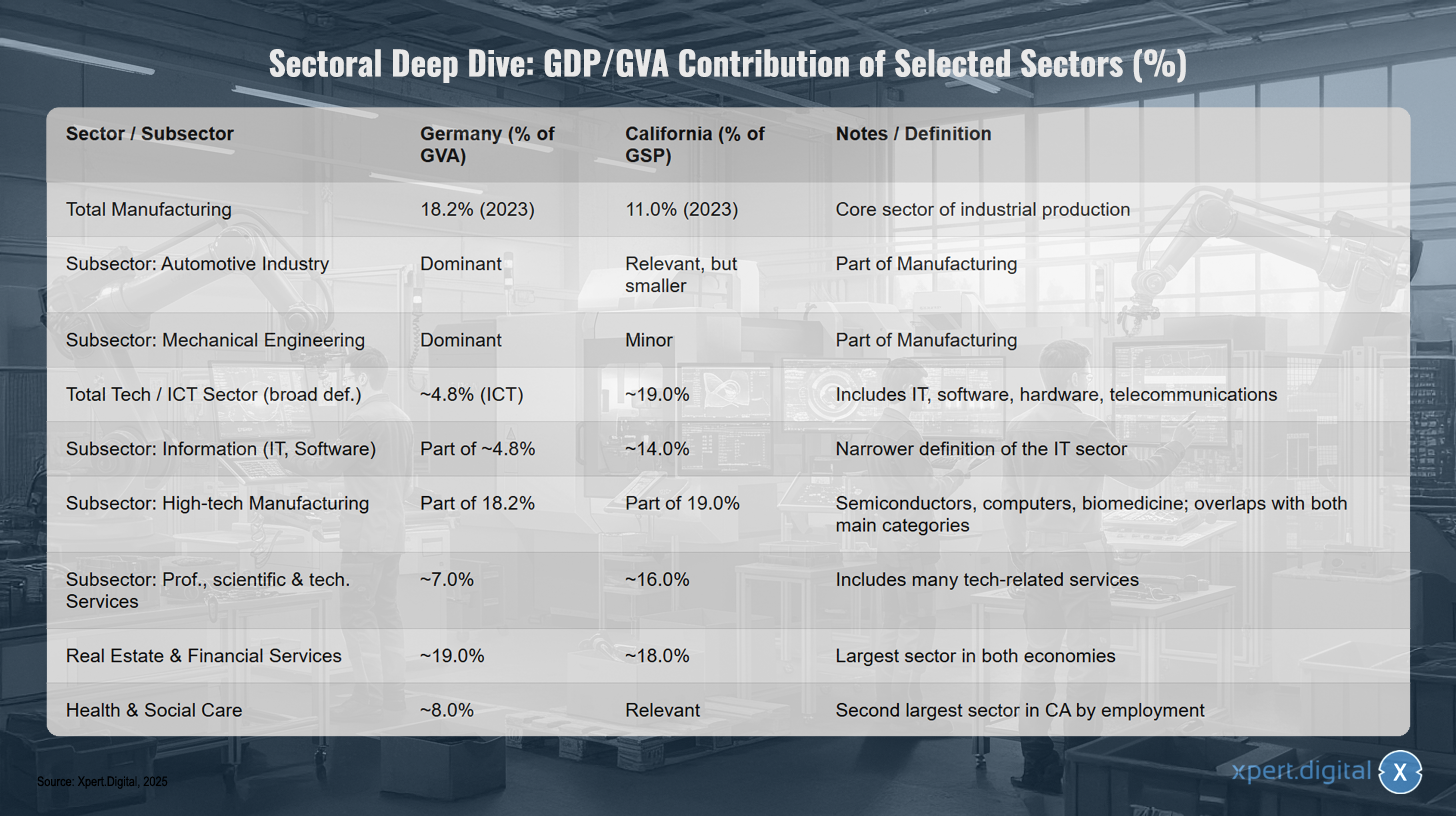
Sectoral in-depth analysis: GDP/GVA contribution of selected sectors (%) – Image: Xpert.Digital
The sectoral in-depth analysis shows the contribution of selected sectors to gross domestic product (GDP) and gross value added (GVA) in Germany and California. Manufacturing as a whole accounts for 18.2% (2023) in Germany and 11.0% (2023) in California, making it a core sector of industrial production. Within this sector, the automotive industry is dominant in Germany, while it is relevant but smaller in California. Mechanical engineering is also dominant in Germany, but less important in California. The tech and ICT sector as a whole accounts for approximately 4.8% (ICT) in Germany and approximately 19.0% in California. This sector encompasses IT, software, hardware, and telecommunications. The information sector, which includes IT and software, accounts for approximately 14.0% in California and is part of the approximately 4.8% in Germany. High-tech manufacturing, which includes semiconductors, computers, and biomedicine, is part of the manufacturing sectors in both regions. Professional, scientific, and technical services contribute approximately 7.0% in Germany and approximately 16.0% in California and include many technology-related services. Real estate and financial services are the largest sector in both economies, accounting for approximately 19.0% in Germany and approximately 18.0% in California. Health and social services account for approximately 8.0% in Germany and are a relevant, second-largest sector by employment in California.
Foundations and Fortresses: The Strategic Value of an Industrial Base in the Digital Age
Analyzing the two economic models goes beyond purely quantitative comparisons and requires an assessment of their strategic robustness. The hypotheses regarding resilience, agility in infrastructure development, and the strength of their respective ecosystems must be critically examined. This demonstrates that traditional industrial strengths can offer new, often unexpected strategic advantages in the digital era.
Speed versus substance: The infrastructure dilemma
The claim that data centers can be built faster than manufacturing facilities is superficially correct, but it misses the real strategic challenge. The physical construction of the buildings is no longer the critical path in the development of hyperscale infrastructure. Rather, it is the lengthy processes of securing the necessary utilities – energy and water – that dictate the timeline and are becoming the primary bottleneck for the growth of the digital economy.
The construction process itself can be significantly accelerated through modular and prefabricated approaches. A modular data center can be operational in as little as – months, whereas a traditional on-site construction takes – months. This initially supports the assumption of greater agility. However, the entire project period from site selection to commissioning of a large data center is typically 3–6 years. The decisive time factors are the permitting processes and connection to the utility infrastructure, each of which can take 6–18 months or longer. A hyperscale data center requires an immense and highly reliable power supply of over 100 MW, often a dedicated substation, access to high-performance water pipes for cooling, and redundant connections to fiber optic networks. Deploying this infrastructure is a complex and time-consuming undertaking that extends far beyond the actual construction.
As already outlined in Section 2.3, these requirements converge with those of modern industrial facilities. An advanced semiconductor factory has a comparably gigantic need for stable energy and ultrapure water. This leads to a reassessment of locational advantages. Germany's established industrial areas could represent a significant "brownfield" advantage. The logic is as follows:
The thesis assumes that the construction of a data center is an isolated task.
The analysis shows that the main constraint is the supply infrastructure.
Germany has a decades-long history of building and maintaining heavy industrial zones with massive energy and water infrastructure. These sites are already dedicated to industry and have established, efficient grid connections. This represents an often overlooked but strategically valuable asset.
California, on the other hand, is implementing far-reaching climate protection laws (e.g., SB 253, SB 261) that require companies to comprehensively report and reduce emissions. Data centers are massive energy consumers, with an average carbon intensity 50% higher than the national average for all economic activities.
This creates a strategic asymmetry: Germany's existing industrial infrastructure could accelerate the construction of data centers by alleviating the biggest bottleneck – supply. At the same time, California's regulatory environment, combined with grid congestion, could pose a significant hurdle to the expansion of energy-intensive AI data centers. This poses the risk of stranded assets if the decarbonization of the power grid fails to keep – with the AI industry's growing energy demand, and creates a strategic opportunity for regions with more robust and available energy infrastructure.
Ecosystem dependencies: capital, talent, and regulation
Success in both the digital and industrial sectors depends on a complex ecosystem of capital, talent, and a supportive regulatory framework. This is where the most significant differences and the greatest challenges for Germany's efforts to catch up become apparent.
venture capital
California, especially the Bay Area, is the undisputed global center for venture capital (VC). An estimated 35% of all US venture capital is concentrated here. American VCs tend to be more active and specialized than their European counterparts, which are more geographically fragmented. This massive capital pool is a crucial factor in the ability to rapidly scale technological innovations and create global market leaders. Germany and Europe have a significant structural disadvantage here.
Human capital (Germany's Achilles heel)
While Germany, with its dual training system, offers an excellent basis for qualified specialists in the industrial sector, the country suffers from a dramatic and worsening shortage of IT specialists (skills shortage). Forecasts by the industry association Bitkom indicate a gap of over 150,000 unfilled IT positions by 2024. Long-term projections are even more alarming: By 2040, this gap could grow to 663,000 IT specialists. This lack of human capital is arguably the most critical bottleneck and fundamentally undermines the thesis that Germany can catch up "quickly" in the IT sector. Without a massive and successful effort in education, retraining, and immigration, the crucial foundation for a flourishing digital ecosystem is lacking.
Regulatory environment
Here, the picture is partly reversed. Companies in California face high operating costs, rising wages, and a complex, often burdensome regulatory environment. In particular, strict climate regulations and high energy costs make the location less competitive for manufacturing companies compared to other US states. While Germany and the EU also offer a highly regulated environment, political stability and an integrated social market economy can also offer advantages for long-term, capital-intensive investments.
In summary, California has an unmatched ecosystem for rapidly scaling software and platform innovation, built on capital and a deep talent pool. Germany possesses a strong industrial ecosystem, but its lack of digital human capital poses an existential threat to its digital ambitions.
Comparing Infrastructure Development: Data Centers vs. Advanced Manufacturing
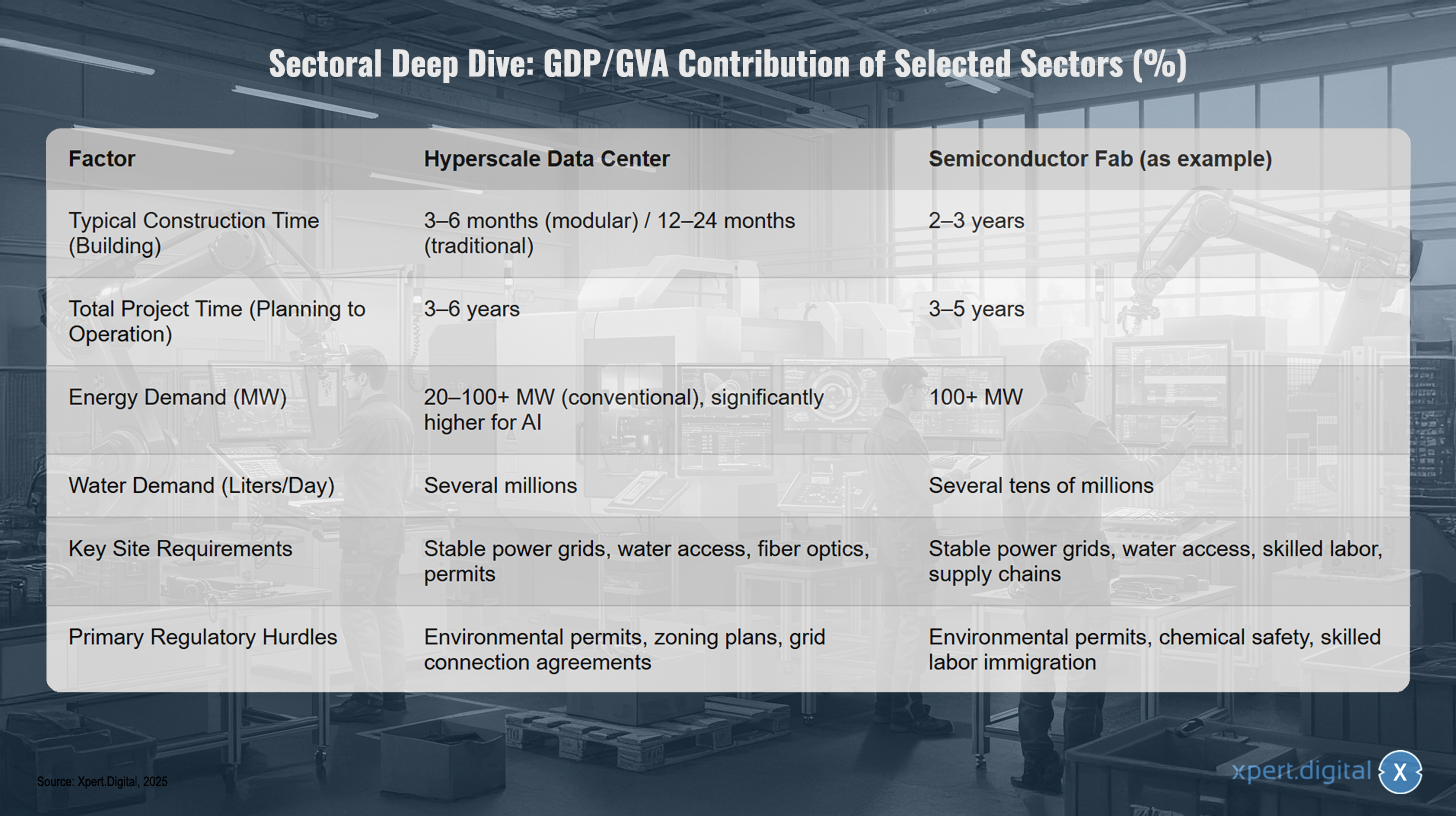
Infrastructure development comparison: data centers vs. advanced manufacturing – Image: Xpert.Digital
A comparison of infrastructure development reveals clear differences between hyperscale data centers and advanced semiconductor factories. The construction time for a hyperscale data center with modular construction is typically between three and six months, while traditional buildings require up to 12 to 24 months. The total project time from planning to operation is approximately three to six years. In contrast, the construction of a semiconductor factory typically takes two to three years, with a total project time of three to five years. In terms of energy consumption, conventional data centers require 20 to over 100 megawatts; for applications using artificial intelligence, consumption is significantly higher, while semiconductor factories typically require more than 100 megawatts. The water demand for data centers is several million liters per day, while for semiconductor factories, it is several tens of millions of liters per day. Important site requirements for data centers include stable power grids, water access, fiber optic connections, and regulatory approvals. In addition to a stable power and water supply, qualified specialists and intact supply chains are crucial for semiconductor factories. The primary regulatory challenges for data centers include environmental permits, development plans, and grid connection contracts, while semiconductor factories must also pay attention to chemical safety and the immigration of skilled workers.
🔄📈 B2B trading platforms support – strategic planning and support for export and global economy with Xpert.digital 💡

B2B trading platforms – strategic planning and support with Xpert.digital – Image: Xpert.digital
Business-to-business (B2B) trading platforms have become a critical component of global trade dynamics and thus a driving force for exports and global economic development. These platforms offer companies of all sizes, in particular SMEs – small and medium -sized companies – that are often regarded as the backbone of the German economy, significant advantages. In a world in which digital technologies come to the fore more and more, the ability to adapt and integrate is crucial for success in global competition.
More about it here:
Europe in the fast lane: Strategies for digital and industrial sovereignty
The way forward: A strategic blueprint for Europe's digital and industrial sovereignty
The comparative analysis demonstrates the need for a coherent and ambitious strategy for Germany and the European Union. The mere existence of a strong industrial base is no guarantee of future prosperity. It must be actively used as leverage to shape the digital transformation and achieve a sovereign position in global competition. This requires targeted policy measures that address the identified weaknesses and capitalize on Europe's unique strengths.
Suitable for:

The EU's digital ambition: A fragmented reality
With the proclamation of the "Digital Decade," the European Union has formulated a clear strategic ambition. The goals include strengthening digital skills, building a secure and sustainable digital infrastructure, digitally transforming businesses, and digitizing public services. The annual "State of the Digital Decade" progress report serves as a monitoring tool. However, the 2025 report has been described as a "wake-up call," highlighting insufficient progress and significant disparities between member states.
A central motive behind these efforts is the pursuit of "digital sovereignty." This refers to Europe's ability to act in the digital space according to its own rules and values, without being dependent on external actors. This dependence is now a reality: the EU is heavily dependent on suppliers from the US and China for strategic technologies such as AI, cloud infrastructure, and semiconductors. This dependence is increasingly perceived as a risk to Europe's strategic autonomy, especially as digital infrastructures and services are becoming increasingly critical to the functioning of the economy and society.
The biggest hurdle on the path to digital sovereignty and competitiveness is the ongoing fragmentation of the single market. Although the EU's single market, with over 440 million consumers, theoretically offers enormous potential, national differences in regulation, standards, and administrative practices prevent digital companies from scaling as quickly and smoothly as their counterparts in the US or China. The cost of this "non-completion" of Europe in the digital sphere was estimated at €315 billion in 2021, with the potential to rise to €1.3 trillion by 2033. Completing the digital single market is therefore not a technical but a strategic imperative of the highest order.
Policy in action: Assessment of the EU instruments (Chips Act, AI Act)
In response to these challenges, the EU has developed an impressive regulatory and investment toolbox in recent years. Two of the most prominent examples are the EU Chips Act and the EU AI Act.
EU Chips Act
This law is a direct response to the semiconductor shortage and the strategic dependence in this sector. The goal is ambitious: to double the EU's share of the global semiconductor market to 20% by 2030. To achieve this, over €43 billion in public and private investment will be mobilized to support research, design, and, above all, new production facilities ("fabs") in Europe. Critics point out, however, that even this amount is modest compared to the investment programs in the US and Asia, and the 20% target is considered highly unlikely. Nevertheless, the law has already triggered a wave of investment announcements and put the strategic importance of the sector on the political agenda.
EU AI Act
With this law, the EU has created the world's first comprehensive regulation for artificial intelligence. The approach is risk-based and aims to promote trustworthy, safe, and human-centered AI. While the EU is setting a global standard ("Brussels Effect"), parts of the industry are expressing concerns that the regulation could slow down innovation and harm European competitiveness in the global AI race. The challenge lies in reconciling the protection of fundamental rights with the need for agility and innovation-friendliness.
Germany's AI strategy
At the national level, Germany is complementing the EU initiatives with its own AI strategy, which is funded with €5 billion until 2025 and focuses on strengthening research, transferring knowledge to industry, and promoting talent. However, recent reports from the OECD and other institutions reveal a discrepancy between aspiration and reality here as well. Germany lags behind other European countries in terms of AI adoption in companies, lacks its own leading AI base model ("frontier model"), and remains heavily dependent on foreign providers.
Strategic recommendations: Shaping a unified industrial-digital future
To effectively leverage Europe's industrial strength and achieve true digital sovereignty, it is not enough to simply rely on regulation or finance individual flagship projects. What is needed is an integrated, bold strategy that addresses the key levers.
Completion of the digital single market for services
This is the most urgent task. The EU Commission and the member states must consistently remove the remaining national barriers to digital services. This applies to areas such as the harmonisation of consumer protection rules, the cross-border recognition of digital identities, and the harmonization of tax regulations for digital businesses. Only a truly seamless single market with 440 million consumers will give European start-ups and scale-ups the chance to achieve the scale and speed necessary for global competition.
A European Digital Skills Pact
The IT skills shortage so clearly evident in Germany is a Europe-wide problem and the single biggest obstacle to growth. A massive, coordinated effort is needed – a "pact" between the EU, member states, businesses, and educational institutions. This pact must set ambitious goals for the retraining and upskilling of the existing workforce, radically modernize computer science education in schools, and make Europe an attractive destination for global IT talent, including through simplified immigration rules and a competitive framework. Without resolving the workforce issue, all other investments will remain ineffective.
Promoting industrial-digital ecosystems
Policymakers should not only focus on building generic digital infrastructure, but also specifically promote deep integration between the industrial base and the digital innovation scene. Instruments such as the Chips Act or the Important Projects of Common European Interest (IPCEI) should prioritize funding projects at the interface between industry and AI. The goal must be to create "Industrial-Digital Champions" who leverage the unique data sets and problems of European industry to develop domain-specific AI solutions that are world-leading (see Section 2.2).
Pooling and targeting of investment capital
The European venture capital landscape is fragmented and undercapitalized compared to the US. The EU should use its financial instruments (e.g., through the European Investment Bank) to promote the creation of pan-European, privately managed funds of funds. These funds must be able to manage the large financing rounds required to scale growth-stage technology companies. A more unified strategy is needed to channel public and private capital more effectively and create European venture capital funds that can compete on a global scale.
By consistently implementing these four strategic pillars, Europe can transform its industrial strength from a passive market for external digital providers into an active driver for a sovereign and competitive digital future.
Policy and Investment Snapshot: Key Digital & Industrial Initiatives
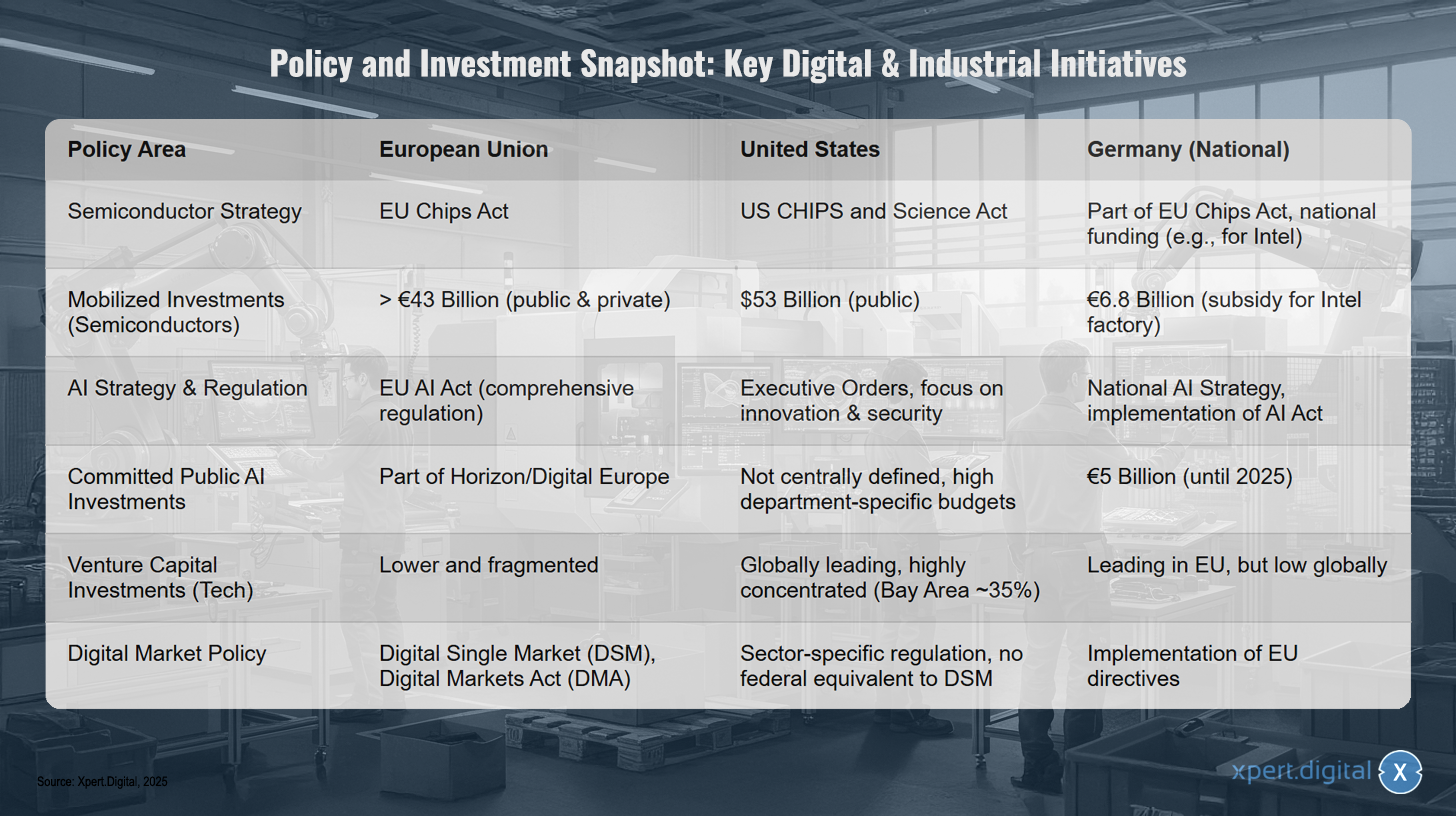
Policy and Investment Snapshot: Key Digital & Industrial Initiatives – Image: Xpert.Digital
The policy and investment snapshot highlights key digital and industrial initiatives in the European Union, the United States, and Germany. In the area of semiconductor strategy, the European Union has responded with the EU Chips Act, mobilizing over €43 billion in public and private investment, while the United States is implementing the US CHIPS and Science Act with $53 billion in public funding. Germany is part of the EU Chips Act and is providing €6.8 billion in national funding to Intel, among others. Regarding AI strategy and regulation, the EU is pursuing comprehensive regulation with the EU AI Act, the United States relies on executive orders focused on innovation and security, and Germany is working on implementing the AI Act with a national AI strategy. Public AI investments in the EU are part of Horizon and Digital Europe, while in the United States they are not centrally determined but are high in each department, with Germany having pledged €5 billion by 2025. In terms of venture capital investments in the tech sector, the EU, with Germany, leads Europe but is low globally. The US leads the world with a strong concentration in the Bay Area, while the EU shows lower and fragmented participation. In digital market policy, the EU pursues the Digital Single Market (DSM) and the Digital Markets Act (DMA). While the US has sector-specific regulations but no federal equivalent to the DSM, Germany implements EU directives.
Your global marketing and business development partner
☑️ Our business language is English or German
☑️ NEW: Correspondence in your national language!

Konrad Wolfenstein
I would be happy to serve you and my team as a personal advisor.
You can contact me by filling out the contact form or simply call me on +49 7348 4088 965 (Munich) . My email address is: wolfenstein ∂ xpert.digital
I'm looking forward to our joint project.










