
Independent AI platforms as a strategic alternative for European companies
Xpert Pre-Release

Available in 27 languages 📢
Prefer Xpert.Digital on GoogleⓘPublished on: April 15, 2025 / Updated on: April 16, 2025 – Author: Konrad Wolfenstein

Independent AI platforms as a strategic alternative for European companies – Image: Xpert.Digital
Independent AI platforms vs. hyperscalers: Which solution is right? (Reading time: 35 min / No ads / No paywall)
Independent AI platforms compared to alternatives
Selecting the right platform for developing and operating artificial intelligence (AI) applications is a strategic decision with far-reaching consequences. Companies face a choice between offerings from large hyperscalers, fully in-house developed solutions, and so-called independent AI platforms. To make an informed decision, a clear distinction between these approaches is essential.
Related to this:
Characterization of independent AI platforms (including sovereign/private AI concepts)
Independent AI platforms are typically provided by vendors operating outside the dominant ecosystem of hyperscalers such as Amazon Web Services (AWS), Microsoft Azure, and Google Cloud Platform (GCP). Their focus is often on providing specific capabilities for developing, deploying, and managing AI and machine learning (ML) models, with a greater emphasis on aspects such as data governance, adaptability, or vertical industry integration. These platforms can run on private cloud infrastructure, on-premises, or, in some cases, on hyperscaler infrastructure, while maintaining a distinct management and control layer.
A key concept that is gaining importance, particularly in the European context and often associated with independent platforms, is "sovereign AI." This term underscores the need for control over data and technology. Arvato Systems, for example, distinguishes between "public AI" (comparable to hyperscaler approaches that potentially use user input for training) and "sovereign AI." Sovereign AI can be further differentiated:
- Self-governing sovereign AI: This refers to multi-tenant solutions that may be operated on hyperscaler infrastructure, but with guaranteed EU data boundaries ("EU Data Boundary") or operating solely within the EU. They often build on public Large Language Models (LLMs) that are fine-tuned for specific purposes. This approach seeks a compromise between the capabilities of modern AI and the necessary control over the data.
- Autonomous sovereign AI: This level represents maximum control. The AI models are operated locally, without dependencies on third parties, and are trained using their own data. They are often highly specialized for a specific task. This autonomy maximizes control but can potentially come at the expense of overall performance or breadth of applicability.
Unlike hyperscalers, which aim for broad, horizontal service portfolios, independent platforms often focus on specific niches, offer specialized tools, vertical solutions, or explicitly position themselves around features like data privacy and data control as core value propositions. Localmind, for example, explicitly advertises the ability to run AI assistants on one's own servers. The use or enabling of private cloud deployments is a common feature, giving organizations full control over data storage and processing.
Differentiation between hyperscaler platforms (AWS, Azure, Google Cloud)
Hyperscalers are large cloud providers that own and operate massive, globally distributed data centers. They offer highly scalable, standardized cloud computing resources as Infrastructure-as-a-Service (IaaS), Platform-as-a-Service (PaaS), and Software-as-a-Service (SaaS), including extensive services for AI and ML. Prominent examples include AWS, Google Cloud, Microsoft Azure, as well as IBM Cloud and Alibaba Cloud.
Their key feature is their enormous horizontal scalability and a very broad portfolio of integrated services. They play a central role in many digital transformation strategies because they can provide a flexible and secure infrastructure. In the AI field, hyperscalers typically offer Machine Learning as a Service (MLaaS). This includes cloud-based access to data storage, computing power, algorithms, and interfaces without requiring local installations. The offering often includes pre-trained models, model building tools (e.g., Azure AI, Google Vertex AI, AWS SageMaker), and the necessary deployment infrastructure.
A key characteristic is the deep integration of AI services into the hyperscaler's broader ecosystem (compute, storage, networking, databases). While this integration can offer advantages through seamlessness, it also carries the risk of strong vendor lock-in. A critical differentiator concerns data usage: there are concerns that hyperscalers could use customer data—or at least metadata and usage patterns—to improve their own services. Sovereign and independent platforms often address these concerns explicitly. Microsoft, for example, states that it does not use customer data for training base models without consent; nevertheless, a degree of uncertainty remains for many users.
Comparison with internally developed (in-house) solutions
Internally developed solutions are fully customized AI platforms built and managed by an organization's own IT or data science teams. In theory, they offer maximum control over every aspect of the platform, similar to the concept of autonomous sovereign AI.
However, the challenges of this approach are considerable. It requires significant investment in specialized personnel (data scientists, machine learning engineers, infrastructure experts), lengthy development cycles, and ongoing maintenance and development efforts. Development and scaling can be slow, risking falling behind the rapid pace of innovation in AI. Unless there are extreme economies of scale or very specific requirements, this approach often results in higher total cost of ownership (TCO) compared to using external platforms. There is also the risk of developing solutions that are not competitive or quickly become obsolete.
The lines between these platform types can blur. An "independent" platform may well run on a hyperscaler's infrastructure but offer distinct added value through specific control mechanisms, features, or compliance abstractions. LocalMind, for example, allows operation on on-premises servers but also the use of proprietary models, which implies cloud access. The crucial difference often lies not only in the physical location of the hardware but rather in the management plane, the data governance model (who controls the data and its use?), and the relationship with the provider. A platform can be functionally independent, even if it runs on AWS, Azure, or GCP infrastructure, as long as it isolates the user from direct hyperscaler lock-in and offers unique control, customization, or compliance capabilities. The core distinction lies in who provides the central AI platform services, what data governance policies apply, and how much flexibility exists outside of the standardized hyperscaler offerings.
Comparison of AI platform types
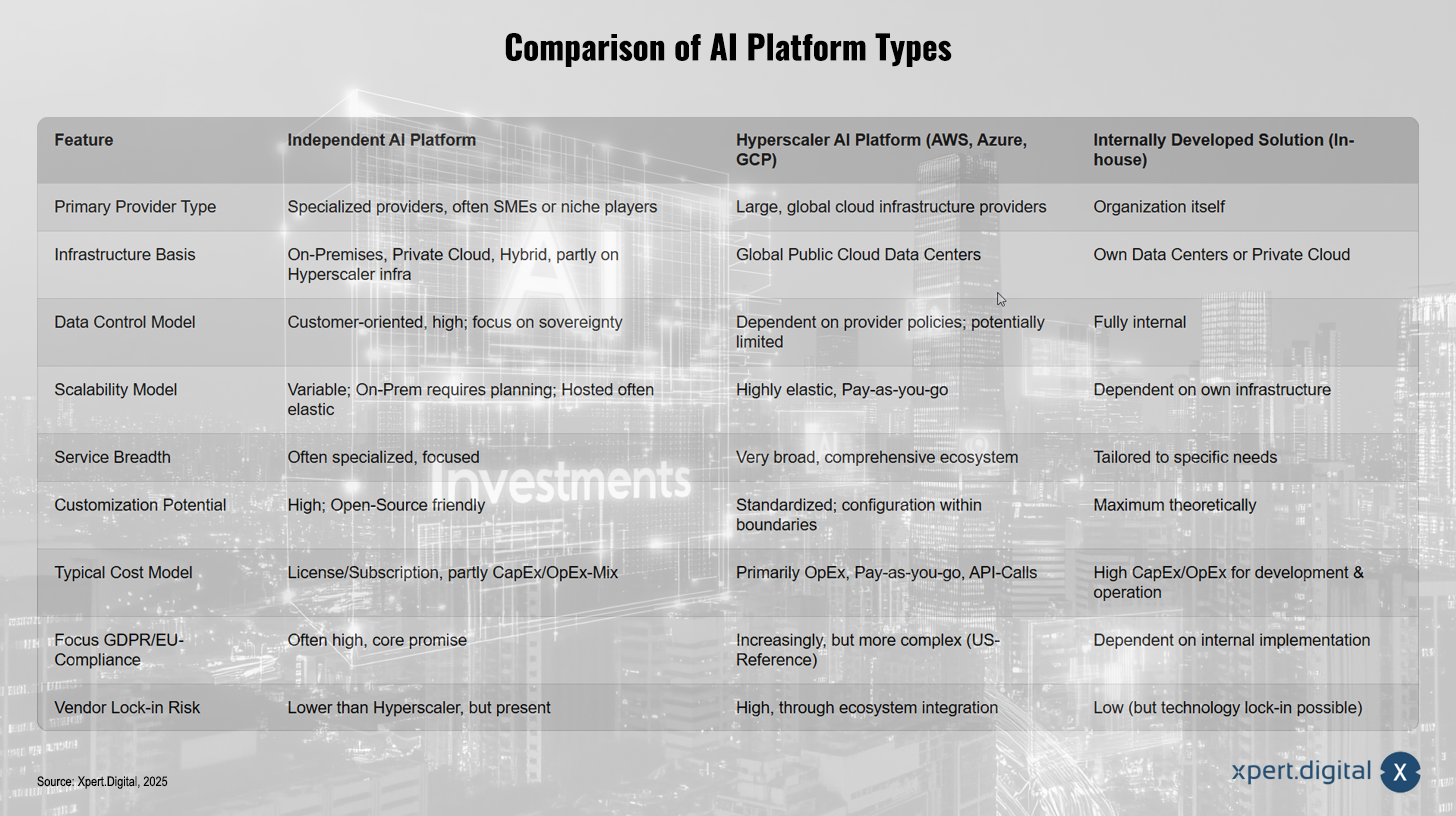
Comparison of AI platform types – Image: Xpert.Digital
This table serves as the basis for the detailed analysis of the advantages and disadvantages of the different approaches in the following sections. It highlights the fundamental differences in terms of control, flexibility, scalability, and potential dependencies.
A comparison of AI platform types reveals differences between independent AI platforms, hyperscaler AI platforms such as AWS, Azure, and GCP, and internally developed solutions. Independent AI platforms are typically provided by specialized vendors, often SMEs or niche players, while hyperscaler platforms utilize global cloud infrastructure providers, and internally developed solutions originate from the organization itself. Regarding infrastructure, independent platforms rely on on-premises, private cloud, or hybrid approaches, some of which incorporate hyperscaler infrastructure. Hyperscalers utilize global public cloud data centers, while internally developed solutions are based on the organization's own data centers or a private cloud. With respect to data control, independent platforms often offer a high degree of customer orientation and a focus on data sovereignty, while hyperscalers may offer limited control depending on the provider's policies. Internally developed solutions enable complete internal data control. Independent platforms are also flexible in their scalability models: on-premises requires planning, while hosted models are often elastic. Hyperscalers offer high elasticity with pay-as-you-go models, while internally developed solutions depend on their own infrastructure. Independent platforms often offer a specialized and focused service breadth, while hyperscalers offer a very broad range with a comprehensive ecosystem. Internally developed solutions are tailored to specific needs. Independent platforms offer high customization potential and are often open-source friendly, while hyperscalers offer standardized configurations within certain limits. Internally developed solutions theoretically offer the maximum customization potential. Cost models vary: Independent platforms often rely on licensing or subscription models with a mix of capital expenditures (CapEx) and operating expenses (OpEx), while hyperscalers primarily use OpEx-based pay-as-you-go models. Internally developed solutions require significant CapEx and OpEx investments for development and operations. Independent platforms often place a strong emphasis on GDPR and EU compliance, which is a core promise, while hyperscalers are increasingly addressing this, although it can be more complex due to their US context. For internally developed solutions, this depends on the internal implementation. The risk of vendor lock-in is lower for independent platforms than for hyperscalers, but it still exists. Hyperscalers pose a high risk due to their ecosystem integration. Internally developed solutions have a low vendor lock-in risk, but the possibility of technology lock-in remains.
Advantage in data sovereignty and compliance in the European context
For companies operating in Europe, data protection and compliance with regulatory requirements such as the General Data Protection Regulation (GDPR) and the upcoming EU AI Act are key requirements. Independent AI platforms can offer significant advantages in this area.
Improvement of data protection and data security
A key advantage of independent platforms, especially for private or on-premises deployments, is the granular control over where data is stored and processed. This allows organizations to directly address data localization requirements that may arise from GDPR or industry-specific regulations. In a private cloud environment, the organization retains full control over where its data is stored and how it is processed.
Furthermore, private or dedicated environments allow for the implementation of security configurations precisely tailored to the specific needs and risk profiles of the organization. These may go beyond the generic security measures offered as standard in public cloud environments. Even though hyperscalers like Microsoft emphasize that security and data protection are considered "by design," a private environment naturally offers more direct control and configuration options. Independent platforms can also offer specific security features aligned with European standards, such as enhanced governance functions.
Limiting data exposure to large, potentially non-EU-based technology companies reduces the attack surface for possible data breaches, unauthorized access, or unintended reuse of data by the platform provider. The use of international data centers, which may not meet the security standards required by European data protection legislation, poses a risk that is mitigated by controlled environments.
Compliance with the requirements of GDPR and European regulations
Independent or sovereign AI platforms can be designed to inherently support the core principles of the GDPR:
- Data minimization (Art. 5 para. 1 lit. c GDPR): In a controlled environment, it is easier to ensure and audit that only the personal data necessary for the processing purpose is used.
- Purpose limitation (Art. 5 para. 1 lit. b GDPR): The enforcement of specific processing purposes and the prevention of misuse of data are easier to guarantee.
- Transparency (Art. 5 para. 1 lit. a, Art. 13, 14 GDPR): Although the explainability of AI algorithms ("Explainable AI") remains a general challenge, control over the platform facilitates the documentation of data flows and processing logics. This is essential for fulfilling information obligations towards data subjects and for audits. Data subjects must be informed clearly and understandably about how their data is processed.
- Integrity and confidentiality (Art. 5 para. 1 lit. f GDPR): The implementation of suitable technical and organizational measures (TOMs) to protect data security is more directly controllable.
- Data subject rights (Chapter III GDPR): The implementation of rights such as access, rectification and erasure (“right to be forgotten”) can be simplified by direct control over the data.
With regard to the EU AI Act, which sets risk-based requirements for AI systems, platforms that offer transparency, control, and auditable processes have an advantage. This is particularly true for the use of high-risk AI systems, as defined in areas such as education, employment, critical infrastructure, and law enforcement. Independent platforms could specifically develop or offer features to support AI Act compliance.
Another crucial point is avoiding problematic data transfers to third countries. Using platforms hosted within the EU or running on-premises circumvents the need for complex legal constructs (such as standard contractual clauses or adequacy decisions) for transferring personal data to countries without an adequate level of data protection, such as the USA. Despite regulations like the EU-US Data Privacy Framework, this remains a persistent challenge when using global hyperscaler services.
Mechanisms to ensure compliance
Independent platforms offer various mechanisms to support compliance with data protection regulations:
- Private Cloud / On-Premises Deployment: This is the most direct way to ensure data sovereignty and control. The organization retains physical or logical control over the infrastructure.
- Data localization / EU Boundaries: Some providers contractually guarantee that data is processed exclusively within the EU or specific country borders, even if the underlying infrastructure comes from a hyperscaler. Microsoft Azure, for example, offers European server locations.
- Anonymization and pseudonymization tools: Platforms can offer integrated functions for anonymizing or pseudonymizing data before it is used in AI processes. This can reduce the scope of the GDPR. Federated learning, where models are trained locally without raw data leaving the device, is another approach.
- Compliance by Design / Privacy by Design: Platforms can be designed from the ground up to incorporate data protection principles ("Privacy by Design") and offer privacy-friendly default settings ("Privacy by Default"). This can be supported by automated data filtering, detailed audit logs to track data processing activities, granular access controls, and tools for data governance and consent management.
- Certifications: Official certifications in accordance with Article 42 GDPR can transparently demonstrate compliance with data protection standards and serve as a competitive advantage. Platform providers can seek such certificates, or users can obtain them more easily on regulated platforms. In particular, they can facilitate data processors' proof of compliance with their obligations under Article 28 GDPR. Established standards such as ISO 27001 are also relevant in this context.
The ability to not only achieve but also demonstrate compliance is evolving in the European market from a mere necessity to a strategic advantage. Data privacy and trustworthy AI are crucial for building trust with customers, partners, and the public. Independent platforms that specifically address European regulatory requirements and offer clear compliance pathways (e.g., through guaranteed data localization, transparent processing steps, and integrated control mechanisms) enable companies to minimize compliance risks and build trust. They can thus help transform compliance from a mere cost factor into a strategic asset, particularly in sensitive industries or when processing critical data. Choosing a platform that simplifies and demonstrably ensures compliance is therefore a strategic decision that can potentially reduce overall compliance costs compared to the complex process of navigating global hyperscaler environments to achieve the same level of security and verifiability.
🎯🎯🎯 Benefit from Xpert.Digital's extensive, five-fold expertise in one comprehensive service package | BD, R&D, XR, PR & Digital Visibility Optimization

Benefit from Xpert.Digital's extensive, five-fold expertise in a comprehensive service package | R&D, XR, PR & Digital Visibility Optimization - Image: Xpert.Digital
Xpert.Digital possesses in-depth knowledge across various industries. This allows us to develop tailored strategies precisely aligned with the requirements and challenges of your specific market segment. By continuously analyzing market trends and monitoring industry developments, we can act proactively and offer innovative solutions. The combination of experience and expertise generates added value and provides our clients with a decisive competitive advantage.
More information here:
Independent AI platforms: More control, less dependence
Flexibility, adaptability and control
Beyond the aspects of data sovereignty, independent AI platforms often offer a higher degree of flexibility, adaptability and control compared to the standardized offerings of hyperscalers or potentially resource-intensive in-house developments.
Tailor-made AI solutions: Beyond standardized offerings
Independent platforms can offer more flexibility in configuring the development environment, integrating specific third-party tools, or modifying workflows than the often more standardized PaaS and SaaS services of hyperscalers. While some modular systems, as seen in the field of AI website builders, prioritize speed at the expense of customizability, other independent solutions aim to give users more control.
This flexibility allows for deeper customization to domain-specific requirements. Companies can optimize models or entire platform setups for highly specialized tasks or industries, potentially exceeding the general capabilities of hyperscaler models, which are often designed for broad applicability. The concept of self-sufficient, sovereign AI explicitly targets highly specialized models trained on proprietary data. The ability to transfer and adapt AI models across industries further underscores this flexibility.
Another aspect is the ability to selectively choose and use only the necessary components, instead of having to accept potentially overloaded or predefined service packages from large platforms. This can help avoid unnecessary complexity and costs. Conversely, however, it must be considered that hyperscalers often offer a wider range of readily available standard features and services, which is discussed in more detail in the section on challenges (IX).
Related to this:

Use of open-source models and technologies
A significant advantage of many independent platforms is the easier use of a wide range of AI models, especially leading open-source models like Llama (Meta) or Mistral. This contrasts with hyperscalers, which tend to favor their own proprietary models or those of close partners. The freedom to choose a model allows organizations to make decisions based on criteria such as performance, cost, licensing terms, or specific suitability for the task. Localmind, for example, explicitly supports Llama and Mistral alongside proprietary options. The European project OpenGPT-X aims to provide high-performance open-source alternatives like Teuken-7B, specifically tailored to European languages and needs.
Open-source models also offer a higher degree of transparency regarding their architecture and potentially the training data (depending on the quality of the documentation, e.g., "model cards"). This transparency can be crucial for compliance purposes, debugging, and a fundamental understanding of the model's behavior.
From a cost perspective, open-source models, especially for high-volume use, can be significantly cheaper than billing via proprietary APIs. A comparison between DeepSeek-R1 (open-source) and OpenAI o1 (proprietary) reveals substantial price differences per token processed. Finally, using open source enables participation in the rapid innovation cycles of the global AI community.
Control over infrastructure and model deployment
Independent platforms often offer greater flexibility in choosing the deployment environment. Options range from on-premises and private clouds to multi-cloud scenarios that utilize resources from different providers. DeepSeek, for example, can be run locally in Docker containers, maximizing data control. This freedom of choice gives organizations more control over aspects such as performance, latency, costs, and data security.
This goes hand in hand with the ability to optimize the underlying hardware (e.g., specific GPUs, storage solutions) and software configurations (operating systems, frameworks) specifically for certain workloads. Instead of being limited to the standardized instance types and pricing models of hyperscalers, companies can potentially implement more efficient or cost-effective setups.
Control over the development environment also enables deeper experimentation and the seamless integration of custom tools or libraries needed for specific research or development tasks.
The increased flexibility and control offered by independent platforms often come with greater responsibility and potentially greater complexity. While hyperscalers abstract many infrastructure details through managed services, independent platforms, especially for on-premises or highly customized deployments, may require more in-house expertise for setup, configuration, operation, and maintenance. The benefit of flexibility is therefore greatest for organizations with the necessary skills and strategic will to actively exercise this control. If this expertise is lacking, or if the primary focus is on rapid time to market with standard applications, the simplicity of managed hyperscaler services may be more attractive. The decision thus depends heavily on strategic priorities: maximum control and adaptability versus ease of use and the breadth of managed services. This trade-off also impacts the total cost of ownership (Section VIII) and the potential challenges (Section IX).
Reducing Vendor Lock-in: Strategic and Cost Implications
Dependence on a single technology provider, known as vendor lock-in, poses a significant strategic risk, particularly in the dynamic field of AI and cloud technologies. Independent AI platforms are often positioned as a means of mitigating this risk.
Understanding the risks of hyperscaler dependency
Vendor lock-in describes a situation in which switching from one provider's technology or services to another involves prohibitively high costs or technical complexity. This dependency gives the provider significant bargaining power with the customer.
The causes of vendor lock-in are manifold. These include proprietary technologies, application programming interfaces (APIs), and data formats that create incompatibility with other systems. The deep integration of various services within a hyperscaler's ecosystem makes it difficult to replace individual components. High egress costs for data transfer from the cloud act as a financial barrier. Added to this are investments in specific knowledge and employee training, which are not easily transferable to other platforms, as well as long-term contracts or licensing terms. The more services from a provider are used and the more interconnected they become, the more complex a potential switch becomes.
The strategic risks of such dependency are considerable. They include reduced agility and flexibility, as the company is bound to the provider's roadmap and technological decisions. The ability to adopt innovative or more cost-effective solutions from competitors is limited, which can slow the company's own pace of innovation. Companies become vulnerable to price increases or unfavorable changes to contract terms, as their negotiating position is weakened. Regulatory requirements, particularly in the financial sector, may even mandate explicit exit strategies to manage the risks of vendor lock-in.
The cost implications extend beyond regular operating expenses. A platform change (replatforming) incurs significant migration costs, which are further exacerbated by vendor lock-in. These include costs for data transfer, the potential redevelopment or adaptation of functionalities and integrations based on proprietary technologies, and extensive employee training. Indirect costs due to operational disruptions during migration or long-term inefficiencies resulting from inadequate planning also contribute to the overall burden. Potential costs associated with phasing out a cloud platform must also be considered.
How independent platforms foster strategic autonomy
Independent AI platforms can help maintain strategic autonomy and reduce lock-in risks in several ways:
- Use of open standards: Platforms based on open standards – for example, standardized container formats (such as Docker), open APIs, or support for open-source models and frameworks – reduce dependence on the provider's proprietary technologies.
- Data portability: Using fewer proprietary data formats or explicitly supporting data export in standard formats facilitates the migration of data to other systems or vendors. Standardized data formats are a key element in this process.
- Infrastructure flexibility: The ability to run the platform on different infrastructures (on-premises, private cloud, potentially multi-cloud) naturally reduces dependence on the infrastructure of a single provider. Containerization of applications is cited as an important technology in this context.
- Avoiding ecosystem entanglements: Independent platforms tend to exert less pressure to use a multitude of deeply integrated services from the same provider. This allows for a more modular architecture and greater freedom of choice regarding individual components. The concept of sovereign AI explicitly aims for independence from individual providers.
Long-term cost advantages through avoiding lock-in
Avoiding strong supplier dependency can lead to cost advantages in the long run:
- Improved negotiating position: The credible possibility of switching providers maintains competitive pressure and strengthens one's own position in price and contract negotiations. Some analyses suggest that mid-sized or specialized providers may offer more negotiating leverage than global hyperscalers.
- Optimized spending: The freedom to choose the most cost-effective components (models, infrastructure, tools) for each task enables better cost optimization. This includes using potentially cheaper open-source options or more efficient, self-selected hardware.
- Reduced migration costs: When a change becomes necessary or desirable, the financial and technical hurdles are lower, making it easier to adopt newer, better, or cheaper technologies.
- Predictable budgeting: The lower vulnerability to unexpected price increases or fee changes from a supplier to whom one is bound allows for more stable financial planning.
However, it's important to recognize that vendor lock-in is a spectrum, not a binary property. Even choosing an independent provider creates a degree of dependency—on its specific platform features, APIs, support quality, and ultimately, its financial stability. Therefore, an effective strategy for mitigating lock-in involves more than simply selecting an independent provider. It requires a deliberate architecture based on open standards, containerization, data portability, and potentially multi-cloud approaches. Independent platforms can facilitate the implementation of such strategies, but they don't automatically eliminate the risk entirely. The goal should be a managed dependency that consciously maintains flexibility and exit options, rather than chasing an illusion of complete independence.
Related to this:

Neutrality in model and infrastructure selection
Choosing the optimal AI models and underlying infrastructure is crucial for the performance and cost-effectiveness of AI applications. Independent platforms can offer greater neutrality in this regard than the tightly integrated ecosystems of hyperscalers.
Avoiding ecosystem bias: Access to diverse AI models
Hyperscalers naturally have an interest in promoting and optimizing their own AI models or those of close strategic partners (such as Microsoft with OpenAI or Google with Gemini) within their platforms. This can lead to these models being given preferential treatment, being better integrated technically, or being priced more attractively than alternatives.
Independent platforms, on the other hand, often lack the same incentive to favor a particular base model. They can therefore offer more neutral access to a broader range of models, including leading open-source options. This allows companies to base their model selection more on objective criteria such as performance for the specific task, cost, transparency, or licensing terms. Platforms like Localmind demonstrate this by explicitly offering support for open-source models like Llama and Mistral alongside proprietary models like ChatGPT, Claude, and Gemini. Initiatives like OpenGPT-X in Europe even focus on creating competitive European open-source alternatives.
Objective infrastructure decisions
Neutrality often extends to the choice of infrastructure:
- Hardware agnosticism: Independent platforms, operating on-premises or in private clouds, allow companies to select hardware (CPUs, GPUs, specialized processors, storage) based on their own benchmarks and cost-benefit analyses. They are not limited to the predefined instance types, configurations, and pricing structures of a single hyperscaler. Providers like Pure Storage emphasize the importance of an optimized storage infrastructure specifically for AI workloads.
- Optimized technology stack: It is possible to design an infrastructure stack (hardware, network, storage, software frameworks) that is precisely tailored to the specific requirements of AI workloads. This can potentially lead to better performance or higher cost efficiency than using standardized cloud components.
- Avoiding bundled dependencies: The pressure to use specific data, network, or security services from the platform provider tends to be lower. This allows for a more objective selection of components based on technical requirements and performance characteristics.
True optimization of AI applications requires the best possible alignment of model, data, tools, and infrastructure for the specific task. The inherent ecosystem bias in the tightly integrated platforms of hyperscalers can subtly steer decisions toward solutions that, while convenient, may not represent the technically or economically optimal choice, but rather primarily benefit the vendor's stack. Independent platforms, by virtue of their greater neutrality, can empower organizations to make more objective, performance-driven, and potentially more cost-effective decisions throughout the entire AI lifecycle. This neutrality is not merely a philosophical principle; it has practical implications. It opens up the possibility of combining, for example, a high-performing open-source model with custom-designed on-premises hardware or a specific private cloud setup—a configuration that may be difficult to achieve or not encouraged within the walled gardens of a hyperscaler. This potential for objective optimization represents a significant strategic advantage of neutrality.
Related to this:

Seamless integration into the corporate ecosystem
The value of AI applications in a business context often only unfolds through integration with existing IT systems and data sources. Independent AI platforms must therefore offer robust and flexible integration capabilities to represent a viable alternative to the hyperscaler ecosystems.
Integration with existing IT systems (ERP, CRM, etc.)
Integration with core business systems, such as Enterprise Resource Planning (ERP) systems (e.g., SAP) and Customer Relationship Management (CRM) systems (e.g., Salesforce), is crucial. This is the only way to leverage relevant business data for training and applying AI and to directly feed the resulting insights and automations back into business processes. For example, AI can be used to improve demand forecasts, which are then directly incorporated into ERP planning, or to enrich customer data in the CRM.
Independent platforms typically address this need through various mechanisms:
- APIs (Application Programming Interfaces): Providing well-documented, standards-based APIs (e.g., REST) is fundamental to enabling communication with other systems.
- Connectors: Pre-built connectors to widely used enterprise applications such as SAP, Salesforce, Microsoft Dynamics, or Microsoft 365 can significantly reduce integration effort. Providers like SEEBURGER or Jitterbit specialize in integration solutions and offer certified SAP connectors that enable deep integration. SAP itself also offers its own integration platform (SAP Integration Suite, formerly CPI) that provides connectors to various systems.
- Middleware/iPaaS compatibility: The ability to work with existing enterprise-wide middleware solutions or Integration Platform as a Service (iPaaS) offerings is important for companies with established integration strategies.
- Bidirectional synchronization: For many use cases, it is crucial that data can not only be read from the source systems but also written back to them (e.g., updating customer contacts or order status).
Connection to various data sources
AI models require access to relevant data, which is often distributed across a variety of systems and formats within an organization: relational databases, data warehouses, data lakes, cloud storage, operational systems, and even unstructured sources such as documents or images. Independent AI platforms must therefore be able to connect to these heterogeneous data sources and process different types of data. Platforms like Localmind emphasize their ability to process unstructured text, complex documents with images and diagrams, as well as images and videos. SAP's announced Business Data Cloud also aims to unify access to enterprise data regardless of format or storage location.
Compatibility with development and analysis tools
For the productivity of data science and development teams, compatibility with common tools and frameworks is essential. This includes support for widely used AI/ML frameworks such as TensorFlow or PyTorch, programming languages such as Python or Java, and development environments such as Jupyter Notebooks.
Equally important is integration with business intelligence (BI) and analytics tools. The results of AI models often need to be visualized in dashboards or prepared for reports. Conversely, BI tools can provide data for AI analysis. Support for open standards generally facilitates integration with a wider range of third-party tools.
While hyperscalers benefit from seamless integration within their own extensive ecosystems, independent platforms must prove their strength in flexibly connecting to existing, heterogeneous enterprise landscapes. Their success depends significantly on whether they can integrate at least as effectively, but ideally more flexibly, with established systems like SAP and Salesforce than the hyperscalers' offerings. Otherwise, a platform's "independence" could prove to be a disadvantage if it leads to integration hurdles. Leading independent providers must therefore demonstrate excellence in interoperability, offering robust APIs, connectors, and potentially partnerships with integration specialists. Their ability to seamlessly integrate into complex, established environments is a critical success factor and can even represent an advantage in heterogeneous landscapes over a hyperscaler primarily focused on integration within its own stack.
🎯📊 Integration of an independent and cross-data-source AI platform 🤖🌐 for all business needs

Integration of an independent and cross-data-source AI platform for all business needs - Image: Xpert.Digital
AI Game Changer: The most flexible AI platform - Tailor-made solutions that reduce costs, improve your decisions and increase efficiency
Independent AI platform: Integrates all relevant company data sources
- This AI platform interacts with all specific data sources
- From SAP, Microsoft, Jira, Confluence, Salesforce, Zoom, Dropbox and many other data management systems
- Rapid AI integration: Tailor-made AI solutions for businesses in hours or days, instead of months
- Flexible infrastructure: Cloud-based or hosting in your own data center (Germany, Europe, free choice of location)
- Maximum data security: its use in law firms is irrefutable proof
- Deployment across a wide variety of enterprise data sources
- Choice of own or different AI models (DE, EU, USA, CN)
Challenges that our AI platform solves
- Lack of fit of conventional AI solutions
- Data protection and secure management of sensitive data
- High costs and complexity of individual AI development
- Shortage of qualified AI specialists
- Integration of AI into existing IT systems
More information here:
Comprehensive cost comparison for AI platforms: Hyperscalers vs. Independent solutions
Comparative cost analysis: A TCO perspective
Cost is a crucial factor when choosing an AI platform. However, simply looking at list prices is insufficient. A comprehensive analysis of the total cost of ownership (TCO) over the entire lifecycle is necessary to determine the most economical option for the specific use case.
Related to this:

Cost structures of independent platforms (development, operation, maintenance)
The cost structure of independent platforms can vary greatly, depending on the provider and the deployment model:
- Software licensing costs: These can potentially be lower than with proprietary hyperscaler services, especially if the platform relies heavily on open-source models or components. Some providers, such as Scale Computing in the HCI space, position themselves by eliminating the licensing costs of alternative vendors (e.g., VMware).
- Infrastructure costs: On-premises or private cloud deployments incur capital expenditures (CapEx) or operating expenses (OpEx) for servers, storage, network components, and data center resources (space, electricity, cooling). Cooling alone can account for a significant portion of electricity consumption. Hosted standalone platforms typically involve subscription fees that include infrastructure costs.
- Operating costs: Ongoing costs include electricity, cooling, and hardware and software maintenance. In addition, there are potentially higher internal personnel costs for management, monitoring, and specialized expertise compared to fully managed hyperscaler services. These operational costs are often overlooked in TCO calculations.
- Development and integration costs: The initial setup, integration into existing systems, and any necessary adjustments can cause significant effort and therefore costs.
- Scalability costs: Expanding capacity in on-premises solutions often requires the purchase of additional hardware (nodes, servers). While these costs are predictable, they require upfront investments or flexible leasing models.
Benchmarking based on the pricing models of hyperscalers
Hyperscaler platforms are typically characterized by an OpEx-dominated model:
- Pay-as-you-go: Costs are primarily incurred for the actual usage of computing time (CPU/GPU), storage space, data transfer, and API calls. This offers high elasticity but can lead to unpredictable and high costs if poorly managed.
- Potential hidden costs: In particular, the costs associated with data outflow from the cloud (egress fees) can be substantial and make switching to another provider difficult, contributing to vendor lock-in. Premium support, specialized or high-performance instance types, and advanced security or management features often incur additional costs. The risk of overspending is real if resource utilization is not continuously monitored and optimized.
- Complex pricing: Hyperscalers' pricing models are often highly complex, with numerous service tiers, reserved or spot instance options, and different billing units. This makes accurate TCO calculation difficult.
- Costs of model APIs: Using proprietary base models via API calls can become very expensive at high volumes. Comparisons show that open-source alternatives can be significantly cheaper per token processed.
Assessment of the costs of in-house developments
Building your own AI platform typically involves the highest initial investment. This includes costs for research and development, acquiring highly specialized talent, and establishing the necessary infrastructure. Significant ongoing costs for maintenance, updates, security patches, and staff retention are also incurred. The opportunity costs should not be underestimated either: resources invested in platform development are unavailable for other value-adding activities. Furthermore, the time to market is usually considerably longer than when using existing platforms.
There is no universally cheapest option. Total Cost of Ownership (TCO) calculation is highly context-dependent. Hyperscalers often offer lower entry costs and unparalleled elasticity, making them attractive for startups, pilot projects, or applications with highly fluctuating loads. However, independent or private platforms can offer a lower TCO in the long run for predictable, high-volume workloads. This is especially true when considering factors such as high data egress costs at hyperscalers, premium service costs, the potential cost benefits of open-source models, or the ability to use optimized, on-premises hardware. Studies suggest that the TCO for public and private clouds can theoretically be similar for the same capacity; however, actual costs depend heavily on utilization, management, and specific pricing models. A thorough TCO analysis that includes all direct and indirect costs over the planned usage period (e.g., 3-5 years)—including infrastructure, licenses, personnel, training, migration, compliance efforts, and potential exit costs—is essential for making an informed decision.
Total cost of ownership comparison framework for AI platforms
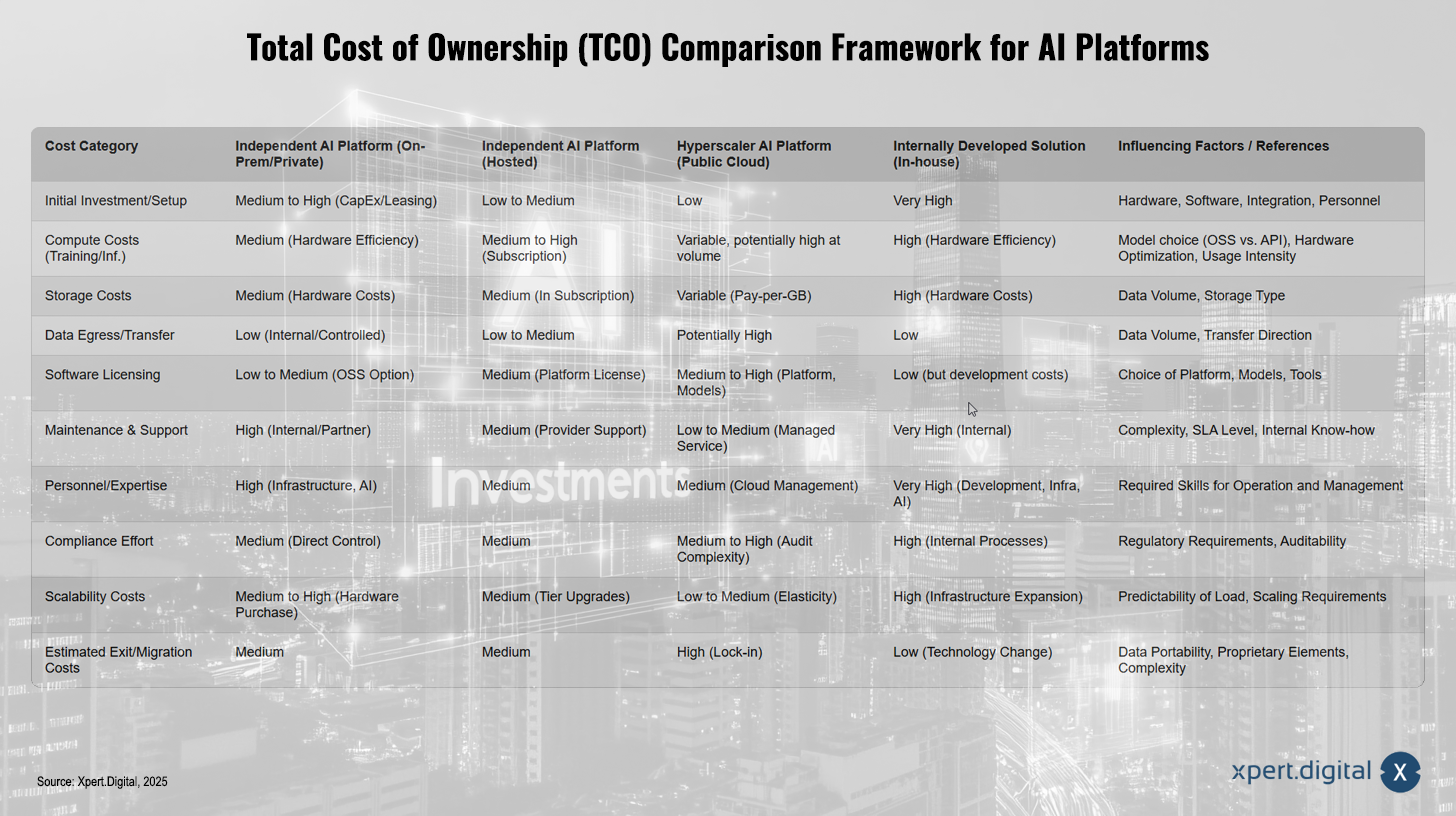
Total cost of ownership (TCO) comparison framework for AI platforms – Image: Xpert.Digital
This table provides a qualitative framework for evaluating cost profiles. The actual figures depend heavily on the specific scenario, but the patterns illustrate the different financial implications and risks of each platform type.
A total cost of ownership (TCO) comparison framework for AI platforms highlights the different cost categories and influencing factors to consider when selecting a platform. Initial investment is medium to high for standalone on-premises or private platforms, while it can range from low to variable for hosted platforms or hyperscaler-based solutions. However, internally developed solutions carry very high upfront costs. Compute costs related to training and inference also vary depending on the platform. These are medium for standalone platforms, while hosted solutions and public cloud options can range from medium to potentially high—especially at high volumes. Internally developed solutions are also cost-intensive.
Storage costs are moderate for independent platforms and hosted options, but often variable in the public cloud and pay off per gigabyte used. Internally developed solutions have high storage costs. Regarding data egress or transfer, costs are low for independent platforms and internal solutions, but can increase significantly in a public cloud environment with high data volumes.
Software licensing also reveals differences: While open-source options keep expenses low to medium for independent platforms, these increase for hosted or public cloud solutions, especially when platform-specific or API models are used. At the same time, internally developed solutions incur lower expenses but higher development costs. A similar pattern applies to maintenance and support – here, internal solutions and independent platforms are particularly cost-intensive, whereas managed services from hyperscalers result in lower expenses.
The required personnel and their expertise are a significant factor in operating costs. Independent platforms and internally developed solutions demand a high level of expertise in infrastructure and AI, while this is more moderate with hosted and public cloud options. Compliance efforts vary depending on the platform and its regulatory requirements and audit complexity. Scalability costs, however, show clear advantages for public cloud solutions due to their elastic scalability, whereas they are higher for internal and on-premises solutions due to hardware and infrastructure expansion.
Exit and migration costs also play a role, especially with public cloud platforms, where there is a certain risk of vendor lock-in and these costs can be high, whereas independent platforms and internally developed solutions tend to incur moderate to low costs in this area. Ultimately, the categories mentioned illustrate the financial implications and risks that must be considered when choosing a platform. The qualitative framework serves as a guide; however, the actual costs vary depending on the specific use case.
Independent AI platforms offer many advantages, but also challenges that must be considered. A realistic assessment of such platforms therefore requires a balanced perspective that includes both the positive aspects and potential obstacles.
Addressing the challenges of independent platforms
Although independent AI platforms offer attractive advantages, they are not without potential challenges. A balanced analysis must also consider these disadvantages or obstacles in order to make a realistic assessment.
Support, community and ecosystem maturity
The quality and availability of support can vary among independent vendors and may not always reach the level of the hyperscalers' global support organizations. Response times or the depth of technical expertise for complex issues could be a challenge, particularly with smaller or newer vendors. Even large organizations may encounter initial limitations when adopting new AI support systems, such as language support or the scope of requests that can be handled.
The size of the community surrounding a specific independent platform is often smaller than the vast developer and user communities that have formed around services like AWS, Azure, or GCP. While open-source components used by the platform may have large and active communities, the platform's own community may be smaller. This can affect the availability of third-party tools, pre-built integrations, tutorials, and general knowledge sharing. However, it's worth noting that smaller, more focused communities can often be very engaged and helpful.
The surrounding ecosystem – including marketplaces for extensions, certified partners, and available professionals with platform expertise – is typically much broader and more deeply developed for hyperscalers. Furthermore, open-source projects that independent platforms might rely on depend on community activity and offer no guarantee of long-term continuity.
Breadth and depth of features compared to hyperscalers
Independent platforms may not offer the sheer number of readily available, pre-built AI services, specialized models, or complementary cloud tools found on the major hyperscaler platforms. Their focus is often on core functionalities of AI development and deployment, or on specific niche markets.
Hyperscalers invest heavily in research and development and are often the first to bring novel, managed AI services to market. Independent platforms might lag behind in delivering the very latest, highly specialized managed services. However, this is partially offset by their often greater flexibility in integrating the latest open-source developments. It's also possible that certain niche features or country coverage may not (yet) be available from independent providers.
Potential implementation and management complexity
Setting up and configuring independent platforms, especially for on-premises or private cloud deployments, can be more technically demanding and require more initial effort than using the often highly abstracted and pre-configured managed services of hyperscalers. A lack of expertise or faulty implementation can pose risks here.
Ongoing operations also require internal resources or a competent partner for infrastructure management, updates, security, and operational monitoring. This contrasts with fully managed PaaS or SaaS offerings, where the provider handles these tasks. Managing complex AI architectures, potentially based on microservices, demands specialized expertise.
Although strong integration capabilities are possible, as outlined in Section VII, ensuring smooth interaction in a heterogeneous IT landscape always involves a certain degree of complexity and potential sources of error. Faulty configurations or an inadequate system infrastructure can impair reliability.
Therefore, using independent platforms may require more specialized internal skills (AI experts, infrastructure management) than relying on the managed services of hyperscalers.
Further considerations
- Vendor viability: When selecting an independent vendor, especially a smaller or newer one, it is important to carefully examine its long-term economic stability, product roadmap, and future prospects.
- Ethical risks and bias: Independent platforms, like all AI systems, are not immune to risks such as algorithmic bias (when models are trained on distorted data), lack of explainability (especially with deep learning models – the “black box” problem), or the potential for misuse. While they potentially offer greater transparency, these general AI risks must be considered when choosing and implementing a platform.
It is crucial to understand that the "challenges" of independent platforms are often the flip side of their "advantages." The need for more internal expertise (IX.C) is directly linked to the increased control and adaptability (IV.C). A potentially narrower initial feature set (IX.B) can correspond to a more focused, less bloated platform (IV.A). Therefore, evaluating these challenges must always be done within the context of the organization's strategic priorities, risk appetite, and internal capabilities. A company that prioritizes maximum control and customization may view the need for internal expertise as a necessary investment rather than a drawback. Choosing a platform is thus not about finding a solution without drawbacks, but rather selecting the platform whose specific challenges are acceptable or manageable given the organization's goals and resources, and whose benefits best align with its business strategy.
Related to this:

Strategic Recommendations
Choosing the right AI platform is a strategic decision. Based on an analysis of the different platform types – independent platforms, hyperscaler offerings, and in-house developments – decision criteria and recommendations can be derived, especially for companies in the European context.
Decision framework: When to choose an independent AI platform?
The decision to use an independent AI platform should be considered particularly when the following factors are a high priority:
- Data sovereignty and compliance: When compliance with the GDPR, the EU AI Act or industry-specific regulations is a top priority and maximum control over data localization, processing and transparency is required (see Section III).
- Avoiding Vendor Lock-in: When strategic independence from the major hyperscalers is a key objective to maintain flexibility and minimize long-term cost risks (see Section V).
- High need for customization: When a high degree of individualization of the platform, models or infrastructure is required for specific use cases or for optimization (see Section IV).
- Preference for Open Source: When specific open-source models or technologies are preferred for reasons of cost, transparency, performance or licensing (see Section IV.B).
- Optimized TCO for predictable loads: When long-term total cost of ownership for stable, high-volume workloads is the primary concern and analyses show that an independent approach (on-prem/private) is more cost-effective than permanent hyperscaler use (see Section VIII).
- Flexible integration into heterogeneous landscapes: When seamless integration into a complex, existing IT landscape with systems from different vendors requires specific flexibility (see Section VII).
- Neutrality in component selection: When the objective selection of the best models and infrastructure components, free from ecosystem bias, is crucial for performance and cost optimization (see Section VI).
Caution is advised when choosing an independent platform if:
- Comprehensive managed services are needed, and internal know-how for AI or infrastructure management is limited.
- The immediate availability of the widest range of pre-built AI services is crucial.
- Minimizing initial costs and maximizing elasticity for highly variable or unpredictable workloads are priorities.
- There are significant concerns regarding the economic stability, support quality, or community size of a specific independent provider.
Key considerations for European companies
Specific recommendations for action arise for companies in Europe:
- Prioritize the regulatory environment: The requirements of the GDPR, the EU AI Act, and potential national or sectoral regulations must be central to the platform evaluation. Data sovereignty should be a primary decision factor. Platforms that offer clear and verifiable compliance pathways should be sought.
- European initiatives and providers should be examined: Initiatives such as Gaia-X or OpenGPT-X, as well as providers that explicitly focus on the European market and its needs (e.g., some of those mentioned or similar), should be evaluated. They could offer a better alignment with local requirements and values.
- Assess the availability of skilled personnel: The availability of staff with the necessary skills to manage and use the chosen platform must be realistically assessed.
- Forming strategic partnerships: Collaboration with independent suppliers, system integrators or consulting firms that understand the European context and have experience with the relevant technologies and regulations can be critical to success.
Europe's AI platforms: Strategic autonomy through sovereign technologies
The landscape of AI platforms is evolving rapidly. The following trends are emerging:
- Increase in sovereign and hybrid solutions: The demand for platforms that ensure data sovereignty and enable flexible hybrid cloud models (combining on-premises/private cloud control with public cloud flexibility) is expected to continue to rise.
- The growing importance of open source: Open-source models and platforms will play an increasingly important role. They drive innovation, promote transparency, and offer alternatives to reduce vendor lock-in.
- Focus on responsible AI: Aspects such as compliance, ethics, transparency, fairness and the reduction of bias are becoming crucial differentiating features for AI platforms and applications.
- Integration remains crucial: The ability to seamlessly integrate AI into existing business processes and systems will remain a fundamental requirement for realizing its full business value.
In summary, independent AI platforms represent a compelling alternative for European companies facing stringent regulatory requirements and seeking strategic autonomy. Their strengths lie particularly in improved data control, greater flexibility and adaptability, and the reduction of vendor lock-in risks. While challenges may exist regarding ecosystem maturity, initial feature set, and management complexity, their advantages make them an essential option in the decision-making process for the right AI infrastructure. A careful assessment of specific business requirements, internal capabilities, and a detailed total cost of ownership (TCO) analysis are crucial for making the strategically and economically optimal choice.
We are here for you - Consulting - Planning - Implementation - Project Management
☑️ SME support in strategy, consulting, planning and implementation
☑️ Creation or realignment of the AI strategy
☑️ Pioneer Business Development

Konrad Wolfenstein
I would be happy to serve as your personal advisor.
You can contact me by filling out the contact form below or simply call me on +49 7348 4088 965 .
I'm looking forward to our joint project.
Write to me

Xpert.Digital - Konrad Wolfenstein
Xpert.Digital is a hub for industry focusing on digitalization, mechanical engineering, logistics/intralogistics and photovoltaics.
With our 360° Business Development solution, we support renowned companies from new business to after-sales.
Market intelligence, smarketing, marketing automation, content development, PR, mail campaigns, personalized social media and lead nurturing are part of our digital tools.
You can find more information at: www.xpert.digital - www.xpert.solar - www.xpert.plus
Keep in touch










