
Nvidia CEO criticizes Germany: How serious is the warning about technological lag?
Xpert Pre-Release

Available in 27 languages 📢
Prefer Xpert.Digital on GoogleⓘPublished on: October 18, 2026 / Updated on: October 18, 2026 – Author: Konrad Wolfenstein
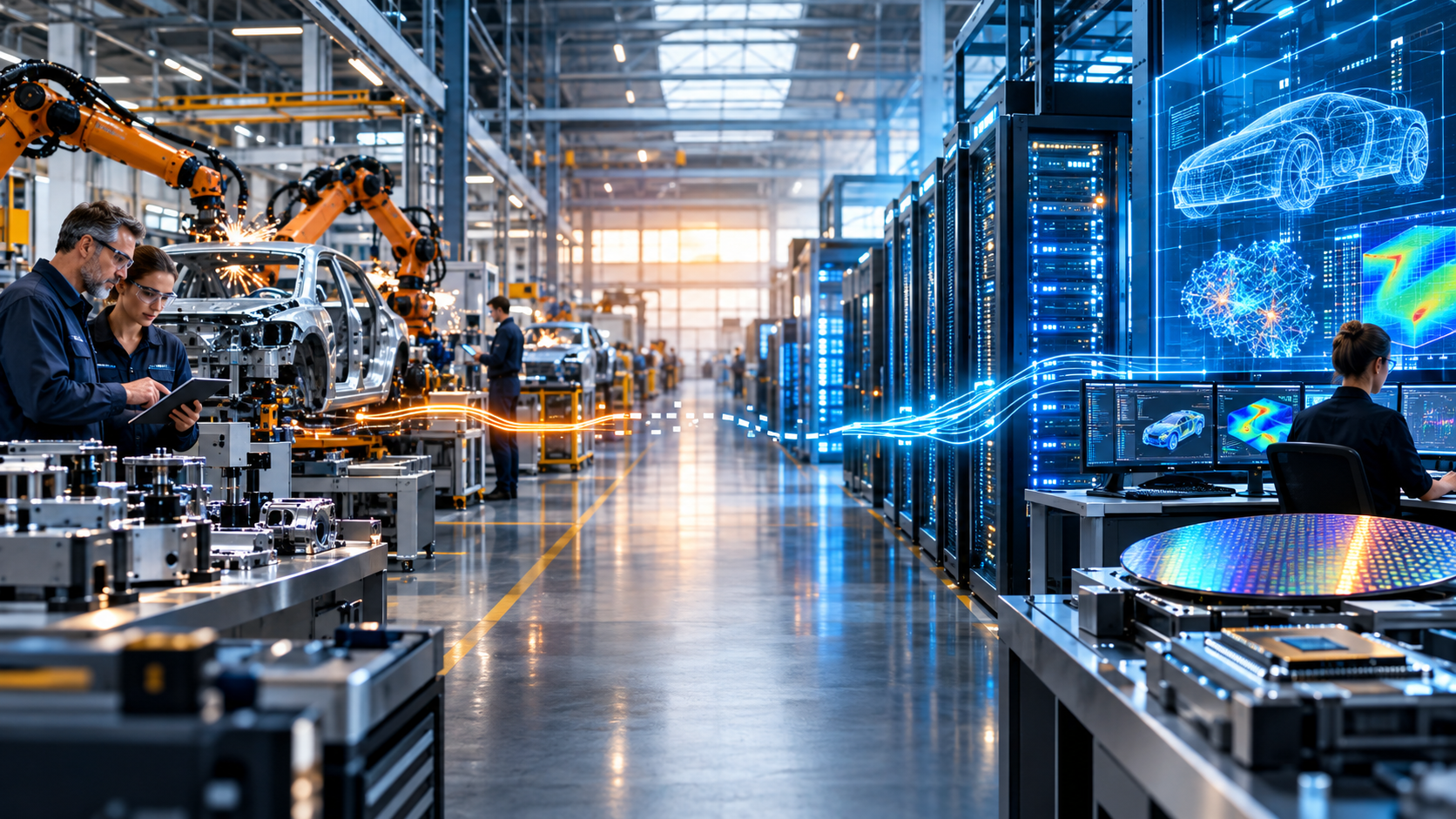
Nvidia CEO criticizes Germany: How serious is the warning about technological lag? – Creative image on the topic, with AI: Xpert.Digital
Germany is not technologically finished – but its lead is rotting away in idleness
AI and Industry: Why Germany needs to move faster from knowledge to value creation
Jensen Huang, CEO of AI chip manufacturer Nvidia, delivers a scathing assessment of Germany: the country has fallen far behind technologically. This statement is pointed and comes from an entrepreneur who himself profits from the global AI boom. However, it hits a nerve. Germany still possesses a strong industrial base, high-performing research, and extensive technical expertise. At the same time, it is often too slow to translate this into successful digital products, scalable businesses, and measurable productivity gains. The gap with international competitors is widening, particularly in AI, software, growth capital, and digital infrastructure.
This doesn't mean that Germany is technologically finished. Rather, the country faces the question of how to combine its industrial strengths with new digital technologies – for example, in robotics, automated manufacturing, and so-called physical AI. Collaboration with Nvidia and German industrial partners could help, but it also carries risks, such as new dependencies on individual suppliers. Therefore, the crucial factor is not to invest as much as possible as quickly as possible, but to reliably transform research and pilot projects into productive applications. Huang's warning is not a final judgment on Germany's future, but it is a reason to seriously examine the country's own pace of implementation.
It is not thinking that paralyzes Germany, but the inability to quickly turn knowledge into added value
Nvidia CEO Jensen Huang's unusually sharp criticism touches a raw nerve in the German economy, but its sweeping generalizations are also excessive. Germany is neither technologically insignificant nor generally lagging behind. The country continues to possess an exceptionally broad industrial base, globally competitive companies, high-performing research institutions, a wealth of engineering expertise, and a high density of automated production facilities. In 2025, 24,476 European patent applications originated in Germany, maintaining its leading position within Europe. With 449 industrial robots per 10,000 employees in the manufacturing sector, Germany also boasts the highest robot density in Europe and one of the highest worldwide.
Nevertheless, Huang's warning must be taken seriously from an economic perspective. Germany's problem lies less in an absolute lack of technology than in the growing gap between scientific and technological capability and its market-effective implementation. Many companies possess advanced expertise in mechanical engineering, automation, materials, sensor technology, production planning, and industrial quality control. However, when it comes to cloud platforms, scalable software, semiconductor ecosystems, digital business models, large-scale AI models, and high-risk growth financing, the focus of value creation is increasingly shifting outside Europe. The crucial question, therefore, is not whether Germany is still innovative. It is whether it can translate its existing innovative capacity quickly enough into productive applications, new companies, exportable platforms, and higher overall economic productivity.
Huang's diagnosis is exaggerated, but not unfounded
The statement that one of the most technologically advanced countries has fallen far behind initially functions as a provocative exaggeration. It doesn't describe a complete industrial decline, but rather a relative loss of position in key digital technologies. Relative means that Germany can improve its capabilities and still fall behind if other economies scale their capacities, investments, and companies significantly faster. This very mechanism shapes the global AI race. Technological progress is not solely measured by whether a country conducts good research or can present individual pilot projects. What is crucial is how quickly capital, computing power, data, skilled workers, and entrepreneurship are combined to create marketable products.
The figures on funding illustrate the scale of the issue. Globally, around US$258.7 billion in venture capital flowed into AI companies in 2025. Of this, approximately US$194 billion, or roughly 75 percent, went to companies in the United States. The entire European Union contributed about US$15.8 billion, or six percent. This difference is not merely a financial detail. It influences where talent is recruited, where data centers are built, where new models are trained, where patents are commercialized, and where young companies evolve into global platform providers.
Huang's criticism, however, is also driven by self-interest. Nvidia benefits when governments, cloud providers, and industrial companies purchase large quantities of AI chips, network technology, and software as quickly as possible. A CEO whose company sells the core infrastructure of the AI boom is not a neutral observer of technology policy. His call for faster action is therefore simultaneously an economic policy diagnosis and a sales pitch. This doesn't invalidate the criticism, but it does require a more sober assessment. Greater speed does not automatically equate to greater economic benefit if investments are made without clear use cases, competition, open interfaces, and reliable cost-benefit analyses.
Germany is strong in technology, but weak in speed
The German innovation apparatus is geared towards thoroughness, safety, technical reliability, and long-term industrial relationships. This model has been extremely successful for decades. It is particularly well-suited to industries where malfunctions are costly or dangerous, product cycles are long, and customers value reliable quality. In chemicals, mechanical engineering, automotive engineering, electrical engineering, and industrial automation, competitive advantages often arise from thousands of incremental improvements. The German system can develop, certify, manufacture, and support complex physical products through international service networks.
However, digital markets sometimes follow a different logic. Software can be distributed globally at low marginal cost. Platforms become more valuable as more customers, developers, and data sources are added. Rapid market learning can be more important than a technically perfect initial design. In AI, models, tools, and business processes are continuously developed in short cycles. Those who scale early gain data, user experience, developer retention, and capital. A system that hedges decisions for years, interprets funding programs in minute detail, and aims to minimize every risk in advance is structurally disadvantaged in such markets.
This makes Huang's accusation of overthinking understandable. However, it remains incomplete. The problem isn't analysis itself, but rather a combination of slow approval processes, fragmented responsibilities, complicated funding conditions, unclear regulations, weak administrative digitization, limited growth capital, and a corporate culture that often punishes mistakes more severely than it rewards learning. The OECD identifies high administrative burdens, skills shortages, and regulatory barriers to competition as detrimental to business dynamism, innovation, and productivity growth. The problem, therefore, isn't too much thinking, but rather a lack of decisive organizational capacity.
The industrial core is not a relic, but Germany's most valuable AI advantage
Germany should not pursue the global AI race by copying the American platform model. A direct race for the largest universal language model would be expensive, risky, and, given the financial power of American corporations, only offer limited prospects for success. The strategic leverage lies instead where digital and physical systems converge. This is precisely where Germany possesses assets that cannot be replicated in the short term: real production facilities, process knowledge, industrial data, machinery, certification expertise, specialized suppliers, and close relationships between manufacturers and business customers.
Physical AI encompasses systems that perceive their environment, make decisions, and control machines or vehicles. This includes self-learning robots, autonomous transport systems, intelligent manufacturing cells, digital twins, AI-supported quality control, and simulation-based training environments. In these applications, a powerful language model alone is insufficient. Precise sensor data, physical understanding, real-time capability, secure control, domain knowledge, and robust integration into existing processes are essential. Germany's industrial structure is fundamentally well-suited for this.
The starting point is stronger than the narrative of decline suggests. Germany is Europe's largest robotics market and had approximately 278,881 operational industrial robots in 2024. Almost half of Western Europe's robotic capacity was installed in Germany. Patent output also remains high, although German patent applications at the European Patent Office declined by 2.2 percent in 2025 compared to the previous year. These figures simultaneously demonstrate strength and serve as a warning signal: Germany possesses significant technological resources, but its continued dynamism is not a given.
The real weakness lies between pilot project and widespread application
Numerous AI initiatives are now underway in German companies. The bottleneck often arises after the initial attempt. A pilot project can be launched with a small team, limited data, and a manageable budget. However, for productive use, standardized data access, IT security, operational responsibility, training, process changes, interfaces to legacy systems, and measurable economic goals are required. Many projects stall in this transition phase because technical, organizational, and legal responsibilities are not aligned.
The adoption of AI therefore presents a mixed picture. By 2025, 26 percent of German companies with at least ten employees were using at least one AI technology. For large companies with 250 or more employees, this figure was 57 percent, for companies with 50 to 249 employees it was 36 percent, and for small companies with 10 to 49 employees it was 23 percent. Germany was thus above the EU average of around 20 percent, but significantly below the European leaders. Denmark reached 42 percent, Finland 38 percent, and Sweden and Belgium each 35 percent.
The picture is less rosy for medium-sized businesses because it also includes very small companies. According to KfW data, 20 percent of medium-sized companies use AI. Most of these are easily accessible applications such as natural language processing or text recognition. Only three percent use more sophisticated data analysis, and a mere one percent employ AI for autonomous machine movements. Applications that are particularly relevant for industrial productivity are therefore still rare.
Furthermore, the pace of digitalization is slowing. Only 30 percent of medium-sized companies had completed digitalization projects during the period under review. Corresponding expenditures fell to €23.8 billion in 2024, a decrease of €8.1 billion compared to the previous year. This is economically significant because AI cannot be scaled on a weak digital foundation. Companies need clean master data, networked machines, modern cloud or edge infrastructures, and digitized workflows. Those who neglect these prerequisites may be able to demonstrate AI, but can hardly operate it productively.
Small and medium-sized enterprises need returns, not technological spectacle
The political debate often focuses on large-scale models, supercomputers, and billion-dollar investments. For the typical medium-sized industrial company, however, other questions matter: Does an application reduce scrap and downtime? Does it shorten development cycles? Does it relieve the burden on scarce skilled workers? Does it improve delivery reliability, energy efficiency, or maintenance? Can it be securely integrated into existing machines and ERP systems? Will data and process knowledge remain controllable? Without clear answers, AI is perceived as adding complexity, not as a productivity tool.
Therefore, Germany's AI strategy should focus less on spectacular individual projects and more on repeatable, industry-specific solutions. A medium-sized machine manufacturer doesn't need a general model for every conceivable task. It needs reliable systems for technical documentation, quotation preparation, fault diagnosis, design, production planning, and remote maintenance. A logistics company benefits from improved route planning, inventory forecasting, visual damage detection, and dynamic workforce management. An automotive supplier can use AI for quality control, material flow, simulation, and predictive maintenance.
The economic impact arises from thousands of such applications. They not only increase the efficiency of individual companies but can also mitigate the demographic-driven labor shortage. Crucially, AI complements existing employees, makes process knowledge available, and reduces routine tasks. A strategy that focuses solely on replacing work would generate resistance and result in the loss of valuable experiential knowledge. Successful implementation therefore requires planning technology, training, and organizational development together.
The Nvidia partnership is both an opportunity and a dependency
The planned collaboration between the German government, Nvidia, and German industrial partners focuses on two key areas: the development of high-performance AI models for industrial applications and the establishment of foundations for physical AI, particularly for robot training and autonomous vehicles. Investments in the hundreds of millions of euros are planned, primarily for computing capacity and model training. In addition to chips, Nvidia will also contribute specialized engineering personnel. Participating companies include Siemens, Audi, and Black Forest Labs.
This approach is plausible in principle. Germany can only utilize its industrial database if sufficient computing power, software tools, and expertise are available. Cooperation can shorten development times, facilitate access to modern infrastructure, and bring together companies that would be too small or too slow on their own. It can also send a signal that industrial AI is being treated not as a niche research area, but as an economic policy priority.
At the same time, a strategic contradiction arises. Germany wants to strengthen its digital sovereignty, but to do so, it relies on the technology of an American company that dominates the market for AI accelerators. In this environment, sovereignty cannot mean complete autarky. For the foreseeable future, Germany will neither manufacture all relevant chips itself nor control the entire cloud and software stack. A more realistic approach is tiered sovereignty: companies must be able to switch providers, use open interfaces, control sensitive data, develop models independently, and operate critical systems even under changing geopolitical or commercial conditions.
A partnership with Nvidia is therefore beneficial if it builds capabilities and fosters competition. It would be problematic if public funds primarily subsidized the sales of a single vendor and created lasting dependencies on proprietary hardware and software. Funding conditions should therefore guarantee interoperability, open standards, transparent performance indicators, and access for small and medium-sized enterprises (SMEs). Equally important is an architecture that does not exclude European chip manufacturers, cloud companies, research institutions, and open-source projects.
🎯🎯🎯 Data-driven B2B industry hub as a quasi-in-house solution

The quasi-in-house solution: How Xpert.Digital closes operational gaps in B2B marketing and sales – Smart Content-Driven Business - Image: Xpert.Digital
Xpert.Digital is a data-driven B2B industry hub led by Konrad Wolfenstein . The company acts as an external, quasi-in-house solution for industrial partners, closing operational gaps in marketing, content, and sales – without requiring additional resources on the client side.
More information here:
Germany lagging behind digitally: What needs to be done now
Open industrial models can make sovereignty practical
The Sovereign Open Source Foundation Models project, or Soofi for short, aims to develop high-performance open AI models that can be trained, operated, and controlled in Germany. The project connects research institutions, universities, and AI companies and utilizes Deutsche Telekom's industrial AI cloud. The first funding phase was supported with €20 million.
The open approach is strategically relevant because industrial users have different requirements than private users of freely accessible chatbots. They need transparent models, controllable data flows, long-term maintainability, and adaptability to specialized terminology, standards, and processes. Open model weights alone, however, do not solve these problems. High-quality training data, transparent licenses, powerful tools, security audits, sustained funding, and an active developer community are essential.
Economic success also depends on whether a research project gives rise to a robust ecosystem. A model only has economic value when companies use it productively, service providers develop applications, and skilled workers can work with it. In the past, Germany has frequently funded demonstrators and research consortia without producing sustainably scalable products. Therefore, Soofi should not be primarily measured by the number of published models. More important are industrial use, measurable productivity gains, the number of active developers, integration into enterprise software, exportability, and the reduction of one-sided dependencies.
Capital decides which innovations will come to fruition
Germany's financing problem doesn't begin with the founding of companies, but often with their growth. Scientific expertise, government programs, and early-stage funding are available. However, when a company needs several hundred million euros to build computing capacity, expand internationally, or mass-produce industrial hardware, the domestic capital market quickly becomes insufficient. At that point, foreign investors take on a large portion of the financing, or successful companies relocate their operations to the United States.
The German venture capital market is showing progress. In 2025, around €7.2 billion was invested in German startups. Of this, approximately €2.9 billion went to AI companies, roughly two-fifths of the total volume and a record high for Germany. Nevertheless, the total German venture capital volume, measured as a percentage of economic output, was slightly below the EU average of 0.18 percent, at 0.16 percent. Particularly in comparison to the United States, the scale remains small.
The problem is not just the amount of capital, but also its structure. AI, robotics, semiconductors, and industrial deep-tech companies require long development cycles, high initial investments, and investors with technical expertise. The bank-centric European financial system is less suited to intangible, uncertain, and long-term investments. The European Central Bank points out that European venture capital and private credit markets are too shallow to adequately finance the scale of the AI opportunity.
Effective policies must therefore mobilize private growth capital, not replace it with public capital. Pension funds, insurance companies, family offices, and industrial investors could participate more in European growth funds, provided that regulations, risk sharing, and incentives are appropriately designed. Public funds should not be used to socialize losses across the board. However, they can structure risks through anchor investments, guarantees, and joint funds in such a way that private actors invest. Crucially, capital must be allocated based on technical quality and market opportunities, not political visibility.
Regulation is not the enemy, but its implementation can stifle innovation
The contrast between American innovation and European regulation is often oversimplified. Reliable rules can build trust, safeguard investments, and limit risks. Especially in industry, medicine, mobility, and critical infrastructure, safety, liability, and data protection are not secondary concerns. A faulty recommendation system is annoying; a faulty control system for machines or vehicles can endanger people and cause significant damage.
The problem arises when rules are unclear, contradictory, or administratively difficult to manage. Large corporations can build specialized legal, data protection, and compliance departments. Small businesses and startups face the same uncertainties with significantly fewer staff. As a result, regulation can unintentionally strengthen the market position of established providers. It is not the existence of rules, but rather the high fixed costs of regulatory compliance that then become the barrier to entry.
Germany therefore needs faster and more competent approval and advisory structures. Companies should be able to obtain binding information early on about the requirements that apply to a specific use case. Standardized testing procedures, regulatory testing environments, and mutually recognized certifications can reduce time and costs. Equally important is the digitalization of public administration. It seems contradictory to encourage companies to invest in AI while government processes continue to be characterized by paperwork, media breaks, and multiple data entries.
Energy and computing power are part of industrial policy
AI models and simulations require significant computing power. For Germany, therefore, not only the number of data centers will be crucial, but also their costs, grid connections, energy supply, and feasibility. High electricity prices, lengthy grid connection processes, and local permitting issues can hamper digital investments, as can a lack of capital. Computing infrastructure is not an abstract cloud; it consists of buildings, chips, cooling systems, power lines, transformers, and skilled personnel.
An industrial policy strategy must integrate data centers with energy, grid, and heat policies. Locations should be established where renewable energy generation, high-performance grids, usable waste heat, and data connections can be effectively combined. Flexible load management can help align electricity demand with the availability of renewable energy. Waste heat utilization is particularly attractive from a technical and economic perspective when suitable heating networks and continuous consumers are present. However, blanket promises are insufficient; every project requires realistic infrastructure and economic feasibility studies.
At the same time, computing power must not become an end in itself. Purchasing thousands of accelerators does not automatically generate productivity. Without data quality, skilled personnel, software, and concrete applications, expensive facilities remain underutilized. Public funding should therefore be linked to usage, access, and measurable results. Universities, startups, and SMEs need transparent access models, while industrial users require reliable capacity and data protection guarantees.
The talent is there, but the system doesn't utilize it consistently
Germany boasts strong technical universities, research institutions, and dual vocational training systems. The high level of patent activity and industrial automation would not be possible without this foundation. Nevertheless, many sectors are experiencing a shortage of software developers, data engineers, electrical specialists, and experts in robotics, semiconductors, and AI operations. Demographic change is intensifying the competition for qualified workers.
The solution isn't simply to train more computer scientists. Industrial AI requires interdisciplinary teams. Mechanical engineers need to understand data and model limitations; software developers need process knowledge; skilled workers must be able to operate, monitor, and improve systems. Continuing education is therefore a strategic production factor. It should be more closely aligned with real-world workflows and not just focus on general AI fundamentals.
International talent is also crucial. Faster visas, English-language administrative services, reliable recognition of degrees, and attractive career paths can improve Germany's position. At the same time, researchers and entrepreneurs must be given better opportunities to build companies from within universities. Technology transfer must not fail due to protracted negotiations over patents, equity stakes, and usage rights.
Germany doesn't need a copy of Silicon Valley
The demand for faster progress is often linked to a desire to adopt American practices. This would be strategically short-sighted. Germany's strength lies not in a cultural copy of Silicon Valley, but in the combination of industrial depth, technical reliability, and digital scalability. A German or European model can combine stricter safety standards, co-determination, and data protection with rapid innovation if processes are clearly structured and enable decisive action.
Germany should differentiate between three levels in this regard. Complete independence is unrealistic for basic AI models and chips; partnerships and diversified supply chains are necessary here. For industrial models, simulation systems, and industry-specific platforms, there are realistic opportunities for internationally leading offerings. When applied in factories, logistics, energy, mobility, and administration, Germany can realize productivity gains particularly quickly.
This focus prevents scarce resources from being distributed symbolically. Not every country needs its own universal top-of-the-line model. However, Germany needs sufficient domestic expertise, computing power, and open technology to be able to test, adapt, and, if necessary, replace foreign systems. Technological sovereignty is therefore not autarky, but rather strategic capability.
The economic measure is called productivity
The decisive test is not the number of AI strategies, data centers, or conferences, but rather the development of productivity. Germany's real economic output grew by only 0.2 percent in 2025. In the manufacturing sector, price-adjusted gross value added fell for the third consecutive year, by 1.3 percent in 2025. The automotive and mechanical engineering sectors, in particular, faced increased global competitive pressure. Against this backdrop, industrial AI is not a prestige project, but a potential instrument for stabilizing value creation and income.
The effect won't happen automatically, however. Companies need to redesign processes, redistribute tasks, and train their employees. Simply applying AI to existing inefficient workflows may only result in digitizing waste. Productivity gains arise when technology is combined with organizational change. This includes clearer responsibilities, better data, faster decision-making, and a willingness to eliminate processes that no longer serve a purpose.
The KfW (German Development Bank) is therefore right to state that Germany does not need to become the world champion in developing the largest models in the short term, but rather the leading application country for AI in industry and SMEs. This perspective is more economically convincing than a purely symbolic race for model size. However, it must not serve as an excuse to forgo domestic research, open models, and infrastructure. A purely application-oriented country would be dependent on the prices, regulations, and product decisions of foreign platform providers.
What matters now in economic policy
Germany needs an implementation agenda with a few verifiable priorities. First, digital infrastructure in small and medium-sized enterprises (SMEs) must be improved. Funding programs should jointly support investments in data quality, interfaces, cloud and edge systems, cybersecurity, and further training. Second, industry-specific AI platforms are needed, enabling companies to use models, data rooms, and test environments without having to build every technical component themselves.
Third, the government should act as a demanding first customer. Public procurement can provide young companies with references and opportunities for scaling if processes become faster and more innovation-friendly. Fourth, growth financing and exit markets need to be expanded so that successful technology companies can remain and expand in Europe. Fifth, critical AI infrastructure needs open interfaces, the ability to switch providers, and clear data control.
Sixth, real-world laboratories for robotics, autonomous systems, and industrial AI should be significantly expanded. Companies must be able to test technologies under controlled conditions before all regulatory issues are definitively resolved. Seventh, every major public investment in AI should be evaluated based on concrete results: productive users, capacity utilization, private follow-up investments, cost reductions, new products, exports, and time to market.
Most important, however, is institutional change. Responsibilities must be consolidated, deadlines made binding, and decisions transparent. Germany doesn't lack strategy papers. What it lacks are organizations that take responsibility, can terminate projects if they aren't working, and can quickly replicate successful approaches.
The counter-argument: Germany is not too slow because it thinks too much
Huang's criticism contains a valid observation, but an oversimplified explanation. Germany has not fallen behind technologically because engineers, companies, or government agencies are inherently overly thorough. Thoroughness remains a competitive advantage in many industrial applications. The country falls behind where thoroughness becomes an excuse for unclear responsibilities, a lack of prioritization, and endless coordination.
It would be equally wrong to treat every regulation as an obstacle to innovation and every rapid investment as progress. The global AI boom contains excesses, misinvestments, and high concentration risks. Hardware is aging rapidly, business models are sometimes unclear, and the benefits of generative AI are overestimated in some areas. Germany should therefore not blindly spend billions simply to demonstrate resolve.
The better answer to Huang's question is: Germany must act faster, but not recklessly. It must leverage its industrial strength instead of imitating American platform strategies. It must utilize foreign technology without becoming entirely dependent on individual providers. It must promote open models without confusing research projects with functioning markets. And it must design regulations in such a way that security is not achieved at the expense of stagnation.
The warning must become a productive shock
The sharp criticism from Nvidia's CEO can be useful if it doesn't devolve into hurt feelings or frantic activism. Germany's technological situation is more serious than the reassurances suggest, but better than the doomsday narrative. The country still possesses industrial, scientific, and engineering assets of exceptional value. At the same time, these strengths risk diminishing in importance if software, data, chips, platforms, and growth capital are permanently concentrated elsewhere.
The planned collaboration in the field of industrial and physical AI could be an important step. However, its success does not depend on the prominence of the participating companies or the amount of announced investments. What is crucial is whether medium-sized and large companies can develop productive applications more quickly, whether knowledge and added value are generated in Germany, and whether the dependence on individual providers remains manageable.
Germany is therefore not faced with a choice between thinking and acting. It must think better, decide more clearly, and implement more quickly. Its industrial lead still exists, but it is not a permanent possession. In a phase of accelerated technological change, a country doesn't lose its position only when its factories close. It loses it as soon as others use the same technologies to create new products, companies, and productivity gains more quickly.
Huang's appeal should therefore be treated neither as an objective judgment nor as mere provocation. It is a pointed description of a real economic problem: Germany possesses knowledge, capital, companies, and talent, but combines these resources too slowly. If the Federal Republic links its industrial base with scalable AI, modern infrastructure, growth capital, and decisive institutions, it can play a leading role in the next technological wave. If, once again, it primarily announces programs, distributes responsibilities, and manages risks, a relative lag will turn into a structural decline.
📈🚀 From visibility to trust 👀🤝 Your scalable path with Xpert.Digital

From visibility to trust: Your scalable path with Xpert.Digital - Image: Xpert.Digital
In industrial B2B, sustainable business relationships rarely emerge overnight. They develop step by step – through visibility, professional relevance, recurring touchpoints, and growing trust. Xpert.Digital's 4-stage model addresses precisely this: It offers a structured path that begins with a manageable entry point and can evolve into deeper collaboration in business development if needed.
Instead of relying on loud marketing promises, this model puts the relationship at the forefront. Companies start with clearly defined, easily calculable measures and then decide, based on their own experience, how far they want to expand the collaboration. A key factor for this undisturbed trust-building process: The platform completely avoids annoying advertising ads, so the editorial focus remains solely on the companies' expertise.
More information here:
Your global marketing and business development partner
☑️ Our business language is English or German
☑️ NEW: Correspondence in your native language!

Konrad Wolfenstein
I and my team are happy to be available to you as your personal advisor.
You can contact me by filling out the contact form here [email protected]:or simply call me at +49 7348 4088 965. My email address is
I'm looking forward to our joint project.