
Interactive warehouse management as a productivity lever: Why poor user interfaces destroy more value than some machine downtimes
Xpert Pre-Release

Available in 27 languages 📢
Prefer Xpert.Digital on GoogleⓘPublished on: April 1, 2026 / Updated on: April 1, 2026 – Author: Konrad Wolfenstein
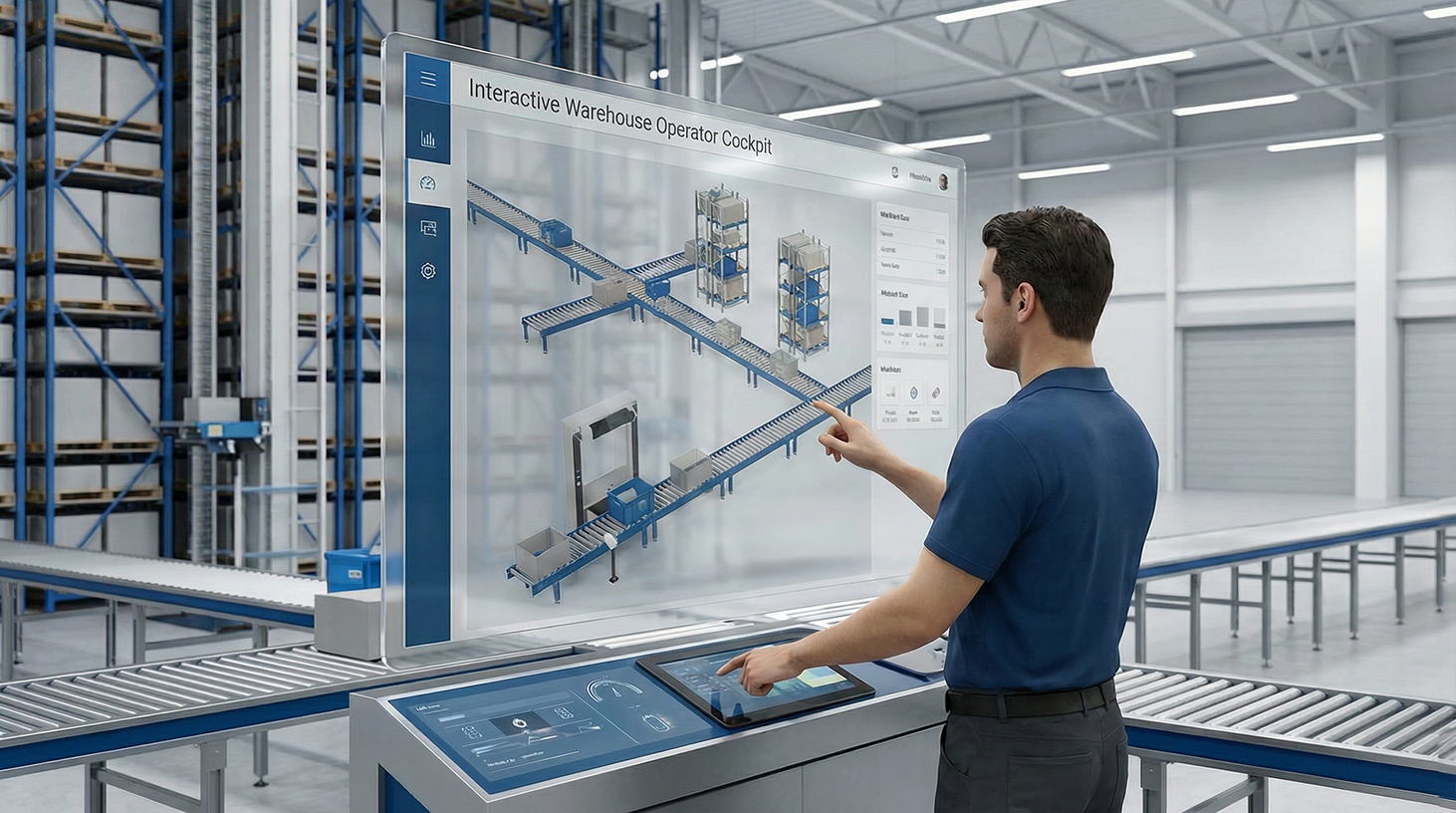
Interactive warehouse management as a productivity lever: Why poor user interfaces destroy more value than some machine downtimes – Image: Xpert.Digital
No more click frustration: How interactive handling is positively changing warehouse management systems
Hidden productivity killer: Why the software interface in your warehouse determines profit
From the rigid mask to the digital cockpit: This is how modern warehouse operators control the flow of materials today
In modern intralogistics, the bottleneck is shifting: no longer is the pure mechanics of conveyor technology or storage and retrieval machines the decisive factor, but rather the interface between humans and systems. Where physical labor once mattered, warehouse operators now act as directors of highly complex material flows. However, while automation is advancing rapidly, many user interfaces are lagging behind this change. Cryptic menus, cluttered screens, and rigid navigation cost valuable seconds with every click. Even worse, they drive up error rates and deter young, smartphone-savvy talent. This article explores why intuitive, interactive handling is no longer just a design consideration, but a hard-nosed business case. Learn how modern system architectures – such as the LIOS Cockpit from LTW – put people back at the center and why investing in an excellent user experience ensures productivity, ergonomics, and the future viability of the entire warehouse.
New requirements for warehouse operators in a digital intralogistics system
The role of the warehouse operator is fundamentally changing in a digitized and largely automated intralogistics system. Previously, the focus was on the physical movement of pallets, boxes, and containers; today, the warehouse operator increasingly acts as the director of complex material flows. The actual physical work is handled by storage and retrieval machines, conveyor technology, and automated small parts warehouses, while humans monitor, intervene, analyze, and optimize processes. This shifts the bottleneck: no longer is pure mechanics the determining factor, but rather the interface between humans and systems.
At the same time, increasing demand volatility, shorter delivery times, and a growing variety of product variants are putting more pressure on warehouse logistics. Systems need to be reconfigured more frequently, warehouse strategies adapted more quickly, and errors identified more rapidly. In such an environment, every additional second an operator spends searching, clicking, or interpreting unclear displays becomes a real cost factor. The quality of the software interface is therefore no longer just a matter of convenience, but a relevant production factor.
Added to this is the demographic shift. Many experienced warehouse professionals are retiring, while younger employees with entirely different digital expectations are entering the workforce. They are accustomed to smartphones, intuitive apps, and clear visualizations. Complex, cryptic interfaces, still common in many older control systems, are off-putting and lead to longer training times, higher error rates, and lower user acceptance. Companies that ignore this trend will face long-term difficulties in attracting and retaining qualified personnel.
Interactive handling: From the user interface to the digital workspace
Interactive handling for warehouse operators means more than just "pretty" screens. It describes a paradigm shift from static, form-based interfaces to dynamic, context-sensitive workspaces. The screen becomes a digital workspace where the operator is guided by the situation, instead of having to navigate rigid menu structures. Interaction is based on familiar patterns from the consumer sector: tapping, swiping, zooming, visual maps, and clear dashboards replace nested tables and cryptic status codes.
The central goal is to reduce cognitive load. Information should be processed in such a way that a warehouse operator can see at a glance what is happening in the system, where problems might arise, and what the next sensible action is. Instead of displaying raw data, condensed information, meaningful prioritizations, and visual cues are needed. This reduces incorrect decisions, accelerates response times, and increases transparency along the entire process chain.
Another aspect of interactive handling is the consistent use of the operating logic: Whether at the control station, the stationary terminal, or on mobile devices – the user should encounter the same symbols, the same language, and the same navigation principle everywhere. Only in this way can they switch tasks flexibly without having to mentally "switch" each time. In modern systems, this merges the classic warehouse management system with operational cockpits and mobile operator solutions into a coherent user experience.
Economic relevance: Why the surface is a business case
At first glance, investments in modern user interfaces seem like a "nice-to-have"—a matter for design and usability, but not essential for controlling. However, closer examination reveals that interactive handling has a very direct impact on key performance indicators. Three economic dimensions stand out in particular: productivity, cost of errors, and time-to-competence.
In production environments, throughput times depend significantly on how quickly operators can make decisions and process orders. Every unnecessary click, every cumbersome navigation, and every unclear status indicator increases processing time. While this might only amount to a few seconds for a single order, over thousands of orders per day, it adds up to measurable time losses. From a business perspective, it is therefore rational to invest in user interfaces that systematically reduce processing times.
Error costs are the second major factor. Incorrectly picked goods, faulty book entries, or improperly handled malfunctions not only cause direct costs in the warehouse but also impact complaint rates, return shipping costs, and customer satisfaction. Many of these errors can be traced back to unclear or error-prone operating logic—for example, when critical functions are too easy to select, warnings are overlooked, or status messages are worded ambiguously. An interactive system that actively guides the operator, integrates plausibility checks, and makes operator errors more difficult permanently reduces these costs.
The third dimension is the onboarding time for new employees. In a tight labor market with high turnover, the speed at which new warehouse operators become productive is crucial. Intuitive, interactive interfaces significantly shorten the learning curve because they build on existing habits – for example, from smartphone apps. This reduces training costs, and temporary or seasonal workers can be better integrated into processes. Over several years, this can noticeably reduce the total cost of ownership of modern intralogistics systems.
LTW Intralogistics Solutions

LTW Intralogistics – Engineers of Flow - Image: LTW Intralogistics GmbH
LTW offers its customers not individual components, but integrated complete solutions. Consulting, planning, mechanical and electrotechnical components, control and automation technology, as well as software and service – everything is networked and precisely coordinated.
In-house production of key components is particularly advantageous. This allows for optimal control of quality, supply chains, and interfaces.
LTW stands for reliability, transparency, and collaborative partnership. Loyalty and honesty are firmly anchored in the company's philosophy – a handshake still means something here.
Related to this:
People at the center: Interactive operating concepts for efficient warehouse processes
LTW as a pioneer: LIOS Cockpit and Operator in context
Against this backdrop, LTW, with its LIOS Intralogistics Operating System, consciously positions itself as a provider that places human-machine interaction at the heart of its system architecture. The LIOS Cockpit consolidates key information on plant control, material flow visualization, and system diagnostics in a single interface designed for clarity and interactivity. Instead of simply listing the status of individual components, processes are displayed in their context, malfunctions are visualized within their surroundings, and action options are clearly structured.
The LIOS Operator consistently applies these principles to mobile applications. Warehouse operators no longer move back and forth between the control room and conveyor systems, but instead take the necessary information and functions directly to the point of operation on their tablet or handheld device. This enables shorter distances, faster responses to malfunctions, and a closer integration between digital control and the physical reality in the warehouse. The operator remains within a familiar interaction logic, regardless of whether they are working at the control room or on the go.
What's remarkable is that with this approach, LTW hasn't just modernized the user interface, but has also deeply embedded interactivity into its system philosophy. The goal isn't simply to visually enhance existing functions, but to consistently design workflows from the user's perspective. Processes are designed so that typical tasks – such as acknowledging transport orders, handling special cases, or managing malfunctions – are accomplished with as few, logically structured interactions as possible. This puts LTW at the forefront of a market segment where many systems remain functionally powerful but cumbersome to use.
Familiar interactions as a bridge to acceptance and efficiency
A key success factor for interactive systems is the use of familiar interactions. Warehouse operators are no longer technophobic, but they are accustomed to working with clear, minimalist interfaces – whether on their smartphones at home or in other business applications. When a warehouse interface adopts these patterns, the barrier to actively using the system decreases, and acceptance increases.
In practical terms, this means that buttons should be clear and sufficiently large, important functions should be within the user's direct line of sight, and status information should be visually differentiated. Building on this foundation, more complex interactions—such as examining different levels of detail in a fault or rescheduling transport orders—can be designed similarly to modern business intelligence tools or navigation apps. The operator no longer needs to "learn the language of IT"; the system speaks their language.
Familiar interactions also reduce the risk of operators reverting to old, informal workarounds under stress or high workload, such as paper-based emergency lists or unofficial spreadsheets. When the digital system is faster, more convenient, and more reliable than any alternative, it becomes the first choice in daily operations. This results in greater process discipline, which in turn is a prerequisite for robust data analysis and continuous optimization of intralogistics.
Data-driven control: Visualization as a decision-making tool
With the increasing digitalization of warehouse processes, the amount of data available in real time is growing. Sensors, controllers, and software systems continuously provide information about inventory, movements, and status. However, without suitable visualization, this potential remains largely untapped. Interactive cockpits like LIOS are therefore becoming key decision-making tools that transform data into actionable insights.
For warehouse operators and shift supervisors, this means that instead of working through lists and logs, they receive condensed key performance indicators and visual representations that highlight anomalies. Color-coded bottlenecks, visually marked disruptions, or dynamic load distributions across different storage zones enable the rapid identification of necessary actions. Interactive filter and drill-down functions allow navigation from the overview level down to the individual transport order without losing context.
From an economic perspective, this creates a dual benefit. Firstly, daily operational management improves – bottlenecks are identified more quickly, resources are allocated more efficiently, and ad-hoc measures can be implemented on a more informed basis. Secondly, these interactive visualizations provide the foundation for medium- to long-term optimization projects. Historical data can be analyzed using the same logic employed to manage day-to-day operations, and potential improvements can be simulated in various scenarios. Companies that develop this data expertise through interactive dashboards gain a sustainable competitive advantage.
Work organization and ergonomics: People at the heart of automation
Interactive operating concepts not only influence key performance indicators but also work organization and ergonomics. A well-designed HMI (Human-Machine Interface) reduces mental strain, prevents overload in stressful situations, and ensures that operators can focus their attention where it has the greatest impact. Clear prioritization, logical task grouping, and intuitive navigation support a structured workflow.
In many warehouses, shift staffing is already based on the complexity of current orders. An interactive system can make this complexity visible and distribute the workload more fairly. Furthermore, mobile interfaces facilitate collaboration between different roles – for example, between the control room, maintenance, and warehouse operators on the shop floor. Information is provided where it is needed, and feedback flows back into the system seamlessly.
In the long run, this also pays off in the form of lower employee turnover and higher employee satisfaction. Those who work in a highly automated environment don't want to become mere cogs in an incomprehensible IT machine, but rather contribute their experience and judgment. Interactive systems that take humans seriously as active decision-makers increase identification with the task. This is a particularly relevant location factor in times of skilled labor shortages.
Strategic perspective: Why you should act now and not wait
Many companies still view the modernization of their user interfaces as a secondary issue, something to be addressed "sometime" when a system change is already planned. From an economic perspective, this approach is risky. Firstly, because the effects on productivity, error costs, and training times described above are ongoing, and every month of delay translates into continuous opportunity costs. Secondly, because the integration of interactive operating concepts into existing system landscapes is often possible incrementally – for example, via new cockpits, mobile operator solutions, or modular extensions.
Providers like LTW demonstrate that interactive operating concepts are not only applicable to new construction projects, but can also create real added value in existing facilities. This provides a way to decouple the modernization of the human-machine interface from major structural or plant engineering investments. Companies can thus gain experience early on, gradually familiarize employees with new operating logics, and realize a faster return on investment.
Strategically, interactive handling is therefore a core element of the transformation towards a learning, data-driven intralogistics system. Those who succeed in combining the potential of modern automation technology with high-performance human-machine interaction will be able to meet customer requirements more flexibly, reduce operating costs, and shorten innovation cycles. From this perspective, the user interface is no longer the final step of a project, but one of the most important building blocks for sustainable competitiveness.
Consulting - Planning - Implementation

Konrad Wolfenstein
I would be happy to serve as your personal advisor.
contact me at wolfenstein ∂ xpert.digital
Just call me on +49 7348 4088 965 .
Your intralogistics experts

Consulting, planning and implementation of complete solutions for high-bay warehouses and automated storage systems - Image: Xpert.Digital
More information here:










