
High-bay warehouse amortization in record time: Why the technology is not a risk today, but a salvation
Xpert Pre-Release

Available in 27 languages 📢
Prefer Xpert.Digital on GoogleⓘPublished on: January 23, 2026 / Updated on: January 23, 2026 – Author: Konrad Wolfenstein
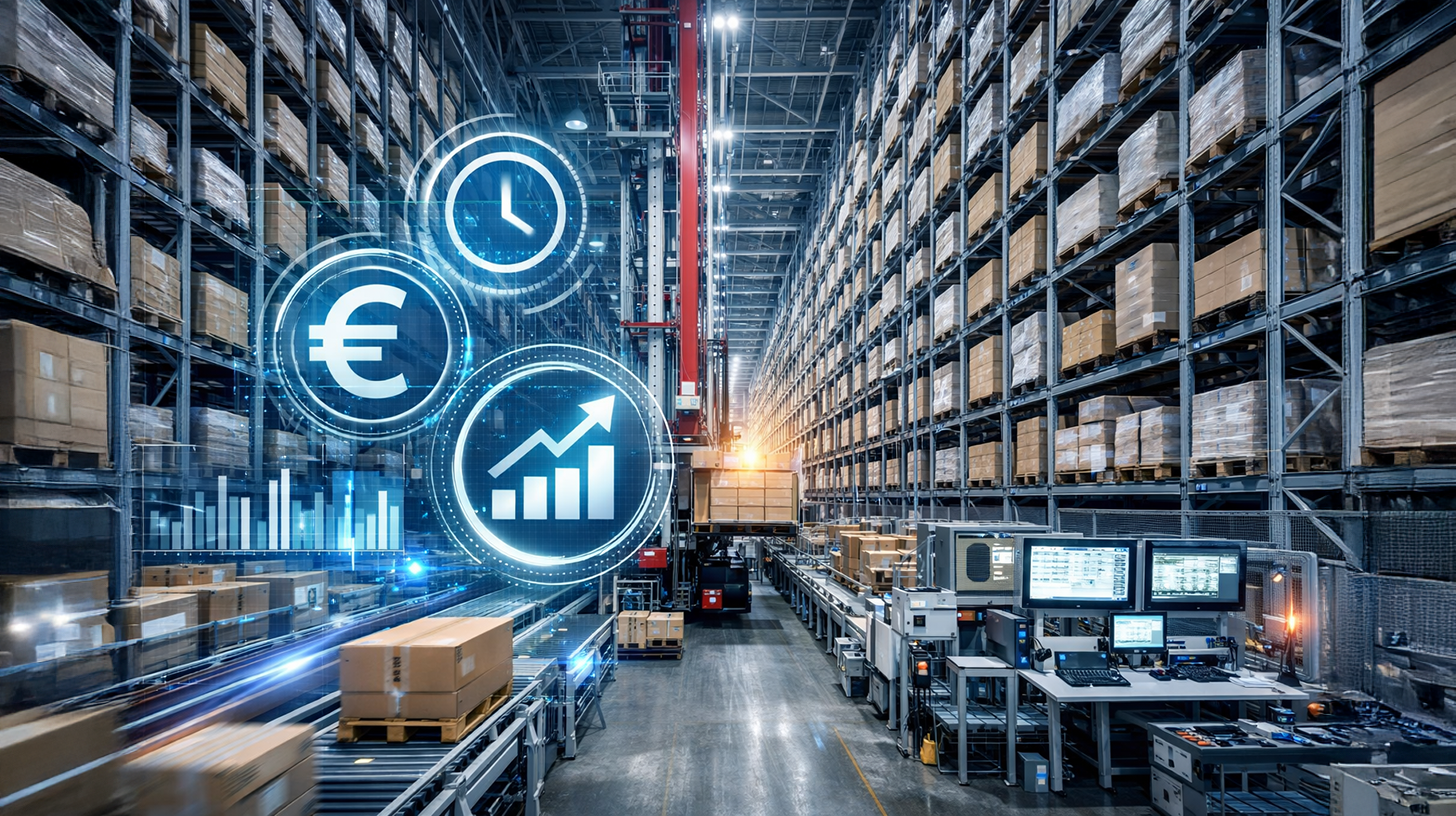
High-bay warehouse amortization in record time: Why the technology is not a risk today, but a salvation – Creative image: Xpert.Digital
Skilled labor shortage as a driver of innovation: How high-bay warehouses now have to compensate for 60,000 unfilled positions
High-bay warehouses as a catalyst for digitized value creation
Why automated intralogistics is becoming a strategic differentiator – and who is falling behind
Warehouse technology is undergoing a radical transformation. What was considered a vision of the future two decades ago—fully automated, floor-to-ceiling high-bay warehouses controlled by artificial intelligence—is now operational reality in leading industrial companies. At the same time, a detailed analysis of German industry reveals a paradoxical picture: While technological solutions are mature and economically viable, the implementation rate remains surprisingly low. This phenomenon is not merely a delay; it is a strategic promise that remains unfulfilled.
The high-bay warehouses of the Industry 4.0 era are no longer passive storage facilities with static racks and manual processes. Instead, they are dynamic information systems in which robotics, sensor networks, machine learning, and cloud-based orchestration converge into an integrated ecosystem. This ecosystem not only creates operational efficiency gains but also fundamental competitive advantages in an era characterized by skills shortages, volatile demand, and rising customer expectations.
The extent of market transformation
The global market for intralogistics automation solutions is projected to more than double from US$25 billion in 2025 to an estimated US$53.9 billion by 2035, representing an average annual growth rate of eight percent. However, regional dynamics reveal significant differences. Germany is expected to disproportionately outperform global growth at 9.2 percent, driven by investments in technology-intensive sectors such as automotive, pharmaceuticals, and high-value manufacturing processes. China's intralogistics market is expanding even more rapidly, at 10.8 percent, fueled by the continued scaling of the e-commerce sector and the integration of artificial intelligence into existing warehouse systems.
These aggregated figures, however, obscure a remarkable reality: European logistics automation is expected to experience annual growth rates of 11.18 percent over the period from 2024 to 2033. This indicates accelerating, not just sustained, growth. Market segments such as autonomous mobile robots (AMRs) and automated guided vehicles (AGVs) alone saw a 16 percent increase in their deployments in warehouses and distribution centers in 2024, with Asia-Pacific and North America exhibiting the highest adoption rates.
Profitability calculation and amortization dynamics
The economic justification for high-bay warehouse investments is measurable and compelling. The amortization period for automated storage systems typically ranges from twelve to eighteen months. This timeframe is not arbitrary; it is based on concrete cost savings. The primary source of cost reduction is the decrease in personnel costs through the transition from manual to automated material handling. Parallel savings effects arise from minimizing human error, reducing product damage through more precise handling, and optimizing the energy use of modern drives. An often overlooked factor is the reduction in the cost per storage location due to improved vertical space utilization, which leads to significant capital savings in high-priced real estate locations in Germany and Switzerland.
Companies that have specifically invested in warehouse technology report demonstrable efficiency improvements in 100 percent of cases. A broader sample shows that 94 percent of the surveyed companies with automation investments documented efficiency gains. These rates are unusually high for technology investments and indicate that the technology maturity level has already reached a point where failures are the exception, not the rule.
The Hermes fulfillment center in Haldensleben, one of the Otto Group's largest distribution centers, exemplifies this dynamic. With the gradual installation of 61 new storage and retrieval machines from the Swiss manufacturer Stöcklin, the warehouse throughput is being increased from 3,500 to 3,900 storage and retrieval operations per hour. The spatial capacity remains the same – 1.2 million cartons – but the throughput per square meter and unit of time is rising significantly. This is the economic essence of automation: higher productivity without additional space allocation.
The discrepancy between potential and reality in German industry
Recent empirical studies have revealed a significant phenomenon: German industry has systematically underestimated the level of automation in its intralogistics, thereby overlooking its modernization deficits. A representative survey of over 100 manufacturing companies shows that 63 percent have not automated their intralogistics at all or only to a limited extent. A further 22 percent have only semi-automated processes. Highly automated processes with integrated systems are present in only 11 percent of the companies, and a mere four percent have reached the highest level of maturity in autonomous intralogistics.
This picture is remarkable for an economy that is considered a global benchmark for automation – with 415 installed industrial robots per 10,000 employees, Germany has the third-highest robot density worldwide, surpassed only by South Korea with 1,012 and Singapore with 730 units. The discrepancy suggests that automation is advancing on the factory floor, while internal logistics is being treated as secondary – a strategic oversight that is reflected in missed efficiency potential.
The underestimation of the maturity level is exacerbated by an additional phenomenon: many companies overestimate how far their automation efforts have progressed. The objective maturity level is consistently lower than the self-assessment. The deficiencies are particularly serious in automated truck unloading at the loading dock, where the challenge of a non-standardized load structure and the lack of controllability of inbound processes becomes apparent.
The structural driving force: The shortage of skilled workers as a catalyst
The strategic pressure for automation is driven by a demographic fact that is proving to be one of Europe's key macroeconomic realities: the persistent shortage of skilled workers in logistics. According to current statistics, over 60,000 positions in warehouse logistics are vacant. Across the broader warehousing sector, approximately 51 percent of companies are affected by significant staff shortages. This is not a temporary situation; forecasts from the German Economic Institute indicate that by 2028, a total of 768,000 skilled workers will be lacking in Germany. The logistics and transport sector is disproportionately affected. The trucking industry is struggling with a shortage of specialized drivers – 94 percent of logistics companies cite the driver shortage as a critical obstacle to their operations.
The economic reaction to this shortage is predictable: personnel costs have risen steadily. In the second quarter of 2025, average gross monthly earnings in the transport and logistics sector increased by 3.7 percent compared to the same period of the previous year – a rise significantly higher than the general inflation rate. These wage increases reduce the profitability of labor-intensive warehousing processes and thus raise the threshold for economically justifiable automation investments.
Paradoxically, this pressure also creates an opportunity. Companies that have previously postponed automation investments due to cheap labor are now forced to recalculate their business models, where automation is no longer an optional cost-cutting measure, but a necessity for business continuity.
Technological Integration: The Convergence of Robotics, AI and IoT
The high-bay warehouses of the 21st century differ fundamentally from their predecessors in the depth of integration of artificial intelligence (AI) and machine learning (ML). These technologies do not act as an appendage to existing systems; they function as the cognitive-operational nervous system that optimizes warehouse operations.
A key use case is demand forecasting and inventory management. The German online retail giant Otto, for example, has been using an internally developed, AI-based forecasting system since 2019. This system analyzes historical sales patterns, current market trends, and external signals to predict demand movements. The result is impressive: 35 percent of the product range is now automatically reordered without the need for manual orders. This leads to an optimized inventory structure, minimizing excess stock and reducing defective inventory. The operational effect is direct: less warehouse space is required, capital savings are achieved, and delivery rates improve.
The scenario at Amazon is even more dramatic. AI-based optimization of order picking processes, called "picking" at Amazon, generates annual savings of around €470 million. The AI not only orchestrates spatial efficiency but also optimizes route planning for delivery vehicles, predicts maintenance needs (predictive maintenance), and dynamically adjusts staff scheduling based on order volume. The system learns continuously: with each processed transaction, the models become more up-to-date and precise.
At Alibaba, the Chinese e-commerce giant, a similar effect with an added dimension is evident. AI-powered coordination of warehouse processes enables warehouse workers to handle up to 3,000 packages per shift, compared to around 1,500 without AI support – a 100 percent increase in productivity. This demonstrates that AI does not necessarily lead to depersonalization, but rather to the augmentation of human capabilities – a dynamic predicted by research in cognitive systems.
DHL, one of the global logistics leaders, applies AI in a variety of contexts: route optimization for truck fleets, predictive maintenance of conveyor systems, and, in contract logistics, even for monitoring customer inventory with automatic reordering to prevent shortages. This last application is of particular strategic importance, as it increases supply chain stability for industrial customers and simultaneously enables a new business model for DHL – increasingly data-driven managed logistics services.
Experts predict that AI technologies could increase efficiency in the logistics industry by over 40 percent by 2035. This is not a technology that offers marginal improvements; it is a structural transformation.
LTW Solutions

LTW Intralogistics – Engineers of Flow - Image: LTW Intralogistics GmbH
LTW offers its customers not individual components, but integrated complete solutions. Consulting, planning, mechanical and electrotechnical components, control and automation technology, as well as software and service – everything is networked and precisely coordinated.
In-house production of key components is particularly advantageous. This allows for optimal control of quality, supply chains, and interfaces.
LTW stands for reliability, transparency, and collaborative partnership. Loyalty and honesty are firmly anchored in the company's philosophy – a handshake still means something here.
Suitable for:
China's logistics miracle as a wake-up call: Is German industry falling behind?
The e-commerce driver: Exponential complexity with linear resources
The exploding e-commerce sector is intensifying the pressure on intralogistics exponentially. Sales in e-commerce are expected to grow by around 64 percent by 2026. This growth is not homogeneous; it extends across a highly diversified product range, heterogeneous package weights, and complex shipping scenarios – from single shipments to multi-country distribution.
The requirements for e-commerce warehouses differ fundamentally from those of traditional B2B warehouses. They must handle simultaneous picking stations with high product variety, fast delivery times, efficient returns management, and flexible capacity adjustments to seasonal fluctuations. An item might have a turnover rate of one in January and 50 in November. This volatility can only be managed with significant inefficiencies using manual or semi-automated systems.
Modern high-bay warehouses with AI orchestration address this problem through dynamic space allocation. The system predicts which items will be frequently requested in the coming weeks and positions them in high-traffic zones near the picking stations. Slow-moving items are placed in the lower zones. This reduces picking times by up to 30 percent and enables higher throughput within the same storage volume.
Sustainable intralogistics as a differentiating factor
A frequently overlooked dimension of high-bay warehouse modernization is the ecological transformation. Automated systems, when properly designed, are more energy-efficient than manual or semi-automated processes.
The AutoStore system, a vertical compact storage concept with robot-assisted allocation, reduces energy consumption by up to 85 percent compared to conventional high-bay warehouses. This is achieved through several factors: The compact design reduces the required warehouse size and thus the heating and cooling requirements. The robots operate along optimal paths calculated by AI. The systems are adaptable in their operating amplitude – they brake motors when no activity is required.
Norwegian electronics wholesaler Berggaard Amundsen integrated solar energy into the power supply of its AutoStore system. This eliminates grid dependency for core operations and significantly reduces both operating costs and the carbon footprint. Companies that power their storage systems with renewable energy sources – which is technically feasible in many cases – also gain a competitive advantage with regard to ESG metrics, which are increasingly crucial for institutional investors and B2B customers.
LED lighting in high-bay warehouses reduces electricity consumption by 85 percent compared to traditional incandescent bulbs and has a longer lifespan. Motion detectors and intelligent timers can reduce energy consumption by a further 15 to 25 percent. These may seem marginal, but in large warehouse complexes, they add up to significant operating cost savings.
The integration of these measures transforms modern high-bay warehouses into models of the circular economy, where resource efficiency not only means cost reduction, but also compliance with increasing ESG requirements and differentiation potential in the market.
Strategic imperatives and the dangers of inaction
The analysis reveals a structural problem in German industrial strategy: While the technology is available, proven, and profitable, its diffusion rate remains suboptimal. Benjamin Hölzle, Director of Supply Chain Management and Logistics at TMG Consultants, succinctly diagnoses this: “Automation is the crucial lever for effectively addressing challenges such as the shortage of skilled workers, rising costs, and the need for faster response times. Nevertheless, businesses are showing a certain resignation. They are thus squandering their competitive edge through outdated intralogistics structures.”
The reasons for this behavioral anomaly are manifold. Companies often lack a strategic overview of their intralogistics – they view warehouse systems as a cost center, not as an enabler for business model innovation. Project resources are limited, especially in medium-sized enterprises. Market overview is fragmented; there is no central authority that systematically differentiates technology offerings according to their suitability for specific types of companies.
To make matters worse, some segments of intralogistics exhibit a higher level of automation maturity than others. While warehouse technology with automated storage and retrieval systems and goods-to-person solutions is established and proven, areas such as automated truck unloading or loading technology remain underdeveloped. This leads to a fragmented automation landscape in many companies, where isolated islands of automation exist instead of integrating into a coherent system.
The consequence is detrimental to operations. Companies lose economies of scale because their automation is not end-to-end. They are overtaken by more agile competitors from countries with higher automation rates.
Cybersecurity: The dark side of digital transformation
A critical dimension that is often underestimated in the public debate on automation is cybersecurity. Automated warehouse systems are digitally interconnected – they rely on network communication, cloud integrations, and external data connections. Each of these connections is a potential attack vector.
The logistics industry has been hit by several significant cyberattacks. The 2023 MOVEit transfer attack was paradigmatic: a vulnerability in widely used file transfer software was compromised, leaving thousands of organizations, including logistics companies, vulnerable. Phishing campaigns by the attackers followed, leading to data theft and further compromise.
Ransomware poses a particular threat to logistics companies. Unlike other sectors where ransomware primarily results in data loss, in highly automated warehouses it leads to a complete production standstill. A wave of automated crane systems in a port can be disabled for weeks by a ransomware attack – with cascading effects for suppliers and customers. The economic costs are no longer measured in data recovery costs, but in supply chain disruptions and business losses.
Many logistics companies still use legacy systems that are difficult to secure and problematic to integrate into modern cybersecurity frameworks. The IoT devices in modern warehouses—sensors, robots, automated guided vehicles (AGVs)—are often equipped with minimal security features, thus representing vulnerabilities. Third-party dependencies—software vendors, system integrators, cloud providers—exponentially multiply the attack surface.
The strategic implications are significant: Companies implementing high-bay warehouses and intralogistics automation must simultaneously build robust cybersecurity programs. This is not an optional add-on, but a fundamental requirement. Security costs are real, but through prevention and best practices, they can remain significantly lower than the cost of a successful attack.
International comparisons and competitive dynamics
The technological landscape for intralogistics automation is increasingly global. Market leaders such as Vanderlande (Netherlands), Dematic (Germany, but globally), and Stöcklin (Switzerland) supply systems that are the same in different countries but implemented with local adaptations. This creates a diffused standard, but also intense competition.
China is investing aggressively in intralogistics automation, driven by e-commerce growth and a shortage of skilled workers in factory-city regions. Alibaba, JD.com, and other operators of large distribution centers are acting as technology laboratories for new concepts. These companies are developing or acquiring innovative automated systems internally, extracting insights faster than traditional European logistics companies.
Germany remains a hub for high-quality intralogistics systems. Its technological depth, engineering capabilities, and customer focus are competitive. However, the adoption rate in Germany is slower than in China, Singapore, or the USA. This poses a strategic risk: if German companies fail to modernize their warehouse systems while automation standards rise globally, their cost advantage and product quality will erode.
Conclusion and imperatives for decision-makers
Industry 4.0 high-bay warehouses are no longer mere infrastructure elements, but rather competitive tools. Equipped with sensors, data processing, and algorithms, they optimize the productivity of physical spaces while simultaneously reducing costs, minimizing errors, and improving sustainability. The technology is proven, and its profitability is measurable – amortization periods typically range from one to one and a half years.
The challenge lies not in the availability of the technology, but in its organizational and strategic implementation. Companies must view these modernizations not as add-on projects, but as central strategic initiatives. They need dedicated resources, external expertise, and a holistic perspective on their intralogistics value chain. Simultaneously, they must establish robust cybersecurity programs to manage the risks of increasing digitalization.
The skills shortage will intensify this investment momentum. As personnel costs in logistics continue to rise and labor becomes increasingly scarce, automation investments will no longer be optional – they will become essential. Companies that invest today will build a capability advantage that will secure their competitiveness for the next ten years. Those that wait risk being trapped in a structural cost trap from which there is no easy escape.
Advice - planning - implementation

Konrad Wolfenstein
I would be happy to serve as your personal advisor.
contact me at wolfenstein ∂ xpert.digital
Just call me on +49 7348 4088 965 (Munich) .
Our global industry and economic expertise in business development, sales and marketing

Our global industry and business expertise in business development, sales and marketing - Image: Xpert.Digital
Industry focus: B2B, digitalization (from AI to XR), mechanical engineering, logistics, renewable energies and industry
More about it here:
A topic hub with insights and expertise:
- Knowledge platform on the global and regional economy, innovation and industry-specific trends
- Collection of analyses, impulses and background information from our focus areas
- A place for expertise and information on current developments in business and technology
- Topic hub for companies that want to learn about markets, digitalization and industry innovations










