

France's container logistics is undergoing a transformation: Intermodal transport units and vertical storage
Xpert Pre-Release

Language selection 📢
Published on: May 31, 2026 / Updated on: May 31, 2026 – Author: Konrad Wolfenstein
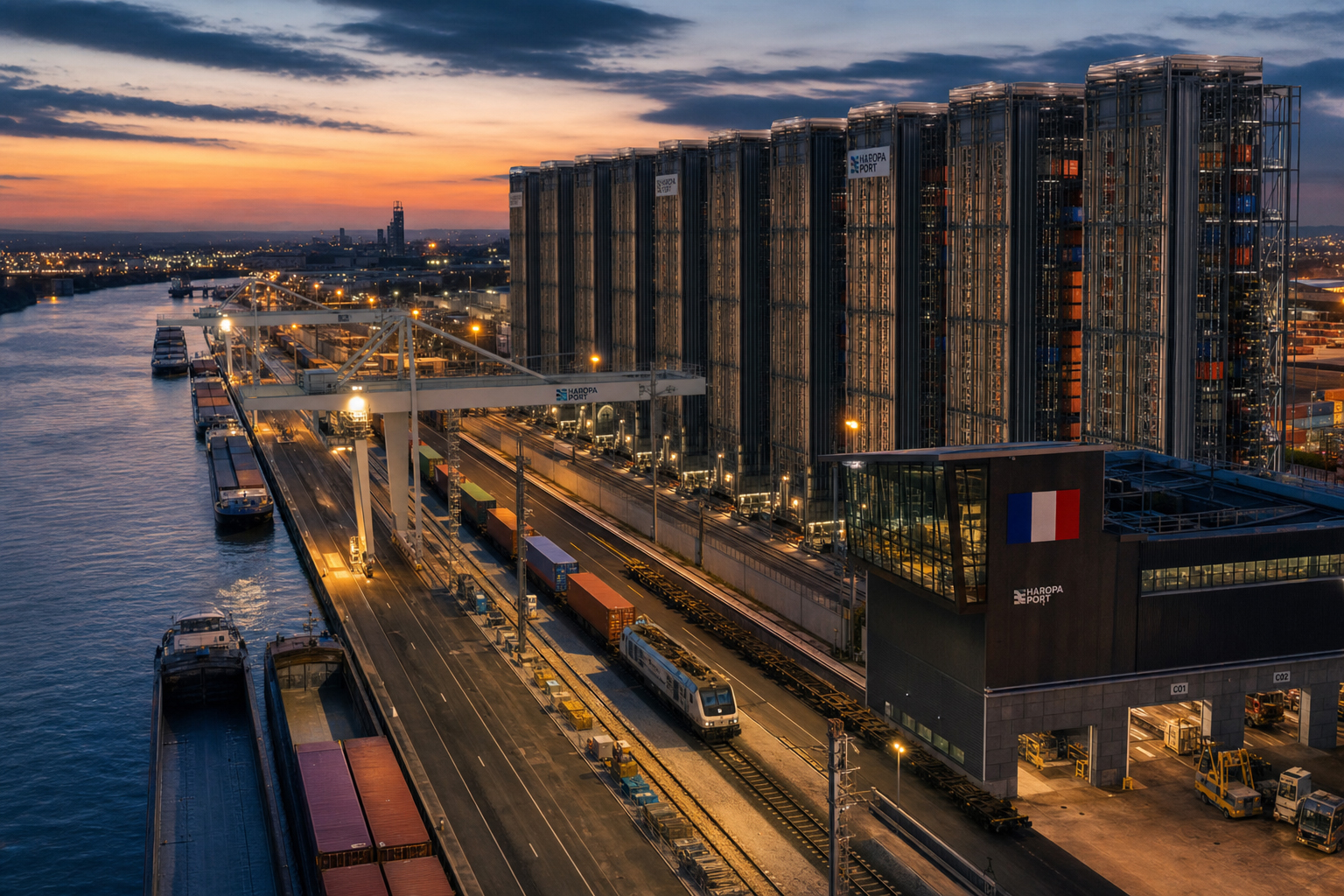
France's container logistics are undergoing a transformation: Intermodal transport units and vertical storage – Image: Xpert.Digital
Mega-ports and trimodal terminals: France's radical plan for the logistics of the future
Record numbers despite the crisis: Why trucks could soon be obsolete in France's ports
France's logistics sector is undergoing a massive transformation. For years, the "Grande Nation" lagged behind its European counterparts, hampered by a chronic reliance on road transport and untapped potential in its rail network. But now the tide is turning: With record volumes at ports from Le Havre to Marseille-Fos, the four-billion-euro "Ulysse Fret" investment program, and the massive expansion of intermodal terminals, France is launching a catch-up campaign. The ambitious goal is to double the share of rail freight and drastically reduce truck traffic. At the same time, the industry is preparing for a technological revolution: Automated high-bay warehouses for containers and state-of-the-art robotics developed in France are intended to solve the acute space shortage in urban ports. The following article examines how France is completely reinventing its infrastructure, which multi-billion-euro projects are currently underway, and why the country is well on its way to assuming a key role in Europe's intermodal logistics.
From traffic jam country to logistics powerhouse: How France is reinventing its transport infrastructure – or why the hexagonal state squandered potential for decades and is now trying to catch up with billions
Record volumes and new alliances: The current situation at France's container ports
France's containerized maritime transport reached historic proportions in 2025. The HAROPA PORT network, encompassing the Le Havre-Rouen-Paris axis, recorded a total container volume of 3.2 million TEU for the year – a four percent increase compared to the previous year and an all-time record for this route. Inland traffic, in particular, reached an all-time high of 2.3 million TEU, underscoring the success of the multimodal connectivity strategy. Total maritime cargo volume climbed to 84.7 million tons (+2%), with bulk solids (+10%) and grain (+4%) showing particularly strong growth.
The Port of Marseille-Fos, France's most important Mediterranean gateway, also finished 2025 strong, with nearly ten million shipping movements, four million passengers, and 75 million tons of cargo. In May 2026, the CMA CGM Grand Palais, a 400-meter-long LNG-powered mega-container ship, called at the Eurofos terminal for the first time – a sign that Fos-sur-Mer is technically equipped for the next generation of deep-sea shipping. The reorganization of shipping alliances at the beginning of 2025 further strengthened HAROPA PORT's position on the Asia-Europe and Europe-America routes, as all major alliances continue to call at the port.
Behind these impressive figures lies a structural problem: the market share of containers in total freight transport in France remains below the Western European average. International forecasts for containerized transport volume in France even predict a decline in the coming years, according to some scenarios, indicating the continued dominance of road transport. The total market for freight and logistics is estimated at US$170.45 billion in 2026 and is projected to grow to US$201.86 billion by 2031 – a CAGR of 3.44%. This growth rate is respectable, but not among the best in Europe, and it reveals the untapped potential that can still be realized from the accelerated expansion of the intermodal sector.
Rail as the backbone: The rise of combined rail-road transport
The centerpiece of France's intermodal offensive is combined rail-road transport, which experienced a significant upswing in 2024 and 2025. Following the disastrous slump in 2023, triggered by economic slowdown and structural strikes on the rail network, combined rail transport increased by 9.9% in tonne-kilometers in 2024. The upward trend continued in 2025, albeit more moderately at +3.2% – a sign that the sector is maturing, but has still not reached the record levels of 2022.
Particularly noteworthy is the dynamic growth of hinterland rail transport along the Seine corridor. In the first half of 2025, rail transport grew by an impressive 16.7%, while inland waterway container transport increased by 8.5%. These figures demonstrate a genuine modal shift away from road transport. Expressed in tonne-kilometers, combined transport now represents over 40% of all French rail freight – doubling its performance since 2010. In 2025 alone, ten new rail services from eight different operators were launched, adding to an existing network of 60 connections. These new lines have made it possible to replace 60,000 truck journeys and save approximately 40,000 tons of CO₂.
A key role in this development is played by the restructuring of Rail Logistics Europe, the company that emerged from SNCF's freight division. In April 2024, Rail Logistics Europe announced a fundamental realignment of its intermodal activities, based on its two subsidiaries Naviland Cargo (maritime combined transport) and Viia (rail highways). Since 2025, the service has been complemented by a third pillar: continental combined transport. The joint management of both companies, under Eric Champeyrol as CEO and Bénédicte Colin as Chairman, aims to leverage synergies and create a rail alternative that is on par with road transport in terms of quality, flexibility, and reliability.
Ulysse Fret multi-billion euro program: France's bet on rail
The strategic foundation of the entire rail offensive is the "Ulysse Fret" investment program, launched in 2023, which defines a funding horizon until 2032 and encompasses a total volume of four billion euros, half of which is provided by the French state. In March 2025, the long-awaited final report was published, defining a clear investment roadmap after 18 months of collaborative work between the Ministry of Transport (DGITM), SNCF Réseau, and the industry alliance 4F. The program allocates one-third of the funds to the modernization of existing infrastructure and two-thirds to the expansion and modernization of the network.
The six main investment categories range from the modernization of tracks and marshalling yards, through capillary lines and secondary terminals, to digitalization, the expansion of loading gauges, the development of combined transport platforms, and the general expansion of network capacity. The latter category receives by far the largest share, with an estimated €2.35 billion. A key element is the expansion of loading gauges to facilitate the transport of semi-trailers by rail – a crucial factor for competitiveness with road transport. The long-term legal objective is ambitious: to double the market share of rail freight in order to meet national climate targets.
Operational subsidies for rail freight and combined transport have been set at around €200 million for 2025. These subsidies are crucial for bridging the price gap with road transport and making new services economically viable. However, critics warn that implementation is at risk of falling behind schedule, as negotiations on the Regional Planning Agreements (CPER), which determine the financial allocation for capillary lines, are progressing slowly. The structural problem remains: rail freight struggles with a chronic capacity bottleneck, as passenger and freight trains share the same network.
A new transport hub is being built: The intermodal terminal initiative
Perhaps the most concrete result of the French intermodal strategy is the national intermodal transport plan, published in October 2024, which presents a comprehensive plan for the development and expansion of terminal infrastructure until 2032. This plan calls for 22 new terminals – including those in Bruyères-sur-Oise, Sète, and Les Aubrais-Orléans – as well as the modernization or expansion of 24 existing rail freight terminals. The total budget for these projects amounts to €1.1 billion, with the aim of increasing nominal handling capacity by 1.8 million transshipments per year by 2032.
The Terminal Ouest Provence (TOP) in Grans-Miramas has been operational since May 2024, while the new transshipment terminal in Cherbourg began operations in the first quarter of 2025. Modernization projects are underway in Vénissieux (Lyon) and Mouguerre (Pau). In Alsace, Rhine Europe Terminals operates trimodal facilities in Strasbourg and Lauterbourg, handling containers, swap bodies, and semi-trailers via ship, rail, and road. In northern France, Contargos Terminal in Bruay-sur-l'Escaut acts as a trimodal gateway for the Hauts-de-France industrial region, with direct access to the inland waterway network.
The Hendaye corridor on the Spanish-French border is particularly dynamic. The Railsider France terminal in Hendaye has seen a significant increase in traffic following the addition of six weekly container services from the German operator Kombiverkehr and four more weekly swap body services from the Vigneron Group. The terminal features a 45-ton crane capable of handling containers from 20 to 45 feet as well as swap bodies with clamping devices, and three 250-meter-long tracks. It exemplifies the new generation of small but highly efficient intermodal hubs that are making the French rail network more interconnected and resilient.
The heart of Île-de-France: Port Seine-Métropole Ouest is being built
The most ambitious single project in France's intermodal infrastructure is Port Seine-Métropole Ouest (PSMO) in the Yvelines department, at the confluence of the Oise and Seine rivers. Construction of the first phase was officially launched on September 25, 2025 – the first project of this scale to be realized in the Île-de-France region since the Port of Limay in 1986. The entire project covers approximately 100 hectares, 50 of which are designated for economic activities in the construction and public works sectors. The first phase, comprising 34 hectares, is scheduled for completion by 2027, with operations commencing in 2028.
PSMO is designed as a true trimodal platform – waterway, rail, and road converge in a single infrastructure – and positions itself as the logistical backbone of the Île-de-France region and a strategic link to the Canal Seine-Nord Europe, the mega-project that will connect the Oise River with the Dunkerque-Escaut Canal. Upon its full completion by 2040, it will create approximately 750 direct jobs. The investment volume is substantial: HAROPA PORT has announced a total investment of €190 million for the entire Seine corridor in 2025 alone, including the new Chatière lock in Le Havre, the 4.5-hectare expansion of the Gennevilliers container terminal, and the development of PSMO.
The economic logic behind PSMO is compelling: Around 10 million tons of building materials are moved annually in the Île-de-France region, 80% of which is transported by road. Even a moderate shift to waterways and rail would remove tens of thousands of heavy goods vehicle journeys from the congested Parisian motorway system, reducing noise and pollution while simultaneously lowering transport costs for developers and logistics companies. However, the timeframe is tight: The major construction projects in the Île-de-France region, from the extension of the Grand Paris Express to various urban renewal projects, already require this capacity.
Marseille-Fos: The Mediterranean giant is preparing for the future
While the Seine corridor is breaking container handling records, Marseille-Fos is investing heavily in the physical infrastructure of its container terminals. The investment program for the Fos industrial zone amounts to approximately US$1.5 billion for the period 2025 to 2029. The Seayard Terminal FOS2 XL – a joint venture between Terminal Investment Limited (MSC, 50%), APM Terminals (42%), and COSCO Shipping Ports (8%) – will be extended by 120 meters of quay length and will gain an additional 3.3 hectares of terminal area, enabling the simultaneous handling of two mega-ships up to 400 meters in length. In the second quarter of 2025, eleven Kalmar hybrid reach stackers were ordered for the Seayard Terminal, with delivery scheduled for the second quarter of 2026.
These orders for hybrid cargo handling vehicles reflect a broader trend toward the electrification of port operations. HAROPA PORT is simultaneously pursuing an ambitious shore power program (RENAQ), which saw the commissioning of the first electrified cruise ship terminal at Pointe de Floride in Le Havre in 2025. The overarching goal is a decarbonized logistics corridor along the Seine, intended to serve as a blueprint for other French waterways. At the same time, in June 2025, the concession for the Fos bulk terminal (35 hectares, expandable to 66 hectares, with 880 meters of quay length) was awarded to HES International – a thirty-year concession that illustrates the port's long-term planning.
The geopolitical context should not be underestimated. CMA CGM, the Marseille-based global corporation with the French state as a major shareholder, achieved robust results in 2025 despite global uncertainties and consistently pursued its investment strategy in terminals, air freight, and logistics. The acquisition of Santos Brasil, the founding of United Ports, and acquisitions in the heavy transport sector (Fagioli) underscore that CMA CGM is not just a carrier, but an integrated logistics group – with direct consequences for infrastructure and competition in France itself.
LTW Intralogistics Solutions – Intermodal Transport

LTW Intralogistics Solutions – Intermodal Transport – Image: LTW Intralogistics GmbH
LTW offers its customers not individual components, but integrated complete solutions. Consulting, planning, mechanical and electrotechnical components, control and automation technology, as well as software and service – everything is networked and precisely coordinated.
In-house production of key components is particularly advantageous. This allows for optimal control of quality, supply chains, and interfaces.
LTW stands for reliability, transparency, and collaborative partnership. Loyalty and honesty are firmly anchored in the company's philosophy – a handshake still means something here.
Related to this:
Vertical container revolution: High-bay racking instead of open space – Making rail, river and road transport efficient through networking
River freight transport: The underestimated mode of transport under pressure
Combined river-road transport is overshadowed by rail, but it is by no means irrelevant. While rail combined transport saw moderate growth in 2025, inland waterway combined transport experienced a decline of 8.6% in transported TEUs – following a 5.6% increase in 2024. This volatility is the result of several factors: declining grain exports, structural weaknesses in river infrastructure, and suboptimal service frequencies on certain routes. The outlook for 2025 had been more optimistic.
The potential is enormous. In the first half of 2025, inland waterway container transport on the Seine grew by 8.5% – a contrast to the national overall figures, highlighting regional disparities. The Seine corridor benefits from massive investments and favorable infrastructure, while other river corridors – particularly in northeastern France – remain structurally underdeveloped. Lorraine Multi Hubs, a consortium of Rhenus, Modalis, MGE, and the Port of Dunkirk, now operates the five public ports of Toul, Nancy, Metz, Thionville, and Cattenom and is working to establish a cohesive trimodal network. The solution lies in integrated operation: only by working together can river, rail, and road achieve the efficiency gains promised by the political goal of modal shift.
Vertical storage: The silent revolution in container logistics
Alongside the major infrastructure projects, a second, less spectacular but economically profound revolution is taking place: the automation and verticalization of container storage. Traditional container terminals operate with horizontal stacking systems, where containers are placed a few layers high on top of each other across extensive terminal areas. The problem: growing container volumes require either new space or radical efficiency improvements in existing facilities – and port areas in urban locations like Le Havre, Marseille, or Gennevilliers simply cannot be expanded indefinitely.
The answer is a high-bay warehouse system for containers, where loading units are stored in fully automated, multi-story steel structures. The principle is similar to the automated small parts warehouse used in order picking logistics, but scaled up to containers weighing several tons and conforming to ISO standard dimensions. The core technology, developed by the German-Emirati joint venture BOXBAY, a collaboration between DP World and the SMS Group, was successfully tested at Terminal 4 in Jebel Ali, Dubai, with 200,000 container movements. Direct access to any container without restacking significantly increases throughput, reduces the damage rate, and drastically reduces space requirements. According to some calculations, capacity can be tripled on the same footprint.
For France, this technology is of particular strategic interest because it allows for expansion from existing terminals without costly land reclamation or politically challenging port expansions. The terminals in Le Havre, where space for Port 2000 is already fully utilized, and in Fos-sur-Mer, where expansion costs are substantial, would be obvious candidates for initial implementation. At the time of this analysis, there were no concrete public announcements regarding the deployment of fully automated vertical container high-bay racking systems in France – but the technological roadmap of terminal operators and the investment incentives of the Ulysse Fret program suggest that such projects are in preparation.
Robotics in the warehouse: France's technological leadership in automated warehouse systems
While vertical container stacking for ports is still in the pilot phase, automated vertical storage technology for general cargo and parcel logistics is already a reality in France – and at the highest technological level. The Grenoble-based company Exotec, now one of the few European logistics unicorns, develops and manufactures its Skypod system entirely in France and has implemented it in several national and international projects. The system uses three-dimensionally moving robots that retrieve products from vertically arranged high-bay racks up to ten meters high and transport them to picking stations – the antithesis of the traditional warehouse worker walking through sprawling warehouses.
In February 2025, Exotec presented its next-generation system for growth in Paris. Hartmann France, a medical technology company, converted its logistics center in the Auvergne-Rhône-Alpes region to the Skypod system by early 2025, aiming to double storage density and increase order processing speed. The global warehouse automation market is projected to grow to US$63 billion by 2030, with 26% of warehouses worldwide automated by 2027. In Europe, the warehouse automation market is expected to grow from US$5.76 billion in 2025 to US$15.43 billion in 2031 – a CAGR of 17.86%.
This technology is not only transforming warehouses, but increasingly also the intermodal logistics chain. Fully automated warehouses at or in the immediate vicinity of container terminals could dramatically reduce last-mile delivery times, as goods are sorted and consolidated in automated high-bay racking systems immediately after container handling, before being transported onward by rail or inland waterway. With Exotec, France has the rare advantage of possessing a national champion in this key technology – an industrial policy asset that is often underestimated in public debate.
Entrepôts verticaux: The new warehouse architecture between port and city
Urban logistics presents France with similar space constraints to those faced by its ports. Major cities like Paris, Lyon, and Marseille are experiencing explosive e-commerce growth, which demands smaller, more frequent deliveries and thus drives the need for distribution centers located in city centers or near ports. The traditional warehouse with its large footprint is giving way to the multi-story, automated urban warehouse – the vertical urban warehouse. Industry analyses indicate that in France and Europe, warehouses of the future will be more compact, multi-story, and fully automated, requiring the maximum vertical utilization of expensive land.
Automated vertical storage systems (entrepôts verticaux automatiques) have become the standard solution in medium-sized and large French warehouses. They allow for the management of goods of varying dimensions thanks to flexible rack spacing and can be combined with specific conveyor systems. Their strengths lie in maximizing space utilization, both vertically and horizontally. A parallel can be drawn in container logistics: where containers were previously stored horizontally on sprawling terminals, vertical stacking in automated steel racks allows for multiple increases in capacity on the same footprint.
For intermodal transport units (ITUs) in the narrower sense – that is, swap bodies and semi-trailers that can be detached from the carrier vehicle without a loading unit – vertical storage is complicated by their high tare weight and standardized dimensions. Swap bodies with standard lengths of 7.15 to 13.6 meters cannot simply be stored in conventional high-bay racking. Specific storage tower systems or automated parking areas with heavy-duty conveyor technology are required, but these are still rarely commercially scaled. This means that vertical storage for swap bodies and semi-trailers as intermodal transport units is a future technology with considerable research and development needs, whereas it is already ready for implementation for ISO containers in port logistics and for general cargo in distribution logistics.
Digitalization as a competitive factor: From booking to terminal control
An often overlooked but economically crucial aspect of intermodal logistics in France is the digital integration of the supply chain. The introduction of the Verified Gross Mass (VGM) declaration system at the Le Havre terminals from June 2025 – mandatory weight declaration for full containers before terminal entry via the S)One platform – is a small but significant step. The VGM value will be used directly for container positioning management at the terminal and stowage planning on ships, increasing efficiency and safety.
At the systems level, CMA CGM is a leader in intermodal digitalization in France. The group's intermodal platform connects 37 maritime liner services with rail and inland waterway solutions to all strategic locations, offering flexible connections throughout France via four main gateways. Specifically, this means eight weekly inland waterway connections and five rail connections from Fos-sur-Mer to Lyon, direct rail connections from Marseille to Paris-Bonneuil, and three weekly rail connections from Dunkirk to Dourges. This dense, digitally bookable network of connections is making intermodal routes no longer an exotic option for large shippers, but increasingly a routine choice.
The Ulysse Fret program has explicitly defined digitalization as one of its six core categories. Specifically, this involves modernizing train management software, digitally integrating terminal booking systems, and introducing real-time tracking for intermodal shipments. In an industry where reliability and predictable transit times are crucial purchasing factors, digitalization is not optional, but essential. A comparison with road transport, whose tracking infrastructure is far more mature, demonstrates the significant need for improvement – and the enormous potential for market share gains once this gap is closed.
Economic assessment: France's position in European intermodal competition
Compared to the Netherlands, Belgium, or Germany, France lags structurally behind in the modal split for freight transport. The share of road freight is significantly higher than the European average, while the share of rail is considerably lower. The political goal of doubling the share of rail freight by 2030 is ambitious, but current trends cast doubt on its feasibility. Combined transport only just managed to recover from the losses of 2023 in 2024 and 2025 – the sector is still far from the targeted doubling.
Nevertheless, there are significant structural advantages: France is the largest country in the EU by area and thus possesses a network on which rail can demonstrate its economic superiority over long distances. Its key geographical role as a transit corridor between the Iberian Peninsula, the United Kingdom, and Central Europe ensures consistently high traffic volumes. The deep-sea ports of Le Havre and Marseille-Fos are among the most efficient in the EU and are experiencing a resurgence thanks to massive investments. The Ulysse Fret investment program and the national terminal network scheme have, for the first time in decades, produced a coordinated, state-supported infrastructure strategy that goes beyond individual flagship projects.
The greatest risk is the fragmentation of implementation. The French state apparatus is known for its enthusiasm for planning coupled with weakness in implementation. The 22 new terminals, requiring €1.1 billion, must not only be planned but also built and operated. Private investors will – rightly so – insist on reliable track capacity and stable subsidy frameworks. The restructuring at Rail Logistics Europe, the merger of Naviland Cargo and Viia under joint management, is a positive sign for industry consolidation, but no substitute for the necessary network capacity growth. France must demonstrate that its multi-billion-euro announcements will also materialize in terminal tracks, loading gauges, and digital booking platforms.
Interim conclusion: Where France stands and where it is headed
French container and intermodal logistics is experiencing a historic period of growth. Volumes are at record levels, investments are higher than ever, and policy objectives are clearly defined and backed by funding commitments. France has recognized that its competitiveness as a trading and industrial nation depends on the efficient, affordable, and climate-friendly movement of goods across the country. Combined rail-road transport is expanding, new terminals are being built, ports are investing in automation and capacity, and Exotec, a national technology leader in vertical warehouse automation, is located in the heart of France.
Vertical container storage in ports and at intermodal hubs, on the other hand, is still in its infancy. The technology has been proven – in Dubai, soon in Busan – but its transfer to European conditions requires pilot projects, regulatory adjustments, and significant capital investment. It would be a logical next step if one of the major French terminal projects – FOS2 XL, the new Gennevilliers terminal, or a new GNTC interchange – were implemented as the first vertical container pilot facility in France. The market potential, the lack of available space, and the technological maturity all support this. What is lacking is the first bold step from an operator willing to test the paradigm shift from horizontal to vertical terminal logistics in practice.
Consulting - Planning - Implementation

Konrad Wolfenstein
I would be happy to serve as your personal advisor.
me at wolfenstein∂xpert.digital contact
Just call me on +49 7348 4088 965 .
Your container high-bay warehouse and container terminal experts

Container high-bay warehouses and container terminals: The logistical interplay – expert advice and solutions - Creative image: Xpert.Digital
This innovative technology promises to fundamentally change container logistics. Instead of stacking containers horizontally as before, they will be stored vertically in multi-story steel racking structures. This not only allows for a drastic increase in storage capacity within the same area, but also revolutionizes all processes at the container terminal.
More information here:










