
Fact check on the FAZ: Why the energy transition is not the real price driver: Fossil system costs as the actual drivers
Xpert Pre-Release

Available in 27 languages 📢
Prefer Xpert.Digital on GoogleⓘPublished on: February 18, 2026 / Updated on: February 18, 2026 – Author: Konrad Wolfenstein
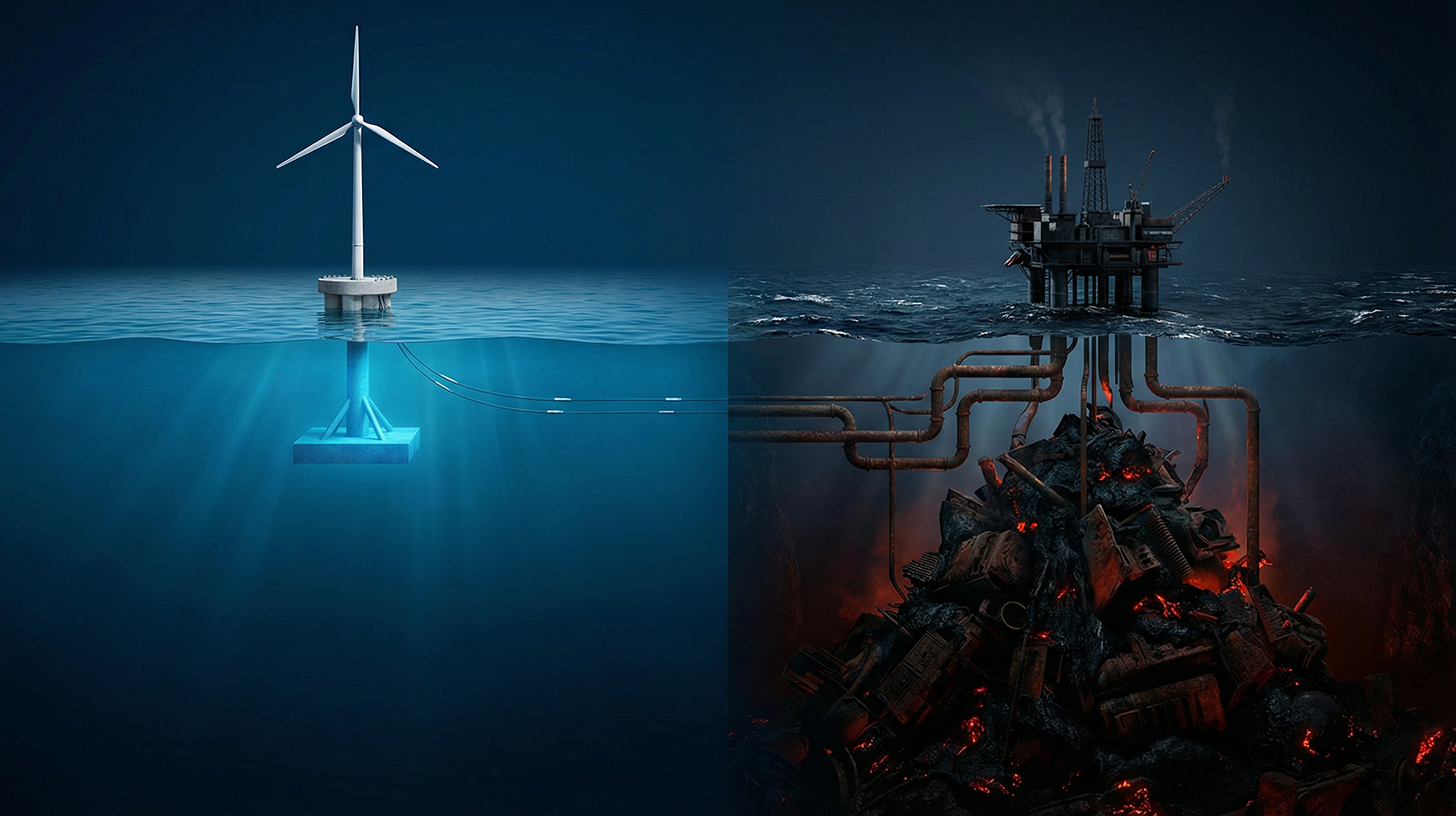
Fact check on the FAZ: Why the energy transition is not the real price driver: Fossil system costs as the actual drivers – Creative image: Xpert.Digital
Frankfurter Allgemeine Zeitung misleading: Fossil system costs are not mentioned as the actual drivers of the overall costs of the energy system
EWI study reveals: Fossil fuel dependency is driving up electricity costs – not wind & solar
In early February 2026, a comprehensive analysis by the Energy Economics Institute (EWI) at the University of Cologne caused a stir in the energy policy debate. Titled "Expenditures for the Electricity System in Germany," the study examined cost trends between 2010 and 2024. The Frankfurter Allgemeine Zeitung (FAZ) picked up on this data and ran an article by journalist Hanna Decker with the headline: "Why the Energy Transition Is Suddenly So Expensive." This headline has since been widely used as evidence for the supposedly spiraling costs of the green transformation. However, a closer look at the EWI study reveals that this framing is misleading and ignores the actual causes.
While the study confirms a real increase in system costs, most recently reaching 30 cents per kilowatt-hour, the primary drivers of this development are by no means wind and solar power plants. Rather, the analysis exposes the costly long-term consequences of fossil fuel dependence: the doubling of gas prices after Russia's war of aggression and the politically driven increase in CO2 prices are the dominant factors. Furthermore, declining consumption leads to statistically higher grid fees, while the massive increase in private self-consumption of PV power raises distribution issues that are entirely absent from the FAZ report. The following article analyzes in detail why the true cost risks lie in the fossil fuel sector and why the energy transition will even act as a price brake in the long run.
Related to this:
- EWI: Expenditure on the electricity system in Germany
- FAZ: Why the energy transition is suddenly so expensive
What is the background to the current debate about the costs of the energy transition?
In early February 2026, the Energy Economics Institute (EWI) at the University of Cologne published a comprehensive analysis entitled "Expenditures for the Electricity System in Germany – A Discussion of Historical Developments." The study examines how the various components of electricity system expenditures developed between 2010 and 2024. Journalist Hanna Decker used this study as the basis for an article in the Frankfurter Allgemeine Zeitung, headlined "Why the Energy Transition Is Suddenly So Expensive." This article has since been frequently cited in public debates as supposed evidence for the allegedly spiraling costs of the energy transition. However, closer examination reveals that the headline is misleading and that the actual cost drivers are quite different from what is suggested.
What are the key findings of the EWI study?
The EWI study finds that spending on the electricity system in Germany has increased by an average of 4.1 percent per year in real terms since 2010. The acceleration from 2018 onwards is particularly striking: while the average increase from 2010 to 2017 was only 0.7 percent per year, spending subsequently exploded to around 8.1 percent annually, adjusted for inflation. In 2024, total system spending amounted to 30 cents per kilowatt-hour of electricity consumed. By comparison, the figure for 2010 was 17 cents per kilowatt-hour in 2024 prices. The study deliberately and methodologically uses the term "electricity system spending" and avoids directly attributing it to the energy transition.
What three cost drivers does Hanna Decker's FAZ article identify?
The FAZ article derives three main cost drivers from the EWI study. First, the doubling of fuel costs since 2018, particularly because the gas price has remained consistently around €35 per megawatt-hour since the end of Nord Stream deliveries. This is roughly twice as high as before Russia's war of aggression against Ukraine, when Russian pipeline gas still flowed to Europe. Second, the EU Emissions Trading System, which, following the 2017 reform, has skyrocketed from a so-called toothless tiger with prices around €5 per ton to over €100 per ton. Expenditure on emission allowances has exploded from €1.8 billion in 2017 to €13.4 billion in 2023. Third, the declining electricity consumption, which has fallen from 479 to 388 terawatt-hours, paradoxically drives up the cost per kilowatt-hour because network costs are predominantly fixed costs spread across lower consumption.
Why is the headline "Why the energy transition is suddenly so expensive" misleading?
The headline is misleading because Decker's own analysis in the article shows that the main drivers of the cost increase are not primarily renewable energies. Framing it as "energy transition costs" significantly distorts the actual findings of the EWI study. The EWI study itself is methodologically much more rigorous and speaks neutrally of "electricity system expenditures" without causally attributing them to the energy transition. Decker uses this to create a more catchy, but also more misleading, headline. Anyone who only reads the headline gets a false impression of what the study actually proves. The cost increases are rooted primarily in geopolitical upheavals and a functioning climate protection instrument, not in wind and solar power plants.
To what extent is the rise in gas prices a consequence of fossil fuel dependency and not of the energy transition?
The rise in gas prices is a direct result of Russia's war of aggression against Ukraine and the subsequent cessation of Nord Stream deliveries. For decades, Germany had become heavily dependent on Russian pipeline gas. When these deliveries ceased, Europe had to switch to more expensive liquefied natural gas (LNG), which is traded at significantly higher prices on the world market. Since then, the gas price has remained consistently around €35 per megawatt-hour, double the pre-crisis level. According to KfW Research, imports of crude oil, natural gas, and hard coal cost Germany a total of around €81 billion per year, which corresponds to approximately 2.5 percent of its gross domestic product or €1,000 per capita. In 2024, natural gas imports alone accounted for €19 billion. Russia's share of German energy imports fell from 35 percent in 2021 to just 0.1 percent in 2024. The main suppliers are now Norway, the USA, and the Netherlands. This cost driver therefore has nothing to do with wind turbines or solar power plants, but is a direct consequence of decades of dependence on fossil fuels from geopolitically uncertain sources.
Why is the CO2 price not an argument against the energy transition?
The EU Emissions Trading System (EU ETS) is a deliberately introduced climate protection instrument designed to make fossil fuel-based electricity generation more expensive. Between 2012 and 2018, the price of certificates was mostly below €10 per ton and was considered a toothless tiger because it had little steering effect. In 2017, the EU decided on a fundamental reform and removed surplus certificates from the market. Prices subsequently rose steadily, exceeding €100 per ton for the first time in February 2023. The fact that spending on emission certificates increased from €1.8 billion in 2017 to €13.4 billion in 2023 is therefore intentional and politically planned. The CO2 price does not make renewable energies more expensive, but rather fossil fuel-based generation. It thus sends a price signal that makes investments in climate-friendly alternatives more economically attractive. Renewable energies such as wind and solar are not subject to emissions trading because they do not produce CO2 emissions. To portray the CO2 price as the cost of the energy transition therefore distorts the causal logic: the CO2 price shows rather how expensive clinging to the fossil fuel system has become.
How can the increase in network costs per kilowatt hour be explained?
Electricity consumption in Germany has fallen by an average of 6.5 terawatt-hours per year since 2010. Most recently, it stood at just 388 terawatt-hours. This is due to more efficient applications, the decline in energy-intensive industrial production, and the increasing self-sufficiency through photovoltaic systems. According to the EWI study, lower demand reduces capital utilization and thus increases national spending per unit of electricity consumed. This effect particularly impacts the electricity grid, as grid costs are predominantly fixed: lines incur high costs even when they are not constantly operating at full capacity, unlike coal- or gas-fired power plants, whose variable costs also decrease with reduced output. The share of grid spending in total expenditure rose from an average of 19 percent in the years 2010–2014 to 26 percent in the years 2020–2024. However, grid expansion would have been partially necessary even without the energy transition, as the existing infrastructure is outdated and would have required modernization anyway. Decentralized generation from renewable energies naturally accelerates grid expansion, but it is by no means solely due to the energy transition.
Our EU and German expertise in business development, sales and marketing

Our EU and German expertise in business development, sales and marketing - Image: Xpert.Digital
Industry focus areas: B2B, digitalization (from AI to XR), mechanical engineering, logistics, renewable energies and industry
More information here:
A thematic hub offering insights and expertise:
- Knowledge platform covering global and regional economies, innovation and industry-specific trends
- A collection of analyses, insights, and background information from our key areas of focus
- A place for expertise and information on current developments in business and technology
- A hub for companies seeking information on markets, digitalization, and industry innovations
The crucial question is missing: What would electricity cost today without the energy transition?
What distributional effect of self-consumption of PV power does the FAZ article fail to mention?
A significant blind spot in the FAZ article concerns the rapidly growing self-consumption of solar power by households. The EWI study points out that this self-consumption has risen from almost zero to a considerable level. According to Fraunhofer ISE, self-consumption of PV power in Germany reached 12.28 terawatt-hours in 2024, representing 17 percent of net electricity generation from photovoltaics. By comparison, it was only 3.55 terawatt-hours in 2020 and a mere 0.25 terawatt-hours in 2012. For households with their own PV systems, this self-consumption significantly reduces their individual electricity bills. They consume the self-generated electricity directly on-site, without using the public grid. At the same time, however, this increases the cost per kilowatt-hour for the remaining grid users, as the fixed grid costs are spread across fewer kilowatt-hours consumed. Decker does not address this social distribution effect between PV owners and non-owners in her article. This is a socially relevant distribution issue that should play a central role in the debate about alleged energy transition costs.
What crucial counter-question is completely missing from the FAZ article?
Perhaps the most important question missing from Decker's account is: What would the fossil fuel system have cost without the energy transition? One must imagine a hypothetical scenario in which Germany had not expanded renewable energy sources and was entirely dependent on Russian gas, without the price-dampening effect of renewables on wholesale electricity prices, and facing the economic costs of unchecked climate change. The study by the Öko-Institut for Agora Energiewende has already shown that, under most foreseeable energy and CO2 price developments, an electricity system with 95 percent renewables in 2050 would cost roughly the same or even less than a fossil fuel alternative. A coal-based system is only significantly cheaper if very low CO2 prices of a maximum of €20 per ton are assumed for the future. A gas-based system can only be advantageous if low gas prices and no high CO2 prices are assumed simultaneously. Reality has shown that both of these scenarios are extremely unlikely. Furthermore, renewables act as an insurance policy against volatile fuel and CO2 prices, since in fossil fuel systems the share of variable costs in the total costs is between 30 and 67 percent, while in renewable systems it is only about 5 percent.
What are the social costs of carbon and why are they relevant to this debate?
The EWI study itself notes in a footnote that the Social Cost of Carbon (SCC), i.e., the macroeconomic costs of climate change, is likely to exceed current ETS prices. Decker completely ignores this point in her article. The Social Cost of Carbon (SCC) estimates the present value of the economic damage caused by an additional ton of CO2 emissions. Current scientific estimates put the SCC value at around US$185 per ton of CO2, which is significantly higher than the current EU ETS price of around €70 to €80 per ton. The German Federal Environment Agency (UBA) estimates the short-term CO2 damage costs at €80 per ton, and even at €145 or €260 per ton in the medium to long term. If one considers climate risks such as extreme weather events and the danger of irreversible tipping points, the SCC value even rises to as much as US$182 per ton. This means that even the current CO2 price in the EU emissions trading system falls far short of covering the true societal costs of fossil fuel-based electricity generation. Every ton of CO2 emitted actually causes greater damage than the emissions trading system factors in. Therefore, anyone who portrays CO2 costs as a burden of the energy transition is ignoring the fact that the true costs of the fossil fuel system are far higher.
How has the role of the state in financing the electricity system changed?
Until 2020, according to the polluter-pays principle, electricity consumers—private households, businesses, and industry—borne all the costs of the electricity system. In recent years, however, the government has begun to provide increased support to consumers. The EEG surcharge was abolished, and the costs were shifted to the federal budget. EEG subsidies alone recently amounted to over €18 billion. In 2023, the government further capped costs with the electricity price brake. Thus, in 2023 and 2024, public budgets covered almost a quarter of all expenditures for generation and distribution. In 2026, there will be a federal subsidy of €6.5 billion for grid fees, intended to significantly reduce network costs for households and businesses. Grid fees have fallen by an average of around 17 percent nationwide. While the government took in more than it spent until 2022 through the auctioning of CO2 certificates, concession fees, and electricity and value-added tax, this ratio has now reversed. A fundamental shift in the financing of the electricity system is emerging, with the state playing an increasingly important role.
What does the EWI study actually show when it is correctly interpreted?
The EWI study provides a methodologically sound and detailed description of the cost increases in the German electricity system between 2010 and 2024. It identifies the key drivers: increased fuel costs due to geopolitical upheavals, the intentionally higher CO2 price resulting from the ETS reform, and the effect of declining consumption on the distribution of fixed costs in the grid. The study consistently refers to "electricity system expenditures" and does not unilaterally attribute the costs to the energy transition. It also points to the growing importance of self-consumption of PV power and notes that the overall economic costs of CO2 emissions are likely to exceed the ETS prices. In summary, the study shows that the energy transition has not "suddenly become so expensive." Rather, the fossil fuel system has become more expensive, grid modernization is costly, and the CO2 price is finally functioning as the steering instrument it is intended to be. Anyone citing the study as evidence against the energy transition has either not read it or has deliberately misinterpreted it.
What lessons should energy policy draw from these findings?
The central lesson from the EWI study and the surrounding debate is that the greatest cost risks in the energy system still stem from the fossil fuel sector. Germany's dependence on imported fossil fuels exposes it to price shocks and geopolitical risks, as the war in Ukraine has so vividly demonstrated. In contrast, an electricity system based on renewable energies offers protection against volatile fuel prices, as it has virtually no variable costs. The accelerated expansion of renewable energies, the further development of storage technologies, and intelligent grid transformation are not cost drivers, but rather long-term cost avoidance strategies. The public debate should not be driven by misleading headlines, but rather by the total costs of different energy systems under realistic assumptions. This must take into account the external costs of climate change, as well as security of supply and economic independence from geopolitically unstable supplier countries. The energy transition is not the problem; it is part of the solution for an affordable and secure energy system of the future.
What role do renewable energies play as price dampeners in wholesale trade?
An often overlooked aspect in the cost debate is the price-dampening effect of renewable energies on the wholesale electricity market. When large quantities of wind and solar power are fed into the grid, the wholesale electricity price falls because these energy sources have marginal costs close to zero. This so-called merit order effect pushes the expensive gas-fired power plants out of the market, which would otherwise drive prices up. Without the massive expansion of renewables, the wholesale electricity price would likely have been significantly higher after the loss of Russian gas supplies. Renewables thus acted as a kind of price buffer during the energy crisis, mitigating the burden on consumers and industry. This effect is not mentioned in Decker's analysis, even though it provides a significant counterweight to the described cost increases. The increasing generation from renewable sources is one of the reasons why wholesale electricity prices fell significantly again after the extreme peak during the 2022 energy crisis.
How should the current development of electricity prices in Germany be assessed?
Despite the system cost increases documented in the EWI study, there are indeed signs of easing in end-consumer prices for 2026. Electricity prices for new customers in January 2026 were around 23 cents per kilowatt-hour. Network charges have fallen by an average of around 17 percent, or about 2 cents per kilowatt-hour, nationwide, driven primarily by the federal subsidy of 6.5 billion euros. Procurement costs on the wholesale market have also decreased, which is directly related to the increased feed-in of renewable energies. This development contradicts the narrative of an inexorably increasing energy transition. Rather, it shows that the high costs of the years 2022 to 2024 were largely attributable to the energy crisis and dependence on fossil fuels, and not to structural problems of the energy transition. At the same time, the challenge remains to make the financing of grid expansion and system transformation socially just and economically sustainable.
Why is a differentiated view of the cost structure of the energy system so important?
The public debate about the costs of the energy transition often suffers from oversimplification and deliberate framing. When an article like Hanna Decker's in the FAZ is instrumentalized as supposed proof of the energy transition's cost burden, even though a closer reading reveals the opposite, it undermines objective energy policy. A nuanced look at the cost structure reveals that fuel costs are a legacy of the fossil fuel industry, that the CO2 price makes the costs of pollution visible, and that grid expansion represents an investment in the future. The actual costs of the energy transition, i.e., the construction of wind and solar power plants, have drastically decreased in recent years. The levelized cost of electricity (LCOE) from photovoltaics and onshore wind energy is now lower than that of new fossil fuel power plants. What is increasing are the system costs arising from the transformation, but also the risks and hidden costs of the fossil fuel system. An honest debate must consider both and not selectively focus on only one side of the equation.
Your global marketing and business development partner
☑️ Our business language is English or German
☑️ NEW: Correspondence in your native language!

Konrad Wolfenstein
I and my team are happy to be available to you as your personal advisor.
You can contact me by filling out the contact form here or simply call me at +49 7348 4088 965. My email address is: [email protected]
I'm looking forward to our joint project.










