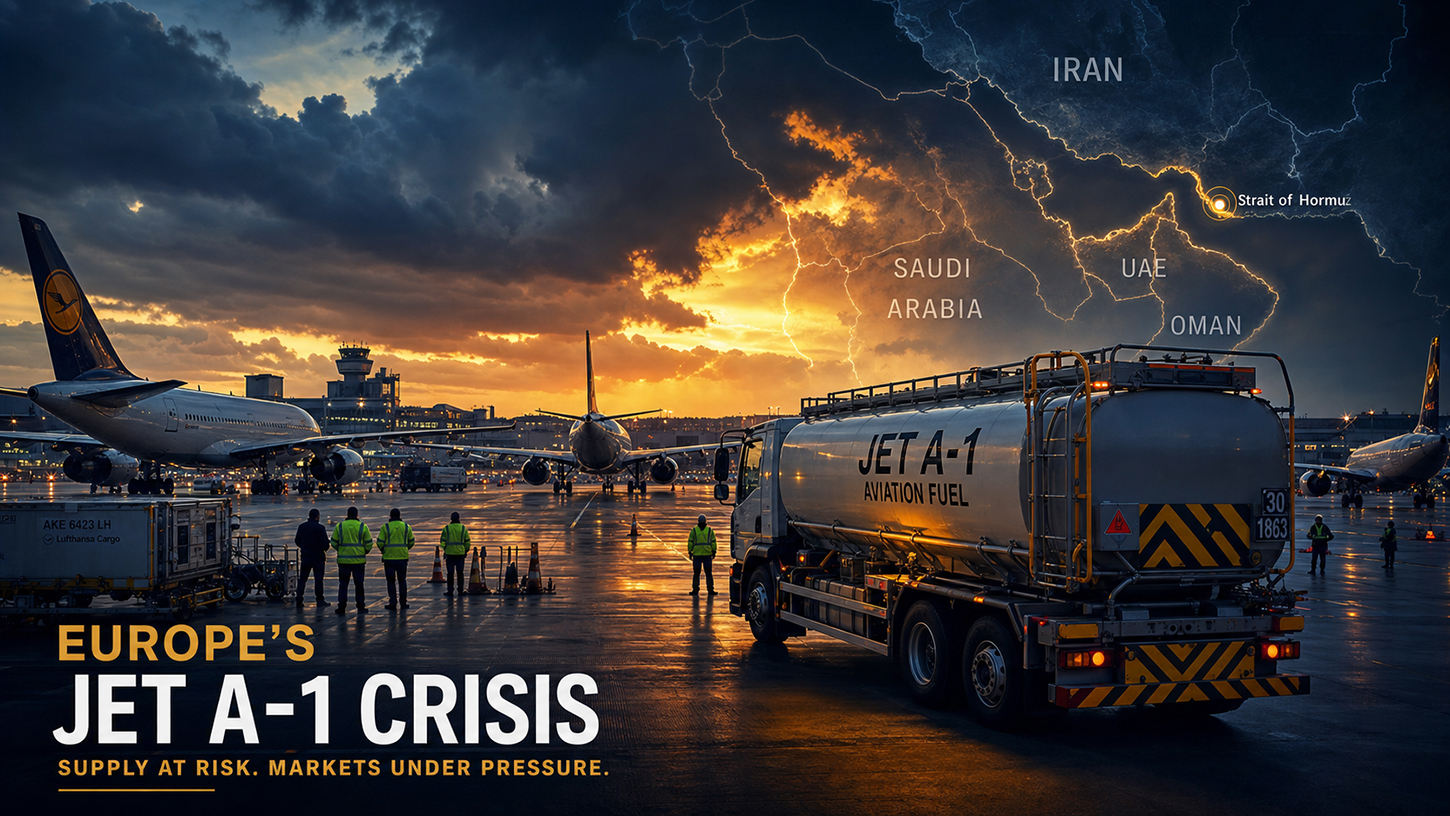
The global Jet A-1 shortage | Europe's kerosene emergency: When the fuel runs out, profits land first – Image: Xpert.Digital
Europe is flying on reserve — and the summer travel season has barely begun
The global Jet A-1 bottleneck and its economic consequences for aviation, travelers and the European single market
February 28, 2026, marks a turning point in modern energy history. The armed outbreak of the conflict between the US, Israel, and Iran triggered a chain of geopolitical events whose implications for civil aviation can hardly be overstated. At the heart of it all is the Strait of Hormuz—a narrow waterway in the Persian Gulf that historically handles approximately 20 percent of global crude oil transport as well as significant portions of worldwide liquefied natural gas (LNG) exports. Shortly after the conflict began, the Iranian Revolutionary Guard Corps (IRGC) effectively closed the strait.
The immediate consequences were drastic: The daily number of ship transits through the Strait of Hormuz plummeted from a pre-war average of 129 to 140 vessels to a mere seven transits per day by mid-April—a drop of approximately 95 percent. At the same time, more than 2,000 merchant ships and some 20,000 international seafarers were effectively trapped in the Persian Gulf. Iran began using hijacked cargo ships, drone attacks near the strait, and ultimately the active mining of the waterway as geopolitical leverage. The entire supply chain for crude oil and its refined products—including jet fuel—was thus severely disrupted at a stroke.
What this meant for Europe was not an abstract threat: the result was the immediate disruption of the most important supply route for the Jet A-1 on the continent. For decades, Europe had maneuvered itself into a structural dependency that, while acceptable in peacetime, was existentially threatening in such a crisis.
The structural legacy: Europe's chronic kerosene supply deficit
The current shortage is not a surprising catastrophe, but rather the result of a structural imbalance that has built up over decades and was long ignored. The figures are clear: OECD countries in Europe consume around 1.6 million barrels of jet fuel and kerosene daily. However, regional refineries produce only about 1.1 million barrels per day—a persistent deficit of at least 500,000 barrels daily that must be covered by imports.
Historically, the Middle East supplied around 60 percent of these imports, making the region an indispensable pillar of Europe's kerosene supply. Approximately 75 percent of Europe's total jet fuel supply came from import sources, with a significant portion transported via the Strait of Hormuz. This fundamental dependence is the result of a European industrial policy that failed to adequately secure or expand refining capacity, while at the same time passenger numbers in air travel continued to rise. Even without a geopolitical crisis, Europe was entirely at the mercy of the Gulf States' goodwill and the security of the Persian Gulf.
The consequences of this structural weakness became strikingly apparent in April 2026. Market data revealed that European jet fuel imports from the Middle East had plummeted to a historic low—virtually to zero, an unprecedented occurrence since reliable records began in 2017. Inventories at the Amsterdam-Rotterdam-Antwerp (ARA) refinery, the most important transshipment point for kerosene in Northwest Europe, fell to a six-year low. Some European countries held less than 20 days' worth of jet fuel reserves. Industry experts know that if coverage falls below 23 days, physical bottlenecks at airports become likely.
The certified industry standard: Why Jet A-1 is irreplaceable
To fully grasp the implications of this bottleneck, an understanding of the product itself is necessary. Jet A-1 is not just any fuel—it is a precisely defined, highly standardized industrial substance whose use in civil jet aircraft, helicopter turbine engines, and turboprop engines is subject to strict certification requirements. The two key standards are the British Defence Standard DEF STAN 91-091 and the American ASTM D1655—both of which define minimum technical requirements for flash point, freezing point, lubricity, density, sulfur content, and other physicochemical properties.
Jet A-1 must have a flash point of at least 38 degrees Celsius and may only freeze at a maximum temperature of minus 47 degrees Celsius—a value that qualifies it for long-haul, high-altitude operations worldwide. Unlike its North American counterpart, Jet A, which can only be used down to minus 40 degrees Celsius, Jet A-1 is the global standard specification for civil aviation outside the USA. This stringent specification means that no significant technical substitute exists—airlines cannot switch to alternative fuels without incurring massive safety and certification risks.
In the B2B context, this standardization is both a quality indicator and a market barrier. Suppliers delivering Jet A-1 according to DEF STAN 91-091 and ASTM D1655 serve a strictly regulated market where quality assurance, supply chain traceability, and certification documentation are not optional value-added services but mandatory prerequisites for market access. The minimum quantities commonly traded in the B2B sector—typically a truckload as the base unit—reflect logistical realities: kerosene is not a product found at gas stations but a critical industrial commodity that flows from the refinery to the aircraft within rigorously monitored supply chains.
The price spiral: From tradable commodity to unaffordable scarcity
The price impact of the Hormuz crisis on Jet A-1 was historically unprecedented in its intensity. According to the IATA Jet Fuel Price Monitor, the global average price at the beginning of April 2026 was around US$209 per barrel—compared to US$99 at the end of February, before the conflict escalated. This represents an increase of over 110 percent in less than five weeks, a price jump unparalleled in modern aviation history.
Pricing reflected not only the price of raw materials but also the rapidly changing procurement realities. While spot deliveries from alternative sources were traded at considerable premiums, airlines attempted to secure long-term contracts to make at least part of their demand predictable—which increased the short-term demand for contract volumes and drove prices even higher. Société Générale recorded jet fuel prices of over US$200 per barrel, while inventories remained tight. At German airports, this increase was reflected in the actual prices quoted: In Frankfurt am Main, the price of Jet A-1 had already exceeded €1,000 per 1,000 liters at earlier times, with a continuing upward trend.
For airlines, this price increase is existential. Fuel costs typically account for between 20 and 25 percent of total operating expenses. A price increase of over 100 percent within just a few weeks simply cannot be absorbed by efficiency measures or other levers—it directly impacts the operating result. Lufthansa CEO Carsten Spohr put it succinctly: With the current margins per passenger, it is simply impossible to absorb such cost increases. Ryanair CEO Michael O'Leary anticipated a ticket price increase of at least 4 percent if the conflict ends before summer—and a significantly higher percentage if disruptions continue.
Industry under pressure: Cutbacks, price increases and strategic reactions
The effects of the kerosene shortage are no longer theoretical scenarios—they are manifesting themselves daily in the operating plans of Europe's largest airline groups. The Lufthansa Group has taken the most far-reaching step to date: The company announced the cancellation of 20,000 flights over a six-month period, with 120 connections being removed from schedules daily, starting April 20, 2026. The first wave of cancellations focused on the Frankfurt and Munich hubs until the end of May 2026—a signal that goes far beyond cost reduction and heralds the company's strategic realignment toward capacity discipline.
SAS, the Scandinavian airline, canceled around 1,000 flights in April and had cut several hundred more connections in the preceding weeks. For an airline with a normal daily operation of around 800 flights, this is a significant, though not existential, reduction. KLM announced the cancellation of 160 intra-European flights, explicitly citing rising kerosene costs as the reason, stating that a limited number of connections was no longer economically viable under these conditions. EasyJet, in turn, reported extraordinary additional fuel costs of £25 million in March 2026 alone and openly warned passengers of inevitably higher summer fares.
The industry's reactions follow a clear pattern. Carriers with high exposure to spot markets, thin margins, and low hedging – typically low-cost carriers – bear the burden disproportionately, as they hold fewer long-term hedging positions in the fuel market. Established network carriers, on the other hand, are often better protected by hedging strategies, but even they reach their limits with a price surge of this magnitude. Meanwhile, the airline industry association in Europe has strongly urged the European Union to take emergency measures – including even widespread airspace closures as a last resort for controlling fuel volumes.
Beyond the direct flight cancellations, ticket prices are also changing in ways that travelers will feel for months to come. Flight bookings from the US to Europe fell by 11.2 percent year-over-year, according to Cirium—even before the strictest measures took effect. United Airlines CEO Scott Kirby predicted ticket price increases of 15 to 20 percent in the coming months. Emirates raised fuel surcharges per flight segment to as much as $322 in economy class for flights to the Americas and to $226 for European routes.
🎯🎯🎯 Global Sourcing & Commodity Trading with integrated logistics


Raw materials, global procurement & trade - Image: Xpert.Digital
State-of-the-art cargo planes, optimized transport routes, and multimodal logistics chains are interchangeable—they can be bought, leased, or outsourced. What money can't buy are direct contacts with producers in Peruvian mines, reliable supply relationships in the CIS countries, and years of built-up trust in markets that are unfamiliar to outsiders. The decisive competitive advantage in global commodity trading lies not in transporting the good from A to B, but in knowing where the good comes from, who produces it, and how to gain access before others even know the market exists. Whoever owns the network sets the price. Everyone else pays it.
More information here:
B2B opportunities and risks: Who benefits from the jet shortage?
Alternative sources at their limit: USA, Nigeria and the geopolitical redistribution of supplies
When the Strait of Hormuz was blocked and import routes from the Gulf ceased, all eyes turned to alternative sources of supply. Two suppliers emerged as the most prominent: the USA and Nigeria. Both countries recorded record export volumes to Europe in April 2026—a fact that demonstrates the flexibility of global energy markets but also reveals the structural limitations of this rerouting.
The US exported an estimated 442,000 barrels of jet fuel per day in the first week of April 2026—twice the five-year average of around 172,000 barrels per day. The share flowing to Europe increased from 30,000 to 60,000 barrels per day to around 200,000 barrels per day, a record high according to data from LSEG and Kpler. Nigeria contributed another 66,000 barrels per day—also a record, largely due to the Dangote refinery, Africa's largest, which began operating in 2024.
However, these replacement volumes only partially cover the overall deficit. Estimates suggest that the increase in US exports alone closes only about half of the supply gap created by the loss of Gulf imports. Added to this is a fundamental problem with the global market architecture: the Pacific region—especially Japan, South Korea, and increasingly China—offers geographically more favorable export conditions for US jet fuel than Europe. The risk is real that Europe will simply be outbid if demand in Asia continues to rise. Analysts aptly describe this dynamic: in the current environment, Europe has to fight for every shipment—a global stress test for the entire aviation industry, where not need, but ability to pay is the deciding factor.
Kpler data shows that Europe has little room to maneuver in its supply: The Atlantic region offers the best alternatives, but the available volumes are insufficient to fully compensate for the deficit. The IEA estimated that by mid-April, Europe had already replaced around 50 percent of the canceled Gulf imports with alternative supplies—a considerable improvement, but one that implies that covering the second half of the deficit will be significantly more difficult.
Structural vulnerability: Why the EU has no answer to kerosene shortages
Beyond the immediate market dynamics, the current crisis is revealing a remarkable institutional weakness. While the European Union obliges its member states to maintain a 90-day strategic petroleum reserve under the emergency reserves mechanism, this regulation refers to petroleum in general—it does not stipulate minimum reserves for specific refined products such as jet fuel. This means that a country can formally meet its 90-day obligation without holding sufficient kerosene for its aviation sector.
This regulatory gap is no small matter. As Cirium analyses show, some European countries had less than 20 days of jet fuel coverage in April 2026—well below the 23-day threshold below which physical shortages at airports are likely. The United Kingdom, Europe's largest jet fuel consumer, relies on imports for 65 percent of its demand and is therefore particularly vulnerable. Spain, on the other hand, is a net exporter and thus structurally much better positioned. This extreme heterogeneity within Europe reveals the lack of a coherent EU-wide aviation fuel supply strategy.
EU Transport Commissioner Apostolos Tzitzikostas issued a stark warning: a continued closure of the Strait of Hormuz would have catastrophic consequences for Europe and the global economy. EU transport ministers convened a special meeting to discuss countermeasures. However, rapid structural solutions—increased European refining capacity, diversified import routes, and product-specific strategic reserves—cannot be implemented in weeks. They require political will, years of investment, and a willingness to prioritize security of supply over short-term cost savings. This is precisely what has been lacking in the past.
The B2B kerosene business in crisis: opportunities and risks for intermediaries and suppliers
The current crisis is fundamentally changing the rules of the game in the B2B kerosene supply segment. Under normal market conditions, the Jet A-1 trade is characterized by long-term supply contracts between refineries, wholesalers, and airlines, supplemented by a spot market for short-term demand. The combination of spot and contract deliveries is the airlines' usual hedging strategy: contract volumes ensure predictability, while spot volumes offer flexibility.
In a crisis situation like the current one, this relationship reverses. Those who have access to contract volumes and can demonstrate control over stable supply routes via unaffected sources possess a significant competitive advantage over competitors who rely solely on the spot market. At the same time, the value of certified quality suppliers increases dramatically: Airlines simply cannot afford to accept substandard or incorrectly specified fuel deliveries—the risk of engine damage, safety hazards, and the loss of operating licenses would be too severe. Proof of compliance with DEF STAN 91-091 and ASTM D1655 transforms from a formal quality indicator into a crucial indicator of trust for business partners.
Delivery terms are also moving into the spotlight. DAP (Delivered At Place) deliveries—that is, Incoterms terms where the supplier is responsible until the agreed handover point at the recipient's premises—are gaining importance in an uncertain market environment because they offer the buyer maximum planning security and leave the transport risk with the seller. For B2B suppliers operating EU-wide and offering both spot and contract quantities starting from minimum truckloads, this results in increased demand—albeit coupled with the need for considerable operational responsiveness to meet delivery commitments in a volatile market.
Sustainable Alternatives: Sustainable Aviation Fuel and the Long-Term Perspective
The crisis inevitably opens up a debate about the long-term alternative to fossil-based kerosene: Sustainable Aviation Fuel, or SAF for short. These fuels, made from renewable resources or synthetically produced, are considered a key tool for decarbonizing air transport. However, the figures on current market readiness are sobering: Global SAF production in 2025 was estimated to cover only around 0.7 percent of worldwide jet fuel demand—at costs that can be up to five times higher than conventional kerosene.
This finding makes it clear that SAF is not a relevant supply component in the current crisis. It is an important strategic instrument for the long-term decarbonization of the sector, but by no means a short-term crisis reserve. The crisis thus highlights a structural dilemma of European climate policy in aviation: The transition to Sustainable Aviation Fuel is politically desired and driven by regulations—for example, through the EU regulation RefuelEU Aviation, which mandates increasing SAF blending quotas—but production scaling is lagging far behind the political targets. An industry that has not even secured its short-term fossil fuel supply is facing a dual transformation pressure: immediate crisis management and simultaneous structural change.
The total economic damage: Who pays the bill?
The economic costs of the 2026 Jet A-1 crisis will ultimately be borne by several parties, with the distribution along the value chain being anything but even. The airlines themselves will be at the forefront. Their economic business model is based on the ability to calculate seat costs as precisely as possible and price them competitively. A doubling of fuel costs within a few weeks renders this calculation obsolete—especially for companies that have not built up sufficient hedging positions.
The second level of impact is the passengers. Ticket price increases of 15 to 20 percent, rising baggage fees, fuel surcharges—all of this directly affects consumers in a market already plagued by inflation. Lower-income travelers who rely on affordable low-cost connections feel this development disproportionately, as margins are thinnest in this segment and passing on the increased costs is most unavoidable.
At a macroeconomic level, the bottleneck is affecting tourism as a whole. For countries like Greece, Portugal, Spain, and Croatia, in particular, where tourism is a significant contributor to GDP, a substantial decline in flight bookings represents an immediate economic threat to the summer season. The measured 11.2 percent year-on-year drop in US bookings to Europe alone is a clear indication that the crisis has real economic dimensions that extend far beyond the airlines' aircraft fleets.
Systemic Lessons: What this bottleneck says about Europe
The Jet A-1 crisis of 2026 is more than a temporary supply shock. It is a symptom of systemic weaknesses that have long been inherent in European energy and industrial policy. Three key messages can be derived from it.
First, the crisis reveals the fatal consequences of an optimization strategy that prioritized cost-efficiency over resilience. For years, European refining capacities were not expanded or were even reduced because it seemed cheaper to import kerosene from the Middle East. The result is a structural deficit of 500,000 barrels per day, which Europe simply cannot close on its own in a crisis situation.
Secondly, the crisis demonstrates the limitations of market logic when it comes to critical infrastructure supplies. Markets can balance supply and demand—but they cannot close physical supply gaps when the total quantity of the available product is simply insufficient. The competition between Europe and the Pacific region for US and Nigerian export volumes shows that in a global shortage scenario, pricing power and negotiating skills determine security of supply—not a factor on which a continent with its own promise of prosperity should rely.
Thirdly, the crisis sheds a harsh light on the EU's institutional shortcomings. The lack of product-specific reserve requirements for kerosene, the inadequate EU-wide coordination of energy preparedness, and the absence of a robust early warning system for supply bottlenecks of specific refining products are not accidents—they are the result of political priorities that now urgently need to be corrected.
The good news: Initial indications suggest that the situation is gradually stabilizing. Tanker tracking data showed a slight increase in transits on both sides of the Strait of Hormuz in April 2026, and according to IEA estimates, Europe has already replaced half of the lost Gulf imports. But even if the acute crisis is defused, the structural weaknesses it caused will remain—and the next geopolitical disruption will come eventually. Those who are prepared will not only survive but will become indispensable players in a market that values reliability most highly precisely when it is scarcest.
Your contact for raw materials ⛏️ Global sourcing 🚢🌐 & trading 📦

Dmitry Kovalenko
I would be happy to serve as your personal advisor.
Dmitry Kovalenko
Tel: +49 7348 4088 961
Your contact for raw materials ⛏️ Global sourcing 🚢🌐 & trading 📦

Konrad Wolfenstein
I would be happy to serve as your personal advisor.
Konrad Wolfenstein
Email: wolfenstein@xpert.Digital
Our global industry and economic expertise in business development, sales and marketing

Our global industry and economic expertise in business development, sales and marketing - Image: Xpert.Digital
Industry focus areas: B2B, digitalization (from AI to XR), mechanical engineering, logistics, renewable energies and industry
More information here:
A thematic hub offering insights and expertise:
- Knowledge platform covering global and regional economies, innovation and industry-specific trends
- A collection of analyses, insights, and background information from our key areas of focus
- A place for expertise and information on current developments in business and technology
- A hub for companies seeking information on markets, digitalization, and industry innovations