

Published on: March 19, 2026 / Updated on: March 19, 2026 – Author: Konrad Wolfenstein
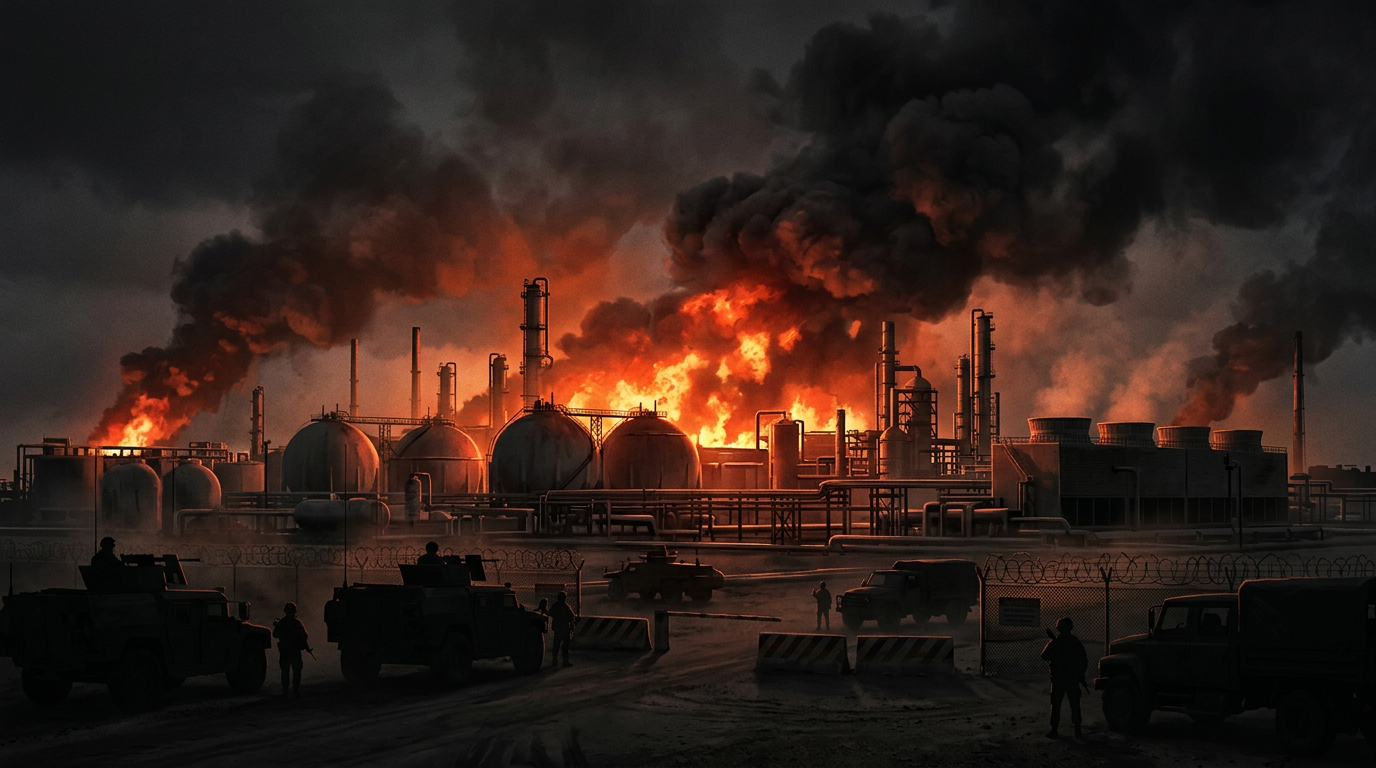
When missiles ignite global gas prices: The Iran war and its consequences for Europe's energy supply – Image: Xpert.Digital
An attack on a facility — and suddenly an entire continent trembles
The spark that ignited the market
What happened in Qatar on the night of March 18-19, 2026, was not a local event—it was a global energy shock in real time. In the early hours of Thursday morning, Iran launched missile attacks on several liquefied natural gas (LNG) facilities in the industrial city of Ras Laffan, Qatar, following Israel's earlier attack, allegedly with US approval, on the Iranian South Pars gas field near Asalujeh. QatarEnergy, the state-owned operator, confirmed severe fires and extensive damage to several LNG units as well as the Pearl GTL facility. The energy markets reacted swiftly: The European benchmark price for natural gas, the TTF futures contract on the Amsterdam Exchange, surged by up to 35 percent during the day, briefly exceeding €70 per megawatt-hour. By morning, it had stabilized at over €66—still around 22 percent above the previous day's close.
Ras Laffan: The heart of the global LNG supply
To understand the magnitude of the shock, one must know what is located in Ras Laffan. The industrial complex, roughly 80 kilometers northeast of Doha, is not just any factory—it is by far the world's largest LNG export facility. Qatar, through its state-owned energy company QatarEnergy, accounts for approximately 20 percent of global LNG exports, and almost all of its production lines are concentrated in Ras Laffan. In 2025, QatarEnergy shipped a total of 80.97 million metric tons of LNG. The gas originates from the North Field, the world's largest natural gas field, which Qatar shares with Iran—South Field on the Iranian side, North Field on the Qatari side. Therefore, when the Iranian missiles struck Ras Laffan, it didn't just affect Qatar, but a fifth of the world's LNG supply capacity in one fell swoop.
How war unleashes a price storm
The current price surge is the result of an escalating spiral that began in late February 2026. When the US and Israel launched their war against Iran at the end of February, the TTF contract rose within just a few trading days from around €32 to over €55 per megawatt-hour—an increase of almost 73 percent. Iran delivered its first major blow on March 1, 2026, when Iranian drones struck the Ras Laffan and Mesaieed facilities in Qatar, prompting Qatar Energy to halt all LNG production. European gas prices subsequently jumped by 45 to 50 percent in a single day. Simultaneously, Iran effectively closed the Strait of Hormuz to international shipping—a waterway through which approximately 19 percent of global LNG trade and about 27 percent of global marine oil trade is conducted. Tanker traffic plummeted by around 70 percent, with over 150 ships anchored outside the passage. On March 8, the price of Brent crude oil exceeded $100 per barrel for the first time since 2022.
Europe's structural weakness: Empty storage facilities at the wrong moment
The external shock is hitting a continent already weakened. At the end of February 2026, German gas storage facilities were only 21.6 percent full—the EU average was around 30 percent, significantly below previous years' levels and far from the regulatory target. By comparison, during the same period of the previous year, storage facilities in Germany were still at around 56 percent. This low fill level is partly due to the unusually cold winter of 2025/2026, which depleted reserves more than anticipated. The low fill level exacerbates the situation structurally: Europe has to import enormous quantities of LNG during the summer months to replenish storage facilities in time for the following winter—precisely when major Asian consumers like China, Japan, and South Korea are also competing intensely on the spot market. Qatar, which was originally slated to supply Germany with ample natural gas starting in 2026, is now completely unavailable as a supplier.
The Strait of Hormuz: A bottleneck with a global lifting effect
The Strait of Hormuz is the strategic bottleneck of the world's energy supply. Tankers carrying approximately 20 million barrels of crude oil—roughly one-fifth of global daily consumption—normally pass through this narrow strait, only 54 kilometers wide, every day. For Qatar, the route is of particular importance: 93 percent of all Qatari LNG exports must leave the Gulf via this passage. Since February 28, 2026, shipping traffic there has virtually ceased. Several major international shipping companies have suspended their operations, a situation the German Shipowners' Association described as an acute operational crisis. As a direct consequence, alternative freight routes around the Cape of Good Hope have emerged, extending transit times by 10 to 14 days, tying up shipping capacity, and significantly increasing insurance and freight costs. While this logistical detour can be organized, it cannot be done quickly or at the same cost.
Who pays the price? Industry, households, and government budgets
The medium-term economic consequences will hit energy-intensive industries particularly hard. The chemical, fertilizer, steel, glass, and paper industries are especially vulnerable—analysts warn that production cuts or factory closures are looming in Germany, Italy, and the Netherlands if the elevated energy prices persist for months. The German Institute for Economic Research (DIW) calculated that GDP growth in Germany could fall to just 0.5 percent by 2026—resulting in economic damage of around 22 billion euros. At the same time, inflation could rise to 2.8 percent. Goldman Sachs estimates that the global commodity shock could reduce global GDP by around 0.3 percent and increase overall global inflation by 0.5 to 0.6 percentage points. Households that already faced higher heating costs last winter are threatened with another wave of burdens: The nationwide average for gas deliveries was recently around 9.4 cents per kilowatt-hour—and wholesale prices are reflected in end-customer contracts with a time lag.
What the analysts say: Between 74 and 100 euros per megawatt hour
Price forecasts from major banks and analysts have repeatedly revised upwards throughout the crisis. Goldman Sachs, which had predicted an April price of €36 per megawatt-hour before the war began, raised its estimate to €55—warning that a one-month disruption of Qatari exports could push the TTF (Total Transit Price) up to €74. ING Bank considers prices of €80 to €100 per megawatt-hour realistic if supply disruptions persist. Analyst firm S&P Global warned that the most aggressive short-term buyers are from the Asia-Pacific region, which will further intensify competition for Europe. Bernstein analysts maintained their TTF forecast of €63 for the second quarter of 2026, warning that physical gas markets in Europe could become so tight that consumers begin to switch from gas to oil.
Parallels to 2022 — and crucial differences
Memories of the energy crisis following Russia's invasion of Ukraine are still fresh. Back then, the TTF (Total Transition Fund) skyrocketed to over €220 per megawatt-hour within a few weeks, and electricity prices reached historic highs of €488 per megawatt-hour. The current crisis follows the same structural logic—a sudden failure of a major supplier, depleted storage facilities, and panic on the spot market. However, Goldman Sachs and other analysts emphasize a crucial difference: Today's shock is concentrated in the energy sector, whereas in 2022, a much broader supply chain crisis and a global surge in inflation occurred simultaneously. The current conflict indirectly affects Europe as an LNG importer because most Gulf volumes flow primarily to Asia—but the global price formation mechanism knows no borders. A return to Russian pipeline gas is politically out of the question. Europe is thus dependent on a global LNG market, which is currently under attack at one of its most vulnerable points.
What now? Options for action under pressure
Following the recent price surge, Economics Minister Katherina Reiche convened a task force. In the short term, policymakers have only limited tools at their disposal: LNG imports from the US, Norway, and North Africa can be expanded in the medium term, but are not easily substituted in terms of logistics and price. The debate about national strategic gas reserves—independent of the EU storage rules expiring in 2027—has gained new urgency due to the crisis. More fundamental, however, is Europe's structural dependence on global LNG flows, which arose from the shift away from Russian pipeline gas and now reveals a new geopolitical risk profile. The Iran-Iraq War ruthlessly demonstrates that energy security is not an abstract geopolitical category, but a concrete question of economic survival—and that a single missile attack on an industrial plant in the Persian Gulf is enough to change heating costs in Ulm, Hamburg, or Munich.
🎯🎯🎯 Benefit from Xpert.Digital's extensive, five-fold expertise in one comprehensive service package | BD, R&D, XR, PR & Digital Visibility Optimization

Benefit from Xpert.Digital's extensive, five-fold expertise in a comprehensive service package | R&D, XR, PR & Digital Visibility Optimization - Image: Xpert.Digital
Xpert.Digital possesses in-depth knowledge across various industries. This allows us to develop tailored strategies precisely aligned with the requirements and challenges of your specific market segment. By continuously analyzing market trends and monitoring industry developments, we can act proactively and offer innovative solutions. The combination of experience and expertise generates added value and provides our clients with a decisive competitive advantage.
More information here:
Your global marketing and business development partner
☑️ Our business language is English or German
☑️ NEW: Correspondence in your native language!

Konrad Wolfenstein
I and my team are happy to be available to you as your personal advisor.
You can contact me by filling out the contact form here or simply call me at +49 7348 4088 965. My email address is: [email protected]
I'm looking forward to our joint project.


