
Energy policy failure: Electricity is given away for free, but you pay record prices: How to escape the energy trap
Xpert Pre-Release

Available in 27 languages 📢
Prefer Xpert.Digital on GoogleⓘPublished on: May 11, 2026 / Updated on: May 11, 2026 – Author: Konrad Wolfenstein
Energy policy failure: Electricity is given away for free, but you pay record prices: How to escape the energy trap – Image: Xpert.Digital
Billions for unused electricity: How to protect yourself from the price madness now
New electricity levy from 2031: Why you absolutely must focus on self-sufficiency now
Energy paradox in Germany: Plenty of green electricity, high prices – and the only way out
Germany is experiencing an absurd energy paradox: While electricity prices on the exchange are increasingly falling below zero due to a massive oversupply of renewable energy, consumers continue to groan under exorbitant electricity bills. The causes lie in a structural political failure: Overburdened grids, billions in compensation for curtailed electricity, and expensive subsidies for new fossil gas power plants are driving up hidden costs. But tenants and homeowners don't have to passively accept this cost explosion. Thanks to new legal frameworks, the combination of dynamic electricity tariffs, and increasingly powerful balcony power plants with long-lasting LFP storage systems, consumers now have powerful tools at their disposal. Learn how you can financially leverage the flaws of current energy policy to your advantage, drastically reduce your electricity costs, and secure maximum independence from the electricity market.
Energy policy failure – and how consumers can regain control
Billions wasted on perverse incentives, squandered green electricity, and a simple solution: Why you shouldn't wait any longer for politicians to act
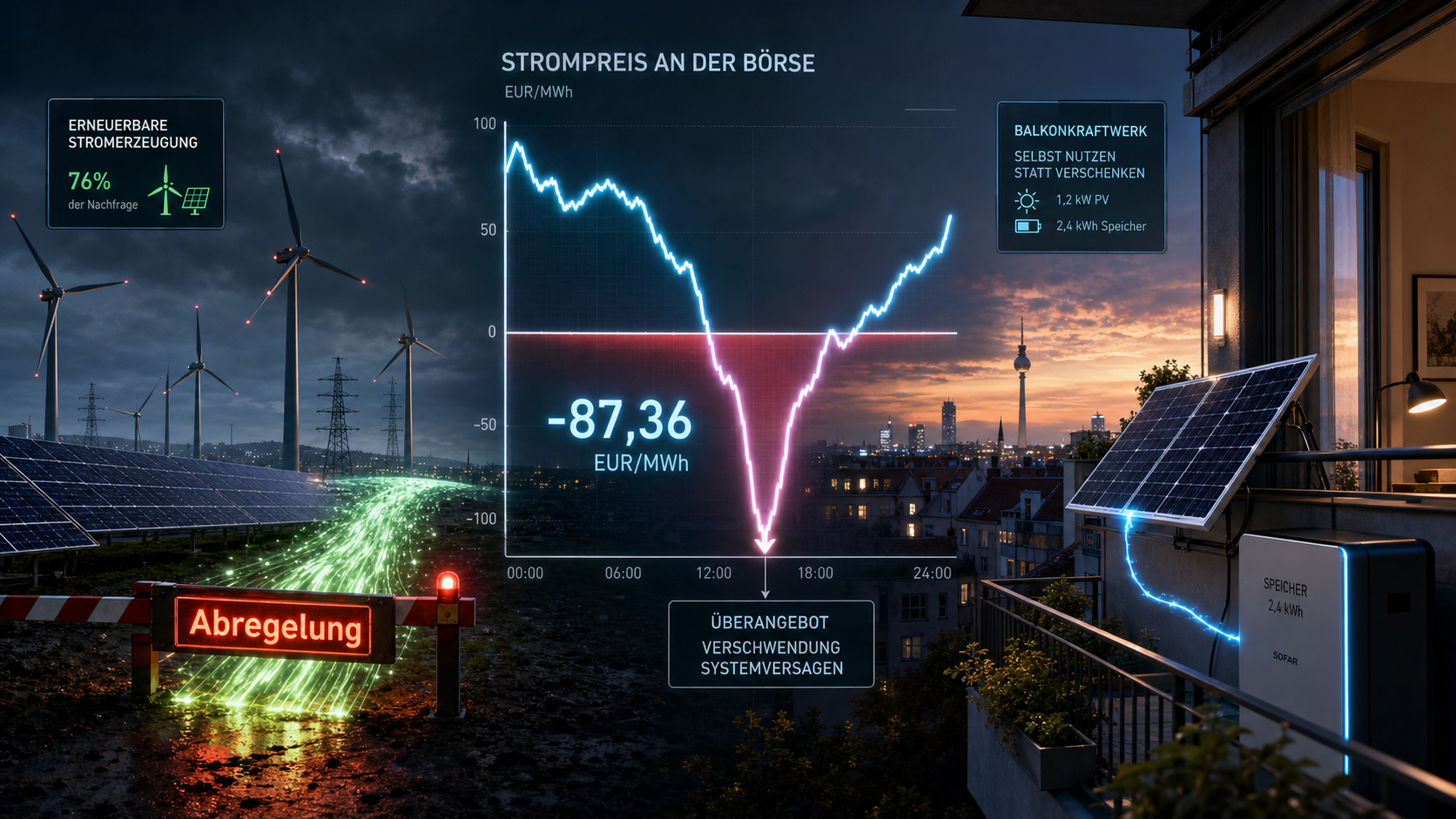
It's one of the greatest absurdities of German energy policy: The country increasingly produces more electricity than it can consume – and yet households pay some of the highest rates in the world compared to other European countries. In 2024, the German electricity market recorded a total of 457 hours of negative wholesale prices, meaning periods when electricity producers effectively paid to have their electricity purchased. This record was surpassed in 2025: For the first time in the history of the German energy markets, 573 hours fell into negative price territory – an increase of around 25 percent compared to the previous year. In the first half of 2025 alone, 389 negative hours were recorded, representing an 80 percent increase compared to the same period of the previous year.
The trend is not random, but structural. Since 2020, the number of hours with negative prices has been increasing at an average annual rate of around 77.5 percent. In June 2020, there were only eight such hours, in June 2023 there were already 30, in June 2024 there were 66 – and this exponential trend continued into 2025. The cause lies in the rapid expansion of wind and solar energy, which is encountering a power grid that is structurally and in terms of capacity not designed for these flexibility requirements. When renewable energy plants are running at full capacity on windy weekends or sunny early summer days, the grid simply cannot absorb the energy. The result is negative prices, curtailment, and – paradoxically – continued high prices for end consumers.
Regulated yet still paid: The hidden billion-dollar bill
While wholesale electricity prices are negative, billions of euros are flowing to plant operators whose electricity never even reaches the grid. In 2024, around 9.4 terawatt-hours of electricity from renewable energy sources were curtailed in Germany – equivalent to 3.5 percent of total renewable electricity generation. These losses are not without cost: operators are compensated for the electricity that is not fed into the grid. According to an official response from the Federal Ministry for Economic Affairs and Energy to a parliamentary inquiry, a total of €553.9 million was paid out as compensation to operators of curtailed plants in 2024. For the photovoltaic sector alone, the curtailed volume increased by 97 percent compared to the previous year, vividly illustrating the rapidly growing discrepancy between generation capacity and grid capacity.
The total costs of grid congestion management – that is, all measures to prevent overloads, including redispatch and countertrading – amounted to €2.776 billion in 2024, according to preliminary evaluations by the Federal Network Agency. These costs are passed on to all electricity consumers via grid fees and are thus hidden in every electricity bill, without the average household customer making a direct connection. This is a perfect example of a fiscal externality: costs arise from systematic market failure but are socialized through opaque price components.
The gas-fired power plant strategy: Expensive, fossil-dependent, and contrary to the system
Instead of designing an intelligent grid and strengthening flexibility mechanisms, policymakers have made a fundamental bet on conventional technology: the power plant strategy with up to 20 gigawatts of new gas-fired power plant capacity. The subsidy costs for this program are substantial. Even for the originally planned 10 gigawatts, the Federal Ministry for Economic Affairs and Energy estimated the subsidy costs at around €6.6 billion. According to a study by the Forum for Ecological and Social Market Economy, the total subsidy costs for the expanded strategy to 20 gigawatts could rise to between €22.2 and €32.4 billion. These subsidies are to be financed from 2031 onwards via a levy on electricity consumption, which will further burden household electricity prices.
Added to this are the ongoing government subsidies for fossil gas infrastructure: Since the beginning of 2026, the costs for gas storage facilities have been financed from the Climate and Transformation Fund – with more than €3 billion per year. Deutsche Energy Terminal receives up to €5 billion in government funding for the construction and operation of LNG terminals. And the energy tax exemption for natural gas in electricity generation cost the government around €1.2 billion in 2024. The argument that gas-fired power plants are a market-based solution thus proves to be an illusion: They are not profitable without subsidies. A study by the Forum for Ecological and Social Market Economy, commissioned by Green Planet Energy, calculated the cost of electricity from new gas-fired power plants at up to 67 cents per kilowatt-hour once subsidies, infrastructure costs, and externalized climate damage are factored in – two to three times more expensive than backup power based on renewable energies.
The trillion-euro investment: Network expansion as a debt burden spanning generations
The structural investment needs extend far beyond the power plant strategy. A study published in December 2024 by the Institute for Macroeconomics and Business Cycle Research (IMK), funded by the Hans Böckler Foundation and with the participation of researchers from the University of Mannheim, estimates the investment required for grid expansion by 2045 at approximately €651 billion. Of this, roughly €328 billion is earmarked for transmission networks and €323 billion for distribution networks. The required annual investments of around €34 billion represent an increase of 127 percent compared to the €15 billion actually invested in 2023.
The consulting firm ef.Ruhr, in a previous estimate, even put the figure at €732 billion, of which €431 billion alone is for distribution networks. For comparison, that would be one hundred times the construction costs of Berlin's airport. These costs are ultimately passed on to consumers via network charges or tax funding – regardless of whether political promises regarding efficiency and affordability are kept. A significant portion of these investments could be avoided or at least considerably reduced through intelligent load management, decentralized storage, and flexible consumption control – but this logic has so far been underrepresented in political priorities.
The end-customer price: Expensive despite abundance
Amidst all these structural flaws, the average German household pays electricity prices that remain exceptionally high compared to other European countries. In 2025, the average household electricity price was around 39.3 cents per kilowatt-hour. By the beginning of 2026, it had fallen to approximately 37.2 cents – a decrease primarily attributable to a one-off government subsidy of €6.5 billion for transmission network charges. For new customers, the cheapest tariffs in May 2026 were around 24 to 28 cents per kilowatt-hour, depending on the region and supplier. However, these prices do not reflect the true market reality: On the electricity exchange, electricity is traded for below zero cents, sometimes even at significantly negative prices, during periods of surplus, while household customers pay the full retail price at the same time.
The cause of this decoupling lies in the structure of the electricity price itself. Around 50 to 60 percent of end-consumer prices consist of taxes, levies, and grid charges – components that are largely independent of the current wholesale electricity price. This means that even if electricity costs nothing on the exchange or is even traded at a negative price, the end customer still bears the entire infrastructure and levy burden. While this structure protects the investment security of grid operators and electricity producers, it also makes them resistant to market signals and prevents effective incentives for flexible consumption.
The dynamic electricity tariff: The politically decided instrument that hardly anyone uses
Since January 2025, all electricity suppliers in Germany have been legally obligated to offer a dynamic electricity tariff. This regulation, enshrined in the Energy Industry Act, is designed to enable households to directly benefit from fluctuations in wholesale electricity prices. Dynamic tariffs are based on the EPEX spot market price, the wholesale price set hourly or quarter-hourly on the European electricity exchange. Providers such as Tibber, aWATTar, Octopus Energy, and Rabot Charge pass this price on to customers with a moderate markup.
The principle is simple: Consumers with a smart meter can shift their electricity consumption over time – concentrating energy-intensive activities like charging electric cars, running the washing machine, or filling a battery storage system during hours with the lowest prices and avoiding expensive peak load times. This not only saves money but also relieves the strain on the power grid precisely when it is most heavily used. Tibber, for example, offers complete quarter-hourly billing with its Pulse electricity tracker, which displays consumption in real time in an app and automatically identifies favorable charging windows.
New: Patent from the USA – install solar parks up to 30% cheaper and 40% faster and easier – with explanatory videos!

New: Patent from the USA – Install solar parks up to 30% cheaper and 40% faster and easier – with explanatory videos! - Image: Xpert.Digital
The core of this technological advancement is the deliberate departure from conventional clamp mounting, which has been the standard for decades. The new, more time- and cost-effective mounting system addresses this with a fundamentally different, more intelligent concept. Instead of clamping the modules at specific points, they are inserted into a continuous, specially shaped support rail and held securely in place. This design ensures that all forces – whether static loads from snow or dynamic loads from wind – are distributed evenly across the entire length of the module frame.
More information here:
Self-sufficiency instead of dependence
Electricity price arbitrage with home storage: The principle of smart charging
The real economic leverage only arises from the combination of a dynamic tariff and battery storage. The principle of price arbitrage is fundamentally simple: electricity is bought when it is cheap, stored, and then consumed when it is expensive. Specifically, this means that during the night hours between midnight and 5 a.m., the wholesale electricity price is often between 5 and 12 cents per kilowatt-hour. On days with high wind and solar production, or on Sundays and public holidays, it falls even lower or becomes negative. A home storage system charged during these hours makes the stored energy available in the evening or morning – at times when the wholesale price rises to 30 to 40 cents or more.
An analysis of 448 German households over five years, published in the journal Energy Policy, documented that households with a dynamic tariff and battery storage had 12.7 percent lower electricity costs compared to similarly equipped households with a fixed tariff. An active price optimization system, which allows the storage system to react to market signals, results in an additional financial benefit of up to six percent. According to EPEX Spot data for 2025, a 10-kilowatt-hour storage system in Germany generates around €620 in arbitrage value per year, in addition to the savings from self-consumption of solar power. Considering the overall picture – arbitrage plus an increased self-consumption rate from 30 to 65 percent – this results in combined annual savings of €850 to €1,200 for a typical three-person household with a PV system.
Balcony power plants in rented apartments: Legal clarity since 2024
The biggest misconception about decentralized solar power is that it only benefits homeowners with their own roof. In fact, the legal situation for tenants was significantly improved by the Solar Package I, which came into effect in 2024. Plug-in solar devices that are simply hung or placed without any structural modifications now only require informal notification to the landlord – no explicit approval is required. The permissible inverter output is 800 watts, and the module output can reach up to 2000 watts peak. Schuko plugs are still permitted, provided the device complies with the relevant VDE standards.
The market has reacted significantly to this liberalization: The number of installed mini-PV systems in Germany exceeded 3 million, and according to industry data, demand increased by over 80 percent in 2025. Around 35 percent of installed balcony power plants are already combined with battery storage. Systems such as the Anker SOLIX E1600, the EcoFlow PowerStream, or the Zendure SolarFlow can be commissioned entirely without an electrician, can be taken along when moving, and are VDE-certified. The Solar Package II, which is currently being prepared, is intended to further simplify storage solutions for tenants and include tax exemptions and tenant electricity subsidies.
LFP battery technology: Why durability makes the crucial difference
One of the key technological advantages of modern balcony solar power storage systems lies in the battery chemistry used. While older lithium-ion storage systems based on NMC or NCA technology typically achieved 3,000 to 5,000 charge cycles until reaching their capacity limit of 80 percent of their original value, modern lithium iron phosphate (LFP or LiFePO₄) storage systems achieve between 6,000 and 10,000 full cycles. Some products, such as the SunEnergyXT system, even guarantee 10,000 cycles. The outstanding priwatt analysis of LFP technology even estimates the lifespan of LFP batteries in residential applications at 20 to 30 years, based on a calendar-based approach.
What do these figures mean in practice? With a daily charging window of one full cycle, 6,000 cycles translate to a calculated operating life of over 16 years. Systems with 10,000 cycles theoretically exceed 25 years with moderate use. Compared to NMC technology with around 3,000 to 5,000 cycles, this represents almost double the usable lifespan. In addition, LFP chemistry offers significant safety advantages: The cells are more thermally stable, the risk of fire is significantly lower due to the stable cell chemistry, and the operating temperature range extends from -20 to +60 degrees Celsius. High-quality home storage systems for the European market feature active thermal management with heating or cooling solutions that keep the battery permanently within an optimal temperature range.
Maximum self-sufficiency: Storage as the key to independence
The true strategic value of a balcony power plant with storage lies not only in saving on electricity costs, but also in structural autonomy from a market shaped by political missteps. Maximizing self-consumption protects against future price increases resulting from new levies for gas-fired power plants or rising grid fees. A family of three in Munich who installed an 800-watt balcony power plant with 2 kilowatt-hour storage in 2024 reduced their annual electricity consumption by around 25 percent, according to practical calculations – an annual saving of approximately 300 euros at a price of 35 cents per kilowatt-hour. The payback period was 5 to 6 years.
A two-person household with a south-facing balcony can generate approximately 360 to 430 kilowatt-hours of self-generated electricity annually with an 800-watt system and a 2-kilowatt-hour battery storage unit, thus reducing electricity costs by up to €180. This figure increases considerably when combining a flexible tariff with active price arbitrage: Calculations show that even on a single day of price volatility with active battery storage, savings of around €3.25, or up to 56 percent of the daily electricity price, can be achieved – compared to a standard fixed-price contract. Extrapolated over a year, this advantage amounts to several hundred euros, depending on battery storage size, consumption profile, and chosen tariff.
Market development in 2026: Plug & Play for every household
The market for balcony-mounted solar power systems with storage is growing by more than 40 percent annually in Germany. What was considered a technological gimmick for energy enthusiasts just a few years ago has become a serious consumer product by 2026, increasingly used by renters in major cities. The leading systems of 2026 – including the Zendure SolarFlow with expandable capacity up to 7.6 kilowatt-hours, the Anker SOLIX system, and the EcoFlow PowerStream with full smart home integration – require no specialized knowledge for installation. Registration with the grid operator has been possible via a simplified online form since 2025.
The plug-and-play nature of these systems is particularly relevant for urban renters. They require no structural modifications, can be easily moved when relocating, and integrate seamlessly into existing living spaces. App-based energy management systems visualize production, storage level, and grid consumption in real time – and, with appropriate configuration, control charging processes fully automatically based on price signals. The entry-level price for a complete system with 800 watts and approximately 1.5 to 2 kilowatt-hours of storage will be between €1,200 and €1,800 in 2026, with many municipalities such as Berlin, Munich, and Cologne offering subsidy programs that cover up to 25 percent of the purchase costs.
Personal responsibility as a rational response to political system failure
The diagnosis of the German energy market is clear: The market is producing ever more affordable electricity from renewable sources, but the political and institutional framework prevents this electricity from being used efficiently. Instead, billions are being invested in curtailment compensation, grid congestion management, fossil fuel subsidies, and excessive grid expansion costs, all of which are ultimately borne by end consumers. The political promises of an affordable, clean energy supply stand in fundamental contradiction to fiscal reality.
For individual households, this leads to a rational conclusion: reducing dependence on a dysfunctional system through decentralized self-sufficiency. Flexible electricity tariffs, balcony power plants, and battery storage are not ideological statements, but pragmatic answers to a systematically misguided energy policy. The technology is mature, clearly regulated by law, and economically viable – especially for renters. Those who act today not only protect themselves against current price increases, but also against the foreseeable additional burdens from new gas-fired power plant levies starting in 2031. The energy transition, which politicians have been waiting decades for, can already begin on a small scale today, right on your own balcony.
Your partner for business development in the fields of photovoltaics and construction
From industrial rooftop PV to solar parks and larger solar parking lots
☑️ Our business language is English or German
☑️ NEW: Correspondence in your native language!

Konrad Wolfenstein
I and my team are happy to be available to you as your personal advisor.
You can contact me by filling out the contact form here simply call me at +49 7348 4088 965. My email address is [email protected]:or
I'm looking forward to our joint project.







