
Electricity price illusion: Why cheap gas won't lower your bill
Xpert Pre-Release

Available in 27 languages 📢
Prefer Xpert.Digital on GoogleⓘPublished on: August 8, 2026 / Updated on: August 8, 2026 – Author: Konrad Wolfenstein
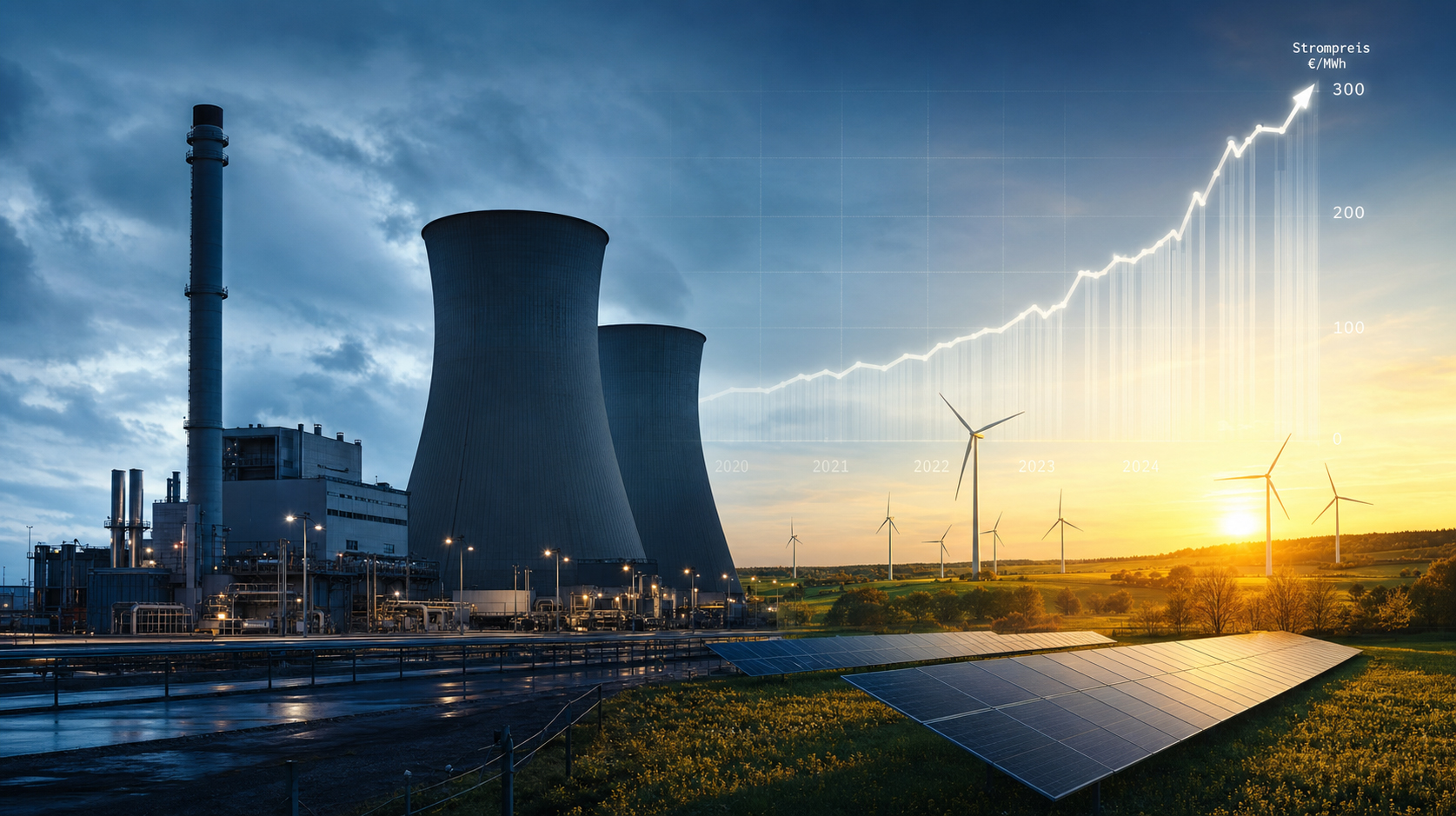
Electricity price illusion: Why cheap gas won't lower your bill – Creative image on the topic, created with AI: Xpert.Digital
85 percent standstill: The billion-euro trap of the new German gas-fired power plants
Capacity market from 2026: Why you will soon be paying for power plants that aren't even running
Relief only from 2030 onwards? The serious calculation error in the gas strategy
Federal Economics Minister Katherina Reiche is promising significant relief in electricity prices for the 2030s, relying on a misguided hope: cheap imported gas. However, a closer look at the upcoming design of the German energy market reveals that this calculation will not work out. When the first new peak-load gas-fired power plants are tendered for the so-called capacity market starting in September 2026, the economic logic will fundamentally change. These plants will be idle for around 85 percent of the year and will function solely as emergency reserves. Remuneration will no longer primarily be based on the electricity generated, but rather on the mere availability of the power plants – a highly capital-intensive model in which the actual gas price becomes a secondary consideration. Instead of benefiting from lower fuel costs, private and commercial consumers face the prospect of substantial additional financial burdens on their electricity bills due to the fixed availability costs. While international examples and recent studies have long proven that a flexible mix of renewable energies and storage would be the far cheaper solution, policymakers are sticking to an expensive long-term fossil fuel project.
When politics relies on hope instead of physics: Expensive reserves instead of cheap electricity – Who pays the true bill for power plants?
Federal Economics Minister Katherina Reiche, in an interview with the German Press Agency (dpa), expressed an expectation that is likely to disappoint many consumers: noticeable relief in electricity prices is not to be expected until the 2030s. She explicitly cites the import of cheaper gas, not the further expansion of renewable energies, as the key lever for lower electricity prices in the future. This statement was disseminated via the dpa news ticker and thus appeared, sometimes unedited, in dozens of media outlets, including the Süddeutsche Zeitung, which marked its version as directly reproduced. The central claim is essentially this: the cheaper gas importers can purchase gas, the lower the costs of electricity generation will be, and the better consumers can absorb price fluctuations.
At first glance, this logic seems plausible. Laypeople who think of gas-fired power plants imagine facilities that continuously burn gas to generate electricity, with the purchase price of the fuel representing the largest cost component. In this scenario, a lower gas price would indeed have a direct impact on electricity costs. The problem: This view doesn't fit the power plants that are actually scheduled to be put out to tender starting in September 2026.
Why a power plant that barely runs disrupts the logic of gas prices
Starting in September 2026, the German Federal Government will issue tenders for new peak-load gas-fired power plants, which are to be built within the framework of a newly created capacity market. The first bidding deadline for this capacity market is September 8, 2026, as stated in the newsletter of the Federal Ministry for Economic Affairs and Energy. The legal basis for this is the Act on Securing Security of Electricity Supply and the Provision of New Capacities (StromVKG), which was passed by the Bundestag on July 9, 2026. The purpose of these plants is clearly defined: they are intended to step in when solar energy, wind power, battery storage, and pumped-storage power plants are insufficient to meet electricity demand.
The planned operating time for these power plants is approximately 15 percent of the year, meaning that the plants are idle for roughly 85 percent of the time. This low utilization has a crucial economic consequence: For a power plant that is not in operation most of the time, the fixed investment costs for construction and maintenance dominate, while the fuel price for gas becomes a secondary consideration. Physicist and transformation expert Mario Buchinger highlighted precisely this point in his analysis of the interview: The main costs of these so-called residual load power plants are incurred regardless of the actual number of operating hours because they are fixed investment costs, while the ongoing operating costs, which include the gas price, play a subordinate role with an operating time of only 15 percent per year.
The payment model based on the fire department principle
To understand why the gas price is almost irrelevant to the profitability of these power plants, it's worth looking at the remuneration model. Payment is not primarily based on the actual amount of electricity generated, but rather on the availability to supply power when needed, similar to the principle of a fire department that is paid even if no fire breaks out. This form of remuneration operates via a so-called capacity mechanism or capacity market.
The legal framework for this has already been worked out in detail. According to the Electricity Supply Act (StromVKG), operators receive compensation for keeping capacities such as power plants, storage facilities, or flexible loads operational, regardless of whether this capacity is ultimately used. Specifically, two auction rounds of 4.5 gigawatts each, totaling nine gigawatts, are planned initially, which corresponds to approximately 20 power plants. A further auction for two gigawatts is scheduled for May 2027. Overall, the German government is planning significantly larger capacities in the medium term: An internal document from the German government and the EU Commission mentions an additional 21 to 26 gigawatts in 2027, followed by another auction of three to eight gigawatts in 2029. Taken together, observers speak of a figure of over 40 gigawatts of new gas-fired power plant capacity, which has been approved by the agreement in principle with the European Commission.
Another detail exacerbates the discrepancy between announcement and economic impact: For the ten gigawatts in the first tender round, a long-term criterion applies, stipulating that the awarded plants must be able to deliver at full capacity for at least ten hours continuously, regardless of whether this capacity is actually used in practice. The capacities must be kept available for a period of 15 years and be operational by 2031. Those investing in this segment are therefore primarily calculating with a 15-year payment guarantee for the provision of capacity, not with the daily trading activity on the gas market.
Whoever ends up paying the bill
The costs of this new system will not simply disappear into the national budget, but will be passed directly on to the electricity bills of private and commercial consumers. Until 2032, the federal government will initially provide taxpayer funds to finance the construction of the power plants through a loan, which must be repaid after the full capacity mechanism is implemented. From 2032 onward, electricity consumers, both households and industry, will bear the costs of the reserved capacity in addition to the regular electricity price. Furthermore, a comprehensive capacity market is planned to be established in 2032, which will ensure that sufficient controllable capacity is permanently available within the system.
From a legal perspective, the granularity of the billing system is remarkable. All capacity providers must pay the transmission system operator the difference, multiplied by their reduced output, for every 15 minutes in which the spot market price exceeds the agreed-upon exercise price, regardless of whether electricity is actually generated. Those committing long-term must also meet minimum investment thresholds, such as €201,000 per megawatt of reserved capacity for a seven-year commitment and €431,000 per megawatt for a 15-year commitment. These figures illustrate that this is a capital-intensive, long-term support scheme whose costs extend far beyond the mere procurement of fuel.
The following overview summarizes the key aspects of the capacity market:
| aspect | control |
|---|---|
| First bidding deadline | September 8, 2026 |
| Tender volume 2026 | Approximately 9 to 12 gigawatts in the first rounds |
| Additional volume 2027 | 21 to 26 gigawatts planned |
| Further volume 2029 | 3 to 8 gigawatts planned |
| Mandatory provision | From 1 November 2031 to 30 October 2032, then a permanent market |
| Investment commitment period | Up to 15 years |
| Planned deployment time | Approximately 15 percent of the year |
| Financing until 2032 | Government loan, then levy on electricity customers |
The narrative of renewables as price drivers
A recurring pattern in the Federal Minister for Economic Affairs' public communication is the implicit portrayal of renewable energies as a cost factor and price driver in the electricity market, while the impact of fossil fuel crises on energy prices is hardly addressed. Yet, many experts see the phase-out of fossil fuel combustion as an opportunity to become less dependent on future geopolitical and market-driven price shocks. It is also noteworthy that, in the interview, she cites as an achievement of her term in office the continued legalization of gas and oil heating systems for consumers, which underscores the ministry's fundamental energy policy orientation.
At the same time, a legal regulation already exists that works in precisely the opposite direction: The Solar Peak Act, in effect since February 2025, ends the compensation for curtailed kilowatt-hours from photovoltaic systems when electricity prices are negative. Anyone who, on the one hand, denies renewables this already reduced compensation mechanism, while simultaneously planning a comprehensive, highly subsidized capacity mechanism for fossil fuel reserve power plants that pays for mere provision, is applying different standards to two comparable market phenomena. This asymmetry in energy policy regulation raises the question of what criteria are actually used to determine eligibility for subsidies in the German energy system.
What international examples show about costs and market displacement
A key counterargument to the official narrative comes from international comparisons. In California and Spain, we can already observe how the combination of renewable energies and battery storage is increasingly displacing gas-fired power plants from the market, because this combination is simply more cost-effective in many operating situations. This market dynamic contradicts the fundamental assumption that cheaper imported gas is the decisive factor for lower electricity prices. Rather, international experience suggests that the accelerated expansion of solar energy, wind power, and storage technologies would be the more effective and, in the long run, more cost-efficient approach.
For the German context, the Fraunhofer Institute for Solar Energy Systems (Fraunhofer ISE) provides a detailed scientific basis. In a study published in June 2026 on the cost-optimal transformation of the German energy system by 2045, the authors calculated what an energy system would need to look like to simultaneously guarantee continuous security of supply, high resilience to disruptions, and transparent, comprehensible costs. In this model, the role of reserve capacity is not primarily filled by new gas-fired power plants, but rather by a combination of biogas plants, combined heat and power (CHP), and various storage technologies, which serve as the backbone for residual load coverage. An accompanying analysis of this Fraunhofer research succinctly summarizes the core message: A system change in the course of the energy transition is already technically and economically feasible; the only crucial factor is the political will to implement it.
The power plant strategy as a long-term political project
The history of the current tender process goes back considerably further than the minister's recent interview. Even before Katherina Reiche took office, the German government had adopted key points of a so-called power plant strategy, designed to incentivize the construction of new hydrogen-capable gas-fired power plants and other technologies for dispatchable electricity generation. Originally, the plan was to tender for new, dispatchable capacities of ten gigawatts, supplemented by additional incentives for switching to hydrogen amounting to two gigawatts by 2040 and a further two gigawatts by 2043. A binding deadline applies to all power plants built under this strategy: they must be fully decarbonized, i.e., operated in a climate-neutral manner, by 2045 at the latest.
The timeline was repeatedly delayed in its practical implementation. While the minister originally wanted to begin the first tenders in 2025, policy experts from within her own party, the CDU/CSU, considered this unrealistic and instead aimed for the first quarter or first half of 2026. The Federal Network Agency, in turn, pointed out that several months could elapse between the adoption of the underlying legislation and the first actual tender. It wasn't until January 2026 that an agreement in principle was reached with the European Commission regarding the project's compliance with state aid rules, although the formal state aid procedure was not yet complete at that time. Only newly constructed gas-fired power plants are eligible for the first round of tenders; existing plants cannot participate in this initial auction. Coal-fired power plants are the only type of power plant that is categorically excluded, while the tender is formally technology-neutral.
Also noteworthy is the planned regional distribution of the new plants. One-third of the power plants are to be built in northern Germany, the region referred to as the north in terms of grid technology, while two-thirds are planned for southern Germany, for which a so-called grid bonus serves as a steering mechanism. This regional focus on southern Germany is likely related to the fact that North Rhine-Westphalia and other western German states are expected to completely phase out their existing coal-fired power plants in the 2030s, as soon as sufficient new peak-load capacity becomes available.
Framing as a political strategy and its limits
The communication strategy of the Federal Minister for Economic Affairs reveals a recurring pattern: she positions herself as the first official to promote greater market integration of renewable energies, while largely ignoring existing regulations such as the Solar Peak Act from her public presentation. Critical observers, such as the editorial team of top agrar, have already explicitly labeled the claim of electricity price relief through cheaper gas as misleading in their reporting. It also seems likely that part of the justification for long-term gas supply contracts, such as the one concluded by the energy company Uniper shortly after the interview, primarily serves commercial and geopolitical hedging interests and is less based on a transparent, consumer-oriented pricing model.
The decisive methodological objection to the minister's argument, however, lies not in the political motives, but in the simple economic structure of the power plants in question. A plant that is idle 85 percent of the time and whose compensation is primarily based on a fixed availability premium can hardly improve its profitability through a lower fuel purchase price, because fuel plays a subordinate role in the overall calculation. Long-term gas contracts with supplier countries like Qatar or Canada may well be sensible for reasons of security of supply and geopolitical diversification. However, as an argument for a noticeable reduction in electricity bills for German households in the coming years, this justification does not hold up to the inherent economic logic of the planned capacity market.
What this means for the debate about affordable energy in Germany
The real question arising from this analysis is less about whether Germany needs new dispatchable power plant capacity in the coming years, but rather which technology should most cost-effectively assume this reserve role. The Fraunhofer ISE study suggests that a mix of biogas, combined heat and power (CHP), and various storage methods within a cost-optimized overall system could play a significantly larger role than the current political focus on new gas-fired power plants would suggest. For investors, grid operators, and ultimately private consumers, a transparent, technology-neutral cost-benefit analysis would be more helpful than public communication that primarily relies on gas prices as an explanation for future electricity price developments.
Until the capacity market is fully operational in 2032 and beyond, the costs of building these new reserve capacities will be gradually passed on to consumers' electricity bills. Whether and to what extent declining gas purchase prices will actually provide noticeable relief remains questionable, given the described cost structure with predominantly fixed provision costs and low operating hours. Anyone seeking reliable predictions about future electricity prices should therefore focus less on individual interview statements and more on the actual design of the tender conditions, the level of capacity premiums, and the pace at which more cost-effective alternatives such as renewables, storage, and combined heat and power are integrated into the system.





