
Davos breakthrough? Will Donald Trump trade an EU tariff freeze for resource rights and a US missile defense shield in Greenland?
Xpert Pre-Release

Available in 27 languages 📢
Prefer Xpert.Digital on GoogleⓘPublished on: January 21, 2026 / Updated on: January 21, 2026 – Author: Konrad Wolfenstein
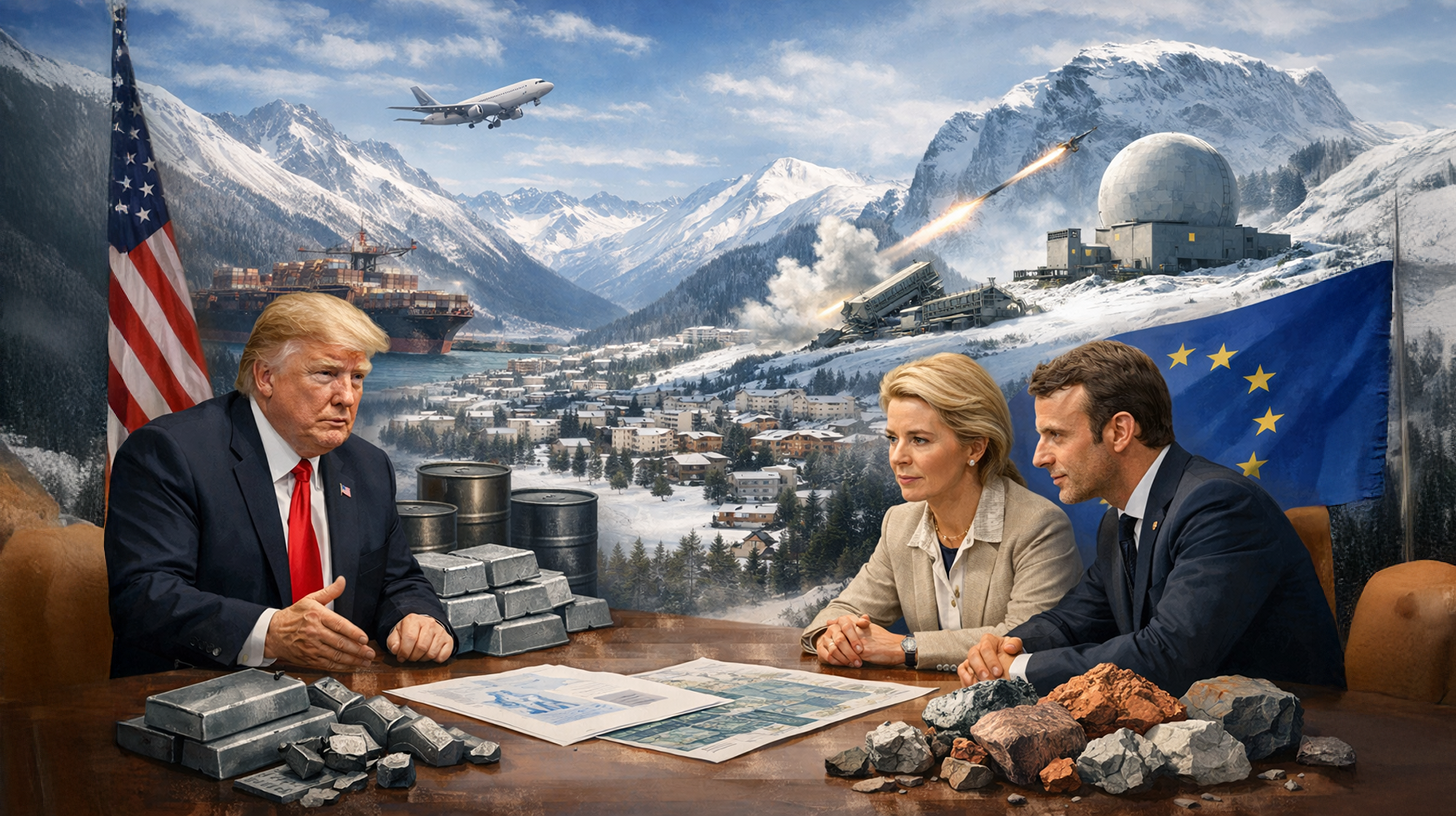
Davos breakthrough? Will Donald Trump trade an EU tariff freeze for resource rights and a missile defense shield in Greenland? – Creative image: Xpert.Digital
Davos diplomacy under pressure: When Donald Trump surprised Europe with a Greenland framework agreement
When transactional geopolitics meets Atlantic power structures – and all sides claim to have won
On the evening of January 21, 2026, an atmosphere of relief hung over the Swiss mountain resort of Davos, an atmosphere that had seemed unimaginable just hours before. After weeks of escalation, massive tariff threats, and a speech that confronted European decision-makers with territorial demands, Donald Trump announced a framework agreement on Greenland. The threatened punitive tariffs against eight European states were withdrawn. Denmark's Foreign Minister Lars Løkke Rasmussen aptly summed up the mood: The day ended better than it began. But behind this diplomatic facade lay a complex transaction that raised fundamental questions about transatlantic relations, economic blackmail, and the reshaping of Arctic power dynamics.
Suitable for:

What was actually agreed upon in Davos
The creation of the Greenland Framework Agreement reveals the characteristic hallmarks of Trump's negotiating style. After his delayed arrival in Davos, Trump delivered a ninety-minute speech in which he portrayed territorial claims to Greenland as a national security necessity. The island was American territory, he argued, citing its geographical connection to the North American continent. Only the US could adequately defend and develop Greenland. At the same time, he categorically ruled out the use of military force for the first time in public – a message he himself described as the most important point of his speech.
Immediately after this speech, Trump met with NATO Secretary General Mark Rutte. This meeting became the pivotal point of the entire agreement. Within hours, Trump announced on his platform TruthSocial that a framework had been established for a future agreement concerning Greenland and the entire Arctic region. The wording was deliberately vague. Trump spoke of a very long-term deal that would put everyone in a good position and would last forever. When asked directly whether Greenland would be purchased, he gave an evasive answer: It was a very good deal.
Rutte confirmed to American media the existence of productive talks but avoided any details. A spokeswoman for the NATO Secretary General later clarified that negotiations between Denmark, Greenland, and the United States would continue with the aim of ensuring that Russia and China never gain a foothold in Greenland, either economically or militarily. This wording cleverly shifts the focus from sovereignty issues to a shared security challenge.
The outlines of the agreement can be reconstructed from various sources. In an interview with CNBC, Trump indicated that the agreement included resource rights and a missile defense shield. He described it as a complex deal. Specifically, Trump repeatedly mentioned the Golden Dome, his planned missile defense system for North America. Greenland is crucial to this system because Russian intercontinental ballistic missiles would travel the shortest route to American targets over the Arctic region. Any realistic defense plan structurally incorporates this region.
The personnel of the negotiating delegation underscores the strategic dimension. Vice President JD Vance, Foreign Minister Marco Rubio, and Special Envoy Steve Witkoff were specifically named as those responsible for further talks. This combination of a top foreign policy official, a personal special envoy, and the Vice President signals the highest priority. A high-level working group had already been established in mid-January following a meeting between Vance, Rubio, and the Danish and Greenlandic foreign ministers. Rasmussen summarized at the time: "We agreed that we don't agree." The working group is tasked with exploring a way forward that respects both American security concerns and Danish red lines.
Suitable for:

Economic coercion mechanisms: How tariff threats create a willingness to negotiate
The background to the Davos deal reveals a textbook example of transactional diplomacy. On January 17, Trump announced that, starting February 1, he would impose punitive tariffs of ten percent on all imports from eight European countries: Germany, Denmark, Norway, Sweden, Finland, France, Great Britain, and the Netherlands. All of these countries had previously issued a joint statement supporting Denmark and reaffirming the principles of territorial integrity. They had also deployed troops to Greenland for a European reconnaissance mission. The tariffs were to rise to 25 percent in June and remain in effect until an agreement was reached for the complete purchase of Greenland.
The economic impact of this threat was considerable. Most German products would have faced a total tariff of 25 percent on exports to the US, in addition to the 15 percent tariff already introduced in the summer of 2025. Simulations by the Kiel Institute for the World Economy show that such measures would shrink the European economy by an average of 0.4 percent within the first year. Germany, as the world's leading exporter, would have been particularly hard hit. Exports to the US could have fallen by 15 to 20 percent, with especially drastic losses in the automotive sector of up to four percent of nominal output.
The economic logic behind Trump's actions follows a simple calculation: Europe is structurally more vulnerable to a transatlantic trade war than the US. The EU's trade surplus with the United States makes Europe susceptible to American tariff policies. At the same time, the US, with its larger domestic market, can better compensate for supply shortages. Trump had already boasted in his Davos speech that he had brought several European countries to heel within minutes with tariff threats. He claimed to have threatened French President Macron with 25 percent tariffs and 100 percent on wines and champagne, whereupon Macron caved.
The European response to the Greenland tariffs was initially decisive. The European Parliament halted the implementation of the tariff agreement with the US, painstakingly negotiated in the summer of 2025. This agreement had stipulated a reduction in car tariffs and offered favorable terms for the US. The chairman of the trade committee, Bernd Lange, argued that Trump had violated the agreement by announcing additional tariffs. EU Council President António Costa called a special summit for January 23 to discuss countermeasures. Retaliatory tariffs on US goods worth €93 billion were considered, as well as the use of the instrument against economic coercion, the so-called trade bazooka.
But the threatening atmosphere had its intended effect. Behind the scenes, a growing realization dawned in European capitals that an escalation would hit Europe structurally harder than the US. Uncertainty about Trump's next steps paralyzed investment decisions. Stock markets reacted nervously, particularly to Trump's explicit mention of Iceland—or Greenland—as a cause of market downturns. The vague threat of retaliation if Europe said no hung over all calculations. In this situation, the Davos meeting offered a way out that allowed both sides to save face.
Arctic Power Projection: Why Greenland Became a Strategic Hotspot
The intensity of American ambitions in Greenland stems from a convergence of security, economic, and technological factors. Geographically, Greenland forms the link between North America and Europe and lies at the shortest distance between North America and Russia. Russian intercontinental ballistic missiles targeting Washington or New York would very likely fly over Greenland. Similarly, Chinese silos on the border with Mongolia, whose expansion has intensified in recent years, would be most quickly accessible via the Arctic route.
The United States has operated Pituffik Space Base, formerly Thule Air Base, in Greenland since 1951; it is the northernmost military base of the United States. During the Cold War, Thule was home to up to 12,000 personnel and served as a base for strategic bombers. After the collapse of the Soviet Union, the presence was drastically reduced to approximately 600 soldiers today. The base houses state-of-the-art early warning radar systems that monitor a significant portion of the Northern Hemisphere's airspace. Since 1982, it has been home to the Air Force Space Command Center, now part of the U.S. Space Force.
Trump's Golden Dome project builds upon this existing infrastructure. The planned multilateral missile defense system is designed to intercept ballistic missiles, hypersonic missiles, and advanced cruise missiles at all four main stages of an attack: launch, early flight, mid-trajectory, and descent. Trump promised a near 100 percent success rate. The system would include ground- and space-based sensors as well as interceptor missiles and, according to current estimates, would cost approximately $175 billion.
Military experts confirm the technical viability of a Greenland component. Due to its geographical location, all Russian intercontinental ballistic missiles targeting the American East Coast would fly over Greenland. Defense systems on the island could intercept such missiles earlier in their flight than systems on the American mainland. However, analysts also emphasize that while military missile defense explains the interest, it does not justify territorial expansion. The US already possesses extensive rights over Greenland based on the 1951 treaty. Neither early warning nor interception capabilities would be qualitatively improved by a change in status.
Parallel to the American missile defense system, Russia and China are massively intensifying their Arctic activities. In recent years, Russia has reopened Soviet-era bases and stationed highly advanced weapons, such as hypersonic missiles, there. The Russian Northern Fleet on the Kola Peninsula is considered a key component of Russia's deterrence. Experts suspect that it harbors RSM-56 Bulava nuclear missiles and state-of-the-art submarines. Moscow's strategy aims to secure the Arctic as an operational area for strategic submarines while simultaneously gaining access to raw materials. Projects like Yamal LNG are extracting Arctic oil and gas with significant Chinese participation.
China is positioning itself as a state close to the Arctic and is pursuing both economic and strategic goals. Through investments in Yamal LNG and the expansion of the Northeast Passage, Beijing aims to control trade routes and secure raw materials. Chinese icebreakers and research vessels are increasingly operating in Arctic waters. Joint Russian-Chinese patrols north of Alaska and Canada have alarmed NATO observers. The American Supreme Allied Commander Europe, Alexus Grynkewich, recently warned that Russian and Chinese ships were conducting bathymetric surveys to undermine NATO capabilities above and below the water. "They're not studying the seals there," he commented drily.
This geopolitical dynamic explains why NATO Secretary General Rutte assumed a key mediating role. For NATO, the Arctic is of great strategic importance as a crucial link between North America and Europe. Stoltenberg's predecessor had already announced a strengthening of NATO's presence in the region in 2022. The defense alliance is investing in maritime patrol aircraft and intensifying exercises. The accession of Finland and Sweden has further strengthened NATO's Arctic presence. Seven of the eight Arctic coastal states are now NATO members; only Russia remains outside the alliance.
Raw material dimension: The hidden economic agenda
Behind the security policy rhetoric lies a massive economic dimension. Greenland possesses exceptional deposits of critical raw materials indispensable for modern technologies. Rare earths, uranium, and strategic metals such as zinc, nickel, copper, lithium, and molybdenum are found in considerable quantities. According to estimates cited by Swedish media, the underground resource potential could exceed $2.5 trillion. The Kringlerne deposit near the town of Narsaq is said to enable an annual production of 3,000 tons of rare earth metals, which would correspond to 60 percent of Europe's annual demand. The Kvanefjeld deposit is considered the world's second-largest deposit of these critical raw materials, with an estimated 6.6 million tons of rare earth oxides.
The geopolitical importance of these resources can hardly be overstated. Rare earth elements are essential for electric vehicles, renewable energies, modern defense systems, and high-tech electronics. Currently, the EU sources 98 percent of its imports from China. The EU law on critical raw materials, adopted in 2023, stipulates that at least 35 percent must originate within the EU or from partner countries in the future. Greenland could significantly reduce this dependency. The EU has accordingly intensified its investments. Denmark and Greenland have received several hundred million euros for the development and expansion of their resource extraction.
China identified Greenland as a strategic hub as early as the 2010s. At times, Chinese investments accounted for around twelve percent of Greenland's GDP. State-owned enterprises like Shenghe Resources participated in mining projects for rare earth elements and uranium. A Chinese company's attempt to purchase a disused naval base in southern Greenland in 2016 was blocked by Danish authorities for security reasons. This episode illustrates the extent of Chinese ambitions and European vigilance.
Besides mineral resources, the Arctic holds significant oil and gas reserves. The US Geological Survey estimates that approximately 13 percent of the world's undiscovered oil reserves and 30 percent of its undiscovered natural gas reserves lie in the Arctic. Greenland's coastal waters are particularly promising. However, since 2021, the Greenlandic government has not issued any new licenses for oil and gas exploration due to environmental concerns. This decision reflects a political realignment toward sustainable economic development but is facing considerable external pressure.
Climate change is dramatically intensifying competition for Arctic resources. Melting sea ice is making deposits more accessible and facilitating transport. New shipping routes, such as the Northeast Passage, are shortening trade routes between Asia and Europe by thousands of kilometers. Russia and China are investing heavily in the infrastructure of this route. Whoever controls the Arctic shipping lanes will possess significant leverage in future conflicts. This is one reason why both powers are expanding their icebreaker fleets. Russia has almost fifty icebreakers, China five, and the US only three.
One fascinating economic aspect is Greenland's sand. The Arctic-focused news portal ArcticToday reported that selling sand off Greenland's coast could generate annual export revenues exceeding two billion euros, more than half of the country's current economic output. The advantage: sand is less politically sensitive than mining or oil extraction. This alternative could promote Greenland's economic independence without risking massive environmental destruction.
Denmark's dilemma: Between adherence to principles and damage control
For the Kingdom of Denmark, the Greenland crisis poses an existential challenge. On the one hand, Copenhagen cannot accept territorial concessions without sacrificing fundamental principles of international law. On the other hand, Denmark lacks the resources to withstand American pressure in the long term. Prime Minister Mette Frederiksen described Trump's proposed purchase as absurd and emphasized that Europe would not be blackmailed. Foreign Minister Rasmussen made it clear that Greenland was non-negotiable and that Denmark would not enter into any negotiations based on abandoning fundamental principles.
At the same time, Denmark is responding pragmatically to changing realities. At the end of January 2025, the government announced investments of nearly two billion euros to increase security in the Arctic. This funding will support three new ships for Arctic waters, two additional long-range drones, and enhanced satellite capabilities. Defense Minister Troels Lund Poulsen emphasized that Denmark would further strengthen its military presence in Greenland and push for more exercises within NATO. A second defense agreement is expected to follow by summer 2026.
This military buildup comes after more than a decade of drastic cuts. Currently, only about two hundred Danish soldiers are stationed in Greenland, armed with one aircraft, four ships, and twelve dog sled patrols. Rasmussen acknowledged that the US once maintained seventeen military bases on the island, of which only one remains. Military personnel have been reduced from ten thousand to two hundred. The situation has changed, and Denmark must respond. This self-criticism reveals the strategic deficit Denmark is facing.
The fundamental problem is economic. Greenland receives approximately 600 million euros annually from Denmark, roughly half of its budget. This financial dependence significantly limits Greenland's options. American investments in mining, infrastructure, and energy could replace this dependence. Senator Tom Cotton argued that an acquisition could benefit both sides economically. President Trump had already emphasized before taking office that he was offering Greenland billions of dollars in assets, ranging from AI data centers to energy projects and critical minerals.
For Denmark, the rational strategy is damage control. A territorial lease agreement modeled on historical precedents could offer a middle ground. Great Britain's 99-year lease of the Hong Kong New Territories from 1898, America's treaty-based control of the Panama Canal Zone from 1903, and the 2024 Chagos Agreement provide relevant precedents. Such an arrangement would preserve formal sovereignty while satisfying American security needs and simultaneously securing massive investments.
The alternative is a confrontation that Denmark cannot win. European unity is fragile, especially when economic interests diverge. States less directly affected could reduce their support if pressure eases. Trump has repeatedly demonstrated his preference for bilateral deals over multilateral negotiations. The threat of retaliation incentivizes individual countries to break ranks. In this scenario, Denmark would be isolated, while Greenland would become a pawn in a confrontation that no one wanted.
Our global industry and economic expertise in business development, sales and marketing

Our global industry and business expertise in business development, sales and marketing - Image: Xpert.Digital
Industry focus: B2B, digitalization (from AI to XR), mechanical engineering, logistics, renewable energies and industry
More about it here:
A topic hub with insights and expertise:
- Knowledge platform on the global and regional economy, innovation and industry-specific trends
- Collection of analyses, impulses and background information from our focus areas
- A place for expertise and information on current developments in business and technology
- Topic hub for companies that want to learn about markets, digitalization and industry innovations
A deal that solves nothing? What's really behind the sudden agreement on Greenland?
Greenland's position: Between the pursuit of independence and external annexation
The real irony of the Greenland crisis lies in the fact that Greenlanders themselves want to belong neither to Denmark nor to the USA. Polls show that approximately 85 percent of the population opposes annexation by the United States. At the same time, a majority favors complete independence from Denmark. The parliamentary election of March 11, 2025, reflected this complex situation. The business-friendly, center-right party Demokraatit, led by Jens Frederik Nielsen, achieved a landslide victory, nearly tripling its share of the vote to almost 30 percent. The incumbent ruling party, Inuit Ataqatigiit, led by Múte B. Egede, which had strongly advocated for rapid independence, received only the third-highest number of votes.
The election result was interpreted as a vote for a pragmatic approach. Solving internal economic and social problems took precedence over a hasty move toward independence. Nielsen announced his intention to form the broadest possible coalition to avoid internal disputes in light of the intense foreign policy pressure. A referendum commission will determine how a legitimate independence referendum should be conducted. Several years are expected to pass before an actual vote takes place.
Trump's pre-election statements highlighted American strategy. On TruthSocial, he emphasized that Greenland's inhabitants had the right to determine their own future, but promised billions in investment, wealth, and security if Greenland joined the US. This message aims to steer Greenlandic independence aspirations in a pro-American direction. The logic: If Greenland is seeking separation from Denmark anyway, why not under American protection and with American capital?
Greenlandic politicians have rejected these attempts at annexation. Prime Minister Egede repeatedly emphasized: "We don't want to be Danish, we don't want to be American, we want to be Greenlanders." His successor, Nielsen, reiterated that Greenland would not be pressured. Researcher Ulrik Pram Gad of the Danish Institute for International Studies commented that no Greenlander simply wants to switch to a new colonial power. This historical sensitivity reflects centuries of colonial experience, initially under Danish, and later, in effect, under American influence during World War II.
However, economic realities severely limit Greenland's options. With only 56,000 inhabitants, extreme climatic conditions, and an economy largely based on fishing, the prerequisites for rapid independence are lacking. Resource projects could theoretically generate massive revenues, but extraction is technically challenging, environmentally controversial, and driven by capitalism. The Kvanefjeld project, for example, contains not only rare earth elements but also radioactive uranium and thorium, which is why it falls under Greenland's uranium moratorium. The government must balance economic development, environmental protection, and political sovereignty—a balancing act further complicated by external influence.
Suitable for:

NATO as mediator: The institutional containment of territorial ambitions
Mark Rutte's central role in the Davos agreement marks a remarkable precedent. The NATO Secretary General acted as a mediator between one member state and the territorial claims of another – a situation that challenges the defense alliance's self-image. Rutte's spokesperson cautiously stated that the talks would focus on ensuring security in the Arctic through joint action by the Allies, particularly the seven Arctic Allies: the United States, Canada, Denmark, Norway, Sweden, Finland, and Iceland.
This wording shifts the narrative from sovereignty violation to collective security. By emphasizing the threat posed by Russia and China, Rutte creates a framework in which American demands appear as legitimate security concerns. The message: it's not about territorial expansion, but about jointly preventing Russia and China from gaining a foothold in Greenland. This interpretation allows all parties to save face. Denmark can claim it has not ceded any sovereign rights. The US can speak of strengthening its security architecture. Greenland formally remains under Danish sovereignty, but may receive an increased American presence.
NATO benefits from this mediating role through increased relevance. At a time when Trump's stance on the alliance remains ambivalent, the organization demonstrates its value as a forum for intra-allied conflicts. While Trump affirmed his 100 percent commitment to NATO in his Davos speech, he simultaneously criticized the fact that the US pays for the entire alliance while receiving too little in return. The Greenland mediation shows that NATO offers an institutional mechanism for conflict resolution, even in cases of profound disagreements between members.
However, this role also carries risks. If NATO is perceived as an instrument for legitimizing American territorial interests, it undermines the trust of smaller member states. The fact that Trump explicitly used his tariff threats as leverage for territorial demands represents an unprecedented breach of transatlantic norms. Threatening member states of a security alliance with economic sanctions contradicts the spirit of collective defense. Should NATO effectively sanction this practice through mediation, it could set a dangerous precedent.
German Defense Minister Boris Pistorius announced in mid-January that Germany would participate in a European reconnaissance mission to Greenland. He emphasized that NATO would not permit Russia or China to use the Arctic for military purposes. This statement implies a united Western front, but obscures the fact that the primary threat to Denmark's territorial integrity currently comes from a NATO partner. The strategic ambiguity of this position reflects Europe's fundamental dilemma: militarily dependent on the US, but increasingly divergent politically.
European Union between principle and pragmatism
The EU's response to the Greenland crisis revealed strategic divisions. Commission President Ursula von der Leyen announced a fearless and appropriate response and warned Trump of a downward spiral. The European Parliament blocked ratification of the customs agreement. A special summit was convened. At the same time, a coherent strategy beyond this was lacking. The retaliatory tariffs that were considered would also have significantly damaged the European economy. The instrument against economic coercion, the so-called trade bazooka, was discussed but not activated.
The structural weakness of European trade policy lies in the asymmetry of vulnerability. Europe exports more to the US than vice versa, and is therefore more susceptible to American tariffs. Furthermore, European economies are in a weaker economic position. Germany's economy is stagnating, France is struggling with budget deficits, and Italy is grappling with structural problems. An escalating trade war would exacerbate these weaknesses. Trump is aware of this and is exploiting it deliberately. His negotiating strategy follows the principle of maximum pressure followed by selective de-escalation to generate gratitude.
Danish Foreign Minister Rasmussen expressed relief after Trump's tariff reversal, but added that it was gratifying to return to more normal communication channels than "Truth Social." This remark reveals a deeper frustration with the unpredictability of American politics. Long-term economic planning becomes impossible when trade policy is changed via social media posts. Investors demand stability and reliability. Trump's transactional style systematically undermines both.
Some analysts argue that Europe must formulate and pursue its own interests, sometimes with China, sometimes with Canada, sometimes with the US. If Europe continues to go along with everything, everyone will become a slave, an anonymous manager in Davos commented to Handelsblatt reporters. This stance reflects growing impatience with American dominance. At the same time, Europe lacks the institutional and material prerequisites for genuine strategic autonomy. The incomplete European single market, fragmented capital markets, and differing foreign policy interests prevent a unified approach.
The Greenland crisis could paradoxically serve as a catalyst for European integration. Economy Minister Katherina Reiche emphasized in Davos the importance of eliminating internal trade barriers and establishing a capital markets union. Many investors are seeking safe havens. The EU Commission must be further pressed to implement reforms. This agenda is not new, but external threats have given it renewed urgency. If America can no longer be considered a reliable partner, Europe must develop alternatives – in trade policy, defense, and technological sovereignty.
Lessons for transactional geopolitics in the 21st century
The Davos deal on Greenland is a turning point in transatlantic relations and global order. What at first glance appears to be a diplomatic success—de-escalation through negotiation—reveals, upon closer inspection, fundamental shifts in the international system. The United States under Trump treats even close allies as transactional partners whose willingness to cooperate can be coerced through economic pressure. Territorial integrity, once a sacrosanct principle of Western foreign policy, has become a bargaining chip.
Europe is facing the realization that adherence to principles is ineffective without material power. Denmark's morally compelling position—Greenland is not for sale—clashes with the harsh reality of American supremacy. The question is not whether Denmark is right, but whether it can enforce its position. The honest answer is: not alone, perhaps with European support, and probably in a watered-down form with NATO mediation. This realization is painful, but strategically necessary.
The economic mechanisms of the deal deserve special attention. Trump is systematically weaponizing America's role as the world's largest import market. Tariff threats are not primarily aimed at protectionism, but rather serve as leverage for foreign policy demands. This linking of trade and security policy is not fundamentally new—the US has historically often exerted economic pressure. What is new is the blatantness and its application to its closest allies. This signals to other actors, particularly China, that similar tactics are legitimate. The rules-based international order, which America played a key role in establishing after 1945, is being dismantled by Washington itself.
A dangerous environment is emerging for medium-sized and small states. When territorial integrity is no longer protected by international norms but depends on balances of power, investments in military capabilities become unavoidable. Denmark's Arctic rearmament program is rational but costly. Other European states will have to make similar calculations. The peace dividend of the post-war order is melting away like Arctic ice.
The resource dimension of the conflict will gain in importance in the future. Competition for critical minerals, rare earths, and energy resources is intensifying with the transition to green technologies. Whoever controls these resources wields considerable geopolitical leverage. China's dominant position in rare earths is strategically problematic. Greenland's potential could reduce Western dependencies, but it also creates new conflicts over control and distribution. The question is not whether Greenland's resources will be developed, but under whose leadership and to whose benefit.
Climate change is acting as a conflict amplifier. Melting ice opens up new sea routes and resource deposits, but simultaneously intensifies competition for them. The Arctic is transforming from a peripheral region into a strategic flashpoint. Russia's massive investments in Arctic infrastructure and China's Arctic strategy are not short-term projects, but rather long-term positioning for a world with an ice-free Arctic. Western states must adopt a similarly strategic approach, which requires significant investment and political coordination.
The Davos deal remains vague in its content, which is likely by design. Vague framework agreements allow all sides to communicate differing interpretations internally. Trump can speak of a great deal that achieves all American goals. Denmark can emphasize that it has not ceded any sovereign rights. Greenland can hope that increased international attention will broaden its negotiating position. NATO can demonstrate its relevance. Everyone wins – at least rhetorically.
The real test will come in the implementation. When the announced negotiations between Vance, Rubio, Witkoff, and their Danish-Greenlandic counterparts begin, concrete questions will inevitably arise. What military rights will the US receive? Who controls resource licenses? How will revenues be distributed? What role will the Greenlandic population play? These questions cannot be resolved through strategic ambiguity. Someone will be disappointed, probably several parties.
The stock market reaction to the de-escalation was positive, with investors responding to the news with price gains. This underscores how much uncertainty paralyzes investment. Even a less-than-ideal agreement is better than persistent ambiguity. In his Davos speech, Trump mentioned that the markets had suffered their first downturn because of Iceland—or Greenland. This remark, though geographically confused, contains a kernel of truth: his Greenland policy had measurable economic costs. The tariff reduction reduces these costs, but does not eliminate them. Companies will factor in higher risk premiums for transatlantic business going forward.
In the long term, the Greenland deal could be remembered as the moment when Europe recognized its strategic vulnerability. The illusion that shared values and historical ties are sufficient to stabilize transatlantic relations is no longer tenable. Security costs money, political capital, and strategic acumen. Europe must decide whether it is willing to bear these costs. The alternative is progressive marginalization in a world order dominated by major powers.
This has specific implications for Germany. As the largest European economy and the world's second-largest exporter, Germany is particularly vulnerable to American trade policy. At the same time, Berlin, due to historical reasons, lacks the willingness to use military power as a political instrument. This combination of economic vulnerability and military restraint makes Germany an ideal target for transactional blackmail. The Greenland crisis should prompt a fundamental rethink—not towards militarism, but towards a realistic assessment of its own interests and the necessary means to enforce them.
The role of institutional frameworks deserves final reflection. NATO, the EU, and bilateral relations formed the network within which the conflict was played out. None of these institutions prevented the crisis, but they provided channels for de-escalation. In a hypothetical world without these structures, the escalation would likely have been more uncontrolled. This does not justify all the weaknesses of European and transatlantic institutions, but it underscores their value as shock absorbers. Instead of abandoning institutions, Europe should strengthen and reform them.
The end result is a paradoxical insight: The Davos deal solves nothing fundamentally, but it buys time. Time for Europe to strengthen its strategic autonomy. Time for Greenland to develop economic alternatives. Time for the US to reconsider whether the estrangement of its closest allies is in its national interest. Whether this time is used wisely or allowed to slip by will determine whether the Greenland crisis is remembered as a catastrophe averted or as a harbinger of deeper divisions. The clock is ticking – in Washington, Copenhagen, Brussels, and Nuuk.
Your global marketing and business development partner
☑️ Our business language is English or German
☑️ NEW: Correspondence in your national language!

Konrad Wolfenstein
I would be happy to serve you and my team as a personal advisor.
You can contact me by filling out the contact form or simply call me on +49 7348 4088 965 (Munich) . My email address is: wolfenstein ∂ xpert.digital
I'm looking forward to our joint project.
☑️ SME support in strategy, consulting, planning and implementation
☑️ Creation or realignment of the digital strategy and digitalization
☑️ Expansion and optimization of international sales processes
☑️ Global & Digital B2B trading platforms
☑️ Pioneer Business Development / Marketing / PR / Trade Fairs
🎯🎯🎯 Benefit from Xpert.Digital's extensive, five-fold expertise in a comprehensive service package | BD, R&D, XR, PR & Digital Visibility Optimization

Benefit from Xpert.Digital's extensive, fivefold expertise in a comprehensive service package | R&D, XR, PR & Digital Visibility Optimization - Image: Xpert.Digital
Xpert.Digital has in-depth knowledge of various industries. This allows us to develop tailor-made strategies that are tailored precisely to the requirements and challenges of your specific market segment. By continually analyzing market trends and following industry developments, we can act with foresight and offer innovative solutions. Through the combination of experience and knowledge, we generate added value and give our customers a decisive competitive advantage.
More about it here:










