
Plunge in the digital rankings: Why Schleswig-Holstein's IT crisis is actually a stroke of genius
Xpert Pre-Release

Available in 27 languages 📢
Prefer Xpert.Digital on GoogleⓘPublished on: June 18, 2026 / Updated on: June 18, 2026 – Author: Konrad Wolfenstein
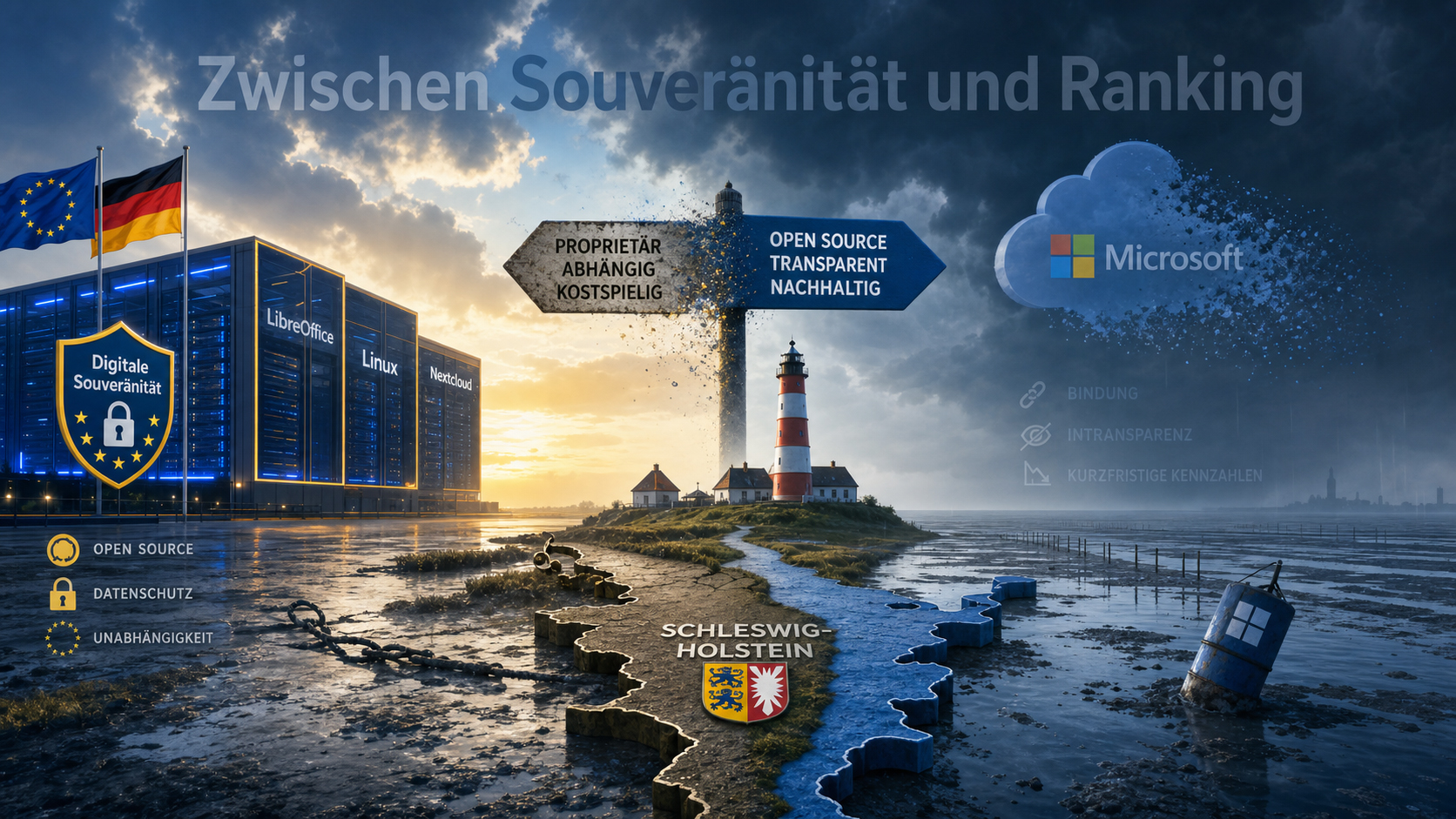
Plunging in the digital rankings: Why Schleswig-Holstein's IT crisis is actually a stroke of genius – Image: Xpert.Digital
Goodbye, Microsoft! How Schleswig-Holstein sacrificed its ranking for true independence – The real reason for the fall in the Bitkom country index
A model for all of Europe: Why Microsoft's departure is revolutionizing public administration
Email chaos in the justice system: The hard price for Schleswig-Holstein's digital freedom
A seeming setback that is in reality a historic breakthrough: In the current Bitkom state index for 2026, Schleswig-Holstein has slipped from seventh to tenth place. But those who only look at the raw numbers overlook the most radical and courageous IT project currently underway in German public administration. As the first federal state, Schleswig-Holstein is banishing Microsoft from its government offices and completely converting over 30,000 workstations to open-source solutions. That this unprecedented effort for true digital sovereignty will lead to friction, protests, and a drop in the index score in the short term is to be expected – replacing the foundation while operations continue inevitably results in a loss of stability. In the long term, however, the system change will save millions in taxpayer money annually and end the risky dependence on US tech giants. A look behind the scenes of this unprecedented transformation reveals why the current slump in the statistics is the price to pay for a future-proof, independent administration.
Schleswig-Holstein's digital decline as a strategic ascent
Changing a foundation means first losing the ground beneath your feet – and then gaining more
Schleswig-Holstein has slipped to tenth place in the Bitkom state index for 2026 – three places lower than in 2024, when the northernmost state held a solid seventh place in the middle of the pack. At first glance, this reads like bad news. On second thought, it could be the opposite: a statistical reflection of one of the boldest reform decisions in the history of German public administration IT.
The slump in the rankings: What the numbers really show
The Bitkom Country Index 2026 evaluates all 16 German states based on 30 indicators in four categories: digital economy, digital infrastructure, governance and administration, and digital society. With 57.9 out of a possible 100 points, Schleswig-Holstein ranks tenth – and this in the very year in which the state is undertaking the most ambitious IT transformation nationwide.
The detailed figures paint a more precise, yet contradictory picture. In the digital infrastructure category, Schleswig-Holstein ranks fourth with an index score of 74.8 points – a strong result reflecting massive investments in fiber optics, 5G coverage, and gigabit networks. For gigabit broadband in schools, the state even achieves an index score of 93.5 – the highest in Germany in this metric. However, the categories measuring the short-term availability and active use of digital services yield weak results: 13th place in digital administration with 51.6 points, and 13th place in the digital economy with 38.1 points.
The digital economy sub-dimension, in particular, reveals the structural weaknesses of this large, rural state outside its major metropolitan areas. Schleswig-Holstein scores only 17.9 points for startup creation and a mere 50.1 points for research in key technologies. This puts it in the same boat as all the other large, rural northern German states without major urban centers: Lower Saxony achieves 39.4 points in the digital economy, and Mecklenburg-Western Pomerania just 29.8. Schleswig-Holstein's fundamental weakness is therefore not new – it is simply being made more apparent by the ongoing systemic changes in its administration.
From seventh to tenth place: The structural context of the ranking
To understand the decline, one must understand how the ranking is constructed. The Bitkom Country Index 2024, the first edition published in April 2024, ranked Schleswig-Holstein seventh with 61.2 points. At that time, the state scored particularly well in digital infrastructure and ranked second nationwide – an outstanding result for a large, geographically dispersed state. The overall score for 2026 is now 57.9 points, representing a decrease of 3.3 points.
At the same time, other states have made enormous strides. Saarland, for example, which was still in twelfth place in 2024, has climbed to sixth place – with 61.7 points in 2026. North Rhine-Westphalia and Lower Saxony also overtook Schleswig-Holstein. The relative decline is therefore not solely due to its own shortcomings, but also to the rise of others. A direct comparison shows that Schleswig-Holstein has lost a minimal number of points in absolute terms, while others have gained.
Another factor concerns the weighting of the index. The Governance and Administration category measures, among other things, the degree of digitalization in municipalities and the use of digital government services. These very metrics are naturally impacted by an ongoing, still incomplete migration. While the hardware infrastructure has remained stable, the usage and availability metrics reflect the challenges of a complex IT transformation. The index measures a state – not a direction.
The decision: Why Schleswig-Holstein turned its back on Microsoft
In April 2024, the state government cabinet formally approved the introduction of the "digitally sovereign workplace." The project is unique in its radical scope in Germany: approximately 30,000 jobs in the state administration are to be completely migrated from Microsoft products to open-source alternatives – from Microsoft Office to LibreOffice, from Microsoft Outlook and Exchange to Open-Xchange and Mozilla Thunderbird, and in the long term, also from Windows to Linux.
The project is divided into six strategic pillars. In addition to office software, it includes replacing the telephony solution, replacing Microsoft Active Directory with an open-source directory system, and introducing a new collaboration platform based on Nextcloud – a European, data protection-compliant alternative to Microsoft SharePoint and Teams. Dataport, the state-owned IT service provider, is responsible for the technical implementation and is rolling out the migration in phases across the entire administration.
The driving force behind the project is Dirk Schrödter (CDU), head of the State Chancellery and Minister for Digitalization. He sees the move away from Microsoft not as a technical cost-cutting measure, but as a fundamental political decision: away from "vendor lock-in," i.e., the enforced dependence on a single provider, and towards genuine digital sovereignty – the right and ability of the state to know, control, and further develop its own IT infrastructure. International authorities and governments are observing this step with great interest – Schleswig-Holstein is explicitly considered a pioneer in the European Commission's Open Source Monitoring Network.
The pain of migration: chaos, data breaches, and protests from the judiciary
Major transformations create friction. In the summer of 2025, the situation escalated in parts of the state administration. After Dataport began migrating email mailboxes from Microsoft Exchange and Outlook to Open-Xchange and Thunderbird in April 2025, problems mounted. In August 2025, the police union spoke of "implementation chaos" at the Ministry of the Interior: emails were said to have appeared in the wrong departments, a data breach that Dataport attributed to human error in account assignment.
The reactions from the judiciary were even more severe. The Attorney General's office and several presiding judges wrote a formal letter to the minister in September 2025, warning of a "massive disruption to the courts." Judges reported that they temporarily had no access to their mailboxes—an intolerable situation given the urgent need for arrest warrants and search warrants. Local courts temporarily reactivated their fax machines to maintain accessibility. In a letter to all state employees, Schrödter publicly acknowledged errors and apologized for the problems that had arisen, while Dataport worked with a larger team to resolve the disruptions.
In the state parliament, the FDP submitted an urgent motion. Representative Bernd Buchholz criticized not only the technical problems but also the lack of employee participation and the minister's management style towards the affected employees. The criticism of the communication was justified: anyone implementing such a profound change for 30,000 employees must understand change management as a core process – not as a subsequent PR task.
Nevertheless, the migration is progressing. By October 2025, 35,000 out of a total of 44,000 email mailboxes had already been successfully migrated to the new platform. Outside of the tax administration, nearly 80 percent of workstations in the state administration have been switched to LibreOffice. The state has thus achieved a level of migration depth in a short time that Germany has rarely seen in comparable projects.
The Munich spectre: When politics overwhelms IT strategy
Anyone wanting to assess Schleswig-Holstein's approach cannot ignore Munich. Starting in 2003, the Bavarian capital undertook a similar experiment with the "LiMux" project: the goal was to migrate around 15,000 municipal jobs to Linux and open-source software. For many years, Munich was considered a prime example of European IT sovereignty.
Then, in 2017, a new city council under Mayor Dieter Reiter decided to return to Windows and Microsoft Office – a move that has since been linked to the relocation of Microsoft's German headquarters to Munich. This example shows that technical migration projects don't necessarily fail due to technical issues, but rather due to a lack of political continuity and institutional support. Schleswig-Holstein learned from this and enshrined the decision early in the cabinet – as a formally binding resolution, not as a pilot project.
The difference to the Munich experience is therefore less technical than political. In Kiel, there is a party-political consensus within the CDU-Green coalition, while in Munich, a change in government derailed the project. Nevertheless, the Munich story shows that structural risks remain: a future change of government, sustained pressure from employee representatives, or politically poorly communicated setbacks can jeopardize even well-founded projects.
The amount of savings: Economic logic behind the system change
Regardless of the sovereignty debate, fiscal logic provides a strong argument. According to the Ministry of Digital Affairs, Schleswig-Holstein will save over €15 million in licensing costs in 2026 alone – funds that the state previously paid annually to Microsoft for Windows, Office 365, and related services. This is offset by one-time investments of €9 million required to complete the migration and further develop the open-source solutions. The return on investment is therefore less than a year.
In the long term, the calculation is even more compelling. Proprietary software contracts with US corporations are subject to unilateral price increases, product changes, and forced upgrades. In these models, the public sector has no real bargaining power – it pays what the vendor demands or loses access to its own infrastructure. Open-source software breaks this cycle: The source code belongs to the community, further developments can be shared, and costs arise primarily from implementation and operation, not from license payments to external monopolists.
The Center for Digital Sovereignty of Public Administration (ZenDis), founded in 2022 by the Federal Ministry of the Interior, formulates this principle as "Public Money, Public Code": Anyone who uses public funds for software development should ensure that the result benefits the public and can be reused. Schleswig-Holstein puts this principle into practice by building its own open-source program office and actively participating in the European open-source community.
The strategic core: Why the US CLOUD Act is a threat to every European state
Behind the question of costs lies a profound geopolitical dimension. In June 2025, Anton Carniaux, Chief Legal Officer of Microsoft France, admitted under oath before a French Senate committee that Microsoft could not guarantee that data from European authorities would not be transferred to the US government. This statement is not a theoretical quibble – it strikes at the heart of the European data sovereignty debate.
The US CLOUD Act, passed by the US Congress in 2018, obligates US companies to grant government agencies access to data upon request—regardless of where that data is physically stored. A server in Frankfurt does not protect European government data from US access if the provider is a US company. Microsoft itself confirmed in writing to Scottish police authorities: "Microsoft have advised that they cannot guarantee data sovereignty for M365." Furthermore, the Patriot Act and the Foreign Intelligence Surveillance Act (FISA), which establish far-reaching access rights for US investigators and intelligence agencies, also apply to data from outside the US.
In the summer of 2025, the Center for Digital Sovereignty of Public Administration explicitly pointed out, under the headline "US Law Knows No Borders": "Laws such as the CLOUD Act and FISA 702 require all US cloud providers to disclose data even when it is stored outside the US." For a government administration that processes personnel data, tax data, social data, judicial data, and security-relevant information, this situation is unacceptable from both a legal and political perspective – regardless of how practical the corresponding cloud services are in everyday use.
92 percent of European cloud infrastructure is controlled by US providers – AWS, Azure, and Google Cloud almost completely dominate the market. This dependency is therefore not a peripheral issue, but a fundamental structural problem of the European digital economy and administration. Schleswig-Holstein is breaking with this logic – not as a theoretical experiment, but as a real, implemented administrative model.
Our EU and German expertise in business development, sales and marketing

Our EU and German expertise in business development, sales and marketing - Image: Xpert.Digital
Industry focus areas: B2B, digitalization (from AI to XR), mechanical engineering, logistics, renewable energies and industry
More information here:
A thematic hub offering insights and expertise:
- Knowledge platform covering global and regional economies, innovation and industry-specific trends
- A collection of analyses, insights, and background information from our key areas of focus
- A place for expertise and information on current developments in business and technology
- A hub for companies seeking information on markets, digitalization, and industry innovations
Bitkom index exposes short-term thinking: How digital sovereignty stands in contrast to ranking optimization
What the Bitkom index measures and what it does not measure
Herein lies the epistemological core problem of the entire debate. The Bitkom country index is a valuable tool for mapping the status quo of digitalization – but it measures current conditions, not transformation processes. Anyone who replaces their IT infrastructure during ongoing operations will inevitably perform worse in a cross-sectional measurement than someone who remains on a stable, albeit dependent, system.
This is exemplified by the category "Use of digital government services," which is included in the governance assessment: Schleswig-Holstein achieves 50.0 points here – a score directly dependent on the availability and user-friendliness of the existing systems. During a migration phase, in which systems are gradually replaced, email mailboxes are migrated in batches, and employees have to learn new software environments, this score will inevitably suffer. The index thus penalizes, in the short term, precisely the behavior that reduces dependencies in the long term.
Equally problematic is the category of digital economy, which measures startup creation and the density of IT professionals—factors that have little to do with the state administration's strategic IT decisions but are significantly influenced by the structural disadvantage of a large, rural North European state without a major metropolitan center. Hamburg scores 72 points in the digital economy, Berlin 68. These city-states are simply competing in a different category. Comparing them with a rural state like Schleswig-Holstein is methodologically problematic in this respect—like comparing a lightweight to a heavyweight without weight classes.
The paradox of sovereignty: Those who lose in the short term can win in the long term
There is a deeper economic logic behind Schleswig-Holstein's fall in the rankings: the logic of switching paths. In economic research, the term "switching costs" refers to the costs incurred when replacing an established system—including temporary productivity losses, training expenses, and compatibility issues. These costs are real and painful. They explain why most organizations and administrations avoid switching paths and prefer to remain in the existing system—even if that system is more expensive, more dependent, and riskier in the long run.
Schleswig-Holstein is consciously paying these switching costs. The decision is strategically sound and fiscally calculated: €15 million in savings per year are offset by a one-time investment of €9 million. Added to this is the strategic return on independence: no unilateral price increases, no data access risks due to US laws, and no dependence on the product paths of a foreign company. The Bitkom index simply does not reflect this return – because it is measured in degrees of freedom and risk reduction, not in measurable point values.
The question other German states should therefore be asking themselves is not: "Why has Schleswig-Holstein crashed?" but rather: "Why haven't we dared to take this step yet – and what is the real cost of inaction?" Bavaria, Baden-Württemberg, North Rhine-Westphalia, and all other states continue to pay millions in annual license fees to US corporations, store administrative data in systems subject to the US CLOUD Act, and thus make themselves vulnerable to an increasingly unpredictable geopolitical actor.
The Saarland as a counterpoint: A leap forward through other means
The Saarland presents the stark contrast to Schleswig-Holstein in the current ranking. Having ranked twelfth in 2024, the smallest of Germany's western states made the biggest leap of all the states in 2026, now occupying sixth place with 61.7 points. The Saarland's strength lies primarily in the "Digital Society" category, where it holds first place with an index score of 73.2 points – significantly better than all other states.
This shows that rapid ranking gains are possible by optimizing for indicators that the index places particular emphasis on: digital literacy, internet usage, and the population's digital attitudes. These categories can be improved in the short term through targeted programs, funding opportunities, and public communication campaigns – without requiring a radical overhaul of the administration's IT systems. Saarland and Schleswig-Holstein are therefore pursuing fundamentally different strategies: one optimized for ranking, the other for structural independence.
Both approaches have their merits. But only one of them addresses the fundamental problem of European digital policy: the technological and legal dependence on systems that are outside the scope of European regulation.
The European dimension: Schleswig-Holstein as a model for a continent
Interest in Schleswig-Holstein's experiment extends far beyond Germany's borders. The European Commission is actively monitoring the project through the Open Source Observatory (OSOR). Denmark, its immediate geographical neighbor, is planning similar steps: Danish Digitalization Minister Caroline Stage has announced plans to replace Microsoft products on at least half of all government computers this year, and by autumn most public institutions should be operating entirely without Microsoft.
The IT Planning Council of the federal and state governments defined strengthening digital sovereignty as a shared goal as early as 2021 and identified "increased use of open-source software" as a key lever. Since 2022, the Center for Digital Sovereignty (ZenDis) has been providing European open-source alternatives, such as "openDesk" and "openConference," which are precisely tailored to the needs of public administration. The political framework is therefore in place – what's lacking is the courage to implement it.
A hearing in the Bundestag's Digital Committee in December 2024 made it clear that the majority of experts considered the German government's commitment to open source to be far too weak. Jutta Horstmann from ZenDis spoke of "critical dependencies" and a "massive loss of control" over the state's digital sovereignty. The Bundestag faces the task of creating binding legal frameworks – the current provisions in the Online Access Act are insufficient. Schleswig-Holstein demonstrates what happens when one doesn't wait for the federal government.
The inconvenient truth behind the ranking: Convenience comes at a price
The German states that performed well in the Bitkom ranking in 2026 achieved this largely without fundamental system changes. They continue to use Microsoft products, pay their license fees, and their systems run stably – at least on the surface. But this stability comes at a high price: financially, through recurring annual license costs in the millions; legally, through continued exposure to the US CLOUD Act; and strategically, through the delivery of critical administrative data to systems outside European control.
The question the Bitkom index doesn't ask is: What does it cost a German state to rank well while pledging its IT sovereignty? The answer is difficult to monetize – but it's real. It manifests itself in the negotiating risks associated with future price increases, the latent risk of access by US law enforcement and intelligence agencies, and the political vulnerability to an American corporation that, in some cases, was even willing to relocate its German branch to a politically sensitive city to gain influence over municipal IT decisions.
Schleswig-Holstein is paying the price of transformation – and doing so deliberately. This is not a malfunction, but a political investment decision intended to bear fruit in the long term. The €15 million annual savings represent the first measurable return on this investment. Complete digital sovereignty is the ultimate goal.
Where the journey leads: Potentials and risks of the chosen path
Schleswig-Holstein will continue on its course. Following the completion of the email migration and the near-complete switch to LibreOffice, the next step is the introduction of Linux as the operating system on an initial one hundred pilot workstations, with the number to be gradually expanded. This is the most technically demanding part of the transformation because it concerns the operating system itself – the foundation of all other applications – and because many specialized applications were historically designed for Windows and will require extensive porting or replacement.
The greatest risk lies not in the technology. It lies in political continuity. Success depends on the state government maintaining this course after the next election, on improving change management to strengthen employee acceptance, and on ensuring that the transition for critical areas such as the judiciary and police is accompanied by sufficient buffer time and technical support. The data breaches and temporary access outages of 2025 have demonstrated where the Achilles' heel lies: not in the software itself, but in the quality of migration management.
At the same time, the potential is enormous. If Schleswig-Holstein proves that a fully open-source administration is practical, more cost-effective, and more sovereign than the proprietary model, this proof will be taken seriously throughout Europe. The state will then no longer be relegated to the middle of the pack in the Bitkom rankings, but rather serve as a laboratory for the digital future of the European rule of law.
The ranking is a snapshot; sovereignty is a long-term project
Schleswig-Holstein's slump in the Bitkom state index 2026 is real – and explainable. It's the statistical echo of a systemic transformation that is well underway. The indicators that weaken the state are precisely those that inevitably suffer during an IT system change: availability, usage rates, and the degree of digitalization in municipalities. The indicators that show the state's strength – infrastructure expansion and gigabit connectivity in schools – demonstrate that the physical and structural foundation is in place.
The comparison with the other 15 federal states should therefore not be seen as a race, but rather as a reflection of different strategic priorities. Those who want to climb the rankings in the short term optimize for metrics. Those who want to be sovereign in the long term invest in fundamentals – even if this means losing points in the index. Schleswig-Holstein has consciously taken this gamble. The outcome is still open. But the direction is clear: not away from digitalization, but towards a digitalization that truly belongs to the state and its citizens.





