
Container high-bay warehouses in the USA: Will this radical high-bay idea solve the US container chaos? Up to 70% less space required
Xpert Pre-Release

Available in 27 languages 📢
Prefer Xpert.Digital on GoogleⓘPublished on: May 30, 2026 / Updated on: May 30, 2026 – Author: Konrad Wolfenstein
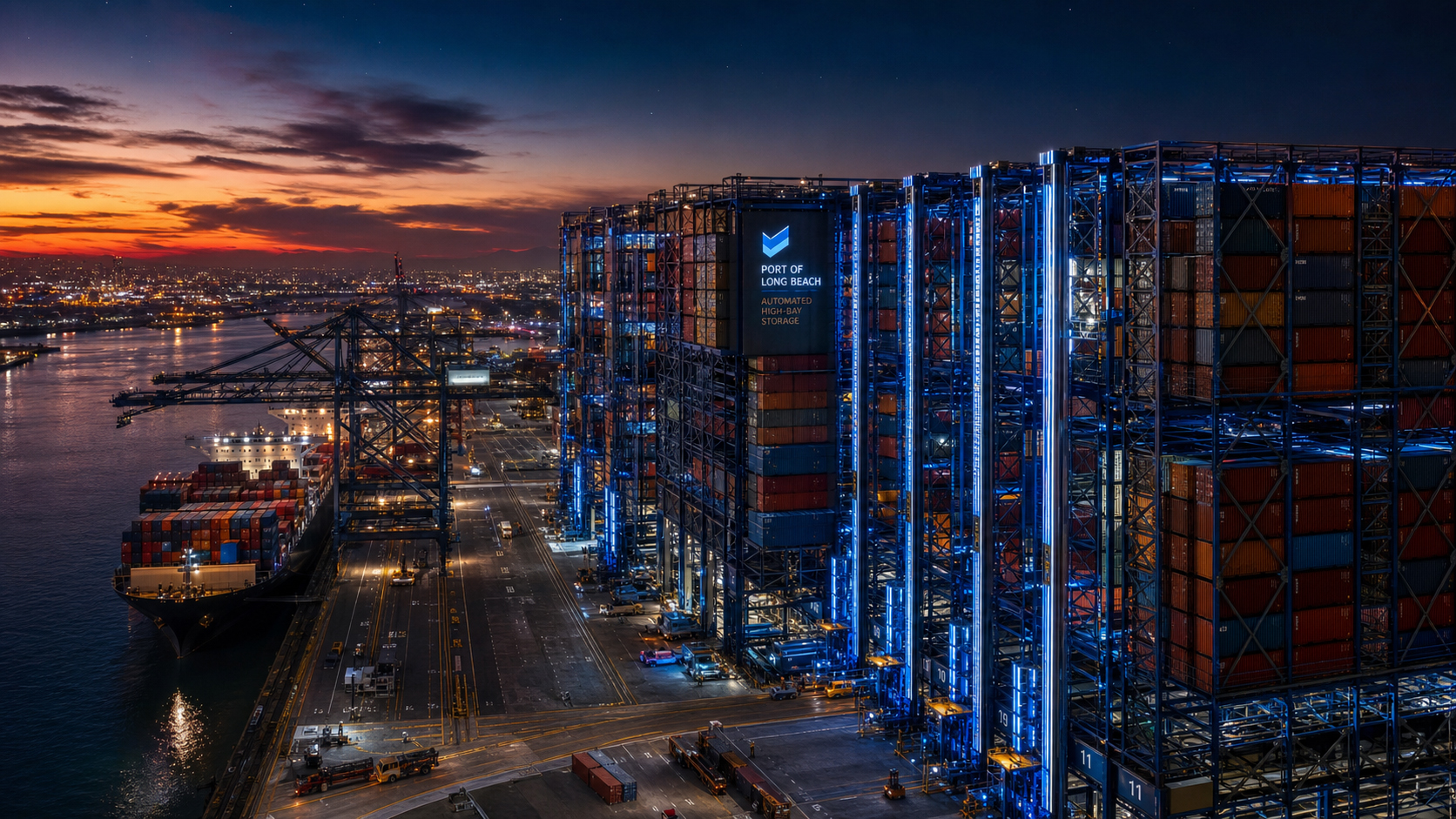
Container high-bay warehouses in the USA: Will this radical high-bay idea solve the US container chaos? Up to 70% less space required – Image: Xpert.Digital
Gigantic container towers: How this technology is forever changing America's ports
Stacking instead of scattering: The end of the flat port and the rise of automated container towers
US ports are facing a logistical and spatial challenge. As import volumes steadily increase and ships grow ever larger, traditional, space-intensive container storage at coastal metropolises is reaching its absolute limits. The solution to this structural bottleneck already exists and promises nothing less than a paradigm shift in the global supply chain: fully automated high-bay container warehouses. Instead of distributing shipping containers across vast areas, these facilities stack them up to sixteen layers high – individually accessible at any time, highly efficient, and emission-free.
Yet, despite the fact that the US, as the world's largest importer, has the most urgent need for this technology, it is paradoxically lagging behind in its implementation. High tariffs on steel, geopolitical dependencies in crane production, and a historically unprecedented social conflict with powerful dockworkers' unions are massively hindering progress. The following article sheds light on the fascinating technology behind the container towers, analyzes the explosive struggle between economic pressures for automation and the preservation of jobs, and shows why the planned billions of dollars in investments over the next few years will be crucial to whether America's ports remain competitive.
When the square meter becomes more expensive than the container – Why America is now building upwards
Space constraints as a strategic wake-up call: The structural pressure on American ports
The ports of the United States are under pressure that can be expressed in stark figures: In 2022, the 25 largest US container ports together handled 96 percent of all TEU (Twenty-Foot Equivalent Units) handled in the US. The Port of New York and New Jersey alone processed 6.66 million TEU, followed by Los Angeles with 6.42 million and Long Beach with 6.09 million. This concentration of container handling in a few megaports creates a structural bottleneck that cannot be resolved simply by expanding the available space – because space is becoming increasingly scarce in urban port areas.
This is precisely where the concept of the container high-bay warehouse comes in: Instead of distributing containers horizontally across vast areas and stacking them directly on top of each other in up to six layers, they are stored in a fully automated steel rack system up to eleven or even sixteen layers high – individually accessible, without time-consuming restacking, and available around the clock. The revolutionary difference lies not only in the height, but in the principle of direct access: Each container has its fixed storage location and can be retrieved independently of neighboring containers. This eliminates the so-called reshuffling effort, which currently accounts for between 30 and 60 percent of all container movements in conventional port terminals.
The economic logic is compelling: A high-bay container warehouse can triple the storage capacity of a conventional terminal on the same footprint and reduce land use by up to 70 percent. With steadily rising land prices near ports—one of the most expensive real estate segments in American metropolitan areas—this metric becomes a key economic argument. The question is no longer whether the US will adopt this technology, but when and at what pace.
The technology behind the tower: How a container high-bay warehouse works
The operating principle of the container high-bay warehouse is based on classic, fully automated high-bay warehouses that have been tried and tested in industry for decades – scaled down to the dimensions of a 20- or 40-foot shipping container. The steel racking structure accommodates each container in an individual storage space, similar to an oversized filing cabinet. Fully electrified stacking cranes or shuttle systems move through the racking aisles, handling storage and retrieval fully automatically.
The best-known reference system worldwide is BOXBAY, a joint venture between the German industrial group SMS Group and the global port operator DP World from Dubai. At BOXBAY, fully electrified, automated cranes move within the racking structure, achieving a throughput of 19.3 movements per hour at each waterside transfer table. The pilot project at the Port of Jebel Ali in Dubai, the first fully implemented system of its kind, was completed after more than 63,000 container movements in practical operation, exceeding all initial efficiency and energy expectations. To date, nearly 500,000 TEU have been handled via the system at the Jebel Ali site.
Another significant player that has recently expanded the technological spectrum is the crane and plant manufacturer Konecranes. In 2022, the company entered the market for automated container high-bay warehouse systems through a partnership with the Swedish high-bay specialist Pesmel. Konecranes' concept differs from BOXBAY in one key aspect: it envisions the direct structural integration of the container high-bay warehouse with adjacent storage and distribution buildings, allowing containers to be transferred directly to loading docks without intermediate handling. This would represent a paradigm shift for port logistics. In addition, the German intralogistics company Vollert is also presenting a complete concept for container-compatible high-bay storage that fully meets the direct access criteria.
The American market: Gigantic potential, hesitant use
The US finds itself in a peculiar position regarding container high-bay warehouses: as the world's largest importer with the most urgent structural need, yet without a single operational, fully operational container high-bay warehouse system on domestic soil. This stands in stark contrast to the US's technological leadership in other areas of warehouse automation.
The North American market for automated storage and retrieval systems (AS/RS) as a whole was valued at US$3.11 billion in 2025 and is projected to grow to US$4.57 billion by 2030, representing an annual growth rate of 8 percent. The US submarket for automated container terminals alone is estimated at US$2.20 billion in 2025 and is expected to reach US$6.21 billion by 2035 – an annual growth rate of nearly 6 percent. The global market for high-bay warehousing – encompassing all types of high-bay warehouses – was estimated at US$18.2 billion in 2024 and is projected to grow to US$36.7 billion by 2033.
What these figures don't yet fully reflect is the specific submarket for container high-bay warehouses, which emerges as a separate segment from the broader automation market. Estimates suggest that the global market for this specialized technology will reach a volume of over US$20 billion by 2034. Realistically, the US would be the single largest market by volume – simply due to the pressure on the few major ports that together handle the overwhelming majority of American foreign trade.
In the US itself, more than 25 automated or semi-automated container terminals will exist as of May 2026. The ports of Los Angeles and Long Beach together handle over 15 million TEU annually and have implemented automation technologies in more than 50 percent of their container handling operations. The Long Beach Container Terminal (LBCT) is considered one of the world's most advanced fully automated terminals, equipped with automated cranes, electric vehicles, and smart logistics systems. Nevertheless, a true high-bay container warehouse based on the principles of direct access and vertical compaction—comparable to BOXBAY in Dubai or the LTW system—has not yet been realized in the US.
Three ports in focus: Virginia, Los Angeles and Mobile
Virginia: Pioneers in crane automation
The Port of Virginia is the national showcase for automated port technology on the US East Coast. In 2023, the port authority ordered 36 state-of-the-art Automated Stacking Cranes (ASCs) from Finnish crane manufacturer Konecranes for the Norfolk International Terminals North Terminal project – a contract worth over €130 million. The 36 cranes were to be delivered in two batches of 18 units each: the first half by mid-2025, the second half by mid-2027. This positions the Port of Virginia as the most aggressive investor in automated container stacking technology on the East Coast.
This move follows a long-term strategy: Back in 2016, Virginia signed a $217 million contract with Konecranes for 86 automated stacker cranes to double capacity at the Virginia International Gateway and the Norfolk International Terminal. The goal at the time was to increase capacity to approximately 2.6 million containers and handle 40 percent of the new volume via double-stack trains operated by Norfolk Southern and CSX. The Port of Virginia thus embraced automation early on – unlike other US ports – and is considered a benchmark for the East Coast. While a complete high-bay container warehouse based on the vertical high-density stacking principle has not yet been implemented, the existing ASC infrastructure largely provides the technical foundation for such a step.
Los Angeles: TraPac and the next expansion stage
The Port of Los Angeles and the adjacent terminal in Long Beach together form the largest port complex in the Western Hemisphere. Within this complex, the TraPac terminal in Los Angeles is a global pioneer: It utilizes automated stacking cranes, fully automated driverless straddle carriers, and automated rail gantry cranes for dock-to-rail operations. According to the company, this system enables consignees to receive their goods an average of two days faster than at competing, non-automated terminals.
In April 2026, a landmark contract for the next expansion phase was announced: Austrian company Künz GmbH and ABB were awarded the contract to supply nine Rail Mounted Stacking Cranes (RMGs) for the expansion of the TraPac terminal. Delivery is scheduled for 2027 and 2028 and is expected to permanently increase yard capacity and container throughput. In parallel, the Port of Los Angeles unveiled extensive plans for a new terminal specifically designed for Ultra Large Container Vessels (ULCVs): featuring an extended quayside, deeper water levels, high-density automated yard blocks, and a focus on a rail-first design that replaces trucks with trains as the primary distribution system.
Meanwhile, in the Long Beach section of the complex, Automated Guided Vehicles (AGVs) – battery-electric units that autonomously transport containers weighing up to 70 tons through the terminal area and are coordinated by central control software – are in operation. A permanent battery swapping station ensures 24/7 operation. AI systems analyze ship arrivals, predict congestion risks, and optimize resource allocation in real time.
Mobile, Alabama: Intermodal link
Further southeast, the Port of Mobile, Alabama, demonstrates that the drive for modernization is not limited to the major ports on the East and West Coasts. In September 2025, the Alabama Port Authority ordered two Konecranes rubber-tired gantry cranes (RTGs) for a new intermodal container terminal in Montgomery, Alabama—the agency's first RTG purchase. Delivery is scheduled for the fourth quarter of 2026. Just months earlier, Mobile-based APM Terminals had announced a $58.6 million expansion of the Intermodal Container Transfer Facility (ICTF), including two new 3,000-foot work tracks and two cantilever rail-mounted gantry cranes. Completion is expected by the end of 2026.
The Port of Mobile stands out due to an episode that illustrates the explosive potential of automation in American labor policy: In the summer of 2024, the International Longshoremen's Association (ILA) broke off collective bargaining negotiations with the US Maritime Alliance (USMX) after APM Terminals implemented an automated gate system that processed trucks without ILA workers. This incident at the relatively small Port of Mobile triggered a national crisis in port labor negotiations and nearly a widespread strike—demonstrating the highly sensitive political and social nature of automation at American ports.
Six billion dollars over five years: The investment wave in US ports
The scale of the upcoming investment cycle is impressive. According to an industry report from May 2026, U.S. port and terminal operators plan to spend nearly $6.7 billion over the next five years on new cranes, handling equipment, and terminal upgrades. This is one of the largest coordinated investment announcements in the history of American port infrastructure.
The modernization strategy is linked to an economic policy agenda: The port industry is calling on the German government to support the relocation of crane production back to the USA. Currently, the global market for port cranes is dominated by Chinese manufacturers – above all ZPMC, which claims a global market share of over 70 percent. This dependence is increasingly viewed by US security agencies and policymakers as a strategic risk, since these cranes are used on critical port infrastructure and could theoretically incorporate functionalities for data acquisition or remote control. The combination of modernization needs, nearshoring logic, and national security policy creates strong momentum for the development of a domestic manufacturing and technology base.
North America dominated the global port infrastructure market in 2025 with a share of 30.28 percent. The global port infrastructure market is projected to grow from US$213.38 billion in 2025 to US$316.51 billion in 2034.
LTW Intralogistics Solutions

LTW Intralogistics – Engineers of Flow - Image: LTW Intralogistics GmbH
LTW offers its customers not individual components, but integrated complete solutions. Consulting, planning, mechanical and electrotechnical components, control and automation technology, as well as software and service – everything is networked and precisely coordinated.
In-house production of key components is particularly advantageous. This allows for optimal control of quality, supply chains, and interfaces.
LTW stands for reliability, transparency, and collaborative partnership. Loyalty and honesty are firmly anchored in the company's philosophy – a handshake still means something here.
Related to this:
Pilot projects, politics and profits: Who will win the race for port automation?
Tariffs, steel and stagnation: The disruptive fire of trade policy
The Trump administration's tariffs, effective from 2025, have created a disruptive environment that significantly complicates investment plans for high-bay container warehouses and port automation. The effects are multifaceted and, in some cases, paradoxical.
The steel market is directly affected: Since steel accounts for 60 to 70 percent of the total cost of racking systems, the 25 percent US tariff on steel and aluminum imports has immediately driven up material costs for high-bay warehouse projects. Steel King manager Brian Pfannes pointed to a 173 percent increase in hot-rolled steel prices within a year since the first tariffs were imposed in 2018. For container high-bay warehouse projects, which require gigantic steel structures, this represents a significant cost increase.
At the same time, imported shipping containers are subject to Section 301 duties ranging from 7.5 to 25 percent, depending on classification and country of origin – containers from China, by far the largest producer, are particularly affected. Reefer containers and high-cube models are subject to even higher tariffs due to their steel and electronic components.
The combined effect on the automation industry was clearly measurable in 2025: Many small and medium-sized enterprises postponed planned capital expenditures for automation projects due to tariff uncertainty. Large customers such as Amazon, Walmart, and some European retailers, on the other hand, continued to invest unabated, driving the overall market. Order intake for warehouse automation grew by a total of 7 percent in 2025 – primarily driven by a few very large investments, while the broader market stagnated. Dematic recorded order volume growth of 50 percent in the first three quarters of 2025, Toyota Industries Logistics Systems even 65 percent, and TGW 55 percent.
For 2026, a normalization and broadening of the investment base is expected: With decreasing geopolitical uncertainty and a declining vacancy rate in warehouses, the excess storage capacity from the pandemic period should be reduced, making new construction projects attractive again in the last quarter of 2026.
Union against robots: The social dynamite of automation
No aspect of container high-bay warehouse technology is more politically sensitive than its impact on port jobs. In the US, this issue has the explosive potential of a genuine conflict between economic necessity and social security.
The International Longshoremen's Association (ILA), the dockworkers' union of the East and Gulf Coasts, has long maintained an uncompromising position: a complete ban on automated and semi-automated equipment. ILA President Harold Daggett made it clear that the union was not prepared to accept even semi-automated equipment, which, by his definition, threatened ILA jobs. In November 2024, ILA negotiations with USMX collapsed after only two days of talks because employers introduced clauses allowing for semi-automated equipment. The union viewed semi-automated cranes, where an ILA worker operates them remotely from an indoor station, as a gateway to full automation.
The opposing economic argument is clear: USMX representatives argued that only modernization could secure the capacity and competitiveness of US ports – and thus ultimately more and better-paid jobs. In contrast, the West Coast's ILWU (International Longshore and Warehouse Union) announced a preliminary agreement on January 5, 2026, between the Pacific Maritime Association and the ILWU regarding the implementation of automation technologies – a breakthrough after years of stagnation. The agreement is expected to include retraining programs, early retirement incentives, and mechanisms for employee profit sharing. If these terms are ratified, it will pave the way for accelerated infrastructure development at the ports of Los Angeles, Long Beach, Oakland, and Seattle.
The social costs of uncontrolled full automation would be substantial: calculations show that automation at the ports of Los Angeles and Long Beach has already eliminated 535,848 working hours and $41.8 million in labor costs. In Mobile, Alabama, the introduction of semi-automated crane systems has projected significant reductions in stevedoring personnel for 2025/2026. The more structurally challenging question is: where will these workers be redirected in a region where port jobs are among the few remaining well-paid positions that don't require a college degree?
BOXBAY and the US perspective: When will the container high-bay warehouse come to America?
BOXBAY's global expansion provides a clear indication of its future direction. Following successful operations in Dubai, DP World invested £170 million in October 2025 to install a BOXBAY Empty Superstack at London Gateway – a system that stores empty containers up to 16 layers high in a fully enclosed, automated facility. Located on the new, fully electric Pier 4, the facility will have a capacity of up to 27,000 TEU of empty containers. The contract is valued at €91.7 million and is part of an ongoing €1.15 billion expansion investment at London Gateway.
A comparable announcement for the US is still lacking. While DP World has communicated plans to implement BOXBAY at the Pusan Newport Corporation (PNC) terminal in Busan, South Korea, US locations have not yet been named in public communications. Nevertheless, the strategic rationale for US expansion is overwhelmingly strong: DP World operates significant terminals in the US, the backlog of empty containers in American ports is a chronic and costly problem, and the shortage of space in major ports is steadily worsening.
Konecranes, on the other hand, is already deeply embedded in the American port infrastructure: The Port of Virginia, with its current €130 million contract for ASCs, is Konecranes' most important single port customer. The Automated High-Bay Container Storage (AHBCS) concept developed by the company, which enables direct integration with warehouse structures, would represent a logical continuation of the existing partnership in a follow-up American contract. While such a move has not yet been publicly confirmed, it is considered likely within the industry.
Vollert, the third major technology company with a serious container high-bay racking concept, is reportedly working on implementation projects for container logistics solutions, though these projects have not been publicly disclosed. Whether one of these projects is in the US remains unclear.
Economic logic in detail: What a container high-bay warehouse really costs
An honest economic evaluation of container high-bay warehouses in the US must address the significant discrepancy between the theoretical efficiency promises and the actual investment costs. Constructing a container high-bay warehouse is no small investment: the BOXBAY system for London Gateway alone costs €91.7 million under the contract, within a total project of €1.15 billion. The London system has a capacity of 27,000 TEU for empty containers – a large, but specialized system.
In the US, the investment landscape is complicated by several factors. First, tariffs on steel significantly increase material costs for the typically steel racking structure. Second, specialized equipment such as container handling cranes still largely comes from imported sources, which are also subject to tariffs. Third, the inevitable conflict with dockworkers' unions in US container projects can lead to project delays and cost overruns. Fourth, the regulatory framework for new port infrastructure in densely populated US coastal regions is complex and time-consuming.
However, there are compelling economic arguments against this. The shortage of skilled workers in the US warehousing sector is structural: The unemployment rate was 4.1 percent in June 2025, which is practically full employment. This shortage is particularly acute in physically demanding warehouse and port jobs where working from home is not an option. Furthermore, wages in the US are among the highest in the world – meaning that automation investments pay for themselves more quickly compared to European or Asian markets. A fully automated high-bay container warehouse requires no shift work with employees, no crane operators, and no security personnel.
The return on investment of such a system depends crucially on the increase in land value achieved through space savings of up to 70 percent. In Los Angeles or New Jersey, where commercial space near the port commands premium prices, this leverage is particularly effective. Adding in the operating cost savings from eliminating reshuffling, personnel costs, and accident risks results in a payback calculation that becomes compelling with high container volumes.
Market structure and competitors: Who is building the future?
The North American market for automated storage and retrieval systems is dominated by international heavyweights. MarketsandMarkets lists among the leading providers in the region: Daifuku (Japan), Murata Machinery (Japan), SSI Schäfer (Germany), TGW Logistics Group (Austria), and Kardex (Switzerland). Other companies with significant US operations include Dematic (KION Group), Honeywell Intelligrated, Swisslog, KNAPP, and Bastian Solutions.
In the specific container high-bay racking sector, the competitive landscape is still manageable: BOXBAY (DP World / SMS Group) is the only provider to have a fully implemented and operated system. LTW Intralogistics from Austria has announced a second container warehouse system that meets all direct access criteria. Konecranes is offering an innovative warehouse integration option with its AHBCS concept, but has not publicly disclosed any previous customer implementations. Vollert is working on projects discreetly.
The geographical distribution is interesting: all leading technology providers for container high-bay warehouses are of European or Japanese origin. The USA has not yet developed its own manufacturing base in this specialized area. This aligns with the broader picture in the port infrastructure sector, where the crane crisis also points to the dominance of Chinese manufacturers and is increasingly being viewed politically as a national vulnerability.
Sustainability dimension: Container high-bay warehouses as climate policy
The climate impact of container high-bay warehouses is an underestimated argument in public debate – yet it is one of the strongest. Fully electrified systems like BOXBAY can be designed so that the entire operation is powered by solar panels on the roof of the facility. This is not a theoretical promise: The Jebel Ali facility was planned from the outset with solar energy as its primary source.
The contrast to conventional terminal operations is stark: diesel-powered reach stackers and terminal tractors, which move containers across vast yards and constantly restack them, are significant emitters of nitrogen oxides, particulate matter, and CO₂ – and this in close proximity to urban residential areas. For ports like Los Angeles and Long Beach, which operate under strict California emissions regulations, full automation is also a regulatory necessity. The AGVs in Long Beach are already battery-electric and part of a program to comply with the California Clean Air Plan.
Beyond direct operational efficiency, the 70 percent space saving has an urban planning dimension: More compact terminal dimensions make it possible to free up adjacent areas for other uses or to enlarge buffer zones to residential areas. At a time when American port cities are grappling with the environmental and social burden of their cargo handling infrastructure, this is a political argument with real impact.
Outlook 2026 to 2030: Course correction or breakthrough?
The next five years will be crucial in determining whether the US catches up with the global leaders in container high-bay warehouses or continues to import technology.
Several factors point to a breakthrough: The $6.7 billion investment wave planned for the next five years provides the necessary financial momentum. Resolving the ILA conflict on the West Coast opens up political room for maneuver. Growing container throughput volumes—September 2024 alone saw a 20 percent year-over-year increase at the ten largest US ports—intensify the structural pressure on available space. Experience gained from successful BOXBAY operations in Dubai and soon in London will provide US port decision-makers with valuable benchmark data.
Arguments against rapid US implementation include the still open automation clause in the ILA negotiations on the East Coast, the tariff-related cost increases for steel and special equipment, and the lack of US manufacturers in this special segment, which leads to dependencies on European and Asian suppliers.
The most likely development path is incremental: Initially, pilot installations for empty containers based on the BOXBAY model will be implemented at one or two US ports – most likely West Coast ports following the ILWU agreement. These will serve as a reference and basis for negotiation. In parallel, the port industry, together with Congress, will develop funding programs for automated port infrastructure, similar to the CHIPS Act model for semiconductors. By 2030, at least one fully operational container high-bay warehouse should be in the US – possibly more if the geopolitical situation further increases the pressure on supply chain resilience.
The global market for container high-bay warehouse systems is projected to exceed US$20 billion by 2034. The USA, as the world's largest importer with the most pressing structural needs and the deepest capital market, will undoubtedly participate in this growth – the only question is whether they will be users or drivers of this technological wave.
Consulting - Planning - Implementation

Konrad Wolfenstein
I would be happy to serve as your personal advisor.
me at wolfenstein∂xpert.digital contact
Just call me on +49 7348 4088 965 .
Your intralogistics experts
Consulting, planning and implementation of complete solutions for high-bay warehouses and automated storage systems - Image: Xpert.Digital
More information here:










