

Published on: July 18, 2025 / Updated on: July 18, 2025 – Author: Konrad Wolfenstein

Container high-bay warehouse: Rack storage with direct individual access instead of restacking – Creative image Xpert.Digital
No more container Tetris, 90% less space, 100% more efficiency – The simple trick against warehouse chaos: Each container a compartment
What is a container high-bay warehouse and what advantages does it offer?
A container high-bay storage system (also known as high-bay storage or HBS) is a fully automated storage system specifically designed for storing standard shipping containers. Unlike traditional container yards, where containers are stacked directly on top of each other, a container high-bay storage system assigns each container its own individual shelf space. This revolutionary technology makes it possible to store containers up to eleven stories high without stacking them directly on top of each other.
The fundamental innovation lies in the fact that each container is housed in its own shelf compartment, thus ensuring direct, individual access to each container. This stands in stark contrast to conventional methods, where containers are stacked on top of each other, and to access a lower container, all the containers above must first be restacked.
The system is based on proven high-bay warehouse technology originally developed for the steel industry. SMS Group and its partner DP World have successfully adapted this technology for container terminals, implementing the world's first commercial system under the name "Boxbay".
Suitable for:

How does the storage and retrieval machine work in a container high-bay warehouse?
The heart of a container high-bay warehouse is the stacker crane, which is responsible for the fully automated transport of the containers. These rail-guided vehicles move in the aisles between the rows of racks and can transport containers in three dimensions: horizontally along the aisle, vertically upwards, and into the depth of the rack compartments.
A typical storage and retrieval machine for containers is a combination of a forklift and a lifting device specifically designed for heavy loads up to 18 tons. These machines are equipped with telescopic forks or other specialized lifting attachments to safely grip and transport containers.
Operation is fully automated by a warehouse management system that digitally manages each container location. Using a transponder system or similar technology, the storage and retrieval machines can precisely locate and retrieve each container. Power is supplied via conductor rails or energy chains, ensuring continuous operation.
What problems does the container high-bay warehouse solve?
Elimination of shuffle moves
The biggest problem with conventional container yards is the so-called shuffle moves or restacking movements. These unproductive movements occur when containers are stacked on top of each other, and to access a lower container, all the containers above it must first be moved.
In traditional container yards, these unproductive movements account for between 30% and 60% of all container movements. This means that up to two-thirds of all crane operations create no productive value but merely serve to remove obstacles. In a high-bay container storage system, these shuffle moves are completely eliminated, as every container has direct access.
Massive space savings
High-bay container warehouses can triple the storage capacity of a terminal on the same footprint. While conventional container yards can usually only stack containers up to six high, a high-bay warehouse allows for the storage of up to eleven containers on top of each other.
A practical example: An automated container warehouse can accommodate up to 250 containers in an area of only 950 m². Conventional storage would require 9,000 m² – that's a reduction in area of 90%.
How does its efficiency differ from that of conventional container yards?
Productivity increase
Container high-bay warehouses demonstrate impressive performance figures: 19.3 movements per hour can be achieved on the water side and 31.8 movements per hour on the land side. This high productivity results from the elimination of restacking operations and the ability to access each container directly.
Reduced waiting times
Direct access to each container can reduce truck handling times by 20 percent. This leads to less congestion at the terminals and better utilization of transport capacity. As a result, 350,000 unproductive movements can be saved annually.
Energy efficiency
Container-based high-bay warehouses are not only more productive but also more energy-efficient than conventional systems. With 29 percent lower energy costs and significantly reduced maintenance, operating costs are lower than those of traditional container yards. Power can be supplied via solar panels on the roof, further improving sustainability.
Your intralogistics experts
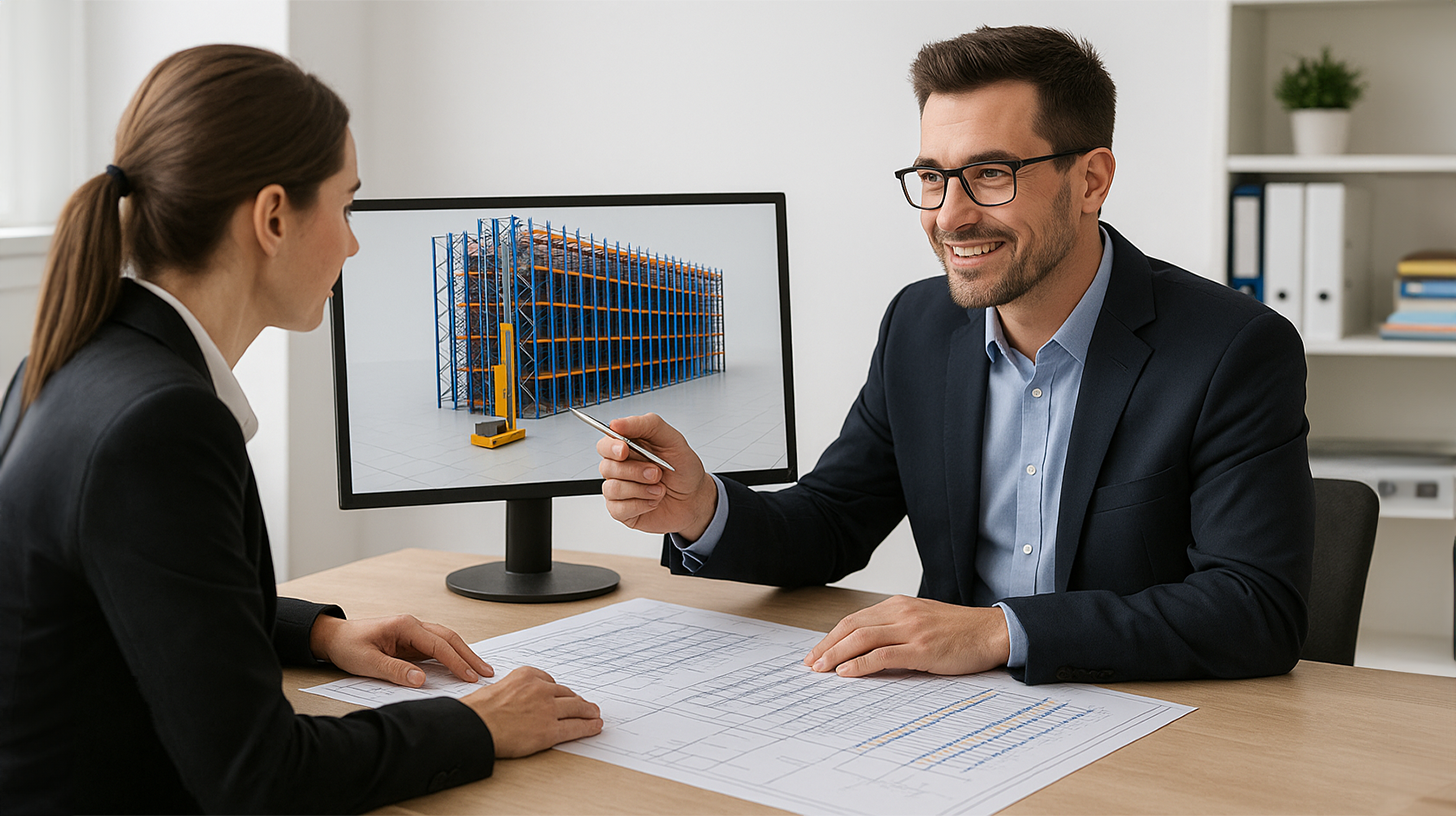
Advice, planning and implementation of complete solutions for high -bay warehouse and automated storage systems - Image: Xpert.digital
More about it here:
Smart container storage – Technological shift: Direct individual access is changing global trade
What technological innovations enable direct individual access?
Automated control systems
The key technology for direct individual access lies in the automated control systems. These computer-aided systems manage the position of each individual container and can optimally coordinate transport orders. Artificial intelligence helps predict the most cost-effective storage location for each container.
Shelf construction
The racking system allows containers to be stored up to a height of 50 meters. The steel structure is dimensioned to safely support loads of up to 50 tons per container. Each container is stored in its own racking compartment, ensuring direct access.
Flexible interfaces
Container high-bay warehouses can be loaded and unloaded from various sides. A circulating transport system connects the aisles and creates flexibility in handling. This makes it possible to serve different modes of transport (ship, truck, rail) simultaneously.
What challenges exist during implementation?
High investment costs
Implementing a high-bay container warehouse requires significant investment. The fully automated technology, the storage and retrieval machines, and the complex control software are expensive to purchase. However, these investments pay for themselves through significantly lower operating costs and increased efficiency.
Complex planning and organization
Constructing a high-bay container warehouse requires complex design and planning. The stability and load-bearing capacity of the racking structure must be guaranteed, and integration into existing terminal structures is intricate. Furthermore, personnel require comprehensive training to operate the specialized storage and retrieval machines.
Technical risks
Highly automated systems carry the risk of total system failure. If the storage and retrieval machine or the control software fails, the entire warehouse area can be affected. Therefore, redundant systems with multiple storage and retrieval machines per aisle are often implemented.
How will container storage develop in the future?
Worldwide distribution
The first commercial high-bay container storage system has already been successfully tested in Dubai, handling over 63,000 container movements without major issues. The system is now being implemented in other ports, such as Busan, South Korea.
Modular expandability
Container high-bay warehouses are modular and fully scalable. Terminals can start with an initial module and expand the system gradually as needed. This allows even smaller ports to benefit from the technology without having to implement a complete solution immediately.
Integration into existing terminals
The technology can be seamlessly integrated into existing terminals. Container high-bay warehouses can be retrofitted on empty storage areas without disrupting ongoing operations. This is particularly important for established ports that need to expand their capacity but lack the space for new terminals.
What impact will this have on global logistics?
Easing of supply chain disruptions
High-bay container storage facilities can make a significant contribution to easing global supply chain problems. The increased storage capacity allows terminals to maintain larger buffer stocks, making supply chains more resilient. Reduced ship turnaround times also alleviate congestion in ports.
sustainability
The technology contributes to sustainability by requiring less space and reducing energy consumption. By minimizing shuffle movements, less fuel and energy are wasted on unproductive motion. The option of using solar energy further improves the environmental footprint.
Competitiveness of the ports
High-bay container storage facilities can significantly increase the competitiveness of ports. Ports implementing this technology can offer faster turnaround times and higher capacities, making them more attractive to shipping companies. This is particularly important as container ships become ever larger and require more handling capacity.
Revolution in container logistics
High-bay container storage systems with direct individual access represent a revolutionary development in port logistics. They solve the fundamental problem of unproductive shuffle movements, which account for up to 60% of all movements in conventional container yards. Storing each container in its own rack space enables direct access, leading to massive increases in efficiency.
The technology offers not only economic advantages such as tripled storage capacity and 20% shorter truck processing times, but also contributes to sustainability. With 29% lower energy costs and the possibility of using solar energy, it is more environmentally friendly than conventional systems.
The successful implementation in Dubai and the planned projects in other ports demonstrate that high-bay container storage facilities are not just a vision, but already a reality. They have the potential to transform global logistics and help ports keep pace with growing container volumes and ever-larger ships.
For the future of container logistics, this signifies a paradigm shift: away from space-intensive, inefficient stacking systems towards highly automated, space-saving high-bay warehouses with direct individual access to each container. This innovation will significantly contribute to overcoming the challenges of global logistics and enabling more sustainable port operations.

Xpert.Plus warehouse optimization - high-bay warehouses such as pallet warehouses consulting and planning
Your global marketing and business development partner
☑️ Our business language is English or German
☑️ NEW: Correspondence in your national language!

Konrad Wolfenstein
I would be happy to serve you and my team as a personal advisor.
You can contact me by filling out the contact form or simply call me on +49 7348 4088 965 (Munich) . My email address is: wolfenstein ∂ xpert.digital
I'm looking forward to our joint project.


