Container high-bay warehouse market 2026: How vertical port logistics is creating a new infrastructure market – container storage instead of port expansion
Xpert Pre-Release

Available in 27 languages 📢
Prefer Xpert.Digital on GoogleⓘPublished on: November 27, 2026 / Updated on: November 27, 2026 – Author: Konrad Wolfenstein
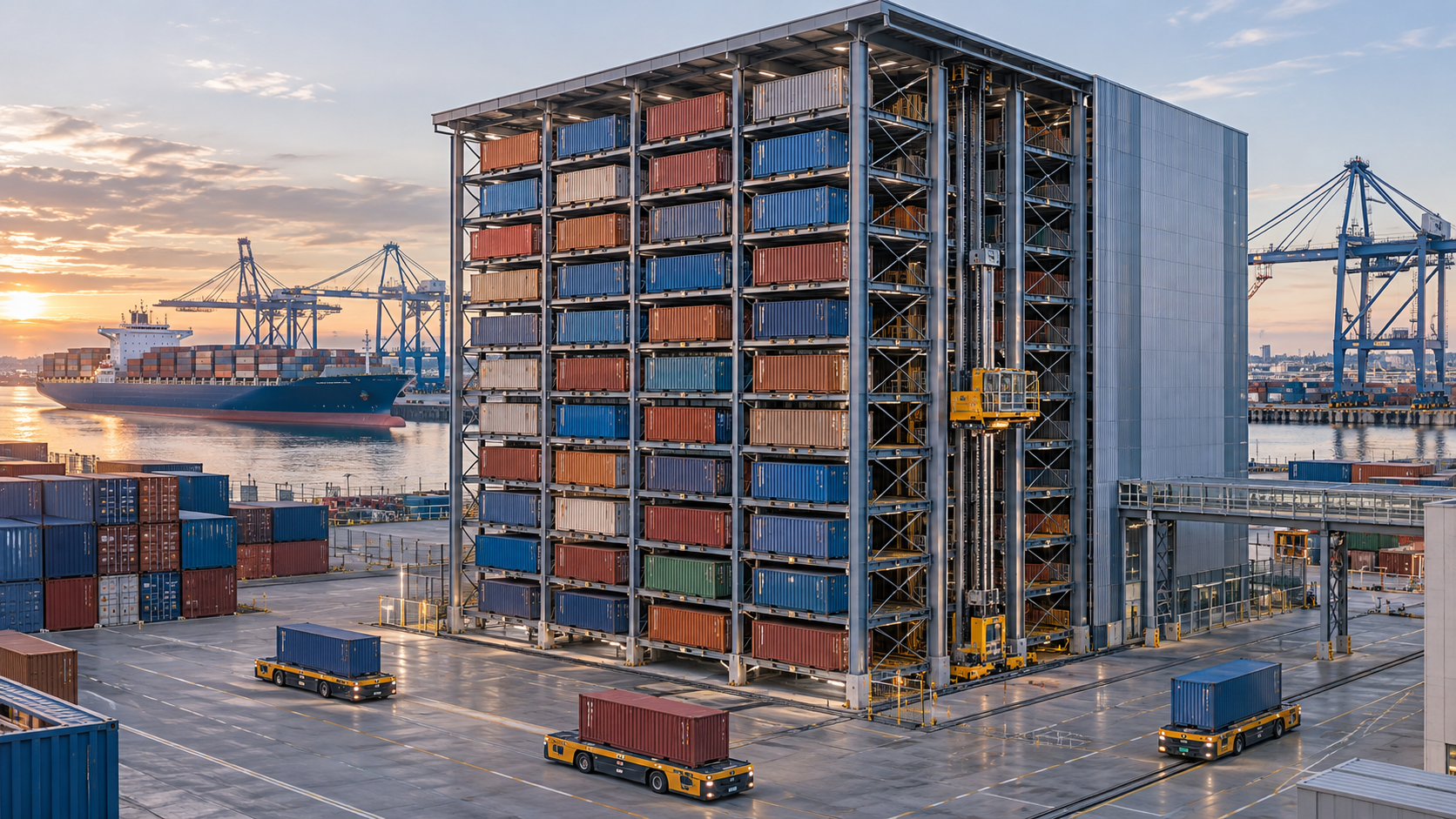
Container high-bay warehouse market 2026: How vertical port logistics is creating a new infrastructure market – container storage instead of port expansion – creative image on the topic, with AI: Xpert.Digital
Container high-bay warehouses: How ports plan to make better use of scarce space in the future
Up to 27,000 containers in a confined space: These port warehouses rely on vertical space
Less space, more storage capacity: Why container high-bay warehouses are becoming interesting for ports
Ports need storage space – but in many places, it's becoming scarce, expensive, or difficult to expand. High-bay container warehouses promise a solution: they store containers on multiple levels, thus creating more capacity in a limited space. By 2026, the technology will have moved beyond the concept phase. Large projects like the planned high-bay warehouse at the British port of London Gateway demonstrate that operators are seriously investing in vertical port logistics. However, widespread adoption has not yet been achieved.
High storage capacity alone does not guarantee a successful business model. Crucially, the systems must function reliably in daily operation, be easily integrated into existing terminals, and actually reduce costs or alleviate bottlenecks. Storage facilities for empty containers and locations where land is scarce and expensive initially appear particularly promising. This overview demonstrates how high-bay container warehouses operate, which projects are shaping the market, and why their success depends on delivering more than simply stacking containers higher.
The most expensive space in the port is the poorly used space
Between technological breakthrough and economic test
By 2026, the global market for high-bay container storage had evolved from a field primarily characterized by pilot plants and technical concepts to an early commercial infrastructure market. However, widespread adoption is still a long way off. Development has so far been driven by a few major projects, diverse technical approaches, and a growing focus on the efficient use of scarce port space. The key shift, therefore, lies less in a high number of installed facilities than in the quality of investment decisions: vertical container storage is increasingly being viewed as a viable alternative to expanding conventional storage areas.
This transition is particularly evident at the British port of London Gateway. There, in October 2025, an investment of £170 million in an automated high-bay warehouse for empty containers was announced. The facility is designed to accommodate up to 27,000 TEU and store containers on up to 16 levels within an enclosed building. The construction period was stated as just over two years. For the market assessment in 2026, this means that a major commercial project has been initiated, but its full operational and economic viability cannot yet be determined.
The outlook for the coming years is generally positive, but highly dependent on location. Container high-bay warehouses solve a real problem: In many ports, the demands on storage capacity, planning, and space efficiency are increasing, while new land is scarce, expensive, or politically controversial. At the same time, these systems compete with established and increasingly automated storage methods. Their success therefore depends not only on how high containers can be stacked, but also on whether the additional density justifies the higher capital, integration, and maintenance costs.
The most economically convincing assessment is therefore this: In 2026, container high-bay warehouses will be neither an experimental niche topic nor the new global standard. They represent an emerging specialized market with considerable potential at selected locations. Applications that converge on high land values, large stocks of empty containers, and long-term secured terminal use appear particularly promising.
Why market definition determines every growth figure
A sound analysis begins with a conceptual distinction. A container high-bay warehouse is not an ordinary pallet high-bay warehouse, nor is it automatically just any container terminal with particularly high stacks. In a narrower sense, it is a system in which standardized transport containers are stored in a load-bearing racking structure and automatically retrieved and stored. Depending on the design, each container has its own designated space, eliminating the need to move other containers to access it.
In addition, high-density storage systems are being developed that continue to stack containers directly on top of each other. These can also reach great heights and operate largely automatically. However, they differ economically and operationally from single-location systems: If a desired container is located beneath other units, additional relocations may be necessary. Therefore, the sheer number of storage levels says little about the ease of access.
Equally important is the distinction between empty and loaded containers. An empty container depot handles different loads, safety requirements, and sorting tasks than a facility for loaded units. Furthermore, there are special applications for swap bodies, military material containers, or intermodal transshipment points. These sub-markets share fundamental technical principles but do not follow the same investment logics.
This creates a significant problem with published market forecasts. Some studies consider automated high-bay warehouses in their entirety, others all container handling, or broad groups of automated port machinery. Such revenue figures cannot simply be extrapolated to container high-bay warehouses in the narrower sense. A multi-billion-dollar market for container technology is not automatically a multi-billion-dollar market for vertical racking systems.
For 2026, the publicly available project data does not allow for a sufficiently reliable, globally standardized revenue figure for this narrow segment. A seemingly precise global market figure would therefore create a false impression of accuracy. More meaningful indicators are concrete investment volumes, announced capacities, technological development status, and verifiable operational references.
Global trade is not growing uniformly – but the pressure on the surface area remains nonetheless
The demand for high-bay container warehouses cannot be explained solely by the growth of global trade. Crucially, it is driven by the interplay of long-term volume trends, regional shifts, and short-term peak loads. In 2024, approximately 920 million TEU were handled in ports worldwide, representing a 6.9 percent increase compared to the previous year. Since 2014, global port container throughput has thus increased by roughly 248 million TEU, or 37 percent.
TEU refers to the capacity of a 20-foot standard container. A 40-foot container is equivalent to two TEUs. Furthermore, a distinction must be made between port throughput and the actual volume of goods transported: A container can be transshipped at several ports during its journey and thus counted multiple times. Global throughput statistics therefore describe the utilization of port infrastructure, not the number of different containers or shipments of goods.
The economic outlook for 2026 is more nuanced. The assessment of maritime transport published at the end of November anticipates stagnation for overall maritime trade, while containerized trade is expected to grow by 3.3 percent. For 2025, container trade is projected to increase by 5.3 percent. This demonstrates that container traffic can continue to expand even in an overall weak maritime environment. However, the figures for 2026 are still forecasts and not final annual results.
Furthermore, there is a shift in trade geography. Container trade between developing countries increased by 12.1 percent in 2025, reaching a share of 14.2 percent of global containerized trade. In contrast, the major East-West shipping routes saw growth of only 0.9 percent. For the port industry, this means that additional infrastructure needs are not evenly distributed across existing trade routes.
This relationship is important for high-bay warehouses, but not mechanically. A growing port doesn't necessarily require a vertical warehouse. Conversely, a port with only moderate volume growth can have a strong investment incentive if its space is fully utilized, containers are sitting idle for extended periods, or existing transport routes are suffering from peak loads. The market is thus determined more by local bottlenecks than by a single global growth rate.
The real bottleneck is often not the quay, but the warehouse behind it
A container terminal functions as an integrated production system. Ship handling, horizontal transport, intermediate storage, truck processing, and rail transshipment must be coordinated. If one area reaches its capacity limit, this can restrict the performance of other areas. Therefore, a more efficient container crane does not automatically increase overall throughput if the storage area behind it can no longer accommodate any more containers.
The economic appeal of a high-bay warehouse stems primarily from decoupling storage capacity from horizontal footprint. With traditional stacking systems, additional capacity often leads to increased density on existing floors or spatial expansion. A racking system, however, shifts a larger portion of the capacity increase vertically. BOXBAY describes its technology as achieving comparable storage capacity on approximately one-third the footprint of conventional systems. These figures should be understood as system-specific benchmarks and not as a universally achievable improvement for every terminal.
The freed-up space can be used in various economically viable ways. It can provide additional storage areas, alleviate traffic congestion, or create space for other terminal functions. Therefore, the benefit is not solely in terms of saved land costs. It can also lie in postponing a necessary expansion or creating additional handling capacity within an existing location.
However, a distinction must be made between storage density and terminal throughput. A storage area with three times the density does not automatically lead to three times the annual throughput. If access roads, rail lines, container cranes, or personnel processes are already operating at capacity, the additional storage capacity will remain partially unused. A convincing investment proposal must therefore demonstrate which specific bottleneck will be eliminated and how this will affect the entire process chain.
From Jebel Ali to London: How a technical proof becomes an investment market
The development of BOXBAY illustrates the transition from technical testing to commercial application. This joint venture between DP World and SMS group transfers the principles of automated heavy-duty storage to container handling. The industrial foundation stems from the handling of heavy metal products, where large loads are moved automatically in tall racking structures over many years.
In early 2021, a pilot facility capable of handling 792 containers simultaneously was commissioned in Jebel Ali. By August of that year, more than 63,000 container movements had been carried out. The containers were stored in a steel structure with up to eleven levels. This facility provided important evidence that the concept works in principle under realistic conditions.
In October 2025, a cumulative throughput of approximately 500,000 TEU was reported for the trial in Jebel Ali. This figure documents the scope of the trial to date, but is neither an annual throughput nor a direct indication of storage capacity. Furthermore, TEU values cannot be directly translated into individual handling operations without knowing the proportion of 20- and 40-foot containers.
The next development step is more demanding than the initial proof of concept. A commercial system must not only move containers reliably, but also do so for many years with predictable costs, high availability, and functioning interfaces to the rest of the terminal. Only then will it become clear whether a technologically compelling solution also achieves a lasting economic advantage in daily operation.
London Gateway is therefore an important reference case. The project combines large storage capacity, a clearly defined use case for empty containers, and integration into an existing port location. At the same time, it should be noted that for 2026, an announced investment and expected performance do not yet constitute a final measurement of success.
Why empty containers currently offer the most convincing entry point
Empty containers may seem like an unattractive storage option at first glance: they don't transport any goods, yet they occupy valuable space and still need to be sorted, staged, and handled. This is precisely where a potential application for high-bay warehouses arises. By storing empty units more densely and in a more organized manner, other terminal areas can be relieved of this burden. For London Gateway, this relief of conventional automated storage blocks is a key part of the intended benefit.
From a technical standpoint, empty containers offer advantages over loaded units. Their lighter weights facilitate taller storage structures and alter the requirements for the supporting structure and handling technology. Furthermore, empty containers can often be grouped by shipping company, size, and design. This makes it less problematic under certain conditions if not every single unit is immediately accessible at all times.
The London concept utilizes double-deep storage. Two storage bays are positioned one behind the other, increasing storage density compared to a single-deep arrangement. However, the rear bay is not accessible independently of the front one. The increased density is therefore achieved at the cost of restricted direct access. For suitable groups of empty containers, this compromise can be economically viable.
Loaded containers, on the other hand, are more heavily influenced by individual delivery dates, contents, weights, and specific handling requirements. In these cases, direct individual access can be more valuable. At the same time, the demands on security concepts and technical design increase. It would therefore be wrong to automatically assume identical economic efficiency for full container storage based solely on the success of an empty container depot.
The most likely development initially is specialization rather than a universal standard solution. Empty container storage facilities, directly accessible full container storage facilities, and special intermodal applications are likely to take on different technical forms. This very differentiation can accelerate market development because it adapts the system to specific economic problems.
London Gateway provides an order of magnitude, but not a general price benchmark
The announced investment volume of £170 million and the planned capacity of 27,000 TEU allow for an initial economic assessment of the London project. This results in a calculated investment intensity of approximately £6,300 per TEU of nominal storage capacity. This figure is a rough derivation from the published project information and not a separately stated plant price.
Their informative value is limited. It is not publicly clear which cost components are included in the investment scope and how they are distributed across the building, supporting structure, conveyor technology, control systems, construction work, and integration. Furthermore, a TEU storage capacity describes an inventory, while a TEU annual throughput refers to performance over time. These two metrics should not be equated.
For economic viability, the frequency with which available storage spaces are used per year is crucial. A warehouse with a high turnover rate spreads its capital costs across more handled units than a similarly sized facility with long dwell times. Conversely, a warehouse with longer dwell times can be economically advantageous if it frees up particularly expensive space or relieves pressure on another important terminal area.
Technical utilization also needs to be considered in a differentiated manner. High utilization does not automatically improve the result if it leads to overloaded transfer points or delayed outsourcing. A combination of usable capacity, sufficient peak performance, and reliable availability is crucial.
The London project is therefore primarily an indicator of the scale of individual investment decisions. It shows that the market already includes projects with hundreds of millions of euros. However, it does not allow for reliable extrapolations to global annual revenues or average costs of all future plants.
LTW Intralogistics Solutions

LTW Intralogistics – Engineers of Flow - Image: LTW Intralogistics GmbH
LTW offers its customers not individual components, but integrated complete solutions. Consulting, planning, mechanical and electrotechnical components, control and automation technology, as well as software and service – everything is networked and precisely coordinated.
In-house production of key components is particularly advantageous. This allows for optimal control of quality, supply chains, and interfaces.
LTW stands for reliability, transparency, and collaborative partnership. Loyalty and honesty are firmly anchored in the company's philosophy – a handshake still means something here.
Related to this:
The economic advantages of container high-bay warehouses
The economic core: avoided movements and avoided expansions
The investment benefits of a container high-bay warehouse consist of several components. These include avoided space expansions, fewer unproductive relocations, better utilization of existing machinery, and potentially shorter handling times. These advantages are site-specific and cannot be simply added together, as they partially influence each other.
An example is the planned application at the Pusan Newport Corporation terminal in Busan. For this project, the stated targets were the avoidance of 350,000 unproductive movements annually and a 20 percent improvement in truck handling time. These figures describe expected project-specific effects. They should not be understood as independently verified operational results, and certainly not as a general performance guarantee for every high-bay warehouse.
The economic logic behind reducing material handling is nevertheless clear. Every additional movement consumes machine time, energy, and reduces the lifespan of the equipment. It can also exacerbate bottlenecks on heavily used machines. Therefore, avoiding a handling operation not only has a direct cost effect but can also free up additional productive capacity during peak times.
The same applies to avoided expansions. If a terminal can forgo additional land through vertical densification, it may not only save on land costs. It can also avoid delays, new transport routes, and costly adjustments to other infrastructure. However, the value of these effects depends on whether horizontal expansion is realistically possible in the first place.
A sound economic analysis must therefore work with a concrete alternative model. The relevant question is not whether a high-bay warehouse is technically superior to maintaining the status quo. The crucial question is whether it delivers greater long-term benefits compared to the best realistic alternative.
The competition never sleeps: Automated block storage systems remain strong
Container high-bay warehouses are not competing against a technologically unchanged port environment. Automated stacking cranes, optimized storage strategies, and improved terminal software are also constantly evolving. Therefore, an operator may be able to increase productivity without switching to a completely new warehouse architecture.
The key advantage of traditional and automated block storage systems is that they already fit the operating model at many locations. High-bay warehouses, on the other hand, often have to justify their added value through more significant interventions in the building structure, material flow, and control architecture. Therefore, the comparison between additional density and increased system complexity becomes particularly relevant.
Different competitive models are also emerging within vertical storage technology. For ZPMC, developments of highly compact, automated empty container storage systems with up to 18 levels were described in 2026. However, in these approaches, containers remain partially stacked directly on top of each other. This fundamentally distinguishes them from racking systems with individual storage spaces and independent access. Furthermore, the publicly described project status does not allow all announced systems to be classified as fully proven, standardized solutions.
This technical diversity argues against a market where a single concept quickly displaces all others. A competition for suitable applications is more likely. One system might excel at maximum empty container compaction, another at direct access to loaded units, and a third at small, particularly reliable specialized storage facilities.
This differentiation is advantageous for customers as long as performance promises are made comparable. To achieve this, nominal storage capacity, actual achievable throughput, required transfers, and availability must be shown separately.
Software determines whether high density translates into high performance
A container high-bay warehouse is not just a structure with automated cranes. It is a tightly integrated control system in which storage space allocation, transport orders, and handovers must be continuously coordinated. Even the order in which containers are stored can influence how quickly they can be made available later.
The integration with terminal operations is particularly challenging. Ship arrivals, truck time slots, and rail traffic follow different schedules. The warehouse must, on the one hand, meet short-term demands and, on the other hand, prevent frequently used equipment or transfer points from being overloaded simultaneously.
The technical discussion surrounding the London concept demonstrates the importance of these interfaces. Among other things, direct truck transfers and separate waterside transfer functions are described. Such designs are intended to integrate the high-bay warehouse into existing transport processes. At the same time, they place high demands on the coordination between warehouse control, vehicles, and the higher-level terminal system.
Artificial intelligence can be seen as a supporting tool in this context, for example for forecasting and evaluating different storage strategies. However, it does not replace robust plant control systems. Safety-critical movements, unambiguous releases, and technical interlocks must function reliably even if forecasts are incorrect or communication links fail.
Economic competition is therefore likely to increasingly shift towards the quality of the overall solution. The supporting structure and lifting technology remain indispensable, but the achievable performance depends significantly on how well the system anticipates changing requirements and manages disruptions.
More automation changes the risk, rather than making it disappear
Automation can remove people from immediate danger zones and further standardize repetitive movements. At the same time, a highly integrated warehouse increases its dependence on technical availability. If a central piece of equipment fails, the crucial question is which containers remain accessible and how quickly a backup operation can be organized.
For economic evaluation, an average availability indicator alone is therefore insufficient. A brief outage during peak demand can have significantly greater consequences than a longer shutdown during a quiet period. Operators must also distinguish whether a disruption affects only one corridor, one transfer point, or a large part of the system.
Specialized applications demonstrate how different priorities can be. In a container depot designed for Emmen by LTW Intralogistics, the focus is on approximately 600 container spaces, a payload of 18 tons, handling various load carriers, and technical redundancy. Such a facility pursues different objectives than a large seaport terminal with pronounced peak loads.
For port facilities, therefore, maintenance accessibility, spare parts supply, fault diagnosis, and restart strategies are integral parts of the business model from the outset. A high storage density can lose its economic advantage if recovery after technical problems takes too long.
Additional requirements include fire protection, escape routes, and the handling of damaged or unsuitable containers. Especially with loaded units, the system must be integrated into a comprehensive safety organization. Increased height and automation are therefore not isolated productivity features, but rather alter the entire risk profile.
The environmental impact depends on the comparison case
Electrically powered high-bay warehouses can help reduce direct emissions during operation. For London Gateway, fully electric storage and retrieval machines are planned; energy recovery and more efficient handling are also cited as technical features.
A serious environmental assessment, however, must consider more than just the propulsion system. Lifting containers requires energy. At the same time, avoiding relocations and shortening transport routes can reduce consumption. Whether the overall balance is better therefore depends on the number and type of movements, the quality of the control system, and the source of the electricity used.
The manufacturing process is also relevant. A large racking system and an enclosed building generate material requirements and construction emissions. These impacts must be assessed over the system's service life and actual throughput. A heavily used, long-lasting system can spread its initial environmental costs over a larger output than an underutilized system.
The comparison between the two is particularly important. If a high-bay warehouse avoids the need for additional port space, extensive groundworks, or longer internal transport routes, this can improve its environmental footprint. However, if an existing, well-functioning area could be used without major expansion, this advantage is less pronounced.
Photovoltaics on large roof areas can make a supplementary contribution. The Busan concept included provisions for such use. However, this does not automatically guarantee energy self-sufficiency: generation and consumption do not always coincide, and the actual coverage rate depends on location, roof design, and operational profile.
Europe, Asia, and the Middle East follow different investment logics
The projects visible so far demonstrate that high-bay container storage facilities are not driven by a single regional demand pattern. Jebel Ali represents technical testing within a large international port network. London Gateway demonstrates the move towards a capital-intensive empty container project. Busan represents the planned integration of a single-access system into an existing, high-performance terminal operation.
For Europe, economic attractiveness can increase particularly where additional port space is scarce and alternative uses are valuable. However, a high land valuation alone is not enough. The terminal must also offer the necessary volumes, a suitable infrastructure, and a sufficiently long-term investment perspective.
In Asian ports, large transshipment volumes meet diverse technical strategies. The Chinese developments described here demonstrate that high empty container density is also pursued with automated stacking concepts that do not correspond to fully accessible single-location racking. This suggests that Asia is not only a sales region but also an important competitive arena for various system architectures.
In the Middle East, the combination of port development, industrial infrastructure, and large logistics networks is of particular importance. The early pilot project in Jebel Ali has provided the technology with visibility and operational data. However, this does not automatically imply that this region will dominate the future infrastructure.
For other markets, long-term spatial planning is of particular interest. The port vision for Brisbane considers high-density vertical storage solutions as a potential answer to future space constraints. Such strategic consideration does not yet constitute a binding investment decision, but it demonstrates that the topic is moving beyond individual manufacturer projects and into infrastructure planning.
Beyond the seaport, additional but smaller fields of application emerge
The market doesn't end at the quayside. Automated container storage facilities can also be used at intermodal hubs, in industrial supply systems, or for specialized inventory. The crucial factor is whether containers are regularly used there as standardized storage and transport units.
The examples from LTW Intralogistics illustrate this expansion. In addition to container storage facilities for specific institutional requirements, an intermodal concept is described that aims to connect trucks, warehouses, and rail via automated storage and transfer technology. Here, the focus is less on handling large container ships and more on the orderly integration of different modes of transport.
Economically, such applications differ significantly from the seaport business. A smaller warehouse can be advantageous when reliability, material protection, or defined individual access are highly valued. It does not need to achieve the throughput of a large terminal.
This is also important for the supplier structure. Companies with experience in industrial heavy-duty storage can contribute expertise from other sectors. Conversely, port applications require knowledge of maritime load profiles, container conditions, and fluctuating traffic volumes. The market is therefore likely to be characterized by both specialized port technology providers and intralogistics companies.
These additional areas of application expand the long-term potential, but should not be prematurely conflated with the seaport market to create a single growth figure. Different production volumes, loads, and performance requirements lead to different value creation structures.
Capital commitment and financing are becoming crucial selection criteria
A high-bay warehouse partially replaces ongoing operating expenses with a higher initial capital commitment. This can be economically attractive if the facility is used intensively and generates reliable long-term benefits. However, it increases the significance of financing costs and utilization risks.
The infrastructure's service life must align with the site's secure use. If an operator has only a limited planning horizon, long-term efficiency gains may not be fully realized economically. The possibility of later expanding or modifying the system also influences the assessment.
Furthermore, it is important to consider who benefits from the improvements. Shorter truck waiting times, for example, also relieve pressure on transport companies and their customers. These macroeconomic benefits do not automatically translate into additional revenue for the terminal operator. A project can therefore be more beneficial to the overall economy than it appears in a narrowly focused operator's calculations.
Conversely, operational benefits must not be counted twice. If fewer transfers are already accounted for in reduced machine hours, the resulting cost reductions cannot be fully added again as an independent productivity gain.
The most important financial question, therefore, is not whether automation saves money in general. It is what measurable cash flow effects a particular system generates compared to a realistic alternative over its entire life cycle. Only this analysis makes different technologies comparable.
The market is expected to grow primarily through a few large reference projects by 2030
For development up to 2030, project-driven growth appears the most plausible. Individual large plants can significantly increase installed capacity without yet creating a broad mass market. At the same time, multi-year planning and construction periods can lead to considerable fluctuations between announced investments, actual expenditures, and subsequent commissioning.
The baseline scenario is therefore selective deployment. Empty container applications at sites with limited space, as well as specialized storage facilities with high demands for orderly access and reliability, are particularly promising. The actual operational experience of new facilities will likely determine how quickly other operators follow suit.
In an accelerated scenario, the first large-scale commercial plants deliver compelling results in terms of availability, integration effort, and life cycle costs. Repeatable technical modules and clearer interfaces could then reduce planning effort. Individually tailored large-scale projects would gradually evolve into a more standardized investment product.
A more cautious scenario would be characterized by delays, higher construction costs, or operational limitations. Similarly, improved conventional storage strategies could capture a portion of the anticipated market. This would not fundamentally invalidate the technology, but it would narrow its economically viable application.
A reliable forecast should therefore not currently claim a seemingly precise global growth rate for this limited market. More crucial than a double-digit percentage is the question of how many independent operators will repeatedly deploy the technology after evaluating actual operating results.
In the long term, hybrid terminals will emerge instead of a completely vertical port world
For the 2030s, a more functional division of terminals is to be expected rather than a complete replacement of traditional container depots. Different container groups require different storage strategies. Fast-turnaround units, longer-term holdings, empty containers, and special cargoes cannot necessarily be optimally served by the same technical architecture.
A plausible target model is therefore the hybrid terminal. High-bay warehouses handle those inventories where compactness and orderly access are particularly valuable. Conventional or automated open-area storage facilities remain responsible for other movement profiles. Transfer points and control software connect the different areas.
This development could also change competition between ports. A location that makes better use of existing space can create capacity without expanding its physical boundaries to the same extent. However, this only results in a competitive advantage if the additional storage capacity is combined with efficient rail, road, and dock connections.
For manufacturers, the focus is shifting in the long term from the individual machine to integration expertise. Solutions are in demand that combine the supporting structure, lifting technology, control system, safety concept, and maintenance into a reliable operating system. Lasting economic value arises not from spectacular stacking heights, but from consistently improved processes.
The decisive verdict: an attractive niche market with high barriers to entry
The market for container high-bay warehouses reached a significant stage of development in 2026. Technical testing, concrete large-scale investments, and diverse supplier approaches have moved the topic beyond the purely conceptual phase. At the same time, the number of publicly verifiable commercial references remains limited, and key performance promises must be validated over extended periods of operation.
The strongest economic justification lies in the better utilization of a scarce production factor: port space. Added to this are potential advantages such as reduced transshipment, more organized inventory, and the relief of existing storage areas. These effects are particularly valuable when a terminal would otherwise reach its spatial limits.
The main risks lie in high capital commitment, complex integration, and technological dependency. The more a system is consolidated and automated, the more critical availability, restart capability, and coordination with the rest of the terminal become. Therefore, high nominal storage capacity is only the starting point for the evaluation.
Looking ahead, there are many indications that vertical container storage will become increasingly important, but little to suggest a one-size-fits-all solution in the short term. The market is likely to prevail where a specific bottleneck can be resolved more economically through vertical storage than through additional floor space, improved conventional processes, or a different inventory organization.
The rationale is therefore optimistic, but not euphoric: high-bay container warehouses have the potential to become an important infrastructure component at selected locations. However, their measure is not the maximum number of containers stacked on top of each other. The crucial factor is whether they generate more usable terminal capacity per euro invested and per square meter over many years.
Consulting - Planning - Implementation

Konrad Wolfenstein
I would be happy to serve as your personal advisor.
You can contact me at wolfenstein∂xpert.digital or
Just call me on +49 7348 4088 965 .
Your container high-bay warehouse and container terminal experts

Container terminal systems for road, rail and sea transport in the dual-use logistics concept of heavy-lift logistics - Creative image: Xpert.Digital
In a world marked by geopolitical upheavals, fragile supply chains, and a new awareness of the vulnerability of critical infrastructure, the concept of national security is undergoing a fundamental reassessment. A state's ability to guarantee its economic prosperity, the provision of essential goods and services to its population, and its military capability increasingly depends on the resilience of its logistical networks. In this context, the concept of "dual-use" is evolving from a niche category of export control to a broader strategic doctrine. This shift is not merely a technical adjustment but a necessary response to the "paradigm shift" that demands a profound integration of civilian and military capabilities.
Related to this: