
Europe's industrial base under pressure: Between climate-resilient logistics and aging infrastructure
Xpert Pre-Release

Available in 27 languages 📢
Prefer Xpert.Digital on GoogleⓘPublished on: August 23, 2026 / Updated on: August 23, 2026 – Author: Konrad Wolfenstein
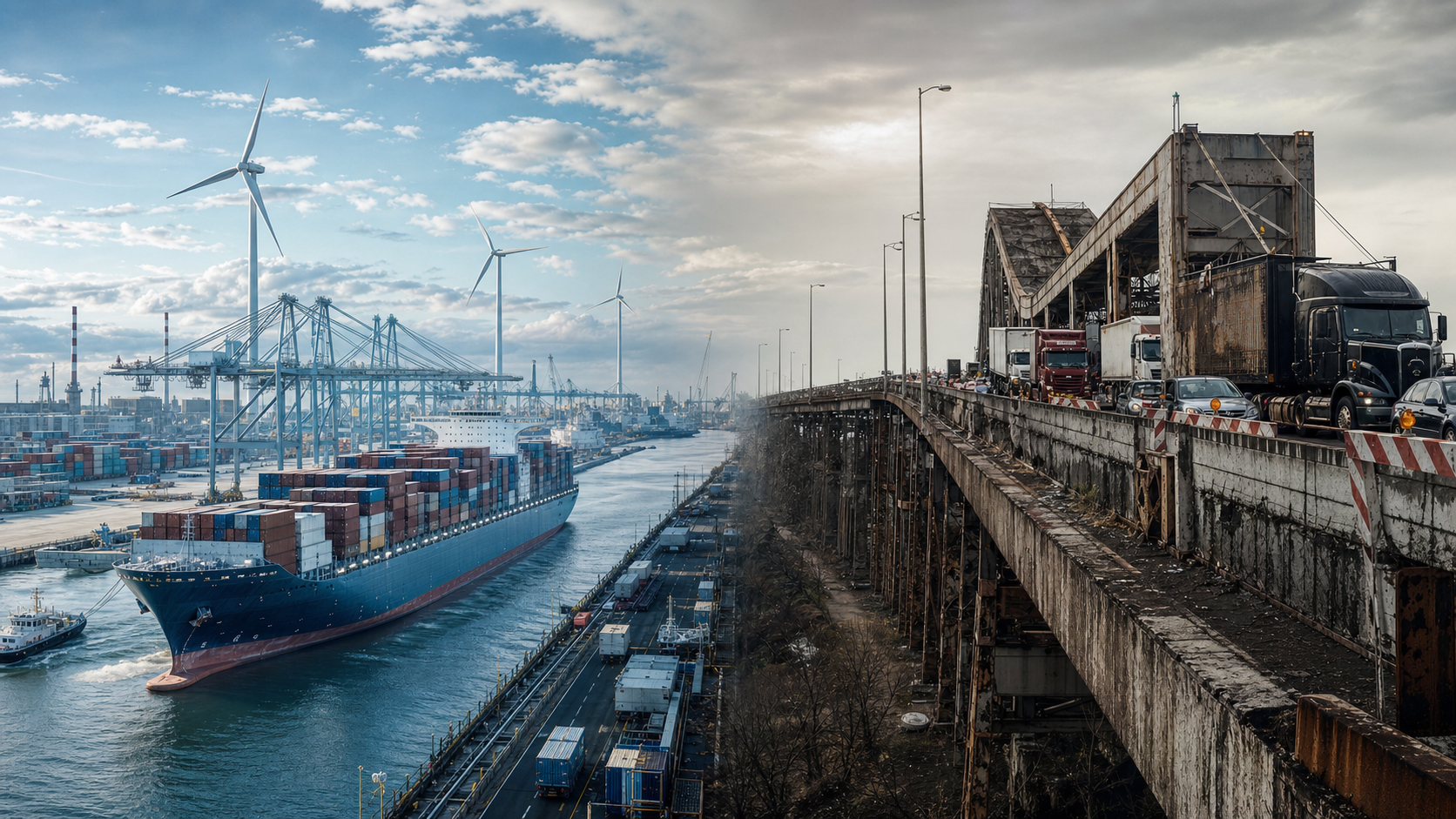
Europe's industrial base under pressure: Between climate-resilient logistics and aging infrastructure – a creative image on the topic, created with AI: Xpert.Digital
Too expensive and too old: How a gigantic backlog of renovations is paralyzing our economy
The Rotterdam Model: What Germany urgently needs to learn from the Netherlands
Energy is expensive, roads are in disrepair: Is Europe losing its most important foundation?
Europe's economy is at a critical turning point: While industrial production stagnates and exorbitant energy prices force countless companies to their knees, the continent's physical foundation is literally crumbling. In Germany alone, over 4,000 dilapidated motorway bridges and a massive backlog of repairs are plunging the country into a logistical bottleneck that poses an acute threat to its economic competitiveness. But there is another way: A look at the Netherlands, and especially the Port of Rotterdam, demonstrates how future-oriented, climate-resilient infrastructure and reliable public-private partnerships can secure an economy in the long term. The structural erosion of Europe's industrial base is far more than just a cyclical weakness – it is a massive competitive disadvantage. Read our comprehensive analysis to find out why Europe must now radically change course to avoid being definitively left behind by the USA and China in the global competition.
A continent is losing its industrial foundation
Europe is currently experiencing a structural erosion of its industrial base that can no longer be dismissed as a temporary economic downturn. In 2025, European industrial production volumes were just five percent higher than in 2007, corresponding to an average annual growth rate of less than 0.3 percent. The low- to medium-tech industries are particularly affected, with cumulative production plummeting by between 15 and 20 percent. Markus Kamieth, President of the European Chemical Industry Council (Cefic) and CEO of BASF, puts it succinctly: Europe is losing industrial capacity at an unprecedented rate, and this is not a temporary slump but a structural shift in competitiveness affecting all manufacturing sectors. For 83 percent of the performance indicators examined in the Antwerp Declaration Monitoring Report, no improvement, and in some cases even a decline, has been observed since the declaration was signed in 2024.
When the electricity doesn't reach where it's needed
A report by the consulting firm Deloitte, commissioned by Cefic, identifies inadequate infrastructure as a key obstacle to European reindustrialization. The expansion of renewable energies, considered a core component of the industrial green transition and intended to reduce energy costs and support electrification for industrial end users, requires a highly interconnected electricity grid and functioning, flexible markets. Despite increased investment, long waiting lists for grid connections, with waiting times of seven to ten years, remain a clear bottleneck for electrification. The European Union is also lagging significantly behind its own targets for carbon dioxide storage, currently offering only 0.6 megatons of annual storage capacity, while the goal is to reach 50 megatons by 2030. Furthermore, the financing architecture for industrial transformation remains complex and fragmented, with an unequal distribution of support among member states, putting the European Union at a disadvantage compared to the more comprehensive and simpler instruments used in the United States and China.
Energy as a systematic competitive disadvantage
A key driver of deindustrialization lies in the energy price gap. In 2025, industrial electricity prices in the European Union were roughly twice as high as in the United States and around 50 percent higher than in China, while gas prices reached about three times the US level. In an industry where energy accounts for six to eight percent of the cost of a basic chemical product, a persistent two- to three-fold price gap acts as a clear signal to withdraw from Europe. However, the situation is more complex than simply an energy cost issue, as only about half of the closures in the chemical industry are attributable to energy costs, while weak demand (around 19 percent), Chinese overcapacity (around nine percent), and regulatory factors (around eight percent) account for the remaining causes. It is thus simultaneously a global cyclical downturn and a structural disadvantage for Europe as a business location. Recommendations from the industry aim to make industrial electricity prices structurally competitive, rather than just subsidizing them, for example by decoupling industrial electricity prices from marginal gas price formation, accelerating grid expansion, long-term contracts and a permanent rather than discretionary compensation scheme for indirect costs of the emissions trading system.
Rotting bridges as a symbol of German failures
While politicians debate the future of the energy transition, the very fabric of the existing transport infrastructure is literally crumbling. In Germany, more than 4,000 motorway and federal highway bridges are considered to be in urgent need of repair, out of a total of around 40,000 such bridges with 52,000 individual structures. The repair program was originally intended to be accelerated to 400 structures per year starting in 2026 in order to eliminate the backlog by 2030 or 2032. However, the reality is quite different: By the end of 2025, only 170 structures were expected to have been modernized, and the Ministry of Transport anticipates around 200 further repairs for the coming year, which is fewer than in 2024. At the current pace, it would take around 19 years to even clear the existing backlog of repairs, and the Federal Court of Auditors already deemed the original 2024 target completely unrealistic. Currently, there are already bans on heavy transport on almost 150 motorway bridges due to inadequate structural condition.
Everyday traffic jams as an economic cost factor
The symptoms of this delayed infrastructure repair are immediately noticeable in everyday German life. In April 2026, 779 active construction sites affected approximately 7.6 percent of the total motorway network of around 1,982 kilometers, a figure almost at an all-time high. In 2025, traffic jams on motorways totaled 478,000 hours, an increase of seven percent compared to the previous year, with estimated annual costs of around 3.6 billion euros. The total backlog of repairs on the railways is estimated at 106 to 130 billion euros, at least 1,500 bridges on the federal highway network are considered to be in need of repair, and waterways suffer from annual underfunding of around 650 million euros. Furthermore, major structural projects such as the Rahmede Valley Bridge in the Sauerland region, closed since 2023, and the ongoing renovation of the Lueg Bridge on the Brenner route, underway since 2025, exacerbate the situation along important European transit routes.
The Dutch counter-proposal using Rotterdam as an example
Europe's largest port takes a completely different approach. Rotterdam handles eight percent of total European freight volume, with over 460 million tons transshipped in 2022, and is addressing rising sea levels and flood risks with a systematic adaptation strategy. Climate projections for the region predict a sea level rise of between 26 and 124 centimeters by 2100, with the strategy conservatively calculating plus 35 centimeters by 2050 and plus 85 centimeters by 2100. The port authority, together with the City of Rotterdam, the Province of South Holland, and the private sector, has developed a strategy based on prevention, adaptation-driven spatial planning, and crisis management, which is regularly reviewed, approximately every ten years. In parallel, Rotterdam is advancing the development of a carbon dioxide transport and storage infrastructure with the Porthos project (Port of Rotterdam Transport Hub and Offshore Storage), aiming to store 2.5 million tons of carbon dioxide annually from the port's major industries starting in 2026. The four companies involved, Shell, Exxon, Air Liquide and Air Products, have secured the storage reservoir for 15 years, demonstrating a long-term industrial planning security that would be hardly conceivable in Germany for transport infrastructure projects.
Four pillars of a new energy infrastructure
The Dutch strategy rests on four clearly defined pillars that could serve as a blueprint for other European industrial regions. The first pillar aims to make existing industries more efficient and to build additional infrastructure for heat, carbon dioxide, electricity, and hydrogen. The second pillar renews the energy system by transitioning from fossil fuels to renewable electricity and hydrogen, while the third pillar modernizes the raw materials and fuels system, and the fourth pillar makes transportation more sustainable. Among the eight key projects of the Rotterdam-Moerdijk cluster energy strategy are the expansion of the electricity grid with new landfalls for offshore wind farms, a delta corridor pipeline to Chemelot and Germany, and shore power facilities for ocean-going vessels. Taken together, these measures are expected to achieve a carbon dioxide reduction of 23 million tons, which corresponds to 35 percent of the Netherlands' total reduction target for 2030.
LTW Intralogistics Solutions – Intermodal Transport

LTW Intralogistics Solutions – Intermodal Transport – Image: LTW Intralogistics GmbH
LTW offers its customers not individual components, but integrated complete solutions. Consulting, planning, mechanical and electrotechnical components, control and automation technology, as well as software and service – everything is networked and precisely coordinated.
In-house production of key components is particularly advantageous. This allows for optimal control of quality, supply chains, and interfaces.
LTW stands for reliability, transparency, and collaborative partnership. Loyalty and honesty are firmly anchored in the company's philosophy – a handshake still means something here.
Related to this:
Logistics at its limit: How climate change and the backlog of repairs threaten Europe's competitiveness
A comparison of the European infrastructure map
A look at international rankings illustrates how differently European countries are positioned in terms of infrastructure quality. According to the IMD World Competitiveness Ranking, which is based on a scale of 0 to 100 and includes basic infrastructure, technological, scientific, health, and educational aspects, Switzerland leads the world with a score of 94.8 points, followed by Denmark with 88.3 and Sweden with 86.0 points. Germany ranks 13th with 77.5 points, while France scores 72.0 and Italy only 56.6 points.
| country | Infrastructure Score 2025 | World rank |
|---|---|---|
| Switzerland | 94,8 | 1. |
| Denmark | 88,3 | 2. |
| Sweden | 86,0 | 3. |
| Finland | 85,0 | 4. |
| Netherlands | 80,5 | 9. |
| Germany | 77,5 | 13. |
| Austria | 77,2 | 14. |
| Belgium | 72,7 | 16. |
| France | 72,0 | 18. |
| Italy | 56,6 | 34. |
| Spain | 62,2 | 27. |
Source: IMD World Competitiveness Ranking 2025
It is noteworthy that the three leading countries worldwide all come from northwestern Europe, suggesting that small, wealthy and institutionally stable states have structural advantages when it comes to continuous infrastructure maintenance.
Who is truly the most advanced
When it comes to which European country is most advanced in terms of climate-resilient logistics and modern infrastructure, the evidence increasingly points to the Netherlands. In addition to the IMD ranking, which places the country among the global top ten, independent analyses confirm the Netherlands' leading position, particularly in the areas of port logistics and water management. The Port of Rotterdam is characterized by exceptionally efficient operations, a dense and high-quality road and rail network, and advanced flood control and water management systems. This combination of centuries of experience in managing water, consistent long-term planning, and close public-private partnerships gives the Netherlands a structural advantage that other countries are struggling to catch up with. Germany follows in second place in comparative assessments, supported by its extensive motorway system, the strong rail network of Deutsche Bahn, and its function as a central logistics hub in Europe—although this very system is now beginning to suffer from a backlog of necessary repairs and maintenance. Switzerland scores points with its globally recognized punctuality in rail transport and advanced tunnel construction technology, such as the Gotthard Base Tunnel, but the landlocked country lacks the maritime dimension that is crucial for climate-resilient logistics in global trade.
Climate adaptation as a new mandatory task for transport planning
The European Union has now enshrined the need for climate-resilient transport infrastructure in binding law. The revised TEN-T Regulation, which governs the trans-European transport network, explicitly requires consideration of infrastructure's climate resilience, an assessment of its vulnerability to the impacts of climate change, and the integration of adaptation measures into planning and modernization. Furthermore, it aims to ensure operational continuity under extreme weather events, while simultaneously introducing provisions for military mobility as part of crisis preparedness, since strategic corridors also serve as the backbone of European security resilience. For the 2021-2027 funding period, a total of €12.8 billion is available under the Connecting Europe Facility for the development and resilience of transport infrastructure, supplemented by €274.3 billion from cohesion policy for national transport projects. It is estimated that the European Union will need a total of around €260 billion annually in climate-related investments by 2030 for sectors such as energy, transport, and buildings alone.
Heat waves as an underestimated stress factor in supply chains
In addition to the physical structure of facilities, the logistics industry is increasingly focusing on their resilience to climate change. Increasing heat waves are putting particular pressure on temperature-sensitive supply chains, driving investment across Europe in cold chain logistics, modern cold storage facilities, and improved port infrastructure. Industry associations such as the Global Cold Chain Alliance are now calling for temperature-controlled logistics to be officially classified as critical European infrastructure in order to reduce investment barriers and create targeted incentives for equipment, vehicles, and skilled personnel. Recommended measures include modernizing the cold chain through advanced cooling technologies, retrofitting existing infrastructure with heat-resistant materials, and implementing comprehensive heat stress management for drivers, such as flexible working hours and improved cabin cooling. The increased use of AI-supported route optimization based on real-time weather and traffic data is also considered a key component in minimizing heat-related disruptions.
Digital infrastructure as the second front of competition
Alongside physical transport and energy infrastructure, Europe's competitiveness increasingly hinges on its digital infrastructure. Current rankings of digital infrastructure quality, based on broadband access, mobile network coverage, download speeds, and grid reliability, place Denmark, South Korea, and Norway at the top with maximum scores, followed by Switzerland and the Netherlands. This observation aligns with the finding that smaller, well-organized European economies are able to drive digital and physical infrastructure investments in tandem, while larger economies like Germany and France struggle with more complex federal structures and historically entrenched administrative processes. The European Commission now publishes annual country reports as part of the Digital Decade, documenting the progress of digital transformation in all 27 member states and thus also highlighting the growing disparities within the Union.
The arms industry and the consequences of decades of capacity reduction
Another, often overlooked chapter of industrial erosion concerns the European defense industry. For decades, the production capacity of this sector was deliberately adjusted to lower demand, meaning that some plants could only operate at a barely viable cost, while at the same time, large numbers of highly skilled and experienced personnel were laid off. Most European governments refrained from maintaining and adequately funding industrial capacity at a contingency level. It is now openly acknowledged that in the event of a high-intensity conflict with the level of munitions and arms consumption seen in Ukraine, Europe would have exhausted its stockpiles within a matter of weeks. This realization exemplifies how closely industrial base, infrastructure capacity, and geopolitical resilience are now intertwined, because without functioning energy, transport, and production infrastructure, a defense-capable industry cannot be ramped up in the short term.
A continent caught between pressure to adapt and administrative inertia
The comparison between Rotterdam and German motorway bridges reveals a fundamental pattern that extends beyond individual countries. Where long-term, institutionally secured planning meets consistent public-private financing, as in the case of the Dutch port and energy infrastructure, resilient systems emerge that are designed for decades to come. Where renovation programs repeatedly fail due to staff shortages, flawed planning, and politically motivated budget cuts, as the German Federal Court of Auditors has repeatedly confirmed regarding German bridge renovation, the existing infrastructure is at risk of deteriorating faster than it can be renewed. Associations from the construction and transport sectors have already warned that investment cuts in the federal budget represent a fatal decision for German infrastructure, while at the same time tenders were canceled due to a lack of funds and construction programs were stretched out. For Europe as a whole, this means that the question of location for the coming decade will not be decided solely by energy prices or regulations, but crucially by the ability to continuously, proactively, and without political delay, renew physical and digital infrastructure. The Netherlands currently provides the most convincing European model for this, while Germany, despite its industrial size and central location in the European logistics network, is increasingly at risk of failing due to its own deferred maintenance.
Consulting - Planning - Implementation

Konrad Wolfenstein
I would be happy to serve as your personal advisor.
You can contact me at wolfenstein∂xpert.digital or
Just call me on +49 7348 4088 965 .
Your container high-bay warehouse and container terminal experts

Container high-bay warehouses and container terminals: The logistical interplay – expert advice and solutions - Creative image: Xpert.Digital
This innovative technology promises to fundamentally change container logistics. Instead of stacking containers horizontally as before, they will be stored vertically in multi-story steel racking structures. This not only allows for a drastic increase in storage capacity within the same area, but also revolutionizes all processes at the container terminal.
More information here:










