
China's signaling intelligence is changing industrial competition: Whoever only sells sensors loses control over the machine
Xpert Pre-Release

Available in 27 languages 📢
Prefer Xpert.Digital on GoogleⓘPublished on: November 10, 2026 / Updated on: November 10, 2026 – Author: Konrad Wolfenstein
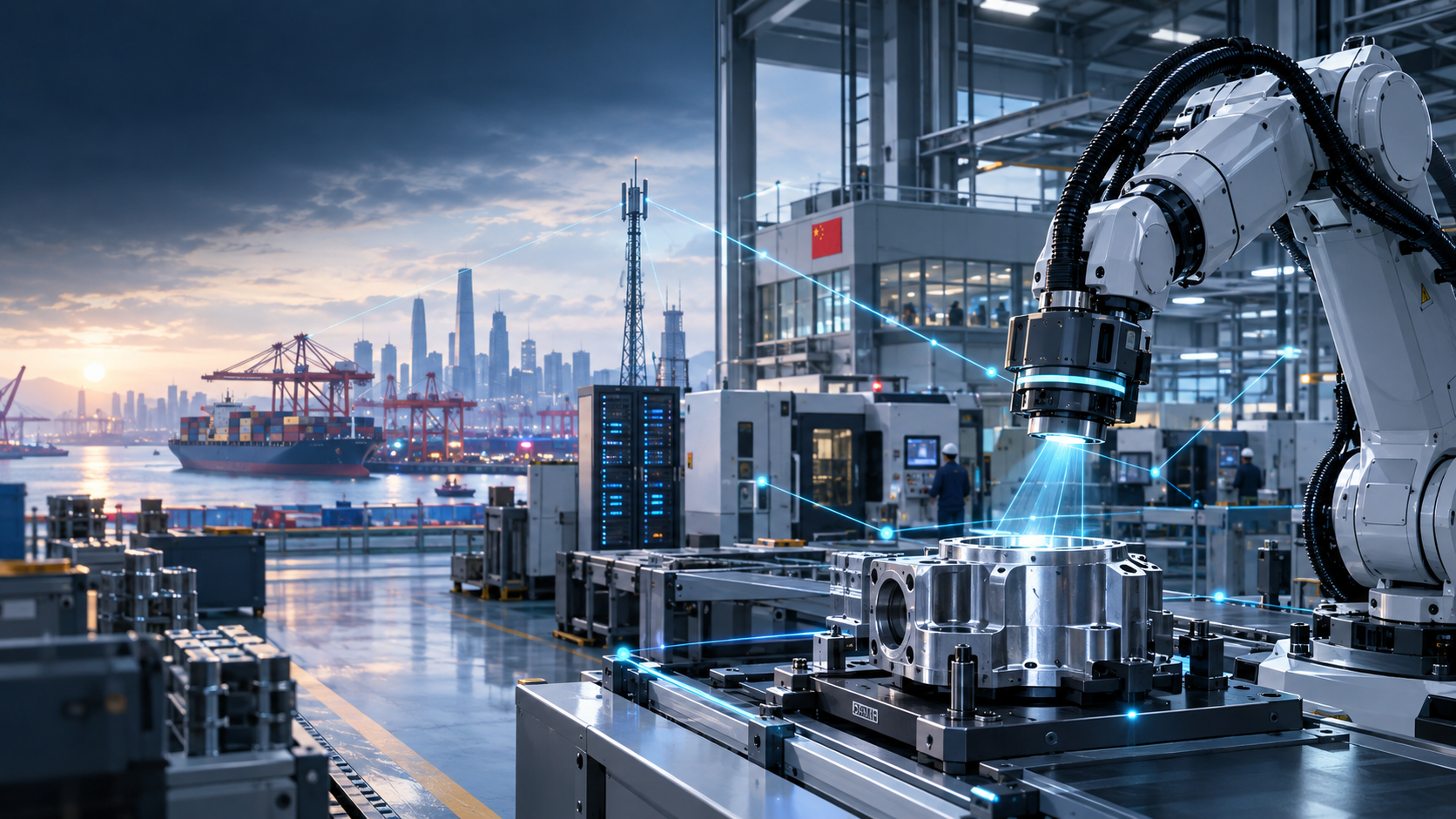
China's signaling intelligence is changing industrial competition: Whoever only sells sensors loses control over the machine – Creative image on the topic, with AI: Xpert.Digital
China's AI offensive reaches the factories: Who will control machine data in the future?
Not just sensors: How intelligent signaling technology is changing industry
China is connecting machines and AI – Europe's industry faces a strategic question
China's AI offensive is no longer confined to data centers and language models. It is increasingly permeating factories, transportation networks, and energy facilities: sensors record machine states, communication networks transmit operational data, and machine learning systems help detect malfunctions and adapt processes. Crucially, the performance of an algorithm is not the only factor. What matters is whether sensors, software, computing power, and operational processes can be integrated into a reliable and economically viable overall system.
This development opens up new opportunities for European industry – for example, for suppliers of measurement technology, automation, and specialized software. At the same time, the risk increases of supplying high-quality components while other companies control data access, system architectures, and ongoing service revenues. The central question, therefore, is not simply whether China is leading the way in AI. The crucial question is where intelligent signal processing is already reliably delivering benefits, how productivity gains can be demonstrated, and who ultimately reaps the added value.
Note: I have written the six headings and the introductory text according to German spelling rules. The complete text you inserted has not been fully edited.
From measurement to decision: Why signal intelligence is becoming a competitive factor
China's economically significant AI offensive is not confined to data centers and language models. It increasingly encompasses the connection between the physical world and digital decision-making: machine states, wireless networks, traffic patterns, production quality, and energy flows are evaluated by machine learning systems and translated into concrete actions. The strategic core of this development lies less in a single, exceptionally powerful algorithm than in the ability to integrate sensors, communication, computing power, and industrial processes into an economically viable overall system.
This presents Europe with a twofold challenge. On the one hand, it creates sales and cooperation opportunities for measurement technology, automation, industrial software, and specialized AI. On the other hand, the risk increases of supplying technically sophisticated components while other companies control data access, system architectures, and recurring service revenues. Therefore, the crucial question is not whether China is leading the way in AI. What matters is in which applications intelligent signal processing already functions reliably, which productivity gains are actually demonstrable, and who can profit from these gains.
Operational decisions are based on measured values
Signaling technology encompasses far more than traffic lights or railway safety systems. It refers to the generation, transmission, acquisition, filtering, and evaluation of physical signals: radio waves, light, sound, vibrations, radar reflections, position information, and electrical measurements. Such signals form the basis for industrial plants to monitor their condition and for technical systems to react to their environment. AI extends these capabilities to include the recognition of complex patterns and the assignment of a technical meaning, such as the onset of wear or a faulty component.
A pump, for example, provides data on vibration, temperature, current, and pressure. Traditional methods filter out disturbances or check predefined limit values. A suitably trained model can additionally recognize whether a combination of these values indicates a specific damage condition. It can recommend an investigation or estimate a likely remaining service life, provided suitable training and operating data are available. However, this does not guarantee certainty: Statistical diagnosis remains dependent on measurement quality, operating conditions, and the model's generalizability.
The transition from mere observation to timely intervention is economically crucial. A measurement initially creates transparency. Economic benefit arises when its interpretation enables better maintenance decisions, less waste, or a more stable process. The decisive added value, therefore, lies not in collecting the largest possible amounts of data, but in closing a robust chain between perception, evaluation, and operational action.
Why China is accelerating the application
China boasts an exceptionally large industrial application area. In 2025, approximately 354,000 new industrial robots were installed there, representing about 59 percent of global installations. This corresponds to a 20 percent increase compared to 2024. This scale creates numerous application areas for optical inspection, force measurement, positioning, motion control, and predictive maintenance. However, an installed robot is not automatically an AI system; these figures primarily describe the automation baseline, not the actual prevalence of machine learning.
In addition, there is an extensive communications infrastructure. By the end of 2025, China had approximately 4.84 million 5G base stations and 2.888 billion cellular connections for Internet of Things (IoT) devices. By mid-2026, more than 25,000 projects connecting 5G and the Industrial Internet had been launched nationwide. However, these figures must be interpreted carefully: a device connection is not a standalone machine, a started project is not proof of sustained profitability, and a large number of base stations does not demonstrate real-time industrial capability at every location.
China's advantage therefore lies primarily in its ability to simultaneously drive industrial demand, grid expansion, and technological development. Many applications can be tested under real-world production conditions and subsequently scaled up to larger production volumes. From a European perspective, this connection between the development environment and the sales market is at least as significant as a single performance record set by an AI model.
Research funding meets industrial cost pressure
The financial resources are substantial. According to figures released in October 2026, China's research and development (R&D) spending reached approximately 3.929 trillion yuan in 2025. This represented an 8.2 percent increase over the previous year and 2.8 percent of the country's economic output. Companies accounted for 77.4 percent of this R&D expenditure. These figures encompass the entire research system and should not be interpreted as a budget specifically for AI or intelligent signaling technology. However, they do demonstrate the extent to which China is funding technological development.
At the same time, industry is under economic pressure. Producer prices for industrial products fell by 2.6 percent in 2025. The profit margin of the statistically recorded larger industrial companies was 5.31 percent, and capacity utilization was 74.4 percent. In such an environment, lower error costs and better plant utilization can be particularly valuable. However, this same margin pressure can delay investments if financing is tight or a rapid return on investment does not seem plausible.
Added to this is the demographic trend: at the end of 2025, 323.38 million people in China were at least 60 years old, representing 23 percent of the population. This does not necessarily imply a widespread labor shortage in every sector. However, an aging society does increase the incentive to automate physically demanding tasks, systematically capture experiential knowledge, and utilize scarce skilled workers more productively. Intelligent signaling technology is therefore not just a technological project, but also a potential solution to structural cost and staffing problems.
Six signaling worlds are merging
For radio, mobile, Wi-Fi, and satellite signals, AI can help detect interference, predict network loads, and distribute transmission resources more efficiently. In mobile communications, energy saving, load balancing, and the optimization of connection switching are already among the standardized or further developed application areas. This differs from using the network for industrial AI applications: A communication network can itself be optimized by AI and simultaneously transport data for other AI systems.
Radar and microwave systems provide information about distances and movements. Optical sensors, cameras, lidar, and infrared systems supplement this with image, depth, or temperature information. In vehicles, drones, aviation, robotics, and industrial automation, this results in various possibilities for object detection, navigation, and quality control. No single sensor type is universally superior. Which one is economically viable depends on the environment, required accuracy, safety requirements, and overall costs.
Acoustics, ultrasound, and vibrations, in turn, reveal material conditions, machine behavior, and wear. Electrical and process engineering measurements support the analysis of power grids, chemical plants, semiconductor manufacturing, and building technology. Satellite, navigation, and remote sensing data extend this understanding to agriculture, logistics, disaster relief, and large-scale situational awareness. The same fundamental principle applies to medical technology, maritime systems, and energy facilities: it is not the individual signal that is new, but rather its increasingly automated interpretation within the respective application context.
Sensor fusion is more than data addition
Things become particularly challenging when multiple sensor sources are evaluated simultaneously. An autonomous vehicle can process camera, radar, lidar, ultrasound, satellite navigation, map, and vehicle information. The goal is not simply a larger volume of data, but a more robust understanding of the environment. To achieve this, the data must be spatially aligned, temporally synchronized, and evaluated for reliability. Errors in this integration can negate the benefits of additional sensors.
Therefore, the quality of the entire perception chain is economically relevant. A high-resolution camera alone does not make a system safe; likewise, a powerful AI chip does not guarantee a correct decision. Suitable sensor positions, calibration, robust data transmission, traceable testing procedures, and appropriate handling of uncertainty are required. More sensors can increase robustness, but at the same time incur additional procurement, integration, and maintenance costs.
The economic optimization task is to find a sufficiently reliable solution, not necessarily the most technically complex one. A system must be able to recognize when its perception is no longer adequate. In such situations, reduced speed, a safe stop, or handover to a human may be more sensible than a seemingly decisive automated action. Especially in safety-critical applications, controlled limitation is a quality characteristic and not a sign of technological weakness.
Edge AI is changing cost accounting
Edge AI refers to the execution of AI functions close to the point of data acquisition, for example, in a sensor, an industrial gateway, or a machine controller. This eliminates the need to transmit raw data in its entirety to a remote data center. This can reduce response times, save bandwidth, and facilitate the handling of sensitive information. This is particularly attractive for high-frequency vibration signals, video streams, or applications that must continue operating even if an external connection is interrupted.
This shifts the cost structure. Instead of continuously transmitting large data streams, more powerful end devices, suitable software, and the reliable operation of numerous distributed systems are required. Limited storage, energy consumption, and available computing power necessitate close coordination between the model and the hardware. Additionally, the organizational question arises of how models are deployed, monitored, updated, and, if necessary, rolled back to a previous state. Local processing does not eliminate these tasks but rather distributes them across more technical locations.
The objectively compelling architecture is therefore often hybrid. Time-critical evaluation and necessary fallback functions remain local, while comprehensive analyses, model training, and site-wide optimization can be performed centrally. Edge AI is thus neither the end of the cloud nor automatically the cheaper solution. Its value arises from the appropriate distribution of computing workload, communication overhead, and operational risk.
The chip issue requires more differentiation
The debate about China's AI capabilities often focuses on powerful accelerators for training large models. In reality, advanced computing chips and related technologies remain subject to complex export controls. US regulations were revised again in 2026; certain shipments are reviewed on a case-by-case basis under defined security conditions. This does not imply unrestricted access or complete technological isolation. For companies, specific product, customer, and usage assessments remain crucial.
However, industrial signal processing does not always place the same demands on the system as training a large language model. A model tailored to a specific error class can operate with significantly fewer resources. Crucial factors here are often response time, reliability, power consumption, and integration into an existing machine. Less computing power, however, does not necessarily mean simpler development: A specialized system can place high demands on measurement accuracy, data processing, and safety.
China reported its intelligent computing capacity at 2,592 EFLOPS at the end of September 2026, an increase of 146 percent compared to the previous year. Such figures indicate rapid expansion, but without standardized definitions, computational accuracies, and utilization data, they do not allow for a direct assessment of usable industrial performance. Installed computing capacity, actually available services, and economically viable results are three distinct metrics.
Networks themselves become measurement systems
With 5G-Advanced and the development of 6G, communication, data analysis, and environmental perception are becoming increasingly intertwined. Mobile communication standards already incorporate AI-supported network optimization, while the international 6G framework explicitly envisions the integration of AI and communication, as well as integrated communication and sensor functions. In the future, this will allow networks not only to transmit information but also to provide additional insights into positions, movements, or spatial conditions.
This opens up new business models, such as for industrial tracking services or the monitoring of specific operating environments. At the same time, it remains crucial whether accuracy, availability, and data protection meet the specific requirements. An existing wireless infrastructure does not automatically replace specialized security sensors. Furthermore, the energy consumption and integration effort required for additional measurement and computing functions must be justified.
6G remains a development and standardization project, not a widely available industrial productivity factor. International planning aims for the completion of key standards around 2030. Therefore, for current investments, it makes little sense to wait for a future mobile communications standard if a use case can already be reliably solved with industrial Ethernet, WLAN, or 5G. Future-proofing primarily means expandability, not premature commitment to a performance promise that is not yet fully developed.
The factory determines productivity
China's industrial AI strategy aims for a broader integration of intelligent systems into manufacturing and equipment. In October 2026, the number of advanced smart factories was reported to exceed 13,000, with over 1,000 application scenarios identified across 20 industries. These figures represent a politically and administratively defined development and should not be equated with an independently measured productivity gain for all the factories surveyed.
Concrete potential lies in the combination of quality inspection, machine condition, and process parameters. Image data can reveal surface defects, while current consumption, temperature, or vibration provide clues to their cause. Only through this integration does downstream defect detection become an opportunity for targeted process improvement. For companies, the key benefits are therefore avoided defect costs, fewer unplanned downtimes, more stable output, and better utilization of existing equipment.
That this is not exclusively a Chinese technology field is demonstrated by international industry. BMW, for example, integrates digital and AI-supported processes into its production in Shenyang and uses real-time analysis of sensor and image data for quality control across the entire group. Competition, therefore, does not simply occur between nationally closed systems. It also takes place within international production networks where technological development, application experience, and economic interests are closely intertwined.
Maintenance becomes a risk decision
Predictive maintenance is one of the most illustrative applications of intelligent signaling technology. Acoustic and vibration-based methods can detect signs of wear and tear, thereby helping to better plan maintenance intervals. However, economic success depends not only on whether a model detects a deviation. Equally important is whether the deviation is recognized in time and whether a meaningful operational response is actually possible.
A highly sensitive system can generate numerous warnings without improving maintenance. False alarms tie up personnel and can trigger unnecessary interventions. Conversely, overlooked defects pose the risk of consequential damage and production interruptions. Therefore, the appropriate threshold is a matter of economic and safety considerations, not simply a question of maximizing statistical accuracy. Furthermore, models must be adapted to changing operating conditions and their effectiveness verified.
For a reliable assessment, companies should first understand the existing damage history, the actual downtime costs, and the available response options. If spare parts or maintenance windows are lacking, an earlier warning may generate less benefit than expected. The bottleneck may then lie not in the algorithm, but in the organization. Signal intelligence pays off most when the diagnosis leads to an actionable decision.
Our China expertise in business development, sales and marketing

Our China expertise in business development, sales and marketing - Image: Xpert.Digital
Industry focus areas: B2B, digitalization (from AI to XR), mechanical engineering, logistics, renewable energies and industry
More information here:
A thematic hub offering insights and expertise:
- Knowledge platform covering global and regional economies, innovation and industry-specific trends
- A collection of analyses, insights, and background information from our key areas of focus
- A place for expertise and information on current developments in business and technology
- A hub for companies seeking information on markets, digitalization, and industry innovations
The role of Edge AI in industrial applications
Ports demonstrate the systemic effect
Port facilities clearly demonstrate why the integration of diverse signal sources is economically crucial. Cranes, transport vehicles, storage areas, and ships must be coordinated both temporally and spatially. In Qingdao, automated operational and equipment controls, visual perception, and other digital processes are employed for this purpose. The benefits arise not only from faster individual machines, but also from reduced mutual interference and better-coordinated processes.
In May 2025, an average single crane throughput of 62.62 TEU per hour was reported for a specific operational process at the automated container terminal. Such a record indicates technical capability, but it is not proof of the port's overall annual average. Economic efficiency also depends on maintenance times, malfunctions, capacity utilization, vessel design, and connections to rail, road, and storage areas. A particularly fast crane movement is of little use if the next process step cannot keep pace.
European suppliers are also involved in this development. In automated grain unloaders in Qingdao, Bühler combines lidar, real-time sensors, and autonomous control functions. This example illustrates the importance of specialized machine expertise and system integration: Access to a demanding Chinese application market can be valuable, but this does not necessarily imply the superiority of a single national technology ecosystem.
Satellite data broadens the industrial horizon
Intelligent signaling technology doesn't end at the factory gate. Satellite navigation, Earth observation, and satellite-based communication support applications in transportation, agriculture, the maritime industry, and disaster relief. Technically, these functions are distinct: navigation provides position and time, remote sensing provides information about observed areas, and communication establishes data connections. AI can analyze this information for specific tasks and combine it with local sensor data.
China's satellite navigation and location services industry reported a production value of 629 billion yuan in 2025, a 9.24 percent increase over the previous year. By the end of 2025, nearly 1.4 billion smartphones in China supported BeiDou positioning; in addition, more than 100 million passenger cars were equipped with the necessary onboard devices. These figures represent a broad range of applications and are not comparable to the revenue of a single navigation system or the market volume for AI.
The integration into seamless workflows is economically attractive. Position data becomes more valuable when combined with cargo status, traffic events, or local machine information. Satellite communication can also enable connections in regions where terrestrial networks are insufficient; corresponding integrations are being further developed in mobile communication standards. For autonomous maritime and aviation systems, particularly demanding requirements regarding safety, reliability, and operation under signal interference remain.
Energy is both a source of benefit and a limitation
Intelligent signal processing can also improve energy infrastructure. Operational and condition data help to monitor systems, assess loads more accurately, and identify optimization potential. The integration of electrical measurements, condition information, and operational decisions is particularly important. Economic benefits arise, for example, when a recognized system condition enables more targeted maintenance or allows a process to be operated stably with lower energy consumption. A distinction must be made between technically feasible optimization and demonstrable savings in overall operation.
The additional digital infrastructure itself requires energy. Global data center electricity consumption in 2025 was approximately 485 terawatt-hours. The central projection for 2030 is around 950 terawatt-hours. These figures encompass data centers as a whole, not just AI, and certainly not solely industrial signal processing. Their significance lies in the fact that centralized processing capacities depend on power supply, network connections, cooling, and site conditions. Local data processing can reduce communication overhead, but it is also not free.
A sound environmental and economic analysis must therefore consider both sides. It must evaluate avoided energy and material losses as well as additional electricity consumption, hardware costs, and renewal cycles. Furthermore, more efficient individual calculations do not guarantee a decrease in overall consumption if the number of applications grows more rapidly. For industrial operators, the goal should not be the largest possible AI installation, but rather the smallest sufficiently powerful solution that delivers demonstrable operational benefits.
The data set needs an industrial context
A large dataset alone does not guarantee a reliable competitive advantage. Measurement data only becomes meaningful when it is known which machine it originated from, the operating state in which it was generated, and the applicable units, time base, and quality characteristics. Industrial information models link data with such meanings and facilitate its use across different systems. The economic challenge, therefore, often lies less in the next algorithm than in the complex processing of existing production information.
For example, a temperature reading might be harmless for one machine but a warning sign for another. Material changes, altered rotational speeds, or maintenance interventions also influence the interpretation. Without this context, a model can detect changes without accurately capturing their operational significance. Therefore, skilled professionals from production, maintenance, and quality assurance remain indispensable for developing meaningful applications. The integration of measurement data and human expertise is an integral part of industrial diagnostic approaches.
For China's large industrial application base, this presents both an opportunity and a limitation. Many systems can create extensive learning opportunities; however, they do not automatically generate a unified, legally freely usable, and technically consistent data space. Different manufacturers, operating procedures, and process variants still need to be integrated. A data advantage, therefore, arises not solely from quantity, but from consistently organized quality, appropriate usage rights, and the ability to develop reusable solutions based on experience.
Open interfaces secure negotiating power
The question of standards is therefore directly economically relevant. Whoever controls data models, access paths, and integration tools influences how easily customers can use additional functions or switch providers. The OPC UA architecture, for example, pursues cross-vendor information exchange; its cloud initiative also aims to support open structures for analytics, digital twins, and AI, and to limit vendor lock-in. Standardization, therefore, concerns not only technical elegance but also long-term competitiveness.
For a machine manufacturer, a proprietary, complete system can be attractive in the short term because it reduces integration work. However, costs can arise in the long run if data export, model changes, or expansions are only possible under the conditions of a single vendor. An open interface alone does not solve this problem. Information models, documentation, data quality, and actually available access rights must also be sufficiently transparent.
In their economic evaluation, companies should therefore also consider the possibility of a future migration. Will historical measurement data remain usable? Can in-house developed models be used on different hardware? Is continued operation possible without a permanent external connection? Such questions change the calculation, because a low initial price can be associated with high subsequent costs. Conversely, a more integrated system is not inherently disadvantageous if responsibilities, scope of services, and exit options are clearly defined.
The added value shifts to the system operator
Intelligent signaling technology is also changing business models. A company can sell a sensor, license evaluation software, handle ongoing condition monitoring, or offer a comprehensive operational service. The further it delves into the interpretation and organization of the application, the greater its influence on day-to-day operations can become. At the same time, integration effort and responsibility increase. As a result, the economic focus can shift from a one-time hardware delivery to recurring services.
For European specialists, this is a strategically relevant question. A high-quality measuring instrument remains valuable, but its manufacturer doesn't necessarily have to receive the largest share of the subsequent benefits. If another platform aggregates the data, provides diagnostic models, and maintains direct customer access, it can have a greater influence on the further development of the application. Conversely, in-depth process knowledge can strengthen the position of a specialized provider because it cannot be replaced by arbitrary computing power.
The appropriate perspective, therefore, is neither hardware pessimism nor platform enthusiasm. A clearly defined specialist can be just as successful as a comprehensive system provider. The crucial factors are whether their services are interchangeable, whether they generate verifiable benefits, and whether they possess the necessary capabilities to deliver them reliably throughout the entire product lifecycle. A service promise without adequate operational organization can be more economically risky than a limited but high-quality product offering.
Profitability requires a verifiable starting point
When investing in intelligent signaling technology, the initial situation should be clearly defined first. What costs are currently incurred due to scrap, malfunctions, unnecessary maintenance, or waiting times? Which of these can the planned application actually influence? What portion of the benefits depends on additional organizational changes? Without this separation, there is a risk of attributing general improvements to an AI project when several changes have occurred simultaneously.
On the cost side, the evaluation should consider more than just sensors and computing hardware. Integration, data preparation, additional testing, training, maintenance, ongoing model monitoring, and any necessary modifications to safety measures must also be taken into account. The technical requirements for hardware-software coordination, model lifecycle, and industrial interoperability demonstrate why these supplementary tasks constitute a significant part of the application. A simple comparison of software price and theoretically avoidable downtime costs would be insufficient.
Meaningful key performance indicators (KPIs) should focus on the application: actual avoided failures, scrap per production unit, timely error detection, false alarm rate, processing time, or energy consumption per usable product. Additional throughput only provides additional economic value if there is demand for it or if other bottlenecks are eliminated. Underutilized capacities do not become more profitable simply because they could technically deliver more. Given China's projected industrial capacity utilization of 74.4 percent in 2025, this distinction is particularly relevant.
Cyber risks begin as early as the measurement stage
The combination of sensors and automated decision-making expands the attack surface. Not only servers and user accounts need protection, but also manipulated input data, altered models, or deliberately influenced training data can compromise a system's integrity. Research on machine learning security distinguishes between attacks on availability, integrity, and confidentiality, among other things. Thus, an outwardly plausible measurement can trigger an incorrect operational conclusion.
This is particularly challenging for systems that adapt to changing conditions during operation by utilizing new data. While such methods can be useful, they also open up additional possibilities for manipulating the model. This does not mean that learning industrial systems are inherently insecure. Rather, it means that security must encompass the entire lifecycle, from data acquisition to updates. Purely local processing does not automatically guarantee security.
From an economic perspective, cybersecurity should be understood as an integral part of operational capability. An inexpensive system lacking reliable updates, clear responsibilities, and manageable failure responses can lead to high consequential costs. Since September 11, 2026, the EU has mandated reporting requirements for actively exploited vulnerabilities and serious security incidents for products containing digital elements. The key additional requirements of the Cyber Resilience Act will become applicable from December 11, 2027. This means that long-term security support is increasingly becoming a legally and economically relevant product characteristic.
Data sovereignty is more than just location
Data sovereignty doesn't simply mean that raw data is stored in a specific factory. Equally important is control over access, processing purposes, updates, and the commercial use of derived information. Even a local installation can create dependencies if models, remote maintenance, or activations are permanently controlled by an external provider. Conversely, a centralized service can be economically viable if rights and responsibilities are clearly and reliably defined.
In cross-border business, it is also essential to distinguish between different types of data. Machine states, personal image data, trade secrets, and security-relevant information are not interchangeable. A camera inspection, for example, can capture images of employees as well as components. A technical data stream can allow conclusions to be drawn about production quantities, capacities, or process parameters. Therefore, the question of what information is truly needed and where it should be transferred must be addressed as early as the architectural planning stage.
For collaborations with China, both a blanket ban on data transfers and the assumption of completely unrestricted data movement would be misleading. The legal assessment depends on the data category, the parties involved, the direction of transfer, and applicable rules. European companies should therefore combine technical data minimization with precise usage agreements. Avoiding the transfer of unnecessary information altogether can reduce risks and integration efforts, but it does not replace the need to review the remaining processing.
Dual use limits some opportunities
Radar, navigation, autonomous systems, and powerful signal processing can have both civilian and military applications. This dual use does not automatically make a technically attractive business venture an impermissible undertaking. However, it necessitates a thorough examination of product characteristics, end users, intended use, and relevant restrictions. Software and technology may also be involved; therefore, the assessment must not end with the physically delivered equipment.
For European suppliers, it is crucial to address regulatory issues early on. Development cooperation, technical support, and the transfer of specialized knowledge can be just as relevant as the eventual sale of the product. Therefore, a promising economic application must be aligned with the permissible course of action. For US-related technology, additional export control requirements may also apply.
European AI regulation also requires a differentiated approach. Not every AI-supported industrial application is a high-risk system. The decisive factors are its use and function, such as its role as a safety-relevant component of critical infrastructure or a regulated product. For companies, this necessitates an application-specific classification rather than a blanket approach to all AI projects. Security, documentation, and traceable responsibilities are not merely additional costs, but prerequisites for reliable market access and sustainable products in the long term.
China's standard is not infallibility
The size of the Chinese market should not be mistaken for smooth implementation. A high number of funded projects or installed devices says little about how widely the applications are already operating profitably. In China, too, existing machinery must be integrated, data processed, and suitable specialists employed. Industrial cost pressures and the limited profit margins of many companies argue against the notion that every technically feasible investment will automatically be financed.
Similarly, development is not uniform across all sectors. While overall Chinese robot installations increased significantly in 2025, they declined in some smaller user industries. Demand was particularly concentrated in the electrical and electronics industry, automotive manufacturing, and the metal and machinery industries. This is more important for market analysis than an undifferentiated growth figure because suppliers need to tailor their solutions to specific processes, investment cycles, and willingness to pay.
A remarkable counter-argument to sweeping narratives of displacement is provided by the supplier figures: While Chinese robot suppliers reached 55 percent of their domestic market in 2025, up from 57 percent in 2024, installations from foreign suppliers increased by 27 percent, a greater increase than those of Chinese manufacturers at 15 percent. National scaling and opportunities for foreign specialists can therefore coexist. This does not imply either permanently guaranteed market access or an inevitable withdrawal of European companies.
Europe's opportunity lies in manageable systems
For Europe, a strategy that combines existing industrial strengths with faster application is advisable. Research into intelligent signal processing, embedded AI, data protection, and industrial assistance systems exists; likewise, established activities for cross-manufacturer industrial communication are in place. The economic bottleneck, therefore, does not lie solely in access to AI models. It also lies in transforming technical knowledge into repeatable solutions with manageable integration effort.
Applications with a clear process focus appear particularly promising: robust quality testing, specialized material diagnostics, retrofittable machine monitoring, and securely integrated autonomous functions. This perspective is based on the fact that industrial diagnostics requires close interaction between sensors, data analysis, and expertise. European companies should not only defend their measurement accuracy but also understand data access, software integration, and long-term operational reliability as part of their offering.
The strategic response to China's rapid pace therefore lies neither in retreat nor in an uncritical adoption of Chinese architectures. Selective cooperation makes sense where economic benefits, technological control, and legal compliance align. At the same time, Europe needs its own large-scale application experience. Anyone who wants to develop reliable signaling intelligence must not only research it but also operate it under real-world conditions, improve it, and bear economic responsibility for its success.
The advantage arises during ongoing operations
By 2030, widespread usability, rather than spectacular individual demonstrations, is likely to determine economic success. China has politically and infrastructurally aligned its industrial networking with long-term development; its goals include 50,000 industrial 5G private networks by 2030. Such a target figure is not yet a tangible result. However, it demonstrates that the integration of communication, data processing, and production is being treated as a cohesive modernization task.
For companies, this means not basing investment decisions on general AI rankings. More relevant are their own error structure, the availability of suitable measurement data, the integration effort, and whether improvements can be sustainably demonstrated. A limited model that reliably improves a specific process can be more economically valuable than a particularly large but poorly integrated platform. Likewise, a technically powerful system can lose its advantage if it creates dependencies or remains unmanageable in everyday use.
The clearly reasoned perspective is therefore this: China's progress in intelligent signaling technology must be taken seriously primarily as a competition for industrial implementation. European companies should not only ask which sensors or algorithms they can supply. They should ask which part of the operational decision-making chain they want to control permanently. This is where it will be decided whether precision becomes an interchangeable supplier product or a viable contribution to future industrial value creation.
🎯🎯🎯 Data-driven B2B industry hub as a quasi-in-house solution

The quasi-in-house solution: How Xpert.Digital closes operational gaps in B2B marketing and sales – Smart Content-Driven Business - Image: Xpert.Digital
Xpert.Digital is a data-driven B2B industry hub led by Konrad Wolfenstein . The company acts as an external, quasi-in-house solution for industrial partners, closing operational gaps in marketing, content, and sales – without requiring additional resources on the client side.
More information here:
Your global marketing and business development partner
☑️ Our business language is English or German
☑️ NEW: Correspondence in your native language!

Konrad Wolfenstein
I and my team are happy to be available to you as your personal advisor.
You can contact me by filling out the contact form here [email protected]:or simply call me at +49 7348 4088 965. My email address is
I'm looking forward to our joint project.