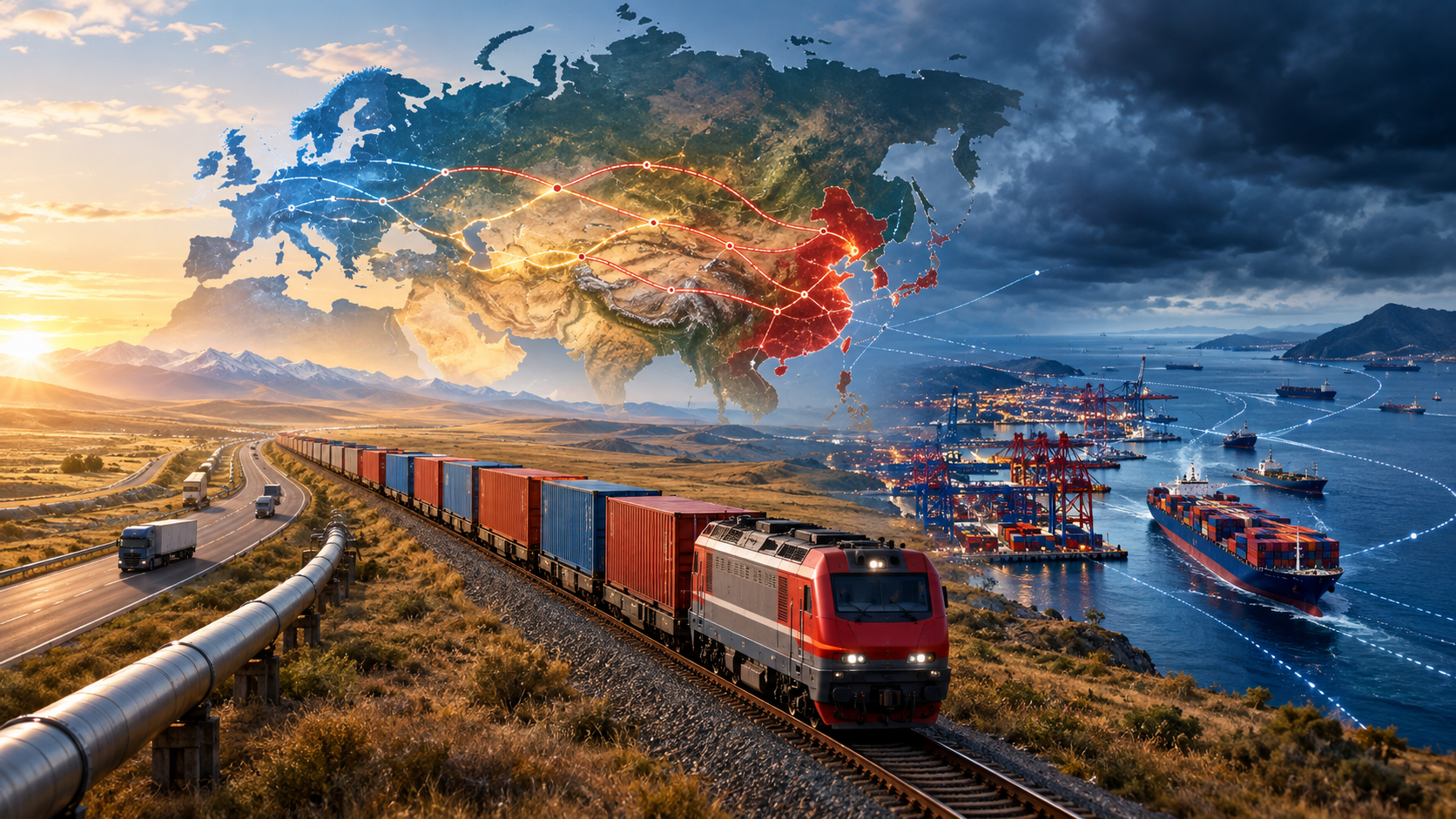
China's secret Plan B: How Beijing is preparing for a break with the West – Creative image on the topic, created with AI: Xpert.Digital
Asymmetric dependency: How China is quietly restructuring the global economy
A ceasefire will not solve China's corridor problem
An end to or freezing of the war in Ukraine would fundamentally be in China's economic interest. Reduced security risks, more predictable insurance conditions, and a potential stabilization of the European environment could facilitate Eurasian relations. Russia, too, would have greater capacity to expand its role as a transit and raw materials partner in the event of a ceasefire. Beijing could present itself as a diplomatic actor while simultaneously protecting its economic ties with Europe.
However, this does not mean that China's primary motive for a ceasefire is solely to secure the Belt and Road corridors. Its interests are broader. Beijing wants to prevent a Russian collapse, limit a direct confrontation with Europe, strategically bind the US, and prevent Western sanctions from becoming a permanent model for later application against China. At the same time, China benefits from cheap Russian raw materials and from Moscow's growing dependence. A protracted war therefore entails both costs and advantages.
Even a ceasefire would not automatically restore the old trade order. Sanctions could remain in place, frozen assets would remain contested, and European companies would continue to price in political risks. Ukraine and its backers would demand security guarantees. Russia, as a transit country, could remain permanently subject to a risk premium. The notion that an agreement would immediately open a secure and politically neutral land corridor from China to Western Europe underestimates the long-term consequences of the war.
For Beijing, the most favorable scenario would therefore be one in which military escalation ends, Russia is not politically defeated, and Europe remains open to Chinese trade. Whether these goals are compatible does not depend solely on Chinese diplomacy. Ukraine, Russia, the United States, and the European states all have their own interests. China's influence is significant, but not unlimited.
Europe's neutrality is a miscalculation
China views the European Union as a significant market, a major regulatory power, and a potentially independent pole. From Beijing's perspective, it would be advantageous if Europe did not fully adopt American export controls, sanctions, and investment restrictions. Chinese diplomacy therefore emphasizes European strategic autonomy, multilateral cooperation, and open markets. At the same time, Beijing seeks to leverage differing interests within the EU, such as those between export-oriented industrialized nations, members with a strong Atlanticist security orientation, and countries with significant investment needs.
However, genuine European neutrality in a serious American-Chinese conflict is unlikely. Most EU members belong to NATO. Security guarantees, intelligence services, military structures, financial markets, and technology systems closely link Europe to the United States. Should China start a war over Taiwan or attack American forces, the political perception in Europe would not be shaped by abstract equidistance, but rather by alliance relationships and the question of who initiated the conflict.
This does not mean that Europe would automatically adopt every American measure. Significant differences could arise regarding tariffs, extraterritorial sanctions, technology controls, or military contributions. Europe can try to keep economic channels open, secure humanitarian exemptions, and limit escalation. However, strategic autonomy does not mean neutrality, but rather the ability to define its own interests and instruments.
Growing trade imbalances also complicate Beijing's calculations. If Chinese exports displace European suppliers in key industries, the willingness to maintain open channels at almost any cost diminishes. Europe's de-risking policy does not aim for complete decoupling, but rather for reducing critical dependencies. Beijing cannot take European loyalty for granted. However, it can count on the high costs of a rupture, differing national interests, and the desire for industrial cooperation preventing a completely united Western economic front.
A break with America would not be a clean break
China is preparing for an abrupt decline in economic relations with the United States, but a complete and immediate severance would be difficult for both sides to implement. Goods flows can be rerouted through third countries, subsidiaries can shift production steps, and global companies have complex supply chains. Even if direct trade decreases, Chinese intermediate goods can still reach the American market via Southeast Asia, Mexico, or other locations. Decoupling, therefore, is often a change in route and statistical classification, not the end of the material connection.
Beijing is simultaneously strengthening the use of the renminbi in cross-border trade, expanding its own payment systems, increasing strategic reserves, and diversifying suppliers. Chinese companies are seeking alternatives to American software, chips, and industrial components. The state can control capital flows and instruct banks to finance specific transactions. These instruments increase resilience to limited sanctions.
The safeguards would be less reliable against a comprehensive financial blockade. The US dollar, Western capital markets, and international banks continue to play a central role. Secondary sanctions could force companies in third countries to weigh access to China against access to the American financial system. Furthermore, sanctions against major Chinese banks would have significant repercussions for the global economy. This very mutual vulnerability acts as a deterrent, but makes the situation difficult to predict in a political crisis.
The more likely scenario is therefore a gradual tightening of selective dividing lines. Particularly sensitive technologies, data, defense equipment, and critical infrastructure will be more heavily shielded. At the same time, trade in less sensitive consumer and industrial goods will continue. Such partial bloc formation is economically less efficient than earlier globalization, but politically more viable than total separation.
The maritime Achilles' heel remains
China's greatest physical vulnerability remains in maritime transport. The country relies on imports of crude oil, liquefied natural gas, ores, agricultural commodities, and industrial intermediates. In the first half of 2025 alone, approximately 7.9 million barrels of crude oil and condensate per day passed through the Strait of Malacca bound for China. At the same time, the Taiwan Strait, the South China Sea, and other waterways are of enormous importance for Chinese imports and exports.
A complete maritime blockade, however, would be neither technically nor politically simple. It would constitute an act of war, affect neutral ships and numerous third-party states, and could destabilize the global energy, transportation, and insurance sectors. China possesses the world's largest merchant fleet by various capacity measures, significant ports, a growing navy, and extensive industrial resources. A blockade would therefore not be a straightforward closure of a few straits, but rather a high-risk, large-scale conflict.
Nevertheless, Beijing is preparing for disruptions. Pipelines from Russia and Central Asia, oil and gas storage facilities, alternative ports, land corridors, and a stronger navy mitigate individual risks. The electrification of transportation, the expansion of renewable energies, and the large coal base also reduce long-term dependence on imported oil. These measures improve resilience but do not eliminate vulnerability.
The crucial limit is volume. Pipelines and trains can secure select shipments, while ocean-going vessels dominate mass transport. A conflict would also affect more than just physical routes. Insurance could be suspended, shipping companies could avoid ports, payments could be blocked, and spare parts could become scarce. Even without a formal blockade, risk premiums and a voluntary withdrawal of private companies could drastically reduce trade. China's maritime preparedness is therefore a race for time, reserves, and deterrence, not the construction of a completely sea-free economic model.
Russia is a partner, buffer, and dependent
Russia holds significant strategic value for China. It supplies energy and raw materials overland, captures Western attention in Europe, and shares Beijing's interest in limiting American power. The long shared border allows for trade and energy relations that are less vulnerable to maritime disruptions. At the same time, Russia possesses military technology, natural resources, and political influence in Eurasia.
The partnership is asymmetrical, however. China's economy is significantly larger and more industrially diverse. Following the withdrawal of many Western suppliers, China has become even more important to Russia as a supplier of vehicles, electronics, machinery, and intermediate goods. Russia cannot simply shift its energy exports from Europe to Asia without price reductions because pipelines, ports, and customer bases impose limitations. This strengthens Beijing's negotiating power.
China has an interest in keeping Russia capable of acting, but not in bearing the full economic burden of Moscow's actions. Beijing typically avoids measures that could immediately expose major Chinese banks and companies to massive secondary sanctions. Support therefore focuses more on trade, energy purchases, diplomatic backing, and dual-use civilian and military goods than on overtly declared arms shipments.
Should the conflict between China and the West escalate drastically, this reluctance could diminish. Direct arms and ammunition deliveries to Russia would then be more conceivable than they are today. However, even in such a scenario, Beijing would have to weigh whether the additional military benefits justify the risk of European sanctions, the loss of export markets, and closer transatlantic unity. China's policy toward Russia is therefore opportunistic and strategic, but not unconditional.
Why a Chinese army of millions in Europe is unrealistic
The idea that China could send 15 to 18 million soldiers to Eastern Europe and, together with Russia, militarily reshape the region east of the Rhine does not stand up to scrutiny. China's entire active military force comprises only slightly more than two million personnel. Even including reserves and paramilitary forces, this number is far below the contingent claimed for such a deployment. Mobilizing 15 to 18 million people would not only require the creation of an entirely new mass army, but also training, command, armament, medical support, and replacement services on an almost unimaginable scale.
The logistical problem would be even greater. Millions of soldiers would have to be transported thousands of kilometers and continuously supplied with fuel, ammunition, food, spare parts, and medical supplies. Existing Eurasian railway lines are already limited for civilian freight traffic due to track changes, border crossings, and restricted terminal capacity. They could not supply such a large force. Transport by sea would be particularly risky in a war against the US and NATO.
Furthermore, there is the strategic logic. In a major US-Chinese conflict, China would have to deploy its military resources primarily in the western Pacific, along its own coasts, to protect sea lanes and secure its home territory. A second major continental offensive in Europe would tie up forces precisely where they would be needed for China's core objectives. Beijing possesses neither a European base network nor the decades of operational experience required to conduct a campaign of this magnitude.
An attack on NATO states would also trigger the alliance's collective defense and create the risk of nuclear escalation. It would destroy European markets, the continued openness of which is supposedly a goal of Chinese strategy. Economic preparedness, trade diversification, and technological autonomy can enable a tougher Chinese foreign policy, but they do not provide a plausible path to a Chinese occupation of Eastern Europe.
More realistic are indirect forms of support for Russia: more dual-use goods, machinery, electronic components, satellite data, financial assistance, diplomatic cover, and, in extreme cases, more overt arms deliveries. Cyber operations, disinformation, or political influence are also more conceivable than large Chinese forces on the Rhine. A sound risk analysis must identify dangerous possibilities but cannot ignore the scale, logistics, and political costs.
Four development paths instead of a World War roadmap
The most likely scenario for the coming years is a controlled rivalry. China, the US, and Europe tighten security measures in relevant areas, while a large portion of trade in goods continues. Companies diversify their operations but maintain a presence in the Chinese market. Beijing deepens its ties with ASEAN, Russia, and the Global South without foregoing Western demand. This scenario would be conflict-ridden but economically manageable.
A second path would be accelerated bloc formation. New sanctions, tariffs, and technology controls could more strongly align supply chains along geopolitical lines. China would expand its standards, payment systems, and platforms in partner countries. The US would integrate allied states more closely into a controlled technology and investment system. Europe would have to decide more frequently where to remain independent and where to follow American rules. The costs would be higher prices, duplicated capacities, and reduced efficiency.
A third scenario would be a severe Taiwan crisis without a protracted major war. Even military exercises, quarantine measures, or limited combat could prompt shipping companies, insurers, and investors to withdraw. Sanctions and Chinese countermeasures would disrupt global supply chains. In this case, China's land corridors and reserves would help, but would not compensate for the losses in maritime trade. Europe would come under intense pressure to coordinate political and economic measures with the US.
The fourth path would be an open American-Chinese war with a comprehensive maritime and financial confrontation. It would entail extremely high global costs and could defy rational economic control. For China, the crucial factor would then not be expansion as far as the Rhine, but rather maintaining its own energy supply, industrial production, financial stability, and internal order. Precisely because this scenario would be so destructive, all sides are investing in deterrence, resilience, and crisis preparedness.
Europe's economic response
Europe should neither downplay China's precautionary strategy nor simply copy it. Complete decoupling would be costly and would cut European companies off from a significant market and crucial supply chains. However, uncritically clinging to existing dependencies would also be risky. The economic policy challenge lies in reducing vulnerability without abandoning openness as a source of prosperity.
This includes a precise inventory of critical dependencies. Not every trade deficit is a security problem, and not every Chinese product needs to be replaced. The crucial factors are goods whose failure would cripple critical infrastructure, defense capabilities, energy supply, healthcare, or core industrial processes. In such sectors, multiple suppliers, stockpiles, recycling, minimum European capacities, and reliable partnerships are essential.
Europe also needs a more proactive industrial and innovation policy that goes beyond simply distributing subsidies. Permits, energy prices, capital markets, knowledge transfer, digital infrastructure, and scalability determine whether European companies remain competitive. China's success isn't solely based on low wages, but on industrial clusters, rapid implementation, high production volumes, and coordinated infrastructure. Responding solely with tariffs protects existing suppliers but fails to address the productivity challenge.
At the same time, Europe should use its negotiating power. The single market, technical standards, competition policy, and public procurement are powerful instruments. Market access can be linked to reciprocity, transparency, and fair competition. However, the EU must act in unison because bilateral special arrangements by individual states increase Beijing's ability to play European interests off against each other.
Germany's business model under stress test
Germany is particularly affected by the restructuring. For a long time, its industry benefited from Chinese demand for vehicles, machinery, chemical products, and high-quality equipment. At the same time, it sourced inexpensive intermediate goods, electronics, and consumer goods from China. This model is coming under pressure because Chinese companies are becoming increasingly competitive in more and more sectors, and Beijing favors local value creation.
For German companies, simply defending the Chinese market is therefore insufficient. They must examine which technologies, data, components, and profits would be blocked in a crisis. A robust stress test should simulate scenarios ranging from new tariffs and export controls to sanctions against banks and transport routes. Supply chains do not need to be completely relocated from China, but they should have alternative sources of supply and realistic contingency plans.
The assumption that economic interests will automatically prevent political escalation is particularly dangerous. Equally dangerous is the opposite assumption: that a rupture is inevitable and therefore any investment in China is worthless. Companies need probabilities, thresholds, and concrete courses of action, not geopolitical certainties. The right strategy is neither blind expansion nor a hasty decoupling, but rather a selective presence with limited risk.
Germany should also strengthen its own industrial base. Affordable and reliable energy, faster planning, efficient networks, skilled workers, digital administration, and better financing options are geopolitical factors. Without increased productivity, de-risking easily turns into deindustrialization. Economic security does not arise from the absence of Chinese products, but from the ability to provide critical services independently or in partnership with others.
The reasoned judgment
China is seriously preparing for a tougher, more fragmented global economy. Its internal circulation, technological self-reliance, closer ties with ASEAN and the post-Soviet space, Eurasian transport routes, and maritime preparedness form a coherent system. This system is designed to increase the costs of Western pressure, improve China's resilience, and create political room for maneuver. It is thus both an economic and a security strategy.
However, the reach of this approach should not be overestimated. China remains dependent on foreign markets, imported raw materials, international financial relations, and, in some areas, advanced foreign technology. The ASEAN states, Russia, and Central Asia can complement aspects of Western relations, but cannot completely replace them. Land corridors increase resilience, but cannot substitute for maritime transport in terms of volume. Europe has its own economic interests, but is closely linked to the US in terms of security policy and is unlikely to remain neutral in a major conflict triggered by China.
The analogy to German-Soviet trade rightly reminds us that high trade volumes do not guarantee peace. It becomes false, however, when it is used to infer an inevitable Chinese war plan. China's leadership is not merely buying time for an already decided attack. It is attempting to simultaneously maximize prosperity, industrial power, deterrence, and resilience. This very ambiguity makes the strategy challenging: the same investments that create legitimate economic resilience can also increase the capacity for coercion and escalation.
A direct Chinese mass intervention in Eastern Europe with 15 to 18 million soldiers is neither plausible in terms of personnel, logistics, nor strategy. Such claims distract from the real risks. These lie in the formation of technological blocs, economic coercion, the erosion of European industrial positions, Chinese support for Russia's war economy, crises in the Taiwan Strait, and the vulnerability of global sea and financial routes.
The appropriate European response is therefore sober strength. Europe must reduce critical dependencies, expand its own innovation and production capacities, increase its defense capabilities, and at the same time keep economic channels of communication open. It should neither rely on a Chinese peace dividend nor talk itself into an inevitable world war. China's Plan B is real. But it is no proof that Plan A is war.
🎯🎯🎯 Data-driven B2B industry hub as a quasi-in-house solution


The quasi-in-house solution: How Xpert.Digital closes operational gaps in B2B marketing and sales – Smart Content-Driven Business - Image: Xpert.Digital
Xpert.Digital is a data-driven B2B industry hub led by Konrad Wolfenstein . The company acts as an external, quasi-in-house solution for industrial partners, closing operational gaps in marketing, content, and sales – without requiring additional resources on the client side.
More information here:
Your global marketing and business development partner
☑️ Our business language is English or German
☑️ NEW: Correspondence in your native language!

Konrad Wolfenstein
I and my team are happy to be available to you as your personal advisor.
You can contact me by filling out the contact form here wolfenstein@xpert.digital:or simply call me at +49 7348 4088 965. My email address is
I'm looking forward to our joint project.