China's fossil fuel climate strategy: Using fossil energy to produce climate-friendly solar power plants, wind energy technology and batteries
Xpert Pre-Release
Language selection 📢
Published on: February 4, 2026 / Updated on: February 4, 2026 – Author: Konrad Wolfenstein

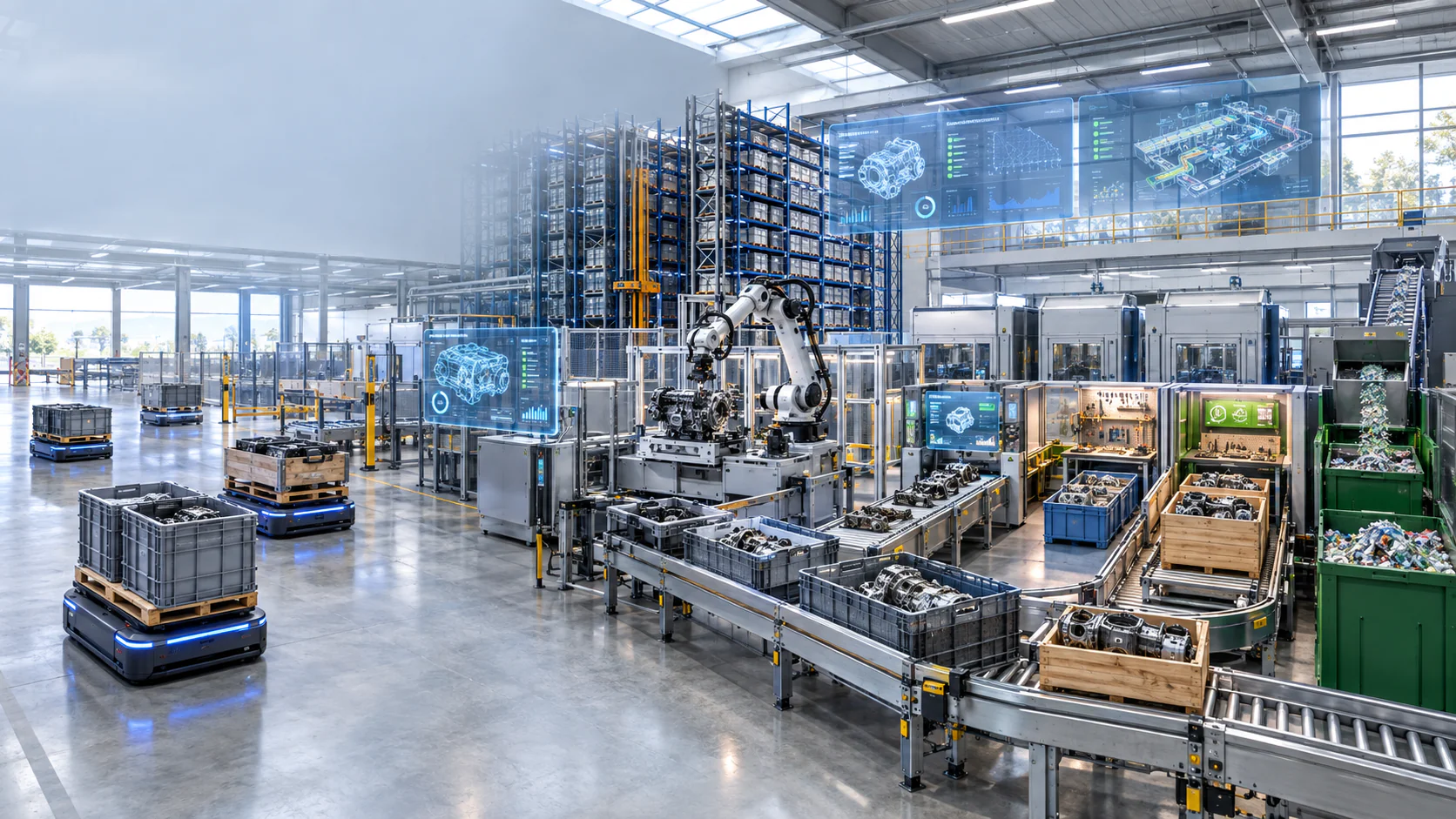
China's fossil fuel climate strategy: Using fossil energy to produce climate-friendly solar panels, wind power technology, and batteries – Image: Xpert.Digital
China's dirty secret: How coal produces our "green" solar panels
The great climate bluff: While we shut down power plants, China is expanding its power
While Europe pursues ambitious climate goals and transforms its industry through strict environmental regulations, a completely different reality is unfolding on the other side of the world: Over the past decade, China has risen to become the undisputed workshop of the global energy transition. But this rise comes at a paradoxical price. The production of the very technologies that promise us in the West a clean future—solar panels, wind turbines, and batteries—is heavily reliant on fossil fuels, especially coal, in China.
The discrepancy could hardly be greater: Europe is formally reducing its CO₂ emissions, but at the same time indirectly financing massive emissions abroad through the import of Chinese "greentech" products. With state-subsidized energy prices and strategic industrial policy, Beijing has achieved market dominance of up to 90 percent in the photovoltaic value chain and is increasingly displacing European competitors. What does this dependency mean for our security of supply? And is a global climate policy even effective if "green" products are in reality produced illegally? The following analysis sheds light on the background of China's fossil fuel-based climate strategy and the pressing questions it raises for Europe.
Related to this:
- China's CO₂ emissions exceed those of the entire West: The suppressed power question in the climate debate
Why is China increasingly viewed critically in connection with green energy production?
Over the past decade, China has established a dominant position in the global production of solar modules, wind turbine components, and battery storage systems. Its industrial strength is based on energy consumption largely driven by fossil fuels—primarily coal. While Europe and North America are striving to reduce their emissions, China uses fossil fuels to produce climate-friendly technologies and then exports them. This paradoxical situation means that while Europe formally reduces its CO₂ emissions, it simultaneously finances CO₂-intensive imports indirectly.
How significant is China's role in the global markets for solar and wind technology?
According to analyses by the European Commission, China now controls around 80 to 90 percent of the global photovoltaic value chain. From silicon mining to intermediate products such as wafers and cells, to the final assembly of modules, virtually all production stages are in Chinese hands. In wind turbines, too, the market share of Chinese manufacturers has now reached over 60 percent, particularly in onshore technologies. In both sectors, production costs in China are significantly lower than in Europe due to cheap energy, less stringent environmental regulations, and massive government subsidies. As a result, German and European manufacturers have been under pressure for years, and many have had to close down or relocate their production abroad.
What energy policy framework underpins China's industrial dominance?
The foundation is the large-scale and continuous expansion of fossil fuels. China possesses the world's largest coal reserves and, according to the Global Energy Monitor, currently operates more than 1,000 coal-fired power plants. Dozens more are in the planning or construction phase. While Europe is shutting down power plants, China is massively expanding its coal and gas-fired electricity generation capacity. This energy is not primarily intended for domestic consumption but is strategically channeled into key industries—those sectors that promise a global competitive advantage. Solar, wind, electromobility, and battery production are precisely the focus of national industrial planning.
What is China's strategic approach?
China's strategy is closely linked to long-term state planning goals. The current Five-Year Plan and initiatives like "Made in China 2025" define high-tech industries as key to global leadership. The government combines direct state support with favorable loans, energy price subsidies, and market access restrictions for foreign companies. The deliberate creation of overcapacity allows Chinese producers to flood international markets with cheap products. A similar pattern was previously observed in the steel, aluminum, and chemical industries.
What are the consequences for Europe?
Europe faces an industrial policy dilemma. On the one hand, it wants to accelerate the energy transition and climate protection, while on the other hand, European manufacturers are increasingly losing market share. Strict climate regulations, high energy prices, and CO₂ pricing are making production in Europe more expensive. While Chinese products are imported as "green solutions," millions of tons of hidden emissions flow into global trade—without appearing in European climate balance sheets. The result is a shift of industrial value creation to Asia, while European competitiveness is simultaneously weakening.
Is China's climate protection strategy actually credible?
China likes to present itself internationally as a pioneer in climate protection. President Xi Jinping has repeatedly stated the goal of achieving carbon neutrality by 2060. At the same time, the country continues to refer to itself as a "developing country" in international climate negotiations and therefore claims special rights regarding emissions targets. This dual role allows China to demand technological cooperation and financing from Western states while continuing to rely on fossil fuels itself. Critics therefore speak of a double standard in climate policy: climate-friendly rhetoric on the outside, and pragmatic power politics on the inside.
Look, this little detail saves up to 40% installation time and reduces costs by up to 30%. It comes from the USA and is patented.

NEW: Ready-to-install solar systems! This patented innovation significantly accelerates your solar construction project
The core of ModuRack 's innovation lies in the departure from conventional clamp fastening. Instead of clamps, the modules are inserted and held in place by a continuous support rail.
More information here:
First Russian gas, now Chinese technology: Europe's fatal dependence in the energy transition
How is China using Europe's climate policy to its advantage?
Beijing views climate policy as a geopolitical tool. Europe is putting itself under pressure to act through ambitious targets – for example, the Green Deal, CO₂ emissions trading, and bans on fossil fuel technologies. This is causing production to shift to countries where these regulations do not apply. China offers itself as a location with cheap energy and industrial infrastructure. It produces cheaply, then exports climate-friendly labeled devices to Europe, thereby gaining economic and political influence.
This strategy weakens European industry in two ways: economically, because it loses market share, and in terms of climate policy, because global emission reductions through production relocation are reversed.
Related to this:
- The apparent giant and disenchanted behemoth: China can only save its weakening domestic growth with a record trade surplus
Is there evidence of Chinese influence on Western climate debates?
Several analyses indicate that China is attempting to influence Western discourse through international foundations, research partnerships, and lobbying groups. This is not about direct manipulation, but rather about long-term narratives: prioritizing the expansion of renewable energies without critically examining the emissions-intensive supply chain. For example, Western environmental organizations and think tanks receive financial support through collaborations with Chinese actors. These arrangements are not necessarily corrupt, but they can contribute to Chinese interests subtly permeating political decision-making processes.
How does this affect European climate strategies?
European climate strategies often rely on symbolic targets – such as percentage quotas for renewable energies, bans on combustion engines, or CO₂ neutrality by 2050. These measures are based on the assumption that technological solutions are globally and fairly accessible. In reality, key components of the energy transition – solar modules, battery cells, permanent magnets for wind turbines – are now in Chinese hands. This makes Europe's energy transition increasingly dependent on imports from a geopolitical rival.
This has security policy implications: In a crisis, China could restrict deliveries or manipulate prices, similar to what Russia did in its gas policy. Climate policy that creates dependencies loses its moral and strategic value.
What alternatives does Europe have?
Europe can align its industrial policy more strategically. This includes:
- Reindustrialization of critical technologies: Building in-house production capacities for solar cells, semiconductors and batteries.
- Energy sovereignty: Diversification of energy sources, including clean but baseload-capable electricity generation such as nuclear energy or geothermal systems.
- Raw Materials Strategy: Secure raw material supply through own mining projects, recycling and partnerships with trusted states.
- WTO-compatible trade policy: Introduction of carbon border adjustment mechanisms (CBAM) and measures against dumping prices.
Furthermore, a reassessment of European climate targets is needed – not in the sense of abandoning climate protection, but in the sense of a balance between ecology, economy and geopolitical stability.
What role does energy pricing play in this context?
Energy prices are key factors for competitiveness. In Europe, industrial electricity prices are sometimes three to four times higher than in China. This is due to taxes, levies, and emissions trading. Chinese manufacturers obtain electricity from state-controlled and subsidized sources – mostly coal and hydropower. This structural asymmetry allows for low production costs, while European companies suffer from regulatory pressure and cost disadvantages.
What industrial consequences are already becoming apparent?
The collapse of the European solar industry serves as a cautionary tale. Companies like SolarWorld, Q-Cells, and REC have either ceased production or relocated it to Asia. A similar trend is evident in the wind power sector: European manufacturers are facing financial difficulties, while Chinese suppliers are increasingly gaining global market share. This threatens to permanently erase Europe's technological leadership in key industries of the energy transition.
How could Europe make its climate policy more realistic?
A realistic climate policy must take global emission flows into account. The crucial factor is not where CO₂ is emitted, but how much can be saved globally. This means that imports of CO₂-intensive "green" technologies can no longer be considered climate-neutral. Europe needs regulatory instruments that incorporate actual life-cycle emissions – from raw material extraction to disposal.
At the same time, Europe should promote research and innovation that develops new energy and storage technologies, instead of solely importing existing Chinese products. A more technological and less ideological approach could help to reframe climate protection as an industrial opportunity rather than a cost factor.
Is moralistic climate policy therefore counterproductive?
Moral objectives are not inherently wrong. The problem arises when they ignore real-world economic effects. European policy often formulates normative demands without considering global supply chains and power dynamics. Thus, moral idealism can unintentionally weaken a country's own economy. China's leadership exploits precisely this contradiction: it formally fulfills international expectations but derives economic and strategic advantages from Western climate morality.
Power instead of morality?
The climate debate is no longer just an environmental issue, but part of a global competition for power, markets, and industrial dominance. China's approach demonstrates that climate policy can be used as a tool to secure geopolitical standing. Europe therefore faces a crucial decision: either it clings to symbolic moralizing and loses industrial strength, or it designs its climate strategy in such a way that ecological and economic interests are balanced. Only then can the continent shape the energy transition with its own value creation and technological independence.
Your global marketing and business development partner
☑️ Our business language is English or German
☑️ NEW: Correspondence in your native language!
I and my team are happy to be available to you as your personal advisor.
You can contact me by filling out the contact form here or simply call me at +49 7348 4088 965. My email address is: [email protected]
I'm looking forward to our joint project.
☑️ SME support in strategy, consulting, planning and implementation
☑️ Creation or realignment of the digital strategy and digitization
☑️ Expansion and optimization of international sales processes
☑️ Global & Digital B2B trading platforms
☑️ Pioneer Business Development / Marketing / PR / Trade Fairs
🎯🎯🎯 Benefit from Xpert.Digital's extensive, five-fold expertise in one comprehensive service package | BD, R&D, XR, PR & Digital Visibility Optimization

Benefit from Xpert.Digital's extensive, five-fold expertise in a comprehensive service package | R&D, XR, PR & Digital Visibility Optimization - Image: Xpert.Digital
Xpert.Digital possesses in-depth knowledge across various industries. This allows us to develop tailored strategies precisely aligned with the requirements and challenges of your specific market segment. By continuously analyzing market trends and monitoring industry developments, we can act proactively and offer innovative solutions. The combination of experience and expertise generates added value and provides our clients with a decisive competitive advantage.
More information here: