
Bulgaria in the European transport network – From the Cold War to a key TEN-T position
Xpert Pre-Release

Available in 27 languages 📢
Prefer Xpert.Digital on GoogleⓘPublished on: July 6, 2026 / Updated on: July 6, 2026 – Author: Konrad Wolfenstein
Bulgaria in the European transport network – From the Cold War to a key TEN-T position
From dead end to mega-intersection: Bulgaria's stealthy rise in the European transport network
Geopolitical trump card: How the Ukraine war is putting Bulgaria at the center of European logistics
Europe's biggest bottleneck: How Bulgaria is now becoming the EU's most important logistics hub
Bulgaria sits atop a geopolitical and economic treasure – its geographical location. As a link between the core European market, the Black Sea, and Turkey, the country is the undisputed hub for trans-European freight transport. But while a glance at the map promises a logistical dream come true, reality has long revealed serious weaknesses: aging railway lines, a lack of bridges, and cumbersome administrative processes have prevented Bulgaria from realizing its full potential for decades. However, in light of global political upheavals, the disappearance of old trade routes, and unprecedented billions in EU investment, the Balkan state now stands at a historic turning point. From the massive expansion of the strategically essential TEN-T corridors and new Danube bridges to revolutionary cross-border rail freight transport – this article examines how Bulgaria is being transformed from a chronic bottleneck into an indispensable logistical backbone of Europe and what enormous challenges still need to be overcome before the project's completion.
Related to this:

Thirty years of wasted opportunities: Why Bulgaria still hasn't played its geopolitical trump card
Bulgaria possesses a geographical location that has fascinated transport planners and logistics strategists for decades: The country lies at the crossroads of the core European market and Turkey, the Black Sea and the Mediterranean, the Danube axis and the western Balkans. Anyone traveling from Hamburg to Istanbul cannot bypass Bulgaria. Anyone wanting to transport goods from the Black Sea region into the European single market needs Bulgarian ports, Bulgarian railway lines, Bulgarian border crossings. And yet, the country lags considerably behind in the infrastructural development of these strategic potentials – a paradox that can be explained by its recent political history as well as by structural weaknesses that persist to this day. The story of the pan-European transport corridors and their transformation into the modern TEN-T system is therefore not merely a technical administrative history, but an economic and geopolitical narrative of missed opportunities, protracted institutional processes, and now finally emerging strategic renewal.
From Crete to Helsinki: How Europe redesigned its transport routes
The historic moment of pan-European planning
The end of the Cold War left Europe's transport infrastructure in a state of division that went far beyond mere political symbolism. Decades of the Iron Curtain had separated East and West not only ideologically, but also physically and in terms of infrastructure. Railway lines that had once connected continents ended abruptly at border crossings. Roads that logically should have continued were lost in dead ends of political isolation. The First Pan-European Transport Conference in Prague in 1991 established the conceptual framework: The corridor concept was defined as an instrument for identifying cross-border investment priorities and pooling scarce resources.
Three years later, in March 1994, the participants of the Second Pan-European Transport Conference in Crete created a concrete reality: nine corridors were identified as priority investment programs, planned for a period of ten to fifteen years. At the Third Conference in Helsinki in 1997, a tenth corridor was added; since then, the entire package has been known as the "Crete Corridors" or "Helsinki Corridors." These corridors comprised a total of approximately 48,000 kilometers of freight transport routes, of which 25,000 kilometers were rail and 23,000 kilometers were road. The concept was deliberately structured differently from the European Union's Trans-European Transport Networks (TEN-T): the Pan-European Corridors were also aimed at non-EU countries and specifically targeted regions that required substantial new investments – precisely those countries that were emerging from centrally planned economies and were now to be integrated into market economies.
Bulgaria's dual role in the old corridor system
For Bulgaria, two of these corridors were of immediate importance. Pan-European Corridor VIII, the east-west axis from Durrës in Albania via Skopje and Sofia to Burgas and Varna on the Black Sea, was a conceptual masterpiece of post-war logic: it was intended to connect the Adriatic and Black Seas, thus creating a trans-Balkan axis that would link several non-EU states to the core European transport network. Corridor X, on the other hand, ran as a north-south axis from Salzburg or Vienna via Ljubljana, Zagreb, Belgrade, and Sofia to Thessaloniki and Istanbul – a route that passed along the capitals of the former Yugoslavia and, precisely for this reason, suffered considerable disruption during the Balkan wars of the 1990s. On paper, Bulgaria was thus a central hub of two strategic European transport axes. In reality, however, both corridors remained largely incomplete, outdated, or underfunded well into the 2000s.
The new rules: Why Europe fundamentally reformed the corridor system in 2013
Two levels instead of ten lines
With Regulation No. 1315/2013, the European Union underwent a decisive paradigm shift in its transport policy. The logic of the old pan-European corridors, based on bilateral agreements and national investment pledges, was replaced by a more binding, multi-tiered system. The new TEN-T concept now has two levels: the overall network, which is to be completed by 2050 and ensure accessibility to all EU regions, and the core network, which bundles the most strategically important connections and was originally intended for completion by 2030. Within the core network, nine main multimodal corridors were then defined – no longer as geographical lines, but as institutional governance instruments with their own coordinators, work plans, and funding mechanisms.
This nine-corridor architecture was not merely a renaming of old routes, but a profound conceptual reorganization. The old Helsinki Corridors disappeared as a separate category, but continued to exist as sections and strategic axes within the new corridors. For Bulgaria, this had far-reaching consequences: The country was now part of two of the nine core European corridors – the Orient/Eastern Mediterranean Corridor and the Rhine-Danube Corridor – and thus formally integrated into the most ambitious infrastructure program in EU history.
The 2024 reform: deepening and expansion
In June 2024, Regulation (EU) 2024/1679, a further comprehensive revision of the TEN-T guidelines, entered into force. In addition to technical adjustments, such as minimum water depths for inland waterways, this reform also brought about a strategic expansion: the TEN-T corridors were extended to candidate countries, which is particularly relevant for the Western Balkan states and Ukraine. For Bulgaria, this meant a further enhancement of its transit function, as cross-border connections to North Macedonia and Turkey could now also be formally integrated into the TEN-T framework.
Corridor 4: Bulgaria's primary European lifeline
A route through six countries – with a chronic bottleneck
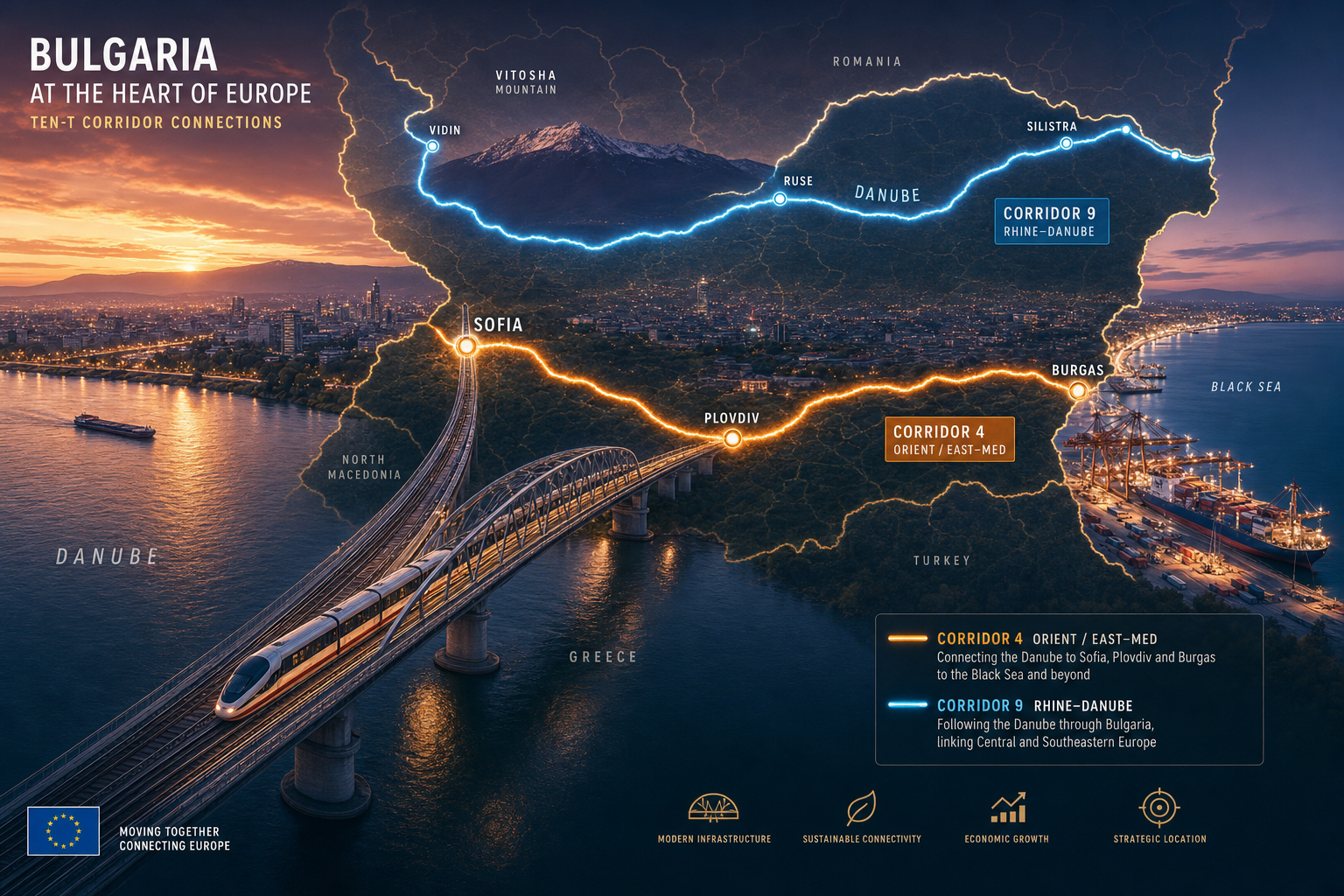
The Orient/East Mediterranean Corridor, known simply as "Corridor 4" in European nomenclature, is one of the most extensive corridors in the entire TEN-T system, with a total length of 6,480 kilometers. It connects the German North Sea ports of Bremen, Hamburg, and Rostock via the Czech Republic and Slovakia, with a branch through Austria, continuing through Hungary to the Romanian port of Constanța, the Bulgarian port of Burgas – and a connection to Turkey – as well as to the Greek ports of Thessaloniki and Piraeus, and finally, via a maritime highway, to Cyprus. This corridor is designed to be multimodal: it includes rail, road, airports, ports, cargo terminals, and the Elbe waterway.
On Bulgarian territory, after crossing the Vidin-Calafat Danube bridge to Sofia, the corridor branches out in several directions: Sofia → Plovdiv → Burgas leads to the Black Sea coast. Sofia → Plovdiv → Svilengrad connects to the Turkish network via the Kapıkule border crossing. And the Sofia → Thessaloniki → Athens → Piraeus route forms the southern axis through Greece. This fan-shaped structure makes Sofia the true hub of the entire corridor in Southeast Europe – a function that gives the country enormous strategic importance, which, however, is undermined by inadequate infrastructure.
The official bottleneck of the entire corridor is not in Germany or Austria, but on the Timișoara–Sofia section. This approximately 400-kilometer stretch, which runs through Romanian Wallachia and then across the Vidin-Calafat Danube bridge into northwestern Bulgaria, largely fails to meet current European standards for speed, axle load, and signaling technology. While the entire 280-kilometer Bulgarian section between Vidin and Sofia is electrified, two-thirds of it remains single-track, and operating speeds are sometimes below 100 km/h. In a core network that aims for 120 km/h for freight trains, this is a critical weak point.
The billion-dollar Vidin–Sofia project
Bulgaria's state-owned rail infrastructure company NRIC has therefore developed plans for the comprehensive modernization and partial reconstruction of the Vidin–Sofia line. The centerpiece is the realignment of the Vidin–Medkovets section to a less winding route, requiring extensive civil engineering work: two tunnels, six bridges, and eleven viaducts, including a 1,126-meter-long overpass at a height of 112 meters. The new alignment will shorten the Vidin–Sofia route by 14 kilometers. Once completed, passenger trains will be able to travel at 160 km/h and freight trains at 120 km/h. The investment volume for the first section, Vidin–Medkovets, alone amounts to €2.3 billion, making this project one of the largest single investment projects in Bulgarian railway history.
This dimension illustrates the fundamental dilemma: the entire Corridor 4 suffers from a massive investment backlog in its Eastern European section, accumulated over decades of neglected maintenance and a lack of modernization. Bulgaria is not an isolated case, but rather symptomatic of the infrastructural gap that has opened up between Western and Eastern Europe since industrialization and which could not be quickly closed even after Bulgaria's EU accession in 2007.
Corridor 9: The Danube as the silent backbone of European freight transport
Water as infrastructure
The Rhine-Danube Corridor is the most important east-west transport axis on the European continent and the core network counterpart to the old Rhine-Main-Danube axis concept. It connects Strasbourg and Mannheim via two parallel routes in southern Germany with Vienna, Budapest, Bratislava, Belgrade, and Bucharest, ultimately terminating at the Black Sea ports of Constanța and Sulina. In the 2024 reform, the corridor was extended by a northern segment running from the German ports of Wilhelmshaven, Bremen, Hamburg, and Rostock via Berlin, Dresden, and Prague to Lviv (Lemberg) in Ukraine.
For Bulgaria, the Rhine-Danube Corridor is primarily relevant due to the Danube as an inland waterway: The entire Bulgarian section of the Danube, from Vidin in the northwest to Silistra in the northeast, a distance of almost 470 river kilometers, is part of this corridor. The port of Ruse is the most important Bulgarian Danube port and a potential transshipment hub between the inland waterway and the rail and road networks. However, the navigability of the Danube remains a chronic problem: Low water levels during dry periods can restrict passage for large ships, and minimum drafts of 2.50 meters are not consistently guaranteed along the entire route.
The third Danube bridge: A long-delayed breakthrough
For a long time, the entire approximately 500-kilometer stretch of the Romanian-Bulgarian Danube border had only a single combined road and rail bridge: the bridge between Ruse and Giurgiu, whose basic structure dates back to the 1950s and is now chronically overloaded. The second Danube bridge near Vidin-Calafat (Danube Bridge 2), opened in 2013, did provide some relief for the northwestern tip of Bulgaria, but it did not solve the structural bottleneck problem.
For years, a third Danube crossing near Ruse-Giurgiu has been under discussion, intended to accommodate both road and rail traffic. In 2023, Bulgaria and Romania jointly applied for EU funding for a feasibility study. At the end of 2024, the regional governor of Ruse announced that €2.5 billion in European funding had been secured and that construction was scheduled to begin in 2026. Another bridge location near Silistra is also being considered to develop the eastern section of the Bulgarian Danube. In addition, there is a plan to electrify the approximately 11-kilometer section from the Ruse marshalling yard to the midpoint of the bridge – a project whose technical planning is expected to be completed by June 2026.
The legacy of the Helsinki corridors: Transformation instead of disappearance
Corridor VIII: From a promise on paper to a planned connection ready for construction
To understand the transformation of the old pan-European corridors into the new TEN-T system, one must grasp the institutional logic of the transition: the old corridors did not simply disappear, but were integrated into the new core network corridors as sections and strategic sub-axes. Corridor VIII is the most striking example of this process in Bulgaria. The original route from Durrës via Skopje and Sofia to Burgas and Varna continues today as a priority element within the Orient/East Mediterranean Corridor and was explicitly classified as a priority segment in the TEN-T freight corridor in 2022.
Of the approximately 1,350 kilometers of total length, 747 kilometers are located on Bulgarian territory – this represents more than half of the total corridor length and underscores Bulgaria's central role in this project. The current status is a mosaic of completed, ongoing, and planned construction projects. North Macedonia opened the 30.8-kilometer Kumanovo–Beljakovce section in January 2025; construction workers are currently building another 34 kilometers from Beljakovce to Kriva Palanka, with a planned completion date of October 2026. On the Bulgarian side, the Sofia–Gyueshevo lines are being adapted to the requirements of the new border tunnel.
The Deve-Bair Tunnel: The last missing link
The most protracted and politically sensitive element remains the border tunnel between Gyueshevo in Bulgaria and Deve Bair in North Macedonia. On November 6, 2025, both countries signed an intergovernmental agreement on the construction of this 2.4-kilometer-long railway tunnel – an agreement negotiated for years under difficult conditions. The project is scheduled for completion by 2030 at the latest; construction is slated to begin in 2026 after all tendering procedures have been finalized. EU funding from the Global Gateway Initiative is available for financing, as both countries, being enlargement and accession regions respectively, can access the relevant funding programs.
As recently as July 2026, the Bulgarian side expressed concerns that North Macedonia still owed formal comments on the draft intergovernmental agreement – suggesting that the administrative groundwork for the start of construction had not yet been fully completed. These delays are symptomatic of a broader structural problem: cross-border infrastructure projects in the Balkans fail less due to a lack of available funding or technical expertise than due to the parallel administrative and political processes within two different national systems.
Corridor X: Life as a freight train corridor
The old Pan-European Corridor X, the connection from Vienna via Ljubljana, Zagreb, Belgrade, and Sofia to Thessaloniki and Istanbul, has found a slightly different institutional home in the new TEN-T system. It lives on in the Alpine-Western Balkan Rail Freight Corridor (RFC AWB or RFC 10), which has been officially operational since January 2020. This rail freight corridor connects Salzburg via Villach, Jesenice, Ljubljana, Zagreb, Belgrade, and Niš to the Serbian-Bulgarian border and from there to Svilengrad on the Turkish border. It comprises 2,165 kilometers of track, 21 terminals, and 12 marshalling yards, thus forming one of the shortest connections between Central Europe and the Middle East.
For Bulgaria, the RFC AWB represents a crucial integration into European rail freight transport: goods from Austria, Slovenia, Croatia, or Serbia can be transported to Bulgarian territory and onward to Turkey without complex retendering processes, because train paths are reserved in advance for the entire corridor. The coordinating body is the RFC AWB One Stop Shop, which handles requests from all five member countries. This integrates Bulgaria into the European freight corridor not only geographically but also operationally – a fundamental prerequisite for making rail transport competitive with road transport.
Our EU and German expertise in business development, sales and marketing

Our EU and German expertise in business development, sales and marketing - Image: Xpert.Digital
Industry focus areas: B2B, digitalization (from AI to XR), mechanical engineering, logistics, renewable energies and industry
More information here:
A thematic hub offering insights and expertise:
- Knowledge platform covering global and regional economies, innovation and industry-specific trends
- A collection of analyses, insights, and background information from our key areas of focus
- A place for expertise and information on current developments in business and technology
- A hub for companies seeking information on markets, digitalization, and industry innovations
Bulgaria after Schengen and the Euro: Why sustainable growth can now begin
Bulgaria as a strategic bridge: Economic dimension and geopolitical significance
The Triple Anchor: Black Sea, Danube, Turkey Corridor
Bulgaria's economic importance within the TEN-T system stems not from a single advantage, but from the combination of three structural strengths. First, the Black Sea ports of Burgas and Varna: both ports are part of the TEN-T core network and offer direct access to Black Sea freight traffic as well as the Trans-Caspian International Transport Route (Middle Corridor), through which goods from Central Asia, Kazakhstan, and China flow westward. Bulgaria must compete with the significantly larger and better-equipped Romanian port of Constanța, which, with a throughput of approximately 67 million tons per year, remains the dominant Black Sea gateway on the EU side. The planned modernization and expansion of Bulgaria's Black Sea ports is therefore a strategic necessity if the country is to increase its share of the growing Trans-Caspian freight traffic.
Secondly, the Danube Corridor: With almost 470 kilometers of Danube riverbank and the river port of Ruse as its most important inland port, Bulgaria possesses considerable potential in inland waterway transport. The Danube, as part of the Rhine-Danube Corridor, is cost-effective, low-emission, and has high capacity – but could handle significantly more goods if the infrastructure at the ports and the intermodal connections to the rail and road networks were improved. In this context, the planned third Danube bridge near Ruse is not just a transport measure, but a key project for the economic development of the entire northern Bulgarian region.
Thirdly, the Turkey Corridor: Svilengrad on the Turkish border is the busiest land border crossing between the EU and Turkey. Thousands of trucks and freight trains pass through this point daily, which is crucial for trade between Germany, Austria, and Turkey, as well as for transit routes to Asia. The RFC AWB Corridor makes Bulgaria an indispensable link between the European single market and the Turkish economic area, which, with a GDP of over one trillion US dollars and intensive trade relations with the EU, represents one of the most important neighboring economic areas.
Related to this:

The North Macedonia Dilemma and the Western Balkan Gap
The unfinished Corridor VIII is more than just a technical infrastructure problem: it represents a strategic gap in the European connectivity architecture. As long as the railway link between Sofia and Skopje is not fully operational, a direct rail link from the Adriatic to the Black Sea through the western Balkans is lacking. This gap has several economic consequences: it increases transport times and costs for goods from Albania and North Macedonia, which must continue to be transported via underdeveloped road routes or detours through other countries. It weakens the competitiveness of these countries in trade with the EU and among themselves. And it prevents the Adriatic ports of Durrës and Vlorë from serving as genuine Western European gateways for west-east transit traffic.
In February 2026, Bulgaria, Greece, and Romania jointly submitted an application for EU funding to modernize the trinational Thessaloniki–Sofia–Bucharest rail corridor. The total investment volume of this project is estimated at around six billion euros. After a hiatus of approximately ten years, the project is scheduled to resume in 2027 and would create a continuous north-south corridor from the Aegean Sea to the Romanian-Ukrainian border. Such a multinational, coordinated application is rather unusual in the history of EU infrastructure funding for this region and signals that the governments involved are increasingly recognizing the urgent need for infrastructure improvements.
The financing architecture: CEF, Cohesion Fund and Global Gateway
Three instruments, one goal
The modernization of Bulgaria's TEN-T network is funded by three different EU financing instruments, each with its own logic, requirements, and conditions. The Connecting Europe Facility (CEF) is the most direct instrument: it finances cross-border projects on the core network directly from the EU budget, with matching funds from member states. For the period 2021 to 2027, a total of approximately €25.8 billion is available for the transport sector, of which around €11.3 billion comes from the Cohesion Fund. As a cohesion country, Bulgaria benefits from increased co-financing rates, meaning that the EU's share of the total project costs is significantly higher than usual. Between 2021 and 2024, more than €21 billion from the CEF was already invested in European transport infrastructure, with the largest share going to railway projects.
The Cohesion Fund complements the CEF by providing program-based financing for Member States whose gross national income per capita is below 90 percent of the EU average – a condition that Bulgaria, as the poorest economy in the EU, clearly meets. Significant funds will flow through the Cohesion Fund into transport infrastructure and environmental projects in Bulgaria between 2021 and 2027. However, the management of these funds is the responsibility of the Member States themselves, which places particular demands on absorption capacity, i.e., the ability to use EU funds in a timely and compliant manner. This is precisely where Bulgaria's historical weakness lies: corruption, inefficient administrative structures, and lengthy procurement procedures have historically resulted in the underutilization of available EU funds.
The most recent addition to the financing portfolio is the Global Gateway initiative, launched in 2021 as Europe's response to China's Belt and Road Initiative. Its goal is to mobilize investments of up to €300 billion by 2027 – a target that was already exceeded ahead of schedule in October 2025 with more than €306 billion. Global Gateway facilitates the financing of cross-border infrastructure projects that also include non-EU countries, which is particularly relevant for Corridor VIII, extending into Albania and North Macedonia. The financing of the Deve Bair border tunnel is intended to be channeled, at least in part, through this channel, which is designed for cross-border connections with candidate countries.
Technical modernization and interoperability: The underestimated dimension
ETCS and GSM-R: The silent battle for interoperability
Railway infrastructure is not just a matter of tracks and bridges. Digital signaling and train control technology are at least as crucial for the operational efficiency of a corridor. The European Train Control System (ETCS) and the GSM-R digital radio system are the fundamental technical prerequisites for trains from different national systems to travel seamlessly across borders. Along the entire Orient/East Mediterranean Corridor, ETCS is currently only operational on 13 percent of the route; GSM-R, however, covers 51 percent. According to the TEN-T guidelines, the entire corridor should be equipped with ETCS by 2030 – a goal that seems extremely ambitious given the current situation.
For Bulgaria, this requirement means significant additional investments in railway signaling technology, which must be carried out in parallel with extensive track modernizations. According to current plans, the Vidin–Medkovets line is to meet the latest EU standards for safety, reliability, and interoperability. This is a necessary but costly prerequisite: without full ETCS equipment, train control systems remain incompatible across national borders, preventing the full realization of the efficiency gains of an integrated European rail network.
Economic perspective: The cost of Bulgaria's infrastructural lag
The invisible growth brake
The economic costs of inadequate transport infrastructure are difficult to measure in economics, but their fundamental nature is clearly evident. Companies with poor transport connections face higher logistics costs, longer delivery times, and less reliable planning for international supply chains. For Bulgaria, the poorest EU member state, which has suffered from a convergence gap with the EU average for decades, transport infrastructure is a crucial prerequisite for economic recovery. The population decline, one of the most severe within the EU, exacerbates the problem: fewer workers mean greater pressure to increase productivity, and these productivity gains, in turn, depend on well-functioning logistics and supply chains.
Improving the Vidin–Sofia railway line alone could significantly reduce overall travel time on the Middle East/East Mediterranean Corridor. Shorter transit times lower storage costs, enable just-in-time deliveries, and make Bulgarian locations more attractive to manufacturing companies. The planned increase in line speed to 120 km/h for freight trains would transform Bulgaria from a transit bottleneck into a competitive logistics hub. A similar situation exists for the ports: modernized and better-connected ports in Varna and Burgas could benefit from the growing Middle Corridor traffic, which has gained considerable importance due to Russia's war in Ukraine – as the traditional northern routes through Russia have now largely disappeared.
Geopolitics as a tailwind
The geopolitical realignment after 2022 has objectively enhanced Bulgaria's transit function. The collapse of Russian transit as an alternative to eastern European connections, the increased importance of the Middle Corridor through the Caucasus and Turkey, and the intensified EU investment policy towards candidate countries have created a situation in which the completion of Bulgaria's TEN-T infrastructure is no longer just a national development task, but a matter of pan-European strategic interest. This changed geopolitical situation also explains why projects such as the Deve Bair Tunnel and the Thessaloniki–Sofia–Bucharest line are now finally gaining momentum after years of stagnation.
Bulgaria is thus at a strategic turning point: The country has a geographical rent to unlock that has been blocked by decades of underinvestment. Available funding from the CEF, the Cohesion Fund, and the Global Gateway is greater than ever before. Political support at the European level is in place. The crucial variable now is institutional capacity – Bulgaria's ability to implement projects on time, in compliance with regulations, and effectively. This is the real challenge for the coming years: not a lack of money or strategic will, but the transformation of infrastructure ambitions into built reality.
🎯🎯🎯 Data-driven B2B industry hub as a quasi-in-house solution

The quasi-in-house solution: How Xpert.Digital closes operational gaps in B2B marketing and sales – Smart Content-Driven Business - Image: Xpert.Digital
Xpert.Digital is a data-driven B2B industry hub led by Konrad Wolfenstein . The company acts as an external, quasi-in-house solution for industrial partners, closing operational gaps in marketing, content, and sales – without requiring additional resources on the client side.
More information here:
Your global marketing and business development partner
☑️ Our business language is English or German
☑️ NEW: Correspondence in your native language!

Konrad Wolfenstein
I and my team are happy to be available to you as your personal advisor.
You can contact me by filling out the contact form here [email protected]:or simply call me at +49 7348 4088 965. My email address is
I'm looking forward to our joint project.





