
The central contradiction: Deburocratization, advise on the profiteers of bureaucracy - the error in the system of bureaucracy reduction
Xpert pre-release

Available in 27 languages 📢
Prefer Xpert.Digital on GoogleⓘPublished on: June 23, 2025 / update from: June 23, 2025 - Author: Konrad Wolfenstein

The central contradiction: Deburocratization, advise on the profiteers of bureaucracy - the error in the system of bureaucracy reduction - Image: Xpert.digital
Expensive illusion: How the advisory density prevents real reforms
State failure through outsourcing: the paradox of German administrative modernization - when profit -oriented actors take on state tasks
The Federal Republic of Germany faces a fundamental challenge that affects the heart of its government and administrative ability. On the one hand, the politically proclaimed imperative of the "Germany Tempos"- an unprecedented acceleration of planning and approval procedures is to promote the modernization of the infrastructure, the energy transition and the digital transformation. On the other hand, the reality of a state is revealed that increasingly hollows out its core competencies and is growing into a growing dependency on external, profit -oriented actors. This development has created a "shadow bureaucracy", the costs and influence of which grow steadily.
This report analyzes the central paradox of modern German government: the attempt to force efficiency through law, while the necessary administrative and strategic skills are systematically outsourced. The central thesis is that the success of every real reform, in particular the "planning and approval acceleration", is inextricably linked to the coping of the systemic problems caused by this shadow bureaucracy. The critical question is examined whether those actors who benefit from bureaucratic complexity and state dependence can have an interest in reforming these structures sustainably. The analysis shows that without a fundamental reform of the use of consultants and a massive reinvestment into one's own state competence, the proclaimed acceleration goals threaten to degenerate into a costly illusion.
"The central contradiction of our time: of all people who live from the bureaucracy, they should abolish them. They advise on detoxification - and nourish themselves from the complexity. Their business model is not the solution, but the permanent condition.
A fundamental conflict of interest arises if precisely these companies are commissioned to simplify state processes, to be streamlined and enable administration to become self -employed. A really successful debut or competence development project would eliminate the need for future consulting services and thus undermine the business basis of the consultants. Companies benefit from the complexity and the "bureaucracy" that they are supposed to fight officially. They sell expensive solutions for problems, the continued existence of which-consciously or unconsciously-contributes to the creation of new, complex management structures and the hollowing-out of internal skills.
This is the core of the problem: The business model of the large strategy consultations and auditing companies is based on the acquisition of long -term, complex projects. They not only sell a unique solution, but ideally follow -up orders, implementation accompaniment and permanent strategic partnerships. ”
Suitable for:

The official narrative: the national imperative of the "planning and approval acceleration"
The political mandate for a faster Germany
The demand for an acceleration of planning and approval procedures has become a central pillar of current government policy. The coalition agreement formulates the ambitious goal of fundamentally reforming the planning, construction, environmental, awarding and administrative procedure law in order to make Germany future-proof. This political mandate feeds itself from the widespread diagnosis of an "investment backlog". Despite the available budget, Germany has had difficulties for years to actually install them, which is reflected in high “investing outdoor remnants” in the federal households.
The narrative of the acceleration serves as an answer to multiple national crises and challenges. It is presented as essential to achieve the ambitious climate goals, in particular through the quick expansion of renewable energies and the necessary network infrastructure. At the same time, the modernization of the dilapidated transport infrastructure - from bridges to railways to waterways - is intended to secure and strengthen the country's economic dynamics. The acceleration is thus staged as a national effort that is intended to guarantee Germany's competitiveness and future viability.
The legal and administrative instrument
digitalization
A core promise is the continuous digitization of all planning and approval procedures. The aim is to overcome analogous, paper -based processes and to replace efficient digital workflows in order to save time and resources.
Procedure for procedure
A central lever is the simplification of the methods of procedure. The more complex "planning approval" is to be pushed back as a rule in favor of the slimmer "planning approval". In addition, uniform procedural law for infrastructure projects is to be introduced in order to end the fragmentation of regulations.
Specific exceptions
The regulation for so -called replacement new buildings is particularly far -reaching. In the area of the federal highways and railways, these will in future be largely without lengthy planning approval procedures and environmental impact assessments, even if they are expanded.
Implementation of EU law
The Federal Government is implementing the EU Directive (EU) 2021/1187 ("Optimizing the Trans-European Transport Network"). This stipulates that the planning approval procedure for certain strategically important projects of the Trans-European Transport Network (TEN-V) must be completed within a period of four years.
Sector -specific measures
In rail traffic, the need for measures to implement the “Germany cycle” is laid down by law and made it difficult to develop railway lines in order to obtain the infrastructure. Autobahn GmbH is intended to create a cadastre of usable areas for federal highways, for example to accelerate the expansion of charging infrastructure or renewable energies.
A controversial vision: conflicts of interest and criticism
Environmental and climate protection concerns
Environmental associations such as the BUND for the Environment and Nature Conservation Germany (BUND) urgently warn that the acceleration laws do not distinguish between climate -friendly and climate -damaging projects. While the expansion of renewable energies stops, the construction of highways would also be accelerated, which is diametrically opposed by the climate goals. The associations also criticize that the restriction of participation rights and lawsuits is undemocratic and, paradoxically, can lead to worse and thus delayed projects, since errors are not recognized at an early stage.
Doubts about legal conformity
A legal opinion commissioned by the Nature Conservation Association (NABU) comes to the conclusion that the planning acceleration law is not compliant with EU law. It is feared that this could not lead to an acceleration, but to waves of complaint before European courts, which could block projects for years and conjure up a new “toll debacle”.
Demands of the economy
On the other hand, business and construction associations such as the Central Association of German Construction (ZDB) are calling for more radical steps. This includes the reintroduction of the "material preclusion", which excludes objections to the legal proceedings, if they have not already been raised in the administrative procedure, as well as a further restriction of the association law for environmental organizations.
The debate reveals that there is no consensus about what exactly should be accelerated. Government policy acts as a blunt instrument here, which also drives the expansion of wind turbines and that of motorways and thus stands in a fundamental conflict of goals with its own climate protection obligations. In addition, the strategy is based on a legally risky basis. The conscious restriction of lawsuits in the hope of faster procedures could prove to be a boomerang if European courts declare the laws inadmissible. This would not only jeopardize individual projects, but also endanger the entire legal framework of the planning acceleration and lead to systemic delays - the exact opposite of the intended goal.
A constructive alternative approach to the expensive flood of consultants of the federal government

A constructive alternative approach to the expensive flood of consultants of the federal government - Image: Xpert.digital
The German federal government faces a serious problem that affects both taxpayers and the integrity of the administration: the uncontrolled dependence on external consulting companies. In its most recent report, the Federal Audit Office has had a clear criticism of the lack of strategy of the government to reduce this costly dependency. The numbers speak a clear language and reveal the extent of this problematic development.
This development is all the more worrying when the Bundestag's budget committee had already called for a substantial reduction in consultant costs in 2020. However, the Federal Government has not fulfilled these claims, as the Federal Audit Office unequivocally determines. Instead, the government's annual advisory reports show little willingness to make changes in the use of external consultants.
The structural weaknesses of the current approach
- Lack of strategic planning
- Hanging up administrative integrity
- Quality problems and copy paste advice
More about it here:
From 32 to 240 million euros: the explosive development of government advice
The shadow narrative: the advancement of the consultant state
A decade of the escalation: the quantification of dependency
The figures of the Federal Audit Office (BRH) draw an alarming image of an escalating dependency. The Federal Government's expenditure for external consulting and support services rose by 39 % to almost 240 million euros per year between 2020 and 2023. Over the last decade, the costs added up to more than 1.6 billion euros, with half of them - around 800 million euros - started in the past four years alone. This indicates exponential growth.
This phenomenon is particularly paradoxical, since the federal administration recorded a significant increase in personnel of around 50,000 jobs in the same period. This increasingly becomes the official justification of the lack of resources. The expenditure focuses on key ministries: in 2023 the Federal Ministry of the Interior and for Home (BMI) with 59.7 million euros and the Federal Ministry of Finance (BMF) with 38.2 million euros - that is, those departments that are responsible for the organization of the state and its finances.
The advancement of the advisory state: the quantification of dependency
Development of federal expenses for external consultants (2014–2023)
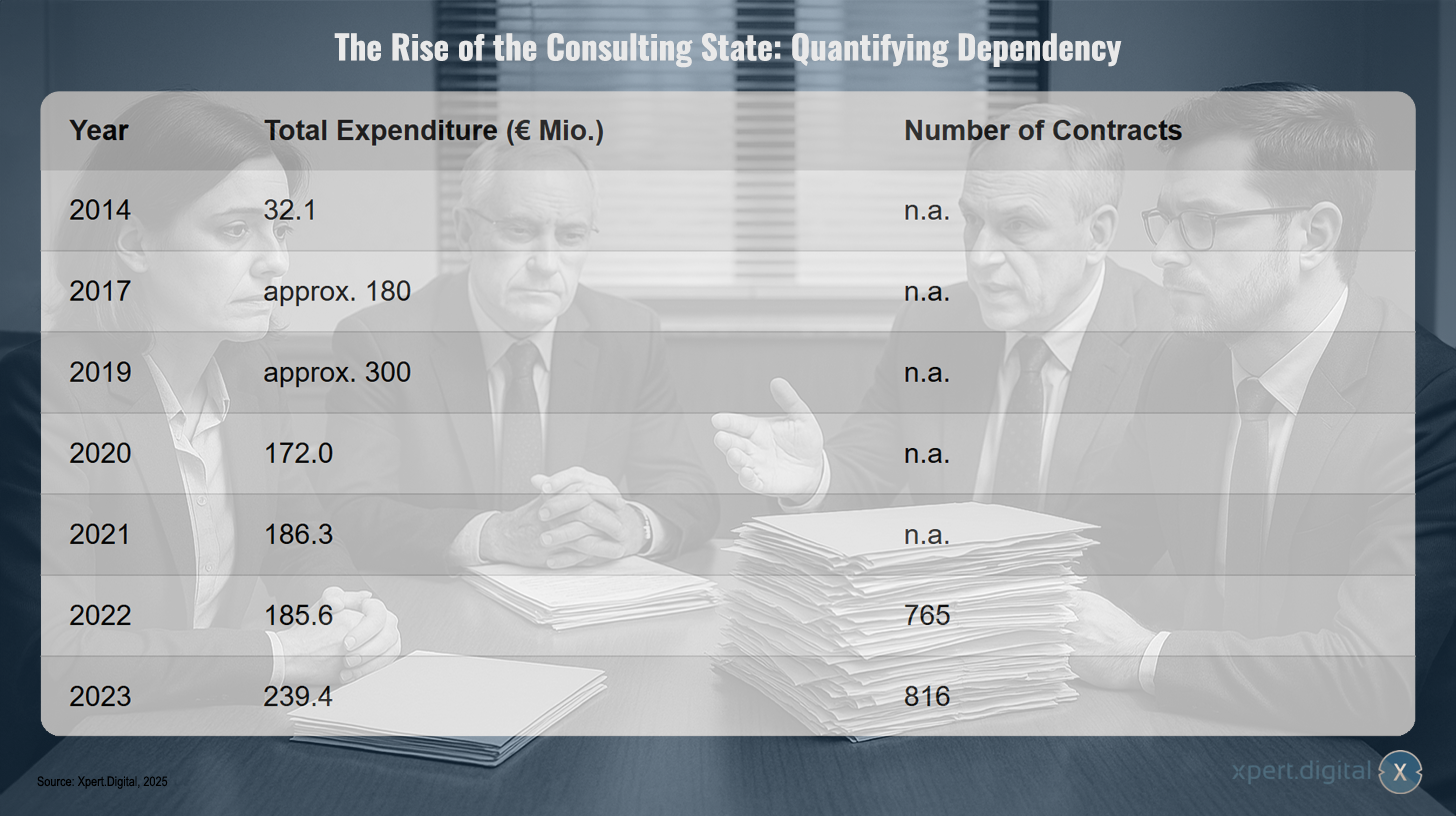
The advancement of the advisory state: the quantification of dependency - picture: xpert.digital
The advancement of the consultant state shows a remarkable quantification of the dependence on external consulting services. In 2014, total expenditure still amounted to 32.1 million euros. Already in 2017 there was a drastic increase to around 180 million euros, which continued to around 300 million euros by 2019. After a decline to 172.0 million euros in 2020, expenditure in 2021 rose to 186.3 million euros. In 2022 they remained almost constant at 185.6 million euros, with the number of contracts recorded for the first time - a total of 765 contracts. In 2023, expenditure at 239.4 million euros reached a new high with 816 contracts concluded.
Data for 2014-2021 are based on aggregated reports and graphics; Data for 2022-2023 are more precise. The numbers for 2020 and 2021 reflect the new, closer definition of consulting services.
Expenses for selected ministries for external advice (2022 vs. 2023)
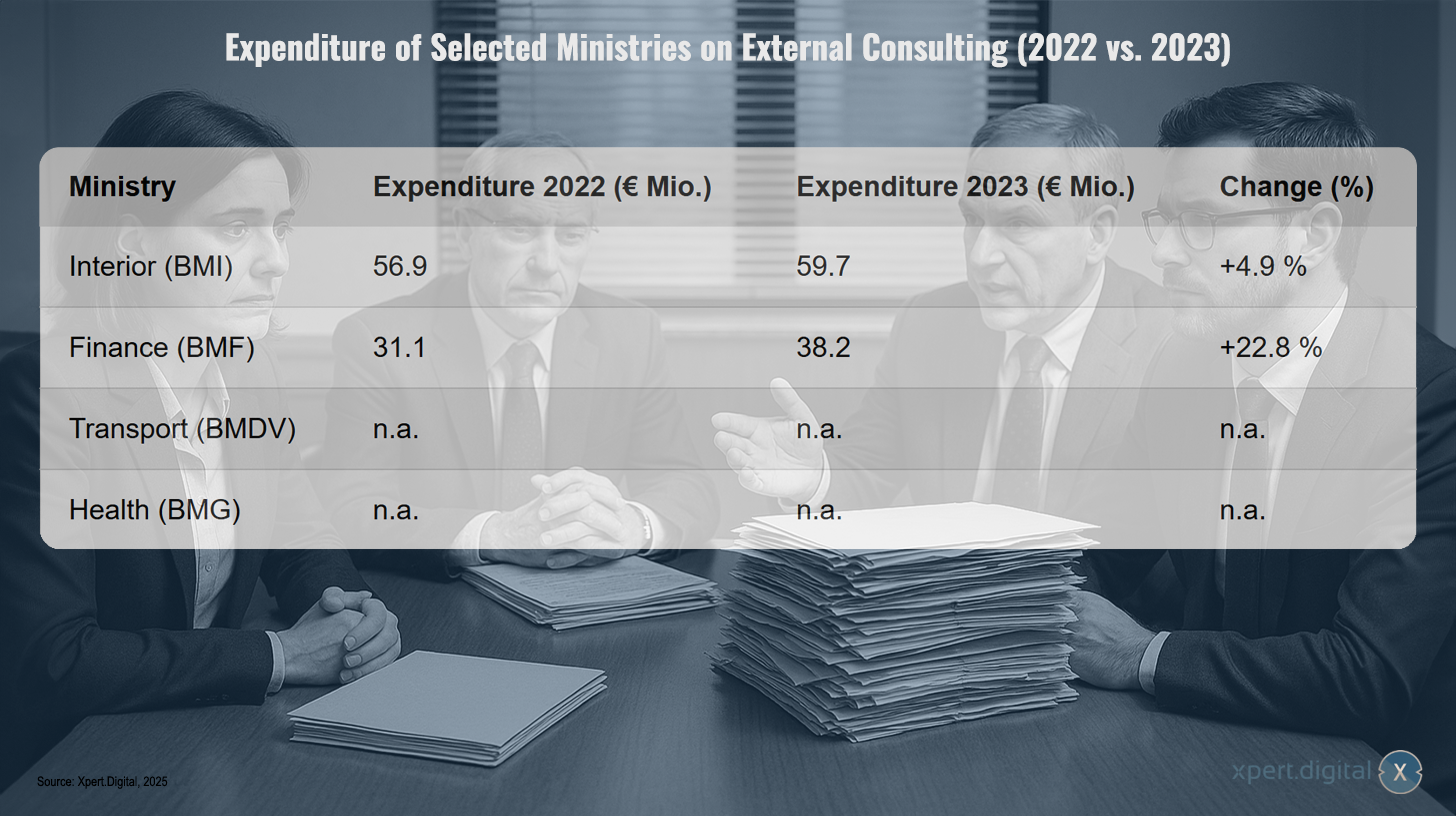
Expenditures of selected ministries for external advice (2022 vs. 2023) - Image: Xpert.digital
The expenses of selected ministries for external advice show different developments between 2022 and 2023. The Federal Ministry of the Interior (BMI) increased its expenditure from 56.9 million euros to 59.7 million euros, which corresponds to an increase of 4.9 percent. The increase in the Federal Ministry of Finance (BMF), which increased its advisory expenses from EUR 31.1 million to EUR 38.2 million, was significantly stronger - an increase by 22.8 percent. There is no corresponding data for the Federal Ministry of Digital and Transport (BMDV) and the Federal Ministry of Health (BMG).
The data illustrates the concentration of expenses in central administrative and financial departments.
More about it here:

The unheard of wax dog: the indictment of the Federal Audit Office
For years, the Federal Audit Office has been warning of the consequences of this development with increasing urgency, but its reports are largely unpainting.
Hanging up administrative integrity
The BRH uses the sharp concept of hazardous to the "integrity of the administration". When core tasks such as financial controlling in the strategic project "IT consolidation BUND" are awarded to external, the state loses control of essential decisions and makes itself dependent on the interests of private companies.
Missing strategy and transparency
The examiners repeatedly criticize the lack of a cross -departmental strategy for controlling and reducing the use of consultants. The annual reports of the Federal Government to Parliament are criticized as "incomplete and vague" and testify to "little willingness to change".
Systematic ignorance
The BRH reports are a chronicle of institutional failure. The Ministry of Finance and the Federal Government consistently ignored the examiners' recommendations for reforming reporting and strengthening transparency.
Inadequate reporting
The reports to the Bundestag are not only late, but also inadequate in terms of quality. The name of the contractor is not mentioned in almost a third of the large orders of over 50,000 euros, which makes parliamentary control of dependencies and conflicts of interest.
The systematic disregard of the warnings of the highest German auditing authority indicates a worrying state of political control. If the executive can consistently pass the sound criticism of its constitutionally anchored control body, this reveals a significant weakening of the separation of powers. In this constellation, the BRH is increasingly acting as a "toothless tiger", whose barking is loud, but does not result in any consequences.
The architecture of influence: how the consultant market works
The massive expansion of the consultant in the federal government is not a coincidence, but the result of targeted administrative and political course.
The "definition knitting" of 2020
A crucial step to cover up the true extent of dependency was the redefinition of the term "external advisory and support services" in 2020. This change in particular "operational services in the IT area" fell out of the reporting obligation. This led to a statistical decline in expenses by over 40 %, while the actual number of consultants and the real costs, especially in the strategically important digitization area, became invisible for the parliament. This act, which was criticized as a "veil maneuver", was a targeted political decision to disguise the costs of its own prestige projects and undermine democratic control.
The dominance of the framework contracts
Access to the lucrative market of government counseling is controlled via so -called framework contracts. In fact, these create a closed oligopoly for a small group of global advisory giants such as McKinsey, BCG and the "big four" (PWC, KPMG, EY, Deloitte). In the BMI, almost 90 % of the orders over 50,000 euros were recently awarded via such contracts. This inhibits the competition and excludes smaller, often more specialized providers.
The role of intermediaries
The “PD - Advisor of the Public Hand GmbH” creates an additional level of non -transparency. Although it is 100 % in public property, she often acts as the main contractor, who then passes on the actual orders to the known private consulting companies. This obscures the direct contractual relationships and money flows.
🎯🎯🎯 Benefit from Xpert.Digital's extensive, fivefold expertise in a comprehensive service package | R&D, XR, PR & SEM

AI & XR 3D Rendering Machine: Fivefold expertise from Xpert.Digital in a comprehensive service package, R&D XR, PR & SEM - Image: Xpert.Digital
Xpert.Digital has in-depth knowledge of various industries. This allows us to develop tailor-made strategies that are tailored precisely to the requirements and challenges of your specific market segment. By continually analyzing market trends and following industry developments, we can act with foresight and offer innovative solutions. Through the combination of experience and knowledge, we generate added value and give our customers a decisive competitive advantage.
More about it here:
Consultant oligopol: the sale of state competence to corporations
The perverse symbiosis: when reforming and private interests collide
A pattern of dysfunction: costly failures and the consultant connection
A number of prominent project defects in recent years shows a recurring pattern: massive costs, blatant failure and the continuous participation of the same large consulting companies.
The car-toll debacle
The companies PWC and Roland Berger were significantly involved in the conception and support of the project. They provided the professional legitimation for a political prestige project, the legal and financial risks of which were ignored. The result: a compensation payment of 243 million euros to the terminated operators and other impending claims.
The BMVG "consultant affair"
In the Ministry of Defense, allegations of the nepotism and violent contracts of order led to a parliamentary committee of inquiry. McKinsey and Accenture were in the center. The appointment of the former McKinsey partner Katrin Suder as State Secretary demonstrably opened doors to her former colleagues and led to millions of contracts, the necessity and legality of which were severely questioned.
The failure of IT consolidation
This mammoth project for modernizing the federal IT, in which Deloitte, Capgemini, BearingPoint and IBM were involved, is a prime example of cost explosions and targeting targets. At the same time, the leading BMI had outsourced core tasks of project management and controlling to external companies.
The Sefe affair (former Gazprom Germania)
Here the Boston Consulting Group (BCG) came under criticism for free-handed contracts and an obvious conflict of interest after a former BCG partner was put at the top of the nationalized energy group.
The Wirecard scandal
The failure of the auditor Ernst & Young (EY) had a direct impact on the state financial supervision and the Ministry of Finance, which had rely on the company's tests.
These cases are not isolated breakdowns, but symptoms of a systemic pathology. The repeated occurrence of the same companies in connection with the same dysfunctional patterns - non -transparent allocation, lack of control, diffuse responsibilities and enormous costs for the taxpayer - indicates a structural problem, not to individual errors.
The central contradiction: Deburocratization, advise on the profiteers of bureaucracy
Here is the core of the problem and the direct answer to the initial question. The business model of large strategy consultations and auditing companies is based on the acquisition of long -term, complex projects. They not only sell a unique solution, but ideally follow -up orders, implementation accompaniment and permanent strategic partnerships.
A fundamental conflict of interest arises if precisely these companies are commissioned to simplify state processes, to be streamlined and enable administration to become self -employed. A really successful debut or competence development project would eliminate the need for future consulting services and thus undermine the business basis of the consultants. Companies benefit from the complexity and the "bureaucracy" that they are supposed to fight officially. They sell expensive solutions for problems, the continued existence of which-consciously or unconsciously-contributes to the creation of new, complex management structures and the hollowing-out of internal skills.
The hollowing out of the state: consequences for government ability and democracy
The long -term consequences of this dependency are serious and undermine the foundations of the state.
Loss of institutional knowledge
The Federal Audit Office has been warning of this "loss of competence" for years. It leads to a self -reinforcing spiral of dependency: the more tasks are outsourced, the more your knowledge disappears, which in turn leads to even more outsourcing. The state loses its institutional memory and the ability to control complex tasks independently.
Erosion of democratic accountability
External advisors are not democratically legitimized and not committed to the common good in the same way as the administration. If you have a significant impact on political strategies and legislative proposals, responsibilities blur. It becomes unclear for parliament and the public whether a decision is based on the analysis of a minister or the presentation of a profit -oriented consultant that is not subject to accounts.
Corrosion of public trust
The series of costly failures, scandals and the obvious waste of taxpayers feed the image of an inefficient government, controlled by particular interests. This undermines the trust of the citizens in the ability to act and integrity of the state.
In this context, the "planning acceleration" agenda proves to be the largest business case for the consulting industry. Politicians create an urgent need for fast, digitized and highly complex planning services through laws, for which the state no longer has its own capacities after years of skills. The acceleration policy does not only exist parallel to the shadow bureaucracy - it is its primary growth driver.
Paths to recovery of state ability and enabling real reforms
The reform of the reformers: a new pact for the advice of the public sector
The current grievances require a fundamental reform of the procurement and contractual system.
Revision of the public procurement law
In -transparent framework contracts and free -handed awards that cement an oligopoly must be drastically restricted. Open, competitive tenders have to become the rule in order to give small and medium-sized specialized providers a fair opportunity and to secure the best price-performance ratio for the taxpayer.
Radical transparency
All consultant contracts above a low threshold (e.g. 25,000 euros) must be published completely and proactively. This must include detailed performance descriptions, the agreed results and the mention of all subcontractors involved in order to enable parliamentary and public control.
Implementation of rules to conflicts of interest
Strictly "cooling phases" are required for the change of high civil servants and politicians to the consulting industry and vice versa to effectively combat the "revolving door policy" and the associated conflicts of interest.
A "competence offensive" for the public sector
The only sustainable path from the dependency trap is the strategic reconstruction of your own state skills.
Strategic investment program
The Federal Government should put on a multi -year “competence of public sector”. This must provide for massive and targeted investments in the training and further education of staff in strategically critical areas.
Focus on key competencies
The focus must be on competencies in the management of IT major projects, in digital transformation, planning infrastructure projects and strategic procurement. The goal must be to make the use of external advisors again, which is used for highly specialized knowledge, and not the rule for coping with core tasks.
Strengthening democratic supervision
The control mechanisms of democracy must be sharpened to prevent future undesirable developments.
Strengthening the Federal Audit Office
The BRH's recommendations must receive a higher legal weight. Ministeries that decide to ignore the recommendations should be obliged to formal and public justification in front of the parliament.
Improvement of parliamentary control
The Bundestag's budgetary committee needs better and, above all, timely information from the government in order to effectively exercise its control function. The covering tactics in reporting must be ended.
Bureaucracy paradox: complexity professionals should create simplification
Planning acceleration impossible: the power of the advisory lobby
The analysis clearly shows that a credible and successful "planning and approval acceleration" is structurally impossible without previously suppressing the "shadow bureaucracy" from external consultants. The suspicion formulated at the core of the request is confirmed: The fundamental conflict of interest to commission the profiteers of bureaucratic complexity with their simplification is the main obstacle for real, sustainable reforms in Germany.
The politics of the “Germany Teeto” threatens to become a huge economic stimulus program for a small group of global advisory companies, while the state itself becomes increasingly incapable of acting. The documented failures and the exploding costs are not the result of individual errors, but the logical consequence of a system that shy away from transparency, weakens control and promotes dependency.
True "Germany Tempo" does not arise from laws alone. It requires a strong, competent and independent state that is able to define, control and implement its core tasks itself. The restoration of this state sovereignty, administrative competence and public trust is the inevitable basis for the future viability of the Federal Republic of Germany.
Advice - planning - implementation

Markus Becker
I would be happy to serve as your personal advisor.
Head of Business Development
Chairman SME Connect Defense Working Group
Advice - planning - implementation
Konrad Wolfenstein
I would be happy to serve as your personal advisor.
contact me under Wolfenstein ∂ Xpert.digital
call me under +49 89 674 804 (Munich)





