

Automated high-bay warehouses in the USA: Europe's logistics standard conquers North America
Xpert Pre-Release

Available in 27 languages 📢
Prefer Xpert.Digital on GoogleⓘPublished on: August 29, 2026 / Updated on: August 29, 2026 – Author: Konrad Wolfenstein
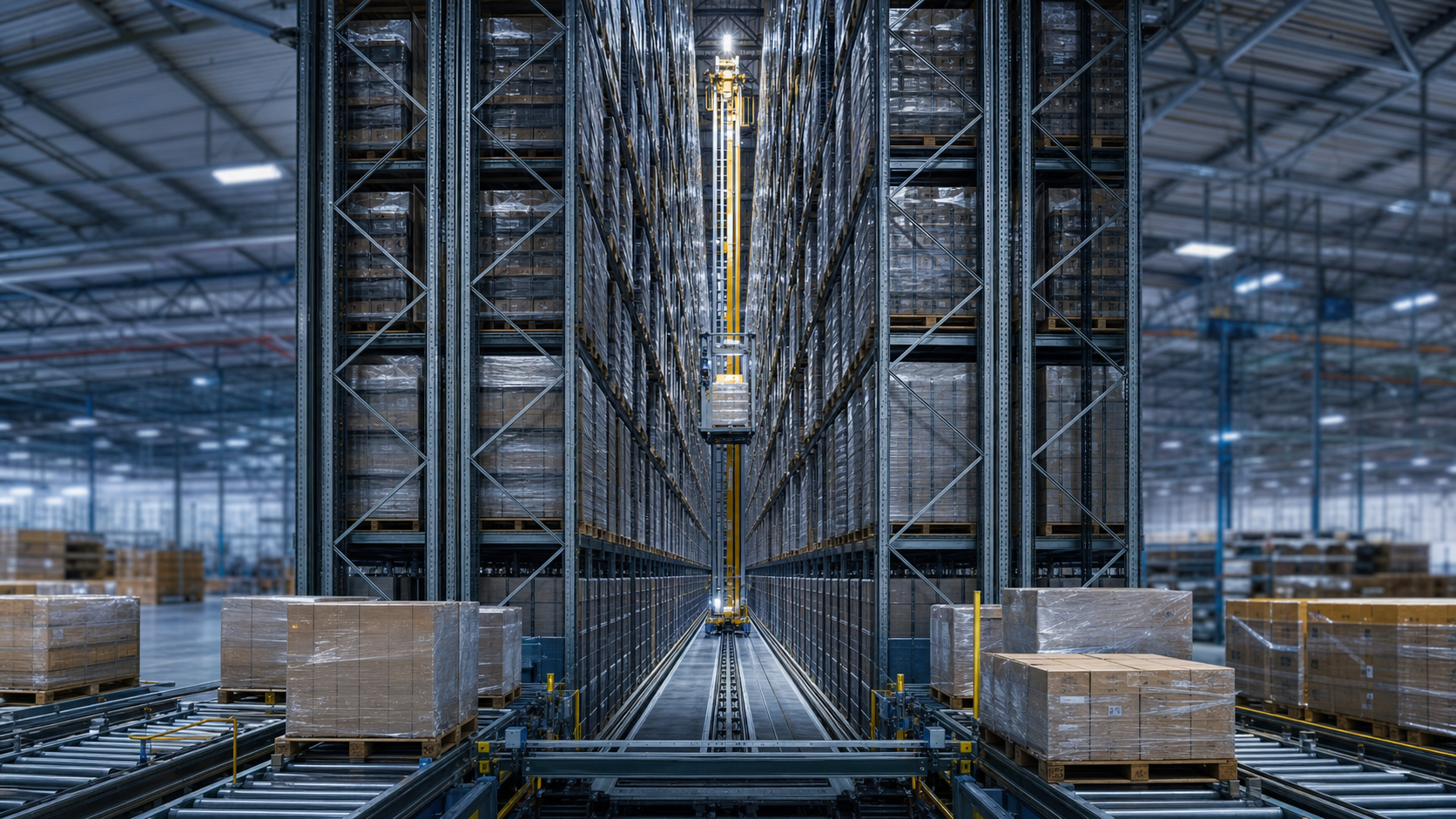
Automated high-bay warehouses in the USA: Europe's logistics standard conquers North America – Creative image on the topic, with AI: Xpert.Digital
Forget humanoid robots: This is what true automation looks like in US warehouses
The billion-dollar trend in the USA that hardly anyone sees: robots, fire protection, tariffs – the unresolved problems of the American high-bay boom
For a long time, they were considered a niche phenomenon in North America, overshadowed by the media hype surrounding autonomous vehicles and humanoid robots. But now, US logistics is undergoing a fundamental transformation: The classic, fully automated pallet high-bay warehouse, modeled on European systems – often in gigantic silo construction – is conquering the American market. Massive construction projects by industry giants and multi-billion-dollar acquisitions on the supplier side signal a veritable gold rush. However, this rapid upswing brings with it considerable hurdles. A risky regulatory vacuum regarding fire safety, contradictory market figures, unclear customs regulations, and the often merely trumped-upon shortage of skilled workers create uncertainty among investors and planners. This in-depth analysis looks behind the scenes of social media myths, contextualizes the transformation of US intralogistics using data, and shows why the reality between announcement and implementation is far more complex than it initially appears.
If robots can stack things higher than humans ever could – who is liable if the alley catches fire?
A market in flux, between announcement and reality
For about twelve months now, the United States has been experiencing a striking increase in announcements concerning automated pallet high-bay warehouses. Unlike in Central Europe, where silo-built high-bay warehouses with stacker cranes have been an integral part of industrial logistics planning for decades, this segment was long a niche phenomenon in North America. The dominant narrative in American trade publications and at investor conferences revolved almost exclusively around mobile robotics, autonomous transport vehicles, and, more recently, humanoid robots. The classic, aisle-bound stacker crane, which stores and retrieves pallets at heights of thirty or forty meters, played a marginal role in this debate. This is precisely what is beginning to change, as evidenced by the concrete construction projects of the past year and a half.
The case of the Italian hygiene paper manufacturer Sofidel in Duluth, Minnesota, is particularly revealing. There, as part of a roughly $200 million factory expansion, a fully automated high-bay warehouse from the Austrian supplier BT-Systems is being built on an area of approximately 600,000 square feet. The warehouse will have 35,000 pallet spaces, five stacker cranes, and additional shuttle vehicles with double the load capacity. The facility is currently in the commissioning phase and is one of the few publicly detailed descriptions of conventional pallet high-bay warehouses in the US. Sofidel isn't stopping there: In Inola, Oklahoma, the company announced another fully automated finished goods warehouse with around 100,000 pallet spaces, this time utilizing technology from the Italian manufacturer E80 and featuring automated guided vehicles (AGVs). While both projects originate from the same corporation, they are technically and geographically distinct and together signal the significant reliance on automated pallet storage in the US tissue and hygiene paper industry.
A second example of industrial scale comes from the Bavarian construction machinery manufacturer Liebherr with its logistics center in Tupelo, Mississippi. Together with the German intralogistics specialist SSI Schäfer, a seven-aisle, silo-built high-bay warehouse with nearly 40,000 pallet spaces is being constructed there, equipped with the so-called Exyz stacker cranes. The facility is complemented by an eight-aisle shuttle warehouse with approximately 170,000 container storage locations. Commissioning is scheduled for 2027, with construction having already begun in the fall of 2025. This project follows precisely the European construction scheme that has been standard in Germany, Austria, and Switzerland for decades: a freestanding, rack-supported silo building in which the steel structure itself supports the building envelope. The fact that such a construction method is now being implemented in Mississippi is by no means trivial from a building code and fire safety perspective, a point that will be discussed later.
Consolidation, acquisitions and the reorganization of the supplier landscape
Parallel to the specific construction projects, a remarkable consolidation is taking place on the supplier side. In July 2026, the US conglomerate Honeywell completed the sale of its warehouse and workflow solutions division, which includes the well-known brands Intelligrated and Transnorm, to the private equity firm American Industrial Partners. The divested unit generated approximately 935 million US dollars in revenue in 2025 and will operate as an independent platform with Trew, a provider already owned by American Industrial Partners, boasting combined revenue of over one billion US dollars. This new entity will be led by manager Alfred Rebello. This move marks the separation of one of the largest American system integrators for conveyor technology, sorting, and automated storage technology from a diversified industrial conglomerate and its transfer to a financial investor specializing in industrial restructuring.
European companies are also strategically expanding their presence in the American market. The Hamburg-based material handling and intralogistics group Jungheinrich, through its subsidiary Storage Solutions, has acquired the American integrator Invar, which specializes in mobile automated storage and retrieval systems as well as warehouse management software. This acquisition gives Jungheinrich additional integration expertise in the American market, although Invar's focus is more on mobile systems than on traditional, aisle-based storage and retrieval machines. The German company SSI Schäfer, for its part, reported a group-wide order intake of €2.1 billion for the past fiscal year, citing a single major US project with a contract value of approximately €250 million as a particular highlight. It is noteworthy that neither the customer, nor the exact location, nor the technology used have yet been fully disclosed to the public, making this project one of the most intriguing unsolved mysteries in the entire industry.
On the manufacturing side, capacity is also shifting to the United States. Daifuku, the Japanese global market leader in material handling technology, has expanded its American production facility in Hobart, Indiana, to an area of over 630,000 square feet and plans to create 350 additional jobs in connection with this expansion. The KION Group, through its Dematic brand, opened a roughly 50 million US dollar Solutions Center in Grand Rapids, Michigan, which primarily serves as a sales and demonstration infrastructure, without necessarily implying a new product for high-bay racking systems. Taken together, these investments represent a clear commitment by international suppliers to a stronger physical and personnel presence on the American continent, regardless of whether the focus in each individual case is on traditional storage and retrieval systems or related technologies.
Where the boundary between high-bay warehouses and neighboring technologies lies
A central methodological problem in the entire American debate is that terms like automated warehouse or warehouse automation are defined extraordinarily broadly, lumping together technically very different systems. The classic pallet high-bay warehouse with stacker cranes, known in English as Unit-Load AS/RS or Stacker Crane System, differs fundamentally from so-called cube systems like those offered by the Norwegian provider AutoStore, where small containers are moved on the surface of a three-dimensional grid by robots. Shuttle systems for container storage, autonomous mobile robots, and, more recently, humanoid robots, which are increasingly being tested as candidates for individual handling tasks in warehouses, are equally diverse.
This conceptual ambiguity is exemplified by the much-discussed framework agreement between AutoStore and Amazon, announced on August 13, 2026. This is a global supply framework agreement without a specific purchase obligation, which has been erroneously portrayed in numerous blog posts as an alleged capitulation of Amazon's in-house robotics development. In reality, this agreement primarily concerns dense, cube-shaped storage and thus only indirectly competes with traditional pallet high-bay warehouses with high aisles, namely through the allocation of available investment capital. Another example is provided by the automotive group Stellantis, which, through its spare parts brand Mopar, has installed an AutoStore system with sixty-six robots in Forsyth, Georgia, on a comparatively small area of sixteen thousand square feet. This, too, is not a traditional high-bay warehouse, but it illustrates the widespread preference in the USA for dense cube storage of small spare parts.
To understand the American debate, it is therefore essential to make clear conceptual distinctions: Storage and retrieval machines (SRMs), also known as stacker cranes or storage and retrieval machines, serve individual, permanently assigned aisles at great heights. Silo construction refers to a building with racking, where the storage racks simultaneously form the structural building envelope, in contrast to an in-house solution, where the racking is located within a conventional warehouse. Very narrow aisle warehouses, known in the industry as such, are a semi-automated intermediate form that still relies on human operators. This differentiation is more than just academic; it significantly determines which statistics, safety regulations, and cost models are applicable in any given case.
The shortage of skilled workers as a narrative for automation and its limits
One of the most frequently repeated justifications for the wave of automation in American warehouses is that an acute and structural labor shortage is practically forcing companies to invest in robotics. This narrative is primarily propagated by suppliers of automated systems, industry associations such as the Association for Advancing Automation, and numerous system integrators, and at first glance seems plausible because the American warehousing and transportation industry has indeed been complaining about high employee turnover for years. However, a closer look at the available labor market data reveals a significantly more complex picture. Official statistics on job openings in the transportation and warehousing sector show not a decline, but rather a trend toward further increases in open positions for the first half of 2026, even though substantial robot orders were placed during the same period. Critics argue that the actual real wage development and the occupancy rates of warehouse facilities do not align with an extreme, widespread labor shortage, as is often suggested in the public debate.
Closely related to this is the second major controversy, namely that automation is destroying a significant number of warehouse jobs. This view is fueled in particular by viral reports about internal calculations at Amazon, according to which every item moved by robots instead of humans supposedly saves around thirty US cents – a figure that Amazon itself has downplayed and presented as merely an internal team target. On the other hand, several business publications show that robot orders and new hires in the American logistics industry are currently occurring in parallel, not in opposition. The example of Sofidel in Duluth is particularly revealing in this regard, because the company is simultaneously hiring additional staff for the entire site as part of its warehouse automation. A serious assessment would have to measure net employment before and after the commissioning of specific high-bay warehouse projects, but precisely such reliable, project-specific employment data is almost entirely lacking in the publicly available literature. The truth, as is so often the case, likely lies between the two extremes: automation changes job profiles and tends to shift employment from simple manual tasks to maintenance, control and monitoring functions, without necessarily resulting in a dramatic net reduction in jobs.
LTW Intralogistics Solutions

LTW Intralogistics – Engineers of Flow - Image: LTW Intralogistics GmbH
LTW offers its customers not individual components, but integrated complete solutions. Consulting, planning, mechanical and electrotechnical components, control and automation technology, as well as software and service – everything is networked and precisely coordinated.
In-house production of key components is particularly advantageous. This allows for optimal control of quality, supply chains, and interfaces.
LTW stands for reliability, transparency, and collaborative partnership. Loyalty and honesty are firmly anchored in the company's philosophy – a handshake still means something here.
Related to this:
Automation in the US market: Why common market studies often lead to misleading logistics decisions
Contradictory market figures and the problem of a lack of uniform definitions
Anyone attempting to describe the size of the American market for automated high-bay warehouses with a single, reliable figure quickly encounters a problem of definition. Various commercial market research institutes arrive at significantly different results, depending on how narrowly or broadly the respective market concept is defined. One institute estimates the North American market for automated storage and retrieval systems at approximately US$3.11 billion in 2025, with a growth forecast to US$4.57 billion by 2030, and assigns the United States a share of around 78.6 percent within North America. Another institute estimates the global market for automated high-bay warehouses, strictly speaking, at around US$3.10 billion in 2024, with a projected growth to US$4.86 billion by 2031. A third source, however, attributes only 22.8 percent of the global market share to the North American storage and retrieval systems market, directly contradicting claims in other reports of North American market dominance of up to 75 percent.
These discrepancies can largely be attributed to the fact that the individual studies conflate different system categories: some include all forms of automated warehousing, including autonomous mobile robots, others limit themselves to classic crane systems, and still others explicitly include or exclude cube storage systems like AutoStore. Additionally, an American procurement study provides an average price estimate of approximately US$445,714 per system for 2026, which may seem realistic for a single, small shuttle system, but is clearly an underestimate for a complete high-bay warehouse with five to thirteen stacker cranes. Other sources cite investment sums between two and over fifty million US dollars for complete unit-load systems, and even up to thirty million US dollars for refrigerated high-bay warehouses. This enormous range makes it clear that reliable, standardized cost comparisons for identical technical specifications simply do not yet exist in the United States, and any general cost estimates should be treated with extreme caution.
The questionable nature of the thesis about the end of the classic high-bay warehouse
Suppliers of cube and container storage systems, such as AutoStore, Hai Robotics, and the American startup URBX, promote their technologies with the argument of high storage density, easy retrofitting in existing buildings, and comparatively short delivery times, sometimes as little as ten weeks. This marketing sometimes leads to the narrative that classic pallet high-bay warehouses with stacker cranes are already obsolete for many applications. However, this claim doesn't hold up under closer scrutiny, especially when dealing with heavy, large, or temperature-controlled goods. The tissue and hygiene paper industry, as the example of Sofidel demonstrates, requires pallets with considerable weight and volume, for which cube storage systems are technically unsuitable. The same applies to refrigerated and deep-freeze logistics, where silo heights of thirty to forty-five meters are necessary to utilize the limited and expensive refrigerated space as efficiently as possible, which is only economically feasible with classic stacker cranes. Even in the automotive industry, for example, in the palletized and wire mesh container storage of components, the classic high-bay warehouse remains the technically and economically more sensible solution.
The real market dynamic therefore lies less in one system being displaced by another, but rather in a differentiation according to use case: Small parts and e-commerce assortments are increasingly migrating to cube and shuttle systems, while heavy, large, or temperature-sensitive pallets continue to be managed in classic high-bay warehouses. However, reliable data on how the investment volume of American tenders has specifically shifted between these two system environments in recent years is currently not available in a processed form and represents one of the biggest gaps in the entire industry discussion.
Fire protection as an unresolved technical and legal bottleneck
One of the most surprising findings in the analysis of the American situation concerns fire protection. Contrary to what one might expect given the long tradition of automated high-bay warehouses in Europe, the United States currently lacks a specific, nationally standardized sprinkler and fire protection standard for automated storage and retrieval systems. The relevant American sprinkler standard, in its 2025 edition, explicitly does not contain any independent criteria for this category of facility, as the responsible research foundation of the National Fire Protection Association noted in a background report in March 2026. A revised guideline specifically tailored to automated warehouses is currently being developed, but is not expected to be incorporated into the standard until the 2028 edition at the earliest.
In practice, this regulatory vacuum means that many operators and insurers instead rely on the guidelines of the private insurance group FM Global, whose technical regulations are known as FM Data Sheet 8-34. However, since these are privately issued and not legally binding government regulations, individual local permitting authorities, known in the US as Authorities Having Jurisdiction, can impose different requirements or demand additional documentation in specific cases. For international plant manufacturers constructing silo-based high-bay warehouses with heights well over 30 meters, as is the case in Tupelo, Mississippi, this creates a significant degree of planning uncertainty because neither the positioning of sprinklers within the racking aisles nor the precise requirements for escape routes and fire department accessibility are uniformly prescribed. Furthermore, since July 31, 2026, regulatory oversight has intensified due to a new national priority program by the US Occupational Safety and Health Administration, specifically targeting warehouse operations and scheduled to run until 2031. This program specifically targets material handling, escape routes and fire protection in closed, automated aisles, but it is not yet clear how the inspectors will deal with the technical features of automated aisles that are normally inaccessible to humans.
Tariffs, trade policy and the question of location for manufacturing
Another aspect that has received little attention in the public debate so far concerns trade and customs policy. In March 2026, the U.S. Customs and Border Protection (CBP) issued a binding tariff classification, known as CBP Ruling N359280, assigning a specific tariff number to a vertical storage lift system (or carousel system) imported from Germany and Switzerland by the manufacturer Hänel. While this decision primarily affects smaller vertical storage lift and carousel systems and not necessarily complete stacker crane high-bay warehouses, it exemplifies the fact that the tariff treatment of imported intralogistics technology from Germany, Austria, and Switzerland is currently in flux and represents a significant cost risk for suppliers with European supply chains. Given the frequently changing reciprocal tariffs and industry-specific special regulations, a truly reliable comparison of the total costs delivered to the construction site between European-manufactured stacker cranes and racking structures on the one hand, and American-manufactured technology, such as that from the expanded Daifuku production facility in Hobart, Indiana, on the other, is not yet publicly available. For European suppliers who want to grow in the American market, this very question is likely to become a decisive competitive factor over the coming years, which is why increased localization of manufacturing, as Daifuku is already doing, can certainly be seen as a strategic reaction to this uncertainty.
Public discourse on social media and its distortions
Finally, it is remarkable how far the public discourse on automation in warehouses has strayed from the actual technical and economic reality of traditional high-bay warehouses. Platforms like X are dominated almost exclusively by narratives about humanoid robots, such as pilot projects by the supplier Apptronik with its Apollo robot at the logistics provider GXO, as well as numerous unsubstantiated claims about alleged mass purchases of humanoid robots by Amazon at a unit cost of supposedly thirty thousand US dollars. Traditional storage and retrieval systems, silo construction, or the outlined fire safety gaps are practically absent from this debate, even though they are likely to be considerably more significant for the actual capacity expansion of American warehouse logistics than the humanoid systems, which receive far more media attention. In addition, there are numerous advertisements from Chinese suppliers of shuttle and omnidirectional vehicle systems that use the term high-bay AS/RS in a way that further blurs the technical distinction between the different system types. A well-founded technical discourse on silo construction heights, crane cycle times, the fire protection standard gap or the new occupational safety inspections practically does not take place in social media, which underlines the need for a sober, data-based technical analysis beyond viral short formats all the more clearly.
Open questions and the need for reliable primary data
Despite the abundance of individual reports, the overall situation remains unclear in key respects. To date, there is no publicly accessible, systematic register of all conventional unit-load high-bay warehouses installed or under construction in the United States, including information on the number of aisles, building height, pallet positions, and actual commissioning date. The aforementioned major project by SSI Schäfer, with a contract value of approximately 250 million euros, remains shrouded in mystery in its details, particularly regarding the customer and location. Likewise, reliable data is lacking on the actual ratio between retrofitting existing buildings and constructing entirely new silo-style warehouses, on the effective customs duties for individual components such as stacker cranes, racking steel, or control technology, on the insurability of facilities without specific fire protection standards, and on the actual availability of service technicians for stacker cranes outside of major American logistics centers. Furthermore, the frequently asserted role of government subsidy programs for the semiconductor and pharmaceutical industries as an indirect driver of demand for automated high-bay warehouses cannot be reliably substantiated based on the currently available information, but rather relies primarily on generalized assessments by individual economic development agencies.
Overall, a far more nuanced picture emerges than the simplified narratives found in marketing materials and social media. The United States is visibly catching up in the field of classic, European-style high-bay warehouse technology, as evidenced by concrete projects in Minnesota, Oklahoma, and Mississippi. However, the regulatory, statistical, and trade policy infrastructure for reliably classifying this development is noticeably lagging behind the technical reality. Anyone wishing to make sound business decisions based on this market—whether as a supplier, investor, or site planner—currently has no choice but to rely directly on primary sources such as building permit documents, insurance requirements from individual permitting authorities, and direct manufacturer specifications. This is because the available aggregated market studies are too inconsistent in their definitions and too contradictory in their figures to provide a reliable basis for decision-making on their own.
Consulting - Planning - Implementation

Konrad Wolfenstein
I would be happy to serve as your personal advisor.
You can contact me at wolfenstein∂xpert.digital or
Just call me on +49 7348 4088 965 .
Your intralogistics experts

Consulting, planning and implementation of complete solutions for high-bay warehouses and automated storage systems - Image: Xpert.Digital
More information here:










