
Why Europe is paralyzing itself: The anatomy of reform failure – Everyone knows it, but nobody changes it
Xpert Pre-Release

Available in 27 languages 📢
Prefer Xpert.Digital on GoogleⓘPublished on: April 17, 2026 / Updated on: April 17, 2026 – Author: Konrad Wolfenstein
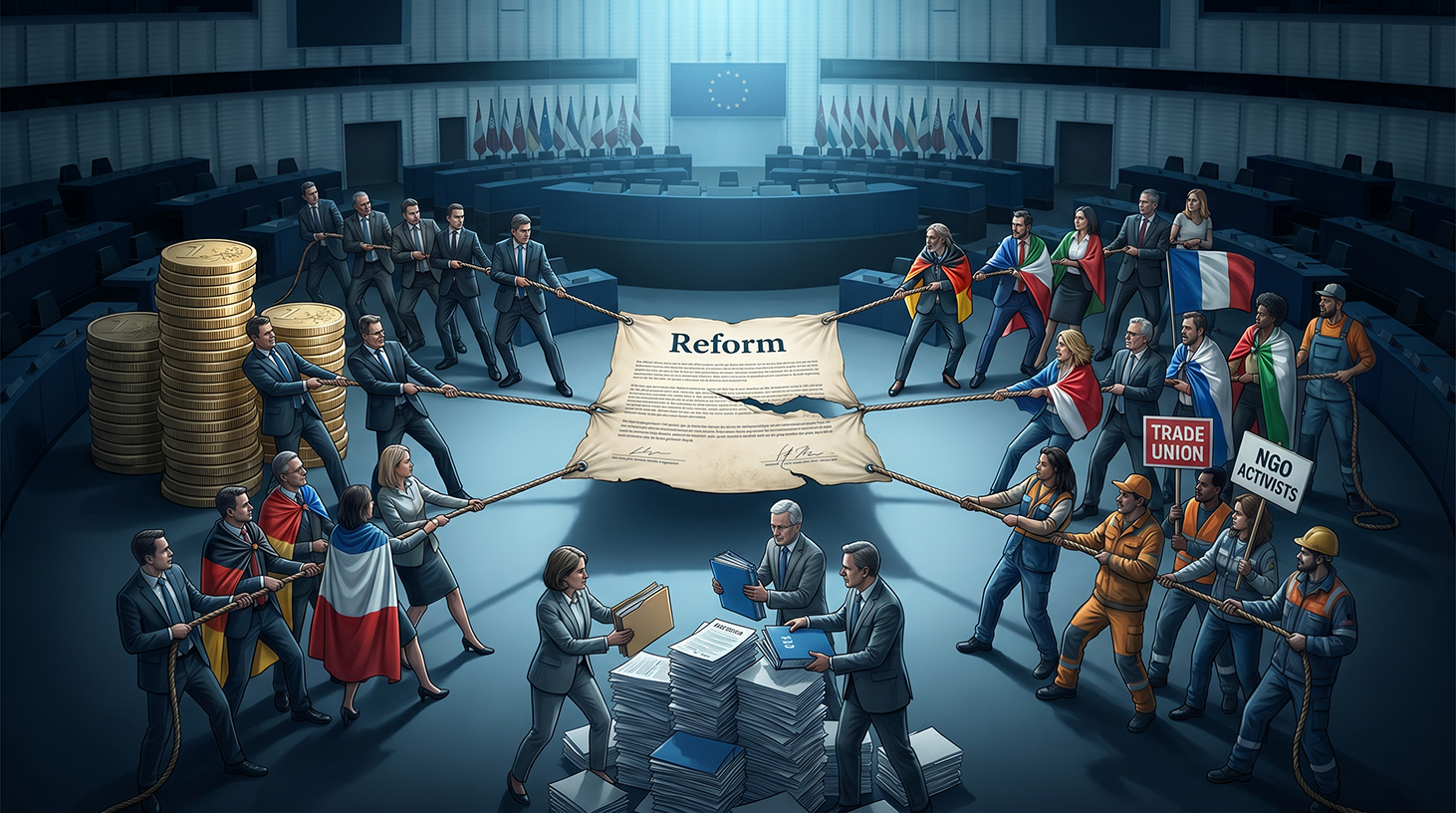
Why Europe is paralyzing itself: The anatomy of reform failure – Everyone knows it, but no one changes it – Image: Xpert.Digital
The secret rulers of Europe: Who is really blocking the reduction of EU bureaucracy?
The Brussels Paradox: Why the EU is suffocating under its own rules – and who benefits from it
Germany's double game: How member states systematically sabotage EU reforms – lobbyists, vetoes and empty promises
Why does the regulatory mountain in Brussels continue to grow relentlessly, even though all political actors publicly and loudly demand a reduction in bureaucracy? The European reform debate is caught in an almost absurd paradox: the economic damage caused by the stagnation is already measurable, the solutions are readily available – yet structurally, virtually nothing is happening. This is neither incompetence nor mere chance, but the result of a perfectly oiled, toxic system. A complex web of national protectionism, an all-powerful lobbying machine, bureaucratic self-preservation, and opaque backroom deals ensures that genuine reforms are systematically nipped in the bud. Anyone who wants to understand why the EU is trapped by its own promises must examine the power mechanisms behind the scenes. This analysis dissects the anatomy of European reform failure and reveals why large corporations in particular profit from ever-new regulations, how member states are playing a double game – and why political rhetoric has long since replaced actual action.
Related to this:

The structural power relations behind Brussels' inability to reform
The European reform debate suffers from a peculiar paradox: the diagnosis has been known for decades, the solutions have been described, the economic costs of the stagnation have been quantified – and yet, structurally, little happens. This is no oversight. It is the result of a complex web of institutional perverse incentives, well-organized coalitions of obstruction, and a political economy that systematically transforms promises of reform into empty rhetoric. Anyone who wants to understand why the EU, despite all this knowledge, does the opposite of what it promises, must dig deeper – into the mechanisms of interest representation, into the logic of bureaucratic self-preservation, and into the national protective reflexes of the member states.
The institutional structure of the problem
Before assigning blame, one must understand the structural logic of the EU system. The European Union is not a state. It is a multi-tiered negotiation system in which decisions require consensus, or at least qualified majorities, from the 27 member states, the European Parliament, and the Commission. Each of these actors does not represent a single, homogeneous preference, but rather a bundle of competing interests. The result is a system with extreme resistance to structural change.
Political science refers to this phenomenon as the veto player problem: the more independent actors must agree to a reform, the smaller the politically feasible corridor for actual change becomes. In the EU, veto players are legion. Every member state, every party group in parliament, every powerful interest group with access to the Commission can slow down, weaken, or completely halt reform projects. As early as the 1960s, political economist Mancur Olson demonstrated that well-organized minorities systematically prevail over diffuse majorities in such systems—because the costs of blocking are low for the blockers, while the benefits of the reform are too diffuse and poorly organized for the beneficiaries to generate any real political counter-pressure.
The first level of obstruction: The lobbying ecosystem in Brussels
Brussels is the second most lobby-dense city in the world after Washington. An estimated 25,000 to 30,000 lobbyists with an annual budget of around €1.5 billion are active in Brussels, working to influence EU legislation in their favor. Around 70 percent of them represent corporate and economic interests. This in itself wouldn't be a problem – legitimate lobbying is part of the democratic process. The problem lies in the structural asymmetry: industrial and financial lobbyists have many times the resources available to civil society organizations, consumer associations, or trade unions.
The decisive influence is exerted not in the publicly visible parliamentary process, but in the early stages of legislative preparation. The EU Commission, as the sole initiator of legislation, systematically collaborates with so-called expert groups – advisory bodies assembled by the Commission that help draft proposals. According to research by LobbyControl and the Corporate Europe Observatory, these expert groups are structurally unbalanced: corporate representatives and industry experts dominate, while independent academics and consumer representatives are underrepresented. This means that before a legislative proposal even sees the light of day in parliament, it has already passed through a filter that favors the interests of well-organized economic actors.
Related to this:


The paradox: Lobbying against bureaucracy – and for bureaucracy at the same time
Herein lies a subtle but crucial mechanism. The business lobby publicly complains about overregulation – and they're not wrong. At the same time, this same lobby uses existing regulatory structures as a safeguard against new competitors. Established corporations can handle complex compliance requirements; startups, SMEs, and foreign market entrants often cannot. For well-positioned market leaders, regulatory complexity is therefore not just a problem, but also an advantage. This explains why lobby groups loudly demand deregulation on the one hand, and discreetly sabotage concrete liberalization projects – for example, in the internal market for services – as soon as they threaten their own market position.
This pattern became particularly evident in the AI law: LobbyControl and the Corporate Europe Observatory documented in detail how Big Tech companies dominated the development of the code of conduct for AI regulation and prevented significantly stricter regulations – while publicly advocating for strong European AI legislation. Consulting firms with obvious conflicts of interest were commissioned by the Commission itself, and tech companies were granted disproportionately more say than civil society.
Related to this:

The second level of obstruction: The national protectionist reflex of the member states
The deepest and most persistent resistance to genuine single market integration does not come from Brussels, but from the capitals of the 27 member states. National governments in Brussels are structurally pursuing a dual strategy: they publicly profess their commitment to European integration while simultaneously blocking concrete liberalization measures that would affect domestic markets and politically important voter groups.
The most classic example is the 2006 EU Services Directive. The original Bolkestein Directive would have allowed for extensive liberalization of trade in services – with significant gains in prosperity for consumers and export-oriented service companies. However, Germany and France, working together in the negotiations, pushed through a far-reaching exemption for large parts of the services sector. The result was a directive that barely deserves the name – and which the European Court of Auditors found in 2026 still had 60 percent of the identified obstacles. In 2017, the Commission attempted to strengthen the effective enforcement of the directive through a notification procedure. This proposal was blocked by the same large member states and ultimately withdrawn by the Commission.
The gold-plating problem: Over-fulfillment as protectionism
Another systematically underestimated mechanism is so-called gold-plating. When EU directives are transposed into national law, national legislators have some leeway. This is often used to exceed the EU minimum requirements in line with national preferences – or to effectively erect new market entry barriers under the guise of implementation. Germany is particularly notorious for this phenomenon: The 2024 annual report of the National Regulatory Control Council reveals that the net burden of EU directives on national implementation costs increased by one billion euros – because national ministries consistently exceeded the EU minimum standards.
The irrational aspect of this is that member states then publicly complain about the bureaucratic burden from Brussels, even though their own legislative practices have significantly contributed to this burden. In 2025, the German Association of Small and Medium-Sized Businesses (SMEs) called for a binding "silver-plating" requirement that would limit national additions to a defined level. So far, this has been unsuccessful. The ministerial bureaucracies in Berlin, Paris, and Vienna carefully guard their room for maneuver.
Related to this:

The fear of social dumping
A legitimate but often exploited objection to the liberalization of the service sector is the fear of social dumping. Trade unions, particularly in high-wage countries like Germany, France, and Austria, fear that complete freedom of movement in the service sector will draw workers from low-wage member states into the high-wage sector, putting downward pressure on wages for domestic employees. This fear is not entirely unfounded empirically – the European single market does indeed facilitate social arbitrage, the strategic exploitation of wage and social standard differences by companies. Trade unions use this as a fundamental argument against deepening the single market in the service sector.
In 2025, the German Trade Union Confederation (DGB) explicitly stated that the EU Single Market Strategy attacked national protection standards and proposed far-reaching liberalization of the services sector – a move the DGB described as misguided. The Commission's proposal for a Single Market Barriers Prevention Act, which would allow the Commission to assess the proportionality of national laws before their adoption, was seen by the trade unions as a revival of the contested notification directive and was rejected.
Our EU and German expertise in business development, sales and marketing

Our EU and German expertise in business development, sales and marketing - Image: Xpert.Digital
Industry focus areas: B2B, digitalization (from AI to XR), mechanical engineering, logistics, renewable energies and industry
More information here:
A thematic hub offering insights and expertise:
- Knowledge platform covering global and regional economies, innovation and industry-specific trends
- A collection of analyses, insights, and background information from our key areas of focus
- A place for expertise and information on current developments in business and technology
- A hub for companies seeking information on markets, digitalization, and industry innovations
Trilogue in the Dark: How opaque negotiations strengthen lobby interests
The third level of obstruction: the institutional self-interest of the EU bureaucracy
A factor systematically underestimated in public debate is the self-interest of the EU bureaucracy itself. The European Commission employs around 32,000 officials and staff in its Directorates-General alone. These institutional units—like all bureaucracies—pursue their own interests in reproduction and expansion. Public choice theory, developed by James Buchanan and Gordon Tullock, precisely describes this phenomenon: bureaucrats act rationally—and rational in this context means maintaining and expanding their own institutional influence, budget, and relevance.
For the European Commission, this means specifically: Each Directorate-General produces regulation within its area of responsibility because that is its institutional raison d'être. A DG Energy regulates energy, a DG Climate Action regulates climate action, a DG Financial Markets regulates financial markets. The overall effect of these 27 specialized regulatory machines is cumulative: 1,456 new legal acts in 2025, even though the Commission President publicly announced plans to reduce bureaucracy. No individual Commission official actively works against their own area of responsibility because that would weaken their institutional position.
The silo problem: When the left hand doesn't know what the right hand is doing
Added to this is the structural failure of coordination between the Directorates-General. Each Directorate-General thinks and acts within its own silo of responsibility. Cross-cutting effects on other policy areas are systematically underestimated. Former EU Industry Commissioner Günter Verheugen described this problem early on: In Brussels, specialists in environmental law, trade law, financial law, and social law negotiate in parallel – without sufficient coordination on whether their respective regulatory proposals are compatible or even counterproductive in their interaction. The result is a regulatory cacophony in which the sum of the parts is more incoherent than any single law.
In 2025, former German Chancellor Scholz publicly stated that a national government in this system can often only avert the worst because it is unclear who in Brussels makes which decisions in which expert committees. The delegated legislation system allows the Commission and its agencies to make regulatory decisions with significant practical impact without a full parliamentary process. Of the 1,456 legal acts in 2025, by far the largest share – 1,196 – consisted of precisely such implementing acts. This is not transparency; this is regulatory action operating in the blind spot of public perception.
The fourth level of obstruction: The trilogue as a factory of intransparency
Another systemic flaw lies in the trilogue procedure, the central agreement mechanism between the European Parliament, the Council, and the Commission. Most major EU legislative acts are negotiated in their final form in informal, three-way talks that are de facto not public. Neither minutes nor the names of the negotiators involved are systematically published. In practice, the European Parliament grants access to negotiating documents only upon request and often with such a delay that genuine monitoring of the legislative process is impossible.
This lack of transparency is not a neutral technical problem – it is structurally advantageous for well-organized interest groups that have the resources to cultivate informal access to negotiators. NGOs, consumer associations, and smaller companies without Brussels lobby offices lack access to these informal channels. As LobbyControl puts it, this is eroding European democracy into an economically dominated lobbyocracy.
Related to this:

The fifth level of obstruction: Political rhetoric as a substitute for action
There is a more subtle mechanism at work, rarely mentioned in public discourse: the strategic use of political rhetoric as a substitute for action. Reducing bureaucracy is a topic of universal appeal – every party, every government, every Commission President professes its commitment. Precisely because the topic sounds so uncontroversial, it is ideally suited as a political vehicle for very different interests.
In 2025, the Verfassungsblog (Constitutional Law Blog) precisely analyzed what can be described as bureaucratic rhetoric: The rhetoric of cutting red tape remains so general that it resonates across all political camps and obscures its deeper political intentions. Under the neutral label of simplification, fundamental political goals can be pursued—such as the erosion of sustainability standards, supply chain due diligence obligations, or data protection rights—without the actual political decision becoming apparent. Ursula von der Leyen masterfully employs this rhetoric: The announcement of unprecedented bureaucratic reduction for 2025, coupled with the simultaneous creation of 1,456 new legal acts, is not an oversight, but rather the result of this strategic communication logic.
The balance of forces map: Who wants what and why
| actor | Public position | Actual interest | Resistance mechanism |
|---|---|---|---|
| EU Commission (Commissioners) | Bureaucracy reduction, competitiveness | Maintaining institutional power | Delegated legal acts, omnibus rhetoric |
| Commission Directorates General | simplification | Expanding one's own regulatory sphere | Silo regulation, 1,196 implementing acts |
| Large member states (DE, FR) | Pro-integration | Protecting domestic markets | Gold-plating, service exemptions |
| Small member states (NL, IE, LU) | Pro-liberalization | Tax and regulatory arbitrage | Blockade Capital Markets Union, EDIS |
| Large corporations / industry lobby | demand deregulation | Using regulation as a barrier to market access | Expert group influence, trilogue lobbying |
| Trade unions (ETUC, DGB) | Protect employee rights | Blocking service liberalization | Political pressure on national governments |
| NGOs / Environmental organizations | Green Deal | Prevent bus deregulation | Parliamentary lobbying campaigns |
| National banking and financial sector | I fundamentally support banking union | Preserving national structures | Block EDIS, reject CMDI connection |
| Professional associations (doctors, lawyers, architects) | Quality standards | Market access restrictions remain | Lobbying against mutual professional recognition |
The balance of power map shows who wants what and why: The EU Commission (especially the Commissioners) publicly claims to be satisfied with reducing bureaucracy and strengthening competitiveness, but in reality, its primary goal is to maintain institutional power; it uses delegated acts and omnibus rhetoric to achieve this. The Commission's Directorates-General promote simplification but primarily pursue the expansion of their own regulatory sphere; their resistance mechanism manifests itself in siloed regulation and the adoption of numerous implementing acts (1.196). Large member states like Germany and France publicly advocate for greater integration but in reality want to protect domestic markets and defend themselves with measures such as gold-plating and service exemptions. Small member states like the Netherlands, Ireland, and Luxembourg take a pro-liberalizing stance but pursue interests in tax and regulatory arbitrage and therefore block initiatives such as the Capital Markets Union or EDIS. Large corporations and industry lobbies demand deregulation, but in reality often use regulation as a barrier to market access; their influence is evident in expert groups and intensive trilogue lobbying. Trade unions (ETUC, DGB) emphasize the protection of workers' rights, but in reality, they aim to prevent the liberalization of the services sector, exerting political pressure on national governments. NGOs and environmental organizations publicly campaign to preserve the Green Deal, seek to prevent omnibus deregulation, and rely on parliamentary lobbying campaigns. National banking and financial sectors generally support banking union but wish to maintain national structures; they block EDIS and reject links such as CMDI. Finally, professional associations (doctors, lawyers, architects) publicly advocate for quality standards but pursue the goal of maintaining market access restrictions and lobby against the mutual recognition of professional qualifications.
The core structural dilemma: Diffuse gains, concentrated losses
The deepest structural problem can be explained by a single economic policy concept: Single market liberalization generates diffuse gains and concentrated losses. The gains from a fully integrated single market for services—up to 2.5 percent GDP growth according to the Court of Auditors—are distributed among 450 million consumers and millions of businesses. Each individual winner gains little. The losses, on the other hand, affect defined, well-organized groups: national monopolists in the notary and pharmacy sectors, domestic trade associations, unions in sectors requiring protection, and national banks without European ambitions.
A well-organized group of losers is always stronger in the political process than a diffuse group of winners who don't organize at all – because the individual gain is too small to justify organizational costs. This mechanism is the fundamental finding of public choice theory, and it explains with disconcerting precision why three decades of European single market integration have achieved so little in the services sector.
The Commission's Communication Paradox
A final, often overlooked factor is the Commission's internal communication logic. Von der Leyen, through her political communication management, has created an expectation trap: by making deregulation the central promise of her second term, she generates short-term political capital – while simultaneously exposing herself to a credibility problem that will be difficult to resolve. The 27 Directorates-General continue to produce law because that is their institutional nature. The omnibus packages represent real, but modest, simplifications in specific areas. The gap between announcement and reality is thus structurally widening, and the political price is a gradual loss of credibility.
This loss of credibility has real economic consequences: companies that cannot rely on stable framework conditions hold back on investments. The 2026 Single Market Report documents precisely this: a decline in private investment despite announced reforms. The promise of reform, if not fulfilled, can itself become a brake on growth – because it creates planning uncertainty without eliminating the burden of bureaucracy.
What real reform would mean
Structural reforms do not fail due to a lack of knowledge. They fail because the political costs of action for the key decision-makers are higher than the costs of inaction. For a government in Paris, the risk of alienating its own union base with service sector liberalization is more immediate than the diffuse economic benefits that will only become apparent years later and for everyone. For a Commission official in a Directorate-General, the prospect of streamlining their own regulatory sphere is linked to a weakening of their own institutional position.
Genuine reform would require three things, which are structurally extremely difficult: first, a binding regulatory brake with real consequences for exceeding net balances; second, consistent, judicially enforced application of existing internal market law without political considerations towards large member states; and third, radical transparency in trilogue procedures and expert groups, making informal lobbying visible and thus vulnerable to challenge. None of these three steps is technically complicated. All three are politically toxic—for the interests they would affect. That is the real answer to the question of why the opposite of what everyone has recognized as right is happening.










