
AI certifications: ISO 27001 or ISO 42001? Why the comparison is misleading
Xpert Pre-Release

Available in 27 languages 📢
Prefer Xpert.Digital on GoogleⓘPublished on: July 6, 2026 / Updated on: July 6, 2026 – Author: Konrad Wolfenstein

AI certifications: ISO 27001 or ISO 42001? Why the comparison is misleading – Image: Xpert.Digital
EU AI Act & Compliance: Which ISO standard does your company need now?
Screwdriver instead of hammer: Why many people make the wrong approach to AI certifications
Data security vs. AI governance: How to find the right ISO standard
When it comes to digital compliance, two standards often come up: the established ISO 27001 and the newer ISO 42001. Many companies are currently wondering which of the two standards is better, or whether both are necessarily needed to be prepared for regulations such as the NIS II Directive or the EU AI Act. However, this direct comparison is fundamentally flawed. While ISO 27001 focuses on classic information security and the prevention of hacking attacks and data leaks, ISO 42001 addresses the specific, often hidden risks of artificial intelligence – such as algorithmic fairness, transparency, and bias. Anyone attempting to solve AI risks with an IT security standard is, quite literally, using the wrong tool. This article details the fundamental differences between the two standards, the situations they are designed for, and how you can gain strategic clarity for your company.
AI certifications: ISO 27001 and ISO 42001 compared: Two standards, two fundamentally different starting points
Not better or worse – but designed for completely different starting points
When companies consider digital governance certifications, ISO 27001 and ISO 42001 are often on the agenda together. This quickly leads to a flawed comparison: which standard is better, or whether it makes sense to have both. However, this perspective misses the point of both standards. ISO 27001 and ISO 42001 start with fundamentally different questions. ISO 27001 asks: How does a company protect its information from external and internal threats? ISO 42001 asks: How does a company ensure that its AI systems are fair, transparent, and auditable? Choosing the wrong standard to address a specific challenge means solving a different problem than the one they are facing.
The crucial decision, therefore, is not the choice between two standards, but rather an honest analysis of one's own starting point: What is the company's primary governance goal? Is it about demonstrating data security and fulfilling regulatory IT obligations? Or is it about responsibly managing the use of AI systems and making this verifiable to customers, authorities, or the public? ISO 27001 answers the first question. ISO 42001 answers the second. The fact that both are based on the same structural foundation facilitates future expansion, but does not make them interchangeable.
The starting point ISO 27001: When data security is the primary governance goal
ISO 27001 is the right certification for companies whose primary goal is to demonstrate robust information security. This starting point is widespread and is triggered by several situations. Companies that process sensitive data—such as financial institutions, healthcare providers, insurance companies, legal firms, or companies with a high volume of personal customer data—face the requirement to reliably protect precisely this data. Their core question is not how a machine makes decisions, but how to ensure that no unauthorized persons can access critical systems and data. For this situation, ISO 27001 is the appropriate tool.
A second, regulatory-driven starting point for ISO 27001 arises from German and European cybersecurity legislation. With the entry into force of the NIS II Implementation Act in December 2025, binding requirements for IT security measures, risk management, and incident reporting apply to an estimated 29,500 institutions supervised by the BSI (Federal Office for Information Security) in Germany. Operators of critical infrastructure (KRITIS) automatically fall into the category of particularly important institutions. For these companies, ISO 27001 is the internationally recognized instrument that demonstrates how mandatory risk management measures are systematically implemented and documented. Those who do not use AI, or who do use AI but exclusively internally to increase productivity without decision-making relevance for third parties, will find ISO 27001 to be a completely sufficient governance foundation.
A third typical starting point for ISO 27001 is positioning oneself as a trusted supplier in complex supply chains. IT service providers, managed service providers, SaaS providers, and system integrators are increasingly confronted by their enterprise customers with demands for proof of their information security. In many industries, including the automotive industry with the TISAX standard as a sector-specific derivative, this requirement is already contractually enshrined. The goal of these companies is to establish trustworthiness with their business partners, and ISO 27001 is the globally established, readily understood proof of this. AI-specific governance is not required for this starting point as long as the AI systems used are internal and have no decision-making relevance for customers or third parties.
Omnifact meets the highest international standard for information security management
ISO 27001 certified: Omnifact meets the highest international standard for information security management – Image: Xpert.Digital
Omnifact operates its generative AI platform based on a certified information security management system according to ISO/IEC 27001:2022. The certification was granted on April 14, 2026, and confirms that the confidentiality, integrity, and availability of all processed company data are ensured by a verified and documented set of rules. For companies with high compliance requirements, this is not just a marketing promise, but a standard proven by independent auditors. Combined with GDPR-compliant EU hosting, this means that your data never leaves the EU or enters uncontrolled processing channels.
More information here:
The starting point ISO 42001: When AI governance is the central goal
ISO 42001 is the right certification for companies that develop, operate, or offer AI systems and need to systematically manage and document their use of AI. This is a specific starting point, clearly distinct from ISO 27001. The core questions addressed by ISO 42001 do not revolve around cyberattacks or data leaks, but rather the ethical, social, and operational consequences of algorithmic decisions: Are the models used fair? Are their decisions explainable? Who oversees automated processes? How is the model monitored if it drifts during operation or produces incorrect results? These questions arise regardless of whether a company has an Information Security Management System (ISMS) according to ISO 27001 or not.
A first, clearly defined starting point of ISO 42001 is the role of the AI provider or AI developer. Companies that develop and market AI products or AI-supported services to third parties face the most fundamental AI governance problem: They must be able to demonstrate to their customers and regulators that their system is safe, predictable, and controllable. For customer-side AI applications—that is, systems that intervene in the business processes or decision-making infrastructure of customers—this is not a theoretical requirement but a concrete market prerequisite. Tenders from large companies and public sector clients increasingly require proof of structured AI governance, and ISO 42001 is the only internationally certifiable framework with which this proof can be provided.
A second ISO 42001 starting point arises when companies use external AI systems that have direct decision-making relevance for third parties. Anyone operating an AI-supported credit decision algorithm, an AI recruiting tool, or an automated quality control system that decides on opportunities, risks, or human resources faces questions that ISO 27001 does not address: How is it ensured that the algorithm does not produce disadvantageous biases? How is human oversight of AI decisions documented? How are impact assessments conducted for new AI applications? ISO 42001 provides the structured answer for precisely this situation, while ISO 27001 simply does not apply here.
A third starting point for ISO 42001 is proactive preparation for the EU AI Act, independent of any existing ISO 27001 certification. The EU AI Act classifies AI systems according to risk categories and sets requirements for technical documentation, conformity assessment, and human oversight for high-risk systems. The AI Act requirements describe the regulatory objective; ISO 42001 provides the organizational framework. For companies developing or operating high-risk AI systems, ISO 42001 certification is the most direct way to demonstrate regulatory compliance without having to document everything from scratch for each regulatory assessment.
The first international standard for AI management systems – independently audited, fully documented, and directly aligned with the EU AI Act
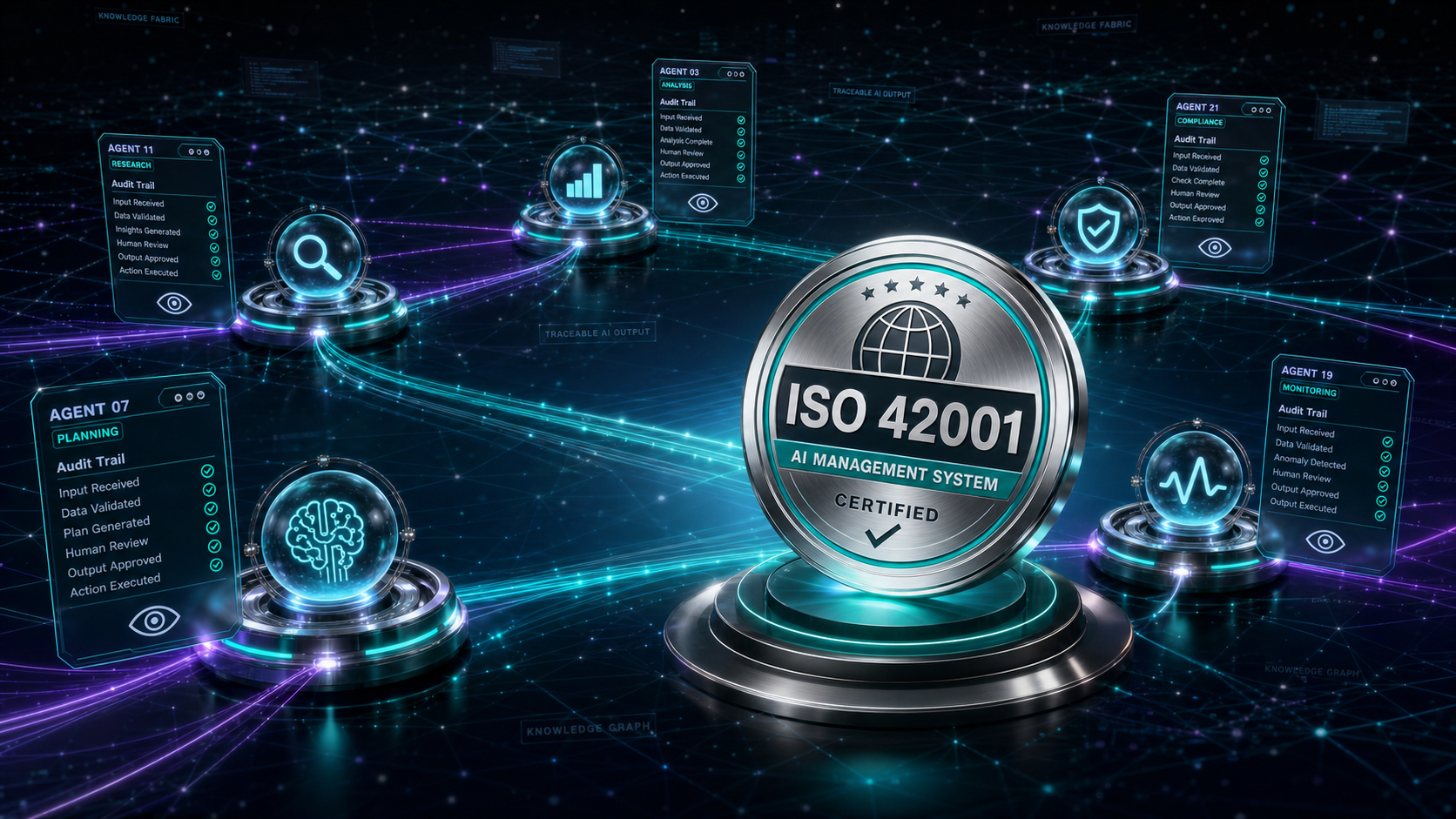
AI governance that delivers on its promises: Unframe is ISO 42001 certified – Image: Xpert.Digital
Unframe operates its enterprise AI platform based on a certified AI management system according to ISO/IEC 42001:2023. This certification demonstrates what must be at the heart of every AI decision: traceability. Every agent is bound to the knowledge fabric, every output is source-bound, and every consequential action requires human approval before execution. For companies that not only use AI but also have to take responsibility for it, this is the crucial difference. At Unframe ISO 42001, alongside SOC 2 Type II and ISO 27001, serves as independent proof that AI governance was not added later but integrated into the platform from the outset.
More information here:
🎯🎯🎯 Data-driven B2B industry hub as a quasi-in-house solution

The quasi-in-house solution: How Xpert.Digital closes operational gaps in B2B marketing and sales – Smart Content-Driven Business - Image: Xpert.Digital
Xpert.Digital is a data-driven B2B industry hub led by Konrad Wolfenstein . The company acts as an external, quasi-in-house solution for industrial partners, closing operational gaps in marketing, content, and sales – without requiring additional resources on the client side.
More information here:
ISO 27001 vs. ISO 42001: Which standard does your company really need?
What differentiates the standards in terms of content: Protection goals and sources of danger
The substantive difference between the two standards lies in their protection goals and the respective threat sources they address. ISO 27001 protects the confidentiality, integrity, and availability of information. The threats it protects against come from external sources or from human error: cyberattacks, data leaks, system failures, unauthorized access, and social engineering. The logic of the standard is defensive and reactive: it identifies vulnerabilities, assesses their risks, and implements controls to prevent potential attacks or limit their impact. The enemy against which ISO 27001 protects is either external or an oversight.
ISO 42001, on the other hand, protects against risks inherent in the AI system itself, risks that can arise without malicious intent. Algorithmic biases occur when training data reflects historical inequalities. Models drift when the real world differs from the conditions under which they were trained. Decisions are inexplicable when the model architecture lacks transparency. All these risks arise not from an attacker, but from the structural functioning of the system itself. The protection goals of ISO 42001—fairness, transparency, human oversight, and data quality—are therefore fundamentally different from those of information security. Anyone attempting to address these risks with an information security management system is trying to use a screwdriver as a hammer.
The following comparison illustrates which specific business objectives are served by which standard:
| Initial situation | Suitable instrument | Reason |
|---|---|---|
| Protecting sensitive customer data, preventing data leaks | ISO 27001 | Core protection objectives: Confidentiality, integrity, availability |
| Fulfill NIS-2 or KRITIS obligations | ISO 27001 | Legally recognized certification for IT risk management |
| Trusted IT supplier in supply chains | ISO 27001 | Globally established trust signal for information security |
| Marketing AI products or AI services to third parties | ISO 42001 | The only certifiable proof of responsible AI development |
| Operating AI with decision-making relevance for third parties | ISO 42001 | Governance for fairness, transparency and human oversight |
| Preparing for EU AI Act compliance for high-risk AI | ISO 42001 | Direct organizational mapping to AI Act requirements |
The standards ecosystem surrounding ISO 42001: Specialization instead of generalization
ISO 42001 does not stand alone, but is accompanied by a number of specialized standards, each addressing specific technical and methodological aspects of AI deployment. These accompanying standards are not mere add-ons to an existing ISO 27001 standard, but rather independent tools for specific AI governance challenges. ISO 23894 provides guidelines for AI-specific risk management: It applies the principles of general risk management standards to the AI lifecycle and describes how risks arising from model drift, hallucinations, adversarial inputs, and lack of explainability should be identified, assessed, and addressed. For companies that have structured AI risk management as a primary objective, ISO 23894 is the direct operational companion to ISO 42001.
For the data layer of AI development, the ISO 5259 series of standards provides a framework for data quality in machine learning. These standards address a problem that is relevant exclusively in the AI context: the quality of a model is inextricably linked to the quality of its training data. Errors in data quality—such as biased samples, missing values, and inconsistent labels—directly affect model performance and can lead to systematically incorrect decisions. This starting point is specific to companies that train their own models or obtain their training data externally. ISO 27001 does not provide a solution for this starting point.
ISO 24027, which addresses the prevention of bias in AI algorithms, and ISO 42005, which focuses on conducting AI system impact assessments, close further specialized gaps. Both standards are aimed at companies that not only manage information security but also actively address the societal consequences of their algorithms. A company operating an automated scoring system for insurance premiums doesn't have an ISO 27001 question, but rather an ISO 24027 question: Are certain demographic groups systematically disadvantaged by the model, and how can this be measured and corrected?
When neither of the two standards is sufficient: Know the limits
A common misconception is that ISO 42001 provides a complete answer to the EU AI Act. The standard is voluntary and lacks direct legal force. It defines how a company should organize AI responsibly, but it says nothing about whether a particular AI system is even permissible, what risk class it has, or which formal conformity assessment procedures must be carried out. For high-risk AI systems under the EU AI Act, a separate legal assessment of the system category is mandatory, regardless of ISO 42001 certification.
Conversely, ISO 27001 does not provide answers to AI-specific questions, even if a company uses AI extensively. Demonstrating that an AI system delivers explainable results and that human oversight is ensured cannot be achieved through an ISMS according to ISO 27001, because the standard does not conceptually address these issues. An internal Reddit community of compliance experts sums it up: Those who use AI only internally to increase productivity can manage with ISO 27001, but those who use AI that influences customer-side decisions will sooner or later need ISO 42001.
Overview of the relevant standards: From information security to AI governance
Besides the certifiable ISO 42001 management system standard, there is a growing ecosystem of specific technical standards, each addressing a clearly defined starting point. The following overview shows which standard stands for which goal – from classic information security to specialized AI governance:
| standard | Initial goal | Certifiable |
|---|---|---|
| ISO 27001 | Information security management: Protection against cyber threats, data loss and IT outages | Yes |
| ISO 42001 | AI management at the organizational level: Control of algorithms, fairness and transparency | Yes |
| ISO 23894 | AI risk management across the entire AI lifecycle | No, guide |
| ISO 42005 | Impact assessment for AI systems with societal effects | No, guide |
| ISO 5259 | Data quality in machine learning and AI training | No, technical standard |
| ISO 24027 | Bias avoidance and fairness in algorithms | No, technical standard |
Strategic clarity instead of striving for normative completeness
The most productive question for companies is not whether they should have both standards, but rather what challenge they actually need to address. Companies whose primary risk lies in the threat to their IT infrastructure from cyberattacks, data leaks, or system failures, and which need to demonstrate information security to customers, authorities, or business partners, will find exactly what they need in ISO 27001. The standard is mature, globally adopted, efficiently auditable by certification bodies, and clearly structured in its requirements.
Companies whose primary governance challenge is to make the use of AI systems controllable, transparent, and verifiable to clients or legislators need ISO 42001 as a structural anchor for their AI strategy. This standard is newer, the market for accredited auditors is smaller, and implementation requires a deep understanding of the company's own AI landscape. In return, it offers a governance system that ISO 27001 cannot provide for structural reasons: the organizational control of algorithms, models, and automated decision-making processes.
Knowing your starting point allows you to make the right choice and avoid wasting resources on a certification that doesn't solve the actual problem.
Your global marketing and business development partner
☑️ Our business language is English or German
☑️ NEW: Correspondence in your native language!

Konrad Wolfenstein
I and my team are happy to be available to you as your personal advisor.
You can contact me by filling out the contact form here [email protected]:or simply call me at +49 7348 4088 965. My email address is
I'm looking forward to our joint project.
☑️ SME support in strategy, consulting, planning and implementation
☑️ Creation or realignment of the digital strategy and digitization
☑️ Expansion and optimization of international sales processes
☑️ Global & Digital B2B trading platforms
☑️ Pioneer Business Development / Marketing / PR / Trade Fairs
📈🚀 From visibility to trust 👀🤝 Your scalable path with Xpert.Digital

From visibility to trust: Your scalable path with Xpert.Digital - Image: Xpert.Digital
In industrial B2B, sustainable business relationships rarely emerge overnight. They develop step by step – through visibility, professional relevance, recurring touchpoints, and growing trust. Xpert.Digital's 4-stage model addresses precisely this: It offers a structured path that begins with a manageable entry point and can evolve into deeper collaboration in business development if needed.
Instead of relying on loud marketing promises, this model puts the relationship at the forefront. Companies start with clearly defined, easily calculable measures and then decide, based on their own experience, how far they want to expand the collaboration. A key factor for this undisturbed trust-building process: The platform completely avoids annoying advertising ads, so the editorial focus remains solely on the companies' expertise.
More information here:









