
Why it's difficult for authorities, towns & municipalities: Administrative modernization and optimization for urban & rural areas | Kaizen

Available in 27 languages 📢
Prefer Xpert.Digital on GoogleⓘPublished on: June 22, 2024 / Updated on: June 22, 2024 – Author: Konrad Wolfenstein

Why it's difficult for authorities, towns & municipalities: Administrative optimization and modernization for urban & rural areas – Image: Xpert.Digital
🛠️🔍 Under strict regulations and limited scope: The challenges of public administration
🌱 Modernization barriers and innovation potential
It's no secret that public administrations operate within a tension between stability and the pressure to change. On the one hand, their freedom is severely restricted by a number of legal frameworks, such as civil service and collective bargaining law or municipal codes. On the other hand, there are many areas within public administrations where considerable scope for action still exists, which could be used to work more effectively and efficiently. This is where the Kaizen approach comes into play.
Related to this:
📚 Strict regulations and dynamic challenges
Public administrations are subject to strict regulations, laws, and bureaucratic processes. This serves to ensure transparency, accountability, and fairness and equal treatment. This strict regulation can slow down modernization processes. Businesses often have more flexibility and can react more quickly to market changes. They operate in a regulated but more dynamic environment, which allows them more room for innovation and adaptation.
🔧 Continuous improvement and change in administrations
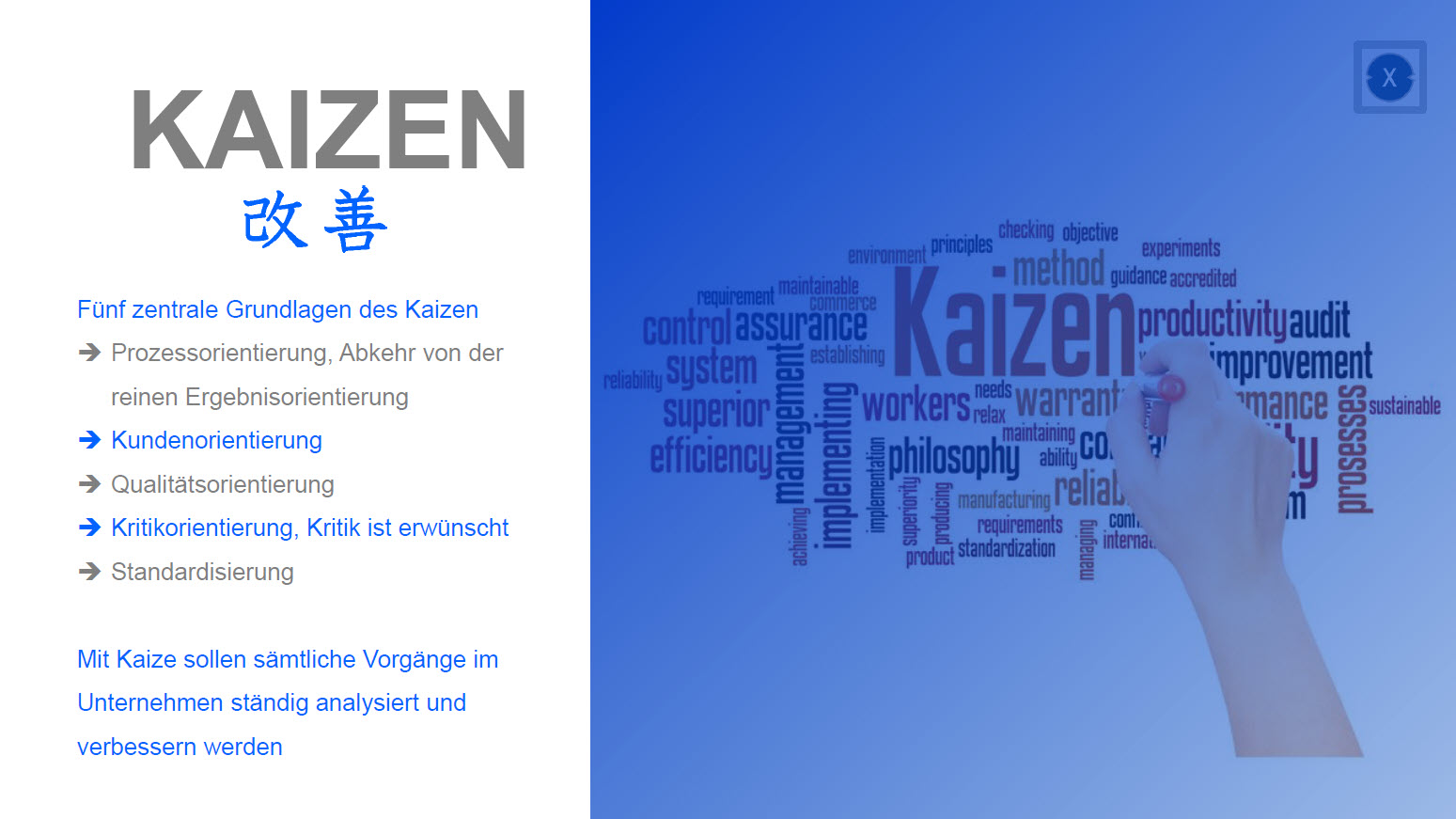
Kaizen basics – Image: Xpert.Digital
Kaizen, a Japanese management concept, means continuous improvement. It is based on the philosophy that there are always opportunities to optimize processes and that improvements should be implemented in small steps. This mindset has proven particularly successful in the automotive industry, which has continuously developed its products through ongoing, detailed improvements. A similar principle could also enable significant progress in public administration.
🔍📊 Challenges and opportunities in administrative modernization and optimization
Public administrations differ from private companies because they are not exposed to the same market risks. They cannot simply go bankrupt or suddenly fall victim to disruptive developments. Nevertheless, they are by no means immune to change. If digitalization progresses slowly, or if entrenched structures make working in public administration increasingly unattractive, this can have serious consequences. Public administration could be increasingly perceived as outdated and eventually replaced by modern, more flexible models. It is already conceivable that new administrative structures will gradually emerge from scratch, structures that are more efficient and adaptable – a kind of "Administration 2.0." At the same time, traditional administration could be slowly phased out, similar to what happened with the German Federal Post Office.
🔄 Continuous questions and changes in administration
A key argument for applying Kaizen in public administration is the need to constantly ask fundamental questions. These questions lead to the examination and continuous improvement of existing assumptions and practices. One example is the challenge of genuine collaboration across departmental boundaries, which often fails due to rigid structures. Such collaboration requires new forms of leadership and a stronger citizen-centric approach that transcends traditional hierarchical structures.
🌐 Transformation through digital innovation and employee participation
Furthermore, public administration should embrace digitalization as an opportunity and actively promote it. E-government, which encompasses electronic administrative systems, offers the chance to accelerate and increase the transparency of administrative processes. Digital solutions can help improve access to administrative services and facilitate interaction between citizens and public administration. They can also help to collect citizen feedback more efficiently and integrate it into the continuous improvement process.
✨ Leadership culture and innovation promotion in public administration*
Administrative modernization also requires an adaptation of the leadership culture. Traditional hierarchical models may need to be replaced by more participative leadership styles that shift more autonomy and decision-making authority to the lower levels of the organization. Managers should act as facilitators and supporters, giving employees the space to find and implement solutions independently. This strengthens employee motivation and sense of responsibility and can lead to more innovative and flexible ways of working.
🎯 Potential and necessity of continuous improvement
Despite strict legal frameworks and seemingly immutable structures, public administrations possess considerable potential for improvement and modernization. Given the ongoing digitalization and rising citizen expectations, implementing continuous improvement processes like Kaizen is essential. These processes enable the systematic review and gradual optimization of existing structures and processes. They foster a culture of continuous improvement and can contribute to making public administration more innovative, effective, and citizen-friendly.
📣 Similar topics
- 📣 The challenge of administrative modernization
- 🚀 KAIZEN: A path to continuous improvement
- 🔄 Public administrations and the pressure to transform
- 💡 Key points on the introduction of new administrative structures
- 💻 Digitalization and e-government as an opportunity
- 👥 Employee participation in the change process
- ⚖️ Regulations and their impact on modernization
- 🌍 Citizen-centricity and modern administrative models
- 📈 Increased efficiency through continuous improvement
- 📚 Leadership culture and new leadership styles in public administration
#️⃣ Hashtags: #AdministrativeModernization #KAIZEN #Digitalization #E-Government #EfficiencyIncrease
🔍📈 Administrative modernization: 10 steps towards a more efficient and transparent public administration
🚀 Modernizing public administration is a crucial step towards more efficient, transparent, and citizen-friendly services. In a world where digital technologies and the call for sustainability are growing ever louder, public authorities, towns, and municipalities face the challenge of fundamentally rethinking and optimizing their administrative processes. Here are the ten key areas at the heart of administrative modernization:
1. 📱 Digital Citizen Services
They focus on researching and implementing advanced technologies and best practices. The goal is to reduce bureaucratic hurdles and thereby increase citizen satisfaction.
2. 💻 E-government platforms
They play a vital role by enabling official procedures and applications to be conveniently completed online from home, significantly reducing administrative effort.
3. 🌆 Smart City Concepts
They bring innovations to urban infrastructures to make urban living spaces more efficient, technologically advanced and environmentally friendly.
Related to this:
- Smart & Compact City for German cities: What we can learn from Japan & China in the areas of urbanization & social dynamics
- Smart City: A Connected Future – How Technology Makes Our Cities Smarter – Metaverse and Digital Twins
4. 🔒 Data protection and cybersecurity
are key components of digitalization that ensure the protection of personal data and the security of information systems.
5. 🖥️ Modernization of the IT infrastructure
This includes updating existing systems to modern, flexible and secure solutions that meet the needs of a digital administration.
6. ⚙️ Internal process optimization
is designed to analyze and streamline workflows within the administration in order to reduce bureaucracy and conserve resources.
7. 💬 Citizen-friendly communication
aims to improve communication channels between the administration and citizens through modern communication tools such as social media, chatbots and mobile apps.
8. 🤝 Intermunicipal cooperation
It opens up opportunities to pool resources and reduce costs by having cities and municipalities collaborate in various areas.
9. 📚 Employee training and change management
are essential to prepare staff for new challenges and technologies and to promote acceptance of change.
10. 🌍 Sustainability and environmental awareness
takes ecological aspects into account in administration through the implementation of measures such as the paperless office, digital record keeping and the use of environmentally friendly technologies.
🤝 Citizens in Focus
Administrative modernization is a complex yet essential process aimed at strengthening the relationship between citizens and the state, using resources more efficiently, and ensuring a sustainable future. By addressing these ten key areas, public authorities can set the course for a future-oriented administration.
📣 Similar topics
- 📱 Digital Future: How Citizen Services Are Revolutionizing Public Administration
- 💻 Redefining e-government: The platform for tomorrow
- 🌆 Smart Cities: The Transformation of Urban Living Spaces
- 🔒 Security in focus: Data protection and cybersecurity in public administration
- 🖥️ Technology shift: IT infrastructures reimagined
- ⚙️ Increasing efficiency: On the path to optimized administration
- 💬 Communication 2.0: Bringing administration and citizens closer together
- 🤝 Stronger together: The power of inter-municipal cooperation
- 📚 Future-proof workforce: Education as the basis for change
- 🌍 Green administration: Setting environmental awareness as the standard
#️⃣ Hashtags: #DigitalFuture #E-Government #SmartCities #DataProtectionCybersecurity #AdministrativeModernization
We are here for you - Consulting - Planning - Implementation - Project Management
☑️ Industry expert, here with his own Xpert.Digital industry hub featuring over 2,500 specialist articles

Konrad Wolfenstein
I would be happy to serve as your personal advisor.
You can contact me by filling out the contact form below or simply call me on +49 7348 4088 965 .
I'm looking forward to our joint project.
Write to me

Xpert.Digital - Konrad Wolfenstein
Xpert.Digital is a hub for industry focusing on digitalization, mechanical engineering, logistics/intralogistics and photovoltaics.
With our 360° Business Development solution, we support renowned companies from new business to after-sales.
Market intelligence, smarketing, marketing automation, content development, PR, mail campaigns, personalized social media and lead nurturing are part of our digital tools.
You can find more information at: www.xpert.digital - www.xpert.solar - www.xpert.plus
Keep in touch









