
Eight barracks – from Boostedt to Sigmaringen: This is what's behind the German Armed Forces' gigantic billion-euro plan
Xpert Pre-Release

Available in 27 languages 📢
Prefer Xpert.Digital on GoogleⓘPublished on: July 11, 2026 / Updated on: July 11, 2026 – Author: Konrad Wolfenstein
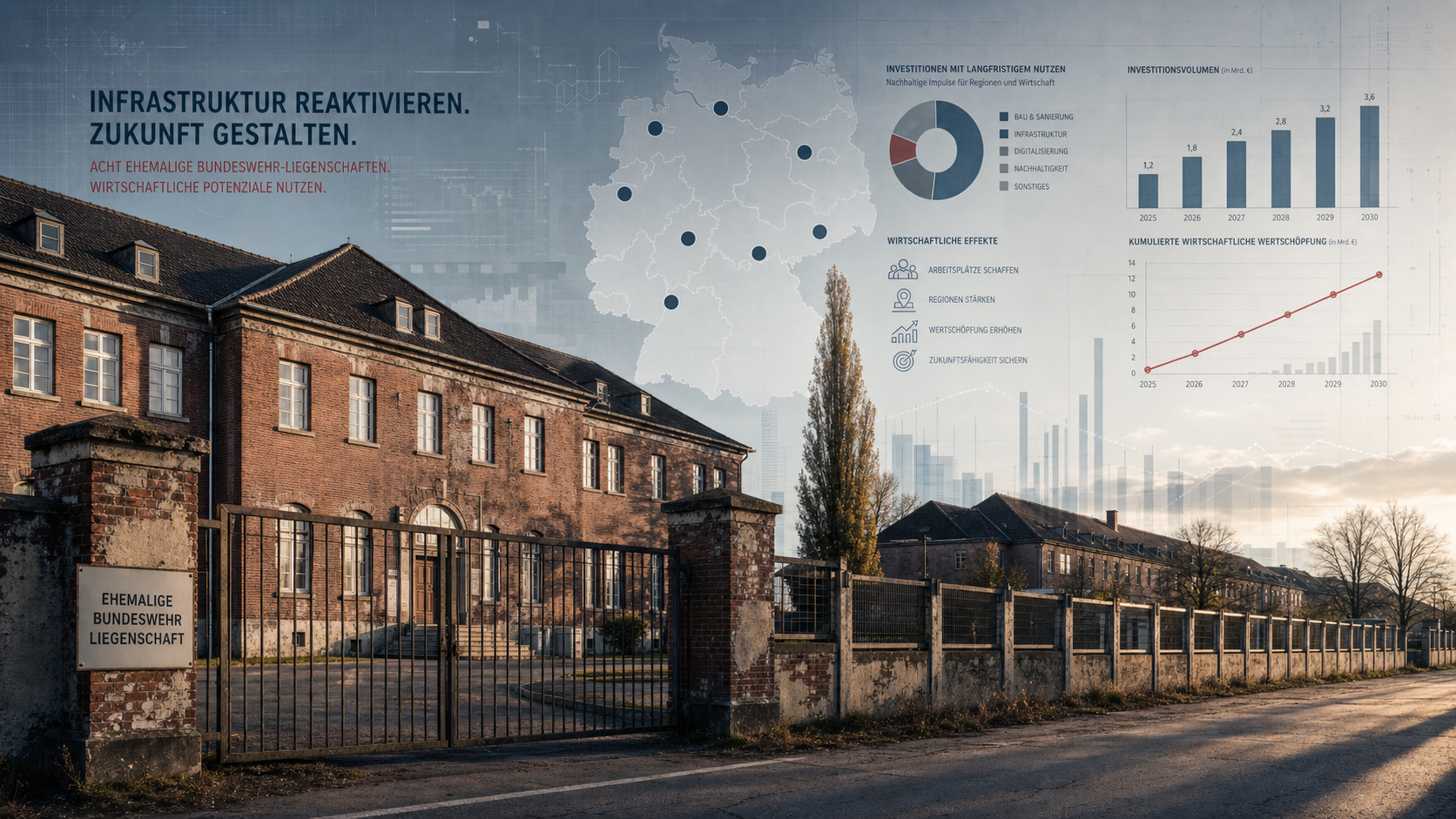
Eight barracks – from Boostedt to Sigmaringen: This is what's behind the German Armed Forces' gigantic billion-euro plan – Image: Xpert.Digital
Drone defense & homeland security: What recruits can expect at the 8 new Bundeswehr locations
The end of disarmament: Why the old Cold War infrastructure is needed again now
The German Armed Forces are returning to rural areas: Eight former barracks sites in western Germany are being reactivated. What at first glance appears to be a straightforward administrative measure by the Federal Agency for Real Estate is, in reality, one of the most profound structural policy decisions in recent German history. Driven by the new 2026 Military Service Act, ambitious NATO targets, and the establishment of a robust "homeland security" force, the federal government is investing billions in the old infrastructure of the Cold War era. For the affected municipalities, the moratorium on these properties often means the abrupt end of civilian construction projects. A look behind the scenes of this military paradigm shift reveals that a modern army cannot be rebuilt without space, barracks, and enormous financial resources.
When military necessity meets decades of demilitarization: Why the reactivation of properties is far more than an administrative decision
When the Federal Ministry of Defense selects eight former military barracks sites across Germany for reactivation, it initially sounds like a matter-of-fact real estate policy. However, behind this announcement lies one of the most profound security and structural policy decisions in post-war German history. Given a changed threat landscape, a conscription law that came into effect on January 1, 2026, and ambitious NATO expansion targets, the decision to reactivate Boostedt, Cuxhaven, Speyer, Kusel, Soest, Mönchengladbach, Sigmaringen, and Friedberg for military use has far-reaching consequences – for the Bundeswehr (German Armed Forces), for the local communities, for the national economy, and for the relationship between society and the armed forces.
The selected locations reveal a characteristic pattern: all eight are situated in the former West Germany. This is neither a coincidence nor an oversight, but rather the result of a historical legacy. The old Federal Republic was the military heartland of the Cold War – densely populated with barracks of the Bundeswehr (German Federal Armed Forces) and the Allied forces. Following reunification, the end of the Warsaw Pact, and finally the suspension of conscription in 2011, a systematic demilitarization began, leaving behind decades of infrastructure in the former West Germany that is now needed again.
The foundation: The Military Service Act and its structural requirements
The law modernizing military service passed the German Bundestag on December 5, 2025, and came into force on January 1, 2026. It establishes a new, initially voluntary, military service, which nevertheless includes a powerful structural framework: All young men and women born in 2008 receive questionnaires, with men being required to complete them. By mid-2026, almost 300,000 such questionnaires had already been sent out, with a response rate of 96 percent among men.
The figures are both sobering and telling: Of the nearly 300,000 people contacted, only about 530 had actually volunteered for military service by mid-June 2026. This sounds like a failure, but it's just a snapshot of a system that's only just getting started. Many interested individuals are initially unavailable due to ongoing school or vocational training. Furthermore, traditional recruitment methods, independent of the questionnaire process, received around 38,500 applications – an increase of 24 percent compared to the previous year. The number of new recruits rose by 13 percent to approximately 11,000.
The real strategic ambition behind the law, however, is of a different order of magnitude. The Ministry of Defense has a clear mandate to increase the number of active-duty soldiers from the current figure of approximately 184,000 to between 255,000 and 270,000 by 2035. This will be supplemented by 200,000 reservists. These numbers necessitate a completely new infrastructural approach. If the Bundeswehr (German Armed Forces) intends to train 40,000 recruits annually by 2031, compared to the current 15,000, it simply needs space – physical, structural, and organizational space.
This is precisely where the strategic importance of the eight reactivated sites lies. They are the answer to a capacity question that can only be solved by utilizing historically developed military infrastructure. New construction on greenfield sites takes too long, is more expensive, and is outside the established military logistics network. From this perspective, reactivating existing properties is not about nostalgia, but about pragmatic efficiency.
The eight locations and their strategic logic
The selection of specific locations follows clearly defined criteria. The Federal Ministry of Defense emphasized that all selected properties are suitable for the new military service due to their location, infrastructure, and capacity. A final decision on reactivation is still pending; the next planning phase is underway.
The Rantzau barracks in Boostedt, Schleswig-Holstein, are located in the economically disadvantaged north. The region has traditionally relied heavily on the German Armed Forces and suffered significant losses in purchasing power after their withdrawal.
The Hinrich-Wilhelm-Kopf barracks in Cuxhaven secures the strategically important access to the Elbe and the sea routes of the North Sea coast.
The Kurpfalz barracks in Speyer and the Unteroffizier-Krüger barracks in Kusel represent Rhineland-Palatinate, a federal state with a traditionally dense military presence, which expects 1.6 billion euros in Bundeswehr investments between 2025 and 2030 alone.
Two locations in North Rhine-Westphalia are included: the Kanaal-van-Wessem barracks in Soest and the former NATO headquarters with the Wegberg military complex in Mönchengladbach. The latter is of particular symbolic and strategic importance, as it is located on the grounds of a former NATO headquarters and embodies the close ties between the German military and the Atlantic alliance.
The Graf-Stauffenberg barracks in Sigmaringen, Baden-Württemberg, offers one of the few locations in southern Germany – a country which, according to the Ministry of Defense, now has hardly any space left for new recruits.
Finally, the former Ray Barracks in Friedberg (Hesse) complete the list – an American property that is now passing into German hands, thus closing a historical circle: once used by US forces for the defense of Europe, the site is now to serve German homeland security forces.
The moratorium: The state is slowing down the conversion
To enable the reactivation of these and other sites, the Federal Ministry of Defense issued a far-reaching moratorium on military properties in October 2025. This moratorium puts a hold on the conversion of military properties to civilian use. Initially, this affects 187 former military properties owned by the Federal Agency for Real Estate (BImA), plus 13 sites still operated by the German Armed Forces, which will now not be abandoned as planned.
This step has significant implications for local politics. In many regions of Germany, cities and municipalities have spent years planning to repurpose vacated military sites: for housing in tight markets, for commercial development, for nature conservation, or for cultural use. These plans are now in jeopardy. Municipalities are effectively powerless against this federal decision – real estate law gives the state the final say.
The historical irony is undeniable. When military bases were closed following the suspension of conscription in 2011 and the preceding Bundeswehr reforms, many municipalities perceived this as an economic catastrophe. Now that some of these sites are slated to become military again, the reaction is similarly lukewarm – because in the meantime, development plans, investment commitments, and municipal plans have been created that are now obsolete. This significantly undermines the federal government's trust and reliability as a real estate partner. The Ministry of Defense emphasizes its intention to find effective solutions through close dialogue with the states and municipalities. However, experience shows that military requirements structurally take precedence in this balancing process.
The training revolution: Homeland security, drone defense and resilience
What is to be taught and trained in the reactivated barracks is no less remarkable than the decision to reactivate them itself. The German Armed Forces have fundamentally reformed their basic training since July 2025. Marching and shooting remain, but are supplemented by key areas that take into account the lessons learned from the war in Ukraine. Drone defense is prominently featured on the training curriculum for the first time – a novelty for an army that, until recently, primarily viewed drones as reconnaissance tools.
Graduates of the three-month basic training course earn the title of Homeland Security Guard – a deliberately chosen term that refers to a specific task. Homeland Security designates the fourth combat zone of the German Armed Forces, after the Army, Air Force, and Navy. Homeland Security Guards secure military and civilian infrastructure in times of crisis, provide support for civil defense operations, and form the backbone that secures German territory in the event of war, while career and temporary soldiers man the front lines to the east. The concept follows a clear strategic calculation: In the event of war, a significant portion of the active-duty troops would be deployed to NATO's eastern flank. Reservists and Homeland Security Guards would then remain on German territory to maintain logistics, supply lines, and infrastructure.
In addition, there is a training element that reflects the societal dimension of the new military service: Individual resilience training is part of the program for the first time. Conscripts learn to cope with stress, pressure, and psychological strain. This is an implicit recognition of the fact that the generation now being called up approaches service with different expectations than previous generations. A Bundeswehr that relies on volunteers must be attractive – also in the way it trains and treats its soldiers.
Infrastructure needs: 67 billion euros by 2040
Behind these eight locations lies a gigantic infrastructure problem that extends far beyond the question of reactivating individual barracks. Parliamentary Commissioner for the Armed Forces, Henning Otte, estimated the backlog of necessary renovations to military infrastructure up to the 2040s at over 67 billion euros. The German Armed Forces alone operate 35,000 buildings with approximately 90,000 rooms on 1,500 sites, which together cover an area equivalent to the Saarland.
The development of new training capacities relies on modular solutions. Starting in 2027, the necessary accommodation will be provided in 270 new company buildings – each with a standardized floor plan, a usable area of 3,100 square meters, and a capacity for 240 recruits. The G-CAP method, a rapid construction procedure that has proven successful in overseas deployments, will be used. The North Rhine-Westphalia building authority will handle the tendering process. The buildings are designed for a service life of at least 25 years – a clear indication that the German Armed Forces are planning for the long term, not just for the future.
At the same time, the costs for individual projects are rising considerably. The reactivation of a site in Rhineland-Palatinate alone – the Kriegsfeld munitions depot – was originally budgeted at 70 million euros, but is now expected to cost around 250 million euros. Such cost increases of more than 200 percent are not exceptional, but rather reflect the general price increase in the construction industry, rising energy costs, and years of neglect. The German government plans to spend 11.31 billion euros in 2026 alone on the accommodation, operation, and maintenance of barracks and facilities – 1.52 billion euros more than in the previous year.
Hub for Security and Defense - Advice and Information

Hub for Security and Defense - Image: Xpert.Digital
The Security and Defence Hub offers expert advice and up-to-date information to effectively support companies and organizations in strengthening their role in European security and defence policy. Working closely with the SME Connect Defence Working Group, it particularly promotes small and medium-sized enterprises (SMEs) that wish to further develop their innovative capacity and competitiveness in the defence sector. As a central point of contact, the Hub thus creates a crucial bridge between SMEs and European defence strategy.
Related to this:
5 percent of GDP by 2035? The economic risks behind Germany's defense plan
The overall fiscal policy framework: Record defense amidst record debt
The reactivation of the eight barracks is taking place within the context of a fundamental shift in budgetary policy, the significance of which can hardly be overstated. Germany's defense spending is projected to rise to €108.2 billion in 2026 – the highest level since the end of the Cold War. The regular defense budget amounts to €82.69 billion, with a further €25.51 billion coming from the special Bundeswehr fund. By 2029, defense spending is expected to climb to around €152 billion – a threefold increase compared to 2023.
The context for these figures is the NATO summit in The Hague in June 2025. There, member states committed to spending at least five percent of their gross domestic product (GDP) on defense and defense-related infrastructure by 2035 – 3.5 percent for traditional military expenditures and 1.5 percent for infrastructure such as railways, tank-capable bridges, and ports. German Chancellor Friedrich Merz noted that for Germany, each additional percentage point of GDP would mean approximately 45 billion euros. Five percent of GDP would thus correspond to annual expenditures of around 225 billion euros. The Kiel Institute for the World Economy estimates that the EU could achieve annual economic growth of up to 1.5 percent simply by increasing military spending to three percent of GDP.
These expenditures are financed to a considerable extent through loans. According to calculations by the German Economic Institute (IW), €334 billion in debt will be incurred for defense alone by the end of the legislative period. By 2028, 67 percent of defense spending is expected to be financed by loans. This fiscal reality raises long-term questions that are often overlooked in the day-to-day political debate about reactivating barracks and conscription laws. Economist Hubertus Bardt from the IW puts it clearly: Annual new borrowing of over €100 billion for current defense expenditures is problematic in the long run. The federal government must ensure that, in the medium term, these expenditures are financed more strongly from the current budget.
The economic dimension: Between arms boom and displacement effects
The financial dimension of the German armed forces' development is not merely a matter of public budgets. It has tangible real-economic repercussions. The arms industry is experiencing an unprecedented boom. According to the Federal Ministry for Economic Affairs and Energy, almost 400,000 people are already employed in the sector, and this number is rising sharply. Rheinmetall alone plans to increase its workforce from 35,000 to 70,000. The German Security and Defence Industry Association has more than tripled its membership within a year.
For the regions surrounding reactivated military bases, the return of the German Armed Forces (Bundeswehr) generally means economic growth. The example of the General Dr. Speidel Barracks in Bruchsal demonstrates how reopenings generate orders for local service providers, tradespeople, and businesses. The presence of soldiers and their families boosts local retail and housing markets. For structurally weak regions like Schleswig-Holstein, which previously lost almost half of its 25,000 soldiers, the return of a military presence is a significant development.
But there are also downsides. The competition for resources is real. The arms boom is absorbing skilled workers, production capacity, and construction services that are then lacking elsewhere. Minister of Economic Affairs Katherina Reiche openly acknowledges that the defense industry is absorbing workers from other sectors – resulting in a redistribution that could be painful for sectors like the automotive industry. Furthermore, municipalities that had relied on conversion sites for housing or commercial use are being set back in their development planning by the moratorium. Investments in zoning plans, expert reports, and architectural services are lost. The fiscal damage to municipalities caused by these thwarted plans is difficult to quantify, but it is real.
The blind spot: East Germany and its geographical imbalance
Perhaps the most provocative detail in the selection of the eight locations is what's missing: a single East German site. All eight barracks are located in former West Germany – in Schleswig-Holstein, Lower Saxony, Rhineland-Palatinate, North Rhine-Westphalia, Baden-Württemberg, and Hesse. This is initially understandable from a military perspective: the old Federal Republic simply had a denser barracks infrastructure from the Cold War era. Furthermore, the eastern states have a shorter history of Bundeswehr membership and possess fewer unused, older properties of a Western design.
Nevertheless, a geographical asymmetry arises that is not politically irrelevant. Eastern German regions, which are often structurally disadvantaged, are left out of this round of military infrastructure investments. Yet it is precisely there that the economic impact of a reactivated barracks would be particularly noticeable. The Bundeswehr (German Armed Forces) has its own properties in eastern Germany that are being expanded, but the spectacular gesture of reactivating historical sites – with the symbolic and economic power it unleashes – is limited in this round to the west.
This also raises military-strategic questions. Germany sees itself as a hub for NATO troop movements eastward. Logistics corridors, supply routes, and hubs for allied forces should ideally be firmly anchored in the center and east of the country. The current location may be sufficient for training homeland security forces, but it does not necessarily meet the strategic requirements of a true hub function.
Volunteering at its limit: The question everyone is asking
Behind all the debates about infrastructure and budgetary policy lurks a more fundamental question: Is voluntary service sufficient? The initial figures from the new military service law are mixed. 530 actual commitments out of 300,000 questionnaires represent a vanishingly small number. At the same time, applications and new recruits are rising significantly, indicating that interest in the Bundeswehr is growing – just through different channels than the questionnaire process.
Defense Minister Pistorius sees the voluntary approach not as a weakness, but as a necessity: only once capacities in barracks and training have been rebuilt will conscription make military sense. This argument is logically sound, but it creates a time constraint. The barracks must come before the soldiers. The eight reactivated bases are therefore not just a reaction to the decision to serve in the military, but a prerequisite for it.
The law nevertheless contains a latent escalation mechanism. If the growth targets are not met—measured against a corridor that must be reported to the Bundestag every six months—the Bundestag can decide on the reintroduction of conscription. While the automatic reintroduction of conscription, which the CDU and CSU had demanded, was not implemented, it is de facto a politically intended mechanism: if voluntary service fails, conscription is on the table. And this would make the infrastructure requirements exponentially greater than they already are—making the current reactivation of eight bases appear merely as the first step on a very long road.
Social imposition and security policy maturity
The reactivation of barracks and the new conscription system represent a societal challenge – in the best sense of the word. They demand a reassessment of military necessity from a generation that has grown up taking peace for granted. Surveys show that the majority of young people between the ages of 16 and 26 have no interest in military service or compulsory service. 55 percent reject general compulsory service. The Federal Student Conference criticizes the fact that the concerns of young people are not taken into account in the military service plans.
And yet, something is happening. Application numbers are rising by 24 percent. More than one in five of the young men contacted are interested. This suggests a shift that is unfolding more slowly, but perhaps more steadily, than any political decision could force. The German Armed Forces are deliberately focusing on attractiveness: a salary of at least €2,600 gross per month, including accommodation, a travel allowance, free train travel, and medical care. This is complemented by the newly introduced title of "Homeland Protector," intended to foster a sense of identity—a connection between military service and concrete territorial responsibility for one's own region.
Whether that will be enough, only time will tell. After decades of demilitarization, societal acceptance of a military presence in Germany is not a given. Federal Defense Minister Pistorius and Chancellor Merz have clearly identified the challenge: barracks, instructors, equipment – all of this needs to be rebuilt from the ground up. This is not a short-term project.
Strategic classification: A turning point with profound implications
The reactivation of eight barracks and the new conscription system are part of a broader strategic transformation that began after Russia's attack on Ukraine in February 2022 and has accelerated since then. In 2026, Germany will invest more than €108 billion in its external security for the first time. It has committed to its NATO partners to spend five percent of its GDP on defense by 2035 – a target that would require annual expenditures of around €225 billion. The Bundeswehr is to become the strongest conventional army in Europe, as Chancellor Merz has stated.
Behind these grand figures and formulas lies the concrete reality: eight military bases where young people from Boostedt and Cuxhaven, from Sigmaringen and Mönchengladbach will learn how to defend against drones, how to function in an emergency, and how to defend their homeland. The infrastructure is the physical embodiment of this ambition. Without barracks, there is no training; without training, there are no reserves; without reserves, there is no defense. This is the simple, albeit uncomfortable, logic behind the decision of the Federal Ministry of Defense.
Historically speaking, this development is a reversal of a thirty-year trend. The peace dividend after the end of the Cold War was used to convert military properties into housing, commercial areas, and parks. Now, security policy is catching up with what détente dismantled. It is not a nostalgia-free return, but a necessary response to a changed world. The question is not whether this response is the right one. The question is whether it is implemented quickly enough, intelligently enough, and with sufficient public support.
All signs indicate that the German Armed Forces and the Federal Government have understood: quality trumps quantity, training trumps sheer troop strength, and infrastructure takes precedence over recruits. The eight barracks are proof that this paradigm shift is not merely a matter of policy papers, but is being translated into concrete construction plans and location decisions. Whether this is sufficient is not a decision for the Minister of Defense alone – it is a decision for society, which either supports these decisions or not.
Consulting - Planning - Implementation

Markus Becker
I would be happy to serve as your personal advisor.
Head of Business Development
Chairman SME Connect Defense Working Group
Consulting - Planning - Implementation
Konrad Wolfenstein
I would be happy to serve as your personal advisor.
You can contact me at wolfenstein∂xpert.digital or
Just call me on +49 7348 4088 965 .





