
Europe's CO₂ price at a tipping point: Will climate protection become a relocation bonus? Closing factories doesn't automatically improve the climate balance
Xpert Pre-Release

Available in 27 languages 📢
Prefer Xpert.Digital on GoogleⓘPublished on: October 22, 2026 / Updated on: October 22, 2026 – Author: Konrad Wolfenstein
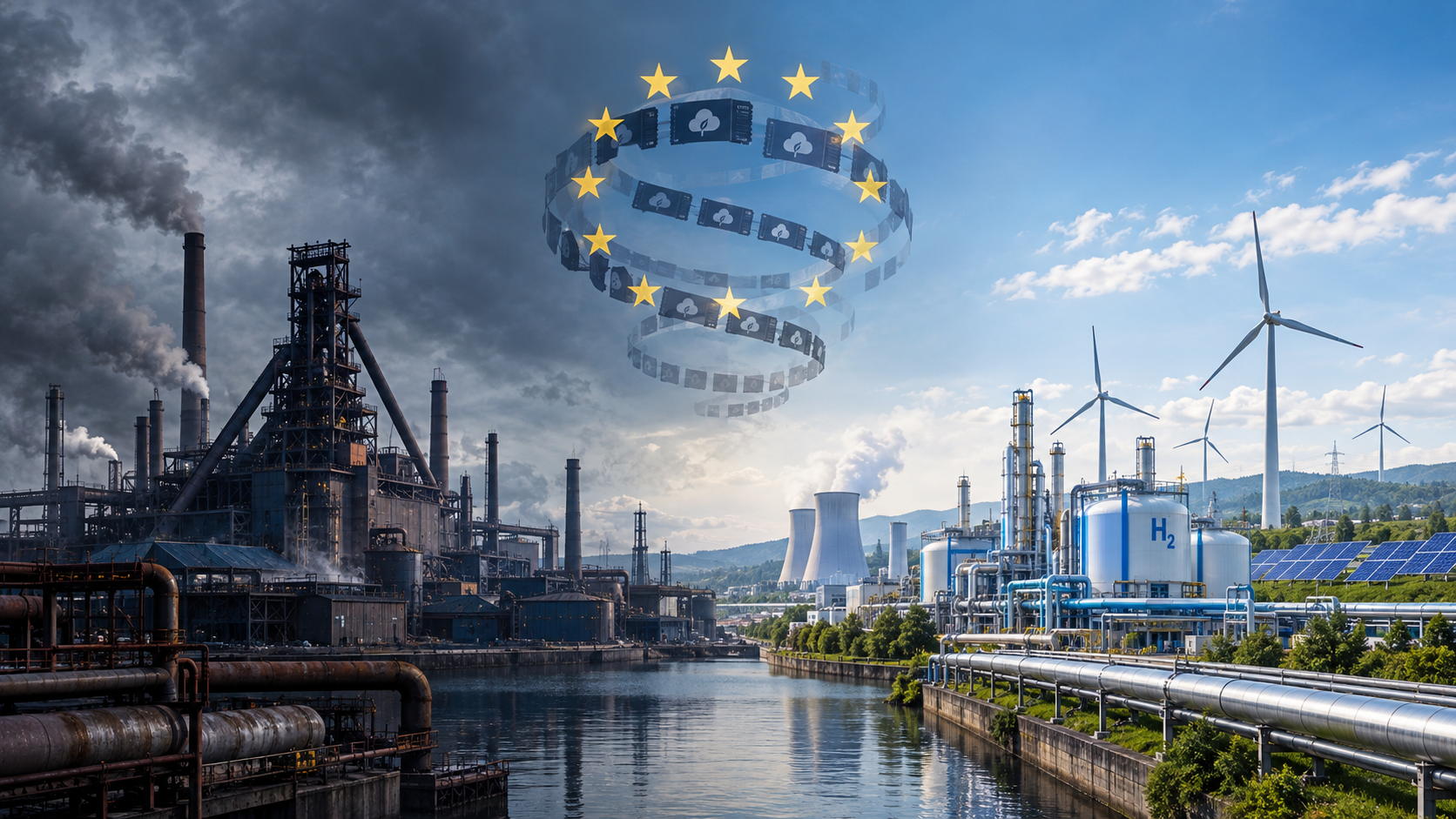
Europe's CO₂ price at a tipping point: Will climate protection become an incentive to relocate? When factories close, the climate balance doesn't automatically improve – a creative image on the topic, created with AI: Xpert.Digital
High oxygen costs, expensive energy, lack of alternatives: Europe's industry is under pressure
Emissions trading is working – but for European industry it is becoming a cost trap
Fewer emissions, more imports: The dangerous paradox of EU climate policy
The European emissions trading system is intended to reduce greenhouse gas emissions while simultaneously promoting climate-friendly investments. However, while electricity generation is undergoing a relatively rapid transformation, many energy-intensive industries still lack affordable alternatives to fossil fuel production methods. At the same time, CO₂ costs are rising, and Europe is already struggling with higher energy prices than key competitors. As a result, companies could relocate their production or make investments outside the EU. While this would improve Europe's climate footprint, it might result in very few emissions being avoided globally. How can the CO₂ price be maintained without jeopardizing Europe's industrial base? Crucially, emissions trading must be combined with reliable energy and infrastructure policies, targeted investment support, and effective protection against carbon leakage.
Europe's CO₂ price at a tipping point: If climate protection drives factories away, Europe's balance sheet will become greener – and the world won't
The European emissions trading system was long considered proof that climate protection and a market economy are compatible. Anyone emitting carbon dioxide needs a certificate; because the number of these certificates gradually decreases, emissions become scarcer and climate-friendly technologies more attractive. This principle is economically compelling. It promises to avoid emissions first where this can be done at the lowest cost, instead of prescribing the same technical solution for every facility.
But this very successful model is reaching its limits. As long as the CO₂ price primarily led to coal-fired power plants being replaced by renewable energies, nuclear power, or more efficient gas-fired power plants, the system functioned relatively well. However, the increasing scarcity is now affecting those industries whose production processes cannot be converted in the short term and whose climate-neutral alternatives are often not yet competitive, not sufficiently available, or not feasible due to infrastructure limitations. Emissions trading is therefore increasingly demanding a response that many companies are not yet technically capable of providing.
The pointed diagnosis, therefore, is not that the CO₂ price has fundamentally failed. Rather, it fails where policymakers treat it as a substitute for energy, infrastructure, industrial, and trade policies. A price can signal scarcity and guide investment. But it cannot build a hydrogen network, accelerate permitting processes, strengthen electricity grids, develop CO₂ storage facilities, or equalize international competitive conditions. If all these tasks are nevertheless imposed upon it, the leading instrument of European climate policy transforms from an investment signal into a relocation incentive.
The alarm from the factory halls
In the summer of 2026, around 40 large industrial companies appealed to European policymakers. These included corporations from the chemical and steel industries, such as BASF, Evonik, Covestro, Thyssenkrupp, and ArcelorMittal. Their demand was clear: the escalating costs in the European emissions trading system had to be stopped. Otherwise, they warned, production relocations, plant closures, job losses, reduced investment, and a further weakening of Europe's industrial base were imminent.
Such warnings are part of the political toolkit of large corporations. Industries with high emissions have a clear interest in obtaining free certificates, electricity price compensation, and public funding for transitions. However, this does not mean their arguments are factually incorrect. Lobbying and a real economic problem can coexist. Anyone who dismisses all criticism of emissions trading as a defense of fossil fuel business models overlooks the changed situation of Europe's basic materials industry.
A particularly vivid example is provided by the Piesteritz nitrogen plant in Saxony-Anhalt. The manufacturer of ammonia, urea, fertilizers, and AdBlue is one of Germany's largest industrial consumers of natural gas. Around 80 percent of the cost of a bag of fertilizer can be attributed to natural gas. According to the company, it paid approximately €40 million for CO₂ certificates in 2025. With a further decrease in the free allocation of CO₂, this burden could gradually increase to around €250 million. Based on an annual turnover of approximately €800 million, this would represent more than 31 percent of the company's revenue.
Such a situation is not comparable to a normal cost increase. Revenue is not profit, nor is it value creation. It must cover raw materials, energy, wages, maintenance, financing, and investments. An additional burden of €250 million cannot simply be absorbed by a lower margin. The company would have to pass the costs on to its products, reduce production, hope for public assistance, or fundamentally reconsider the location. However, on international fertilizer markets, passing the full cost on to customers is hardly possible when suppliers from regions with comparable CO₂ costs can deliver the same products more cheaply.
The Piesteritz case also demonstrates why the debate about supposedly dirty industries falls short. Ammonia and fertilizers are emission-intensive, yet crucial for agriculture and food security. Some of the carbon dioxide generated during production is used as a raw material, for example in urea, beverages, or greenhouses. This doesn't eliminate all climate impacts, but it makes the overall balance more complex than simply burning fossil fuels. Climate policy must therefore differentiate between avoidable emissions, process-related emissions, raw material use, and readily available alternative technologies.
A success with a dangerous imbalance
Industry criticism should not obscure the fact that the European Emissions Trading System (ETS) has achieved measurable success. Emissions from the covered stationary installations were around 51 percent lower in 2024 than in 2005. In 2024 alone, emissions from installations and airlines covered by the system fell by approximately five percent compared to the previous year. The European Union is thus generally moving towards its goal of reducing emissions from the ETS sectors by 62 percent by 2030 compared to 2005.
The overall impact, however, is unevenly distributed. The largest share of the reductions to date comes from electricity generation. Emissions in this sector fell particularly sharply in 2024 because more electricity was generated from renewable energy sources and nuclear power, while coal and gas-fired power generation declined. The CO₂ price supported this shift because it made fossil fuel-based electricity generation more expensive and relatively more attractive for low-carbon technologies. At the same time, the expansion of renewable energy sources, national support mechanisms, fuel prices, electricity consumption, and political decisions all played a role.
In industry, development has been considerably slower. There is a systematic reason for this. A power generator can switch between several fuels and generation technologies, provided power plants, grids, and capacity are available. A cement plant, on the other hand, cannot completely eliminate the chemically induced emissions from clinker production simply by switching fuels. A steel mill requires large quantities of inexpensive hydrogen and renewable electricity for low-climate direct reduction. An ammonia producer also needs hydrogen, which is currently produced primarily from natural gas. For remaining emissions, carbon capture, transport, and long-term storage may be necessary.
The costs of many industrial mitigation options are significantly higher than the current CO₂ price. While renewable electricity generation can become competitive in many cases even at CO₂ prices below €50 per ton, green hydrogen, low-carbon primary steel, or carbon capture and storage often require a considerably higher revenue signal, depending on the location and process. A certificate price of €70 or €80 can therefore be high enough to significantly burden conventional production, but too low to make the climate-neutral alternative profitable. It is precisely in this gap that the industrial cost trap arises.
The Paradox of the Effective Price
Emissions trading becomes increasingly politically contentious the more consistently it functions. A rising price is intended to incentivize companies to build low-emission plants. However, if these plants are not approved in time, if networks are lacking, if hydrogen remains too expensive, and if customers do not pay a premium for green raw materials, a clean technological shift will not occur. Instead, the utilization of existing plants will decline, investments will be postponed, and production will relocate.
For the European emissions account, a factory closure might appear to be a success. The recorded emissions decrease. However, the global climate balance only improves if demand also falls or if production is actually carried out with lower emissions elsewhere. If European steel is replaced by more carbon-intensive steel from a third country, emissions are merely shifted. The same applies to fertilizers, aluminum, cement, and basic chemicals. A climate policy that reduces territorial emissions while simultaneously importing more emissions-intensive goods confuses statistical accuracy with real climate protection.
This risk is known as carbon leakage. In the early stages of emissions trading, no comprehensive relocation of emissions could be clearly demonstrated. This has sometimes led to the conclusion that the warnings were exaggerated. However, this interpretation ignores the fact that industry was protected for many years by free allowances. At times, more than 90 percent of direct industrial emissions were theoretically covered by free allocations. The absence of significant relocation effects under a protective system does not prove that the same effects will not occur after this protection is phased out.
Furthermore, carbon leakage doesn't begin with the spectacular relocation of an entire factory. It can develop gradually: a replacement investment is no longer made in Europe, a production line is expanded abroad, a plant operates at reduced capacity, or an energy-intensive intermediate product is increasingly imported. In company statistics, this initially appears as a normal investment decision. However, the cumulative effect on Europe's industrial base can be considerable.
Europe's structural cost disadvantage
The CO₂ price is not being applied to a neutral location, but rather to an industry already struggling with high energy prices. European companies recently paid significantly more on average for electricity and gas than their competitors in the United States and, in some cases, also in China. For the second quarter of 2024, the industrial electricity price in the European Union was approximately 2.2 times higher than in the US and about twice as high as in China. For natural gas, the European price was at times three to five times higher than in the United States.
This gap has several causes. Europe has fewer affordable fossil resources of its own, lost large parts of its former Russian pipeline gas supply, and is more dependent on the global liquefied natural gas (LNG) market. At the same time, bottlenecks in electricity grids, storage facilities, cross-border connections, and flexible generation are hindering the full utilization of affordable renewable energy. Taxes, grid fees, national regulations, and differing tax relief measures exacerbate the disparities between member states.
The CO₂ price is therefore rarely the only or even the greatest burden. However, it acts as an additional cost block on an already unfavorable foundation. The combination of high energy prices, fluctuating certificate prices, expensive financing costs, and uncertain demand is particularly critical. For a company, what matters is not just the average burden, but whether it remains liquid and competitive under unfavorable conditions.
A macroeconomic perspective can underestimate these risks. Even if all industrial emissions were fully taxed, the direct costs of the ETS would theoretically amount to around €29 billion, or just under one percent of industrial gross value added. On average, this seems manageable. However, the burden is concentrated on a few energy- and emissions-intensive sectors, often with low margins and high international tradability. One percent of the total industrial value added says little about a fertilizer plant, an aluminum smelter, or a blast furnace, whose individual cost structure would be massively impacted.
Free certificates do not solve the problem
The free allocation of emission allowances was the central European response to carbon leakage. Efficient plants in vulnerable sectors receive certificates based on technical benchmarks. Those who produce more cleanly than the benchmark are relatively favored; those who produce more emissions-intensively must purchase additional allowances. The system thus does not protect every actual emission and maintains a certain incentive for efficiency.
Nevertheless, the free allocation of CO₂ certificates has significant weaknesses. It dampens the immediate cost pressure and thus also the signal to completely replace fossil fuel production processes. In some markets, companies were able to factor CO₂ costs into their prices, even though they received a large portion of the certificates free of charge. This led to windfall gains. Furthermore, in the past, entire sectors were classified as being at risk of relocation, even though the actual risk was sometimes limited.
The benefits of free certificates are therefore ambivalent. Without them, European industry would have faced earlier and more severe international competitive disadvantages. However, they bought time without the necessary infrastructure and climate-neutral business models being established everywhere in a timely manner. Policymakers treated the transitional protection as a permanent solution for too long and failed to consistently use the protected period for building hydrogen, electricity, and CO₂ networks.
Since 2026, several sectors have been gradually phasing out free allowances. At the same time, the carbon border adjustment mechanism (CBAM) is intended to align the burden on imports with the European carbon price. In principle, this combination makes sense: free allowances for domestic use are reduced, while emissions-intensive imports bear a comparable carbon burden. However, significant gaps remain in its practical implementation.
Our EU and German expertise in business development, sales and marketing

Our EU and German expertise in business development, sales and marketing - Image: Xpert.Digital
Industry focus areas: B2B, digitalization (from AI to XR), mechanical engineering, logistics, renewable energies and industry
More information here:
A thematic hub offering insights and expertise:
- Knowledge platform covering global and regional economies, innovation and industry-specific trends
- A collection of analyses, insights, and background information from our key areas of focus
- A place for expertise and information on current developments in business and technology
- A hub for companies seeking information on markets, digitalization, and industry innovations
The challenge of the CO₂ border adjustment
Border adjustment with open flanks
The carbon border adjustment mechanism initially covers selected basic materials such as iron and steel, aluminum, cement, fertilizers, hydrogen, and electricity. Importers must purchase certificates for the emissions contained in these goods, whereby CO₂ prices already paid in the country of origin can be credited. This is intended to prevent European producers from being squeezed out of the internal market solely due to climate policy.
CBAM can offer important protection for the basic materials it covers. It also rewards foreign manufacturers who produce with lower emissions, because fewer certificates are required for their goods. Thus, the instrument does not simply export European regulation, but creates an economic incentive to measure and reduce emissions more transparently in global supply chains.
The crucial weakness lies in the limited scope. Many downstream products are not yet fully covered, or not at all. A European manufacturer of machinery, vehicle parts, or household appliances may therefore have to use more expensive, CO₂-emitting European steel or aluminum, while a foreign competitor produces the finished product from cheaper materials and sells it in the European Union without incurring equivalent emissions. The risk of carbon relocation thus shifts from the basic materials industry to downstream stages of the value chain.
A problem also remains for exports. A European steel or chemical producer can be protected in the single market through border adjustments, but in a third-country market, it must compete with companies that do not bear a comparable CO₂ price. A blanket reimbursement of European CO₂ costs would be problematic from both a trade and climate policy perspective, as it could weaken the price signal and be perceived as an export subsidy. Without a solution, however, Europe risks losing market share in third countries, even though domestic production might be more climate-friendly.
CBAM is therefore necessary, but not sufficient. Its scope must be extended to selected downstream products on a risk-based basis, without creating an unmanageable bureaucratic system for every screw and every component. At the same time, robust rules against circumvention, credible emissions data, and an external trade strategy that prioritizes cooperation with trading partners over pure confrontation are needed.
Volatility prevents transformation
A market-based CO₂ price fluctuates because of economic fluctuations, weather, energy prices, political expectations, and the supply of certificates. This flexibility is generally beneficial, as it ensures the price reacts to new information. However, for multi-billion-euro industrial investments with lifespans of several decades, this same volatility can become an obstacle.
The average price of a European emissions certificate in 2025 was approximately €74 per ton of CO₂, around 13 percent higher than the previous year. In January 2026, the price temporarily rose to over €90 before falling significantly to around €69 within a few weeks. Since 2022, it has fluctuated within a broad range of approximately €50 to €98. For traders, this is a functioning market. For an industrial group that has to calculate the profitability of a new steel plant, electrolyzer, or CO₂ capture facility over 15 or 20 years, it represents a considerable revenue risk.
While a high expected CO₂ price theoretically improves the economic viability of clean technologies, if it remains unclear whether this price will be politically sustainable, investors demand a higher risk premium. If policymakers threaten market intervention or additional certificates at every price spike, the signal loses its credibility. Conversely, if they implement the price cap regardless of the actual availability of technological alternatives, they increase the risk of companies abandoning their production. This conflict cannot be resolved by choosing between strictness and leniency, but only through a more reliable link between price, infrastructure, and investment protection.
Revenue is part of the solution
Emissions trading not only generates costs but also substantial public revenue. In 2024, auction proceeds amounted to approximately €38.8 billion. Of this, around €24.4 billion went directly to the member states. Approximately €6.3 billion went to the Modernisation Fund, roughly €2.3 billion to the Innovation Fund, and about €5.6 billion to the European Recovery and Resilience Facility for energy and transformation measures.
These funds are the economic key to a sustainable reform. A CO₂ price is politically and economically easier to bear if its revenues are visibly used to improve emission reduction options. If, on the other hand, the proceeds are absorbed into general budgets while businesses and households are not provided with affordable alternatives, the system appears as a fiscal burden machine.
For industry, revenues should be used more rigorously according to a clear principle of return on investment. Public support must not be used across the board to preserve outdated production structures. It should secure investments in measurable emissions reduction, energy efficiency, electrification, the circular economy, hydrogen, carbon capture and storage, or innovative processes. Funding agreements must include milestones, repayment clauses, and site commitments. Companies receiving public funds must submit credible transformation plans and contribute a reasonable share of the costs themselves.
At the same time, the distribution must not depend solely on the financial strength of the member states. If Germany or France can finance large national aid programs, but smaller and fiscally weaker countries cannot, there is a risk of subsidies being shifted within the single market. European instruments should therefore jointly finance a larger share of the industrial transformation. This not only protects the climate, but also fair competition within the European Union.
The CO₂ price needs a safety net
Abolishing emissions trading would be economically short-sighted. It would eliminate the crucial scarcity signal, devalue investments, and undermine the credibility of European climate targets. Companies that have already invested in low-emission technologies would be disadvantaged compared to those that lag behind. Furthermore, revenues needed for infrastructure, innovation, and social compensation would be lost.
It would be equally problematic to tighten the certificate pathway unchanged and treat every industrial response as a refusal to adapt. A politically imposed reduction pathway cannot replace technical reality. If hydrogen, networks, storage facilities, or permits are lacking, a higher price does not automatically lead to faster decarbonization. Initially, it can only worsen the profitability of existing plants.
The better solution is an emissions trading system with a reliable safety net. The quantity pathway, and thus the ecological upper limit, should be maintained in principle. Short-term interventions in the supply of certificates must not become a normal tool of industrial policy, because they undermine trust and reduce climate impact. At the same time, policymakers should limit extreme price fluctuations through transparent, predefined rules, without overriding the long-term trend toward scarcity.
One possible approach would be a sliding price corridor. A minimum price logic would signal to investors that climate-friendly investments will not be devalued by a sudden price drop. A rule-based cost brake could, in the event of exceptional price fluctuations, temporarily release additional certificates from reserves or bring forward auctions. Crucially, such mechanisms must be automatic, limited, and quantitatively neutral. Subsequently, fewer certificates would need to be issued to ensure that climate targets are not weakened.
Transformation agreements instead of permanent subsidies
For industries that are particularly difficult to decarbonize, certificate prices and border adjustments are insufficient. Here, carbon contracts, also known as Carbon Contracts for Difference, are a suitable instrument. The government guarantees a selected project a contractually agreed-upon revenue for every ton of CO₂ avoided. If the market price for certificates is lower, the government pays the difference. If it is higher, the company can repay a portion of the additional revenue under bilateral contracts.
Such contracts solve two problems simultaneously. They close the cost gap between conventional and climate-friendly production and reduce price risk over many years. This lowers financing costs, and private investors can undertake projects that would be too risky without hedging. The state does not subsidize a company across the board, but rather purchases verifiable emissions reductions at a competitively determined price.
Climate protection agreements are not a panacea. They can bind poorly designed projects to the state for extended periods, crowd out technological alternatives, and create significant budgetary risks. Therefore, they should be technology-neutral, competitive, and ideally awarded at the European level. Funding must be based on actual emissions avoided and regularly adjusted to reflect energy, raw material, and product prices. A project that becomes profitable without subsidies due to changing market conditions should not receive the same level of support indefinitely.
Furthermore, Europe needs leading green markets. Climate-friendly steel, cement, or fertilizer will remain expensive if customers only consider the lowest price. Minimum quotas in public procurement, reliable product standards, carbon footprint labeling, and time-limited demand premiums can create a market where low emissions have economic value. The public sector should not favor individual brand names but rather establish verifiable emission limits and life-cycle values.
Infrastructure determines success
The most important alternative to ever-increasing CO₂ costs is not a lower price, but cheaper avoidance. This is precisely where Europe's greatest challenge lies. If the price of clean electricity, hydrogen, grid usage, and CO₂ transport falls, companies can reduce emissions without being permanently dependent on subsidies.
This requires an accelerated expansion of electricity generation, grids, storage facilities, and flexible demand. Energy-intensive businesses need long-term electricity supply contracts with predictable conditions. Grid fees should take greater account of whether a company produces in a way that supports the grid, shifts loads, or provides its own flexibility. A flat-rate reduction in the price of electricity for industry can mitigate acute location-related problems, but it must not become a permanent consumption subsidy without any transformative effect.
When it comes to hydrogen, policymakers must distinguish between aspiration and reality. Green hydrogen will remain scarce and expensive for the foreseeable future. It should be prioritized for use where direct electrification is technically impossible or significantly less efficient, such as in certain steel, chemical, and refinery processes. For other applications, the direct use of electricity is usually more cost-effective. An undifferentiated hydrogen strategy would squander scarce quantities and increase costs for the industries that truly depend on it.
Carbon capture and storage (CCS) also needs to be assessed more objectively. It can be indispensable for process emissions in cement, lime, and parts of the chemical industry. However, it must not be used as a blanket extension of inefficient fossil fuel power plants. Europe needs clear liability rules, transport networks, approved storage facilities, and common standards. Without this infrastructure, the CO₂ price remains a calculation for affected companies, offering no technical alternative.
Consumers and employees belong in the model
The costs of the transformation don't end at the factory gate. Raw materials are used in buildings, vehicles, machinery, food, and consumer goods. A higher CO₂ price can therefore be passed on along the value chain. For many end products, the absolute surcharge initially remains small because the raw material only makes up a limited portion of the sales price. However, even moderate additional costs for energy, housing, and transportation can be significant for low-income households.
With the second emissions trading scheme for buildings and road transport, the social dimension becomes even more important. Unlike an industrial corporation, a tenant cannot simply replace their heating system or insulate their building on short notice. Commuters in rural areas often lack a viable alternative to their car. A CO₂ price without accessible alternatives has a regressive effect there, because low-income households spend a larger portion of their budget on energy.
The revenues must therefore be partially returned per capita, through targeted climate funds, or by financing concrete alternatives. A combination of relief and incentives for change is crucial. Full reimbursement of every additional burden would neutralize the price signal. No reimbursement would jeopardize acceptance and social stability. Lump-sum transfers that provide relatively greater relief to poorer households, while continuing to financially reward savings, are a sensible approach.
For employees in vulnerable regions, a general training program is insufficient. The loss of a steel, chemical, or cement plant impacts suppliers, municipal finances, training structures, and regional identity. Structural policy must therefore intervene early, before a closure is decided. New networks, research centers, industrial sites, faster permitting processes, and binding investment prospects are more effective than retrospective remedial programs.
A new balance for Europe's climate policy
European climate policy needs neither a capitulation to industry nor a demonstrative tightening of regulations at any cost. It requires a robust division of labor among different instruments. Emissions trading should ensure ecological scarcity. Border adjustments should create fair competitive conditions within the single market. Climate agreements should safeguard risky pioneering investments. Energy and infrastructure policies should reduce the real costs of abatement. Product standards and public procurement should generate demand for climate-friendly raw materials.
This architecture demands clear conditions. Companies must not simultaneously receive permanently free certificates, full electricity price compensation, investment subsidies, and guaranteed product prices without verifiable return. Support must be linked to emissions pathways, investments, employment, and site retention. Profits from a successful transformation should not be fully privatized if the state previously bore a significant portion of the risk.
Conversely, policymakers must fulfill their own obligations. Those who prescribe a binding CO₂ pathway for companies must provide permits, networks, and infrastructure within a suitable timeframe. If official decisions are delayed for years, the resulting backlog should not be solely blamed on businesses. Climate policy credibility arises not only from ambitious goals but also from the ability to create the necessary material conditions for achieving them.
The European level also needs stronger coordination. Twenty-seven national support schemes, differing electricity price relief measures, and competing hydrogen strategies lead to high transaction costs and distort the internal market. Common standards, European grids, and centrally financed transformation instruments would be more efficient. This would allow smaller member states, in particular, to secure industrial projects without being forced into a fiscal subsidy race with larger countries.
The price alone will not save Europe
The European CO₂ price is not at a dead end because market-based climate protection is impossible. It is because a single instrument is expected to take on too many tasks. It is supposed to reduce emissions, finance innovation, compensate for international competitive disadvantages, steer investments, and demonstrate political resolve. No matter how elegant the pricing logic, it cannot fulfill these tasks without complementary institutions.
A generally lower CO₂ price would reduce costs in the short term, but weaken the key investment signal. An ever-increasing price would accelerate emissions reduction, provided clean alternatives were available and affordable. Where these conditions are lacking, it primarily increases the pressure on production and employment. The real question, therefore, is not what the abstract CO₂ price should be. It is at what price, and with what complementary measures, can companies in Europe actually decarbonize.
The rationale is therefore clear: Emissions trading should be retained, but embedded in a comprehensive European industrial and energy policy. Its revenues must be used more consistently for transformation and social compensation. Carbon leakage must be taken into account along entire value chains and also in export markets. Climate agreements and green lead markets must safeguard investments, while infrastructure policy reduces the costs of clean production.
Europe must not improve its climate footprint by outsourcing the production of essential raw materials and then importing the same products. This would weaken it economically, create new geopolitical dependencies, and often be a deception in terms of climate policy. Nor should it cling to fossil fuel processes out of fear of losing its competitiveness. The industrial future lies in production that is lower in emissions, more energy-efficient, and technologically advanced.
The decisive factor is therefore not whether the CO₂ price is as high or as low as possible. What matters is whether every additional burden offers a realistic opportunity for avoidance. Where companies can invest, the price must have a consistent effect. Where networks, hydrogen, storage, or permits are lacking, policymakers must first create the necessary conditions and contractually secure the transition. Only then will emissions trading become what it should be: a guidepost to a climate-neutral industry, and not a price tag for its departure from Europe.
🎯🎯🎯 Data-driven B2B industry hub as a quasi-in-house solution

The quasi-in-house solution: How Xpert.Digital closes operational gaps in B2B marketing and sales – Smart Content-Driven Business - Image: Xpert.Digital
Xpert.Digital is a data-driven B2B industry hub led by Konrad Wolfenstein . The company acts as an external, quasi-in-house solution for industrial partners, closing operational gaps in marketing, content, and sales – without requiring additional resources on the client side.
More information here:
Your global marketing and business development partner
☑️ Our business language is English or German
☑️ NEW: Correspondence in your native language!

Konrad Wolfenstein
I and my team are happy to be available to you as your personal advisor.
You can contact me by filling out the contact form here [email protected]:or simply call me at +49 7348 4088 965. My email address is
I'm looking forward to our joint project.










