
Anglo-American propaganda: China today like Germany in 1912? Why a historical conflict is looming
Xpert Pre-Release

Available in 27 languages 📢
Prefer Xpert.Digital on GoogleⓘPublished on: August 9, 2026 / Updated on: August 9, 2026 – Author: Konrad Wolfenstein
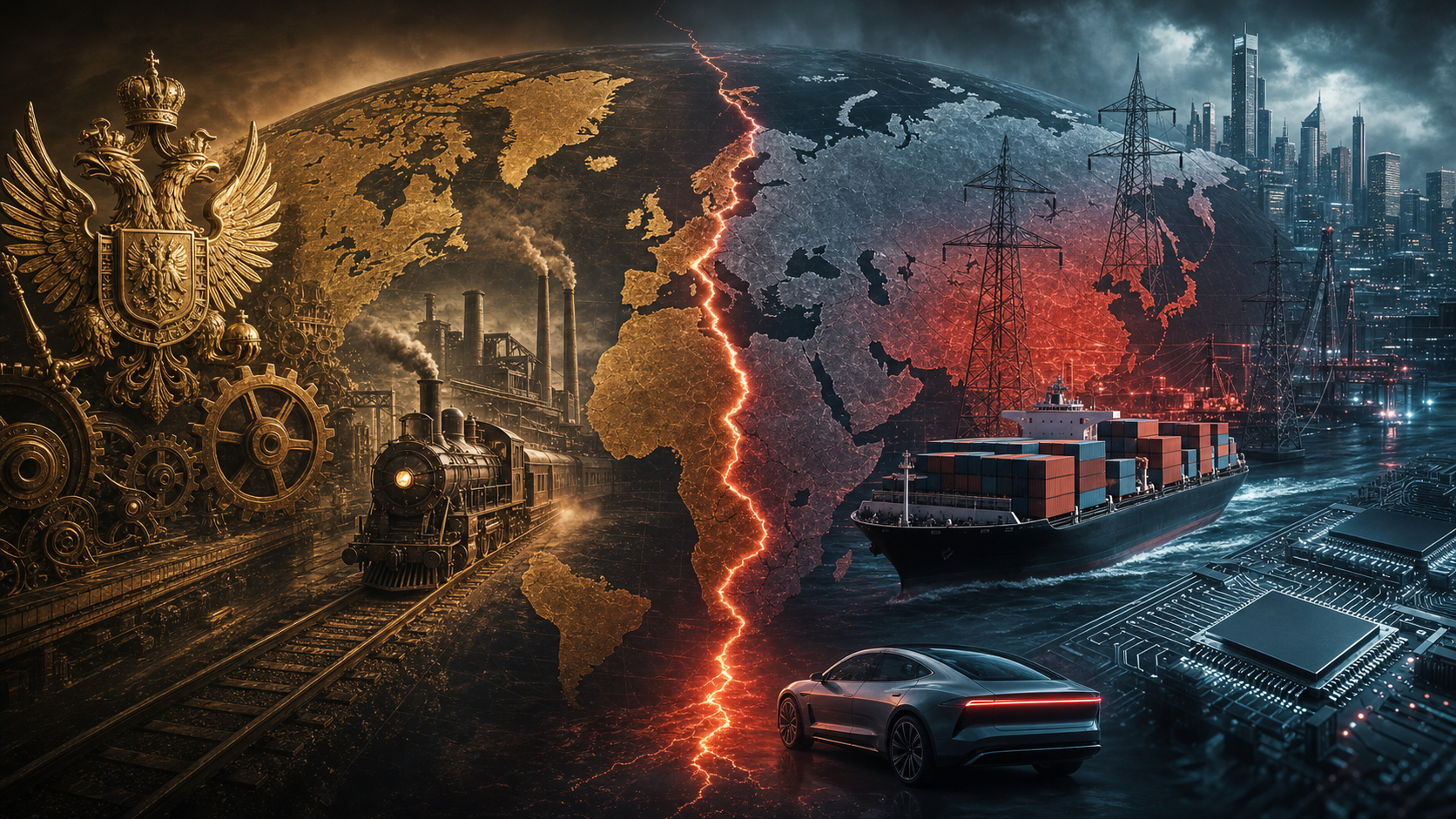
Anglo-American propaganda: China today like Germany in 1912? Why a historical conflict is looming – Image: Xpert.Digital
Between the blocs: What the relentless power struggle between the superpowers means for the European economy
Tariffs, trade wars and a new axis: The global world order is at a historic turning point
As economic and political tensions between the US and China continue to escalate, observers are increasingly confronted with a disturbing historical comparison: Is the pattern repeating itself that led to the catastrophe of the First World War in 1914?
Back then, it was the rising German Empire that economically overtook the established British hegemonic power, leading to a fatal arms race. Today, China is challenging the US-dominated Western order. The economic rise of decades past has transformed into a cutthroat systemic competition, waged with punitive tariffs, technology monopolies, and the forging of new strategic alliances – most notably the Eurasian axis between Beijing and Moscow.
The following article takes an in-depth look at the parallels and differences between 1912 and the present day. It analyzes why the current hype surrounding Chinese technology giants like BYD could quickly become a historical footnote in the face of a looming global bloc conflict, and highlights the enormous challenges facing Europe. This is an essential analysis for anyone who wants to understand whether history repeats itself—and how the strategic errors of the past might still be averted.
If yesterday's challenger becomes tomorrow's hegemon, who will write the rules of the day after tomorrow?
The parallel between two rags-to-riches stories
There are moments in world history when a rising power not only challenges the established order but has effectively overtaken it, without the old order fully acknowledging this. Around 1912, Germany found itself in precisely this liminal position. It had risen to become the world's second industrial power, had already significantly surpassed Great Britain in steel and iron production, and was on the verge of catching up with the hitherto undisputed trading nation in terms of its share of world trade. Between 1880 and 1913, Germany's share of global industrial production quadrupled, while Britain's share declined by about a third during the same period. The gap in global trade share had also narrowed from twelve percentage points in 1880 to just under two percentage points in 1913. This economic reality clashed with a political order based on Great Britain's continued supremacy as the leading maritime and trading power, and this collision gave rise to a rivalry that erupted in an unprecedented naval arms race and ultimately in open military confrontation.
The assertion that China finds itself in a structurally comparable position today is provocative, but not without merit. China has long since overtaken the United States in key industrial indicators, particularly in manufacturing, shipbuilding, and increasingly in future technologies such as battery cells, solar panels, and electric vehicles. At the same time, this economic rise is hampered by an international order shaped after World War II by the United States and its allies, whose institutions, trade rules, and security architectures remain predominantly Western in character. Those who draw the analogy to 1912, therefore, do not mean that events will repeat themselves exactly, but rather that a similar underlying pattern of structural tension between economic reality and political recognition is discernible.
How history is told and what interests it serves
Historical narratives are never neutral; they are always also instruments of power. The image of Imperial Germany as an inherently aggressive, war-mongering nation was systematically cultivated in Anglo-American war propaganda (i.e., by England and the USA) between 1914 and 1918 to morally legitimize their own participation in the war and to demonize the opposing side. This interpretation of an allegedly fatefully aggressive German national character was even legally enshrined after the war in the Treaty of Versailles, which assigned Germany sole responsibility for the outbreak of the war. More recent historical research paints a considerably more complex picture, in which structural factors such as the alliance system, the logic of mutual rearmament, and the established powers' fear of relative power loss played just as significant a role, if not a greater one, than the individual intentions of the politicians involved.
This observation is of immediate relevance today, as very similar patterns of interpretation can be found in current Western reporting on China. In large parts of the Western public sphere, China is primarily portrayed as an expansionist, authoritarian threat whose economic rise is inextricably linked to aggressive geopolitical ambitions. Whether this interpretation does justice to the complex reality, or whether, similar to the case of Imperial Germany, it primarily serves to justify one's own strategic policy of containment, is a question that can only be answered seriously with historical distance. It is noteworthy, in any case, that both cases share a common structural feature: An established power reacts to the relative rise of a challenger not primarily with recognition, but with containment, and this containment is ideologically framed as a necessary defense against a supposedly inherent aggression of the rising power.
The historical mistake of 1914 and its strategic lesson
From a purely power-political perspective, the decisive confrontation between rising Germany and the established Anglo-American powers around 1914 was perhaps unavoidable once the shift in relative power had exceeded a certain threshold. International relations theory recognizes the so-called "power transition trap," which states that the transition from an established to a rising power historically ends in armed conflict with above-average frequency. This is because the established power acts preemptively before the challenger becomes too strong, while the challenger, in turn, becomes impatient once it feels powerful enough. Viewed from this perspective, however, the decisive strategic error of the German Empire lay not in the existence of the rivalry itself, but in the specific design of its alliance policy. Instead of securing the neutrality of Tsarist Russia or even reaching an understanding with Saint Petersburg, Kaiser Wilhelm II declared war on the Russian Tsar, thereby driving Russia definitively into the arms of France and Great Britain. Germany thus maneuvered itself into a two-front war which it could hardly win in the long run, and squandered the opportunity to control the Eurasian continent together with Russia against the Anglo-American powers operating from the sea.
This strategic lesson appears to have been very well understood in Beijing today. The Chinese leadership is clearly acting according to the maxim that while a transfer of power will very likely be accompanied by tensions, these tensions can be significantly mitigated, or at least steered in a direction more favorable to China, through a shrewd policy of alliances. For this reason, Beijing attributes a strategic importance to its relationship with Moscow that extends far beyond short-term economic calculations.
The new Eurasian axis between Beijing and Moscow
The economic and political rapprochement between China and Russia has accelerated dramatically since 2022, intensifying in ways that would have been scarcely imaginable a decade ago. In the first quarter of 2026, bilateral trade between the two countries grew by nearly 15 percent year-on-year to over US$61 billion, with more than 99 percent of all transactions now conducted in yuan and rubles, bypassing the Western-dominated dollar system entirely. Russia has become China's primary oil supplier, while Chinese manufactured goods and industrial products are increasingly filling the gaps in the Russian economy created by Western sanctions. Vladimir Putin and Xi Jinping have repeatedly and publicly cited this strategic coordination in their talks as the key stabilizing factor in a world of increasing great-power rivalry, emphasizing in particular cooperation in the energy, nuclear, and high-tech sectors.
However, a closer look at this alliance reveals that it is by no means a relationship between equal partners. Current analyses of the economic structure of this relationship suggest that the balance of power is increasingly shifting in China's favor. Russian raw materials are exported to China at discounted prices, while Chinese goods enter Russia at a significant markup, and China now accounts for around 35 percent of total Russian foreign trade—a share that was considerably lower before the start of Russia's comprehensive invasion of Ukraine. Russia has thus effectively maneuvered itself into the position of a dependent supplier of raw materials to a single dominant buyer, which can enforce substantial price reductions because there are hardly any alternative buyers for Russian energy on a comparable scale. This structural asymmetry means that while the Eurasian axis between Beijing and Moscow is politically portrayed as an alliance of equal great powers, economically it is increasingly taking on the character of a hierarchical relationship in which Russia is ceding economic and political power to China in the long term.
For the assessment of the historical analogy, this means that while China is indeed trying to avoid the strategic mistake of 1914 by maintaining its relationship with Russia rather than risking it, this relationship itself could become a new source of instability should Russia one day perceive its economic dependence on Beijing as an existential threat to its own sovereignty.
Our global industry and economic expertise in business development, sales and marketing

Our global industry and economic expertise in business development, sales and marketing - Image: Xpert.Digital
Industry focus areas: B2B, digitalization (from AI to XR), mechanical engineering, logistics, renewable energies and industry
More information here:
A thematic hub offering insights and expertise:
- Knowledge platform covering global and regional economies, innovation and industry-specific trends
- A collection of analyses, insights, and background information from our key areas of focus
- A place for expertise and information on current developments in business and technology
- A hub for companies seeking information on markets, digitalization, and industry innovations
Economic-historical parallels: Why BYD's rise remains geopolitically fragile
Between trade war and decoupling: The current dynamics of escalation
The thesis of historical repetition is further supported by the fact that in 2026, the relationship between the United States and China is in a phase that can, without exaggeration, be described as a state of economic siege. Effective American tariffs on Chinese imports have averaged approximately 33 percent since May 2026, composed of several layered tariff levels, with individual strategic sectors such as electric vehicles and lithium-ion batteries reaching tariff rates of up to 145 percent. China has responded to these measures with its own retaliatory tariffs, tightened export controls on rare earth elements, and targeted restrictions on agricultural imports from the United States. Of particular significance is the fact that China accounts for more than 80 percent of global production of solar panel components and, for the first time in April 2026, openly used this position as a bargaining chip in talks with Washington.
Although both sides agreed to a preliminary de-escalation in Busan in October 2025, in which the United States pledged tariff reductions in exchange for Chinese concessions on fentanyl control, soybean imports, and the flow of rare earth elements, this fragile truce is deliberately time-limited and expires in November 2026. The fundamental pattern of a reciprocal economic escalation spiral, repeatedly interrupted by brief periods of détente without resolving the underlying structural rivalry, is reminiscent of the diplomatic ups and downs between the major European powers in the years before 1914, when periodic détente agreements never truly overturned the underlying logic of arms buildup.
BYD as a symbol of technological upheaval
Within this broader geopolitical narrative, the automaker BYD occupies a particularly revealing position. BYD has transformed itself in just a few years from a Chinese battery manufacturer into the world's largest producer of electric vehicles, achieving global market leadership in 2025 with approximately 4.6 million vehicles sold featuring new drive technologies. The company's success is closely linked to China's wider rise as a leading nation in electric mobility, with China exporting more than one million vehicles in June 2026 alone, a record 75 percent increase year-on-year.
However, a look at recent developments in 2026 also reveals just how volatile this leading position actually is. In the first quarter of 2026, BYD experienced a sales decline of approximately 25 percent and was temporarily overtaken by Tesla in global market share of battery electric vehicles (BEVs) before reclaiming the top spot in the second quarter with over 557,000 BEVs delivered. These fluctuations illustrate that, despite its impressive industrial base, BYD operates in an exceptionally competitive and politically charged environment where expiring government subsidy programs in China, fluctuating demand, and an increasingly protectionist international climate can significantly impact business performance.
The parallel drawn in the initial thesis between BYD and the historic German automobile brand Horch is less a statement about product quality than about their historical hierarchy of importance. In the 1930s, Horch was indeed the most prestigious German luxury brand within Auto Union, which had been formed in 1932 from the merger of Audi, DKW, Horch, and Wanderer, and which developed into the second-largest German automotive group after Opel. However, with the outbreak of World War II, civilian vehicle production declined dramatically for Auto Union. The factories were almost entirely converted to war production, manufacturing tank engines, tracked vehicles, and ammunition. During the final years of the war, thousands of forced laborers and several thousand concentration camp prisoners were forced to work in the factories under inhumane conditions. Within this broader historical context, the once-luxurious Horch brand now appears as a largely tragic, historically marginalized footnote, its significance completely overshadowed by the momentous political events of the time.
Applying this observation to BYD does not mean that Chinese electric vehicles will fail technically or economically, but rather that their historical significance might be far less than the current media hype suggests, should the geopolitical confrontation between the major powers intensify after 2030 to such an extent that all individual economic phenomena fade into the background. If the grand historical narrative of the coming decades is characterized by military conflicts, bloc formation, and fundamental shifts in the world order, then retrospectively, hardly anyone will likely talk about the market shares of individual car manufacturers, much like today hardly anyone remembers the former importance of Horch, even though the company was considered a technological pioneer in its time.
Structural differences between 1912 and the present
For all the persuasive power of the historical analogy, it is important not to overlook the crucial differences between the past and present situations, because an overly mechanical application of historical patterns regularly fails to grasp the inherent logic of the present. The economic interdependence between China and Western economies is far deeper and more complex than that between Imperial Germany and Great Britain before the First World War. American and European companies are so closely intertwined with China through investments, supply chains, and sales markets that a full-scale military confrontation would plunge not only the defeated side but also the supposedly victorious one into a profound economic catastrophe.
Added to this is the existence of nuclear weapons as a fundamentally altering element of the strategic equation. In 1914, the major European powers could still enter a war relatively unconcerned because the true costs of an industrialized mass war were simply inconceivable to their decision-makers. In contrast, a direct military confrontation between nuclear-armed superpowers in the twenty-first century carries a risk of annihilation that negates any rational calculation of gains from conquest. Therefore, the more likely form of conflict lies in economic, technological, and proxy military confrontation rather than a direct global war between the main actors.
Finally, the demographic and economic starting points also differ considerably. In 1912, Germany had a young, rapidly growing population and an expanding industrial base, whereas China today faces an aging society, a declining birth rate, and significant structural problems in the real estate sector and municipal debt. These demographic challenges could restrict China's long-term ability to maintain its economic dynamism for decades far more than was the case for Germany a little over a century ago.
Europe's role between the blocs
For Germany and Europe as a whole, this analysis yields an uncomfortable but important strategic insight. Should the global economy indeed split into two largely separate technological and trade policy blocs, as the tariff architecture of 2026 and the debate surrounding strategies like China-plus-one already suggest, then Europe will face the necessity of redefining its own position within this bloc formation. The European automotive industry, traditionally a technological leader, is under considerable pressure to adapt due to the rapid rise of Chinese manufacturers like BYD, which have now captured significant market shares in Europe itself.
At the same time, Russia's close ties with China make it clear that a strategic realignment of Europe vis-à-vis Moscow will also influence Europe's position vis-à-vis China in the long term. The more Russia moves economically and politically into a partnership dominated by Beijing, the more the entire Eurasian power structure shifts in a direction that runs counter to the interests of a European economic order based on open markets, rules-based trade, and multilateral institutions.
A sober assessment of the probability
At the end of every historical analogy lies the question of its actual predictive power, and here intellectual humility is called for. Historical patterns never repeat themselves identically; they vary in form, speed, and outcome depending on the specific circumstances of their time. The observation that China today is in a position exhibiting structural similarities to Germany in 1912 is therefore not a deterministic prediction of the future, but merely an analytical tool that helps to better understand the basic patterns of current great power rivalry. The probability that the events after 1914 will repeat themselves in some form after 2030 cannot be reliably quantified, but the structural similarities are sufficiently clear that politics, economics, and society in Europe would be well advised to prepare for several possible future scenarios instead of relying on the continuation of the existing, comparatively stable world order.
Anyone making economic decisions today, whether as an entrepreneur, investor, or political decision-maker, should understand this historical perspective as an additional layer of analysis that considers long-term geopolitical shifts alongside short-term market data. History doesn't provide certainties, but it does provide patterns, and ignoring them poses a significant risk.
📈🚀 From visibility to trust 👀🤝 Your scalable path with Xpert.Digital

From visibility to trust: Your scalable path with Xpert.Digital - Image: Xpert.Digital
In industrial B2B, sustainable business relationships rarely emerge overnight. They develop step by step – through visibility, professional relevance, recurring touchpoints, and growing trust. Xpert.Digital's 4-stage model addresses precisely this: It offers a structured path that begins with a manageable entry point and can evolve into deeper collaboration in business development if needed.
Instead of relying on loud marketing promises, this model puts the relationship at the forefront. Companies start with clearly defined, easily calculable measures and then decide, based on their own experience, how far they want to expand the collaboration. A key factor for this undisturbed trust-building process: The platform completely avoids annoying advertising ads, so the editorial focus remains solely on the companies' expertise.
More information here:
Consulting - Planning - Implementation

Konrad Wolfenstein
I would be happy to serve as your personal advisor.
You can contact me at wolfenstein∂xpert.digital or
Just call me on +49 7348 4088 965 .










