Is the New Silk Road on the brink? Why China's trillion-dollar project needs to be rethought: When trade routes become battlefields – Image: Xpert.Digital
Geopolitical earthquake: How the Iran conflict is paralyzing China's most important trade route
The rise of the Central Corridor: Europe's safe alternative to the blocked Russian route
Multi-billion dollar poker game over Central Asia: Why the EU now needs to get involved in China's Silk Road
The Belt and Road Initiative (BRI) was long considered China's unstoppable master plan for reshaping the global trade architecture. However, massive geopolitical upheavals—from the war in Ukraine and the escalating conflict in Iran to targeted attacks on maritime chokepoints—have put the trillion-dollar project to an unprecedented test. Key routes once planned are now blocked or have become unpredictable risk zones.
This analysis sheds light on Beijing's forced strategic shift: away from initial expansionist euphoria and towards pragmatic risk diversification and resilience. At the heart of this global realignment lies the so-called "Central Corridor" (the Trans-Caspian Route). It bypasses the conflict zones in Russia and the Middle East, transforming strategic hubs—from the Caspian Sea to the Bulgarian port of Burgas—into new gateways to Europe. Learn below which transport routes are collapsing, which countries are surprisingly benefiting, and why the European Union must actively shape this transformation to ensure its own economic security.
Related to this:


Trade in the shadow of war: The real winners and losers of the Belt and Road Initiative
The Belt and Road Initiative (BRI), known as the "New Silk Road" since its announcement by President Xi Jinping in 2013, is far more than an infrastructure program. It is China's most ambitious attempt to reshape the global economic architecture through roads, railways, ports, and pipelines connecting East Asia with Europe, the Middle East, Africa, and Central Asia. Up to 150 countries are involved in various ways, and annual Chinese investments in BRI partner countries recently exceeded US$22 billion. Some estimates suggest that the total investment volume has already surpassed US$1 trillion.
The driving forces behind the initiative are multifaceted. On the one hand, there is the domestic political dimension: China's western provinces, particularly Xinjiang, suffer from chronic underdevelopment. Chinese planners saw new trade corridors as a means of economically integrating these regions and promoting social stability. On the other hand, there is the geopolitical calculation: those who build infrastructure create dependencies—and thus influence. The countries involved along the route become more economically tied to China, which in the long term strengthens Beijing's position as a global power. Added to this is energy security: China imports immense quantities of oil and gas; diversifying supply routes and sources is therefore a strategic necessity.
Iran: Crossroads under fire
No country has been described more frequently by BRI strategists as an “essential hub” than Iran. Iran’s geographical location—at the crossroads of Central Asia, the Caucasus, the Middle East, and the Persian Gulf—theoretically makes it an ideal transit corridor between East Asia and Europe. In 2021, Beijing and Tehran signed the Comprehensive Strategic Partnership Agreement, a 25-year cooperation framework that envisioned up to $400 billion in Chinese investment in exchange for long-term oil deliveries and infrastructure rights.
However, implementation fell far short of the announcements. US secondary sanctions, particularly the Comprehensive Iran Sanctions, Accountability, and Divestment Act (CISADA), deterred Chinese state-owned enterprises and banks from investing directly in Iran. Many projects were instead conducted through barter agreements, with Iran supplying oil and other commodities as payment. Nevertheless, bilateral trade relations developed: China became the largest buyer of Iranian exports and the second-largest supplier of Iranian imports. By the end of 2025, China was importing up to approximately 1.4 million barrels of oil per day from Iran – representing about 13 percent of its total crude oil imports.
With the outbreak of active conflict between the US and Iran, the strategic situation changed fundamentally. The closure of the Strait of Hormuz by Iranian forces crippled one of the world's most important maritime chokepoints: roughly a quarter of global crude oil shipments pass through this narrow waterway daily. Reports indicate that over 1,000 ships were stranded in the Persian Gulf. Chinese Belt and Road Initiative (BRI) projects in Iran were immediately threatened by uncertainty, potential suspension, or physical destruction. The Iran route has thus transformed from a manageable risk corridor into a de facto unusable supply chain.
Iraq: Oil partner caught between instability and strategic potential
Iraq occupies a peculiar dual role within the Belt and Road Initiative (BRI): as an energy supplier, it is of considerable importance to China, while as a transit corridor, it remains fragile. Between 50 and 67 percent of Iraqi oil production comes from fields in which Chinese companies are involved as investors, producers, or in service functions. In 2024, Iraq received the second-highest share of Chinese BRI investments in the Middle East, amounting to US$9 billion – behind Saudi Arabia with US$18.9 billion. In May 2025, another agreement was signed for the Tuba oil field in Basra: an US$18 billion megaproject encompassing an oil refinery, petrochemical and fertilizer plants, and two power stations.
Of greater strategic interest is Iraq's Development Road, the $17 billion program intended to create a seamless transport corridor from the deep-water port of Al Faw on the Persian Gulf – scheduled for completion in 2025 – to the Turkish border at Fishkabur, from where road and rail links would extend to Europe. One sub-project, the railway connection between Basra (Iraq) and Shalamcheh (Iran), was conceived as a link to the BRI network and would have opened the way to Syria and the Mediterranean. However, as long as the conflict with Iran continues, this route remains blocked.
Iraq's core problem as a BRI partner is structural: political instability is chronic, the state apparatus is weak, and ethno-religious tensions between Kurds, Sunnis, and Shiites strain its governance. China currently benefits primarily from Iraqi oil but avoids deeper political involvement—a strategy Beijing generally pursues in the region: economically present, politically neutral. While this reticence protects Chinese interests in the short term, it also makes Iraq's BRI connection vulnerable to political upheavals over which China has no control.
The complete route atlas: Stability and fragility along the BRI
The BRI is not a single corridor, but a network of parallel and overlapping routes, each with its own risk profile.
Northern Corridor: Blocked by Russia
The Northern Corridor, also known as the New Eurasian Land Bridge, runs from China through Kazakhstan, Russia, and Belarus to Europe. Before 2022, it was the fastest and cheapest land route between China and Europe, handling up to 1.5 million standard containers annually on the Trans-Siberian Railway. Russia's war of aggression against Ukraine dramatically altered this: Western sanctions against Russia and Belarus rendered the corridor virtually unusable for many Western companies, and China-EU freight traffic on this route plummeted by 40 percent. Today, the Northern Corridor is considered politically compromised and not a reliable transit route for the European market in the medium to long term.
China-Pakistan Economic Corridor (CPEC): Investments in a war zone?
The Central Pacific Economic Corridor (CPEC) connects China via Xinjiang to the Pakistani deep-sea port of Gwadar on the Arabian Sea and, with over US$65 billion in Chinese investment, is the flagship bilateral BRI project. Theoretically, it offers China access to the Indian Ocean, bypassing the Strait of Malacca. In practice, the CPEC is one of the most unstable BRI projects. Pakistan suffers from chronic economic weakness, its debt burden from Chinese loans is substantial, and the threat of terrorism from groups like Tehreek-e-Taliban Pakistan (TTP) and other jihadist networks poses a constant danger to Chinese engineers and infrastructure. Adding to the tension is the strained situation between Pakistan and Afghanistan following the Taliban's return in 2021: the Durand Line, the disputed border between the two countries, is the scene of regular military skirmishes that directly threaten the routes the CPEC is intended to use. Afghanistan was formally integrated into the BRI framework in 2025, but the reality on the ground is different – China wants access to Afghanistan's lithium and copper deposits, but cannot use the mine transport routes without stable transit corridors through Pakistan.
Southeastern Maritime Corridor: Vulnerable due to chokepoints
The maritime arm of the BRI runs along the coasts of the Indian Ocean – from Shanghai via the Strait of Malacca, the Indian Ocean, the Red Sea route (via the Suez Canal), or alternatively around the Cape of Good Hope to Europe. It is the most important trade route between China and Europe in terms of volume, but also the most vulnerable to maritime bottlenecks. The Strait of Hormuz, the Strait of Malacca, the Suez Canal, and the Red Sea – all these chokepoints have been affected by conflicts or attacks in recent years. Houthi attacks on container ships in the Red Sea in 2024 forced many shipping companies to take the long route around Africa, drastically increasing transit times and costs. Iran's closure of the Strait of Hormuz from 2025 onward exacerbated this effect and severely impacted global energy supply chains.
Kazakhstan and Central Asia: A pillar with growing pains
Kazakhstan is indispensable for almost all westward-facing BRI routes. The country hosts the international logistics hub of Khorgos on the Chinese-Kazakh border, as well as the "Western China – Western Europe" corridor. China has invested more than US$40 billion in Central Asia. Kazakhstan benefits from its neutral foreign policy stance and consciously tries to balance itself between China, Russia, and the West. However, the risks are real: debt dependency in poorer countries like Kyrgyzstan and Tajikistan, potential secondary sanctions risks from the war with Russia, and the latent instability in Afghanistan, which borders the Central Asian region.
Türkiye: Strategic Winner and Balancing Act
Turkey is positioning itself as a crucial hub on the Middle Corridor – between Asia and Europe, between NATO and the SCO, and between China and the West. Ankara has significantly accelerated the modernization of its transport infrastructure in recent years and sees the Middle Corridor as an opportunity to expand its strategic influence. The Baku-Tbilisi-Kars Railway (BTK), commissioned in 2017, is the physical foundation of this ambition. However, Turkey's role as a BRI partner is ambivalent: it is a NATO member, maintains close ties with the West, but simultaneously negotiates with China and Russia. This dual role protects it from complete dependence, but also makes it unpredictable.
Related to this:


The Trans-Caspian Route: The more stable alternative system
While the Iran Corridor is in a state of active conflict and the Northern Corridor is politically fraught, the Trans-Caspian International Transport Corridor (TITR), widely known as the Central Corridor, is experiencing a remarkable resurgence. The route connects China to Europe via Kazakhstan, the Caspian Sea, Azerbaijan, Georgia, and Turkey – without crossing Russian or Iranian territory.
The figures demonstrate the growing interest: Freight volume on the Central Corridor doubled in 2022 to 1.5 million tons, while volume on the Northern Corridor fell by 34 percent during the same period. In the first eleven months of 2024, transit volumes increased by 63 percent to 4.1 million tons, and container traffic grew 2.6 times to 50,500 TEU. The World Bank forecasts that with the right investments and reforms, the annual volume could rise to around 11 million tons by 2030 – a threefold increase compared to the baseline levels of the early 2020s. Transit times between China and Europe decreased to 18 to 23 days by 2024, compared to 38 to 53 days previously.
The geopolitical stability of the transit countries along the Central Corridor is comparatively higher than that of the Iran or Russia corridors. While Kazakhstan, Azerbaijan, Georgia, and Turkey are not without their own tensions—Nagorno-Karabakh and Georgian domestic politics are among the known risk factors—the region exhibits a significantly lower intensity of conflict compared to the Middle East or Russia. Kazakh analyst Doschan Satpaev succinctly summarized the situation: even if the Central Corridor is not free of geopolitical tensions, these have a considerably smaller impact on the transport environment than the conflicts in the Middle East or with Russia.
Our EU and German expertise in business development, sales and marketing


Our EU and German expertise in business development, sales and marketing - Image: Xpert.Digital
Industry focus areas: B2B, digitalization (from AI to XR), mechanical engineering, logistics, renewable energies and industry
More information here:
A thematic hub offering insights and expertise:
- Knowledge platform covering global and regional economies, innovation and industry-specific trends
- A collection of analyses, insights, and background information from our key areas of focus
- A place for expertise and information on current developments in business and technology
- A hub for companies seeking information on markets, digitalization, and industry innovations
Burgas in focus: How Bulgaria's ports could change trans-Eurasian trade: How realistic is the expansion of the Trans-Caspian Route?
Where the middle corridor is still weak
Despite its growth, the Central Corridor is struggling with structural bottlenecks. The most serious problem is the Caspian crossing: While the port infrastructure in Aktau and Kuryk (Kazakhstan), Turkmenbashi (Turkmenistan), and Baku/Alat (Azerbaijan) has capacities of between 5 and 17 million tons annually, the available ferry and ship fleet cannot adequately handle the growing freight traffic. A unified tariff system, a common operator, and fully harmonized border procedures between the transit countries are lacking. The World Bank estimates that around €18.5 billion is needed for the most urgent infrastructure improvements along the Central Corridor alone. By comparison, in 2024, the Central Corridor had a capacity of only 6 million tons, while the Russian Northern Corridor handled over 100 million tons per year. The gap is enormous – and building the necessary capacity requires time, coordinated political investment, and private actors willing to bear the risk.
Related to this:

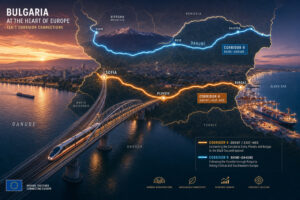
Burgas and Bulgaria: Europe's eastern gateway
The Bulgarian Black Sea ports of Varna and Burgas are increasingly coming into focus for the European extension of the Central Transit Rail Link through the EU (TITR). In June 2025, Bulgarian President Rumen Radev and Kazakh President Kassym-Jomart Tokayev agreed in Astana to integrate the ports of Burgas and Varna into the TITR project. A Memorandum of Understanding was signed between the transport ministries of both countries, outlining the exchange of expertise, the development of port infrastructure, and the minimization of transit times.
The Port of Burgas is already an Associate Partner of the International Association TITR and was selected in September 2024 as the European receiving port for a service that transports maritime containers by rail from China via Kazakhstan to Europe – organized by Beijing Trans Eurasia International Logistics Co. The volume remains modest so far, but the direction is clear.
Burgas is connected to the European rail network via the Trans-European Transport Corridor Orient/East-Med, which links Burgas via Sofia to the German North Sea ports and to Greece (Thessaloniki, Piraeus). With a total distance of approximately 9,400 to 11,000 kilometers from China, the Burgas–Sofia railway line is the shortest possible rail connection to the heart of Europe. Corridor VIII, which runs from the Adriatic to the Black Sea, also connects Bulgaria with North Macedonia, Albania, and the Adriatic port of Durrës in Italy, and will be further strengthened by the agreement signed in November 2025 for a cross-border railway tunnel near Gyueshevo. The rail distance from Burgas to Budapest is approximately 1,190 kilometers – comparable to the Romanian port of Constanța, which, at 1,060 kilometers, is only slightly shorter.
European Integration: TEN-T, the Single Market and the Global Gateway
The development of the Central Corridor and its European feeder lines is not just an infrastructure issue, but also a question of the internal market. With the TEN-T network (Trans-European Transport Network), the European Union has created a regulatory framework that sets clear requirements for interoperability, train speed, and digital systems. The core network must be completed by 2030 – including the rail lines in Bulgaria along the Orient/East-Med Corridor. From 2040, passenger trains on the core network must travel at least 160 km/h, and the European Train Control System (ERTMS) will be mandatory.
The EU, for its part, has mobilized considerable resources. At the Investors Forum in Tashkent in January 2024, €10 billion was pledged for the Central Corridor; at the first EU-Central Asia Summit in Uzbekistan in April 2025, a further Global Gateway investment package of €12 billion followed. This is complemented by financing from the European Bank for Reconstruction and Development (EBRD) and the European Investment Bank (EIB) for Kazakhstan, Kyrgyzstan, and Uzbekistan. The context is clear: Europe is seeking to diversify its supply chains away from single, vulnerable routes – whether with regard to Russia after 2022 or with regard to the Middle East after 2025. EU Commissioner for Enlargement, Marta Kos, summed it up perfectly at the Tashkent Forum: Europe has learned how quickly dependencies can become risks, and diversification is crucial for Europe's economic security.
However, the integration of the Central Corridor into the European Single Market faces structural obstacles: EU support instruments, particularly the EFSD+, do not operate directly but rather through guarantee mechanisms designed to attract private investors. In a region like Central Asia, which investors perceive as high-risk and low-yielding, this instrument regularly results in a gap between announcements and actual cash flows. For the European Single Market, the question remains whether goods from China can achieve competitive transit times and costs via the Central Corridor, comparable to those of the sea route or the Northern Corridor. Currently, the volume of the Central Corridor is still significantly below its potential.
Strategic Implications: China's Response to the Route Collapse
The Iran war is forcing China to fundamentally rethink its position on the Belt and Road Initiative (BRI). The strategic assumption that economic connectivity can be isolated from geopolitics has proven to be an illusion. Three patterns of response are emerging.
First, China is shifting its priorities from expansion to resilience. Large-scale projects in unstable regions are being approached with greater caution by Chinese state-owned enterprises. Beijing is increasing its strategic energy reserves and reducing its exposure to volatile regions.
Secondly, China is accelerating its investments in the Middle Corridor. Since 2022, Beijing has signed agreements with Kazakhstan, Georgia, and Azerbaijan to develop infrastructure along this route. Kazakhstan's state railway, KTZ, plans to invest $10 billion by 2030, including 900 kilometers of new track and six new ships for the Caspian crossing.
Thirdly, the BRI is increasingly fragmenting into regional “mini-corridors” that are less focused on full Eurasia integration than on specific bilateral economic objectives. This fragmentation is not only a weakness but also a form of risk diversification: if one route fails, others take over.
Overall assessment: Stability, fragility, and the long-term horizon
An honest assessment of the BRI routes according to their level of stability reveals the following picture: The Central Corridor currently offers the highest geopolitical stability among the available land routes between China and Europe, but suffers from significant capacity and coordination deficits. The Northern Corridor is politically fraught for years to come. The Iran Corridor is in an active state of war and operationally unusable. The CPEC suffers from chronic security problems. The maritime route remains voluminous, but is dependent on maritime bottlenecks that have proven surprisingly fragile.
The Trans-Caspian Route is not the perfect solution – it is the best available. Its development with European support via Burgas and the TEN-T structures makes economic sense and is geopolitically necessary. The integration of Bulgarian Black Sea ports not only strengthens transit capacity but also anchors the route in the European single market, thereby creating a legitimacy and regulatory framework that Chinese-dominated corridors cannot offer.
The time horizon is crucial: For China, the BRI represents a 30- to 50-year strategic gamble. Individual routes will fail, be rerouted, or redesigned – just as in traditional trade. The real question is whether Europe is wise enough to actively participate in this development process instead of merely observing. A stable Middle Corridor, integrated into the European single market, benefits not only China but also Europe: as an alternative to dependencies that have all too often proven to be strategic vulnerabilities in the past.
Your global marketing and business development partner
☑️ Our business language is English or German
☑️ NEW: Correspondence in your native language!

Konrad Wolfenstein
I and my team are happy to be available to you as your personal advisor.
You can contact me by filling out the contact form here wolfenstein@xpert.digital:or simply call me at +49 7348 4088 965. My email address is
I'm looking forward to our joint project.
☑️ SME support in strategy, consulting, planning and implementation
☑️ Creation or realignment of the digital strategy and digitization
☑️ Expansion and optimization of international sales processes
☑️ Global & Digital B2B trading platforms
☑️ Pioneer Business Development / Marketing / PR / Trade Fairs
🎯🎯🎯 Data-driven B2B industry hub as a quasi-in-house solution


The quasi-in-house solution: How Xpert.Digital closes operational gaps in B2B marketing and sales – Smart Content-Driven Business - Image: Xpert.Digital
Xpert.Digital is a data-driven B2B industry hub led by Konrad Wolfenstein . The company acts as an external, quasi-in-house solution for industrial partners, closing operational gaps in marketing, content, and sales – without requiring additional resources on the client side.
More information here: