
Stock market shock: What's behind the sell-off in AI stocks – Three trillion dollars less market capitalization
Xpert Pre-Release

Available in 27 languages 📢
Prefer Xpert.Digital on GoogleⓘPublished on: November 6, 2026 / Updated on: November 6, 2026 – Author: Konrad Wolfenstein

Stock market shock: What's behind the sell-off in AI stocks – Three trillion dollars less market capitalization – Creative image on the topic, with AI: Xpert.Digital
The AI boom is getting a reality check: These risks are now coming into focus
After the AI hype, profitability is what counts: Which companies are now under pressure?
Data centers, electricity, profits: Why AI euphoria is reaching its limits
The AI boom fueled stock markets for years. But now investors are asking an uncomfortable question: Will the enormous investments in chips, data centers, and energy infrastructure actually generate the profits already priced into share prices? A sharp sell-off in technology stocks shows that the market is no longer solely focused on grand promises for the future. Increasingly, concrete returns, reliable customers, and the ability to finance large investments are what count.
This is about more than just a weak trading day. Delays in data center construction, rising electricity demand, and political uncertainty could alter expectations for the growth of the AI industry. At the same time, high investments are not automatically proof of sustainably profitable business models: The crucial factor is whether companies can attract enough paying customers with their AI offerings and cover their costs. The stock market shock is therefore neither proof of the end of the AI boom nor a reason to dismiss losses lightly as a mere buying opportunity. Rather, it marks a reassessment that should reveal which companies are actually creating value – and which were primarily driven by high expectations.
Related to this:
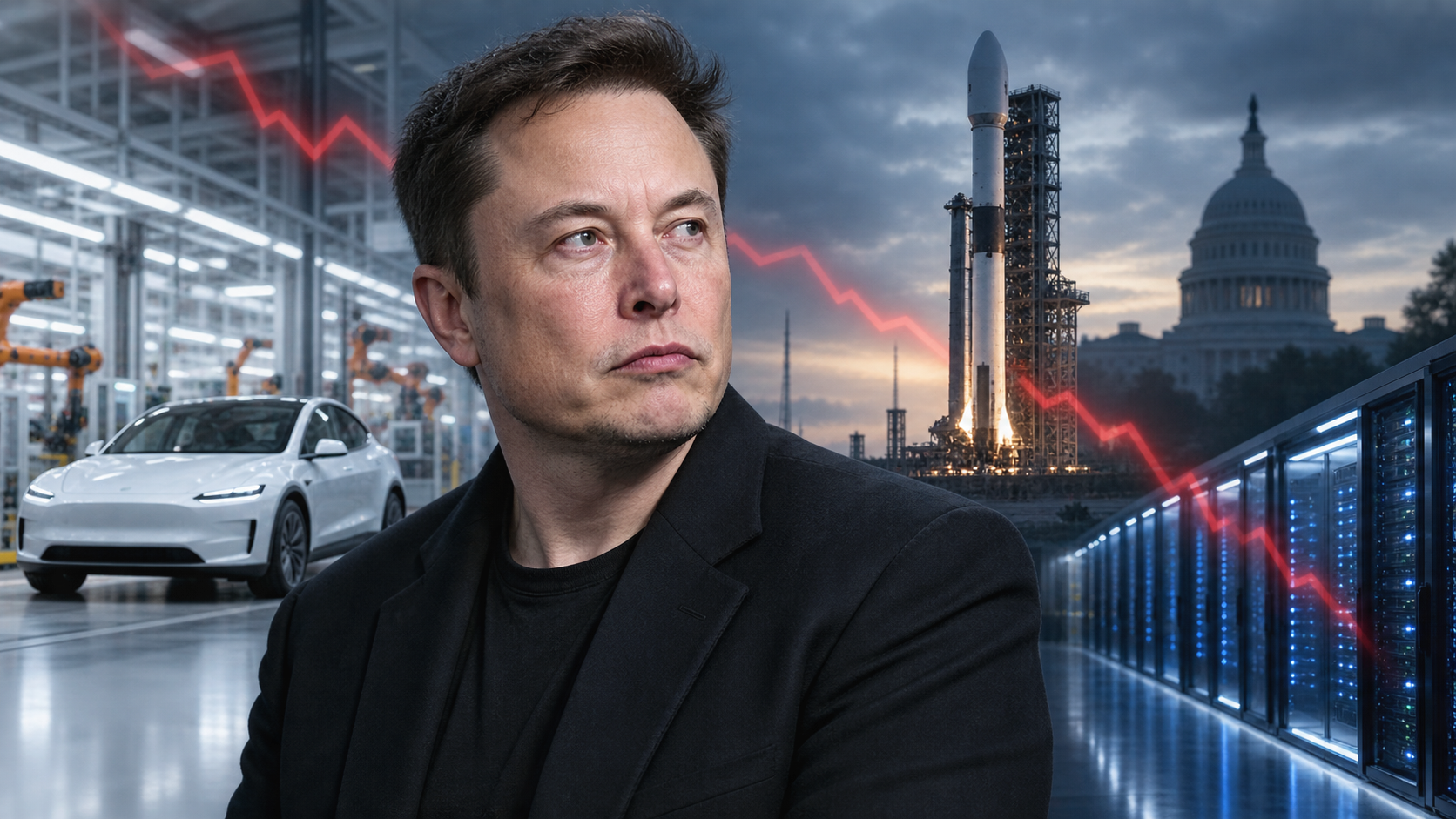
When the future becomes too expensive: Now it's not the promise that counts, but the profit
A stock market shock of greater significance than a bad trading day
International stock markets are undergoing a revaluation whose significance extends beyond the losses of individual trading days. At its core lies a question that was often overshadowed by technological enthusiasm during the rapid rise of artificial intelligence: How much should companies be worth today when a substantial portion of their expected profits are only to be generated in an uncertain future? The recent sell-off shows that investors are once again answering this question more rigorously.
On Thursday, November 5, 2026, the Nasdaq 100 fell by approximately 6.4 percent. The broader Nasdaq Composite lost about 5.5 percent, falling more than ten percent below its recent high. This distinction is important: the two indices represent different groups of companies and should not be considered synonymous despite their similar names. The losses were particularly pronounced among semiconductor companies and other firms whose business is closely linked to the expansion of AI infrastructure.
The overall loss for the American stock market was estimated at approximately three trillion US dollars in market capitalization. The corresponding euro figure of about 2.68 trillion is an exchange rate-dependent conversion, not an independent loss figure. Uncertainty continued internationally on Friday. South Korea's stock market temporarily lost almost nine percent, while the DAX fell by approximately 2.4 percent the day after reaching a record high.
These figures describe a sharp loss of confidence, but not yet a uniform economic crisis. Crucially, the losses are distributed unevenly. While particularly ambitious AI business models are coming under pressure, some healthcare, food, and industrial companies are faring comparatively better. The stock market is once again distinguishing more sharply between promised growth and already generated returns.
Why lost market value is not vanished cash
The idea that trillions of dollars were wiped out in a single day conveys the magnitude of the shock, but can be economically misleading. Market value is calculated by multiplying the number of outstanding shares by the current market price. If this price falls, the theoretical value of all shares decreases, even though only a portion of them were actually traded.
Therefore, three trillion dollars were not necessarily withdrawn from portfolios and invested elsewhere. Rather, buyers and sellers accepted lower prices. These new prices also revalue the shares that no one sold. It follows, then, that price declines do not automatically mean that a corresponding sum of money must now flow into other sectors.
Economically, such valuation changes are by no means insignificant. Investors have less capital, companies may receive less money per share in capital increases, and leveraged positions can come under pressure. If collateral loses value, additional funds may be demanded or positions may be forcibly sold.
The real economy can also be affected. People who feel poorer may postpone major expenditures. Companies review investments when financing becomes more difficult. A stock market shock, therefore, doesn't necessarily remain confined to trading screens. Whether this leads to a broader economic burden, however, depends on how persistent the losses are and how severely they affect financing, consumption, and investment.
After the political relief comes the cost accounting
The rapid shift in sentiment following the US midterm elections illustrates how political events are processed in the capital markets. Initially, a clear election result can bring relief because uncertainty about majorities and responsibilities decreases. Only subsequently do investors examine more closely what economic consequences the new political situation might have for individual sectors.
For AI stocks, potential restrictions on data centers became a central focus. The electoral successes of politicians who want to limit, temporarily suspend, or subject new locations to stricter regulations increased concerns about a slower expansion. This didn't necessarily change the long-term significance of artificial intelligence, but it did alter the expected pace of its infrastructural expansion.
For the stock market, a change in probability is enough. A specific law doesn't even need to be passed for investors to reduce their profit expectations. If a project potentially starts later, orders, sales, and cash inflows are delayed. At the same time, planning and financing costs can increase.
A sober analysis must nevertheless distinguish between campaign promises, legal possibilities, and measures actually implemented. Not every political demand becomes reality in the same way. Differing state and municipal responsibilities, existing contracts, and economic interests limit the scope for action.
The uncertainty is therefore real, but its ultimate extent is open. It becomes particularly problematic where the assessment already presupposes a virtually trouble-free expansion.
The supposedly limitless digitalization is encountering physical bottlenecks
Artificial intelligence is often perceived as a purely digital development. In reality, it relies on a physical infrastructure that cannot be built arbitrarily quickly. Powerful processors require buildings, power connections, cooling, data lines, and reliable operating conditions. Any one of these factors can become a bottleneck.
A chip ordered doesn't generate any economic benefit if the data center isn't completed on time. A finished building remains unproductive if the promised network capacity is lacking. And a high-performance facility doesn't automatically generate revenue if its capacity is only partially utilized or if customers negotiate lower prices.
These dependencies explain why a problem at a single location can spread to an entire supply chain. Data center operators postpone hardware orders. Suppliers adjust their production plans. Equipment manufacturers anticipate delayed revenue. Financiers have to bridge longer timeframes.
Technological progress thus operates within economic and physical limits. The coordination between short innovation cycles for processors and long planning cycles for energy infrastructure is particularly relevant. If hardware is rapidly replaced by more powerful generations while construction projects are delayed, the risk increases that investment plans will have to be revised even before their full implementation.
This creates a key challenge: Success is not determined by the maximum speed of a single company, but by the coordinated development of the entire infrastructure.
Resistance to data centers is a distribution issue
Political resistance to new data centers cannot be adequately explained as mere technophobia. Often, it's about the distribution of costs and benefits. For a municipality, a large project can mean additional investments and tax revenue. At the same time, it creates burdens such as land use, construction traffic, electricity demand, and the expansion of local infrastructure.
The question of who pays for additional network capacity is particularly sensitive. If costs are spread widely through fees, households and other businesses could be burdened. If data center operators bear a larger share themselves, their project profitability may suffer. Both options have political and economic consequences.
The number of permanent jobs also plays a role. A capital-intensive data center can have high investment sums without employing a similar number of people during its operation as a comparable industrial site. Therefore, the investment sum alone is not a sufficient measure of regional benefit.
Studies by the International Monetary Fund highlight the importance of electricity demand. In companies with vertically integrated AI activities, the share of electricity costs in total expenses rose on average from 0.8 to 1.6 percent between 2019 and 2023. For pure data center companies, it was significantly higher, at 13 to 15 percent. These figures reflect different business models and are not directly applicable to every company. However, they demonstrate that energy supply is a crucial component of the economic equation.
The crucial question is: Who actually profits from AI?
The size of an investment initially says little about its later profitability. A company can invest billions in computing power and still struggle to achieve a reasonable return. The crucial factor is whether customers are consistently willing to pay prices that cover operating costs, depreciation, financing, and a reasonable return on capital.
Interests differ along the value chain. A chip supplier can generate high profits upon sale. Their customer then needs to utilize the purchased hardware economically. A cloud provider can record additional revenue, while the companies using their services are not yet deriving sufficient benefit from their AI applications.
Conversely, a technology can be very valuable to users without enabling its providers to achieve exceptional margins in the long term. When competition and technical efficiency drive down prices, customers benefit, while the return on investment for individual infrastructure operators comes under pressure.
Overall economic progress and shareholder returns are therefore different factors. The successful spread of artificial intelligence does not guarantee that every share involved will be an attractive investment.
The investment cycle becomes sustainable in the long term primarily when independent customers achieve demonstrable benefits: reduced processing time, lower error rates, better capacity utilization, or additional revenue. Only such results create reliable demand that is not permanently dependent on new rounds of financing or increasingly optimistic future assumptions.
High expectations make even good companies vulnerable
An excellent company can be a poor investment if its price too closely reflects its success. This simple distinction explains a significant part of current market movement.
Stock prices reflect not only current profits but also expectations of future cash inflows. The stronger these expected returns are projected to grow and the further into the future they lie, the more sensitive the valuation becomes to changing assumptions.
A purely illustrative example demonstrates the relationship. If a company is valued at 50 times its expected annual profit and the market later only accepts 35 times that amount, its calculated value falls by 30 percent, assuming profits remain unchanged. If, at the same time, profit expectations fall by ten percent, the combined decline is 37 percent. This would not require either insolvency or a complete collapse of the business.
That's precisely why stocks can fall sharply even though the company in question continues to grow. It may simply be growing more slowly than the previous share price had anticipated.
AI stocks can face a confluence of factors: delayed revenues, lower margins, higher financing costs, and a more cautious valuation metric. The market then adjusts not just a single quarterly forecast, but potentially the entire expected outlook.
Anyone assessing a price decline must therefore ask what assumptions were previously priced in. The previous peak price is not independent proof of economic value.
Why semiconductor companies are reacting particularly strongly
The semiconductor industry is at the center of the sell-off because its demand is closely linked to the investment budgets of other companies. If the expansion of data centers is accelerated, orders for processors, memory, and other components increase. If it is postponed, revenue forecasts can quickly come under pressure.
The losses of almost 16 percent in American chip stocks since the beginning of the week illustrate this sensitivity. The fact that even Nvidia slipped into negative territory year-to-date shows how little protection a strong market position offers against short-term valuation changes.
However, the industry is not homogeneous. Companies differ in terms of products, customers, manufacturing models, and sales markets. A company that primarily supplies data centers faces different risks than a supplier with a broad business in industrial electronics, automotive technology, or communications. The interchangeability of products and negotiating power with customers also vary.
Furthermore, deferred and lost demand must be distinguished. If a data center is built several months later, an order can be placed subsequently. If a project is permanently canceled or replaced by a more efficient technical solution, the long-term demand changes.
Previous declines of 30 to 40 percent followed by recoveries demonstrate that high volatility occurs in this sector. However, they do not constitute an automatic buy rule. The prevailing conditions, valuations, and demand cycles may not align with the current situation.
🎯🎯🎯 Data-driven B2B industry hub as a quasi-in-house solution

The quasi-in-house solution: How Xpert.Digital closes operational gaps in B2B marketing and sales – Smart Content-Driven Business - Image: Xpert.Digital
Xpert.Digital is a data-driven B2B industry hub led by Konrad Wolfenstein . The company acts as an external, quasi-in-house solution for industrial partners, closing operational gaps in marketing, content, and sales – without requiring additional resources on the client side.
More information here:
Europe's relative strength compared to the AI sector
The lesson from the dot-com bubble is not technological pessimism
The comparison with the year 2000 is obvious, but should be used precisely. The dot-com bubble did not prove that the internet was economically insignificant. It showed that a correct assessment of technological direction can be linked to completely inaccurate company valuations.
With AI, both statements can be true simultaneously: The technology fundamentally changes economic processes, and yet some stocks are still too expensive. Anyone who sees these possibilities as a contradiction is confusing societal benefit with individually achievable returns on investment.
However, a blanket comparison of today's markets with the situation back then would be problematic. Within the technology sector, there are significant differences between profitable large corporations, specialized suppliers, and capital-intensive operators with high financing needs. Therefore, an overreaction does not necessarily affect the entire market equally.
It is helpful to separate three questions. Is the technology relevant in the long term? Can the specific company generate sustained profits from it? And is the current share price reasonable in relation to these profits?
Only when all three levels convincingly align does a sound investment rationale emerge. The mere statement that AI will be more important in ten years than it is today does not answer the valuation question. Likewise, a sharp price drop does not prove that the technology was overestimated. It can only mean that the market had overestimated its economic benefits, both in terms of timing and financial impact.
From the shared upward movement, a selection will be made based on yield quality
During the boom, very different companies were able to benefit from the same overarching narrative. In this view, more AI meant more data centers, more chips, more electricity demand, and thus rising profits along the entire value chain. The recent correction calls this simplistic connection into question.
Now, differences are becoming more apparent. A company with long-term, secure contracts and a solid balance sheet must be assessed differently than a provider that pre-finances its capacity and only needs to acquire customers later. A manufacturer with technology that is difficult to replace has different options than a provider of interchangeable services.
Even outside the AI sector, more nuanced scrutiny is taking place. Healthcare and food sectors can benefit from relatively steady demand. Nevertheless, neither rising profits nor stable share prices are guaranteed. Regulation, competition, cost increases, and already high valuations remain relevant.
The industrial sector, often considered a defensive category, should be treated with particular caution. Many industrial groups are heavily dependent on economic cycles, demand for capital goods, and international trade. Others rely more heavily on recurring revenues from maintenance or specialized consumer products.
The new dividing line therefore runs less between modern and traditional industries than between different profit qualities. Reliable demand, sufficient margins, and limited financing needs are gaining importance compared to mere promises of growth.
Europe's relative strength is initially an effect of its composition
European stock markets can benefit from a lower weighting of AI companies that are particularly hard hit. Large healthcare, food, and industrial companies have a greater influence on many European indices than on the Nasdaq 100.
However, this does not automatically imply overall economic superiority for Europe. If a market falls less due to its industry mix, this is initially a structural difference in the index composition. A meaningful comparison would also need to compare companies from similar industries and with similar business models.
The location of a corporation's headquarters is not necessarily the same as its economic territory. A European manufacturer may be heavily dependent on its American business. An American healthcare company may generate revenue worldwide. Therefore, focusing solely on country weightings only captures a portion of the true risk distribution.
For investors in the Eurozone, exchange rates also come into play. A gain in dollar terms can be reduced by unfavorable currency developments. Conversely, a stronger dollar can offset some of the losses in stocks.
Europe's relative strength should therefore be understood more as a shift in industry preferences than as a clear departure from the United States. European companies will not become permanently attractive simply through less AI in the index, but through competitive products, productive investments, and reasonable valuations.
The greatest concentration risk is often hidden within one's own portfolio
Many investors carry more technology and AI risk than they realize. A global ETF, additional Nvidia shares, a semiconductor fund, and an AI-themed fund may appear as several separate investments. However, from an economic perspective, they can contain the same companies and the same future expectations multiple times.
The number of positions therefore says little about the actual dispersion. What is crucial is how strongly their returns depend on common factors. If several investments rely on rapid data center investments, high technology valuations, and favorable financing, they can all fall simultaneously during a period of market stress.
Market capitalization-weighted global indices do not intentionally reinforce this relationship, but they do reflect it. If the market capitalization of individual large companies rises, their index weight increases. Anyone who subsequently buys additional shares of these companies further increases the already existing concentration.
A meaningful portfolio analysis therefore considers not only names and countries, but also shared economic dependencies. These include industries, customers, currencies, financing, and whether profits are expected now or only in the distant future.
In addition to other assets, there's the overall financial situation to consider. Those whose professional lives are heavily reliant on technology investments, or who own a related company, may already be facing significant financial risks in this area, in addition to their portfolio. Therefore, diversification should consider the entire financial situation, not just the securities portfolio.
Why the world index looks less dramatic than the headlines
The MSCI All Country World index was recently trading around six percent below its record high and is still up about eight percent since the beginning of the year. This snapshot shows that a sharp decline in individual market segments does not automatically translate into an equally large drop in the global stock market.
At the same time, caution is advised when interpreting the results. A broad index smooths out differences between countries, sectors, and companies. It can appear relatively stable even though individual portfolios have already suffered significant losses.
Furthermore, personal returns depend on the entry point. Someone who invested at the beginning of the year experiences the same market movement differently than someone who bought just before the peak. Both can look at the same index and still see very different results.
Even a small gap to the record high does not necessarily indicate a favorable valuation. If earnings expectations fall more sharply than share prices, a stock may have become more expensive, measured against expected earnings, despite the decline.
The figures from the global index therefore put the notion of a complete global collapse into perspective. However, they do not rule out further losses or an escalation of the problems. The crucial question remains whether the correction will be limited to particularly ambitious valuations or whether it will affect the financing and investment activity of broad segments of the economy.
How a valuation adjustment can become a financing problem
A sell-off becomes particularly dangerous when it hinders the implementation of the very projects on which previous growth expectations were based. Falling share prices can make capital increases less attractive. Higher risk premiums make loans more expensive. Uncertain earnings prospects can lead lenders to postpone investments.
This creates a potential feedback loop: Doubts about expansion lower valuations, lower valuations make financing more difficult, and more difficult financing in turn slows expansion. This mechanism does not affect every company equally.
Financially strong corporations with high ongoing cash flow are more likely to bridge investment phases on their own. Specialized providers with high debt financing needs are more dependent on the continuous trust of their investors.
Furthermore, close business relationships can transfer risks. If a major customer cuts spending, this affects not only the immediate supplier but potentially other equipment manufacturers and financing partners. The more a company is concentrated on a few major customers, the more significant this correlation becomes.
This leads to a practical evaluation criterion: revenue growth should always be considered in conjunction with cash flow, debt, and capital requirements. A rapidly growing company can be more financially vulnerable than a slower-growing company with stable liquidity and limited investment needs.
Energy and infrastructure remain areas of opportunity with their own risks
The search for alternatives inevitably leads to energy supply, networks, cooling, and industrial infrastructure. These sectors can benefit from the long-term needs of the digital economy. Nevertheless, it would be wrong to consider them automatically secure replacements.
A power producer doesn't earn more simply because additional demand arises somewhere. Location, available capacity, contract terms, and regulatory conditions are all relevant. A grid equipment supplier can receive large orders and still suffer from cost increases or project delays.
Capital intensity is also crucial. If new facilities become expensive and their financing costs increase, additional growth can dilute returns. More revenue then does not necessarily translate into more value for shareholders.
The availability of additional electricity generation also plays a role in the overall economic assessment. Model calculations by the International Monetary Fund show that a sharply increasing demand for data centers, coupled with limited expansion of renewable energies and transmission networks, could exert considerable pressure on electricity prices. These are conditional scenarios, not reliable price forecasts.
The economic opportunity therefore lies not in the buzzword "energy," but in concrete business models that efficiently solve bottlenecks and are paid appropriately for doing so.
Apart from AI, the same evaluation rules apply
It's understandable that analysts see potential in other sectors. If attention and capital have been concentrated on a few technology stocks for an extended period, other companies may have received less attention. This can create opportunities, but it doesn't necessarily mean a general undervaluation.
For healthcare companies, product quality, reimbursement systems, regulatory risks, and, where applicable, patent protection are crucial. For consumer goods manufacturers, brand strength, sales volumes, and the ability to pass on higher costs are key. For industrial groups, order quality, capacity utilization, and return on capital are paramount.
An analyst's price target is not a guaranteed return. It is based on assumptions about earnings, valuation metrics, and economic conditions. After a significant market event, these assumptions may become outdated, even if the price target is still published unchanged.
A larger gap between the current price and the target value can therefore mean two completely different things: a more favorable entry opportunity or a delayed adjustment of the model to worse prospects.
A more sensible approach than searching for the highest price target is to compare different scenarios. How will the company perform under normal business conditions? What happens if demand weakens? How much financial flexibility does it have if the recovery takes longer? These questions distinguish a sound analysis from mere hope for a price recovery.
The right entry point does not depend on the previous high price
After significant losses, the temptation grows to buy stocks simply because of their price discount. A 30 percent decline feels like a bargain. However, it is only economically attractive if the intrinsic value has not deteriorated as much.
A falling price can correct an overextension without necessarily being a bargain. Likewise, a relatively small decline can present an attractive opportunity if long-term returns remain largely unchanged. The distance from the previous high does not answer this question.
The investment horizon is also frequently misunderstood. A long-term perspective doesn't mean ignoring every interim development. It's particularly helpful when the company remains economically viable and the invested capital is genuinely not needed for an extended period.
Staggered purchases can reduce the risk of investing the entire amount at an unfavorable time. However, they do not prevent losses due to a weak business model or inflated valuation. Systematic buying is not an automatic quality control measure.
It is particularly important to separate investment capital from foreseeable liabilities. Money for taxes, current expenses, or major planned purchases serves a different purpose than long-term available assets. A strategy is only resilient if it can withstand a prolonged period of unfavorable market conditions.
The psychological stress test is an economic factor
The question of whether investors can withstand losses is not merely a matter of personal composure. It directly impacts the actual investment outcome. Those who sell hastily after sharp declines and then return after a recovery can achieve poor results even with fundamentally sound investments.
Financial loss tolerance and emotional risk appetite are not the same thing. An investor can have sufficient financial reserves and still suffer greatly from daily fluctuations. Conversely, someone might willingly take high risks even though their financial situation doesn't support them.
Frequent portfolio monitoring also heightens awareness of short-term changes. With highly volatile stocks, this can easily create the impression that one must react to every movement. A long-term approach can thus inadvertently morph into short-term trading.
A predefined logic is helpful: What purpose does the position serve? What assumptions support the investment? What changes would actually refute these assumptions? This makes it easier to distinguish between normal price fluctuations and fundamental deterioration.
The stress test of the current sell-off therefore lies not only in enduring losses. It lies in recognizing whether one's portfolio is appropriate for one's actual financial and psychological situation.
Three development paths instead of one seemingly certain forecast
Further developments can be described more meaningfully in scenarios than in a single price forecast. In the best-case scenario, political restrictions remain limited, energy bottlenecks are gradually resolved, and the use of AI grows sufficiently profitably. In that case, the downturn could, in retrospect, prove to be a significant but temporary valuation correction.
A moderate scenario would involve slower and more regionally distributed expansion. Investments would remain high but would be more precisely prioritized. Companies with weak financing or interchangeable offerings would come under pressure, while profitable market leaders and successful users could survive. Share prices would then diverge more significantly based on company quality.
In a worst-case scenario, demand for paid AI applications, financing options, and the speed of infrastructure expansion could all disappoint simultaneously. This could lead to project cancellations, declining orders, and further profit revisions. Such a development would extend beyond the technology sector.
These scenarios are not probabilities. They illustrate which economic relationships need to be monitored. Particularly meaningful are actual investment expenditures, contract quality, capacity utilization, operating cash flow, and demonstrable productivity gains among users.
Not every new model generation and not every spectacular product launch answers these economic questions.
The new stock exchange regulations reward demonstrable value creation
The recent sell-off suggests less the end of artificial intelligence than the end of an overly generalized valuation of its beneficiaries. The technology can remain economically significant while individual companies deliver weaker returns and some stocks continue to fall.
The crucial change lies in the scale. Investors are asking more precise questions about how additional computing power actually translates into solvent demand, how long it takes for investments to pay for themselves, and who bears the costs of power grids, sites, and financing. These questions are not a hindrance to economic progress, but rather a prerequisite for ensuring that progress remains sustainably financeable.
This presents relative opportunities for Europe and for sectors outside the traditional AI hub. However, these opportunities will only translate into sustainable investment prospects if solid business models meet reasonable prices. Simply abandoning the previous stock market favorite is not enough.
The clearly reasoned economic perspective is therefore this: The market does not have to decide whether AI is good or bad. It has to differentiate which investments are productive, which companies can reap the benefits, and what valuations are appropriate. This very differentiation is now returning with considerable force.
The future of artificial intelligence therefore does not depend solely on increasingly powerful models. It also depends on electricity connections, reliable customer relationships, efficient capital deployment, and profits that can be financed without constantly incurring new hopes.
📈🚀 From visibility to trust 👀🤝 Your scalable path with Xpert.Digital

From visibility to trust: Your scalable path with Xpert.Digital - Image: Xpert.Digital
In industrial B2B, sustainable business relationships rarely emerge overnight. They develop step by step – through visibility, professional relevance, recurring touchpoints, and growing trust. Xpert.Digital's 4-stage model addresses precisely this: It offers a structured path that begins with a manageable entry point and can evolve into deeper collaboration in business development if needed.
Instead of relying on loud marketing promises, this model puts the relationship at the forefront. Companies start with clearly defined, easily calculable measures and then decide, based on their own experience, how far they want to expand the collaboration. A key factor for this undisturbed trust-building process: The platform completely avoids annoying advertising ads, so the editorial focus remains solely on the companies' expertise.
More information here:
Your global marketing and business development partner
☑️ Our business language is English or German
☑️ NEW: Correspondence in your native language!

Konrad Wolfenstein
I and my team are happy to be available to you as your personal advisor.
You can contact me by filling out the contact form here [email protected]:or simply call me at +49 7348 4088 965. My email address is
I'm looking forward to our joint project.