
From hype to hard currency: Virtual Reality as a strategic learning lever in the corporate landscape
Xpert Pre-Release

Available in 27 languages 📢
Prefer Xpert.Digital on GoogleⓘPublished on: May 16, 2026 / Updated on: May 16, 2026 – Author: Konrad Wolfenstein
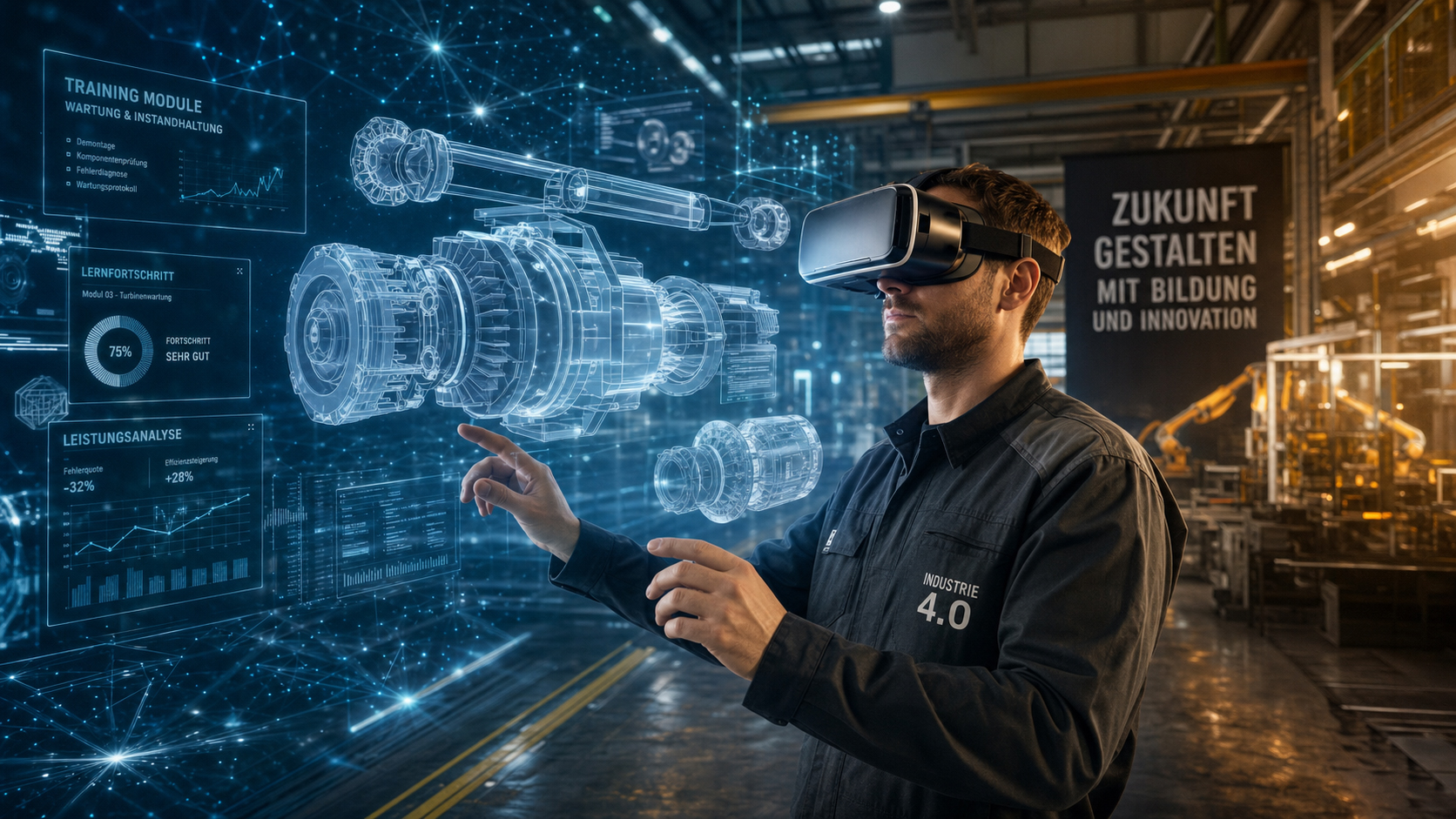
From hype to hard currency: Virtual Reality as a strategic learning lever in the corporate landscape – Image: Xpert.Digital
Siemens, Deutsche Bahn & Bosch are leading the way: How Virtual Reality is revolutionizing the world of work
Once declared dead, but now standard: Why corporations are secretly investing in VR glasses
Learn 4x faster: The astonishing figures behind the VR boom in companies
Virtual reality was long considered a failed hype in the tech world – but while the consumer market stagnated, the technology has evolved far from the headlines into the ultimate secret weapon of the corporate world. Whether at Siemens, Bosch, or Deutsche Bahn: VR is no longer an expensive toy, but a highly profitable tool for corporate training. Studies clearly show that those who learn with VR glasses grasp content four times faster, retain it significantly longer, and apply it much more confidently in their daily work.
But why does virtual reality so successfully trick our brains? When does the investment truly pay off for companies? And what role does artificial intelligence play in the next major evolutionary step? This article examines the rapid rise of immersive learning, presents fascinating practical examples from German industry, and explains why executives must now put this topic on their strategic agenda to avoid falling behind in the competition for talent, security, and efficiency.
Too expensive? Not at all: Why VR training becomes a real cost-saving trick for companies with 375 or more employees
Brain research proves: This is why employees learn dramatically better with VR glasses
Rarely has a technology experienced such a meteoric rise and such a painful fall as virtual reality. In the early 2010s, the industry dominated headlines with visions of a completely digitized world of experience. Glasses that promised to transport people from their physical surroundings to any virtual space were touted as the next revolution after the smartphone. Investors poured billions into startups, corporations announced revolutionary products, and Gartner's famous Hype Cycle temporarily placed VR at the peak of inflated expectations. Then came what always follows: disillusionment.
But anyone who dismisses VR as a failed technology today is looking at the wrong scene. While the consumer market stagnated for a long time and the vision of a mass-market VR headset for home use progressed only sluggishly, a quiet revolution was taking place in the corporate world, away from the headlines. Virtual reality has embarked on the path from toy to productivity tool—and this journey is irreversible. What was once the domain of expensive pilot projects and well-intentioned innovation labs is now used as a standard tool in training centers, factory floors, and onboarding processes at major German corporations. The crucial question is no longer whether the technology works, but why it took so long to acknowledge the obvious: VR is primarily a learning tool—and as such, it surpasses almost everything that has come before.
What the numbers really mean
Statistics in education are often overused to justify enthusiasm for technology. However, the findings on the effectiveness of VR training are unusually consistent and robust—and they come from diverse research areas and business contexts. A foundational study by PwC, published in 2020 and now among the most cited works in organizational learning research, examined how employees complete soft skills training in three different learning formats: the traditional classroom, e-learning, and virtual reality. The results are clear: VR participants completed their training four times faster than their counterparts in face-to-face classes. They were four times more focused than e-learning participants and 1.5 times more focused than classroom participants. And they demonstrated 275 percent more confidence in applying what they learned in their daily work.
This combination of speed, focus, and transferability is remarkable—because it addresses precisely the three critical points where traditional corporate learning most often fails. Continuing education in a corporate context is traditionally expensive, time-consuming, and difficult to measure in its effectiveness. Knowledge imparted in a seminar room is often no longer accessible after just a few days. Ebbinghaus's forgetting curve shows that after 24 hours, a person can only retain about 34 percent of passively absorbed learning material. After six days, this figure drops to a mere 23 percent. VR training counters this biological mechanism with something that traditional formats cannot offer: experiential, physically grounded learning.
More recent data from a 2026 PwC study examining the use of immersive technologies in HR management further reinforces this picture. In VR-based onboarding, participant motivation increased by 49 percent compared to traditional e-learning. The so-called flow state—an indicator of particularly deep, productive learning concentration—was 53 percent higher than in traditional formats. These are not marginal differences. These are structurally different learning outcomes.
Neurobiological foundations: Why the brain takes VR seriously
To understand why VR is so effective as a learning tool, we need to take a brief look at brain research. The human brain doesn't process information like a file folder that's filled and then opened again. Knowledge is primarily stored permanently when it's linked to emotional engagement, sensory diversity, and spatial orientation. Virtual reality activates precisely these three dimensions simultaneously.
When a person wears a VR headset, their visual cortex processes the virtual images almost identically to real-world impressions. The hippocampus—the center for spatial memory and long-term storage—maps the virtual environment and creates real memories there, as if the learner had actually experienced the event. The brain doesn't distinguish between the real and the convincingly simulated: it reacts with the same neurological processes, building the same synaptic connections. This is the neurobiological core of the learning effect: VR experiences are not stored as information, but as experiences—and experiences are not forgotten as quickly as facts.
In addition, there is the complete absence of distractions. Unlike e-learning formats, where employees check emails or attend meetings on the side, the VR headset forces complete cognitive presence. There is no multitasking, no divided focus of attention. This immersion enforced by the medium is not a side effect, but a key learning enhancer. VR training achieves knowledge retention of up to 80 percent after one year, while traditional training formats often leave only 20 percent after one week.
Siemens: Safety culture through tangible danger
No area of corporate training is more sensitive and simultaneously more difficult to teach than occupational safety. EHS training—Environment, Health, Safety—must convey scenarios that occur only rarely in real-world work situations, and when they do, often under fatal conditions: fires, machine malfunctions, hazardous materials, emergency procedures. Traditional training formats reach a fundamental limit here. You simply can't train for a hazardous situation entirely on a flip chart.
Siemens, Europe's largest industrial group with more than 385,000 employees worldwide, has overcome this barrier by consistently integrating virtual reality into its EHS programs. In collaboration with VR specialist VRdirect, Siemens has developed a virtual tour of an industrial plant, allowing employees to navigate simulated work environments and act in realistic emergency scenarios. The effect is measurable: VR training at Siemens achieves time savings of 40 to 60 percent compared to conventional training formats. At the same time, it not only improves factual knowledge of safety regulations but also actual safety behavior—because employees have virtually experienced the consequences of incorrect decisions and internalized them emotionally.
This is the crucial difference between knowledge and skill. An employee who has consumed a safety briefing as a presentation knows the rules. An employee who has experienced a fire safety procedure in VR has experienced it—and their brain has stored this as a relevant memory. The company benefits not only from more competent employees, but also from fewer accidents, lower insurance costs, and a stronger safety culture that goes beyond formal compliance.
Deutsche Bahn: When trains cannot be blocked for training
Deutsche Bahn's EVE project is one of the most insightful examples of the pragmatic and economic benefits of VR training beyond mere efficiency gains. When Deutsche Bahn introduced the ICE 4, the company faced a classic resource conflict: new trains need to be trained before employees can operate them. But new trains aren't sitting in storage—they're carrying passengers. Taking trains out of service for training means lost revenue, logistical complications, and, with an order of 119 vehicles, a challenge of considerable magnitude.
EVE — Engaging Virtual Education — resolved this conflict by creating a complete virtual training environment for the ICE 4 train. Employees can practice operating the lift for passengers with reduced mobility, with its 28 steps, in a precise sequence within virtual reality, without blocking a single real train. A trainer provides support via a tablet app, can intervene, and offer situation-specific feedback. Since April 2018, this system has been in use nationwide at all nine long-distance training centers; by the end of 2018, over 1,000 employees had already completed the training, with the goal of reaching all 4,000 train attendants by 2020.
What happened here is economically significant: A company has eliminated the classic trade-off between training quality and operational capacity. VR makes it possible to intensively train safety-critical, highly complex tasks without consuming the resources needed for day-to-day operations. For industries with capital-intensive infrastructure—railways, aviation, energy, chemicals—this is a transformative advantage.
Bosch: When the vehicle doesn't need to be on site
The third prominent German example illustrates another dimension of the economic benefits: the decoupling of physical presence and high-quality training. Bosch has been relying on AR and VR technologies for years in the area of technical employee training, initially with augmented reality for workshop training. In a field study, Bosch tested AR support for workshop mechatronics technicians and measured a time saving of 15 percent, even with common vehicles and less complex repairs. The company expects the savings to be significantly higher for more complex vehicle technology.
The economic core of this development lies in scalability. A physical vehicle can only be accessible to a limited group of learners at a given location at any one time. A virtual vehicle representation, on the other hand, can theoretically be used by any number of participants simultaneously. Bosch is consistently developing its training platform: The updated AR platform CAP enables content to be published regardless of the device – on smartphones, tablets, or special glasses. In so-called trainer mode, the instructor can control the devices of all participants and guide them through the same scenario, while each participant retains their individual perspective. This is no longer training; it's distributed, immersive learning with centralized control.
🗒️ Xpert.Digital: A pioneer in the field of Extended and Augmented Reality

Finding the right Metaverse agency, planning office, or consulting firm - Image: Xpert.Digital
🗒️ Finding the right Metaverse agency, planning office, or consulting firm – Search and search: Top Ten Tips for Consulting & Planning
More information here:
From workshop training to a global learning platform: AR as a game changer
The economics of immersion: Scaling as a crucial variable
A common objection to VR in a business context is the supposedly high initial investment. Development costs for a professional VR application in Germany, depending on the scope, can quickly reach five- to six-figure euro amounts. Compared to a short in-person seminar, this seems high. However, when compared to the long-term benefits, a different picture emerges.
The PwC study precisely quantified the cost parity of VR training: From 375 learners, VR training reaches cost parity with traditional classroom instruction; from 1,950 learners, it is as cost-effective as e-learning; from 3,000 learners, it costs 52 percent less than classroom training. This is the scaling principle of digital learning: Marginal costs approach zero once a VR application is developed. It can be repeated as often as needed without additional material costs, digitally updated, and used regardless of location. Travel expenses are eliminated, production downtimes are reduced, and trainers can focus their time on the most valuable interaction points.
In addition, there are the indirect costs, which appear less frequently in ROI calculations but are economically significant: accident costs, quality defects due to poorly trained personnel, and employee turnover due to poor onboarding experiences. Tyson Foods, for example, was able to reduce injuries and illnesses by more than 20 percent through VR-supported safety training. H&R Block recorded a 50 percent reduction in dissatisfied customers and a 9.9 percent reduction in processing times after the introduction of VR training. Boeing estimated a 90 percent improvement in initial quality through XR training. These figures speak for themselves.
Market dynamics: An industry undergoing structural change
The global VR training market isn't growing—it's exploding. The VR segment of the immersive training market generated $7.5 billion in revenue in 2024 and is projected to reach $31.7 billion by 2030—an annual growth rate of 28.1 percent. The AR and VR training market as a whole is expected to grow from $16.75 billion in 2024 to $658 billion by 2035. This may sound like an audacious forecast, but the drivers are structural, not speculative.
First, the world of work is changing at a pace that traditional training cycles can no longer keep up with. The World Economic Forum, in its Future of Jobs Report 2025, highlighted the dramatic transformation of job profiles—millions of jobs disappearing, and just as many new roles emerging for which there are no established training formats. Companies need learning formats that are fast, scalable, and demonstrably effective. VR fulfills all three criteria.
Secondly, remote and hybrid work have expanded the geographical reach of companies. Employees spread across multiple countries cannot all be brought together for the same in-person seminar. VR enables location-independent learning with a high degree of immersion—an advantage that is gaining increasing strategic relevance in a globalized workforce.
Thirdly, hardware is becoming cheaper and more accessible. MetaQuest headsets now cost a fraction of what developer devices cost ten years ago. Standalone headsets without PC tethering allow for flexible use even without on-site IT infrastructure. Entry barriers are falling, while device performance is increasing.
The Convergence of AI and VR: The Next Chapter
Those who view VR training for corporate learning merely as a technologically advanced form of simulation are only seeing half the story. The real disruption is occurring at the intersection of virtual reality and artificial intelligence—and it has only just begun.
Generative AI opens up the possibility of designing dynamic and personalized VR training content. Instead of a fixed scenario, an AI-driven system can react to the learner's behavior in real time, adjust the difficulty level, analyze errors, and calculate individual learning paths. Research from 2025 shows that AI systems can now handle up to 90 percent of daily coaching tasks. What was previously individual feedback only for executives with expensive executive coaching is now scalable for all levels of an organization thanks to AI-supported VR.
In 2025, researchers at the University of Cambridge released a free, AI-powered VR platform that enables training in front of virtual, interactive audiences that react in real time—a quantum leap for developing presentation and leadership skills. For 2026 and beyond, experts predict an even closer fusion of AI and simulation technologies: AI assistants that provide support not only after, but also during, a virtual training session through discrete visual cues in the augmented reality view. The learning environment thus becomes a permanently adaptive system that adjusts to the learner in real time.
The strategic blind spot: What companies risk when they wait
The question of whether virtual reality creates measurable added value in corporate learning has been empirically answered. The open question is a strategic one: What risks do companies risk if they wait?
The risk is multifaceted. At the competency level, slow, inefficient learning translates into competitive disadvantages in an economy where the half-life of expertise is constantly shrinking. A company that offers its employees learning formats that are significantly slower and less sustainable than those of its competitors will structurally have a less qualified workforce—regardless of how talented the staff is. At the safety level, suboptimal training in high-risk environments means an increased potential for accidents, generating both direct costs and regulatory and reputational risks.
Finally, on the level of employer attractiveness, VR impacts a dimension often neglected in discussions about corporate training: employer branding. A 2026 PwC study shows that VR-based employer presentations increase a company's perceived innovative strength by 35 percent. In a labor market where qualified professionals have a choice, the signaling effect of modern learning methods is significant. Companies that offer advanced learning infrastructures attract employees who value development and innovation—and these are usually precisely the employees companies want to attract.
Immersive learning as a management task
Implementing VR training is not simply an IT procurement decision. It's a strategic decision that touches upon the interplay of learning design, technology infrastructure, organizational culture, and leadership style. The technical hurdle is now manageable—the conceptual challenge remains.
Those who view VR merely as a digital version of existing training formats will not recoup their investment. The added value arises where the new medium can demonstrate its specific strengths: in complex, high-risk, or resource-intensive training scenarios that are difficult or even impossible to replicate physically. High-voltage technology in the automotive sector, emergency management in chemical or pharmaceutical companies, safety-critical processes in infrastructure, intercultural leadership skills in global teams—these are the use cases for which VR is not only better, but structurally superior.
The question leaders should therefore ask themselves is not: Can we afford VR? But rather: Can we afford to continue foregoing experiential learning?
A change of perspective: From technology adoption to learning strategy
VR is not the goal. The goal is an organization where people learn faster, transfer knowledge more effectively, and act more confidently in critical situations. VR is—and the data shows this with impressive consistency—the most powerful tool to date for achieving this goal. The technology is mature. The evidence is overwhelming. The use cases in Germany—from Siemens and Deutsche Bahn to Bosch—are not pilot project idealism, but rather established business practice.
A shift in perception is underway: VR is moving from a nice-to-have to a strategic learning tool. Those who recognize and shape this shift early on build a competitive advantage that is difficult to catch up with. Because ultimately, learning is not a cost factor—it is the foundation for everything else a company strives for.
Your global marketing and business development partner
☑️ Our business language is English or German
☑️ NEW: Correspondence in your native language!

Konrad Wolfenstein
I and my team are happy to be available to you as your personal advisor.
You can contact me by filling out the contact form here simply call me at +49 7348 4088 965. My email address is [email protected]:or
I'm looking forward to our joint project.









