
“The bookshelf for containers”: How the container high-bay warehouse as a vertical storage solution is revolutionizing global port logistics
Xpert Pre-Release

Available in 27 languages 📢
Prefer Xpert.Digital on GoogleⓘPublished on: March 2, 2026 / Updated on: March 2, 2026 – Author: Konrad Wolfenstein
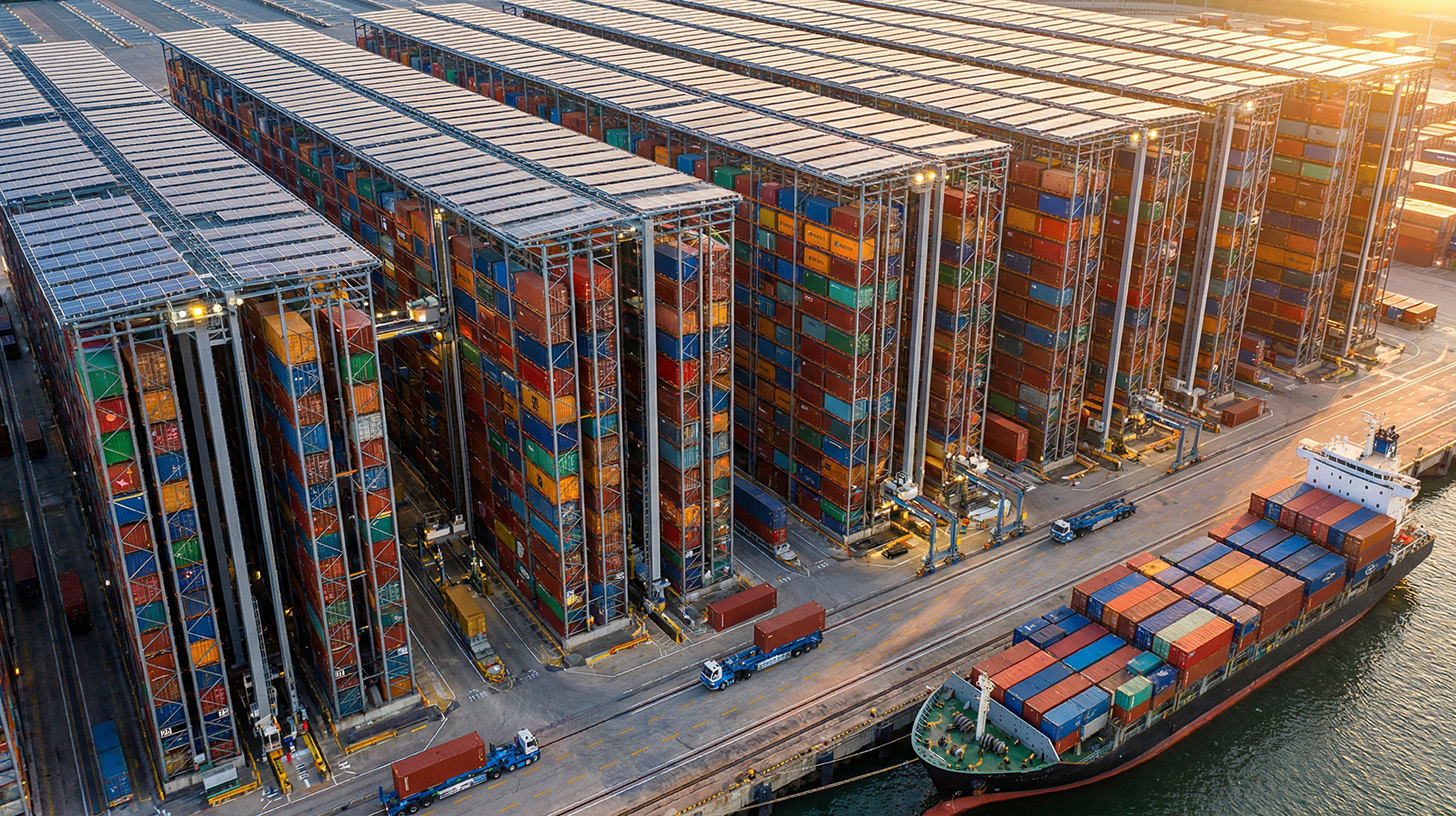
“The bookshelf for containers”: How the container high-bay warehouse as a vertical storage solution is revolutionizing global port logistics – Creative image: Xpert.Digital
The first major update in 65 years: This technology is turning the global supply chain upside down
Why the world's biggest waste is finally coming to an end and who benefits from it
End the container chaos: The end of the stack economy – How vertical container hubs are bringing port logistics out of the past
Since the American freight forwarder Malcolm McLean had the first standardized shipping container loaded onto a ship in 1956, the basic principle of port logistics has changed remarkably little. To this day, the multi-ton steel boxes are stacked on top of each other in enormous towers. What worked in times of low trade volume has now become an unprecedented inefficiency: Up to 60 percent of all crane movements at traditional terminals are purely unproductive restacking (so-called "reshuffling"), simply to access containers at lower levels. Given that over 160 million containers are handled worldwide each year and increasingly stringent climate regulations, this system has inevitably reached its limits.
But now the logistics industry is facing the biggest paradigm shift in over 65 years. The solution is called high-bay storage (HBS) and operates on a surprisingly simple concept: the principle of a bookshelf. Instead of stacking containers haphazardly on top of each other, each container has a fixed place in a fully automated steel structure up to 50 meters high. The advantages are immense: The system allows immediate, 100% direct access to every container, multiplies storage capacity on the same footprint, and completely eliminates unproductive movements.
In addition, the technology is developing into a powerful lever for greater sustainability. With fully electric drives, integrated photovoltaic systems on the vast roof surfaces, and the massive reduction of diesel truck journeys at the terminal, the climate-neutral port of the future is suddenly becoming a tangible reality. Learn how leading technology companies are already dominating this multi-billion-dollar market and why vertical stacking will forever change the entire value chain – from cargo ship to factory floor.
Related to this:
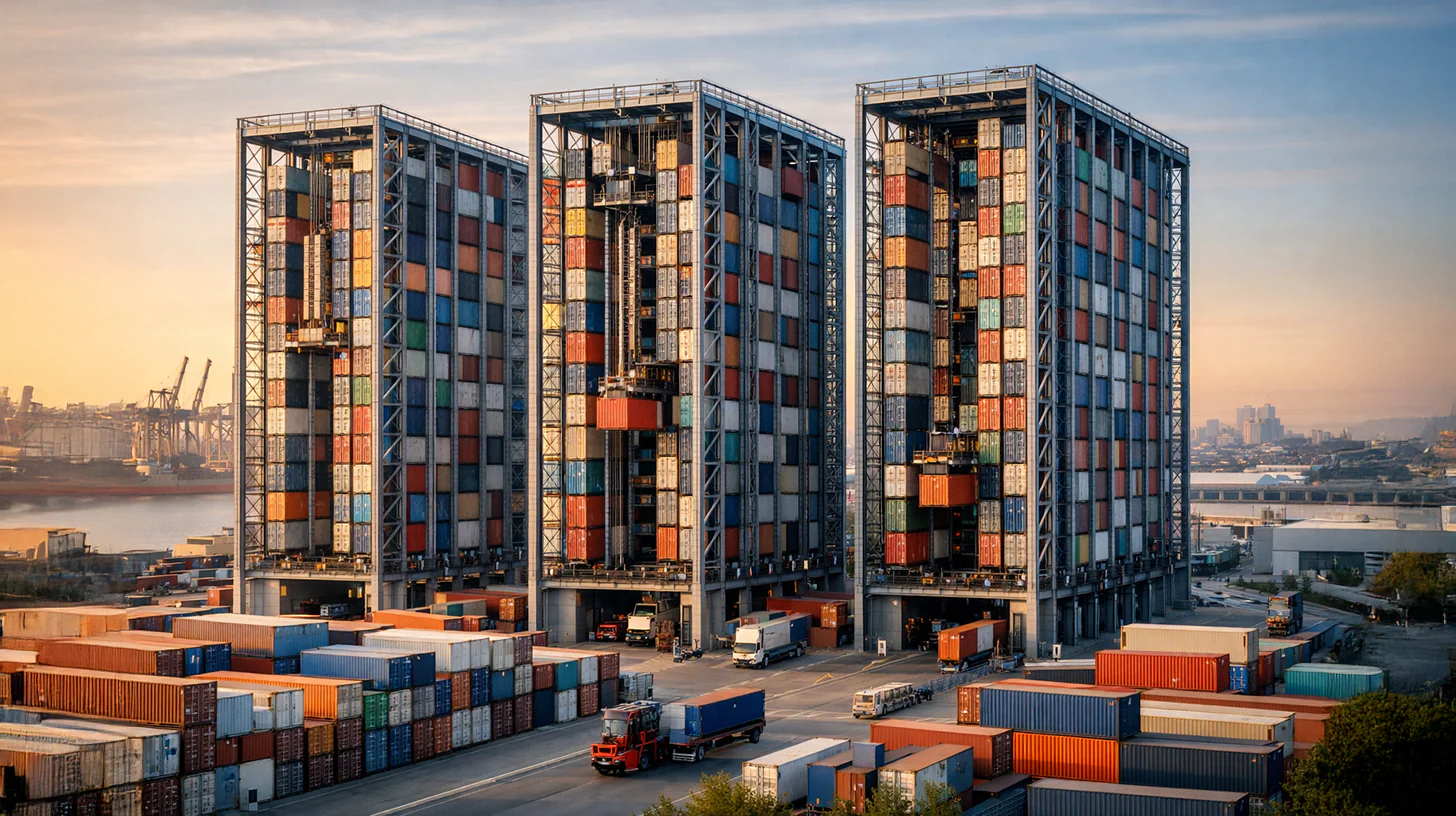
A paradigm shift in container logistics
Global container logistics is facing a fundamental transformation. Since Malcolm McLean had the first standardized shipping container loaded onto a ship in 1956, the basic method of container storage in ports has changed remarkably little. Containers are stacked, blocked, rearranged, and restacked again. This practice is as inefficient as it is ubiquitous. Now, with the container high-bay warehouse, internationally known as high-bay storage or HBS, a technological leap is emerging, representing the first fundamental advancement in container handling in over 65 years.
The principle is surprisingly simple: Instead of stacking containers on top of each other as has always been done, they are stored in fully automated racking systems, similar to books in a library. Each container has a fixed, individual storage space in a steel rack up to 50 meters high and can be accessed directly at any time without having to move other containers.
The problem of unproductive movements
To grasp the significance of this innovation, one must understand the fundamental problem of conventional container storage. In traditional container yards, containers are stacked in blocks up to five or six layers high. If a specific container is needed that is not in the top position, all the containers above it must first be removed by crane and temporarily stored. This process, known as reshuffling, is pure waste. Studies show that up to 60 percent of all crane movements in a traditional yard are unproductive restacking operations.
This inefficiency worsens exponentially with increasing capacity utilization. Once a storage block is more than 70 to 80 percent full, performance collapses as more and more unproductive movements become necessary. For the port industry, which is under pressure from growing container volumes—global container throughput reached around 161 million TEU in 2024, an increase of 6.2 percent compared to the previous year—this is an untenable situation.
LTW Intralogistics Solutions

LTW Intralogistics – Engineers of Flow - Image: LTW Intralogistics GmbH
LTW offers its customers not individual components, but integrated complete solutions. Consulting, planning, mechanical and electrotechnical components, control and automation technology, as well as software and service – everything is networked and precisely coordinated.
In-house production of key components is particularly advantageous. This allows for optimal control of quality, supply chains, and interfaces.
LTW stands for reliability, transparency, and collaborative partnership. Loyalty and honesty are firmly anchored in the company's philosophy – a handshake still means something here.
Related to this:
No more container Tetris: This German technology is revolutionizing the world's ports
The technology in detail
Container high-bay warehouses radically solve the reshuffling problem. The system stores standard shipping containers in highly compact, vertical steel racking structures. Fully automated storage and retrieval machines, known as stacker cranes, transport the containers in and out of their storage locations. This allows 100% direct access to each individual container without the need to move other containers.
The space efficiency is impressive. While traditional systems can usually only stack three to four containers on top of each other, HBS systems reach heights of seven to eighteen layers. The BOXBAY system in Dubai, for example, stores containers on up to eleven levels with a total height of 50 meters. This at least triples the storage capacity on the same footprint.
Related to this:

The market leaders and their strategies
The joint venture BOXBAY, founded in 2019 by DP World, one of the world's largest port operators headquartered in Dubai, and the German SMS Group, a leading global technology group in plant and mechanical engineering, is considered a market leader. The pilot plant in the Port of Jebel Ali in Dubai was commissioned in 2021 and, after more than 200,000 container movements, has not only met but exceeded expectations. The commercial breakthrough came in 2023 with the contract to build a plant in the South Korean port of Busan, which will eliminate 350,000 unproductive movements per year and improve truck handling times by 20 percent.
The Finnish consortium of Konecranes and automation specialist Pesmel entered the market in 2022, offering a system with a stacking capacity of up to 14 layers. Its unique selling point is the seamless integration with distribution centers, where the container storage system is directly connected to the loading docks of a warehouse. The Chinese port crane giant ZPMC is building a facility in the port of Ningbo-Zhoushan with a capacity of 25,000 TEU, capable of stacking containers up to 18 layers high.
Related to this:

Sustainability as a driver
The ecological dimension of the technology is a key driver of market penetration. Container high-bay warehouses are fully electrically powered and can be supplied with renewable energy. The vast roof areas of the facilities are ideally suited for photovoltaic installations, enabling CO2-neutral or even energy-positive operation. The elimination of unproductive reshuffling movements dramatically reduces energy consumption, the enclosed design significantly lowers noise emissions, and the weather resistance allows for continuous operation even in storms, rain, and snow.
Ports worldwide are under immense pressure to reduce their CO2 emissions. They are hotspots for diesel consumption by trucks, cranes, and other vehicles. HBS systems are a key component of the green port of the future and thus address regulatory requirements that are becoming increasingly stringent in Europe, Asia, and North America.
Integration into the entire supply chain
The next evolutionary step for this technology is direct integration into the value chain. Instead of operating the HBS as an isolated port storage facility, it will be physically attached to warehouses or production lines. The container will be transported fully automatically from the rack to a specific loading dock or conveyor interface. Intermediate transport by truck from the yard to the warehouse will be completely eliminated.
These so-called goods-to-warehouse scenarios transform the HBS from a mere warehouse into an active buffer and sorting center deeply integrated into the value creation processes. The entire chain, from ship to production line, becomes a single, automated, and data-driven process.
Market forecasts and economic outlook
Market trends point to rapid expansion. DP World has announced that feasibility studies are underway for over 20 port locations worldwide. Konecranes forecasts an annual market volume of over one billion US dollars from 2028 onwards. Konecranes-AMOVA's SideGrid retrofit approach, which modernizes existing container yards incrementally rather than building them from scratch, significantly lowers the barrier to entry for port operators and accelerates the transformation.
By 2026, the logistics industry as a whole will be moving towards a smarter, more connected, and automated infrastructure across the entire supply chain. Multidirectional shuttle vehicles will become increasingly important in the development of more flexible and scalable automated warehouses. At the same time, geopolitical instability, extended shipping routes around the Cape of Good Hope instead of through the Suez Canal, and the diversification of manufacturing locations will drive demand for more efficient port infrastructure.
Consulting - Planning - Implementation

Konrad Wolfenstein
I would be happy to serve as your personal advisor.
contact me at wolfenstein ∂ xpert.digital
Just call me on +49 7348 4088 965 (Munich) .
Your container high-bay warehouse and container terminal experts

Container high-bay warehouses and container terminals: The logistical interplay – expert advice and solutions - Creative image: Xpert.Digital
This innovative technology promises to fundamentally change container logistics. Instead of stacking containers horizontally as before, they will be stored vertically in multi-story steel racking structures. This not only allows for a drastic increase in storage capacity within the same area, but also revolutionizes all processes at the container terminal.
More information here:










