
Triple the capacity in the same space: Container high-bay storage technology as a lifeline
Xpert Pre-Release

Available in 27 languages 📢
Prefer Xpert.Digital on GoogleⓘPublished on: January 31, 2026 / Updated on: January 31, 2026 – Author: Konrad Wolfenstein
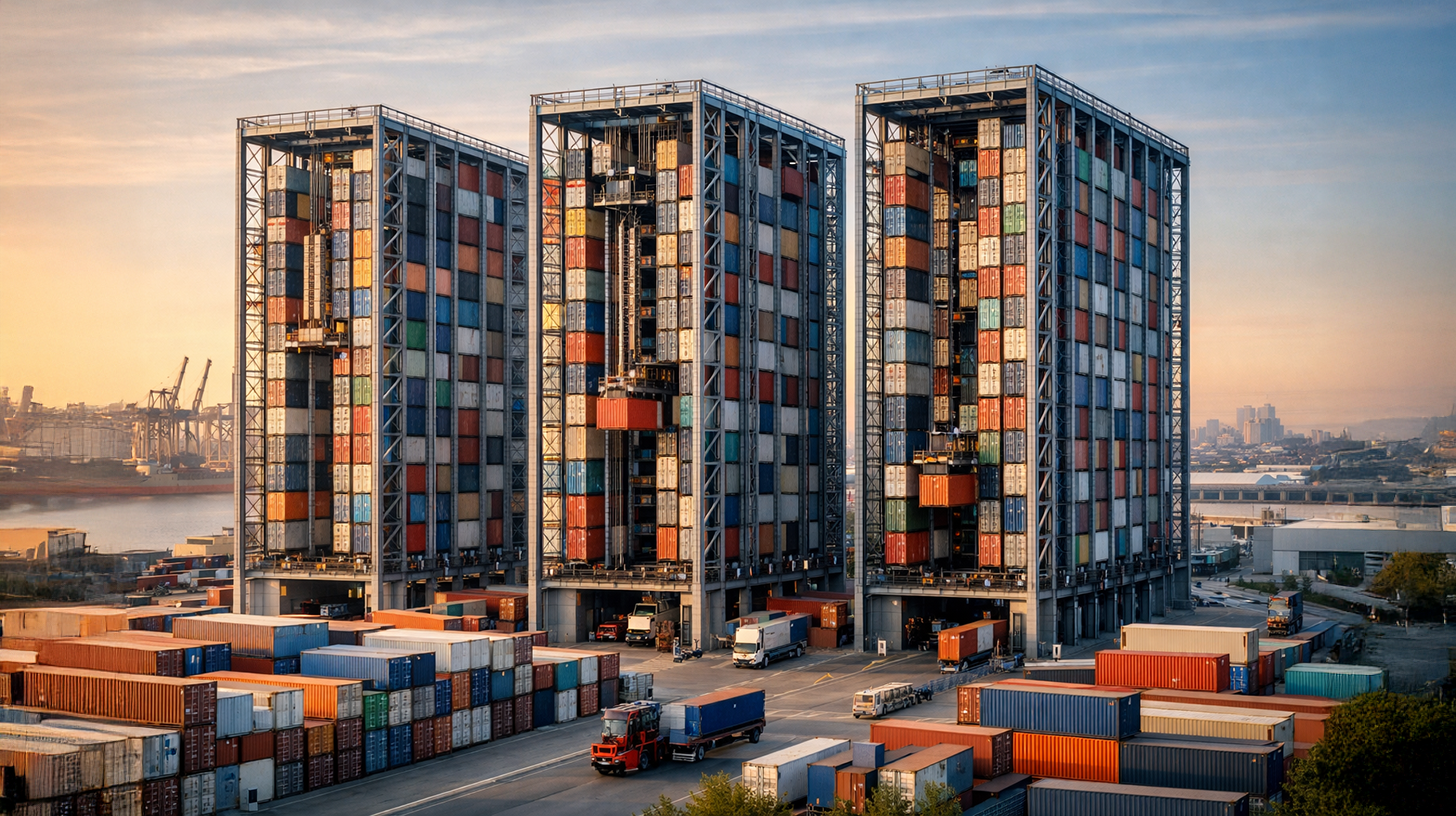
Triple the capacity in the same space: Container high-bay storage technology as a lifeline – Creative image: Xpert.Digital
No more restacking: This fully automated technology saves millions in container logistics operations
What is container high-bay storage technology and how does it work?
High-bay storage technology, also known as container high-bay storage systems, is revolutionizing container storage in ports and logistics centers through vertical stacking in automated steel racking systems. Unlike conventional container terminals, where containers are stacked directly on top of each other, this technology places each container in an individual racking compartment up to a height of 11 levels or more. The flagship of this innovation is BOXBAY, a joint venture between the global port operator DP World and the German industrial group SMS Group.
The system operates using fully automated, electrically powered cranes that move containers precisely between storage areas and transfer points within the steel structure. Each container remains directly accessible at all times without the need to move other containers – a fundamental difference from traditional systems. The entire facility can be equipped with solar panels on the roof and operates entirely electrically with energy recovery systems.
What capacity increases are realistically achievable?
The documented performance data is impressive: Container high-bay storage systems achieve three times the storage capacity on the same footprint compared to conventional systems. Put another way, this means a reduction in floor space of up to 70 percent for the same number of containers. These figures are not theoretical, but have been confirmed in real-world operating environments.
The pilot facility at Jebel Ali Port in Dubai, with 792 container positions, has completed over 63,000 container movements since its commissioning in 2021, exceeding initial expectations. Measured performance reached 19.3 movements per hour on the waterside transfer table and 31.8 movements per hour on the landside truck cranes. The first large-scale commercial installation at London Gateway will have a capacity of 27,000 TEU across 16 stapper levels and will be able to handle over 200 container movements per hour on the waterside.
For investors, this means specifically: One hectare of land that can accommodate 10,000 TEU with conventional technology can reach up to 30,000 TEU with high-bay storage technology. With port land prices between €2,000 and €3,000 per square meter, a land saving of three hectares corresponds to a value of €60 to €90 million.
Why is this technology becoming a decisive competitive advantage right now?
Several market trends are converging, making high-bay container storage systems a necessity rather than an option. First, global container trading capacity will increase by 64 million TEU in 2025 – the largest annual increase since the financial crisis. Container volume grew by 4.4 percent to 126.75 million TEU from January to August 2025 alone. These volumes are impacting urban ports that can no longer physically expand.
Scientific studies prove that containerization is extremely land-intensive, with container terminals requiring four to five times more space per unit of cargo handled than before the container era. Ports in metropolitan areas like Hamburg, Rotterdam, or Singapore are reaching their absolute spatial limits. Land reclamation projects, which previously served as a solution, now cost between 1.5 and 2 billion US dollars per project and take years to complete.
Secondly, ultra-large container ships exacerbate the problem. These mega-freighters, with a capacity of over 20,000 TEU, require 16-meter-deep shipping channels, specialized cranes with a reach of 22 to 24 rows, and massive terminal areas. When a single ULCS docks and unloads thousands of containers, it creates capacity peaks that overwhelm traditional yards and lead to port congestion that spreads globally.
Thirdly, inefficient restacking in conventional terminals accounts for between 20 and 60 percent of all container movements. These unproductive movements cost time and energy and significantly reduce throughput capacity. High-bay container storage systems eliminate this problem entirely through single-location storage with direct access.
What economic arguments support investors?
Return-on-investment calculations for port automation typically show amortization periods of three to five years. This timeframe is driven by several factors: First, operating costs can be reduced by 25 to 55 percent, primarily through lower energy consumption, reduced maintenance costs, and optimized personnel allocation. The Jebel Ali test facility achieved energy costs 29 percent below forecasts, while simultaneously achieving significantly reduced maintenance costs.
Secondly, high-bay storage systems avoid costly land expansion. In densely populated port cities, available land is scarce and expensive. Scientific studies show that only cities with ample land were able to significantly increase their shipping volume after containerization. Ports in cities with land scarcity either had to forgo growth or undertake extremely expensive recultivation projects. High-bay container storage solves this fundamental dilemma through densification instead of expansion.
Thirdly, service levels and competitiveness are improved. The implementation in Busan, South Korea, is expected to eliminate 350,000 unproductive container movements per year and improve truck handling time by 20 percent. For port operators, this translates to more satisfied customers, higher throughput rates, and the ability to handle larger vessels efficiently.
The London Gateway installation, representing a £170 million investment, demonstrates the confidence established port operators have in this technology. The project comprises a 10-aisle system with 15 storage and retrieval machines and is specifically designed for the efficient handling of empty containers – a chronic problem that incurs significant costs.
What sustainability benefits does the technology offer?
Environmental factors are increasingly becoming regulatory requirements and competitive advantages. Container high-bay warehouse systems offer multifaceted benefits in this regard. Full electrification eliminates local CO2 emissions, while energy recovery systems feed electricity back into the system when containers are braked and lowered. The integration of solar panels on the large roof areas theoretically enables energy-autonomous systems.
Studies on automated port solutions show that solar integration typically pays for itself in less than five years, with lifetime energy cost savings of up to US$74 million. The Port of Valencia has already achieved an 18 percent solar energy share, generating more energy than the port consumes during peak times.
The compact design significantly reduces noise and light pollution, which is particularly relevant for urban ports with adjacent residential areas. The enclosed, clad structure even allows for aesthetically pleasing designs with green facades, increasing public acceptance in urban environments.
Last but not least, the drastic reduction in land area lessens the pressure on urban development and prevents environmentally damaging land reclamation projects that harm coastal ecosystems. For investors who must consider ESG criteria, these factors offer measurable sustainability metrics.
LTW Solutions

LTW Intralogistics – Engineers of Flow - Image: LTW Intralogistics GmbH
LTW offers its customers not individual components, but integrated complete solutions. Consulting, planning, mechanical and electrotechnical components, control and automation technology, as well as software and service – everything is networked and precisely coordinated.
In-house production of key components is particularly advantageous. This allows for optimal control of quality, supply chains, and interfaces.
LTW stands for reliability, transparency, and collaborative partnership. Loyalty and honesty are firmly anchored in the company's philosophy – a handshake still means something here.
Suitable for:
When ports grow vertically: The smart solution to acute land shortages
How does the technology perform in practice?
The technology's maturity is demonstrated through multiple operational implementations. The proof-of-concept at Jebel Ali Port ran from 2021 and was officially declared market-ready in September 2022 after handling nearly 500,000 TEU. The test phase not only demonstrated technical reliability but also exceeded simulated performance values in critical parameters such as performance, reliability, and energy efficiency.
The commercial implementation at Busan Newport Corporation, a terminal 66 percent owned by DP World, marks the transition from the testing phase to regular operation. There, the system is being retrofitted onto an existing empty container storage area and combined with existing automated rail-mounted gantry cranes and truck operations.
The London Gateway installation, scheduled for completion approximately two years after the project's start in 2025, demonstrates the scalability of the technology. With a capacity of 27,000 TEU, it is significantly larger than the Dubai test facility and will be fully integrated into the highly automated Berth 4.
Alternative providers like Konecranes, with their Automated High-Bay Container Storage System, offer similar solutions with up to 14 levels for empty containers, highlighting the technology's broader market maturity. The modular design allows for gradual expansion without interrupting ongoing operations.
What challenges and risks exist?
Transparency regarding implementation risks is essential for informed investment decisions. The primary challenge is high initial investment. While specific project costs vary, the London Gateway installation, at £170 million for 27,000 TEU capacity, illustrates the scale. By comparison, conventional terminal expansions cost less per TEU but require available land.
Studies on port automation warn that not all automated terminals achieve the expected productivity. A McKinsey survey found that while operating costs are decreasing as expected, productivity in some fully automated terminals is falling by 7 to 15 percent instead of increasing. However, this mainly concerns fully automated quay cranes, not yard storage systems.
Integration into existing terminal operating systems and warehouse management systems requires careful planning. BOXBAY addresses this with its own warehouse management system, which can communicate with higher-level terminal operating systems. Nevertheless, system integration remains a critical success factor.
Technological dependence on specialized suppliers represents a strategic risk. The market for container high-bay storage systems is currently dominated by a few suppliers, which can influence negotiating positions and long-term maintenance costs. However, supplier diversification is clearly underway.
Labor market issues cannot be ignored. While automation reduces labor costs, it faces significant resistance from trade unions in Europe and North America. Implementation projects must include stakeholder management and change management strategies.
For which port locations is the technology particularly suitable?
The ideal use cases can be identified based on several criteria. First, ports in urban areas with acute land scarcity benefit the most. Hamburg, Antwerp, Singapore, or ports in Japan fall into this category, where land expansion is either physically impossible or prohibitively expensive.
Secondly, high-bay storage systems are ideal for terminals with a high volume of empty container handling. The London Gateway installation focuses explicitly on Empty Superstack functionality. Repositioning empty containers costs billions annually, and efficient storage near their points of origin significantly reduces unnecessary transport.
Thirdly, terminals with ULCS service are ideally suited. The ability to absorb massive volume peaks upon the arrival of 20,000+ TEU vessels becomes a competitive advantage. High-bay storage systems, with their high throughput and storage density, can handle these peaks better than horizontal systems.
Fourth, brownfield sites in need of modernization are suitable. Retrofit capability allows for capacity increases without physical expansion. For established ports that need to secure their competitiveness, this offers an evolutionary rather than revolutionary path.
Geographically, early adoption is concentrated in Asia-Pacific and Europe. North America is showing growing interest, although investment decisions are often more complex due to labor regulations. The global market for automated container terminals is projected to grow at a rate of 7 percent annually until 2035.
What does this mean for strategic investment decisions?
Container high-bay storage technology represents a paradigm shift in port logistics, driven by converging megatrends: space scarcity, volume growth, ULCS proliferation, and sustainability requirements. Three strategic implications are key for investors and port operators.
First, vertical densification is becoming a basic requirement for competitive terminals in space-constrained markets. The alternative – expensive land expansion or capacity limitations – is economically and strategically disadvantageous. Early adopters secure competitive advantages through higher throughput capacity and service levels.
Secondly, the high initial investments are justified by combined savings in operating costs, avoided land costs, and improved revenue quality. The documented amortization periods of three to five years are within an acceptable range for infrastructure investments. Projects that can monetize land savings are particularly attractive.
Third, successful implementation requires integrated project management that addresses technical, operational, and social dimensions. The technology is proven, but project success depends on careful planning, stakeholder engagement, and realistic expectations.
Container high-bay warehouse technology is no longer a futuristic concept, but an operational reality with a growing installed base and proven performance. For port logistics hubs worldwide, the question is no longer whether, but when and how this innovation will be implemented.
Advice - planning - implementation

Konrad Wolfenstein
I would be happy to serve as your personal advisor.
contact me at wolfenstein ∂ xpert.digital
Just call me on +49 7348 4088 965 (Munich) .
Your container high-bay warehouse and container terminal experts

Container high-bay warehouses and container terminals: The logistical interplay – expert advice and solutions - Creative image: Xpert.Digital
This innovative technology promises to fundamentally change container logistics. Instead of stacking containers horizontally as before, they will be stored vertically in multi-story steel racking structures. This not only allows for a drastic increase in storage capacity within the same area, but also revolutionizes all processes at the container terminal.
More about it here:










