
Ellwangen | Varta insolvency and the future of its 4,000 employees: What happens next?
Xpert Pre-Release

Available in 27 languages 📢
Prefer Xpert.Digital on GoogleⓘPublished on: July 25, 2026 / Updated on: July 25, 2026 – Author: Konrad Wolfenstein
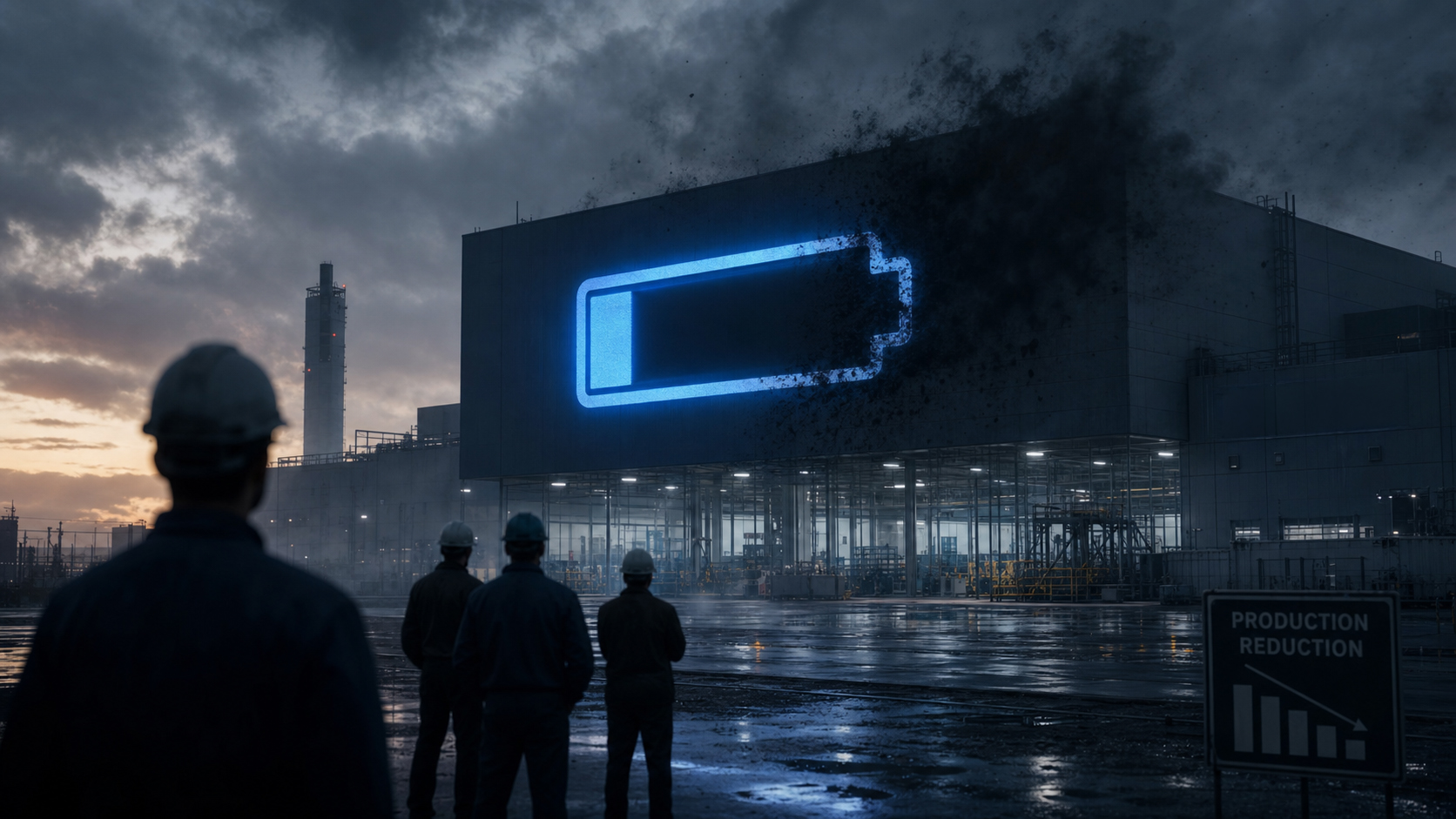
Varta insolvency and the future of its 4,000 employees: What happens next – Image: Xpert.Digital
Apple pulls out, investors pull the plug: This is why Varta is now being broken up
Insolvency in four parts: What happens next with battery giant Varta
Despite a 100 million injection of funds: The dramatic fall of the Swabian battery myth
The Swabian battery manufacturer Varta is facing the wreckage of its recent restructuring efforts. Just a year and a half after a drastic debt reduction and a €100 million cash injection, the long-established company had to file for insolvency again on Friday at the Stuttgart District Court – this time in the form of four separate applications for the parent company and three operating subsidiaries. While the lucrative household battery business is to be kept out of the insolvency proceedings and apparently spun off by the creditors, around 4,000 employees face an uncertain future. The loss of major customers like Apple and the hesitancy of existing investors reveal deep structural problems. The Varta case is thus becoming a dramatic symbol of the crisis in the European battery industry and demonstrates that purely financial rescue measures without a functioning operational business model are often insufficient.
When the Swabian myth crumbles
Battery manufacturer Varta filed for insolvency under self-administration at the Stuttgart District Court on Friday. In addition to the parent company Varta AG, headquartered in Ellwangen, the proceedings also affect the operating subsidiaries Varta Microbattery GmbH, Varta Micro Production GmbH, and Varta Storage GmbH. This marks the beginning of a period of profound uncertainty for the company's approximately 4,000 employees, although management emphasizes that the move is not due to an acute insolvency in day-to-day operations, but rather aims to secure the company's long-term economic future.
The Swabian company with its long tradition is plunging into an existential crisis for the second time in two years – and this time it is not threatened with a gentle restart, but with being broken up
As recently as January 2025, Varta underwent a complex restructuring process under German insolvency law (StaRUG), during which its share capital was reduced to zero and minority shareholders were completely expropriated. The Stuttgart Regional Court upheld the legality of this radical measure after investor protection groups unsuccessfully challenged it. CEO Michael Ostermann described it as a necessary step to resolve over-indebtedness and liquidity problems and to lay the foundation for a fresh start. Fresh capital of €100 million was injected at the time by Austrian investor Michael Tojner, who was already the majority shareholder, sports car manufacturer Porsche, and participating banks. The fact that these same investors, who injected fresh capital just a year and a half ago, are now unwilling to provide further funding demonstrates the true depth of the company's operational problems and how little the previous financial restructuring addressed the structural weaknesses of its business model.
The loss of the anchor customer as the trigger
Varta cites significantly worsened market conditions, weaker demand, negative currency exchange effects, and the decision of a major anchor customer to terminate the partnership as the primary reasons for the renewed crisis. This customer is the technology company Apple, which will be relocating the production of button cell batteries for its AirPods headphones to China. Apple had already terminated the supply contract in May of this year, leading to the announcement that Varta would close its plant in Nördlingen, Bavaria, in October, which employs around 350 people, as this effectively deprived the site of its entire capacity utilization. This loss of a customer highlights a fundamental risk of Varta's business model in the microbattery sector: an extremely high dependence on a few large customers makes the company vulnerable to sudden order cancellations against which it has little protection.
Creditors are planning to break up the company
Parallel to the insolvency filing, it is becoming clear that Varta will not continue in its current corporate structure. The main creditors – including Deutsche Bank and the financial investors RBC BlueBay, Blantyre, and Whitebox – no longer see a viable overall solution for the company and instead want to spin off the profitable business with traditional household batteries from the group and transfer it to a new ownership structure. A spokesperson for the creditor group stated that despite intensive discussions with all stakeholders, no commitment to provide the necessary additional financing has been received from any party. Meanwhile, the Austrian investor Michael Tojner has signaled interest in continuing the remaining Microbattery and Solutions divisions, particularly the microbattery and button cell segment, such as that used in hearing aids. Porsche, another existing shareholder, however, appears unwilling to inject any further capital.
The logic of the separation: Why the household battery business survived
From a business perspective, the planned split follows a clear logic: The household battery business, i.e., the classic AA and AAA cells that Varta sells under its well-known consumer brand, is considered one of the group's more profitable segments. This business is explicitly not affected by the insolvency proceedings, as the company announced. For creditors such as Deutsche Bank and the hedge funds involved, it makes more financial sense to extract the valuable and cash-flow-stable core brand and market it separately, rather than investing further capital in the capital-intensive and lower-margin industrial sectors of microbatteries and energy storage solutions. This strategy is typical in restructuring cases where, after a failed initial attempt at restructuring, lenders take control and break up the company along the value chain in order to salvage at least some of their invested capital.
The numbers behind the crisis
The most recently published financial figures from 2024 paint a clear picture of the company's financial difficulties: With a turnover of more than €790 million, Varta recorded a loss of approximately €64.5 million. These figures demonstrate that even after the capital injection and debt restructuring under the StaRUG program, the operational problems were not resolved. The company was apparently unable to operate profitably enough to meet its long-term financial obligations, ultimately leading to the renewed capital shortage that has now resulted in the insolvency filing.
What self-management means for the workforce
Insolvency proceedings under self-administration differ fundamentally from traditional insolvency proceedings. In this process, the existing management remains largely operational and retains control over day-to-day business, while a court-appointed administrator oversees the proceedings, rather than an external insolvency administrator assuming full management. For employees, this has the practical advantage that their wages are secured through insolvency benefits for a transitional period of up to three months, as has been reported. Furthermore, self-administration allows the company to actively participate in finding a solution and negotiating a restructuring plan with creditors, instead of being subject to an externally controlled liquidation process.
Reactions from the union and the workforce
Representatives of the IG Metall union issued urgent warnings that the livelihoods of entire families are at stake and demanded swift transparency from management, as well as genuine employee participation in future decisions. The exact number of jobs that will be affected by the impending breakup remains unclear, as the precise division of business units among the various stakeholders – the creditor consortium, Tojner, and potentially other investors – has not yet been finalized. The workforce at the main site in Ellwangen, where the majority of Varta's approximately 3,260 employees work, faces a period of considerable uncertainty.
A symbol of the crisis in the European battery industry
The Varta case is emblematic of the structural challenges facing the European battery industry as a whole. While the global market for energy storage and mobility solutions is experiencing structural growth, established European manufacturers are increasingly caught between high energy costs, expensive labor, and intense price competition from Asian rivals. Varta was once synonymous with German engineering and quality in battery manufacturing, but caught between global cost pressures, dependence on a few major customers, and the constraints of the financial markets, the company was unable to maintain this position in the long term. Similar problems plague large parts of the European supplier industry, which struggles with structurally higher production costs compared to its international competitors, without being able to adequately compensate for this through economies of scale or unique technological selling points.
Regional significance for East Württemberg
For the East Württemberg region, where Ellwangen is a traditional industrial center, the Varta case has particular economic significance. The company has been one of the region's leading employers for decades, and a potential massive reduction in staff or a permanent downsizing of the site would have a noticeable impact on the local economic structure, including suppliers and the regional service sector. Locally, there is hope that at least essential core competencies and a significant number of jobs can be preserved, even if the company, in its current corporate form, is unlikely to continue.
Uncertain weeks lie ahead
The coming weeks will determine whether an orderly restructuring of the business units succeeds or whether the company faces further turmoil. Crucially, the key will be how quickly the creditors involved, the investor Tojner, and management can agree on a viable new ownership structure for the household battery business, and what prospects emerge for the remaining divisions: Microbattery, Micro Production, and Storage. Until then, employees can only wait and see how things develop while the responsible Stuttgart District Court reviews the four insolvency applications that have been filed.
Our EU and German expertise in business development, sales and marketing

Our EU and German expertise in business development, sales and marketing - Image: Xpert.Digital
Industry focus areas: B2B, digitalization (from AI to XR), mechanical engineering, logistics, renewable energies and industry
More information here:
A thematic hub offering insights and expertise:
- Knowledge platform covering global and regional economies, innovation and industry-specific trends
- A collection of analyses, insights, and background information from our key areas of focus
- A place for expertise and information on current developments in business and technology
- A hub for companies seeking information on markets, digitalization, and industry innovations
Four insolvency filings – The legal roadmap to breaking up a battery giant
Varta faces a major upheaval: Four applications, one fate
Not a single insolvency application, but four parallel proceedings mark the formal end of the Varta Group in its previous structure – a procedure that already legally prepares for the planned breakup of the company.
Four separate insolvency petitions from the Swabian battery manufacturer Varta were filed with the Stuttgart District Court on Friday, as confirmed by a court spokeswoman. The petitions are currently being reviewed by the presiding judge. The fact that four petitions were filed instead of a single one for the entire group is no coincidence, but rather reflects the complex structure of the company, which consists of several legally independent entities.
Who is specifically affected?
In addition to Varta AG, the parent company headquartered in Ellwangen, three operating subsidiaries have also filed for insolvency: Varta Microbattery GmbH, Varta Micro Production GmbH, and Varta Storage GmbH. This breakdown by legal entity is significant because it shows that the financial problems are not evenly distributed across the entire group, but are primarily concentrated in the industrial divisions for microbatteries, production facilities, and energy storage systems. The separate business with conventional household batteries, which operates under its own, non-insolvent structure, is deliberately excluded, thus legally supporting the creditors' strategic plan to spin off and continue this segment independently.
The path to the application: Weeks of uncertainty
Several days before the actual insolvency filing, it had become clear that Varta was facing a major restructuring. Reports indicated that key investors wanted to spin off the household battery business from the group because the company's strained financial situation left no other viable solution. The Reuters news agency had already learned the previous day that the Ellwangen-based company would file for insolvency again after its previous owners – sports car manufacturer Porsche and Austrian investor Michael Tojner – refused to provide further capital injections. This withdrawal of the two main investors marked the decisive turning point that ultimately made the formal insolvency filing unavoidable.
Self-administration instead of regular insolvency: A conscious strategic choice
It is important to understand the current situation that Varta has not filed for regular insolvency proceedings, but rather for self-administration proceedings. This distinction is of great legal and economic significance. In regular insolvency proceedings, a court-appointed insolvency administrator assumes complete control over the company and its assets. In self-administration proceedings, however, the existing management remains essentially able to act and can continue to run the company under the supervision of a trustee. This form of procedure is typically chosen when a company can credibly demonstrate that continuing operations is in the interest of its creditors and that a structured restructuring appears more realistic than immediate liquidation by an external administrator. Varta itself emphasized that the application was not filed due to acute insolvency in its ongoing business operations, but rather to secure its economic future and enable its sustainable continuation.
The creditor structure behind the proceedings
The key players on the creditor side are Deutsche Bank and the financial investors RBC BlueBay, Blantyre, and Whitebox. This group states that, despite intensive discussions with all stakeholders, it has not received a commitment to provide the necessary additional financing and therefore intends to use its position as a debt provider to take control of the group's most valuable segment. Such situations are not uncommon in restructuring cases: when equity investors, like Porsche and Tojner in this instance, are no longer willing to contribute further venture capital, de facto control of the company automatically shifts towards the debt providers, who can exert considerable influence on the further restructuring process through their claims.
Tojner's dual role as former owner and potential buyer
The role of Austrian entrepreneur Michael Tojner is noteworthy. While the previous majority shareholder was unwilling to invest any further fresh capital in the existing structure, he simultaneously signaled interest in acquiring the microbattery business, specifically the division for button cells used in hearing aids, among other things. This situation illustrates a recurring pattern in insolvency proceedings with self-administration: Former owners often strategically position themselves for the later acquisition of individual business units at significantly reduced valuations after the old shareholder structures have been economically devalued during the insolvency proceedings. This allows them to rid themselves of the company's legacy issues while simultaneously acquiring strategically attractive business units at favorable prices.
The background: A StaRUG procedure without lasting effect
The current developments cannot be viewed in isolation from the company's first major crisis in 2024 and 2025. At that time, Varta was already on the verge of bankruptcy and underwent restructuring proceedings under the German StaRUG Act, the Corporate Stabilization and Restructuring Act. In January 2025, the Stuttgart Regional Court upheld the legal validity of these proceedings, which reduced the share capital to zero and left minority shareholders with nothing – a move against which investor protection groups unsuccessfully challenged the decision. CEO Michael Ostermann described the proceedings at the time as a necessary foundation for a fresh start and emphasized that they had laid the groundwork for a successful restructuring. The fact that another, even more far-reaching, step towards insolvency is now following a year and a half later exemplifies that purely financial restructuring measures such as capital reductions and debt forgiveness, without a parallel operational realignment of the business model, are often insufficient to stabilize a company in the long term.
Market reactions and media coverage
The reporting on the four insolvency filings illustrates how quickly a struggling, but supposedly restructured, traditional brand can become a case for the insolvency courts within a short period. Various media outlets unanimously described the development as a watershed moment for the former world market leader and symbol of German battery technology. Observers interpreted the sudden withdrawal of capital by the previous owners as the trigger, acting like pulling the plug on an already unstable system and ultimately making the overdue second step in insolvency unavoidable.
What happens next
Following the filing of the applications, the formal judicial review by the Stuttgart District Court now begins. This typically involves the appointment of a provisional administrator to oversee management during the self-administration process. In parallel, negotiations between the creditors involved, management, and potential investors such as Tojner are expected to continue in the coming weeks to clarify the specific distribution of assets and business units. For the affected employees in the insolvent companies, this initially means financial security through insolvency benefits for a limited transitional period, while no final decision has yet been made regarding the long-term future of their jobs. The Varta case will thus become one of the most important test cases in the coming months for how insolvency proceedings under self-administration perform in practice for complex, multi-tiered corporate structures.
Your global marketing and business development partner
☑️ Our business language is English or German
☑️ NEW: Correspondence in your native language!

Konrad Wolfenstein
I and my team are happy to be available to you as your personal advisor.
You can contact me by filling out the contact form here [email protected]:or simply call me at +49 7348 4088 965. My email address is
I'm looking forward to our joint project.
☑️ SME support in strategy, consulting, planning and implementation
☑️ Creation or realignment of the digital strategy and digitization
☑️ Expansion and optimization of international sales processes
☑️ Global & Digital B2B trading platforms
☑️ Pioneer Business Development / Marketing / PR / Trade Fairs
📈🚀 From visibility to trust 👀🤝 Your scalable path with Xpert.Digital

From visibility to trust: Your scalable path with Xpert.Digital - Image: Xpert.Digital
In industrial B2B, sustainable business relationships rarely emerge overnight. They develop step by step – through visibility, professional relevance, recurring touchpoints, and growing trust. Xpert.Digital's 4-stage model addresses precisely this: It offers a structured path that begins with a manageable entry point and can evolve into deeper collaboration in business development if needed.
Instead of relying on loud marketing promises, this model puts the relationship at the forefront. Companies start with clearly defined, easily calculable measures and then decide, based on their own experience, how far they want to expand the collaboration. A key factor for this undisturbed trust-building process: The platform completely avoids annoying advertising ads, so the editorial focus remains solely on the companies' expertise.
More information here:










