
USA market entry for German mechanical engineering: How to successfully conquer the US market and you must not make these mistakes
Xpert pre-release

Available in 27 languages 📢
Prefer Xpert.Digital on GoogleⓘPublished on: June 16, 2025 / update from: June 16, 2025 - Author: Konrad Wolfenstein
USA market entry for German mechanical engineering: How to successfully conquer the US market and you must not make these mistakes-picture: xpert.digital
USA overtakes China: Why America is now Germany's most important machine export market
The US market as a strategic need and opportunity
The United States is not only a highly interesting market for German mechanical engineering, but are currently the export market No. 1. In 2023, German machine and plant exports in the USA reached a value of 30.0 billion euros, which corresponded to 13.4 percent of the total German machine export. This development is additionally fired by massive US investment programs such as the Infrastructure Investment and Jobs Act with a volume of $ 1.2 trillion and the chips act, which provides subsidies of $ 39 billion. These programs create an enormous need for special machines from which German manufacturers benefit to a great extent.
The driving forces behind this growth are complex. US companies specifically invest in technologies to increase efficiency, which leads to a record growth of labor productivity. At the same time, the necessary modernization of the nationwide infrastructure require highly specialized systems. Many US companies rely on German know-how. Historical de -industrialization in certain segments has led to a technology piece, especially for highly specialized machines that are not available locally in sufficient quality or quantity.
In the global competitive environment, the United States is the third largest supplier of mechanical engineering products, but its strength is often due to universal systems. For the import of machines, Germany with a market share of almost 13 percent is the second most important supplier for the USA, just behind Mexico and still ahead of Japan and China. This underlines the outstanding position that German special machines take in the US market.
In view of this dynamic and the potential volatility of US trade policy, German mechanical engineers no longer ask whether, but how the market entry should be designed. The complexity of the market requires a departure of purely export -oriented, opportunistic approaches. Rather, success promises a systematic, strategic and long -term presence on site, which is based on a deep understanding of the market, its legal framework and its unique business culture.
Suitable for:

Phase 1: Strategic foundation and market analysis
Entry into the complex US market requires careful and methodological preparation. Before operational steps are taken, a stable strategic foundation must be created based on a clear internal analysis, a defined expansion strategy and realistic resource planning.
Internal analysis: motifs, goals and resources
Before every expansion, the basic motifs and goals must be thoroughly reconsidered. Companies must precisely define what they want to achieve in the USA. Is it primarily about the development of new sales potential, the diversification of market risks, the strategic proximity to the key to North American or securing protectionist tendencies through local production? These goals should be formulated as quantifiable as possible in order to be able to measure the success of the company later. A first, realistic cost estimate is essential in this early phase to evaluate the load -bearing capacity of the project and create the basis for further strategic planning.
Determination of the expansion strategy
If the internal analysis confirms the reasons for an expansion, follows the specific strategy. The central decision concerns the type of presence on site. Should a pure sales and service settlement be set up to ensure market proximity and customer service? Or is your own manufacturing location necessary to react to specific customer requirements, shorten delivery times and be able to bypass tariffs? A combination of these models is also conceivable. Another strategic option is the acquisition of an existing US company (Mergers & Acquisitions) to get market access, an existing customer base and local know-how faster.
At the same time, the focus for products and customers must be sharpened: Which specific products should be manufactured or sold at the new location? Which customer groups and industries should primarily be supplied from there? These stipulations are crucial because they directly influence the later selection, the marketing strategy and personnel requirements.
Detailed financial and resource planning
A market entry is a long -term investment, the financial requirements of which goes far beyond the pure start -up costs. Budgeting must be comprehensive and, in addition to the start-up costs, also take into account the long-term operating costs, potential losses in the start-up phase, investments in extended warehousing and costs for US-specific product adjustments. An often underestimated cost factor is the integration of the new branch into existing IT systems and corporate structures. The German parent company must have financial stability to carry the branch until the profitability is reached. This requires a detailed and realistic financial analysis that builds on the previously defined expansion strategy and provides for continuous monitoring of activities in the first few years.
Market and niche analysis
The data of the VDMA (Association of German Machine and Plant Construction) show that German exports in certain sectors already take an outstanding position. In 2023, agricultural technology (with 9.9 percent of German machine exports to the USA) and the conveyor technology (9.8 percent) were the leading branches. General air technology, process engineering machines and devices as well as precision technology for the semiconductor industry are also extremely strong fields for German providers.
This data situation allows a deeper strategic conclusion. The dominance in sectors such as land, construction and conveyor technology correlates directly with the great US infrastructure and re-horing initiatives. This indicates that the demand for robust, durable and highly automated investment goods is not only historically strong, but also secured for the future. The success in precision technology for semiconductor production, where German companies sometimes cover 68 % of the US requirement, underlines that the seal of approval “Made in Germany” not only stands for mechanical strength, but above all for a technological superiority that is not easily replica in the USA. For a company that plans to enter the market, this means either positioning yourself in these established niches with a clearly differentiated unique selling point (USP) or identifying an adjacent, up -and -coming niche that benefits from the same macroeconomic trends, such as recycling technology or systems for battery supplement.
Phase 2: Operative course - the right setup for the USA
The operational implementation follows after the strategic foundation. This phase includes the choice of the right legal form, the careful location analysis, the use of established support networks and the planning of personnel requirements.
Choice of legal form and presence
Various models are available for the market entry that differ in costs, control and risk. The first, inexpensive step can serve a virtual office with a US address and a local telephone number to signal presence and make initial contacts.
For a substantial commitment, the establishment of a subsidiary is the common way. The most common legal forms are the limited liability company (LLC) and the corporation (Inc.). The choice depends on complex tax and liability law considerations and should definitely be coordinated with US legal and tax experts. A US subsidiary can offer a certain “shielding effect” for the German parent company, but there is a risk of groaning liability in US law (“Piercing the Corporate Veil”), especially if the business of the mother and subsidiary is not separated.
The acquisition (M&A) of an existing US company offers the advantage of quick market access and an established customer base, but harbors high financial and, above all, cultural integration risks.
Market entry model
Market entry model - Image: Xpert.digital
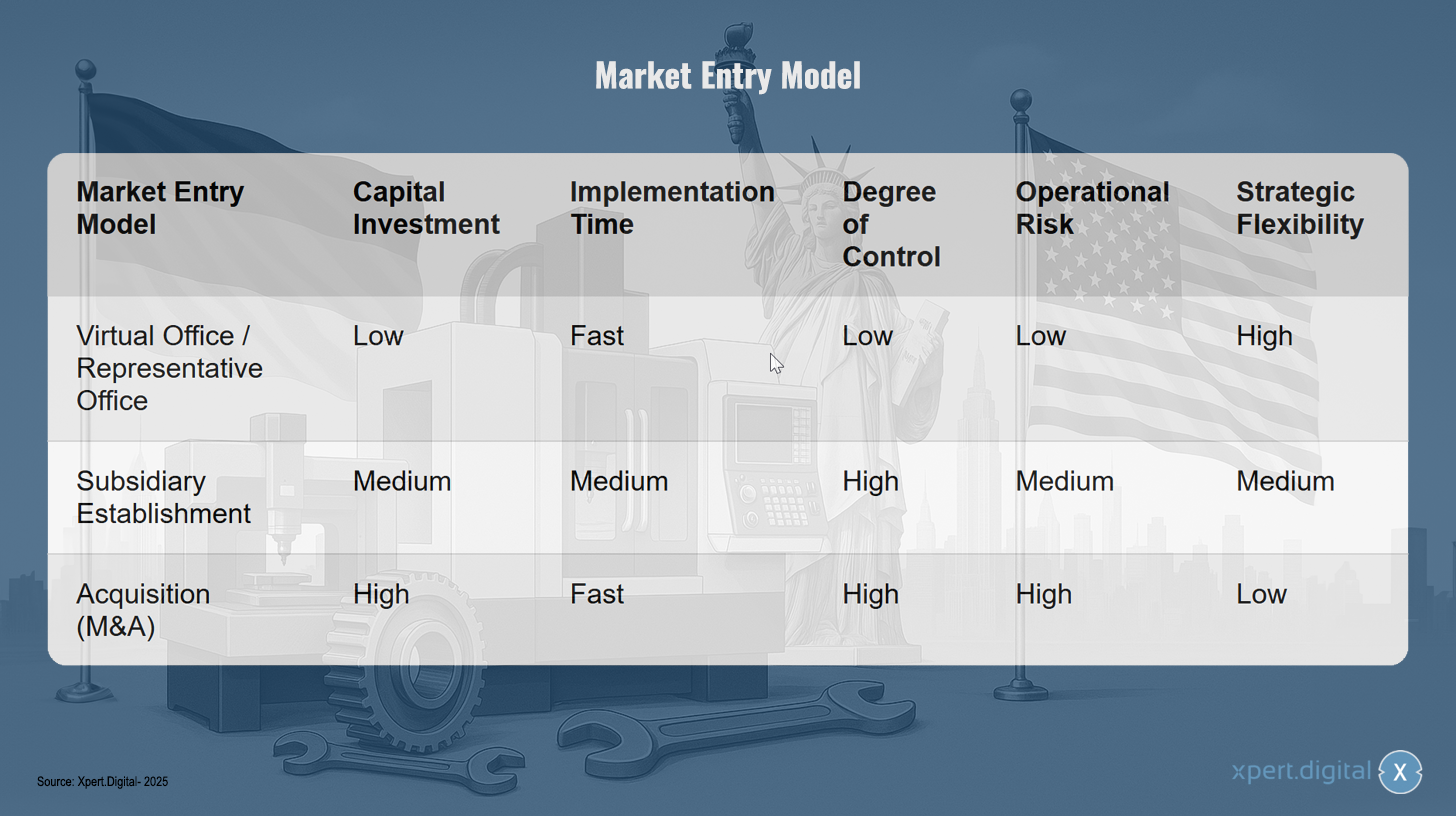
When choosing the right market entry model, companies face various strategic options that differ in several essential dimensions. The virtual office or a representative is characterized by low capital use and quick implementation, but only offers a low degree of control with low -surgical risk and high strategic flexibility. The establishment of a subsidiary requires medium -sized capital and medium implementation period, but enables a high level of control with medium surgical risk and medium strategic flexibility. An acquisition by Mergers & Acquisitions (M&A) means a high level of capital, but can be implemented quickly and offers a high degree of control, but is accompanied by high operational risk and low strategic flexibility.
Location analysis: more than just one address
The choice of the right state is a far -reaching strategic decision. It should not be based solely on tax advantages. Other crucial criteria are the proximity to relevant industrial clusters and potential customers, the connection to the logistical infrastructure (ports, airports, motorways), the availability of qualified specialists and the local wage level. In addition, many states and municipalities offer specific support programs (“incentives”) for new settlements that have to be checked. The complexity of this decision makes advice from experts who are familiar with the local conditions. The German-American Chambers of Commerce (AHKS) offer independent and neutral support for this.
Use of support networks: The AHK advantage
The AHKs are the official representatives of the German economy in the USA and an invaluable partner for market entry. They act as a consultant, service provider and as central network hubs. Your service portfolio is specially tailored to the needs of German companies and covers the entire process of expansion:
- Market analysis & strategy: The AHKs create detailed market and feasibility studies and develop individual market entry strategies.
- Operative support: You offer practical help such as virtual offices, postal and telephone service as well as back office management, including order processing and support in the debt collection.
- Business initiation: A core service is the mediation of business partners and the targeted search for qualified sales representatives.
- Personnel: The AHKs offer extensive support for recruiting (recruiting) of qualified, often bilingual staff. They help with visa questions (especially the J-1 visa for interns) and support the establishment of dual training programs based on the German model.
- Messe support: You provide valuable help in preparation, implementation and follow-up of trade fair appearances.
- Networking & Training: With the organization of networking events, delegation trips and intensive “Us Market Entry Bootcamps”, you enable you to exchange knowledge and experience.
Personnel: The human factor
Collection of the right employees is a critical success factor. The AHKs have proven to be a competent partner how the positive testimony of the Ritz Group provides about the GACC South. In addition to the professional qualification, the cultural fit is crucial. It is a common mistake to transfer German leadership mentality and working methods one to one to the US location. American employees expect respect for local rules, especially in the area of occupational safety, and a leadership style based on empowerment and flatter hierarchies.
Our recommendation: 🌍 Limitless reach 🔗 Networked 🌐 Multilingual 💪 Strong sales: 💡 Authentic with strategy 🚀 Innovation meets 🧠 Intuition

From local to global: SMEs conquer the global market with clever strategies - Image: Xpert.Digital
At a time when a company's digital presence determines its success, the challenge is how to make this presence authentic, individual and far-reaching. Xpert.Digital offers an innovative solution that positions itself as an intersection between an industry hub, a blog and a brand ambassador. It combines the advantages of communication and sales channels in a single platform and enables publication in 18 different languages. The cooperation with partner portals and the possibility of publishing articles on Google News and a press distribution list with around 8,000 journalists and readers maximize the reach and visibility of the content. This represents an essential factor in external sales & marketing (SMarketing).
More about it here:
German mechanical engineers underestimate these critical legal traps when entering the US market-content marketing and account-based marketing
Phase 3: Protection of the business - master legal and regulatory framework conditions
The US market is not only the largest, but also the most process of process in the world. Inadequate legal protection can quickly transform the market entry into a financial disaster. The examination of product liability, contract law and trade policy is therefore not an option, but a compelling necessity.
Product liability: Manage the greatest risk
The topic of product liability is the largest hurdle for many German manufacturers. There is no uniform product liability law in the United States; The legal situation is mainly based on the fall right (“Case Law”) of the individual states. Every participant in the supply chain - from the German manufacturer to the importer and dealer to the supplier - can be sued in the event of damage.
There are essentially three claims:
- Strict Liability in Tort (hazard liability): This is the most critical basis for claim. It is independent of fault, which means that the plaintiff does not have to prove that the manufacturer acted negligently. It is sufficient to prove that the product had an error and this error caused damage.
- Negligence (negligence liability): This fault -dependent liability corresponds approximately to the German crime law (§ 823 BGB). The plaintiff must prove that the manufacturer has violated a duty of care.
- Breach of Warranty (contract/warranty liability): This liability results from the non-compliance with expressly or tacitly guaranteed product properties and is regulated in the Uniform Commercial Code (UCC).
A “product error” can arise in three types: as a design or design error, as a manufacturing error or- and this is the greatest risk of high-quality German products- as an instructional error (failure to warn). This exists if the manufacturer fails to adequately warn the user of well -known or reasonably predictable dangers.
The crucial role therefore has the technical documentation and the warnings. Operating instructions may not be simply translated; They must be adapted to the US market and a potentially lower technical understanding of the users. The de facto standard for the design of warnings is the NUSI Z535.6 standard. It specifies in detail how warnings have to look in terms of content and visual (signal words such as Danger, Warning, Caution; Coloring; pictograms). The use of ISO pictograms instead of the required ANSI symbols is a common and dangerous mistake.
A standard product liability insurance from Germany generally does not cover the US risk or only insufficiently. For exports or a branch in the USA, the conclusion of special US product liability insurance is imperative. These policies often contain high deductibles, the enormous lawyers and court costs calculate on the sum insured and do not extend automatically. So-called spunitive damages (sentence replacement) that go beyond the actual damage are not enforceable in Germany, but can be enforced against assets in the USA (e.g. the US subsidiary). This risk co -insurance is only possible through special agreements.
Contract law: The art of the detailed contract
US contract law is fundamentally different from the German. It is based on “Common Law” (judge law) and national laws, while in Germany the Civil Code (BGB) offers a comprehensive codified framework. For the purchase of mobile goods, in almost all states of the Uniform Commercial Code (UCC). However, the UN sales law (CISG) is automatically applicable for cross-border sales contracts between German and US companies if the parties do not explicitly exclude its validity.
The necessity of extremely long and detailed contracts in the USA is a direct result of the Common-Law system. Since there is no all -encompassing code of law that fills the contractual gaps, the contract itself must explicitly regulate all conceivable eventualities. He almost creates the “private law” of the contracting parties. Oral side agreements are often excluded due to the so -called “slogan Evidence Rule”. The desire for shorter, clearer contracts, which is often expressed from a German perspective, is therefore not only out of place in the US context, but also highly risky. German companies have to accept this contract culture and invest in qualified US legal advice instead of trying to enforce German contracts.
Customs, taxes and trade policy
The political environment in the United States is volatile. Trading policy can quickly change how the introduction of tariffs to steel, aluminum and automobiles has shown in the past. This risk must be included in the strategic planning and cost calculation and is a strong argument for local production. US tax law is also extremely complex and fragmented at federal, state and local levels. It requires careful planning, especially in the area of clearing prices between the mother and subsidiary, where tightened obligations to cooperate and short lectures apply to the documentation. The implementation of a Tax Compliance Management System is therefore urgently advised.
Customs, taxes and trade policy - Image: Xpert.digital
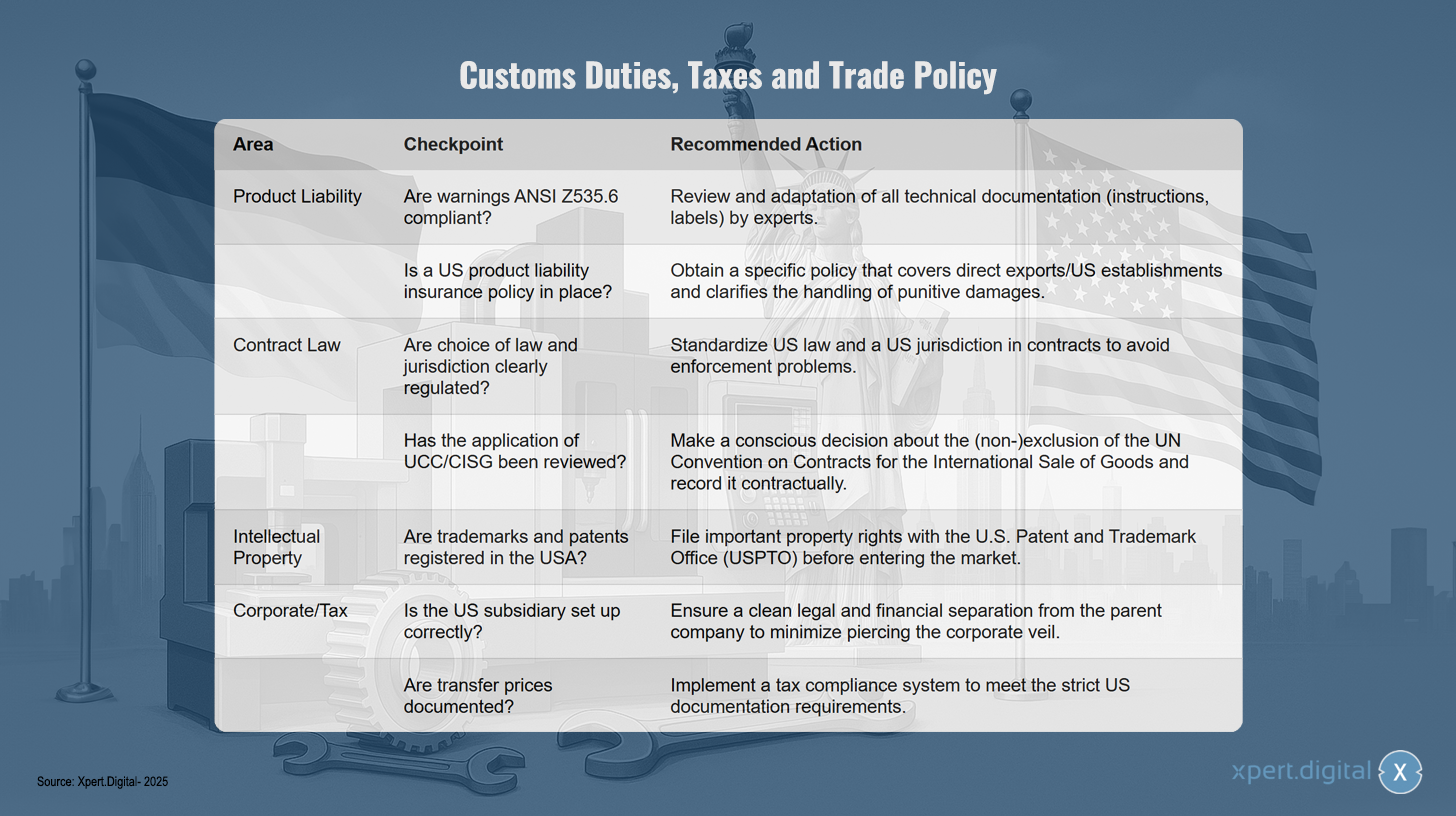
When preparing for the US market, German companies must observe various legal aspects. In the area of product liability, it must first be checked whether all warnings correspond to the ANSI Z535.6 standard. If not, the entire technical documentation, including instructions and labels, should be checked and adapted by experts. In addition, it is recommended to take out special US product liability insurance that covers direct exports and US operating facilities and regulate the handling of spunitive damages.
In contract law, the choice of law and place of jurisdiction should be clearly determined. By default, it is advisable to agree US law and a US court in contracts in order to avoid later enforcement problems. In addition, a conscious decision on the application or exclusion of the UN sales law (UCC/CISG) must be made and contractually documented.
In intellectual property, the timely registration of brands and patents in the USA is essential. Important property rights should be registered with the US Patent and Trademark Office (USPTO) before entering the market.
In terms of tax and corporate law, a proper structure must be paid to the establishment of a US subsidiary. A clean legal and financial separation from the parent company minimizes the risk of grip liability. In addition, clearing prices must be documented carefully, for which the implementation of a Tax Compliance System is required to fulfill the strict US documentary obligations.
Phase 4: Market penetration-visibility, trust and lead generation
An excellent product alone does not sell itself in the competitive US market. The establishment of visibility, the establishment of trust and the systematic generation of qualified leads are the pillars of a successful market penetration strategy.
Visibility and brand structure: more than “made in Germany”
Visibility is a currency in the digital world. The promise of quality “Made in Germany” is a valuable asset, but it is not a sure-fire success and has to actively translate and communicate into the US context. The basis for this is a clear market positioning: Who is the target group and what specific problems does the product solve for you? Who are the main competitors? And what is the unique unique selling point (USP) that takes off your own offer? This positioning must be authentic and communicated clearly and convincingly in all marketing measures. Effective strategies for building brands include the storytelling of a convincing brand history, the creation of an unmistakable brand personality (“Be Loud, Be Proud, Be yourself”), the targeted sponsors of industry events and the establishment of a professional presence on social media.
Content marketing as a trust engine
In the B2B sector, especially in mechanical engineering with its complex products and long sales cycles of 102 days, content marketing is the crucial lever to build trust and establish itself as an expert. Companies that regularly publish valuable content not only generate more qualified leads, but also record more visitors on their website significantly.
The strategy for mechanical engineering should focus on the following points:
- Establish thought leadership: by publishing well -founded white papers, detailed case studies (case studies), technical webinars and profound blog articles, a company demonstrates its expertise. It becomes a trustworthy source of information and a problem solver (“Go-to Solution”) by a pure product provider.
- Target group -oriented content: The content must address the specific challenges and “Pain Points” of the target group - be it engineers, production managers or buyers. Instead of just listing technical features, the use should be in the foreground. Storytelling is a powerful tool to make the value of complex machines tangible and understandable.
- Visual and interactive formats: Visual content is particularly effective in mechanical engineering. High-quality videos (product demonstrations, tutorials, customer references), meaningful infographics and interactive elements such as online product configurators make complex technologies tangible and understandable.
- Account-based marketing (ABM): A ABM strategy is recommended for particularly valuable target customers. Marketing and sales efforts are concentrated on a small, selected group of companies (“accounts”) and addressed with highly personalized content and campaigns.
Suitable for:

Digital presence and public relations work
The company website is the digital figurehead. A simple translation of the German side is inadequate. It must be optimized for the search behavior of American users. This requires not only a cultural and linguistic adaptation, but also a technical. The use of structured data (e.g. JSON-LD) is of crucial importance. This machine-readable information helps search engines such as Google, but also AI-based procurement systems in large US corporations to better understand the products and services offered and list in relevant searches.
For B2B communication in the USA, LinkedIn is by far the most important social media platform, followed by Twitter. It serves to build and maintain networks, the spread of specialist knowledge (thought leadership) and to increase company visibility. Employees can and should act as an authentic brand ambassador by sharing their expertise and taking part in industry discussions.
A targeted public relations (PR) work in US specialist media complements the content strategy. The goal is to draw attention to positioning the company as experts and building trust. Instead of pure press releases, specialist articles, user reports (case studies, success stories) and interviews are far more effective, as they focus on the benefits for the customer and convey credibility. A precise analysis of the media landscape is essential for this. The most important publications in mechanical engineering include the Mechanical Engineering Magazine (published by Asme), Design News, Machine Design, Manufacturing Engineering and Control Engineering. The establishment of personal contacts with the editors of this media is a central and long-term part of successful PR work.
🎯🎯🎯 Benefit from Xpert.Digital's extensive, fivefold expertise in a comprehensive service package | R&D, XR, PR & SEM

AI & XR 3D Rendering Machine: Fivefold expertise from Xpert.Digital in a comprehensive service package, R&D XR, PR & SEM - Image: Xpert.Digital
Xpert.Digital has in-depth knowledge of various industries. This allows us to develop tailor-made strategies that are tailored precisely to the requirements and challenges of your specific market segment. By continually analyzing market trends and following industry developments, we can act with foresight and offer innovative solutions. Through the combination of experience and knowledge, we generate added value and give our customers a decisive competitive advantage.
More about it here:
Lead generation at US trade fairs: Why follow-up decides on success or millions of losses
Phase 5: From contact to the contract - the sales process in the USA
The conversion of initial interest into concrete orders requires a structured sales process adapted to the US culture. Measuring is often the starting point, but the decisive part of the work only begins afterwards.
Suitable for:

Lead generation at trade fairs: The starting point of the sales
Trade fairs are still central meeting points in industry in the United States and one of the most important sources for initial contacts and qualified leads. They offer an ideal stage to work in “awareness” (attention) and “consperation” phase (weighing up) of the customer journey by enabling live demonstrations and personal interaction.
The selection of the right trade fair is a strategic decision that must match the target group and the product portfolio. The most important US trade fairs for mechanical engineering are:
- Imts (International Manufacturing Technology Show): The most important mechanical engineering in the USA with a clear focus on metal processing and machine tools.
- Fabtech: North America's largest event for metal formation, production, welding and final processing.
- Specialized trade fairs: Depending on the industry, fairs such as the Conexpo-Con/AGG (construction machinery), the automate show (automation and robotics) or the best practice expo & conference (compressed air, vacuum, cooling water systems) of high relevance.
Lead generation at trade fairs: The starting point of the sales picture: xpert.digital
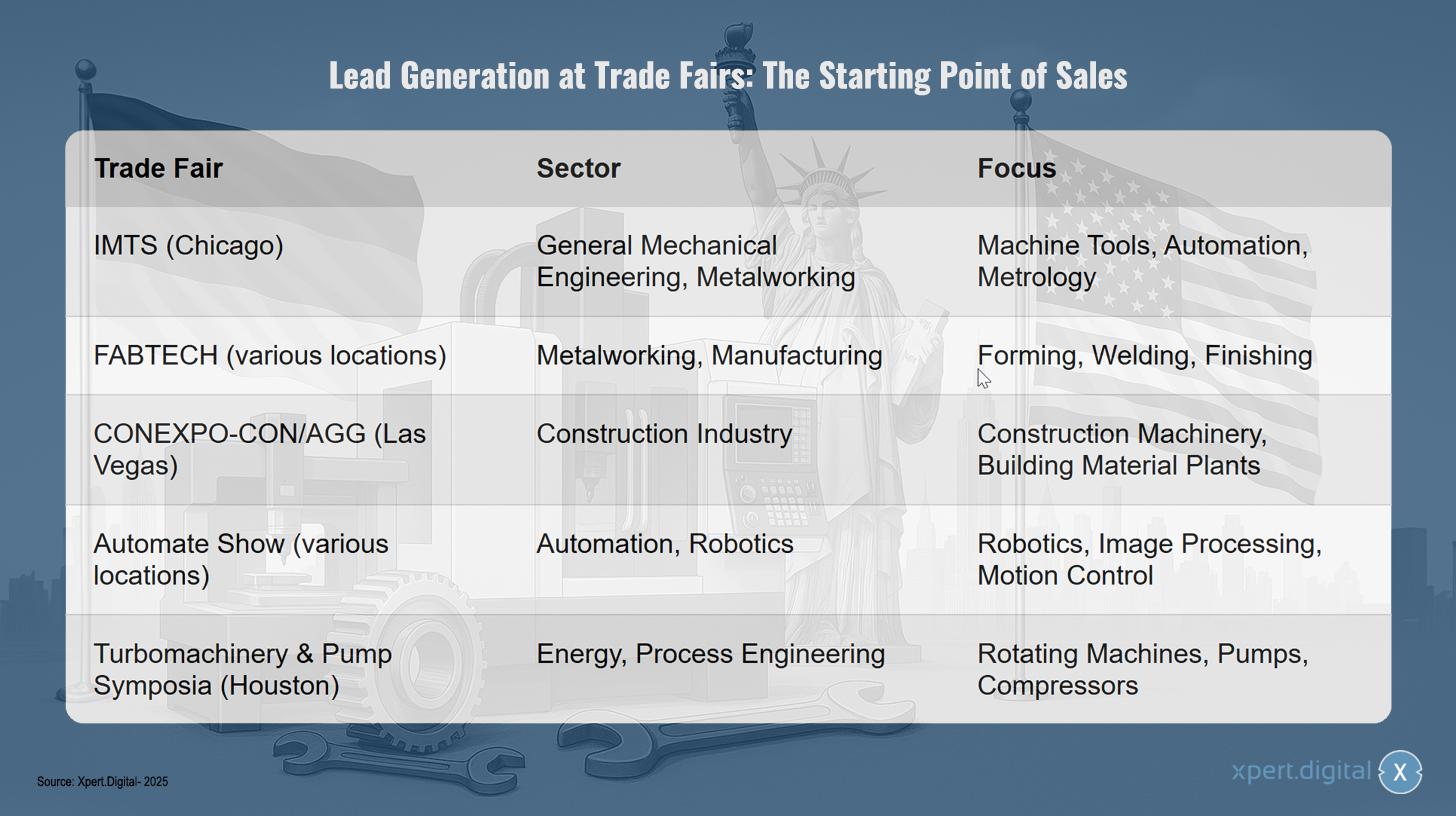
Lead generation at trade fairs represents the decisive starting point of the sales. One of the most important US trade fairs for mechanical engineering is the IMTS in Chicago, which focuses on general mechanical engineering and metal processing and focuses on machine tools, automation and measurement technology. The factor with changing event locations is also dedicated to metal processing and production, but focuses on transforming, welding and final processing. For the construction industry, the Conexpo-Con/AGG in Las Vegas is of particular relevance because it presents construction machinery and building materials. The Automate Show, which takes place at various locations, focuses on automation and robotics with the areas of robotics, image processing and motion control. After all, the Turbomachinery & Pump Symposia in Houston offer a platform for energy and process technology, whereby rotating machines, pumps and compressors focus.
The following best practices are crucial for a successful trade fair appearance:
- Preparation: A clear objective (e.g. the number of qualified leads), the collection of lists of participants to identify top goals and the proactive agreement of appointments 2-6 weeks before the fair are essential. Accompanying social media marketing increases attention in advance.
- At the stand: The stand personnel must be trained to wake up the interest of a visitor within the first 10 seconds (“10-second rule”). The focus should not be on an aggressive sales talk, but on a quick qualification of the visitor (is he a potential customer, decision-makers or competitors?) And collecting relevant information for the later follow-up.
- Lead recording: Instead of the outdated “business cards in-in-fish glass” method, modern, digital lead retrieval systems should be used. These enable immediate recording and prioritization of the leads (e.g. in “hot”, “warm”, “cold”), which lays the basis for an efficient follow -up process.
The American B2B sales cycle
The B2B sales cycle in the US industry is long. From the first contact (lead) to the conclusion of the contract (Close), an average of 102 days. This period is typically divided from lead generation to the identification of a concrete sales chance (opportunity) and another 18 days from opportunity to the end. This long cycle illustrates that a one -off contact is not sufficient. A structured, multi-stage sales process is necessary, which typically includes seven phases: 1. Preparation & research, 2. Proximity, 3. Need analysis, 4. Pitch/presentation, 5. Objection treatment, 6. Completion and 7. Follow-up & customer loyalty.
From the lead to the conversion: the decisive follow-up process
Probably the most common and expensive mistake of German companies after a trade fair appearance is an inadequate, too slow or impersonal follow-up. A trade fair appearance without a rigoros planned and executed follow -up process is a burned investment. In the fast-moving US business culture (“Time Is Money”), a quick, personalized and value-oriented follow-up is the decisive factor that separates successful companies.
The apparent discrepancy between a long sales cycle and a fast-moving culture dissolves in the follow-up process. The first reaction after contact must be made extremely quickly, ideally within 24 to 48 hours. This signals professionalism and ensures that your own company remains in your memory. However, the subsequent process is not a sprint, but a marathon. This so-called “Lead Nurding” requires patience and the continuous provision of valuable content tailored to the lead (such as case studies, white paper or demo videos) in order to gradually lead the potential customers through the long sales funnel. The investment in a good CRM system (Customer Relationship Management) and an automated but still personalized nuring process is therefore just as important as investing in the exhibition stand itself.
The best practices for the follow-up include:
- Speed: The first contact must be made within 24-48 hours.
- Priorization: The leads recorded at the fair must be divided into categories such as “hot” (ready to buy), “warm” (interested) and “cold” (little potential) in order to adapt the communication intensity.
- Personalization: Generic mass emails are ineffective. Communication must refer to the specific conversation at the fair.
- Offer value, do not sell: Instead of a pure sales message, the first contact should provide valuable information that addresses the leads discussed at the fair.
- Clear call-to-action (CTA): Every communication must suggest a clear, simple next step, be it the agreement of a telephone date, booking an online demo or an exclusive trade fair offer.
Phase 6: Intercultural competence as a decisive success factor
Technical excellence and a solid business strategy are the prerequisite for success in the United States. However, the decisive factor that decides on long -term business relationships or costly misunderstandings is intercultural competence. The German and American business culture differ in fundamental aspects.
Communication style: the art of “positive framing”
The entry into every business discussion in the USA is Smalltalk. It is not a senseless banter, but a mandatory and important part of the relationship structure. Germans who tend to get straight to the point are quickly perceived as rude or rugged.
Intercultural traps in the US business: How German directness prevents American deals from
While German communication is considered direct, precise and fact -based, Americans prefer a more indirect, more positive and descriptive style. A hard, direct “no” is often avoided. Instead, criticism is cleverly packed between praise statements (the “feedback sandwich”). A statement formulated as a polite request such as “if you get a chance, please take care of xy” is usually a clear work instruction that requires timely completion.
Presentations should be less a flood of numbers, data and facts, but rather tell a convincing, optimistic story (storytelling). Humor and the active involvement of the audience are not only desirable, but are rated as a sign of sovereignty and intelligence.
Negotiation culture: “Time is money” meets “devil in detail”
Americans appreciate a quick decision-making and a pragmatic “Get It Done” mentality. They plan less long -term and detailed than their German counterparts and are willing to flexibly adapt plans if necessary. However, this speed in the process must not be confused with negligence in the result. Oral agreements and a friendly tone in the negotiation are of minor importance. The only decisive factor is what is in the end in detail in the written contract. American business partners can be extremely friendly in a personal conversation and tough in the contract text - this is not understood as a contradiction, but as a professional separation of relationship and business (“Nothing Personal, Just Business”).
Business relationships and networking
In the United States, a personal relationship is often the basis for a business, not its result. These relationships are often built and maintained in informal settings such as lunch or dinner or at networking events. Americans practice a strong separation of different areas of life (“com parties”). The quick salutation with the first name is the standard and not a sign of special familiarity. A business partner who is referred to as “friends” cannot be equated with a “friend” in deep German understanding. This professional courtesy is often a source of misunderstandings.
Leadership and work culture
US companies tend to be shaped by flatter hierarchies in which employees receive more autonomy and responsibility at all levels. This leads to more agile and faster decision -making processes. The so-called “Hire and Fire” mentality means higher mobility on the job market. Lower loyalty to the employer and more frequent job changes are normal and are often considered a sign of ambition and flexibility, not as a float in the résumé.
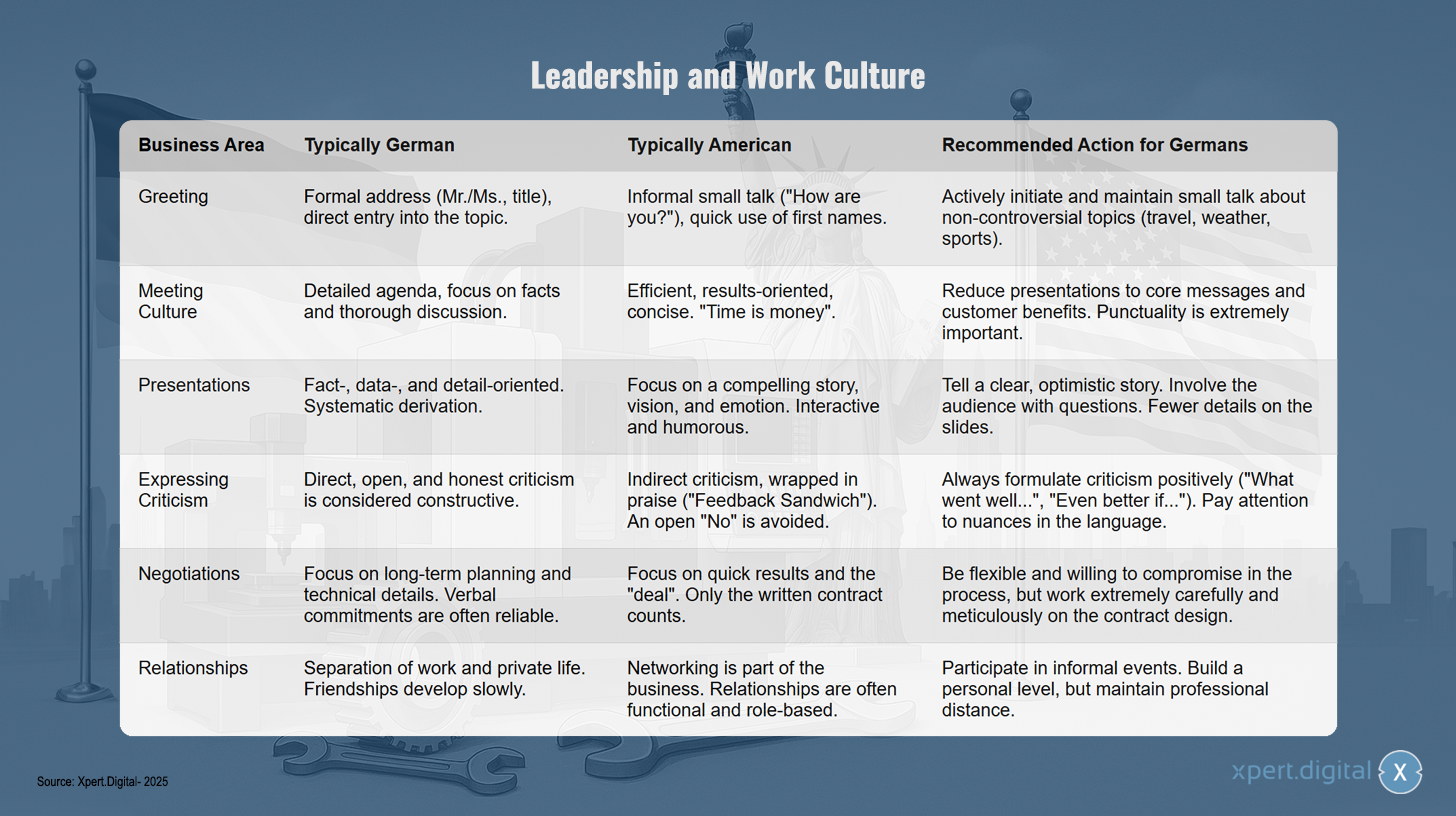
Leadership and work culture- Image: Xpert.digital
The leadership and work culture differs significantly between German and American companies. When greeting, Germans prefer a formal salutation with titles and climb directly into the topic, while Americans maintain informal small talk and quickly switch to first names. Germans are recommended to actively conduct small talk about imperishable topics such as travel, weather or sports.
The meeting culture shows further differences: Germans rely on detailed aging and thorough discussions, while Americans are efficient and result-oriented according to the motto “Time Is Money”. Germans should reduce their presentations on core messages and customer benefits, although punctuality is extremely important.
During presentations, German facts and detailed are systematic with systematic derivation, while Americans rely on convincing stories, visions and emotions and act interactively and humorously. Germans should tell clear, optimistic stories, include the audience and use fewer details on foils.
Criticism is expressed differently: Germans prefer direct, open criticism as constructive, while Americans pack indirect criticism in praise and avoid an open “no”. Germans should formulate criticism positively and pay attention to linguistic nuances.
In negotiations, Germans focus on long -term planning and technical details, although oral commitments are often reliable. Americans focus on quick results and “deals”, with only written contracts count. Germans should be flexible in the process, but should work extremely carefully when designing the contract.
German profession and private life separate in relationships, while friendships are slowly developing. For Americans, networking is part of the business, with often functional and role -based relationships. Germans should take part in informal events, build a personal level, but should maintain professional distance.
Summary and strategic recommendations for action
The success of a German mechanical engineer in the USA is not a random product, but the result of a systematic, multi -phase strategy. The analysis shows that successful market entry is resting on four pillars: a solid financial and strategic preparation, a rigorous protection against the considerable risks of the US market, a marketing and sales strategy based on long-term confidence and- as everything connected and often decisive- a high intercultural competence. The neglect of only one of these columns can endanger the entire project.
For companies that are planning the step into the US market, a prioritized checklist for the first twelve months can be derived:
- Month 1-3 (strategy & law):
- Internal goals and motifs clearly define and budget.
- Contact the responsible AHK for an initial consultation and a first market study.
- Mandate a lawyer specializing in US law and an experienced insurance broker in order to clarify the basic questions about legal form, contract law and product liability insurance.
- Month 4-6 (setup & visibility):
- Make the final decision on legal form and geographical location.
- Start the recruiting process for the first key positions (e.g. sales manager USA).
- A US-optimized website with initial content (case studies, white paper, product information) launches that meet technical and cultural requirements.
- Month 7-9 (market entry):
- Identify the first relevant US trade fair and secure the participation with stand booking.
- Build a professional presence on LinkedIn and begin with the targeted spread of specialist content.
- Take the proactive PR work on the top specialist media in the industry to place the first specialist articles or interviews.
- Month 10-12 (operation & sales):
- Carry out the trade fair appearance and establish a rigorous, fast lead management process.
- Implement and start the follow-up and lead-nurturing process in the CRM system.
- Perform first sales trips and personal customer appointments on site.
- The entire team that interacts with the USA continuously train intercultural.
We are there for you - advice - planning - implementation - project management
☑️ SME support in strategy, consulting, planning and implementation
☑️ Creation or realignment of the digital strategy and digitalization
☑️ Expansion and optimization of international sales processes
☑️ Global & Digital B2B trading platforms
☑️ Pioneer Business Development

Konrad Wolfenstein
I would be happy to serve as your personal advisor.
You can contact me by filling out the contact form below or simply call me on +49 7348 4088 965 (Munich) .
I'm looking forward to our joint project.
Write to me

Xpert.Digital - Konrad Wolfenstein
Xpert.Digital is a hub for industry with a focus on digitalization, mechanical engineering, logistics/intralogistics and photovoltaics.
With our 360° business development solution, we support well-known companies from new business to after sales.
Market intelligence, smarketing, marketing automation, content development, PR, mail campaigns, personalized social media and lead nurturing are part of our digital tools.
You can find out more at: www.xpert.digital - www.xpert.solar - www.xpert.plus
Keep in touch











