
Building sales partnerships in Germany and Europe
Xpert Pre-Release

Available in 27 languages 📢
Prefer Xpert.Digital on GoogleⓘPublished on: May 14, 2025 / Updated on: May 18, 2025 – Author: Konrad Wolfenstein

Building sales partnerships in Germany and Europe – Image: Xpert.Digital
Mastering Market Entry: The Power of Strategic Sales Partnerships (Reading time: 64 min / No advertising / No paywall)
Success Factor Sales Partners: How Companies in Germany and Europe Grow – The Power of Strategic Sales Partnerships
Distribution partnerships represent a fundamental strategic instrument for companies, extending far beyond mere revenue growth. They act as a lever for sustainable growth, enable deeper market penetration, and contribute to risk diversification. This is particularly true when entering complex or new markets, such as the German market or the diverse European regions. The decision for or against a distribution partnership is therefore a fundamental course correction that significantly and sustainably influences a company's market position, the nature of customer relationships, and the allocation of internal resources.
The relevance of distribution partnerships becomes particularly clear when considering the specific characteristics of the target markets of Germany and Europe. Germany, as one of the strongest economic nations, is attractive but also characterized by intense competition. Here, local expertise and established networks brought in by partners can create decisive competitive advantages. Europe, on the other hand, presents a particular challenge with its pronounced cultural and regulatory diversity. Distribution partners can serve as indispensable "bridgeheads" here, enabling companies to successfully navigate local market conditions and meet the specific requirements of individual national markets.
This report aims to provide a comprehensive and practical guide. It is designed to empower companies to make informed decisions regarding the establishment and management of sales partnerships in Germany and Europe. Strategic, operational, and cultural aspects are examined in detail to ensure a holistic overview.
Progressive globalization, and especially digitalization, has significantly increased both the complexity and the opportunities of sales partnerships. Companies face the challenge not only of understanding and applying traditional partnership models, but also of recognizing and strategically leveraging the growing role of digital platforms and entire ecosystems as potential partners or sales channels. The mention of online marketplaces like Amazon as an indirect sales channel, or the importance of B2B marketplaces, illustrates that the term "partner" must now be defined more broadly. The strategic significance of partnerships no longer lies solely in bilateral agreements, but increasingly also in their intelligent integration into larger digital sales structures. This implies that companies need to broaden their partnership strategy and actively consider technology-supported forms of cooperation.
An inadequate or poorly adapted sales strategy, particularly when entering new regions, is a frequently identified primary cause of business failure. Successful sales partnerships can significantly mitigate this risk. By contributing in-depth local market knowledge and access to established sales channels, partners can reduce the typical hurdles of market entry. There is a clear causal relationship: a lack of local adaptation in sales leads to a higher market entry risk. Conversely, sales partners with specific local expertise can significantly reduce this risk. Consequently, investing in the careful selection and professional management of sales partners represents an effective form of risk minimization and increases the likelihood of a successful and sustainable market presence.
Fundamental aspects of distribution partnerships
A. Definition and core concepts
A distribution partnership, in general, refers to a form of cooperation in which companies work together with external entities—whether individuals or organizations. The primary goal of this collaboration is to distribute their own products or services more effectively to end customers and to significantly expand their market reach. A characteristic feature is that the participating partners typically retain their legal and economic independence. This definition forms the basis for understanding the various forms and strategic implications of distribution partnerships.
To fully grasp the strategic importance of distribution partnerships, a clear distinction from other forms of distribution is necessary:
- Direct sales: In this form, the company sells its products or services directly to the end customer without involving intermediaries. Examples include sales through its own online shop, by the company's own sales representatives in the field, or in its own retail stores. Direct sales offer the advantage of high control over the sales process and customer relationships, as well as potentially higher profit margins, since no intermediaries are involved. However, this is offset by often limited reach and generally higher initial and ongoing costs for building and maintaining the company's own sales structures.
- Indirect distribution: In contrast, indirect distribution involves sales through intermediaries or partners. These handle significant parts of the distribution process. Indirect distribution allows for greater reach and often faster market entry, particularly in new or difficult-to-access markets, potentially with less effort on the part of the manufacturing company. However, this often comes with less direct control over the sales process and the end-customer relationship, as well as lower profit margins, since partners must be compensated for their services. Distribution partnerships are a core form and a key instrument of indirect distribution.
Clearly defining these distribution channels is crucial for companies. It enables them to make a conscious strategic decision in favor of indirect sales and thus the development of partnerships, based on a sound evaluation of alternatives.
Overview of the most important types of distribution partnerships
The landscape of distribution partnerships is diverse, and each model has specific characteristics that make it more or less suitable for certain products, markets, and business objectives. A fundamental understanding of these differences is crucial for selecting the right partnership model.
- Sales representatives (agents): Sales representatives operate as independent businesspeople and broker deals on behalf of and for the account of the commissioning company. They receive a commission for their services. A key characteristic is that sales representatives generally do not purchase the goods themselves and therefore bear no inventory risk. This results in comparatively low fixed costs for the company. However, the company often has less direct control over sales activities and immediate customer service, as the sales representative operates independently.
- Distributors/Authorized Dealers: Unlike sales representatives, distributors or authorized dealers purchase the manufacturer's products on their own account and resell them in their own name and for their own account. They therefore bear the full distribution and inventory risk. This form of partnership can enable deeper market penetration, as distributors often have established logistics and distribution networks. However, the partner may need to make a greater investment, and the manufacturing company may relinquish some control over marketing activities and the direct relationship with the end customer.
- Franchising: In franchising, a company (franchisor) grants an independent partner (franchisee) the right to use its brand, established business model, and operational processes in exchange for fees (e.g., initial franchise fee, ongoing license fees). Franchising enables rapid growth and benefits from the franchisees' local investments and market knowledge. However, it requires strict control from the franchisor to ensure quality and brand standards and carries the potential for conflicts, for example, regarding profit sharing or compliance with regulations.
- Reseller agreements: These are agreements in which one company grants another the right to resell its products or services. Resellers typically purchase the products from the manufacturer or an upstream supplier and then distribute them to their own customers. This model is similar to that of a distributor but can be broader and include different levels of commitment and integration.
- Strategic alliances with distributors: This form of partnership involves cooperation with companies that already have established and efficient distribution networks, with the aim of significantly increasing the reach of their own products or services. Such alliances can take many forms and include collaboration with wholesalers, retailers, or other specialized distribution partners.
- Joint Ventures: In a joint venture, two or more partner companies establish a new, legally independent company. This typically involves shared ownership and control rights. The goal is to pool resources, expertise, and market knowledge to capitalize on business opportunities that might not be feasible for a single company. Joint ventures are frequently used for entering new markets, developing new products, or undertaking large-scale projects requiring significant investment and risk sharing.
- Multi-level marketing (MLM): This model is based on a network of independent distributors who earn income both through the direct sale of products to end customers and through recruiting and building their own team of new distributors, from whose sales they participate. Multi-level marketing offers high flexibility and the potential for a scalable income for its partners. However, it also carries specific risks such as income insecurity, potential reputational problems for the entire distribution system, and often intense recruitment pressure. A clear and unambiguous distinction from illegal pyramid schemes, where the recruitment of new members takes precedence over product sales, is of crucial legal and ethical importance.
The following table provides a comparative overview of the aforementioned distribution partnership models:
Comparison of distribution partnership models
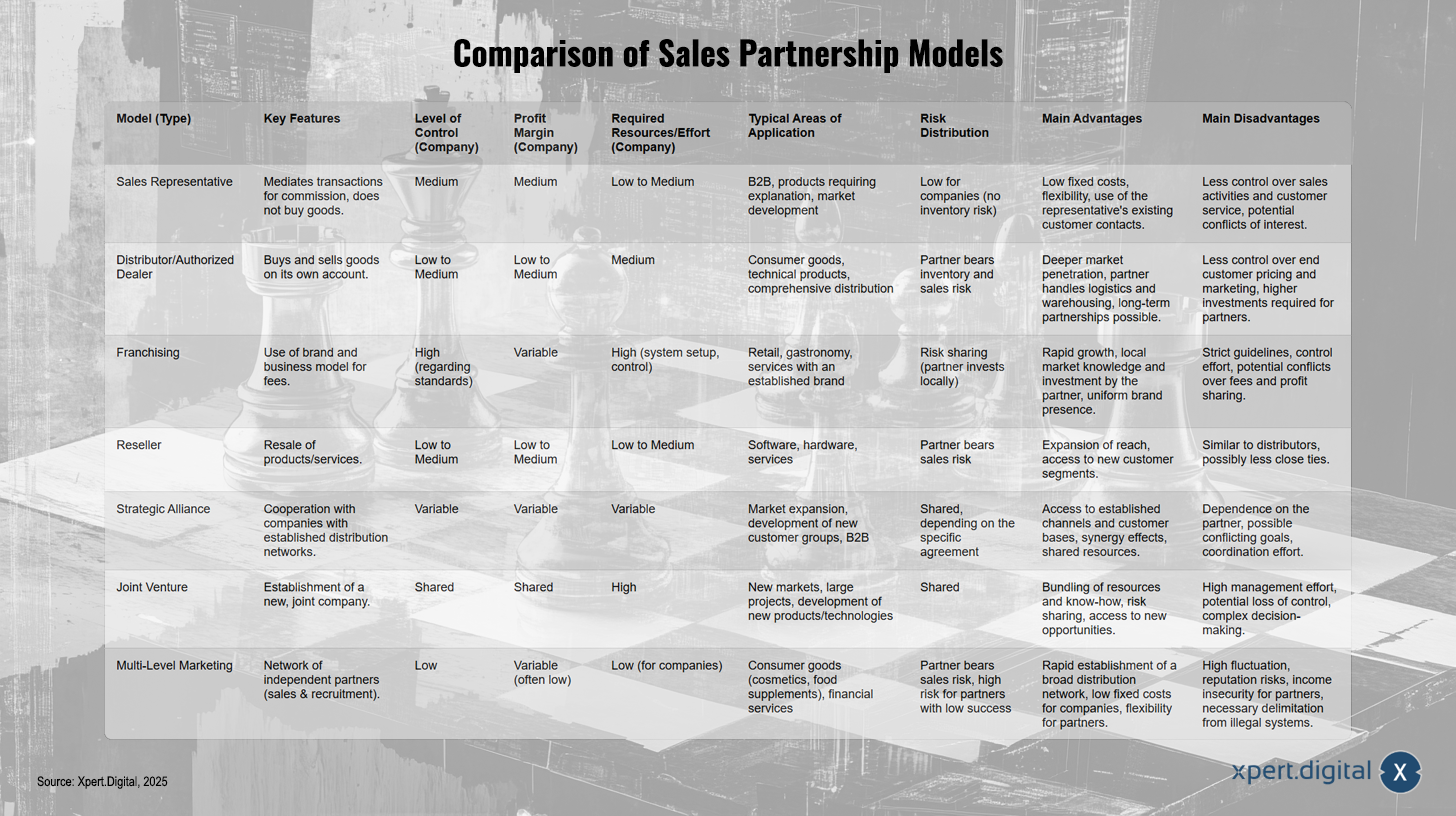
Comparison of distribution partnership models – Image: Xpert.Digital
A comparison of distribution partnership models reveals different approaches and their main characteristics. A sales representative brokers deals on a commission basis without purchasing any goods. The company has a medium level of control and profit margins, while the required resources are low to medium. Typical applications are in the B2B sector, with products requiring explanation, or for market development. The company bears only a low risk, as there is no inventory risk, benefits from low fixed costs and flexibility, but has less control over sales activities, and conflicts of interest can arise.
Distributors or authorized dealers buy and sell goods on their own account. In this model, the company has a low to medium level of control and profit margins with moderate resource expenditure. This method is frequently used for consumer goods, technical products, or for nationwide distribution. The partner bears the risk of goods and sales, allowing companies to benefit from deeper market penetration, outsourcing of logistics and warehousing, and long-term partnerships. However, there is less control over end-customer pricing and marketing, and partners must make higher investments.
Franchising enables a company to grow rapidly by leveraging an established brand and business model in exchange for fees. Standards control is high, while profit margins and resource expenditures range from variable to high, particularly due to the system's structure and oversight. Franchising is used in retail, food service, and service industries, often featuring established brands. Risk is shared through investments by partners, who simultaneously benefit from local market knowledge and a consistent brand image. Disadvantages include strict guidelines, significant oversight effort, and potential conflicts over fees and profit sharing.
Resellers buy and resell products or services. Their level of control and profit margins are low to medium, as are the required resources. They operate in software, hardware, and services. Resellers bear the sales risk, allowing companies to expand their reach and access new customer segments. These partnerships are similar to those with distributors, although resellers may have a less close relationship with the company.
Strategic alliances refer to cooperative partnerships with companies that have established distribution networks. The level of control, profit margins, and resource expenditure are all variable. They are frequently used for market expansion or to tap into new customer groups in the B2B sector. Risk is shared according to the agreement. Key advantages include access to established channels, synergy effects, and shared resource utilization. Disadvantages include dependence on the partner, potential conflicts of interest, and increased coordination efforts.
A joint venture describes the establishment of a joint company where resources and risks are shared, and high profit margins and management costs are expected. Typical applications include projects in new markets, the development of new products or technologies, and large-scale projects. The partners benefit from pooling resources and expertise, while the high management effort, potential loss of control, and complex decision-making can be challenging.
Multi-level marketing (MLM) is based on a network of independent partners who both sell products and recruit new partners. Control is minimal, profit margins are variable but often low, and the company requires minimal resources. Typical applications include consumer goods such as cosmetics or dietary supplements, as well as financial services. The risk lies primarily with the partners. Advantages include the rapid development of a broad sales network, low fixed costs for companies, and flexibility for partners. Challenges include high turnover, reputational risks, income insecurity for partners, and the need to clearly distinguish this model from illegal schemes.
Choosing the right partnership model is not an isolated decision, but must be directly linked to the company's overarching strategic goals. For example, models like franchising or using distributors often enable rapid growth and market penetration. However, this advantage can come at the cost of some control over the brand or direct customer interaction. If the primary strategic goal is to quickly capture market share, a greater degree of relinquishment of control may seem acceptable. Conversely, if long-term brand image management and building direct, loyal customer relationships are paramount, a model with more corporate control—perhaps through fewer, but more selectively chosen partners—might be preferable, even if it means slower growth. This underscores that the distribution partnership strategy must always be derived from the overall corporate strategy and cannot be considered in isolation.
Weighing the pros and cons: When is a distribution partnership the right choice?
The decision to establish a sales partnership should be based on a careful assessment of the potential advantages and the associated disadvantages.
Advantages of distribution partnerships:
- Greater reach and faster market entry: A key advantage lies in the ability to leverage the existing networks, customer bases, and established market presence of partners. This can lead to significantly faster market penetration than would be possible with in-house resources, especially when entering new geographic regions or complex market segments.
- Reduced (internal) effort and cost savings: Since partners handle a large portion of the sales tasks, companies can conserve their own resources and concentrate on core competencies such as product development, production, and overarching marketing. Building a nationwide sales team or opening numerous branches often involves significant investments and ongoing costs, which can be reduced or avoided through partnerships.
- Access to specific market knowledge and expertise: Sales partners often bring valuable local market knowledge, in-depth industry experience, and long-established customer relationships. This know-how can be invaluable for companies that are new to a market or want to target specific customer groups.
- Risk sharing: In certain partnership models, such as joint ventures or cooperation with distributors who purchase goods on their own account, the financial and operational risk of market entry and distribution is spread across several shoulders.
- Flexibility and scalability: Compared to building their own, firmly established sales structures, partnerships can often be structured more flexibly, adapted more quickly, or dissolved again if necessary. This allows companies to react more agilely to market changes.
Disadvantages of distribution partnerships:
- Reduced control: Collaborating with external partners inevitably means relinquishing some control over the sales process, direct customer relationships, and brand image presentation. The way the partner operates cannot always be controlled down to the last detail.
- Lower profit margins: The services of distribution partners must be compensated, whether through commissions, dealer discounts, or other forms of profit sharing. This generally leads to lower profit margins for the manufacturing company compared to direct sales.
- Dependence on partners: The success of sales activities depends significantly on the performance, motivation, and commitment of the selected partners. If a partner fails to meet expectations or even drops out, this can considerably impair the company's sales and lead to revenue losses.
- Potential for conflict: Differing corporate goals, contrasting corporate cultures, unclear expectations, or communication problems can lead to friction and conflict between partners. Such conflicts can strain collaboration and, in the worst case, lead to the failure of the partnership.
- Communication effort and management requirements: Successful sales partnerships require continuous and open communication, careful coordination of activities, and active relationship management. This ties up management resources and incurs costs.
- Reputational risks: The behavior and business practices of a distribution partner can directly reflect negatively on the image and reputation of the manufacturing company. Missteps or unprofessional conduct by a partner can therefore damage the image of the company's own brand.
An honest and comprehensive examination of these advantages and disadvantages is essential. It helps companies develop realistic expectations of a sales partnership and make a decision for or against such a collaboration on a solid, well-informed basis.
It is striking that many of the aforementioned disadvantages of distribution partnerships—such as loss of control, dependency, or the potential for conflict—are not necessarily and inevitably inherent in the chosen partnership model itself. Rather, they are often the result of oversights or errors in earlier phases of the partnership process. A flawed or hasty partner selection, unclear or incomplete contract drafting that fails to clearly regulate important aspects of the collaboration, or inadequate, reactive partner management can significantly increase the likelihood of these disadvantages occurring. The importance of a clear definition of objectives and division of responsibilities in the contract, the need for clearly defined shared goals, open communication, and sound legal frameworks, as well as the significance of governance structures, active relationship management, and clearly defined roles, indicate that proactive and diligent measures can mitigate many of the risks. This implies that companies can significantly reduce risks while maximizing potential benefits through conscientious planning, careful partner selection, and professional execution and management of the partnership. It is therefore less a question of whether a partnership is fundamentally sensible, but rather how a partnership is structured and managed.
Multi-level marketing (MLM) occupies a special position among distribution partnership models. While it offers potential advantages such as flexibility for distributors and the opportunity to generate passive income, this model is also associated with specific and sometimes serious risks. These include often high income insecurity for distributors, a potentially negative public image of the distribution system, intense sales and recruitment pressure, and a frequently high turnover rate among distributors. Particularly critical is the necessary, clear distinction from illegal pyramid schemes, where the primary focus is not on product sales but on recruiting new members, and revenue is generated mainly from the contributions of these new members. Due to this specific risk structure and the ethical and legal implications, considering MLM as a distribution option requires particularly careful and in-depth examination. A superficial review is insufficient; rather, comprehensive due diligence, a precise analysis of the compensation plan, and a robust compliance framework are essential to avoid legal pitfalls and reputational damage. This model is therefore not suitable for every company or product and should only be considered after very critical evaluation.
Strategies for identifying and selecting sales partners in Germany
The success of a sales partnership begins significantly with the careful identification and selection of the right partner. Established strategies and resources exist for the German market that can support this process.
Market analysis and definition of the ideal partner profile
Before actively searching for distribution partners, thorough preparation is essential. This begins with a deep understanding of the German target market. This includes an analysis of market size, the current competitive landscape, relevant customer segments, and the specific cultural and economic conditions in Germany.
A crucial first step is creating an ideal customer profile (ICP). Companies must clearly define who their end customers are, what their needs and problems are, and how their product or service addresses these needs. This customer profile forms the basis for deriving the ideal partner profile, because the desired partner must be able to effectively reach and serve precisely these target customers.
The ideal partner profile can be derived from the ICP and one's own strategic goals. The following questions are key here:
- What specific characteristics, skills, and resources must a potential partner possess? This can include industry experience, an existing and suitable customer network, technical expertise, proven sales strength, financial stability, or a compatible corporate culture.
- What type of partner (e.g., sales representative, distributor, specialist retailer) best suits your sales strategy, product or service, and defined goals in the German market?
A clearly and thoroughly developed partner profile serves as a compass for the search, focuses efforts, and significantly facilitates the subsequent evaluation and selection of candidates.
Effective search methods in Germany
A number of effective methods and channels are available for finding sales partners in Germany:
- Online platforms and directories:
- Specialized platforms for sales representatives: Portals like handelsvertreter.de offer a qualified search for sales representatives, often filterable by industry, product group, and target customer. Features such as an email push service inform registered representatives directly about new offers.
- B2B marketplaces and business directories: Platforms such as Amazon Business, Unite (formerly Mercateo), Kompass, or "Wer liefert was" (wlw) can serve not only as direct sales channels but also for identifying potential sales or cooperation partners. They often offer detailed company profiles and contact information.
- Industry events and trade fairs:
- Trade fairs are key platforms for initiating business contacts and networking with potential partners. They offer the opportunity for personal introductions and the presentation of one's own products or services.
- AUMA (Ausstellungs- und Messe-Ausschuss der Deutschen Wirtschaft eV) is an important source of information for trade fair dates and locations in Germany and supports companies in their trade fair planning.
- Networking:
- Active participation in events organized by industry associations can open up valuable contacts with potential partners or multipliers.
- Professional online networks such as LinkedIn and XING are ideal for identifying companies and individuals who are potential partners, as well as for making initial contact.
- Cold calling and direct approach:
- Targeted research of potential partner companies and subsequent direct contact via telephone, email, or post is a proactive method. Thorough preparation, a clear understanding of the potential partner's business, and a compelling value proposition are crucial for success.
- Content marketing and lead generation:
- Creating and distributing high-quality, target-group-specific content such as white papers, technical articles or webinars can help to draw the attention of potential partners to your company and its offerings and to generate qualified inquiries.
- Use of Sales Intelligence Tools:
- Modern software solutions, such as the tools offered by Dealfront, can make the process of identifying, researching and qualifying potential sales partners significantly more efficient by accessing extensive company databases and filter functions.
Combining different search methods generally increases the likelihood of identifying a sufficient number of suitable partner candidates. The German market offers a well-developed infrastructure and diverse points of contact for partner searches. Partner searches in Germany are increasingly moving towards digital and data-driven approaches. Platforms, B2B marketplaces, and sales intelligence tools are gaining importance and complementing traditional methods such as trade fairs. The mention of LinkedIn, specialized online platforms for sales representatives, B2B marketplaces, and prospecting tools underscores this development. While trade fairs remain important meeting points, digitalization enables broader, faster, and often more targeted initial contact and research with potential partners. Companies should therefore pursue a hybrid search strategy that integrates both digital channels and traditional methods to fully leverage the potential.
Evaluation and due diligence of potential partners
After identifying potential candidates, the critical phase of evaluation and due diligence follows. A superficial examination is insufficient to establish successful long-term partnerships.
- Development of a criteria catalog for evaluation: Based on the ideal partner profile, a detailed criteria catalog should be created. This can include aspects such as proven experience in the relevant industry, specific expertise, available resources (e.g., sales team, warehouse capacity, technical equipment), demonstrated commitment and motivation for a partnership, technological affinity, market reputation, financial health and stability, and the compatibility of corporate cultures and values.
- Obtaining references and conducting background checks: It is advisable to obtain references from the candidate's current or former business partners to better assess their reliability and performance. Furthermore, professional background checks (e.g., credit checks, verification of commercial register entries) can provide important information about the potential partner's integrity and financial situation. The principle of the German-Chinese Chamber of Commerce (AHK China) of verifying background information is also applicable to the German market.
- Personal conversations and building an initial relationship: Direct conversations, ideally in person, are essential to gain a deeper understanding of the potential partner's company, get to know their team, and assess interpersonal chemistry. Trust is a fundamental basis for any successful partnership and often begins to develop during these initial interactions.
- Checking for potential conflicts of interest: It must be carefully examined whether the potential partner already sells products or services of direct competitors or maintains other business relationships that could lead to conflicts of interest.
A thorough and systematic due diligence process minimizes the risk of poor decisions and prevents future problems and disappointments in the partnership. Carefully defining the ideal partner profile, based on a clear understanding of your target customer, is a critical success factor that significantly influences the efficiency of the search and the quality of the subsequent partnership. Emphasizing the creation of an ideal customer profile as an initial step and listing partner selection criteria based on the company's needs and the ability to reach the end customer underscores this connection. Without a clear understanding of who the end customer is and what their needs are, it is impossible to precisely define the specific skills and resources a sales partner requires to successfully reach that customer. A vague or incomplete partner profile inevitably leads to a less efficient search and potentially to the selection of partners who are not an optimal fit for the target group or the company's strategy. This, in turn, impairs the partnership's performance from the outset. The preliminary work in the form of a precise profile definition is therefore crucial for the final result and the long-term viability of the cooperation.
Using Chambers of Industry and Commerce (IHKs), German Chambers of Commerce Abroad (AHKs) and Germany Trade & Invest (GTAI) for partner searches in Germany
Institutional actors such as the Chambers of Industry and Commerce (IHKs) and Germany Trade and Invest (GTAI) can offer valuable support in the partner search process, even if their primary mandates differ.
- Chambers of Industry and Commerce (IHKs): The IHKs in Germany are important points of contact for companies. They often offer initial consultations on general sales strategies, provide market information, and explain the legal framework. Some IHKs offer specialized services such as business consulting or initial consultations on marketing and sales issues, which can indirectly help in preparing for the search for a partner. They can support companies in defining their specific partnership needs and, if necessary, point them toward relevant networks, events, or information sources. Although the information provided does not explicitly mention services offered by the IHKs to find purely domestic sales partners, they are nevertheless important institutions for strategic preparation and information gathering.
- Germany Trade and Invest (GTAI): GTAI is the economic development agency of the Federal Republic of Germany. Its primary focus is on attracting foreign investment to Germany and supporting German companies in their international expansion. Its direct role in facilitating partnerships between two German companies within Germany is therefore rather limited. Nevertheless, the detailed market analyses, industry reports, and information on economic trends published by GTAI can also be useful for finding domestic partners by helping to identify market potential and suitable partner segments.
Although Chambers of Industry and Commerce (IHKs) and Germany Trade & Invest (GTAI) represent valuable resources, the primary responsibility for actively searching for, contacting, and selecting sales partners ultimately lies with the company itself. These institutions primarily act as supporters, information providers, and facilitators. They are rarely pure intermediary agencies, especially when it comes to purely domestic partnerships. The consulting services, information, and support programs they provide are important components, but they do not replace entrepreneurial initiative. Companies should therefore proactively utilize these organizations as part of a broader search and selection strategy and not rely solely on their intermediary services.
🎯🎯🎯 Benefit from Xpert.Digital's extensive, five-fold expertise in a comprehensive service package | BD, R&D, XR, PR & Digital Visibility Optimization

Benefit from Xpert.Digital's extensive, fivefold expertise in a comprehensive service package | R&D, XR, PR & Digital Visibility Optimization - Image: Xpert.Digital
Xpert.Digital has in-depth knowledge of various industries. This allows us to develop tailor-made strategies that are tailored precisely to the requirements and challenges of your specific market segment. By continually analyzing market trends and following industry developments, we can act with foresight and offer innovative solutions. Through the combination of experience and knowledge, we generate added value and give our customers a decisive competitive advantage.
More about it here:
Mastering cultural diversity and regional expertise: The key to successful expansion in Europe
Developing the European market: Special considerations when looking for a partner
Expanding into European markets through distribution partnerships requires a differentiated approach that takes into account the continent's heterogeneity. A strategy that proves successful in Germany cannot simply be transferred to other European countries.
Overview of the European distribution landscape
Europe is not a homogeneous single market, but rather a mosaic of over 44 countries, each with its own economic structures, varying purchasing power, specific consumer habits, and individual legal frameworks. While the EU single market facilitates cross-border trade by reducing customs barriers and harmonizing certain regulations (e.g., in product liability or, to some extent, competition law), significant national differences remain, for example, in contract law, tax law, approval procedures for certain products, and, above all, in consumer culture and business practices. Recognizing this pronounced heterogeneity is the first and most important step toward a successful European expansion strategy. Experience has shown that a one-size-fits-all strategy applied indiscriminately to all European markets rarely succeeds and carries considerable risks.
Regional differentiations: Western, Northern, Southern and Eastern Europe – specific approaches
For effective partner searches, it is helpful to divide Europe into larger regions with generally similar characteristics, even if national differences still exist within these regions:
- Western Europe (e.g., France, Benelux countries, Great Britain): These markets are often very mature, with high purchasing power and demanding consumers. Distribution structures are generally well-established, and competition is intense. Quality, innovation, and excellent service are frequently crucial differentiators. Compared to Germany, cultural nuances may exist in business development and communication.
- Northern Europe (Scandinavian countries such as Sweden, Norway, Denmark, and Finland): This region is also characterized by high purchasing power. There is a strong focus on high quality, functional design, and increasingly on sustainability. The business culture is often egalitarian; punctuality and efficiency are highly valued, as is a good work-life balance. Communication tends to be direct, but polite and less formal than in Germany. Consensus-building plays an important role in the decision-making process. Ostentatious status symbols or extravagant gifts should be avoided, as these could be perceived as inappropriate.
- Southern Europe (e.g., Italy, Spain, Portugal, Greece): Building personal relationships and mutual trust is often fundamental to business success in these cultures and can take more time than in Northern or Central European countries. Time management and agendas may be more flexible. Communication may be more indirect, and there is a greater emphasis on hospitality and social interaction. Consumer price sensitivity may be higher in some segments. Small, well-chosen gifts may be acceptable and even welcome in certain business contexts.
- Eastern Europe (e.g., Poland, Czech Republic, Hungary, Baltic States): Many of these markets are dynamically growing economies with significant consumption and investment needs. Per capita income is often still lower on average than in Western Europe, which can create a market for less expensive or simpler products, although demand for quality is also increasing. Building trust is an important aspect of the business relationship. Communication can be more indirect and context-dependent than in Germany. Hierarchies and formal etiquette can play a larger role, and initial reticence in business contacts is not uncommon. The search for injection molding companies in specific regions such as Western and Eastern Europe underscores that even within industries, different market needs and specializations exist in the various European subregions.
Knowledge of these regional trends and cultural nuances enables a more targeted approach to potential sales partners and a more effective adaptation of one's own negotiation strategy and communication style.
Strategies for finding a partner across Europe
The search for distribution partners at the European level requires a tailored strategy that takes into account the diversity of markets and utilizes international resources:
- Market research as a basis:
- A thorough analysis of the suitability of one's own product or service for the respective national market is essential. Local cultural conditions, consumer habits, trends, and regulatory requirements must be taken into account.
- Assessing market size, potential distribution channels (e.g., established retail chains, specialized dealers, online platforms), the competitive situation, and competitors' pricing provides important decision-making criteria.
- Use of international platforms and networks:
- Enterprise Europe Network (EEN): This network, co-financed by the European Commission, offers a comprehensive, free database for finding business, technology, and research partners in Europe and beyond. Companies can search for suitable cooperation opportunities and also create their own profiles with their cooperation requests.
- Online B2B directories with European reach: Platforms such as Kompass, Europages, Tradewheel.com or ExportPortal list companies from numerous European countries and industries and can be used to identify potential partners.
- Partner ecosystem platforms: Certain software solutions for partner relationship management (PRM), such as Kademi, Introw PRM or Kiflo PRM, are primarily management tools, but can also be helpful in identifying new partners in Europe through their network effects and databases.
- Export consultants and specialized agencies:
- Companies such as Exporteers or Ad Maiora Consulting specialize in supporting international market development and offer services to identify and approach distributors, sales representatives and other sales channels in specific European countries.
- Such consultants often have established local networks, detailed market knowledge, and can provide valuable support in overcoming cultural and linguistic barriers.
- German Chambers of Commerce Abroad (AHKs):
- The German Chambers of Commerce Abroad (AHKs) are represented in most European countries and offer a wide range of services for German companies. These include support with market entry, conducting address research, targeted searches for business partners, and organizing initial meetings. They possess excellent local networks and in-depth knowledge of the respective market conditions.
- Germany Trade and Invest (GTAI):
- GTAI supports German companies in their expansion abroad by providing comprehensive market information, industry analyses and contacts to relevant players in the target markets.
- Personal visits and networking on site:
- Travel to European target markets is often essential to develop a feel for the local culture, to directly examine the business landscape, to meet potential partners in person, and to build a robust network.
The role of trade fairs and international industry events
Leading international trade fairs, often held in Germany but also in other major European economic centers, serve as central meeting points for industry players from across Europe and beyond. They offer excellent opportunities to discover new products and technologies, observe market trends, and, above all, establish direct contacts with potential sales partners. AUMA (Association of the German Trade Fair Industry) provides support and information for companies wishing to participate in international trade fairs, for example, through the German government's international trade fair program.
The cultural and economic distance between Germany and other European countries, particularly in Southern and Eastern Europe, is often underestimated. Insufficient adaptation of search strategies, communication styles, and negotiation tactics to these specific differences frequently leads to lower success rates in finding partners and can hinder the development of long-term business relationships. The differences in purchasing power and product requirements between Eastern and Western Europe, the varying business etiquette regarding punctuality, relationship building, and communication style in Northern, Western, Southern, and Eastern Europe, as well as the importance of the respective national language and local customs, all bear witness to this. For example, if a German company operates in a Southern European market with a typically German, very direct, and highly task-oriented approach, without adequately considering the often more important aspect of personal relationship building, potential partners could be deterred or at least confused. This underscores that intercultural competence and the ability to adapt flexibly are key variables for the success of partner searches and relationship building in the European context.
While large, internationally established companies may possess the necessary internal resources for their own extensive market analyses and direct approaches in various European countries, small and medium-sized enterprises (SMEs) are often more reliant on cost-effective or government-subsidized support services. These include, in particular, the Enterprise Europe Network (EEN), the services of the German Chambers of Commerce Abroad (AHKs), and the expertise of specialized export consultants. The complexity and costs associated with accessing over 44 European markets can pose a significant hurdle for SMEs. Services such as the EEN (often free of charge) and consulting from AHKs are explicitly tailored to the needs of SMEs, as evidenced by funding programs for SMEs. Although export consultants charge fees for their services, these can be considerably lower compared to building their own international sales structures or the costs of failed market entries. This suggests that the choice of search strategy also depends significantly on the size and the financial and human resources of the searching company, and that SMEs should specifically seek out supporting networks and funding instruments to realize their international ambitions.
Another aspect influencing partner searches in Europe is the increasing strategic trend toward shortening and diversifying supply chains. This increases the attractiveness of distribution partners in geographically closer European regions, particularly in Central and Eastern Europe, as an alternative to distant procurement and sales markets. The statement that Central and Eastern Europe is becoming increasingly important for the German economy, also with regard to shortening supply chains, indicates a strategic realignment that goes beyond mere sales interests. Companies may be seeking partners in these regions not only for the distribution of their products but also as an integral part of a more resilient and responsive European value chain. For partner searches, this means that criteria such as geographical proximity, the partners' logistical capabilities, and, where applicable, their production capacities (if relevant for a combined sales and procurement partnership) could gain in importance.
Contract design for successful sales partnerships
A carefully drafted and legally sound distribution agreement is the foundation of every successful and long-term partnership. It clarifies rights and obligations, minimizes risks, and serves as a guideline for cooperation.
Important legal frameworks in Germany and the EU
When drafting distribution agreements, especially with partners in Germany and within the European Union, various legal frameworks must be observed:
- German Commercial Code (HGB): For commercial agents based in Germany, Sections 84-92c of the HGB are of central importance. These provisions regulate, among other things, the duties of the commercial agent and the principal, the entitlement to commission, notice periods, and in particular the commercial agent's entitlement to compensation upon termination of the contract.
- EU Commercial Agents Directive (86/653/EEC): This directive harmonizes the law governing self-employed commercial agents within the EU and forms the basis for the national commercial agent laws of the member states, including the relevant provisions in the German Commercial Code (HGB). It aims to guarantee a minimum level of protection for commercial agents throughout the EU.
- EU competition law: Article 101 of the Treaty on the Functioning of the European Union (TFEU) is of particular relevance, as it prohibits agreements between companies that restrict competition. The Vertical Block Exemption Regulation (Vertical Block Exemption Regulation) No. 2022/720 lays down the conditions under which certain vertical agreements (i.e., agreements between companies at different stages of production or distribution, such as distribution agreements) are exempt from the cartel prohibition of Article 101(1) TFEU. This applies to arrangements concerning exclusivity, territorial restrictions, or certain forms of pricing. It is crucial to note that direct or indirect fixed or minimum price fixing for resale by the partner is generally considered a serious restriction of competition and is therefore prohibited. Non-binding price recommendations, on the other hand, are usually permissible as long as no pressure is exerted on the partner to actually apply them.
- Geoblocking Regulation (EU) 2018/302: This regulation prohibits the unjustified discrimination of customers based on their nationality, place of residence, or place of establishment when accessing goods and services online within the EU. This has implications for online sales strategies and the design of sales territories.
- General Data Protection Regulation (GDPR): As soon as personal data of customers or contact persons at the sales partner is processed, the strict requirements of the GDPR must be observed. This applies to the collection, storage, use, and transfer of such data and often requires specific data processing agreements when the partner processes data on behalf of the company.
A thorough understanding of these legal frameworks is essential for drafting legally compliant and enforceable contracts. Failure to comply can lead to substantial penalties, the invalidity of individual contract clauses or even the entire contract, and significant financial disadvantages.
Essential contract clauses
A well-structured distribution agreement should contain a number of essential clauses to clearly define the rights and obligations of both parties and to prevent potential disputes:
- Contracting parties: Precise and complete description of the companies involved (company name, legal form, address, registration number).
- Goal of the partnership: A clear definition of the common goals and the purpose of the cooperation helps to align expectations.
- Subject matter of the contract/products/services: A precise and detailed description of the products or services that are the subject of the distribution agreement. This should include specifications, quality standards, and, where applicable, trademarks.
- Sales territory: A clearly defined geographical area for which the sales partner is responsible. This can be exclusive or non-exclusive.
- Exclusivity/Non-exclusivity: Clear regulation as to whether the distribution partner receives the sole distribution right in the defined territory (sole distribution right) or whether the manufacturing company itself or other partners are also allowed to operate in this territory.
- Obligations of the supplier/manufacturer: Definition of the company's obligations, such as the timely delivery of the contract products in agreed quality, the provision of product information, marketing materials, technical support and training.
- Duties of the distribution partner: Detailed description of the partner's tasks, such as active sales promotion and efforts to penetrate the market, achievement of agreed minimum sales targets or purchase quantities (possibly with clear consequences for failure to achieve them, such as loss of exclusivity or right of termination), regular reporting on sales activities and market developments, safeguarding the supplier's interests and compliance with its quality and brand standards.
- Compensation/Commission/Prices: A transparent and comprehensible agreement regarding the partner's compensation. For sales representatives, this typically includes commission rates (possibly tiered) and their calculation basis. For distributors/authorized dealers, the purchase prices, potential discount structures, and payment terms must be defined.
- Non-compete clauses:
- During the term of the contract: A non-compete clause, which prohibits the partner from distributing competing products, is often provided for by law (e.g. for sales representatives) or by contract and is permissible.
- Post-contractual non-compete clause: A non-compete clause that extends beyond the termination of the contract is only valid under strict conditions. It must generally be reasonable in terms of duration (usually a maximum of two years), geographical scope, and material extent (only for the products distributed and the contract territory). For sales representatives, such a clause is often contingent upon the payment of reasonable compensation for the restraint period.
- Intellectual property rights: Regulations governing the use of the manufacturer's trademarks, logos, patents, copyrights, and other intellectual property by the distributor. This often includes granting a (possibly limited) license for the duration of the contract.
- Confidentiality Agreement (NDA): An obligation by both parties to maintain the confidentiality of confidential information and trade secrets that become known during the course of their collaboration. This clause should remain in effect for a specified period even after the termination of the contract.
- Liability and warranty: Clear regulations regarding liability for product safety, material and legal defects of the distributed products, and for damages arising in connection with distribution. This may also include indemnification clauses that stipulate which party will hold the other harmless in the event of third-party claims.
- Contract duration and termination: Determining whether the contract is concluded for a fixed or indefinite period. Defining ordinary notice periods and conditions, as well as important reasons that justify extraordinary (immediate) termination.
- Minimum purchase quantities: Minimum purchase quantities may be agreed upon, particularly in distributor agreements. Failure to meet these quantities can have contractual consequences, such as loss of exclusivity, conversion to a non-exclusive agreement, or the supplier's right to terminate the contract.
Including these clauses in a detailed and clearly understandable form minimizes the risk of misunderstandings and potential conflicts and makes a significant contribution to adequately safeguarding the interests of both contracting parties.
Checklist for critical contract clauses in distribution partnerships
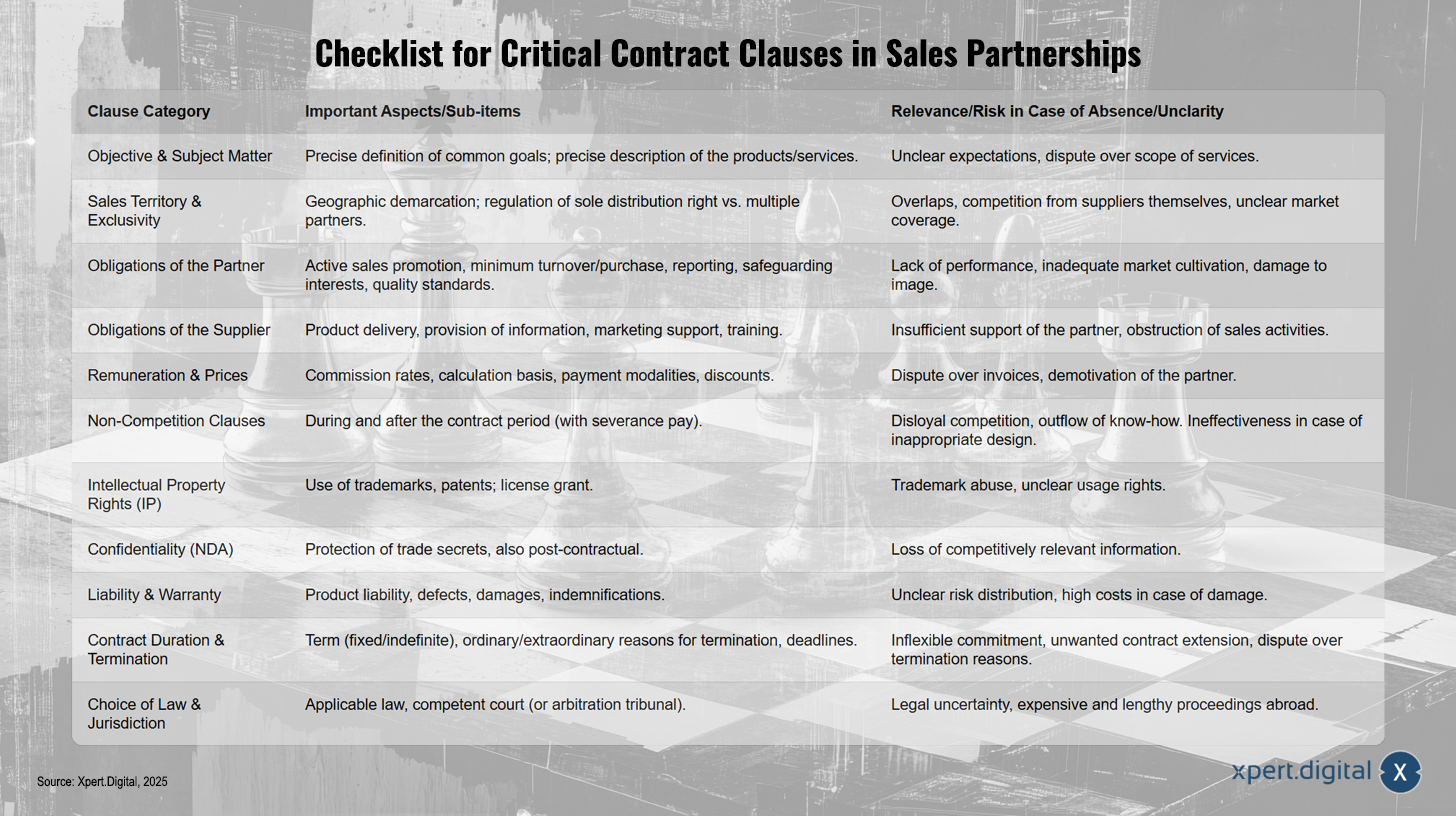
Checklist for critical contract clauses in distribution partnerships – Image: Xpert.Digital
The checklist for critical contract clauses in distribution partnerships encompasses various categories that should address essential aspects to minimize risks and conflicts. First, it is crucial to clearly define the contract's objective and subject matter by precisely establishing shared goals and accurately describing the products or services to avoid unclear expectations and disputes. Regarding sales territory and exclusivity, geographical boundaries should be defined, along with provisions for exclusive distribution rights and multiple partners, to prevent overlaps, competition from the supplier itself, and ambiguities concerning market coverage.
The partner's responsibilities include aspects such as active sales promotion, minimum sales targets, reporting, safeguarding interests, and adherence to quality standards, as poor performance or inadequate market coverage can lead to problems. Conversely, the supplier's responsibilities should also be clearly defined, including product delivery, provision of information, marketing support, and training, as insufficient support could hinder sales activities.
Compensation and pricing are also essential, with commission rates, calculation methods, payment terms, and discounts being clearly defined to avoid disputes over billing and potential demotivation of the partner. Non-compete clauses should be clearly stipulated both during and after the contract period, possibly including compensation for the restraint period, to counteract unfair competition and the loss of know-how. However, the terms must be reasonable to ensure that the non-compete clauses are not rendered ineffective.
With regard to intellectual property rights such as trademarks, patents, and licenses, their use should be clearly regulated to prevent trademark infringement and unclear usage rights. Non-disclosure agreements (NDAs) ensure that trade secrets remain protected, even beyond the contract term, to prevent the loss of competitively relevant information. Liability and warranties must also be precisely defined, particularly concerning product liability, defects, damages, and indemnification, to avoid unclear risk allocations and high costs in the event of claims.
Furthermore, clear provisions regarding contract duration and termination are necessary. These include stipulations about the contract's term (fixed or indefinite), ordinary and extraordinary grounds for termination, and corresponding notice periods to avoid inflexible commitments, unwanted contract renewals, or disputes over termination grounds. Finally, the choice of law and the place of jurisdiction should also be clearly defined. By specifying the applicable law and the competent court—or, if necessary, an arbitration tribunal—legal uncertainties and costly, lengthy proceedings abroad can be avoided.
Unclear or unfair contract clauses are a major cause of future conflicts and the potential failure of distribution partnerships. Proactive, detailed, and balanced contract drafting is therefore not only a legal necessity but also a crucial investment in the longevity and success of the collaboration. The emphasis on the importance of clearly defining goals and tasks, the warning against vague terms, and the need to unambiguously establish responsibilities to reduce disputes, as well as the recognition that unrealistic expectations and unclear role assignments frequently lead to conflict, all underscore this point. The contract is thus not merely a legal formality but a fundamental instrument for managing the partnership. Deficiencies in contract drafting almost inevitably lead to operational problems, misunderstandings, and a loss of mutual trust, which can jeopardize the entire partnership.
Special features of international contracts (especially in the EU context)
In distribution partnerships that extend beyond national borders, especially in a European context or with partners in third countries, additional contractual aspects become important and require special attention:
- Choice of law: It must be clearly stipulated which national law is to apply to the contract. Despite harmonization efforts within the EU, the national contract law of the member states still differs. A clear choice-of-law clause provides legal certainty in this regard. If no choice of law is made, the law of the state in which the distributor is based or performs its characteristic service often applies. However, it is important to note that mandatory provisions, such as competition law, are generally governed by the law of the state in which the distribution actually takes place and has an effect, and cannot be circumvented by a choice-of-law clause.
- Jurisdiction: It should be agreed which court has jurisdiction in the event of disputes between the contracting parties. A jurisdiction agreement is common in international contracts and often very useful to avoid costly and lengthy disputes over jurisdiction.
- Arbitration: As an alternative to state courts, an arbitration clause can be considered. Arbitration can offer advantages in international disputes, such as greater neutrality of the decision-makers, specific expertise of the arbitrators, higher confidentiality of the proceedings, and often better international enforceability of arbitral awards.
- Language of the contract: It is important to define the binding contract language. If contracts are translated into multiple languages, it should be clarified which language version will prevail in case of differing interpretations. The accuracy and quality of the translations must be given the utmost priority.
- Import/export regulations, customs duties, taxes: In cross-border trade, country-specific import and export regulations, customs duties, excise taxes, and VAT regulations can significantly influence pricing, delivery obligations, and the overall economic viability of the partnership. These aspects must be considered in the contract, and responsibilities must be clearly assigned.
These additional aspects increase the complexity of international distribution agreements and require careful review and, if necessary, the involvement of legal advisors with expertise in international contract law.
While EU competition law, particularly the Vertical Block Exemption Regulation (VBER), sets clear limits on anti-competitive agreements in distribution contracts, it also provides a so-called "safe haven" for many typical distribution arrangements. Companies should therefore view these regulations not only as a potential restriction of their contractual freedom, but also as a framework that enables permissible and competition-promoting collaborations and ensures their legal certainty. For example, the VBER permits certain exclusive contracts or selective distribution systems under defined conditions and market share thresholds. This means that not every form of restriction on the partner is prohibited per se. Companies that comply with the requirements and market share thresholds of the VBER can structure their distribution agreements with a high degree of legal certainty. A thorough understanding of these European regulations thus enables companies to implement their distribution strategy more effectively and in compliance with the law, instead of foregoing potentially advantageous but seemingly complex contractual arrangements out of excessive caution or lack of knowledge.
An often underestimated but potentially significant cost factor when terminating distribution partnerships is the commercial agent's compensation claim under Section 89b of the German Commercial Code (HGB), which is based on the EU Commercial Agents Directive. This claim is intended to compensate the agent for the benefits they generated from the customer base that remain with the company after the contract ends. This compensation claim is mandatory and can hardly be effectively excluded by contract. Under certain conditions developed by case law, such a compensation claim may also apply analogously to authorized dealers if they are integrated into the manufacturer's sales organization in a similar way to a commercial agent and perform comparable tasks. This represents a hidden complexity that must be taken into account in the financial planning and risk assessment of distribution partnerships. Companies that work with commercial agents or certain types of closely integrated authorized dealers should therefore include the possibility of this claim in their calculations and, if necessary, create provisions to avoid being surprised by substantial financial demands at the end of the contract. As mentioned, a contractual exclusion of this claim is usually only possible to a very limited extent or not at all and should therefore not be considered a reliable safeguard.
Management and further development of sales partnerships
Successfully establishing a sales partnership is only the first step. Proactive management and continuous development of the relationship are essential for long-term success.
Building a strong partnership
The foundation of any successful and lasting sales partnership is a strong, trusting relationship between the companies involved. The following aspects are of central importance here:
- Open and regular communication: Transparent, honest, and continuous communication is the fundamental prerequisite for building trust and ensuring smooth collaboration. This includes not only communicating when problems arise, but also a planned and regular exchange about goals, progress, challenges, and market observations.
- Building trust: Trust develops over time and is based on reliability, honesty, transparency in actions, and keeping promises. It is the result of consistently positive experiences in collaboration.
- Shared objectives and strategic alignment: It must be ensured that both partners pursue the same overarching goals and that their respective strategies and measures are aligned to leverage synergies and avoid conflicting objectives. Defining SMART goals (Specific, Measurable, Achievable, Relevant, Time-bound) for the partnership can be helpful in this regard, similar to goal setting in CRM.
- Clear roles and responsibilities: A clear definition and demarcation of the roles, tasks and responsibilities of each partner avoids misunderstandings, duplication of effort and potential conflicts from the outset.
- Value proposition for the partner: The sales partner must recognize a clear and compelling benefit in collaborating with the company. This benefit often extends beyond purely monetary aspects such as commissions and can include, for example, access to innovative products, a strong brand, excellent support, or new technologies. A clearly communicated value proposition motivates the partner and strengthens the relationship.
A good, resilient relationship is not only pleasant, but also forms the foundation for the long-term success and sustainable motivation of the sales partner.
Effective onboarding, training and support for partners
To ensure that sales partners can effectively market and sell the company's products or services, structured onboarding as well as continuous training and support measures are essential:
- Structured onboarding: New sales partners should be systematically introduced to the products or services, the relevant company processes, the systems to be used (e.g., CRM, PRM portal), and the fundamental company culture. A well-planned onboarding process accelerates the learning curve and lays the foundation for successful collaboration.
- Regular training: Continuous professional development is crucial to keeping partners' knowledge up-to-date. This includes product training (especially for new products or updates), sales training to improve closing techniques, training on marketing campaigns, and instruction on the IT systems and sales tools used. Suitable formats include webinars, e-learning courses, in-person workshops, and mentoring programs where experienced partners support new or less experienced colleagues.
- Provision of resources: Distributors need access to up-to-date and high-quality sales and marketing materials. These include product brochures, presentations, price lists, technical data sheets, case studies, and templates for offers or communication materials.
- Continuous support: There should be clear contact persons and support channels for sales partners, whom they can turn to with questions, problems, or suggestions. Fast and competent support when needed is a key factor for partner satisfaction and performance.
Well-informed and professionally supported sales partners are not only more efficient and successful in sales, but are also generally more loyal and more committed to the company. Investments in partner onboarding, training, and ongoing support thus pay off directly in higher partner performance and stronger partner retention. Neglecting these aspects, on the other hand, often leads to demotivated, poorly informed, and ultimately less successful partners. When partners don't feel adequately informed and supported, their ability and motivation to effectively sell the company's products or services decrease. This results in poorer sales performance, which in turn strains the relationship between the company and its partners. This illustrates that partner management is an ongoing process of empowerment and support, and not merely a control function.
Definition of clear key performance indicators (KPIs) and performance management
Systematic performance management is crucial to ensure that the sales partnership delivers the desired results and to be able to react to potential problems or deviations at an early stage:
- Joint definition of KPIs (Key Performance Indicators): Together with the sales partner, clear, measurable, achievable, relevant, and time-bound (SMART) goals and performance indicators should be defined. Typical KPIs in sales partner management include, for example, sales targets, market share development, number of leads generated, conversion rates, customer satisfaction scores, or the speed of market penetration.
- Regular monitoring and reporting: The partner's performance should be continuously tracked and documented using the agreed KPIs. This requires transparent reporting structures and processes.
- Feedback sessions: Regular and open communication about performance, current challenges, successes, and areas for improvement is essential. These discussions should be constructive and give both sides the opportunity to give and receive feedback.
- Incentive systems and commission models: Attractive and fair compensation models that reward partner performance and incentivize above-average results are a key motivational factor. These can include tiered commissions, bonuses for achieving targets, or other performance-related incentives.
Systematic performance management creates transparency, promotes accountability, and enables the partnership to be actively managed and continuously optimized.
Use of Partner Relationship Management (PRM) systems
As the number of sales partners increases or the complexity of the partner program grows, the use of specialized software solutions for partner relationship management (PRM) can become very advantageous or even essential:
- Definition and purpose: PRM systems are software applications that help companies efficiently manage, control, and optimize their collaboration with their sales partners.
- Key features: Typical features of a PRM system include a central partner portal for accessing information and resources, tools for lead management and deal registration (to avoid channel conflicts), communication tools, a library of marketing and sales materials, features for performance tracking and partner data analysis, modules for managing commission statements, and integrated platforms for training and certifications.
- Advantages: The use of a PRM system can lead to significant increases in efficiency in partner management, improve transparency for both sides, simplify communication and support the scalability of the entire partner program.
- Selection criteria for a PRM system: When selecting a PRM solution, companies should pay attention to criteria such as the desired level of automation, the flexibility and scalability of the platform, the ease of use (both for their own team and for partners), the ability to integrate with existing systems (especially CRM systems) and the quality of the support offered.
PRM systems are a crucial tool for professionally managing partner programs and unlocking the full potential of sales partnerships. With the increasing complexity of partner networks and the growing need for data-driven decisions, the use of PRM systems is evolving from an optional "nice to have" to a strategic necessity for efficient partner management, especially in an international context. Manually managing numerous aspects such as onboarding, marketing support, lead distribution, and performance measurement across a multitude of partners, potentially in different countries, time zones, and with varying agreements, is extremely error-prone, time-consuming, and inefficient. PRM systems provide the necessary structure, automate routine tasks, and create the required transparency for all stakeholders. Companies that want to successfully scale and professionalize their partner programs should therefore invest in relevant technologies early on to reduce administrative overhead and focus on the strategic development of their partnerships.
Conflict management and solution strategies
Conflicts are not uncommon in business partnerships and can arise from differing expectations, goals, communication problems, or external market changes. A proactive and structured approach to conflict resolution is crucial to prevent lasting damage to the relationship and to ensure continued collaboration
- Early detection of conflict signals: It is important to be sensitive to the first signs of disagreements or problems. These can include changes in the partner's communication behavior, a decline in performance, repeated complaints, or a generally tense atmosphere. Early detection allows for timely intervention (analogous to the principles for dealing with customer conflicts).
- Establishing clear conflict resolution processes: Ideally, clear processes and escalation levels for dealing with disagreements and conflicts should be defined in advance or in the partnership agreement. This includes naming contact persons on both sides who are responsible for conflict resolution.
- Open communication and collaborative problem-solving: Emerging problems should be addressed directly, openly, and respectfully. The goal should be to jointly analyze the causes of the conflict and seek solutions that are acceptable to both sides (win-win approach).
- Mediation or conciliation: In cases of deadlocked conflicts where the parties cannot find a solution on their own, the involvement of a neutral third party in the form of mediation or conciliation can be beneficial. This can help restore communication and prevent escalation into legal disputes.
- Contractual provisions for dispute resolution: As already mentioned in the section on contract drafting, contracts should contain clauses on choice of law and jurisdiction or arbitration, which apply in the event of an irresolvable conflict.
A constructive approach to conflict can even strengthen a partnership by showing that both sides are interested in long-term cooperation and are willing to overcome challenges together.
The "value proposition" is not only crucial for acquiring end customers but also plays a critical role in acquiring and retaining sales partners long-term. Partners must clearly and convincingly understand why collaborating with this specific company is particularly advantageous for them. This benefit often extends beyond the commission rate alone and can include aspects such as access to highly innovative and in-demand products, a strong and well-known brand name that facilitates sales, excellent technical and sales support, the opportunity to tap into new customer segments, or access to advanced technologies and training programs. Partners choose which companies they cooperate with, as they often work with multiple providers, including competitors. A company that offers its sales partners a clear, differentiated, and compelling added value will be favored in partner selection and can expect a higher level of commitment and loyalty. This means that companies must actively market their partnership offerings as a kind of "product" to potential partners and differentiate themselves in the competition for the best partners.
Successful partner management requires a careful balance between standardized, efficient processes and individualized support tailored to the specific needs of each partner. On the one hand, the advantages of systematization through PRM systems and the need for clear, measurable KPIs underscore the importance of structured processes. On the other hand, aspects such as "offering tailored support" and the importance of "personal service for your partners" highlight the need for individualized approaches. A purely system-driven approach to partner management can quickly become impersonal and demotivating, while an exclusively individualized approach is not scalable and inefficient with a large number of partners. The best partner management strategies therefore leverage technology and standardized processes to simplify administrative tasks and free up resources. These resources can then be used for high-quality, personal interactions, flexible adaptation to the needs of individual partners, and the building of strong, trusting relationships.
Our recommendation: 🌍 Limitless reach 🔗 Networked 🌐 Multilingual 💪 Strong sales: 💡 Authentic with strategy 🚀 Innovation meets 🧠 Intuition

From local to global: SMEs conquer the global market with clever strategies - Image: Xpert.Digital
At a time when a company's digital presence determines its success, the challenge is how to make this presence authentic, individual and far-reaching. Xpert.Digital offers an innovative solution that positions itself as an intersection between an industry hub, a blog and a brand ambassador. It combines the advantages of communication and sales channels in a single platform and enables publication in 18 different languages. The cooperation with partner portals and the possibility of publishing articles on Google News and a press distribution list with around 8,000 journalists and readers maximize the reach and visibility of the content. This represents an essential factor in external sales & marketing (SMarketing).
More about it here:
Success factors for sales partnerships: Cultural intelligence, clear rules, and sustainable collaboration
Cultural intelligence in European sales
Successfully establishing and managing sales partnerships in the heterogeneous European market requires a high degree of cultural intelligence. Cultural differences in business communication, relationship building, and general business practices can significantly influence success.
Understanding cultural differences in business communication and relationship building in Europe
Although generalizations should always be treated with caution, typical cultural trends in business life can be observed in various European regions, which may differ from German business culture:
- Germany: German business culture is often characterized by a strong focus on tasks, a direct and explicit communication style, and a high value placed on punctuality, detailed planning, and adherence to rules. Formal address (“Sie”) is widespread, and hierarchies are generally respected. Building deep personal relationships often plays a less significant role in a purely business context than professional competence and the quality of the product or service.
- Northern Europe (Scandinavia): An egalitarian attitude often prevails here. Punctuality and efficiency are also important, as is a strong work-life balance. Communication tends to be direct, but polite and often less formal than in Germany. Decisions are frequently made by consensus. Ostentatious gestures or expensive gifts are generally avoided, as they could be interpreted as inappropriate or as an attempt at bribery.
- Southern Europe (Italy, Spain, Portugal, Greece): Building a personal relationship and mutual trust is often a fundamental prerequisite for successful business deals in these cultures and can take considerably more time. Timelines and agendas may be handled more flexibly. Communication may be more indirect and context-dependent. Hierarchies can play a role, and hospitality and social interactions are often important components of business relationships.
- Eastern Europe (e.g., Poland, Czech Republic, Hungary): Here, too, building trust is an important aspect. Communication, similar to Southern Europe, can be more indirect and context-dependent. Respect for hierarchies and formal etiquette may be more pronounced. Initial reticence with new business contacts is not uncommon but can be overcome by developing a personal relationship.
- Western Europe (e.g., France, Benelux): In countries like France, professionalism, structure, and formal communication are often highly valued. The importance of the national language alongside English can be greater here, similar to Russia, than in other regions of Europe.
Generally speaking, some Europe-wide trends can be observed: A handshake is a common form of greeting, formal attire is appropriate in most business situations, and respectful communication is expected. However, the significance of academic or professional titles can vary from country to country. Cultural misunderstandings resulting from a failure to recognize such differences can significantly strain business relationships or, in the worst case, even cause them to fail.
Cultural business etiquette compared: Germany vs. selected European regions
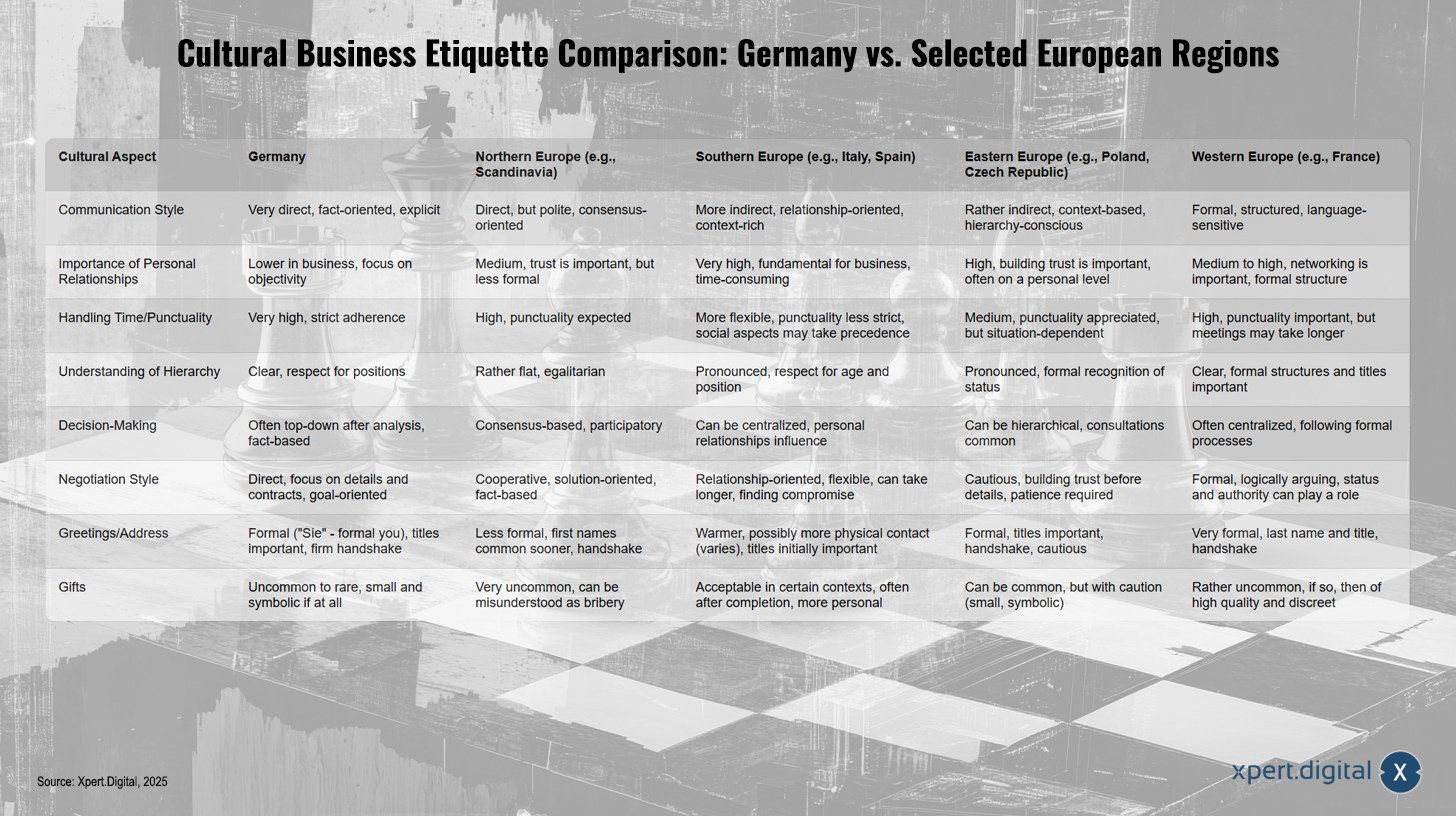
Cultural business etiquette compared: Germany vs. selected European regions – Image: Xpert.Digital
A comparison of cultural business etiquette between Germany and selected European regions reveals significant differences in communication, relationships, time management, hierarchy, decision-making, negotiation style, greetings, and gifts. In Germany, the communication style is very direct, factual, and explicit, whereas in Northern Europe it is more polite and consensus-oriented, in Southern Europe more indirect and relationship-oriented, in Eastern Europe context-dependent and hierarchy-conscious, and in Western Europe formal and linguistically sensitive. Personal relationships play a less significant role in Germany, while they are fundamental in Southern Europe, highly valued in Eastern and Western Europe, and rated at a moderate level in Northern Europe. Punctuality is of paramount importance in Germany, similar to Northern and Western Europe, although more flexible views prevail in Southern Europe, where social aspects may take precedence. In Eastern Europe, punctuality is also valued but is situation-dependent.
The understanding of hierarchy is clearly defined in Germany, while in Northern Europe it tends to be flatter and more egalitarian. In Southern and Eastern Europe, on the other hand, hierarchy is strongly pronounced and respected, and in Western Europe, formal structures and titles retain significant importance. Decisions in Germany are often made top-down and based on facts, whereas in Northern Europe a consensus-based, participatory approach is preferred. In Southern Europe, decision-making can be centralized and influenced by personal relationships, in Eastern Europe consultations are common, and in Western Europe it often follows formal processes.
German negotiations are direct, goal-oriented, and focus on details and contracts, while in Northern Europe, negotiations are cooperative, solution-oriented, and fact-based. Southern European negotiations are relationship-oriented, flexible, and can take longer, while in Eastern Europe, patience and building trust are key. In Western Europe, a formal and logically argumentative negotiation style, with a focus on status and authority, plays a more significant role. Greetings in Germany are formal, with a firm handshake and the use of formal address ("Sie") and titles, while in Northern Europe, first names become more common. In Southern Europe, greetings are warmer with potentially more physical contact; in Eastern Europe, they are formal with a handshake and titles; and in Western Europe, they are highly formal, using surnames and titles. Gifts are rare and symbolic in Germany, very uncommon in Northern Europe, and could be misinterpreted as bribery. In Southern Europe, they are acceptable in certain contexts, common with caution in Eastern Europe, and, if given at all in Western Europe, of high quality and discreet.
Adapting sales and management strategies to local conditions
A successful European sales strategy requires more than just the translation of marketing materials; it requires genuine cultural adaptation and localization at various levels:
- Language: The use of the respective national language in all communication with partners and end customers, in marketing materials, on websites, in training materials, and in technical support is crucial. This is especially true for products or services that require explanation, where nuances and precise wording are important. Studies show that a significant proportion of EU citizens do not speak a foreign language and may therefore not understand or may not respond as positively to content not written in their native language.
- Sales pitch (value proposition): The core value proposition of the product or service must be adapted to the specific local needs, cultural values, and purchasing motives of the target customers in each country. What is a strong sales argument in one country may be less relevant in another.
- Negotiation tactics: Negotiations with potential partners or major clients should take local negotiation styles and expectations into account. This includes aspects such as directness, handling of concessions, the importance of deadlines, and creating a favorable negotiating atmosphere.
- Management style: The leadership style and the way of communicating with established sales partners should also be adapted to cultural customs in order to ensure effective and harmonious cooperation.
- Marketing and advertising: Marketing campaigns and advertising messages must be carefully localized to ensure cultural relevance and avoid unintentional misinterpretations or even offense. This applies to imagery, tone of voice, and the choice of channels.
- Product presentation and adaptation: In some cases, even minor modifications to the product or service itself may be necessary to meet local preferences, legal regulations, or technical standards in the target market.
The importance of trust and long-term relationships in different cultures
While German business culture often prioritizes objectivity and efficiency, in many other European cultures, particularly in Southern and Eastern Europe, building a solid foundation of personal trust is an essential prerequisite for establishing and maintaining successful, long-term business relationships. This trust-building process can require significantly more time and patience than in Germany and often includes more informal interactions outside of a purely business context, such as shared meals or social events. Impatience or an overly direct, purely factual approach can be perceived as impolite, disinterested, or even disrespectful in some European cultures, thus hindering or at least complicating the development of a sustainable partnership from the outset.
A lack of cultural intelligence and sensitivity not only leads to avoidable misunderstandings in communication, but can also be interpreted by potential or existing partners as a lack of appreciation or genuine interest in the local market. This undermines the necessary trust and significantly reduces the willingness to cooperate. If a company ignores the basic forms of courtesy, communication styles, or business practices of a country, it may signal to the potential partner a lack of respect or insufficient commitment to that specific market. This, in turn, makes it considerably more difficult to build the foundation of trust that is so crucial for a successful and long-term partnership.
The need for profound cultural adaptation presents companies with a strategic decision: either to invest in comprehensive training of their own employees in intercultural competence and the relevant local languages, or to strategically utilize local employees or sales partners who already possess these essential skills and the necessary cultural sensitivity. The recommendation to invest in qualified personnel who are fluent in the local language and familiar with the cultural specifics of the target region, along with the observation that local sales representatives often have a better grasp of local regulations and customs, points to a "make-or-buy" decision: either to provide extensive training for their own team (which requires time, resources, and continuous effort) or to purchase external expertise in the form of local partners, consultants, or employees who can already build this cultural bridge. For small and medium-sized enterprises (SMEs), the second option is often the faster, more cost-effective, and less risky way to gain a foothold in new European markets.
While a comprehensive adaptation to local cultures is essential for success in international business, companies should be careful not to completely abandon or dilute their core values, unique brand identity, and fundamental ethical principles. It's about intelligent and sensitive adaptation to local conditions, not complete assimilation that obscures their own identity. While relevant sources emphasize the need for adaptation, they do not imply that companies should lose their fundamental direction. A successful international brand often manages to combine global consistency in its core messages and quality standards with strong local relevance in its messaging and offerings. This requires a delicate balance, where companies act with cultural sensitivity and flexibility while remaining authentic and preserving and leveraging the strengths of their own established corporate culture and brand. A deep understanding of both their own identity and the respective target culture is a prerequisite for this.
Government and institutional support for building distribution partnerships
Companies wishing to establish distribution partnerships in Germany or other European countries can access a range of government and institutional support programs. These can help reduce costs, minimize risks, and facilitate access to markets and partners.
Funding programs and initiatives in Germany
Several German states and the federal government offer funding programs to support companies in their internationalization efforts. Examples include:
- “Go International” (Bavaria): This funding program of the Free State of Bavaria is specifically aimed at small and medium-sized enterprises (SMEs) and provides them with financial support for developing up to two new foreign markets. Funding is provided for, among other things, first-time participation in international trade fairs, the creation or translation of marketing materials, product certifications for foreign markets, and intercultural employee training.
- Bavarian Trade Fair Participation Program: This program offers specific support for the participation of Bavarian companies in selected trade fairs at home and abroad.
- Delegation and business trips: Many German states, business associations, and chambers of industry and commerce regularly organize delegation and business trips to target markets. These trips offer an excellent platform for making initial contacts with potential business partners, learning about local market conditions, and expanding one's network.
- Digital Bonus (Bavaria): Although not specifically aimed at sales partnerships, grants from this program can be used for the digitization of business processes, including sales and marketing activities, which can indirectly support the establishment and maintenance of partner relationships.
Knowledge and use of these and similar programs at the state and federal levels can significantly reduce the financial burden of market entry and partner search, and enable access to valuable resources.
EU funding programs
There are also various funding programs at the European level that may be relevant for companies with international sales ambitions:
- COSME (Program for the Competitiveness of Enterprises and SMEs): This EU program aims to strengthen the competitiveness of businesses, particularly SMEs. It can support projects in areas such as digitalization, the development of new business models, and access to finance, which are also relevant for building international sales structures.
- Creative Europe: This program supports projects in the cultural and creative sectors. For companies in industries such as music, books and publishing, design, fashion, or cultural heritage, it can offer support for measures aimed at the international dissemination and distribution of their products and services.
- Enterprise Europe Network (EEN): The EEN is a network co-financed by the European Commission with contact points in numerous countries. It offers SMEs free and practical support in finding international business, technology, and research partners, provides information on EU legislation and funding programs, and helps with access to financing.
- Funding database of the federal government, the states, and the EU: A central point of contact for researching suitable funding programs is the funding database of the Federal Ministry for Economic Affairs and Climate Action. It offers a comprehensive overview of current funding initiatives at the national and European levels.
The European Union offers a wide range of programs which, while not always directly aimed at finding sales partners, can indirectly promote the development of international business relationships and sales structures. However, the sheer number of funding programs at the German and EU levels can quickly become overwhelming for companies, especially SMEs. The mere existence of programs is not enough; companies need guidance and often support to identify the funding opportunities that best suit their specific needs and to submit successful applications. Proactive research, for example using the aforementioned funding database, as well as individual consultation with institutions such as the Chambers of Industry and Commerce (IHKs), the German-speaking Chambers of Commerce Abroad (AHKs), Germany Trade & Invest (GTAI), or the Enterprise Europe Network, is therefore often necessary to effectively utilize these financial and advisory resources. The complexity of the application procedures and compliance with the respective funding guidelines can present additional hurdles, and professional support is invaluable in overcoming these challenges.
The role of Germany Trade and Invest (GTAI) and German Chambers of Commerce Abroad (AHKs)
For German companies expanding internationally and seeking sales partners abroad, Germany Trade and Invest (GTAI) and the network of German Chambers of Commerce Abroad (AHKs) are central and often the first point of contact:
- Germany Trade and Invest (GTAI): As the economic development agency of the Federal Republic of Germany, GTAI's mission is to promote Germany as a business location internationally and to support foreign companies in establishing operations in Germany. At the same time, it provides comprehensive support to German companies in their export activities and in developing foreign markets. GTAI provides detailed market information, industry analyses, and information on the legal and tax frameworks in target countries, and assists in establishing contacts with potential business partners or relevant institutions abroad. It works closely with the global network of German Chambers of Commerce Abroad (AHKs). GTAI also informs German companies about tenders and specific business inquiries from potential foreign partners.
- German Chambers of Commerce Abroad (AHKs): The global network of German Chambers of Commerce Abroad (AHKs), delegations, and representative offices of German industry is present in over 90 countries at more than 150 locations. The AHKs are the direct point of contact for German companies in their respective foreign markets. They offer a wide range of services, from general market entry consulting and detailed address research to targeted searches for suitable business partners (distributors, sales representatives, importers, etc.), as well as support with contract negotiations and the organization of business meetings, business trips, and trade fair participation. A key advantage of the AHKs is their in-depth local market knowledge, their established networks with decision-makers in the host country's business and government sectors, and the fact that their staff are generally bilingual and can act as cultural mediators.
The close cooperation and complementary division of tasks between GTAI and the German Chambers of Commerce Abroad (AHKs) create a particularly effective and comprehensive support network for German companies seeking to do business abroad. While GTAI often provides overarching market analyses, strategic information, and marketing for Germany as a business location, the AHKs offer concrete, operational support and individualized consulting directly on-site in the target markets. This coordinated division of labor enables deeper and more comprehensive support than either organization could provide alone. Companies can benefit from this structure by strategically utilizing the services of both organizations in a coordinated manner.
Beyond simply connecting companies with sales partners, institutions like the German Chambers of Commerce Abroad (AHKs) can also provide support with very practical aspects of building sales structures abroad. One example is the "Incubation Solutions" offered by the German Chamber of Commerce Abroad in China (AHK China). This service allows companies to employ and support staff locally without having to immediately establish their own expensive representative office or branch in the host country. While this example is specifically related to China, it points to a broader and more flexible service portfolio offered by the AHKs that extends beyond simply facilitating contacts. For companies that have found a suitable sales partner but desire closer market support or their own local contact person, without incurring the significant costs and administrative burden of establishing their own subsidiary, this can represent an extremely valuable and cost-effective interim solution. This expands the potential benefits of collaborating with the AHKs and offers flexible models for gradually increasing a company's presence in a foreign market.
Strategic success factors for effective sales partnerships in Germany and Europe
Establishing and successfully managing distribution partnerships in Germany and Europe are complex but strategically important undertakings. They offer significant opportunities for growth, market development, and risk diversification, but require careful planning, prudent execution, and continuous management.
Key success factors
The analysis of the various aspects of distribution partnerships has revealed a number of critical success factors:
- Careful strategic planning and selection of the appropriate partnership model: A clear definition of one's own goals and a corresponding choice of sales partner model (e.g. sales representative, distributor, franchise) are fundamental.
- Thorough partner identification, evaluation and due diligence: Selecting the right partner who has the necessary resources, market knowledge and a suitable corporate culture is crucial.
- Clear, fair and comprehensive contract design: A detailed and legally sound contract that clearly regulates the rights and obligations of both sides minimizes the potential for conflict.
- Proactive and continuous partner management: Open communication, regular training and support, shared objectives and fair performance management are essential for the motivation and performance of partners.
- Cultural intelligence and adaptability: Especially in the heterogeneous European market, understanding and adapting to local cultural conditions is a key factor in business practice.
- Utilizing available support networks and funding instruments: Institutions such as Chambers of Industry and Commerce (IHKs), German Chambers of Commerce Abroad (AHKs), Germany Trade & Invest (GTAI), as well as government and EU funding programs can provide valuable assistance.
The success of building distribution partnerships is therefore not a matter of chance. Rather, it is the result of a systematic, multi-stage process that requires strategic vision, operational excellence in implementation, and a high degree of intercultural sensitivity. The preceding sections have comprehensively outlined the necessity of detailed planning (Sections II, III, IV), careful and legally sound contract drafting (Section V), continuous and dedicated management of the partner relationship (Section VI), and conscious cultural adaptation (Section VII). These elements must be integrated into a coherent overall concept. Companies that take shortcuts, neglect individual phases of the process, or underestimate the complexity run a significantly higher risk of their partnership efforts failing or not achieving the desired results.
Strategic recommendations for action
Based on the analysis, the following strategic recommendations can be derived, which are specifically tailored to the needs of companies that want to expand or optimize their sales activities in Germany and Europe through partnerships:
- For the German market:
- Systematically utilize established resources for finding partners, such as specialized online platforms (e.g. handelsvertreter.de), industry trade fairs and the consulting services of the local Chambers of Industry and Commerce.
- Define a precise ideal partner profile based on a thorough analysis of your target customers and your own strengths.
- Conduct thorough due diligence on potential partners, including reference checks and personal interviews.
- For the European market:
- Take a phased approach. Start with thorough market research for selected European target regions or countries.
- Prioritize countries or regions based on the identified market potential, the competitive situation, and the cultural and economic proximity to your own company.
- Actively utilize the support services offered by the Enterprise Europe Network (EEN), the German Chambers of Commerce Abroad (AHKs) in the target countries, and, if necessary, the expertise of specialized export consultants.
- Invest specifically in the intercultural competence of your employees or ensure that your local partners have the necessary cultural sensitivity.
- General recommendations:
- Develop a clear and compelling value proposition not only for your end customers, but also specifically for your potential sales partners. What makes a partnership with your company attractive to them?
- Consider implementing Partner Relationship Management (PRM) tools early if you plan to scale your partner network or expand into multiple markets.
- Establish robust internal processes and responsibilities for managing and supporting your sales partners.
- Consider building a successful partner network as a long-term strategic investment that requires continuous attention, nurturing, and resources. It's not a "set-it-and-forget-it" approach. Aspects such as "ongoing collaboration," the need for "continuous evaluation and adaptation," "regular meetings," and the absolute necessity of "actively cultivating relationships" all point to an ongoing, dynamic process. This implies that companies must sustainably allocate human and financial resources not only for the initial setup but also for the ongoing management and development of these partnerships.
Future developments
The landscape of distribution partnerships is constantly evolving. Future developments that companies should keep an eye on include:
- Increasing importance of digital partner ecosystems and platform-based sales models: The role of online marketplaces, affiliate networks and integrated digital platforms as sales channels and partners will continue to grow.
- Increasing demand for sustainability and ethical considerations: Consumer and business partners' expectations regarding environmental and social responsibility are rising. This will increasingly influence the selection of distribution partners and the structuring of collaborations. The statement that consumers are increasingly seeking environmentally friendly and socially responsible products can imply that companies will prefer partners who share these values and can credibly represent them.
- Further professionalization of partner management through technology: The use of artificial intelligence (AI), advanced data analysis and automated processes will further change partner management and make it more efficient.
The ability to not only manage distribution partnerships efficiently, but also to innovate together with partners, identify new market opportunities, and adapt flexibly to rapidly changing market conditions will become an increasingly important competitive advantage. The mention of innovation and growth through partnerships, and the necessity of adapting sales strategies to new markets as a success factor, goes beyond purely operational management. It points to a more strategic, co-creative dimension of partnerships. Future-oriented companies will therefore view their distribution partners not merely as sales channels, but rather as an integral part of their extended innovation ecosystem and as strategic allies on the path to sustainable market success.
We are there for you - advice - planning - implementation - project management
☑️ SME support in strategy, consulting, planning and implementation
☑️ Creation or realignment of the digital strategy and digitalization
☑️ Expansion and optimization of international sales processes
☑️ Global & Digital B2B trading platforms
☑️ Pioneer Business Development

Konrad Wolfenstein
I would be happy to serve as your personal advisor.
You can contact me by filling out the contact form below or simply call me on +49 7348 4088 965 (Munich) .
I'm looking forward to our joint project.
Write to me

Xpert.Digital - Konrad Wolfenstein
Xpert.Digital is a hub for industry with a focus on digitalization, mechanical engineering, logistics/intralogistics and photovoltaics.
With our 360° business development solution, we support well-known companies from new business to after sales.
Market intelligence, smarketing, marketing automation, content development, PR, mail campaigns, personalized social media and lead nurturing are part of our digital tools.
You can find out more at: www.xpert.digital - www.xpert.solar - www.xpert.plus
Keep in touch






