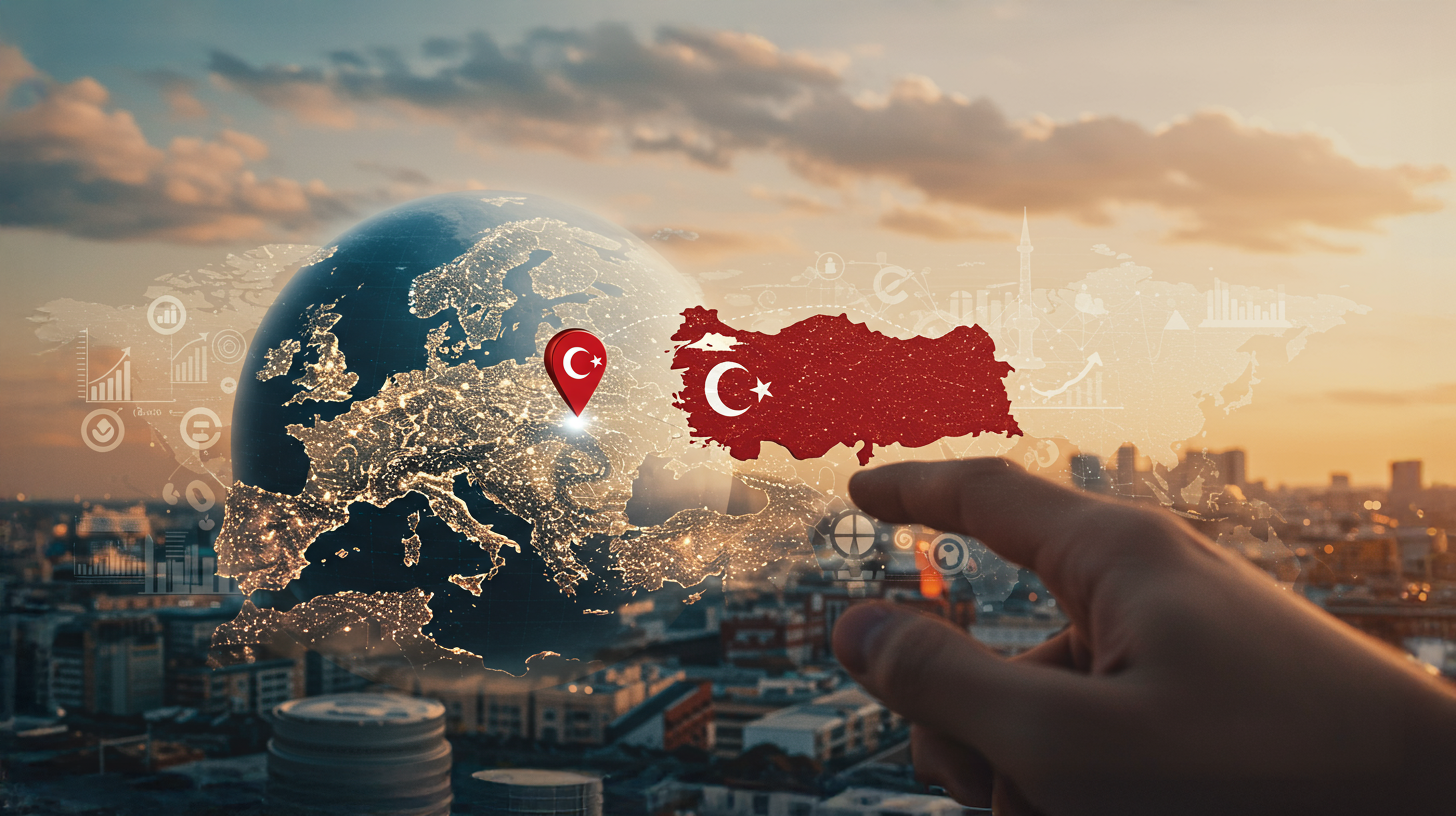
Turkey as a key strategic partner for Europe – Image: Xpert.Digital
Indispensable and unpredictable: Why Europe needs Turkey now more than ever
### Erdogan's Super Army: How Turkey is becoming a new military power on Europe's doorstep ### Values overboard? Why Germany is now supplying fighter jets to Erdogan ### Friend and foe at the same time: Turkey's risky double game between Putin and the West ### More than just drones: This new Turkish fighter jet is challenging the US and Europe ###
No EU membership, but partners: Europe's new, pragmatic plan for Turkey
Turkey, under President Recep Tayyip Erdoğan, is increasingly positioning itself as a key player in the European security architecture. This development is not accidental, but rather the result of fundamental geopolitical shifts. With the changing global balance of power, uncertainty surrounding American security guarantees under various US presidents, and the challenges posed by Russian aggression, Ankara sees a historic opportunity to solidify its strategic importance for Europe.
The Turkish leadership argues that European security is simply inconceivable without Turkey. Erdogan underpins this position with concrete figures: Turkey has the second-largest army in NATO with 355,000 soldiers, significantly more than France with 202,000 or Great Britain with 141,000. It is a battle-tested army with practical operational experience in various conflict zones, from Syria and Libya to supporting Ukraine.
What distinguishes Turkish foreign policy from the European approach?
Turkey is already practicing what Europe is only now striving for: strategic autonomy. This independence stems from the country's geographical location and military strength. Ankara controls access to the Black Sea through the Bosporus and Dardanelles straits and projects its power as far as the South Caucasus and the Middle East.
Turkish foreign policy is characterized by a pragmatic balancing act. While Ankara supports Ukraine with weapons and defends its territorial integrity, it simultaneously maintains profitable trade relations with Russia. This "cold-blooded balancing act" allows Turkey to present itself both as an honest broker to the war's opponents and to participate in meetings of the "coalition of the willing," which discusses military security guarantees for Ukraine.
What role does the Eurofighter deal play in German-Turkish relations?
The sale of 40 Eurofighter Typhoon fighter jets to Turkey, approved in July 2025, marks a significant turning point in German policy towards Turkey. After more than two years of hesitation, the German government under Chancellor Friedrich Merz gave the green light for the deal, even though a Turkish court had shortly before sentenced Istanbul Mayor Ekrem Imamoglu, a prominent critic of Erdogan, to prison.
This decision illustrates the shift from a values-based to an interest-driven foreign policy. European states are increasingly pursuing a pragmatic power policy with their difficult partner on the Bosporus, replacing a generally critical stance towards Ankara due to human rights violations and democratic deficits.
The Eurofighter deal also confirms Turkey's strategy of diversifying its defense procurement. The share of American imports has declined sharply over the past ten years, while Spain, Italy, and Germany have become the new leading importers. For Turkey, the EU's SAFE loan program for joint defense procurement, with its €150 billion budget, is a particular incentive, as it is also open to candidate countries like Turkey.
How is the Turkish arms industry developing into a global player?
Over the past two decades, Turkey has become a major arms exporter. Exports reached a record high of US$7.15 billion in 2024 and are projected to reach US$8 billion in 2025. This development is the result of strategic investments and the direct subordination of the Defense Industry Agency to President Erdoğan in 2018.
Turkish drone manufacturers like Baykar have been particularly successful; their Bayraktar TB2 drones have been sold in more than 35 countries and used in conflicts from Ukraine to Libya. The company is expanding internationally through the acquisition of the Italian company Piaggio Aerospace and a joint venture with Leonardo called LBA Systems.
A milestone in the Turkish defense industry is the fifth-generation KAAN fighter jet, developed by Turkish Aerospace Industries. Series production is scheduled to begin in 2028, and Turkey has already secured its first export contract with Indonesia for 48 KAAN jets, worth approximately US$15 billion. This project makes Turkey one of the few countries capable of developing and exporting fifth-generation fighter jets.
What strategic interests does Turkey pursue in the Black Sea?
The Black Sea occupies a central position in Turkey's security strategy. Through the Montreux Convention, Turkey controls the only access routes between the Mediterranean and the Black Sea. This position gives Ankara considerable geopolitical influence, especially since Russia's invasion of Ukraine.
Turkey and Russia have established a kind of informal condominium in the Black Sea region, designed to exclude external actors. This shared vision of a regional order is evident in how Turkey interpreted the Montreux Convention after the outbreak of war and how the Black Sea Grain Initiative came about. Nevertheless, Ankara maintains a dual balance: it supports Ukraine's territorial integrity while simultaneously cultivating profitable relations with Russia.
For Turkey, it is crucial that it desires a Russian neighbor strong enough to maintain regional order, but one that does not engage in revanchist, military adventures. This position allows Ankara to establish itself as an indispensable mediator in the region.
How do European positions towards Turkey differ?
European countries pursue different approaches in their relations with Türkiye. Analysts at the German Institute for International and Security Affairs (SWP) distinguish three groups of states: friends, partners, and rivals.
The "friends" include Poland, Spain, Italy, and the non-EU member United Kingdom. These countries maintain close security policy and, in some cases, defense cooperation with Turkey and wish to further deepen their relations with Ankara. For example, the UK recently signed a Memorandum of Understanding for the sale of the Eurofighter and works closely with Turkey on various defense projects.
The partners include Sweden, Finland, and Germany, which, for security policy reasons, favor a cautious approach. Berlin must balance the interests of its defense policy with those of civil society critical of Erdoğan. This balancing act is evident in the hesitant, but ultimately positive, decision to sell the Eurofighter.
The rivals are Greece, Cyprus, and France, which view European rapprochement with Turkey with reservations or even outright rejection. Historical and current conflicts play a crucial role in this. France maintains close arms cooperation with Greece and is aware of how costly an estrangement from Turkey would be, especially given its close security cooperation with the pro-Turkish United Kingdom.
Hub for Security and Defense - Advice and Information
Hub for Security and Defense - Image: Xpert.Digital
The Security and Defence Hub offers expert advice and up-to-date information to effectively support companies and organizations in strengthening their role in European security and defence policy. Working closely with the SME Connect Defence Working Group, it particularly promotes small and medium-sized enterprises (SMEs) that wish to further develop their innovative capacity and competitiveness in the defence sector. As a central point of contact, the Hub thus creates a crucial bridge between SMEs and European defence strategy.
Related to this:
Türkiye between conflict and cooperation: Europe's geopolitical challenge
What conflicts exist between Turkey and its neighbors?
Tensions between Turkey and its European neighbors are mainly concentrated in the eastern Mediterranean and the Aegean Sea. The central point of contention is territorial disputes over maritime borders and natural resources.
Turkey claims large maritime areas off its coasts as part of its "Mavi Vatan" (Blue Homeland) doctrine. If implemented, these claims would mean that the Aegean Sea, extending to the east coast of Crete, and parts of the Mediterranean Sea far south of Cyprus would fall within Turkey's exclusive economic zone. The Greek islands in this area would become enclaves.
Particularly explosive are Turkey's exploration plans for gas reserves in disputed maritime areas. Greece, Cyprus, Israel, and Egypt are cooperating on the exploitation of mineral resources in the Mediterranean – deliberately excluding Turkey. This exclusion reinforces Ankara's motivation to create facts on the ground through its own activities.
Turkey has not yet ratified the United Nations Convention on the Law of the Sea and threatens war if Greece were to invoke it. This uncompromising stance leads to recurring tensions that could erupt again at any time.
How does Turkish migration policy function as a means of exerting pressure?
The 2016 EU-Turkey agreement forms the foundation of migration policy cooperation between Europe and Turkey. Turkey committed itself to controlling irregular migration to the West and to taking back migrants who enter the EU via its territory.
In return, Turkey received a six billion euro aid package to support the more than three million Syrian refugees in the country. Additionally, the EU promised visa-free entry for Turkish citizens, a renewal of the customs union, and a revival of EU accession negotiations.
The agreement initially had an effect: the number of crossings to the Greek islands plummeted from tens of thousands to a few hundred per month. At the same time, migration shifted to land routes, with Turkish security forces preventing more than 100,000 irregular border crossings in the border city of Edirne alone between 2017 and 2018.
President Erdogan, however, does not shy away from using migrants as leverage against the EU when it suits his purposes. This instrumentalized migration policy underscores Europe's dependence on Turkish cooperation in this sensitive area.
What role will Turkey play in the future European security architecture?
The debate about a new European security architecture is gaining importance in light of the uncertainty surrounding the American role. Turkey is positioning itself as an indispensable partner in this new order, arguing that European defense would not be functional without Turkish participation.
Ankara offers concrete military capabilities: over 480,000 battle-tested soldiers, an advanced arms industry, and strategic geographical positions. Turkey has expressed openness to sending troops to Ukraine for a European peacekeeping mission and has already established itself as an important mediator in various conflicts.
The EU's SAFE instrument, adopted in May 2025, allows Turkey, as an accession candidate, to participate in joint procurement projects. However, unlike goods from Ukraine, Turkish arms products do not automatically count towards the "European" share. This distinction reflects the persistent reservations towards Ankara.
How does Turkish domestic politics influence European relations?
Turkey's authoritarian domestic policies, characterized by the erosion of democracy, deficits in the rule of law, and repression, significantly hinder the deepening of bilateral cooperation. The European Parliament reaffirmed in 2025 that Turkey's EU accession process cannot be resumed under the current circumstances.
Turkey's geopolitical and strategic importance cannot compensate for democratic setbacks, and the EU accession criteria are non-negotiable. At the same time, Europeans recognize Turkey's strategic importance and its growing presence in areas crucial to international security.
Despite close economic ties, normative differences exist between Germany and Turkey. There is no consistent strategy to overcome them; instead, the Turkish government is relying on industrial policy compensation. Leading European politicians have recently voiced their criticism of Turkey's growing democratic deficits much less forcefully, which weakens the remaining political space for Turkish opposition parties and civil society organizations.
What alternatives to full EU membership are being discussed?
Since full EU membership for Turkey has become unthinkable in the foreseeable future and hardly seems desirable to Turkey anymore, new forms of cooperation are developing. Here, the first outlines of an EU alliance policy are becoming visible, one that aims not at political integration but at pragmatic cooperation.
One alternative under discussion is a security partnership with Ankara instead of full membership. This could benefit both Turkey and the EU by promoting shared interests in security and stability issues in the region. A customs union or visa facilitation are also conceivable in the short term if the situation improves.
The European Commission has proposed the SAFE Regulation, which would allow all candidate countries, including Turkey, to participate in joint procurement projects. This could mark the beginning of a new alliance strategy, offering various countries such as Turkey, Japan, South Korea, or even India points of contact through partnership agreements.
What are the long-term prospects for EU-Turkey relations?
The future of EU-Turkey relations will depend significantly on the ability of both sides to find pragmatic compromises. Turkey has already achieved what Europe is only now striving for: strategic autonomy and the capacity to pursue an independent foreign policy.
Ankara's geopolitical double game between different partners and its refusal to commit to one side reflects a trend among regional powers that want to respond flexibly to geopolitical challenges and pursue their own independent interests. Turkey refuses to be drawn into the great power rivalry between the US and China.
For Europe, this means it must learn to deal with a self-confident partner that pursues its own interests. Traditional EU enlargement models do not work with Turkey, which is why new forms of cooperation must be developed.
A strategic rethink of European policy towards Turkey is needed. This should aim to promote economic stability, strengthen Turkey's security integration within Europe, and counteract Ankara's strategic rapprochement with Moscow or Beijing. Future cooperation should be clearly linked to conditions such as democracy, the rule of law, and human rights.
Developments show that despite all their differences, Europe and Turkey remain interdependent. The challenge lies in finding a balance between strategic interests and democratic values that is fair to both sides and contributes to stability in the region.
Consulting - Planning - Implementation

Markus Becker
I would be happy to serve as your personal advisor.
Head of Business Development
Chairman SME Connect Defense Working Group
Consulting - Planning - Implementation
Konrad Wolfenstein
I would be happy to serve as your personal advisor.
You can contact me at wolfenstein∂xpert.digital or
Just call me on +49 7348 4088 965 .