
Job insecurity: How managers can transform their employees' fear of AI into real productivity

Available in 27 languages 📢
Prefer Xpert.Digital on GoogleⓘPublished on: May 12, 2026 / Updated on: May 12, 2026 – Author: Konrad Wolfenstein
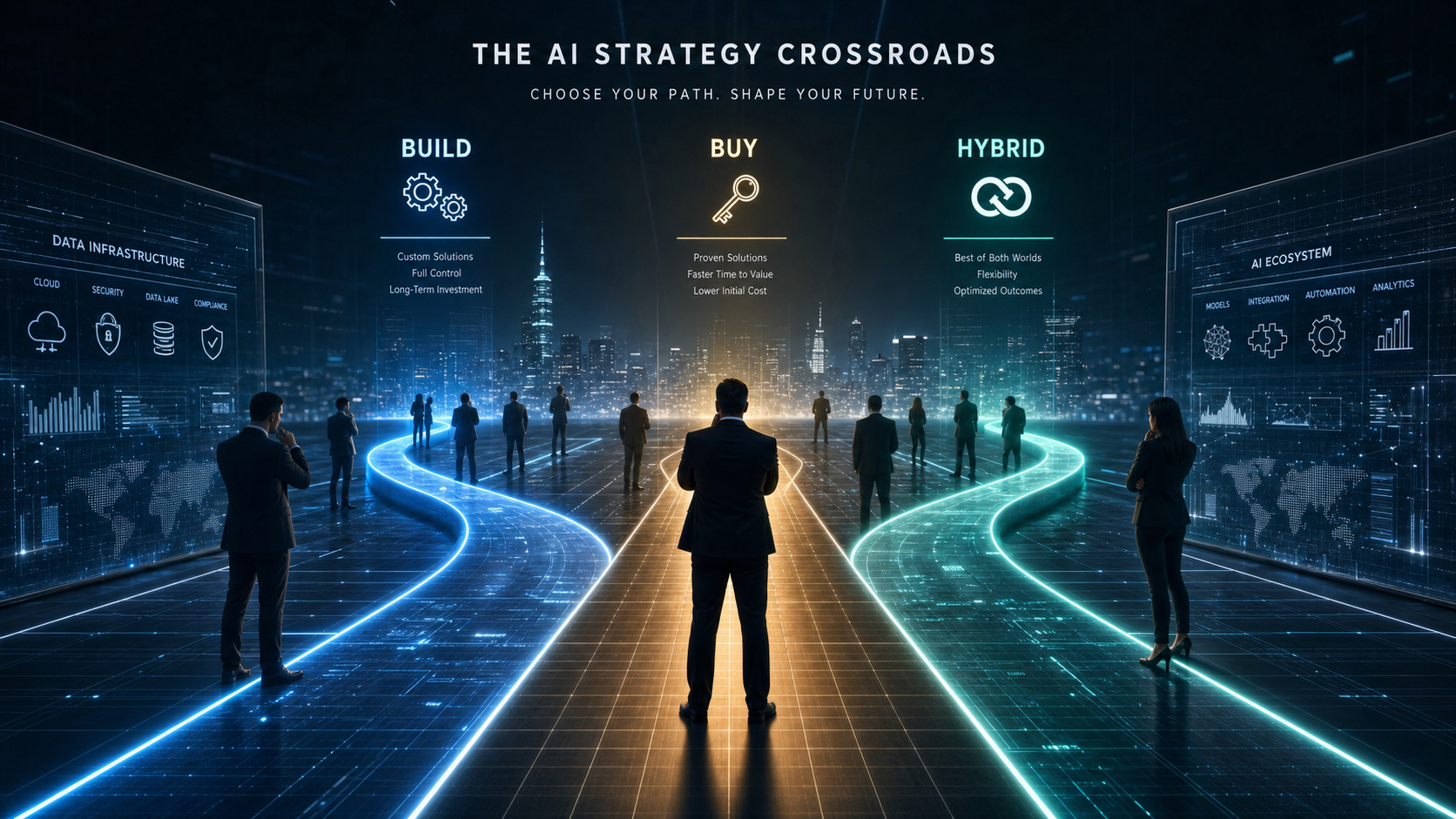
Build, buy, or hybrid? Why the wrong AI strategy costs companies millions – Image: Xpert.Digital
Build, buy, or hybrid? Why the wrong AI strategy costs companies millions
AI sabotage in the office: Why 29 percent of employees secretly work against their own boss
The hybrid AI solution: This strategic trick helps successful companies outpace the competition
The introduction of artificial intelligence (AI) in the modern economy is no longer merely an IT issue, but a strategic struggle for survival. Under enormous external competitive pressure, companies face a complex decision: Should they develop costly, customized AI solutions in-house, rely on standardized products, or choose a hybrid approach? While the so-called "build-versus-buy" debate and multi-million-dollar budgets are being discussed in the executive suites, a much bigger problem is brewing at the grassroots level. Fearing a loss of control, increased workload, and job losses, many employees are blocking or sabotaging the new technologies in their daily work. This comprehensive guide analyzes why neither purely in-house development nor mere acquisitions will deliver the hoped-for added value in the long run. It demonstrates how the hybrid approach of "composable architecture" intelligently combines both worlds and why, ultimately, it is not the most powerful technology, but rather people and a participatory corporate culture that will determine victory or defeat in the AI revolution. Those who fail to transform their workforce from victims to active participants will pay an extremely high price.
The companies that will be considered winners of the current AI transformation in ten years' time will not necessarily be those that have implemented the most powerful technology. They will be the ones that have succeeded in elevating their workforce to a state where AI is perceived not as a threat, but as a natural extension of their own capabilities.
Between in-house development and acquisition: The new power question in the digital age
Between job insecurity and competitive pressure: Why the AI strategy debate is tearing companies apart from within
The decision of whether a company should develop its own artificial intelligence, purchase ready-made solutions, or pursue a combination of both is one of the most consequential strategic decisions of our time. What was once a purely pragmatic IT procurement question is now a matter of competitiveness, corporate culture, and in many cases, even business survival. The build-versus-buy debate has evolved so rapidly that traditional decision-making frameworks are hardly applicable anymore. The AI landscape is changing at a pace that is overwhelming even well-positioned technology companies.
What distinguishes the current situation from previous technology cycles is the simultaneity of the disruption: AI is penetrating all business processes – from accounting and customer service to product development. Companies can no longer proceed sequentially, learning one thing and then implementing the next. They face a strategic complexity that extends far beyond the technical dimension. The question is no longer simply: build or buy? It is: Who develops what, for whom, with what resources, within what timeframe – and with what consequences for their own workforce?
The strategic relevance of this decision is also evident in market trends. Within just one year, the ratio of in-house development to outsourced AI solutions has completely reversed: While 47 percent of companies relied on internal development in 2024, this figure had dropped to just 24 percent by 2025. The proportion of companies purchasing ready-made AI solutions rose from 53 to 76 percent during the same period. This development unfolded faster than any market analyst had predicted – and it is far from over.
The race that no one can win, but no one can lose either
Behind the accelerated adoption of AI lies a fundamental dilemma that is reproduced daily in the strategy departments of many companies: competitive pressure. The fear of being technologically overtaken by the competition drives decisions that would be more carefully considered under other circumstances. Observing numerous business processes reveals a recurring pattern: executives often don't know if and how exactly AI will improve their competitive position. But they do know that inaction is risky.
The German Economic Institute (IW Cologne) has shown that 82 percent of German companies already report productivity gains through generative AI; on average, they quantify these gains at 13 percent annually. Such figures exert enormous pressure on companies that are not yet using AI or are only using it minimally. Anyone who allows themselves to be distanced by a hypothetical 13 percent productivity advantage of the competition, without knowing whether this advantage will actually materialize, is taking on a strategic risk that no executive is willing to bear.
The KPMG study on generative AI in the German economy in 2025 puts it bluntly: waiting is not an option, because the gap between companies that successfully use AI and those that don't is widening. This finding aligns with data from the strategy consultancy Simon-Kucher, whose "European Growth Study 2026" shows that successful companies are using AI in their processes at a rate of 66 percent, while less successful firms are stuck at 25 to 35 percent. Technology, the study concludes, is the new competitive divide. Those who hesitate in 2025 will fall structurally behind in 2026.
The pressure resulting from these figures is real. However, it also creates a dynamic that is equally problematic for companies and their employees: decisions are not made based on a clear strategic vision, but rather on a sense of threat. Transformation doesn't happen because it's desired, but because it's believed to be necessary. This discrepancy has far-reaching consequences – especially for the people directly affected by these decisions.
The paralyzing fear: When employees experience AI as an existential threat
Parallel to the strategic debate at the management level, an equally consequential conflict is taking place within the workforce itself. Employees worldwide are responding to the increasing pervasiveness of AI in their work environment with a mixture of skepticism, rejection, and open resistance. And this reaction is by no means irrational – it is the logical consequence of a communication culture in which AI is primarily positioned as an efficiency tool and rarely as a tool for empowering the individual.
The figures paint a clear picture: According to the EY "European AI Barometer 2025," 36 percent of employees in Germany fear negative impacts of AI on their own jobs; across Europe, this figure rises to 42 percent. Seven out of ten employees in Germany expect the use of AI to lead to a general reduction in jobs. The Xing Job Market Report 2025, based on a representative survey of 2,000 employees, arrives at similar conclusions: 16 percent are worried about their own jobs, while 29 percent are convinced that AI will generally make many human workers redundant.
These fears are not limited to Germany. The EY “Work Reimagined Survey 2025,” which surveyed 15,000 employees and 1,500 employers in 29 countries, shows that 37 percent of employees fear losing their own skills due to excessive use of AI. At the same time, 64 percent report that their workload has increased in the past twelve months – apparently primarily as a result of the pressure to keep pace with AI-supported processes. However, only five percent are actually using AI in a transformative way to fundamentally change their work.
A particularly revealing finding, which never appears in keynote presentations on AI adoption but has enormous practical relevance, is that 29 percent of employees openly admit to actively sabotaging their company's AI strategy. Among Generation Z employees, this figure rises to 44 percent. As a result, 40 percent of company-wide AI expenditures fail to deliver satisfactory results—not due to technological shortcomings, but because of a lack of acceptance. This equates to a wasted budget of approximately $21.7 million per organization.
The DEKRA Occupational Safety Report 2025 points out that the fear of job loss due to AI is one of the most noticeable psychological stressors in the modern workplace. This particularly affects employees in repetitive or easily automatable fields of work. What initially appears to be a rational risk assessment can, over time, lead to stress, anxiety, and a feeling of worthlessness—a feeling that reduces both performance and loyalty to the employer. Companies that ignore this emotional context are subsequently surprised when their expensive AI implementations fail to deliver the expected results.
Caught in the decision trap: Acting out of coercion rather than conviction
This creates a paradoxical situation that, while common in business reality, is rarely explicitly addressed in the literature on digitalization: companies find themselves caught between two opposing forms of pressure. On the one hand, there is external competitive pressure, which demands rapid action. On the other hand, there is internal resistance from the workforce, fueled by justified or unjustified fears. The result is not a strategically coherent AI adoption, but rather a flurry of activity that serves neither the interests of the company nor those of its employees.
The rejection of AI in a business context doesn't arise in a vacuum. It develops in organizations where AI initiatives are implemented without sufficient involvement of those affected. Forbes' analysis of employee resistance to AI shows that a significant portion of this rejection stems from employees perceiving the technology as a tool for surveillance and control, not as a supportive instrument. A 2023 Pew Research study found that while nearly two-thirds of Americans expect AI to have a major impact on the workplace, only 13 percent believe it will personally benefit them.
This shift in perception has strategic consequences. If employees cannot recognize the personal added value AI creates for them, they will not become agents of transformation, but rather adversaries. The Gallup report from 2026 offers a counter-perspective: Within organizations implementing AI, 65 percent of employees report that the technology has improved their productivity and efficiency. However, this positive effect does not occur automatically – it requires a specific type of implementation that puts people at the center.
The question of whether a company builds, buys, or pursues hybrid approaches to AI is therefore not merely a technological or business question. It is primarily a human question. Which solution generates acceptance? Which solution strengthens the skills of the existing workforce instead of undermining them? Which solution enables employees to experience themselves as agents, rather than passive recipients, of a transformation?
🤖🚀 Managed AI Platform: Faster, safer & smarter to AI solutions with UNFRAME.AI

Managed AI Platform - Image: Xpert.Digital
Here you will learn how your company can implement customized AI solutions quickly, securely and without high entry barriers.
A managed AI platform is your all-inclusive, worry-free solution for artificial intelligence. Instead of dealing with complex technology, expensive infrastructure, and lengthy development processes, you receive a ready-made solution tailored to your needs from a specialized partner – often within just a few days.
The key advantages at a glance:
⚡ Rapid implementation: From idea to ready-to-use application in days, not months. We deliver practical solutions that create immediate added value.
🔒 Maximum data security: Your sensitive data stays with you. We guarantee secure and compliant processing without sharing data with third parties.
💸 No financial risk: You only pay for results. High upfront investments in hardware, software, or personnel are completely eliminated.
🎯 Focus on your core business: Concentrate on what you do best. We take care of the entire technical implementation, operation, and maintenance of your AI solution.
📈 Future-proof & scalable: Your AI grows with you. We ensure continuous optimization and scalability, and flexibly adapt the models to new requirements.
More information here:
Time-to-market, skills shortage, shadow AI: The hidden costs of the AI decision
What in-house development really costs and why simply buying in-house solutions also fails
A rational analysis of the build-versus-buy decision requires that the true costs of both strategies be fully captured – a requirement that is surprisingly rarely met in practice. Companies that develop AI solutions internally often calculate based on development costs and personnel, but neglect the Total Cost of Ownership (TCO) over the entire lifecycle of a solution.
According to estimates based on a McKinsey study, developing AI systems in-house costs on average three to five times more than purchasing off-the-shelf solutions. The time-to-market for purchased AI solutions is typically three to six months, while internal development takes twelve to 24 months. In a technological landscape that evolves in quarters rather than years, this time advantage is strategically significant.
Another factor, particularly relevant to the German market, is the glaring shortage of qualified AI specialists. According to reports from the online job portal Indeed, 87 percent of companies are experiencing significant difficulties finding AI developers with the necessary qualifications. Companies that spend months searching for developers who are either unavailable or prohibitively expensive waste valuable time, while their competitors with ready-made solutions are already accumulating competitive advantages. The problem is not merely financial – it is a structural issue within the German and European labor market for technology talent that is unlikely to resolve itself in the foreseeable future.
At the same time, it would be wrong to present a pure buy strategy as a hassle-free alternative. Off-the-shelf AI solutions offer generic functionalities optimized for broad use cases, but not designed for the specific needs of a single company or team. The Unframe platform aptly describes this dilemma: standard, off-the-shelf solutions solve narrow problems and force the company to adapt to the technology—not the other way around. A purchased tool that isn't embedded in a company's existing processes and cultural reality won't generate sustainable added value, no matter how technologically powerful it may be.
The EY study 2025 also shows that between 23 and 58 percent of employees – depending on the industry – bring their own AI solutions into the workplace, operating so-called shadow AI. This is not only a compliance issue, but also a sign that purchased enterprise solutions often fail to meet the actual needs of users. If employees prefer to use external, uncontrolled tools rather than officially procured systems, this is a clear indication of an implementation strategy that has missed the mark with users.
Composable Architecture: Flexibility as a strategic competitive advantage
The concept of the hybrid approach, increasingly referred to as a blend strategy or composable architecture, attempts to resolve precisely this contradiction between standardization and customization. The basic idea is more elegant than it initially appears: companies purchase a powerful core AI component but adapt it to their own differentiating use cases. Standardized, stable functions—such as data processing, search capabilities, or standard reports—are purchased, while the truly competitive functions are either developed in-house or highly customized.
The platform Informatik Aktuell explicitly refers to this as a composable architecture, which allows for the flexible combination of in-house developments, purchased modules, and cloud-based components. This architecture makes it possible to strategically combine the strengths of both worlds – the speed of acquisition and the precision of in-house development. As a result, companies gain both control and adaptability, two qualities that are equally essential in a rapidly changing technological environment.
However, the Accenture study on the European productivity gap reveals that despite these strategic options, significant implementation barriers exist. Only 45 percent of large German companies have successfully scaled AI. European workers now achieve only 76 percent of the productivity of their US counterparts – 30 years ago, Europe was on par. Accenture identifies persistent underinvestment in future technologies as the main cause. According to the study, if all large European companies with a revenue exceeding one billion euros were to develop their AI capabilities to the level of leading industries, additional revenues of nearly 200 billion euros per year could be generated.
The European Growth Study 2026 by Simon-Kucher underscores that 73 percent of companies currently use AI in less than 30 percent of their processes. Noticeable productivity and employment effects are only expected once AI penetration reaches 30 to 50 percent. This means that most companies are still far below the threshold at which AI truly has a transformative effect. The path to a hybrid approach is therefore not just a technological journey, but an organizational and cultural strategic undertaking that requires careful planning, consistent implementation, and, above all, the involvement of the workforce.
From victims to stakeholders: The paradigm shift in AI rollout
This is where a strategically sound AI implementation diverges from one that is technologically motivated but fails due to human factors. The crucial difference lies not in the choice of technology, but in how that choice is made and implemented. Companies that involve their employees in developing tailored solutions from the outset not only achieve better technical results, but also prevent their workforce from feeling marginalized.
The company Unframe has made this approach an explicit core feature of its platform: customers are directly involved in developing solutions tailored to their teams. Instead of a finished solution implemented from the top down, a customized answer to real operational challenges is created – in close collaboration with those who deal with these challenges on a daily basis. This co-development model ensures that employees perceive technology not as a threat, but as an extension of their own capabilities. They are not the objects of a transformation, but its architects.
The effectiveness of this approach is supported by research data. The BCG report 2025 shows that with strong leadership support, employees' positive attitudes toward AI increase from 15 to 55 percent – a factor of 3.7. EY data demonstrates that employees with more than 81 hours of AI training per year save an average of 14 hours per week, thus achieving a significantly higher productivity increase than those receiving less than four hours of training. Involvement, training, and participation are therefore not merely matters of soft skills – they are hard economic levers.
Accenture's "Augmented Workforce Framework" describes how companies can help their employees develop the skills required for AI-powered work. Crucially, AI should not be positioned as an adversary of humans, but rather as a collaborative partner. When employees understand that AI takes over repetitive, time-consuming, or error-prone tasks so they can focus on more complex, value-adding work, their emotional attitude toward the technology fundamentally shifts. The technology is then no longer perceived as competition, but as the infrastructure for their own growth.
When humans reach their limits: AI as an amplifier, not a replacement
The question of what AI should achieve in a company is fundamentally also a question of what it should achieve for people. The concept of productivity pressure, which appears in almost every AI strategy, conceals an uncomfortable truth: In many companies, employees are expected to achieve more than is realistically possible with human resources. This pressure is not new, but it has intensified dramatically with the expectations of a fully digitized economy.
The EY study shows that 64 percent of employees perceive an increased workload. However, only five percent use AI in a way that actually reduces this pressure structurally. The rest use AI, at best, for isolated, basic tasks such as drafting texts or summarizing information. This is not a failure of the employees – it is the result of implementation strategies that are not designed to address the limits of human capacity, but primarily to optimize costs or accelerate processes.
The conceptual difference between replacement and augmentation is fundamental. If AI is used to cut staff, it confirms the workforce's fears and increases resistance. However, if AI is used to empower every existing employee to achieve more without working more hours, a fundamentally different dynamic emerges. Humans remain the driving force; AI becomes a multiplier of their capabilities. This "workforce augmentation" model is not only ethically compelling, but also economically more efficient: Instead of expensive new hires or lengthy onboarding processes, the existing potential of the workforce is amplified in a targeted and scalable way.
Gallup data from 2026 illustrates this possibility: Within organizations adopting AI, 65 percent of employees report improved productivity. Frequent AI users report greater productivity gains—a finding that suggests the depth of integration is crucial, not just its breadth. Simply introducing AI into a company is not enough. It must be embedded in such a way that the workforce uses it daily and naturally—as a natural extension of their work, not as an additional tool that needs to be operated in parallel.
The practical consequence of this insight is that the co-development approach is not only psychologically smarter, but also economically superior. Solutions developed jointly with users have a higher acceptance rate, are more deeply integrated into daily work, and therefore achieve measurable results faster and more sustainably. The Unframemodel, in which customers are directly involved in solution development and employees experience empowerment rather than threat, is not a philanthropic concept—it is a rational answer to the economic problem of wasted AI investments.
Why the real competitive advantage lies not in technology, but in attitude
The debate about build, buy, and hybrid approaches concludes with a finding that may be surprising in its simplicity: the choice of implementation strategy is less crucial than the attitude with which it is implemented. Companies that introduce AI as a tool for control or cost reduction will not realize the expected productivity gains in the long run. Companies that understand AI as a tool for empowerment create the conditions for a transformation that is both economically sustainable and socially acceptable.
The challenge lies not in the technology itself, but in the leadership culture. BCG research shows that strong leadership support can triple the workforce's positive attitude toward AI. Leaders who not only mandate change but also explain, guide, and communicate it meaningfully are the crucial difference between an AI implementation that encounters resistance and one that generates enthusiasm. This holds true regardless of whether the company builds, buys, or combines its AI solutions.
In this context, Germany faces a dual challenge. On the one hand, there is a significant lag in AI scaling: only 45 percent of large German companies have successfully scaled AI, and the European productivity gap with the US is widening. On the other hand, there is a cultural predisposition for caution and thorough evaluation, which, combined with widespread fears of job loss among the workforce, necessitates a particularly sensitive approach to AI transformations. German companies can leverage this cultural strength—the focus on quality, employee involvement, and skepticism towards hasty decisions—as a strategic advantage if they consistently integrate these values into their AI strategy.
The path forward lies in recognizing that the question of "Build vs. Buy vs. Hybrid" has no definitive answer. It is a context-dependent assessment that must be regularly re-evaluated. What remains constant, however, is the fundamental condition for a successful AI transformation: the people who will be working with this technology must be part of the solution from the outset. Not merely recipients of change, but active participants in shaping it. In an economic landscape where technological parity is becoming ever more easily attainable and ever more fleeting, this human factor is becoming a lasting differentiator.
The companies that emerge as winners of the current AI transformation in ten years' time will not necessarily be those that have deployed the most powerful technology. They will be those that have succeeded in elevating their workforce to a state where AI is perceived not as a threat, but as a natural extension of their capabilities. This is not a romantic ideal—it is the most sober strategic conclusion that the available data allows.
Consulting - Planning - Implementation

Konrad Wolfenstein
I would be happy to serve as your personal advisor.
me at wolfenstein∂xpert.digital contact
Just call me on +49 7348 4088 965 .
🎯🎯🎯 Data-driven B2B industry hub as a quasi-in-house solution

The quasi-in-house solution: How Xpert.Digital closes operational gaps in B2B marketing and sales – Smart Content-Driven Business - Image: Xpert.Digital
Xpert.Digital is a data-driven B2B industry hub led by Konrad Wolfenstein . The company acts as an external, quasi-in-house solution for industrial partners, closing operational gaps in marketing, content, and sales – without requiring additional resources on the client side.
More information here:





