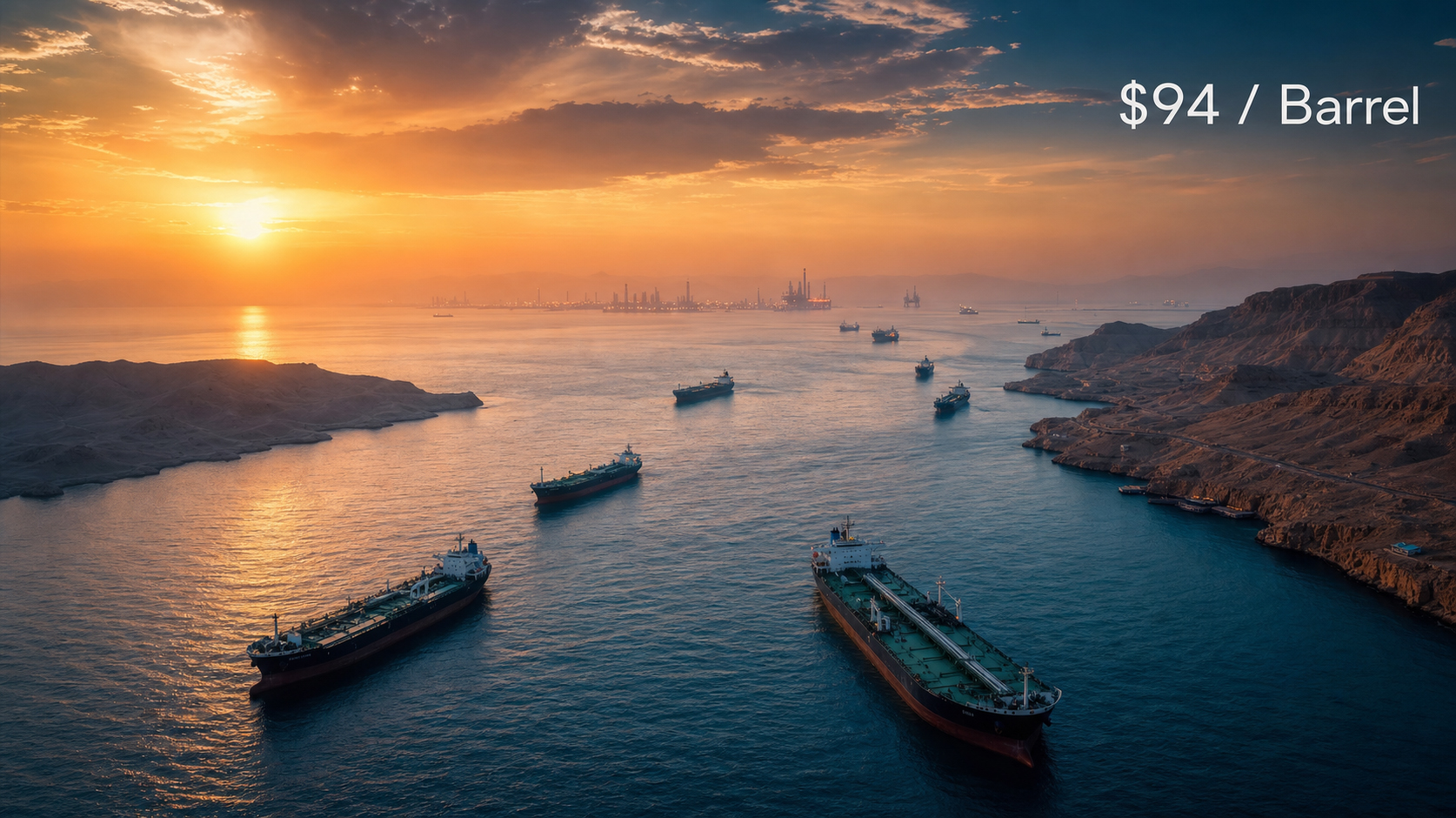
The ticking oil time bomb: Why the real $200 shock is yet to come – Image: Xpert.Digital
Despite the Hormuz blockade, no price collapse: China's secret maneuver saves the world market
The deceptive peace in the oil market: If this buffer bursts, a historic crisis threatens
Experts predicted oil would reach $200: This is the real reason why the price hasn't (yet) exploded
Since the outbreak of the Iran-Iraq War in early 2026, the global economy has been holding its breath. The Strait of Hormuz is effectively blocked, millions of barrels of oil are missing from the market daily – and yet the apocalypse predicted by experts, with prices reaching up to $200 per barrel, has so far failed to materialize. The reason for this puzzlingly calm storm lies in the east: China is drastically reducing its imports and instead drawing on gigantic strategic reserves accumulated over years. This quiet intervention is cushioning the global price shock and preventing an immediate recession in the Western world. But the apparent peace is deceptive. China's buffer is melting away at a record pace. What will happen when Beijing is forced to buy again on the already depleted global market? An in-depth analysis of the most dangerous balancing act in global energy history – and the ticking time bomb that could explode at any moment.
Cheap oil despite the threat of world war – the calmest storm of all time
Since the outbreak of the Iran-Iraq War in late February 2026, the world has been anticipating an economic shock that would dwarf anything seen before. Analysts at JPMorgan, Goldman Sachs, and Bernstein warned of oil prices exceeding $130 to $200 per barrel, central bankers predicted inflationary shockwaves similar to those of the 1970s, and logistics companies began activating contingency plans. And then: nothing. Or at least far less than feared. While the price of oil did spike, briefly exceeding $100, it has since stabilized in the $90 to $97 per barrel range. The Strait of Hormuz, through which roughly 20 percent of the world's traded oil and a significant portion of global liquefied natural gas (LNG) flows, is effectively blocked. Nevertheless, the feared apocalyptic price surge failed to materialize. The question of why leads directly to Beijing.
The International Energy Agency has already described the Iran-Iraq War as the largest oil supply disruption in history. In March 2026, global oil supply plummeted by over ten million barrels per day, with OPEC+ supply shrinking by 9.4 million barrels per day compared to the previous month. Saudi Arabia reduced its production from 10.4 to 7.25 million barrels per day, and Iraq lost almost two-thirds of its production capacity. Exports from the oil-producing states of the Persian Gulf, including Saudi Arabia, Kuwait, the United Arab Emirates, and Iraq, largely ceased because Iran blocked the only viable export route and repeatedly attacked production facilities in the region. Alternative pipelines, such as those running along Saudi Arabia's west coast or the ITP pipeline through Turkey, together amount to a maximum of 7.2 million barrels per day and are far from able to fill the resulting gap.
And yet: Prices have remained moderate enough to avert a global economic recession so far. China provides the key explanation.
Beijing's silent balancing valve: Why the People's Republic supports the market
The figures published by commodity analysts like Kpler in recent weeks are extraordinary. China's overseas crude oil imports plummeted from 11.39 million barrels per day in February 2026 to just 6.36 million barrels in May – a drop of more than 44 percent and the lowest level since October 2016. From Iraq, once one of China's most important suppliers, only 60,000 barrels per day arrived in May, down from 790,000 barrels in February. Kuwait delivered no oil at all in May, after having supplied 522,000 barrels per day in October. Even from Russia, which had become a major supplier to Beijing due to Western sanctions, imports fell to 1.07 million barrels per day, compared to 1.96 million in February.
This drastic decline in Chinese imports is acting like a massive pressure relief valve on the global market. According to JPMorgan analyses, China alone accounted for roughly 74 percent of the total global decline in crude oil imports. Morgan Stanley reached a similar conclusion: China's import slump represents half of the total global demand collapse, while on the supply side, increased US exports and the decline in Chinese imports together absorbed 9.3 million of the 12.3 million missing barrels per day. Less Chinese demand means less pressure on an already severely restricted global supply. For consumers in Europe, the US, and other importing countries, this initially provides some relief.
But where does this decline come from? China isn't buying less because its economy is weak or because it's voluntarily saving. It's buying less because it can. In recent years, Beijing has strategically amassed enormous oil reserves. According to analysts at Société Générale, China had built up strategic oil reserves of around 1.4 to 1.5 billion barrels – enough to cover roughly 200 days of normal oil imports. The Oxford Institute for Energy Studies estimates that China's implicit reserves will have increased by around 250 million barrels by 2025 alone. These reserves now allow it to purchase less on the global market in the short term and instead draw on its own stores. Since the beginning of May, Chinese refineries have been withdrawing around one million barrels daily from commercial storage to maintain their processing capacity.
Historical comparison: Shock greater, price effect smaller
The contrast to historical oil crises is both remarkable and instructive. During the OPEC embargo in 1973, global oil supply plummeted by about five to seven percent, causing prices to rise by more than 130 percent and plunging Western industrialized nations into severe stagflation. In the 1979 oil crisis, triggered by the Iranian Revolution, prices tripled again. The current war with Iran has resulted in a significantly larger physical supply shock: approximately 14 percent of global oil supply is unavailable, far more than during the crises of the 1970s. IEA chief Fatih Birol emphasized that back then, the global shortage was around five million barrels per day, while today it is eleven million. Despite this, price increases so far have been only around 30 percent compared to pre-war levels.
Natixis analysts point to a structural difference compared to 2022: Back then, the energy shock caused by the Russian invasion of Ukraine had already resulted in a complete supply disruption. Today, the shock still depends in part on how long the Hormuz blockade lasts and how intensely it is maintained. At the same time, China is cushioning the shock on the demand side – an effect that simply did not exist in the 1970s because China played no significant role in the global oil market at that time and held no strategic reserves that could have been deployed to any significant extent.
A second dampening factor is the IEA. In response to the Iran-Iraq War, the International Energy Agency coordinated the largest release of strategic oil reserves ever. Its 32 member countries unanimously agreed to release a total of 400 million barrels of crude oil onto the market, more than double the amount released in the previous largest coordinated reserve release after the Russian invasion of Ukraine in 2022. The US alone released 172 million barrels from its strategic reserves. However, energy analyst Saul Kavonic estimated that this measure could only cover up to a quarter of the daily supply gap of up to 20 million barrels as long as the Strait of Hormuz remains blocked. And despite the historic reserve release, the price of oil temporarily exceeded $100 per barrel, vividly illustrating market skepticism about the viability of this buffer strategy.
When the buffer ends: China's dilemma and the temporary price shock
The crucial economic question is not why the price shock has remained moderate so far. It is: How long can China maintain this role as a silent stabilizer? And the answer is soberingly clear: not indefinitely.
Global crude oil and petroleum product inventories are dwindling at a record pace. In May 2026, visible inventories fell by an average of 8.7 million barrels per day, according to calculations by Goldman Sachs – almost twice the average rate since the start of the Iran-Iraq War. IEA chief Fatih Birol warned that the depletion of commercial oil reserves is accelerating and that even if the war ends soon, the market will remain severely undersupplied until October 2026. China's crude oil imports are already at their lowest level in a decade. The real capacity limit, which Michal Meidan of the Oxford Institute for Energy Studies describes as an "open question," is: How much further can China reduce its import volume before large-scale withdrawals from its reserves are no longer sufficient and new purchases on the global market become essential?
Meidan estimates China's actual crude oil demand at around 10.4 million barrels per day. With current imports of approximately 6 to 7 million barrels, this gap can only be filled by withdrawals from reserves, which were already running at one million barrels per day in May. This means that China's buffer, given the ongoing conflict and the continued blockade of the Strait of Hormuz, is designed to last for months, not years. If the strategic reserves fall to a politically unacceptable minimum level, or if refineries can no longer be adequately supplied, Beijing will again have to increase its purchases on the global market. Then, additional, pent-up Chinese demand will meet a market that is already operating at its limit. The price level, which currently appears artificially suppressed, could then rise abruptly.
As an additional variable, Meidan analyzes whether the Chinese chemical industry can use coal as a substitute for oil to further reduce import needs. In fact, despite the official decarbonization strategy, coal in China remains a significant "open variable," as experts from the OIES put it—it is only being reduced gradually and could temporarily fill some of the gap created by the loss of liquefied natural gas and oil supplies. While this approach extends the stabilization period, it does not solve the structural problem, but merely postpones it.
The geopolitical dimension: Trump, the midterms, and American oil calculations
The Iran war is not just an energy market event; it is also a highly volatile domestic political problem for the US government. November 3, 2026, hangs like a sword of Damocles over the Trump administration in the American political calendar: the midterm elections, in which all seats in the House of Representatives and one-third of the Senate seats are up for grabs. High gasoline prices are traditionally a reliable poll killer for the ruling party in America, and Trump himself, during his first term, played few issues more aggressively than the promises of cheap energy.
Trump's chief of staff, Susie Wiles, discussed internally the possibility of temporarily suspending the gasoline tax. The average price of gasoline climbed to over four dollars per gallon shortly after the outbreak of war, compared to just under three dollars before the conflict—an increase of more than a third. Trump himself acknowledged that he expected persistently high energy prices until the midterm elections. This domestic vulnerability has strategic consequences for the oil market, as the US is currently one of the few countries with significant oil export capacity. Morgan Stanley calculated that increased US seaborne oil exports, combined with China's decline in demand, have made up for 9.3 million of the missing 12.3 million barrels per day.
Should gasoline prices in the US continue to rise or remain at a high level, the Trump administration might be tempted to consider export restrictions or other measures to retain more crude oil domestically and thus lower consumer prices. Such a decision would deprive the global market of another important stabilizer and increase upward pressure on oil prices. This intertwines economic and political interests in Washington in a way that appears difficult for the market to predict. Indeed, this creates a rarely observed situation: the world's largest military power is also the second most important oil-producing nation and is simultaneously fighting a war that is disrupting the oil supply to half the world and putting its own electorate under pressure through rising fuel prices.
Our global industry and economic expertise in business development, sales and marketing


Our global industry and economic expertise in business development, sales and marketing - Image: Xpert.Digital
Industry focus areas: B2B, digitalization (from AI to XR), mechanical engineering, logistics, renewable energies and industry
More information here:
A thematic hub offering insights and expertise:
- Knowledge platform covering global and regional economies, innovation and industry-specific trends
- A collection of analyses, insights, and background information from our key areas of focus
- A place for expertise and information on current developments in business and technology
- A hub for companies seeking information on markets, digitalization, and industry innovations
China's oil reserves as a stabilizer – and how China's electric vehicle boom is secretly dampening the oil price
Structural change as an invisible buffer: China between oil peak and geopolitical dependence
The current crisis is revealing a structural shift that would be less visible in normal times. China is decoupling its oil consumption—not through politically enforced austerity measures, but through a fundamental economic transformation. China's electric vehicle boom surpassed the 50 percent market share mark for pure electric car sales for the first time in 2025. The IEA estimates that by 2025, the global electric vehicle fleet will have already displaced around 1.7 million barrels of oil per day from consumption, with the Asian market contributing disproportionately to global growth. China's state-owned oil company, CNPC, projects that Chinese oil demand will plateau between 2025 and 2030, driven by the substitution effect of electric vehicles on gasoline and diesel consumption. Sinopec anticipates that total demand will reach its historical peak in 2027.
This structural decline in demand means that China can draw on its reserves during the current crisis and simultaneously purchase less oil without significantly impacting its economy, because the overall demand is decreasing anyway due to the shift towards electric vehicles. However, this effect is not linear: oil will remain indispensable for the foreseeable future in the industrial sector, petrochemicals, and power generation. Meidan estimates China's actual daily demand, despite the EV boom, at around 10.4 million barrels. And even coal, which can be used as a short-term substitute in the chemical industry, remains a stopgap measure, not a sustainable alternative.
What makes this doubly significant is that historically, around 50 percent of China's oil imports were transported through the Strait of Hormuz. The blockade therefore affects not only the global market as a whole, but also China directly. Beijing has thus invested in a massive buffer, enabling it to at least temporarily mask this dependence. What appears to be strategic composure is in reality the result of years of proactive inventory management – and a certain amount of luck in having sufficient reserves at the right time.
The global chain reaction: Inflation, central banks, and the specter of stagflation
The Iran war and its impact on the oil market are not an isolated energy market phenomenon. They are a transmission belt for widespread economic disruptions. The Strait of Hormuz is not just an oil route: significant quantities of liquefied natural gas (LNG) also flow through it, particularly from Qatar, which counts Germany and other European countries among its most important importers. Helium, which Germany imports from Qatar for 50 percent of its value and which is essential for semiconductor manufacturing, is transported via this route. Rising oil prices increase the cost of fuels, fertilizers, and petrochemical products, which in turn raises food prices, transportation costs, and industrial production costs worldwide.
Analysts at Cash-Online calculated that each additional week of continued blockade reduces the eurozone's GDP by approximately 0.1 percent and adds another 0.1 percentage points to inflation. For Europe, this means that even if the Strait of Hormuz were to reopen in the short term, inflation in the eurozone threatens to rise above three percent, while growth could fall below 0.5 percent. German producer prices rose by 2.5 percent month-on-month in March 2026, an early indicator that price pressures are building up in the supply chain and will soon impact consumer prices. The specter of a new stagflation – a combination of stagnant economic output and simultaneously rising inflation – is therefore no longer just a historical relic of the 1970s.
The reactions of central banks to this dilemma are closely linked to the duration of the conflict. Argus Chief Economist Fyfe estimated that a one-month Hormuz blockage would still be manageable without the Fed or ECB having to significantly adjust their interest rate policies. A three-month blockage, however, would already create sufficiently high inflationary pressure to postpone planned interest rate cuts by several months. A six-month interruption could even force central banks to raise interest rates again. Given that the blockage has now been ongoing since the beginning of March 2026, and that oil exports through the strait, according to Goldman Sachs, remain at only five percent of normal levels, the scenario of a prolonged monetary policy dilemma is no longer merely theoretical, but a process currently unfolding.
OPEC+ between structural damage and strategic calculation
The shock also exposes the internal contradictions of the OPEC+ cartel. On the one hand, eight member states formally agreed to increase production quotas—initially by 206,000 barrels per day as a first response to the conflict. On the other hand, the main exporters in the Persian Gulf, including Saudi Arabia, Kuwait, the United Arab Emirates, and Iraq, are effectively unable to ramp up production: The Strait of Hormuz, their only viable export route for the majority of their output, is closed. Iran's attacks on oil facilities in the region have caused further production losses. The production increase resolutions thus exist on paper, but are ineffective in practice.
Saudi Arabia and other Gulf states have begun developing alternative routes via the west coast or pipelines to Turkey. However, these capacities are limited and will not be able to close the Hormuz Gap in the foreseeable future. Goldman Sachs has repeatedly raised its Brent price forecast for 2026 – from an initial $56 before the war to $85 after the outbreak of the conflict – and estimates further price levels between $76 and $93 per barrel if the disruption persists for 30 to 60 days. JPMorgan warned that further destabilization of Iran, for example through regime change, would lead to significantly higher and longer-lasting oil prices, analogous to historical patterns of destabilization in the Gulf region.
The potential for escalation: Three scenarios for the oil price
How realistic is the horror scenario of $200 per barrel? A sober analysis reveals three scenarios that can be distilled from the available market data and geopolitical indicators.
In the first scenario, involving a swift diplomatic solution and the reopening of the Strait of Hormuz, oil prices would fall rapidly and sharply, following the pattern of April 2026, when Iran's foreign minister briefly announced the opening for the duration of a ceasefire: At that time, the WTI price plummeted by more than twelve percent to around $82 within a few hours. A permanent reopening would initially cause a spike in demand due to the pent-up demand from reserves, before the market normalizes.
In the second scenario, a prolonged standoff with a stagnant level of conflict—meaning no escalation but also no resolution—global stockpiles would continue to dwindle. Goldman Sachs' scenario analysis in this case points to Brent prices between $93 and $100, driven by accelerated reserve withdrawals and the fact that China cannot indefinitely extend its import decline.
In the third and most dangerous scenario of a military escalation leading to regime change in Iran or lasting damage to the critical oil infrastructure of the Persian Gulf, price levels of $130 to $200 per barrel would indeed be conceivable. JPMorgan points out that, based on historical patterns, such an escalation would result in "significantly higher and sustained oil prices over extended periods." The investment bank Bernstein even considers $120 to $150 as a baseline in the extreme case of a prolonged conflict, before even modeling extreme scenarios.
The time bomb is ticking: What comes after the Chinese buffer?
China has stabilized the oil market in a historically unique way. The People's Republic did not act out of altruism or strategic solidarity with the rest of the world, but simply out of its own self-interest: to avoid expensive oil as long as its reserves lasted. When these reserves run low, China will transform from a silent stabilizer into one of the biggest potential price drivers in the crude oil market – a reversal of roles that has hardly escaped the notice of any market observer and which constitutes the real latent escalation potential of the current situation.
Global crude oil inventories are dwindling at a record pace, a significant portion of Western countries' strategic reserves has already been deployed, and even the IEA's release of 400 million barrels provided only short-term market reassurance. The foundation of this apparent stability is more fragile than current prices suggest. One of those moments when market confidence shifts—triggered, for example, by further military escalation, renewed Iranian threats regarding the passage of Hormuz, or even just China's public announcement that it will end its reserve withdrawals and resume active purchases—could be enough to abruptly revise current depressed expectations and trigger price movements closer to what analysts predicted for the worst-case scenario back in March 2026.
The $200 mark is therefore not merely a panic-inducing reference point. It is the price signal that the market has begun to factor in as soon as China stopped buying as it had been – and simultaneously had to buy more than ever before. The distance to this threshold is currently a measure of China's cash reserves. And those reserves are shrinking every day.
🎯🎯🎯 Data-driven B2B industry hub as a quasi-in-house solution


The quasi-in-house solution: How Xpert.Digital closes operational gaps in B2B marketing and sales – Smart Content-Driven Business - Image: Xpert.Digital
Xpert.Digital is a data-driven B2B industry hub led by Konrad Wolfenstein . The company acts as an external, quasi-in-house solution for industrial partners, closing operational gaps in marketing, content, and sales – without requiring additional resources on the client side.
More information here:
Your global marketing and business development partner
☑️ Our business language is English or German
☑️ NEW: Correspondence in your native language!

Konrad Wolfenstein
I and my team are happy to be available to you as your personal advisor.
You can contact me by filling out the contact form here wolfenstein@xpert.digital:or simply call me at +49 7348 4088 965. My email address is
I'm looking forward to our joint project.