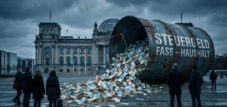
The state demands everything from us, but knows nothing itself: The 111 billion euro scandal of the Pistorius Ministry – Image: Xpert.Digital
47,000 contracts, no idea where the billions of this turning point in history are really disappearing to
111 billion euros flying blind: The German Armed Forces' unbelievable loss of control
Small and medium-sized businesses are suffocating in bureaucracy – while the federal government is sinking 111 billion euros into data oblivion
When Chancellor Olaf Scholz proclaimed a "turning point" in 2022, billions began to flow. The Ministry of Defense has since spent around €111 billion on new armaments – spread across a staggering 47,000 contracts. But whether the tanks, ammunition, and equipment ever actually reached the troops is something the ministry simply doesn't know. A completely outdated IT system, a failed SAP migration, and sheer structural overload have led to an unprecedented loss of government control. The bitter irony: While the German government burdens small and medium-sized enterprises with ever-increasing bureaucratic and documentation requirements, it capitulates to the very simple task of tracking its own expenditures. This offers a profound insight into a systemic failure that was entirely predictable and not only jeopardizes billions in taxpayer money but also Germany's defense capabilities.
When the state doesn't know what it has bought — a systemic failure waiting to happen
Numbers without control: The spectacular balance sheet of a turning point in history
When Olaf Scholz proclaimed a new era in the German Bundestag on February 27, 2022, he promised nothing less than a historic course correction in German defense policy. The state would henceforth invest its full strength in the Bundeswehr (German Armed Forces), modernize the military, which had been neglected for years, and ensure that Germany lived up to its security policy responsibilities. What followed was indeed historic—at least in quantitative terms: Since 2022, the federal government has concluded 47,000 procurement contracts for armaments, according to its own figures, with a total value of 111 billion euros. This equates to more than 30 contracts signed every day, seven days a week, for four years.
But what was actually achieved with this gigantic volume of procurement, whether the goods were actually delivered, whether they arrived at the troops ready for use, and whether the Bundeswehr is more capable of defending itself today than in 2022 – the Ministry of Defense doesn't know. Or at least, it claims it can't know. In response to a parliamentary inquiry from Left Party politician Dietmar Bartsch, the Federal Ministry of Defense (BMVg) explained that an automated, centralized evaluation of all procurement projects was not possible. This would require manually evaluating several thousand pages – an effort the ministry deemed unreasonable and unforeseeable.
This response is not a bureaucratic mishap. It is a systemic failure. And it reveals a fundamental paradox: The very government agency that has burdened German companies for decades with ever-increasing documentation, verification, and reporting requirements is itself unable to account for the expenditure of hundreds of billions of euros.
The state as an actor without oversight: Structural causes of the control deficit
The extent of the control failure can only be truly understood against the backdrop of the institutional architecture of German defense procurement. The responsible authority is the Federal Office of Bundeswehr Equipment, Information Technology and In-Service Support (BAAINBw) in Koblenz, one of Germany's largest state procurement agencies with more than 10,000 civilian and military employees. The agency handles the entire procurement process, from market research and tendering to contract award—and since 2022, it has operated with a procurement volume that has exceeded all previous capacity planning.
The central IT backbone of this procurement organization is the SAP-based system SASPF (Standard Application Software Product Family), which has been gradually introduced into the German Armed Forces since 2009. Theoretically, all logistics run through this system: warehouse management, maintenance documentation, personnel planning, and arms procurement. Theoretically—because in practice, the system has been notorious for years for its cumbersome nature, lack of user-friendliness, and inability to fully integrate decentralized procurement channels. In the 2017 Armed Forces Report, the then Parliamentary Commissioner for the Armed Forces criticized a multitude of serious problems, including a complete system failure during the Niger deployment.
Instead of consolidating the system, the changing times have exacerbated the situation. Since 2022, the SASPF has been confronted with a procurement volume many times greater than previous levels. The necessary migration to the new SAP platform S/4HANA—planned for October 27, 2025—failed due to serious quality deficiencies: The system repeatedly failed acceptance tests, and internal documents from the Ministry spoke of problems preventing acceptance. Even the SAP board publicly admitted to inadequate software quality in August 2025. The migration was postponed until at least October 2026—meaning the German Armed Forces will remain on an outdated core system until then, for which SAP will discontinue regular maintenance starting in 2027.
It is this constellation – exploding order volumes, outdated IT infrastructure, digital breaks between different procurement channels, and institutional inertia – that explains why the ministry doesn't know what it received for 111 billion euros. The response to Bartsch was less a political excuse than a technical truth about a structurally overwhelmed system.
The dual nature of the bureaucratic state: What the state demands and what it delivers
Anyone who takes in the response from the Ministry of Defense is confronted with a bitter comparison — that between the demands the German state places on private companies and what it itself is capable of delivering.
Germany is the world champion of documentation requirements. Companies of all sizes are subject to a dense web of reporting, verification, information, and documentation requirements: from tax law, labor law, environmental and data protection law, procurement regulations, supply chain due diligence obligations, and a growing arsenal of European compliance regulations. According to surveys conducted by the ifo Institute on behalf of the Munich and Upper Bavaria Chamber of Industry and Commerce, this excessive bureaucracy costs the German economy up to €146 billion annually in economic output. Small and medium-sized enterprises (SMEs), which constitute 99 percent of all German companies and employ more than half of all private sector workers, bear the proportionally largest burden.
A KfW study has calculated that medium-sized companies spend an average of around seven percent of their total working time on bureaucratic tasks. Statistically, a managing director of a medium-sized company spends almost one working day per week filling out forms, preparing reports, and fulfilling documentation requirements—capacities that are lost to innovation, customer relations, and growth. Companies that want to participate in public tenders fare even worse: reliability, expertise, performance, safety requirements, technical standards, and quality standards must be fully documented. And those seeking defense contracts face security checks that—as the defense industry has been complaining for months—have become an absolute bottleneck in hiring processes because they drag on for many months.
The bitter irony is obvious: The same state that demands precise documentation, complete traceability, and full transparency from businesses regarding all transactions is unable to report which of its own €111 billion contracts have already been fulfilled. The authority that imposes unreasonable burdens on businesses considers the effort it requires of itself to be unreasonable.
Refusal to provide information as a system indicator: What the ministry's response really means
The German Ministry of Defense's response should not be dismissed as a mere evasive maneuver by a ministry caught in the act. It is something more remarkable: a rare admission of structural incompetence. And in this respect, it is more revealing than any glossy brochure about reform progress.
The statement that automated, centralized evaluation is not possible means nothing other than that the ministry lacks a functioning controlling system for its own procurement. Controlling is not a peripheral task of public administration, but a core function of any organization that manages public funds. The Basic Law and the Federal Budget Code obligate the federal government to use public funds sparingly and economically—an obligation that cannot be fulfilled without robust controlling.
The Federal Court of Auditors had already sounded the alarm in a special report in June 2025. The Court of Auditors found that the Federal Ministry of Defense and the Bundeswehr (German Armed Forces) frequently failed to use the allocated funds in a targeted and economical manner. President Kay Scheller explicitly warned that the security and defense policy-based primacy of operational capability must not become a mindset in which money plays no role. The report criticized failed procurement and digitization projects, management errors, and the expansion of the officer corps: the proportion of officers in the Bundeswehr has risen from 15 to 21 percent since 2010, even though the total number of authorized positions has decreased by approximately 60,000.
The parliamentary dimension of this oversight failure is even more alarming. Investigations by Correctiv revealed that in 2025, the Ministry of Defense and the governing coalition actively reduced transparency in armaments projects: reporting obligations to the Budget Committee for 19 subject areas were abolished—including the annual report on the implementation of the DLBO project, one of the Bundeswehr's largest digitization projects. The justification given was the appealing term "reducing bureaucracy." What is considered an essential transparency requirement for private companies is apparently seen as a superfluous burden by the Ministry.
30 contracts signed per day: The economics of uncontrolled purchasing
To grasp the extent of the control deficit, a sober look at the procurement arithmetic is worthwhile. 47,000 contracts in four years: that equates to 32.2 contracts per calendar day, 225 per week. Even excluding weekends and holidays, this results in a rate of over 45 contracts concluded daily on working days. The BAAINBw, with its approximately 10,000 employees, achieved a procurement density during this period that is unparalleled in German administrative history.
This pressure to accelerate processes had a reason: the turning point also represented a political shift in procurement law. The Procurement Acceleration Act and various expedited procedures were intended to ensure that armaments could be procured more quickly than the previously applicable procurement regulations allowed. From a fiscal perspective, this acceleration seems sensible—but it comes at a price: if processes are accelerated without establishing parallel controlling structures, systemic gaps emerge. And that is precisely what happened.
The lack of a central, digitized monitoring system means, specifically, that no one can reliably determine which of the 47,000 contracts has been fully fulfilled, which is in default, which has been canceled, and which may have been paid for goods that were never delivered or do not meet the agreed specifications. In the private sector, such a situation would immediately raise alarm bells for the auditor. Apparently not in the public sector.
In 2026, an additional €108.2 billion will be available for the German armed forces: €82.7 billion from the regular budget and €25.5 billion from the special fund. The €100 billion special fund, established in 2022 through a constitutional amendment, forms only the basis. This is supplemented by debt-financed expenditures based on the reformed debt brake, which permanently exempts defense spending from the fiscal rule. The macroeconomic dimension of these expenditures is therefore no longer temporary: Germany is structurally financing its rearmament on credit—and is unaware of the amount it received for previous tranches.
Our EU and German expertise in business development, sales and marketing


Our EU and German expertise in business development, sales and marketing - Image: Xpert.Digital
Industry focus areas: B2B, digitalization (from AI to XR), mechanical engineering, logistics, renewable energies and industry
More information here:
A thematic hub offering insights and expertise:
- Knowledge platform covering global and regional economies, innovation and industry-specific trends
- A collection of analyses, insights, and background information from our key areas of focus
- A place for expertise and information on current developments in business and technology
- A hub for companies seeking information on markets, digitalization, and industry innovations
Armaments reform agenda: More rebranding than real control?
The concentration of orders: Who benefits from uncontrolled spending?
An analysis of contracts awarded from the €100 billion special fund reveals a striking concentration of power. According to research by ZDF, which systematically evaluated 125 major projects, 22 of them, with a total volume of €42 billion, went to a single corporation: Rheinmetall. This means that almost half of the entire special fund is concentrated in the hands of one company. Rheinmetall increased its revenue in 2024 to €9.75 billion—a rise of 36 percent compared to the previous year. Following behind are Airbus, KNDS Deutschland, Rohde & Schwarz, and Diehl Defence, all also large corporations with established lobbying networks in Berlin.
This concentration is no coincidence. The German Armed Forces' procurement system structurally favors large, long-established arms companies because only they can meet the complex requirements—technical standards, security certifications, classification regulations, and multilateral contract structures. Small and medium-sized enterprises (SMEs), which are considered drivers of innovation in other European defense economies like Sweden or France, are largely excluded from the market in Germany. A study by the Institute for SME Research in Bonn showed that bureaucratic burdens significantly reduce SME participation in public tenders—psychological costs due to formalism, difficulties in understanding the requirements, and perceived inefficiency deter small businesses from submitting bids.
The paradox intensifies: The very BAAINBw, formally responsible for all procurement, accused the arms industry in April 2025 of excessive bureaucracy—long production times and sluggish capacity expansions. A government agency portraying itself as a victim of bureaucratic overcomplication by industry, while simultaneously admitting it cannot understand its own procurement processes: This is not a caricature, but the documented state of German arms procurement in 2026.
The shopping list of the future: 377 billion euros and new blind flights?
The deficiencies described would be alarming in themselves. What makes them critical is the outlook for the future. According to a document obtained by Politico, the Ministry of Defense has launched a procurement plan for the period from 2024 to 2034 with a total volume of €377 billion. This shopping list includes, among other things, 687 Puma infantry fighting vehicles, 561 Skyranger mobile air defense systems, 15 additional F-35A fighter jets, and 400 Tomahawk cruise missiles.
Of the approximately 320 planned procurement projects, 178 had already been awarded contracts at the time of reporting—with a total contract value of €182 billion, predominantly to 160 German companies. The number of parliamentary proposals exceeding €25 million—the threshold requiring approval from the Budget Committee—rose from 55 in 2023 to 97 in 2024 and 103 in 2025. The parliamentary oversight mechanism, which is activated during the approval process for major projects, is thus under considerable strain quantitatively—but structurally unable to provide the level of oversight that systematic project monitoring after contract award would require.
If the Federal Ministry of Defense cannot say today what has happened to 111 billion euros, how credible is the promise to bring the Bundeswehr up to combat readiness with 377 billion euros over the next eight years? This turning point was also a promise to the taxpayer: the promise that Germany truly takes its security seriously. This promise can only be kept if funds not only flow but also reach their intended recipients—and if there is someone who can reliably verify this.
Armaments reform agenda: Too late, too slow, too vague?
On May 20, 2026, Defense Minister Boris Pistorius presented the "Armaments Reform Agenda" to the Bundestag's Defense Committee. The Federal Office of Bundeswehr Equipment, Information Technology and In-Service Support (BAAINBw) is to be reorganized according to military operational domains—land, sea, air, cyberspace, and space. New locations are to be established in Dresden (IT and cyber operations), Bremen (space and sea), Brussels (NATO coordination), and Kiel (naval electronics). Procurement procedures for commercially available products are to be reduced to the legally required minimum in order to increase speed.
These are sensible approaches. But they fall short structurally. The reform agenda primarily addresses process organization—who decides what, where, and under what responsibility. It fails to address the crucial question: How can it be ensured that, after a contract is signed, a fully automated, real-time overview of the progress of all ongoing procurement projects exists? Without such an overview, the reform agenda remains merely an organizational restructuring of the same structural vacuum.
Added to this is the unresolved IT problem. As long as the new SAP system S/4HANA is not running stably—and currently, commissioning is planned for no earlier than October 2026, with further risks of delays—the technical foundation for any genuine digital controlling is lacking. A reform agenda without a functioning data basis is just an announcement, not a solution.
What the middle class would have to say about this — and why it remains silent
German entrepreneurs know the feeling of being strangled by red tape. For years, small and medium-sized enterprises (SMEs) have complained in Chamber of Industry and Commerce (IHK) surveys that bureaucracy is their biggest obstacle—even more so than energy prices, skills shortages, and economic downturns. Documentation requirements stemming from the Supply Chain Due Diligence Act, the Building Energy Act (GEG), the CSRD, public procurement law, the GDPR, and a seemingly endless chain of national and European regulations consume resources that are then lacking elsewhere.
A typical craft business seeking a public contract must provide evidence of reliability, expertise, and performance, which sometimes takes more time than the actual cost calculation. Companies wishing to supply the German Armed Forces face security certifications, security clearances, and technical standards requirements, the documentation of which is prohibitive for small businesses. These companies—the potential source of innovation for drone defense, cyberattack systems, and dual-use technologies—are being systematically driven out of the market by bureaucratic hurdles.
The contrast to state-run self-governance could not be sharper. A company that cannot trace its own procurement processes, that cannot say which orders were paid for and which were fulfilled, would face a serious problem in the next tax audit. In a publicly traded company, such a statement from the board of directors would trigger a shareholder revolt. In the German state system, however, it is simply the answer to a parliamentary inquiry—and is largely ignored without consequence.
The silence of German businesses on this matter is understandable, but symptomatic. They are accustomed to the state setting standards that don't apply to themselves. They have learned to accept this asymmetry as a natural law. However, this doesn't change the fact that this asymmetry is economically destructive and democratically problematic.
Economic consequences: What uncontrolled military spending really costs
The fiscal risk of the described control deficit cannot be precisely quantified—precisely because the necessary data is lacking. However, its dimensions can be estimated. If just five percent of 47,000 contracts worth €111 billion were delayed, poorly fulfilled, or not delivered at all, this would correspond to a potential loss of over €5.5 billion. At ten percent, it would amount to €11 billion—more than the entire annual budget of the German Federal Ministry of Education and Research.
The economic damage, however, extends beyond direct misinvestments. Uncontrolled military spending distorts markets. It favors established corporations over agile medium-sized businesses. It reduces the pressure on suppliers to innovate, as the client does not conduct reliable performance monitoring. It creates perverse incentives throughout the entire defense industry: Anyone who knows that their contractual partner cannot verify whether and when deliveries have been made has less motivation to deliver on time and to the required quality standards.
Furthermore, this lack of oversight jeopardizes the very strategic objective of this paradigm shift: restoring Germany's defense capabilities. If the Ministry cannot state which weapons systems are operational, it cannot provide a reliable assessment of the Bundeswehr's situation. Germany's credibility within NATO hinges precisely on Berlin not only making promises but also being able to substantiate them. A state that spends €108 billion on defense and yet cannot demonstrate what it receives in return is not a reliable partner—but an expensive one.
The systemic question: Transparency as an obligation of the state
What would be the right consequence of the findings described? The obvious answer—more digital infrastructure—is correct, but not sufficient. The problem is not primarily technical, but institutional. A culture of accountability is lacking in the German defense apparatus.
This culture cannot be imposed through yet another reform program. It arises from the consistent application of the fundamental principles of sound administration: complete documentation of all procurement processes, automated real-time monitoring of delivery status, regular external audits by the Federal Court of Auditors with genuine access rights to all project data, and parliamentary reporting obligations that do not disappear in the interest of reducing bureaucracy, but are protected as core democratic functions.
The Federal Court of Auditors has formulated these requirements. Its warnings are clear: efficiency is not an option, but a constitutional obligation. Accelerating procurement processes must not come at the expense of their transparency. And the expansion of defense spending—which will reach historic levels in 2026 and the following years—requires not a reduction, but a strengthening of oversight.
What is self-evident for every German entrepreneur—namely, that they must be able to provide their authorities with complete information about their business transactions at any time—should also apply to the state. Especially when 111 billion euros of taxpayers' money and loans are at stake. The turning point was a promise of the ability to act. But the ability to act requires knowledge. Those who don't know what they have cannot defend what they want to protect.