
The next B2B standard? Why reach is no longer enough in B2B – and which business model is now becoming more important
Xpert Pre-Release

Available in 27 languages 📢
Prefer Xpert.Digital on GoogleⓘPublished on: November 25, 2026 / Updated on: November 25, 2026 – Author: Konrad Wolfenstein
The next B2B standard? Why reach is no longer enough in B2B – and which business model is now becoming more important – Creative image on the topic, with AI: Xpert.Digital
Xpert.Digital: How expertise, market knowledge and implementation create a new B2B model
SEO, Social Media, AI: Why individual channels are no longer a growth strategy
AI is changing search: Why companies need to rethink their digital strategy
For years, a simple equation held true in the digital economy: those who are visible online gain attention – and attention leads to inquiries and business. But this logic is becoming less reliable. AI-generated search results can deliver information without users even visiting the original website. Social networks distribute reach according to their own rules, and more and more content is competing for the same attention. For companies, the crucial question will therefore no longer be just how many people they reach, but whether they can translate relevant knowledge into better decisions and concrete business opportunities.
Especially in the B2B sector, numerous steps lie between visibility and revenue: Expertise, trust, genuine need, and the ability to implement solutions must all converge. A well-placed article is no substitute for sound market knowledge, and a high number of clicks is no proof that the right decision-makers have been reached. Xpert.Digital's business model addresses this interrelationship. It combines a specialist publication and industry hub with market and demand analyses, business development, and operational implementation. The aim: Knowledge should not end with publication but should support strategic decisions – and continuously improve through practical experience. Thus, Xpert.Digital represents an approach where digital visibility is not an end in itself, but rather part of a broader economic infrastructure for the B2B market.
After the reach illusion: Why Xpert.Digital represents a new B2B business model
The crisis does not affect the internet itself, but rather its existing business logic
For many years, the digital economy has marketed a simple promise: those who are visible online gain attention. Those who gain attention receive inquiries. And those who receive enough inquiries develop a profitable business. Search engine optimization, online marketing, social networks, and digital professional communication have often been organized around this idea.
This model was never entirely wrong. However, it has too often been mistaken for an economic law. Between visibility and revenue lie trust, professional competence, actual need, investment capacity, and the ability to implement. These intermediate steps are crucial, especially in the B2B sector. A well-placed ad is no substitute for sound market knowledge. A high number of impressions does not prove relevance for industrial investment decisions.
With AI-generated content, automated search responses, and an increasingly platform-dependent distribution of attention, the weaknesses of the existing logic are becoming more apparent. Content can be visible without triggering a website visit. Posts can generate reach without engaging an economically relevant target audience. At the same time, it is becoming easier to produce texts that sound professional without possessing the corresponding practical experience.
The key change, therefore, is not that SEO, online marketing, or social media will disappear. Rather, as isolated value propositions, they are losing their persuasive power. Their benefits must be more strongly explained by their contribution to a broader economic context.
This is precisely where Xpert.Digital's business model comes in: specialist media, industry hub, market intelligence, strategic business development and operational implementation are not understood as separate services, but as components of a common system.
A new entrepreneurial logic arises from the weakness of individual channels
Xpert.Digital can be seen as a response to a structural flaw in digital marketing. For too long, the focus has been on individual disciplines: better rankings, more visitors, higher interaction rates, larger contact lists, or an increased publishing frequency. Each discipline developed its own key performance indicators (KPIs), tools, and value propositions.
From the perspective of an industrial company, however, this division is of limited help. A machine manufacturer doesn't primarily need more content. It needs access to suitable markets, a clear value proposition, trust among relevant decision-makers, and an economically viable way to meet actual demand.
Conversely, a logistics company gains little from simply drawing attention to a topic if this doesn't lead to a better understanding of customer requirements, investment conditions, or competitive opportunities. Therefore, communication must be more closely aligned with the issues that are actually affecting the company.
The new model doesn't begin with the question of which channel should be optimized. It begins with the relationship between market, knowledge, decision, and implementation.
Reach alone doesn't pay for a future – but neither does consulting without market proximity
The traditional division of labor in the industrial information market seems plausible at first glance: trade publications explain developments, market researchers investigate potential, management consultants formulate strategies, and operational service providers handle implementation. Each of these functions serves its own purpose. However, difficulties arise at the interfaces. Information must be reclassified, findings disseminated, and strategic assumptions tested under real-world conditions. In the process, time, context, and crucial connections can be lost.
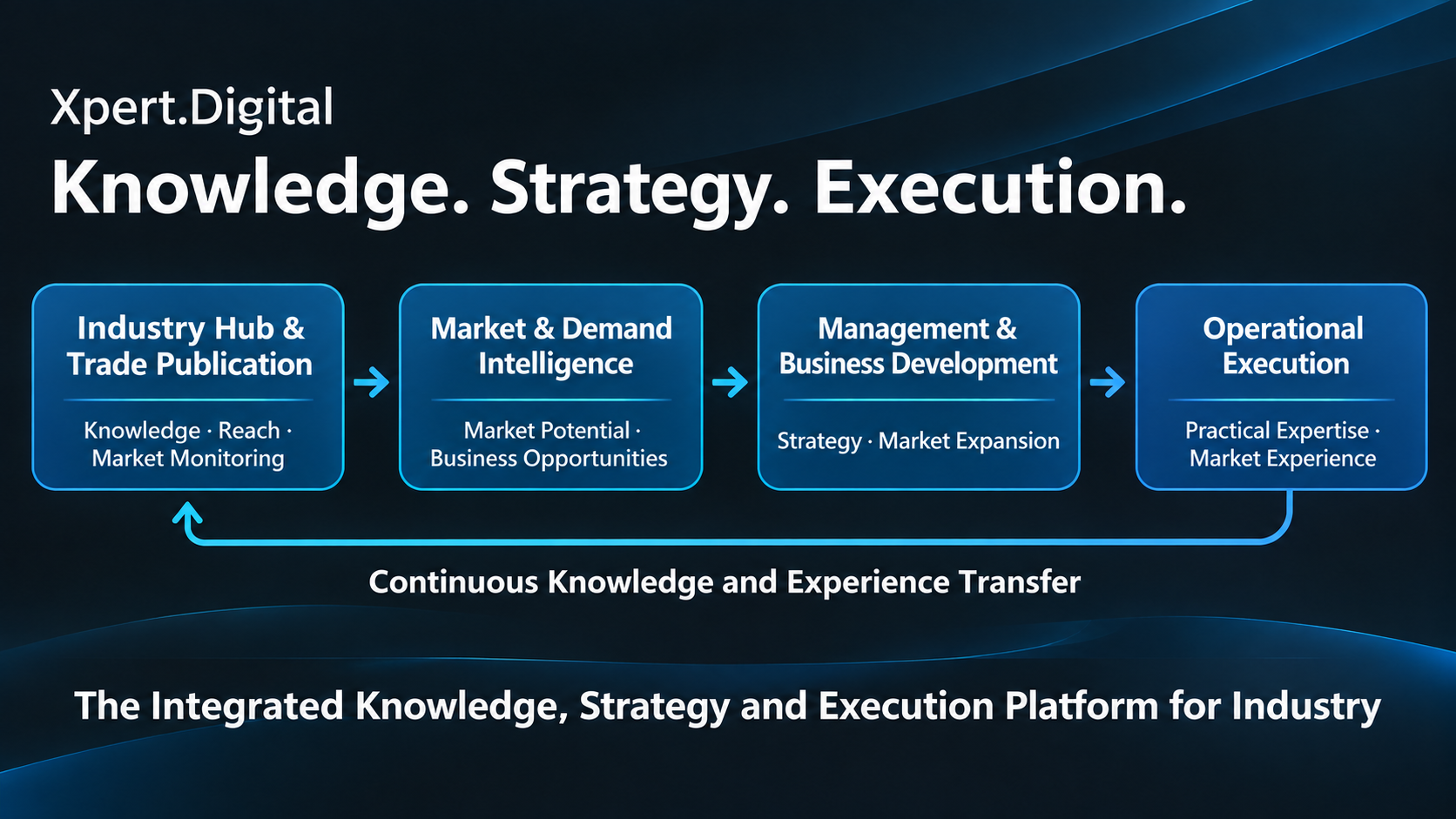
Xpert.Digital counters this functional separation with an integrated business model. The approach combines an industry hub and a specialist publication with market and demand analyses, management and business development, as well as operational implementation. Crucially, it's not just that these services are offered side-by-side. The economic core lies in their feedback loop: Market monitoring supports the identification of business opportunities, their strategic development leads to practical implementation, and the experience gained there, in turn, improves the quality of market monitoring.
In response to the weaknesses emerging in digital marketing, this model follows a different logic than the isolated optimization of individual channels. SEO, online marketing, AI, and social media are not ends in themselves, but rather tools within a broader business context. Their value is measured by whether they make relevant knowledge accessible, support strong relationships, and contribute to addressing actual market needs.
The potential economic advantage lies in the fact that knowledge does not need to be rebuilt at every interface. Technical expertise can support multiple tasks, while operational experience helps to assess the feasibility of recommendations. This requires that knowledge is documented, critically evaluated, and made available across different areas of activity. Only then does the combination of individual contributions create a learning system.
This also points to a new B2B standard: The focus shifts from simply generating attention to the demonstrable integration of expertise, market understanding, and implementation. This doesn't mean that every company has to provide all services itself. The crucial point is that communication, analysis, and practical work work together to solve economic problems.
Why the old equation between search position and business success is becoming more fragile
The changes in search behavior illustrate the problem particularly clearly. A Pew Research Center study of the search behavior of 900 adults in the US in 2025 revealed significant differences between Google search results pages with and without AI summaries. On visits with such a summary, a traditional search result was clicked in eight percent of cases. Without an AI summary, this figure was 15 percent. A link within the AI summary was clicked in only one percent of cases on these visits.
These results should not be generalized to all countries, industries, or B2B search queries. Nor do they prove that AI summaries alone cause all the differences. Nevertheless, they highlight a fundamental shift: Providing relevant information does not automatically lead to users visiting the original website.
This makes a previously crucial connection less secure. If search systems directly aggregate information, content can contribute to answering a question without the author receiving any corresponding notification of use of their website.
This does not mean that companies should ignore search engines. Rather, it means they need to avoid basing their business model solely on redirected attention. Those who can only realize economic value when a specific click occurs remain particularly dependent on the design of external systems.
SEO remains necessary, but is losing its claim as the sole growth strategy
Technical findability, clear page structures, and a well-organized content structure remain important. The problem is not search engine optimization itself, but rather confusing it with a comprehensive business strategy.
A company can have excellent technical search engine rankings and still lack a compelling offering. It can appear for numerous search terms without reaching the right decision-makers. And it can attract visitors whose interests are hardly aligned with its business model.
Google's published quality requirements also focus on original information, independent analysis, demonstrable experience, and content that genuinely helps people. Simply producing content for search engine rankings does not meet these requirements. However, this does not guarantee stable rankings or commercial success.
The strategic consequence is a different order: First, there must be technical substance, market relevance, and business relevance. Search engine optimization then supports their discoverability.
In the integrated model, SEO thus becomes an infrastructure service. It helps to make existing value accessible. It should not replace economic value through technical or linguistic optimization if that value does not yet exist in terms of content or business.
Online marketing must be measured by the quality of its impact
A conflict of objectives also arises in other areas of online marketing when the optimization of individual key performance indicators (KPIs) is decoupled from the actual business goal. A campaign might generate leads cheaply, but the subsequent follow-up consumes a lot of time and yields few suitable business opportunities.
Conversely, a smaller, more narrowly focused initiative can be more economically viable, even if it appears less impressive in terms of reach and number of contacts. The crucial factor is not just how many people respond, but what problems they face and whether the company can make a relevant contribution to addressing them.
For B2B business, a comprehensive approach is therefore essential. What counts as a successful marketing measure must also hold up in subsequent discussions and service delivery.
In the integrated model, feedback from these later phases is fed back into the communication. If inquiries are regularly based on false expectations, this is not just a sales problem. It can also indicate unclear positioning or an unsuitable approach.
This doesn't make marketing any less important. It simply becomes more closely linked to economic reality and no longer has to justify itself solely through its own platform metrics.
Social media is a point of contact, but not a market in its own right
Social networks can facilitate networking, disseminate expertise, and increase company visibility. However, a profile, a large number of followers, and regularly successful posts are not the same as a self-controlled market position.
The distribution remains bound by rules that are not set by the individual company. Which posts become visible, which formats are preferred, and how relationships remain technically accessible are largely determined by the respective platform operators.
This creates a strategic dependency risk. Anyone who concentrates all their communication on a single external channel closely ties their market approach to its conditions.
For an integrated B2B model, social media is therefore neither superfluous nor the central focus. It serves as a distribution channel, a forum for discussion, and an additional sensor for relevant topics. However, the permanent knowledge base and one's own positioning should not exist exclusively within this environment.
A post can draw attention to well-founded technical content. The resulting exchange can provide insights into a customer problem. This problem can then be analyzed and, if necessary, addressed. Each individual channel derives its economic value from its contribution to the overall process.
AI exacerbates the interchangeability of ordinary content
Artificial intelligence is changing not only how we search, but also the production conditions of digital communication. Texts, outlines, summaries, and variations can be created with minimal additional effort.
This opens up productive possibilities. Companies can process information more quickly and support specialist work. At the same time, the differentiating power of content that consists primarily of generally available statements decreases.
When numerous providers answer similar questions with similar wording, the reader doesn't gain any corresponding increase in knowledge. More text then primarily means more effort required to select the right information.
The bottleneck shifts from production to evaluation. Which information is reliable? Which developments are economically relevant? Which statements take real-world implementation conditions into account? And where is something already known simply being reformulated?
For Xpert.Digital, this is a key starting point. The aim is not to participate in a competition for the largest amount of text. It is to combine published knowledge with market observation, strategic analysis, and practical experience.
AI can support this system, but it is not a replacement. Its usefulness depends on the quality of the underlying information and how carefully the results are checked.
Four functions form a common economic architecture
The structure of Xpert.Digital can be divided into four interconnected functions.
It all starts with the industry hub and its specialist publication. This provides continuous market monitoring, expert analysis, and access to relevant topics and target groups.
Market & Demand Intelligence builds on this. Its task is to derive reliable assessments of market potential, demand conditions, and business opportunities from information.
Management and business development translate these assessments into strategic decisions. This includes selecting suitable target markets, developing offerings, and shaping market access.
The operational implementation ultimately leads to practical application. It reveals which assumptions work, which obstacles arise, and which adjustments become necessary.
The crucial element is the feedback of these experiences. Practical knowledge improves subsequent analyses and further communication. Therefore, the four functions do not merely constitute a list of offerings, but rather a shared economic architecture.
Their aim is to prevent insights from being lost at organizational boundaries, but to use them productively across multiple areas of activity.
An industrial hub is more than just a publishing venue
A specialist publication publishes content. An industry hub also connects topics, stakeholders, and economic issues.
The difference isn't solely in the size of a website. What's crucial is whether information is presented in a coherent and comprehensible way. For example, a report on automation gains value when it also considers investment conditions, staffing issues, integration costs, and industry-specific requirements.
Readers gain orientation. The business model benefits from a growing body of structured market understanding.
This database can serve various purposes. It supports editorial work, facilitates the preparation of discussions, and improves the classification of new developments. A single topic does not need to be completely researched from scratch for every inquiry.
Active maintenance is essential. A comprehensive archive does not automatically constitute a high-performance knowledge system. Outdated assessments, contradictory terminology, and unconnected contributions can limit its usefulness.
The hub derives its economic value from thematic depth, comprehensible connections, and continuous updates. The decisive factor is not the number of published pages, but the quality of the understanding they provide.
Interest only becomes a business opportunity through classification
Distinguishing between attention and demand is one of the model's most important tasks. A topic can be read frequently without triggering short-term investments.
Interest in a technology can arise from curiosity, further education, competitor analysis, or a specific procurement project. These motives have different economic significance.
Market intelligence must therefore not stop at evaluating digital usage signals. It must examine what operational problems underlie the interest and under what conditions this creates a need for action.
For an industrial company, for example, it is not only relevant whether an automation solution appears technically attractive. Crucial factors are the existing processes, capacity utilization, financing, integration capabilities, and available personnel resources.
Only the combination of such factors creates a viable business opportunity. The analytical skill lies in recognizing the gap between public interest and economically viable implementation.
This model can also lead to a conscious decision not to make a decision. A topic may be relevant in the long term without yet justifying a viable offer or a short-term investment.
🎯🎯🎯 Data-driven B2B industry hub as a quasi-in-house solution

The quasi-in-house solution: How Xpert.Digital closes operational gaps in B2B marketing and sales – Smart Content-Driven Business - Image: Xpert.Digital
Xpert.Digital is a data-driven B2B industry hub led by Konrad Wolfenstein . The company acts as an external, quasi-in-house solution for industrial partners, closing operational gaps in marketing, content, and sales – without requiring additional resources on the client side.
More information here:
Why B2B particularly benefits from this connection
Why B2B particularly benefits from this connection
In the B2B sector, decisions are often prepared and evaluated by multiple stakeholders. Technical departments assess functionality. Commercial managers examine economic viability and risks. Other stakeholders deal with integration, operation, or contractual terms.
A compelling product description only partially answers these questions. Likewise, an attention-grabbing article is insufficient if the subsequent economic analysis is missing.
This results in a particular requirement for communication: it must consider different perspectives without breaking down into contradictory individual messages. Technical performance and economic benefits must be aligned.
An integrated knowledge model can support this connection. It considers a solution not only from the perspective of its marketing, but also from the perspective of its application.
The benefit doesn't lie in a single message for everyone. It lies in a consistent line of reasoning that takes different requirements seriously. A management team needs different details than a technical project manager, but they should be able to make decisions based on the same objective criteria.
Especially with services that require explanation, this consistency can be more important than having as many short-term contacts as possible.
Trust is built through substance, not through publication frequency
The ease of content production makes the question of its credibility more important. Those who publish frequently gain visibility. Whether they are competent depends on other factors.
This includes the precision of the problem statement, the comprehensibility of the argumentation, and the handling of limitations. A contribution gains value when it not only lists advantages but also explains conditions and makes conflicting objectives visible.
A 2024 study by Edelman and LinkedIn showed that 73 percent of surveyed decision-makers considered high-quality, thought-provoking content from industry leaders a more trustworthy basis for assessing a company's competence than its marketing materials and product documentation. This reflects the respondents' perceptions, not evidence of a corresponding increase in revenue.
This leads to a clear requirement for the business model: journalistic work must not be reduced to the linguistic extension of a sales pitch.
Their economic strength stems precisely from the fact that they offer intrinsic value. If an analysis is helpful even when the reader doesn't commission a service, it creates a different basis for trust than mere product advertising.
The economic leverage lies in the multiple use of knowledge
The economic significance of the integrated model cannot be reduced to the question of how many additional consulting projects are generated by a specialist publication. Such a view would primarily treat publishing as a tool for customer acquisition.
The more comprehensive approach is to make knowledge usable across multiple fields of activity and to continuously improve it through practical experience.
Thoroughly developed market knowledge can simultaneously enhance the quality of a specialist article, facilitate the evaluation of a business opportunity, and improve the preparation of an operational project. Conversely, implementation can reveal which assumptions from the initial analysis were valid.
The potential economic benefit therefore lies not only in additional revenue. It can also arise from better utilizing existing knowledge, reducing repeated fundamental work, and identifying unsuitable projects earlier.
A distinction must be made between meaningful reuse and mere repetition. An editorial analysis answers different questions than a concrete investment decision. Shared fundamental knowledge supports this work, but does not replace the examination of the respective operational requirements.
A reliable evaluation requires real process and results data. Arbitrarily set sales assumptions, on the other hand, would only create a false sense of precision. The crucial factor is where the combination of functions demonstrably leads to better results.
Combined benefits replace the isolated optimization of individual services
Economically, this shared use can be described as a potential synergy advantage. Several services can be provided more efficiently or with higher quality when combined because they rely on shared resources.
In this model, these resources include specialist knowledge, market understanding, documented experience, and established work processes. Their value does not automatically increase with every additional activity. It increases where actual overlaps exist.
One example is the investigation of an industrial application area. The insights gained can simultaneously support a specialist publication, a strategic evaluation, and a concrete implementation discussion.
This is countered by coordination efforts and quality requirements. Information must remain accessible, responsibilities must be clarified, and not every finding can be used in every context.
The advantage therefore does not arise from offering the widest possible range of services. It arises from the targeted combination of professionally related activities.
This is what distinguishes an integrated knowledge platform from any full-service offering. The goal is not to do everything in-house, but to effectively deploy relevant knowledge at crucial points.
Business development translates market knowledge into entrepreneurial priorities
Identifying demand is not yet a strategy. Companies must decide which opportunities match their capabilities and which resources they are willing to allocate.
Business development handles this translation. It combines market observation with questions of supply, positioning, and economic access.
Restraint is just as important as initiative. Not every growing market is attractive to every company. High entry costs, unsuitable distribution channels, or a lack of service capabilities can render a fundamentally interesting business area unsuitable.
The integrated model can offer an advantage here because it doesn't just consider abstract market sizes. It can incorporate feedback from communication and implementation into the strategic evaluation.
Recurring questions reveal where understanding is lacking. Specific discussions clarify operational requirements. Practical experience helps to assess which services can realistically be provided.
Strategy is therefore not created as an isolated document. It becomes a continuous comparison between market opportunities and one's own capabilities. Especially in dynamic technology fields, this connection is more valuable than a one-off plan that is subsequently updated unchanged.
Operational implementation turns a claim into a verifiable result
Practical work is the stress test of the entire model. This is where it is decided whether a comprehensible analysis will lead to a viable solution.
A concept can appear convincing and yet fail due to missing data, unclear responsibilities, or unsuitable processes. Conversely, a limited measure can generate great benefits if it addresses the actual bottleneck.
Therefore, implementation should not be understood merely as the fulfillment of a predetermined task. It is also a source of knowledge.
To make this resource usable, the goals and initial situation must be documented. What improvement was intended? What assumptions were made? What difficulties arose? What adjustments were necessary?
Technical functionality is not synonymous with cost-effectiveness. A solution can work reliably and yet be too complex, too expensive, or organizationally unsuitable.
The integrated model gains in quality when such results are fed back into the next analysis. It loses in quality when only success stories are communicated and difficulties disappear from the knowledge base.
The feedback from practical experience is the real difference
Many providers combine content and services. That alone does not constitute a new business model.
The crucial difference lies in whether practical experience actually changes further knowledge production. Do new obstacles become apparent? Do previous assessments need to be revised? Do more precise questions and better decision criteria emerge?
A true cycle is open-ended. It does not necessarily confirm the original position, but can change it.
At the same time, the experience gained from a single project should not be generalized too hastily. Companies differ in terms of size, organization, investment capacity, and technological starting point.
The analytical task, therefore, is to distinguish general patterns from specific conditions. An integration hurdle may be typical of the industry or arise solely from a particular legacy system. Weak project success may be due to the technology or an unsuitable implementation.
Only this distinction transforms experience into transferable knowledge. The economic advantage of the model depends significantly on how carefully this evaluation is carried out.
The economic foundation lies in performance, not in the hope of clicks
A business model requires a sound economic foundation. With an integrated knowledge, strategy, and implementation platform, this lies in services for which customers recognize a concrete benefit: analysis, strategic support, business development, and operational collaboration.
The special feature is not that knowledge is created for free or that journalistic work requires no effort. It lies in the fact that the individual activities are not evaluated solely independently of one another.
A technical article may not generate immediate revenue, yet it can facilitate communication with a future client. A project can generate revenue while simultaneously providing valuable insights for future work. A market analysis can support several subsequent decisions.
However, these correlations should not lead to a blanket attribution of success. Not every inquiry arises from content. Not every operational experience is strategically valuable.
Sound management therefore considers both the cost-effectiveness of individual services and their contribution to the overall system. This prevents short-term profitable activities from crowding out the long-term knowledge base or costly activities from being continued indefinitely without any discernible benefit.
Better decisions are what matters, not bigger key performance indicators
The new model requires a different method of measuring success than a pure reach strategy. Visitor numbers, impressions, and followers can still provide clues. However, they are insufficient as the sole metrics.
More relevant is whether the right target groups are reached and whether the communication contributes to clarifying economic issues.
Market intelligence raises the question of how frequently identified opportunities are subsequently confirmed. Business development requires examining whether suitable projects are identified and unsuitable options are ruled out in a timely manner. In implementation, the focus is on achieving objectives, quality, and economic benefit.
Overall, it remains to be seen whether the connection between the different areas works. Are projects understood more quickly? Is less information lost? Is the coordination between recommendations and implementation improved?
A perfect attribution of each result to a single contribution is neither necessary nor always possible. What is required is a transparent evaluation using multiple indicators.
This shifts the focus from maximizing activity to achieving a justifiable impact. This is a crucial difference from simply optimizing platform metrics.
Personal knowledge becomes more important than rented attention
Search engines and social networks remain important access channels. However, the ability to be relevant independently of any single distribution mechanism is becoming increasingly strategically valuable.
This includes having one's own well-maintained body of knowledge, as well as a recognizable professional position and a reliable relationship with customers and partners.
The term independence should not be understood in an absolute sense. No digital business model operates completely outside of technical infrastructures and external systems. What is meant is a reduced reliance on a single access point.
For Xpert.Digital, this means that the industry hub is not just a repository for content that is subsequently distributed via platforms. It is part of its own economic substance.
If the insights gained there support analysis, advice and implementation, their value does not depend solely on short-term visitor numbers.
This changes the role of publication. It remains external communication, but at the same time an element of internal knowledge organization. This dual function, in particular, can make the model more resilient to changes in individual channels.
Credibility and confidentiality form the basis of the model
The combination of a specialist publication and commercial activity creates a conflict of interest. A provider might be tempted to present those developments in a positive light for which they sell their own services.
This risk cannot be eliminated by a general commitment to quality. Clear working principles are required.
Analyses must consider different possibilities. Recommendations should stem from the problem itself, not from a desire to sell a particular service. Equally important is the willingness to acknowledge limitations and involve other specialists.
Furthermore, responsible handling of project experiences is crucial. Not everything learned in operational work can be published or used in other contexts. Confidential operational information and generalizable findings must be kept separate.
The knowledge cycle must therefore not be an uncontrolled data cycle. Its value arises from the structured processing of experiences, not from the most extensive possible exploitation of sensitive details.
Credibility and confidentiality are therefore not merely additions to the business model. They are among its core prerequisites.
Growth requires more than the performance of individual experts
An integrated approach can initially be strongly supported by individuals. They combine specialist knowledge, market understanding, and practical experience. However, this personal connection alone is not sufficient for sustained growth.
Knowledge must be documented and made comprehensible to others. Recurring research and review processes require clear structures. At the same time, it must remain clear who is responsible for which technical assessment.
Otherwise, a bottleneck arises: operational work crowds out analysis, analysis delays publications, and the maintenance of knowledge bases is neglected.
Standardization can be helpful here, as long as it is not confused with formulaic consulting. Research processes, documentation, and quality controls can be standardized. However, the assessment of a specific business situation remains context-dependent.
The organizational task is to make repeatable work efficient while preserving room for reasoned judgments.
Only then does a personal way of working become a resilient business model that can endure beyond individual projects and individual limits of resilience.
Specialization makes integration credible
A broad range of services is only convincing if the individual offerings are based on a common professional foundation. Those who address too many disparate topics risk losing the desired depth.
The strength of the model therefore does not lie in its claim to be able to answer every entrepreneurial question. It lies in the close connection of relevant competencies within specific industrial subject areas.
Market observation, analysis, and implementation can truly benefit each other in this environment. Concepts, requirements, and typical difficulties do not need to be rediscovered for every task.
Outside this area of expertise, the benefits of collaboration decrease. The additional research effort increases, while the transferability of individual experiences diminishes.
External specialists are therefore not incompatible with integration. They can complement the model if the overarching problem is understood and responsibilities remain clear.
The appropriate guiding principle is not maximum depth of service in every area, but maximum compatibility between the services that are necessary for the respective customer problem.
Why this could lead to a new B2B standard
The prospect of a new standard rests on several interacting developments: Ordinary content is easier to reproduce. Search systems are increasingly answering questions directly. Companies need to justify the benefits of their communication more precisely. At the same time, complex B2B decisions remain dependent on trust and reliable classification.
Under these conditions, a model that does not separate professional visibility from market understanding and implementation gains plausibility.
The potential new standard does not mean that every company must operate its own specialist publication or that every consultancy must offer operational services. The crucial factor is the underlying requirement: communication should be based on real knowledge, analysis should support decisions, and practical results should enhance that knowledge.
This connection can be organized internally or established through suitable partners. Various company structures are possible.
Whether and how quickly this approach will prevail remains to be seen. However, it is a sound strategic expectation: the more interchangeable the mere production of content becomes, the more important skills that cannot be replaced by sheer volume of text become.
Xpert.Digital stands for connection, not for the next individual discipline
The answer to the declining reliability of old reach models does not necessarily lie in yet another optimization shortcut. New labels for visibility do not solve the fundamental problem if they lack technical substance and economic viability.
Xpert.Digital represents a different approach in this context. The model doesn't simply attempt to better utilize an existing channel; it combines information management with business development.
This changes the positioning. Compared to a traditional trade publication, it gains the ability to process findings strategically and operationally. Compared to isolated consulting, it establishes a continuously cultivated connection to the public professional discourse. Compared to a pure marketing service, the focus is more strongly on the economic problem at hand.
This connection is not an automatic proof of superiority. However, it describes a coherent answer to the weaknesses of fragmented offerings.
Competitive advantage arises where functions truly collaborate and mutually enhance their results. Without this connection, all that remains is a broad range of services under a common name.
The next standard combines attention with economic impact
The crucial shift is this: Visibility remains valuable, but it must be linked to real-world capabilities. Content remains important, but it needs to offer independent insights. AI remains a powerful tool, but it replaces neither market understanding nor responsibility.
Xpert.Digital's business model integrates these requirements into a cycle. The industry hub observes and explains. Market intelligence assesses opportunities. Business development sets priorities. Operational implementation verifies assumptions and delivers new insights.
This provides a sound perspective for a future B2B standard. The complete abolition of existing disciplines is not imminent, but rather their stronger integration into a common economic context.
The problem arises when SEO, online marketing, AI, and social media are pursued as ends in themselves. The constructive response lies in placing these technologies on a more sustainable foundation.
Those who merely generate reach remain dependent on its distribution. Those who systematically translate knowledge into decisions and implementation create further value. It is precisely this transition that transforms digital presence into an integrated business model – and individual communication measures into a corporate infrastructure for the B2B market.
📈🚀 From visibility to trust 👀🤝 Your scalable path with Xpert.Digital

From visibility to trust: Your scalable path with Xpert.Digital - Image: Xpert.Digital
In industrial B2B, sustainable business relationships rarely emerge overnight. They develop step by step – through visibility, professional relevance, recurring touchpoints, and growing trust. Xpert.Digital's 4-stage model addresses precisely this: It offers a structured path that begins with a manageable entry point and can evolve into deeper collaboration in business development if needed.
Instead of relying on loud marketing promises, this model puts the relationship at the forefront. Companies start with clearly defined, easily calculable measures and then decide, based on their own experience, how far they want to expand the collaboration. A key factor for this undisturbed trust-building process: The platform completely avoids annoying advertising ads, so the editorial focus remains solely on the companies' expertise.
More information here:
Your global marketing and business development partner
☑️ Our business language is English or German
☑️ NEW: Correspondence in your native language!

Konrad Wolfenstein
I and my team are happy to be available to you as your personal advisor.
You can contact me by filling out the contact form here [email protected]:or simply call me at +49 7348 4088 965. My email address is
I'm looking forward to our joint project.