

Container high-bay warehouses, hub-and-spoke networks and dual-use infrastructure
Xpert Pre-Release

Available in 27 languages 📢
Prefer Xpert.Digital on GoogleⓘPublished on: January 29, 2026 / Updated on: January 29, 2026 – Author: Konrad Wolfenstein
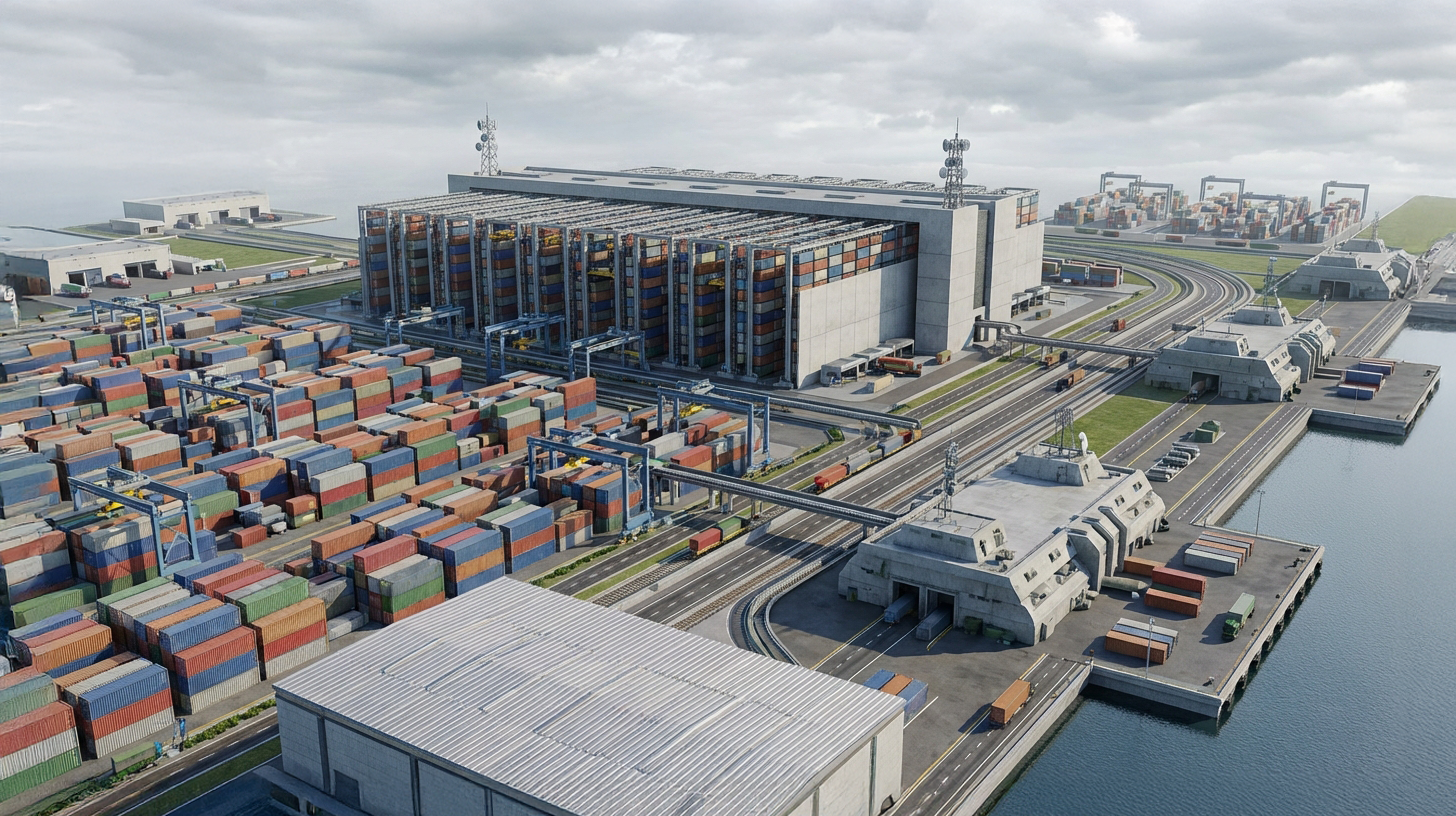
Container high-bay warehouses, hub-and-spoke networks and dual-use infrastructure – Creative image: Xpert.Digital
Global supply chains, nearshoring and storage capacity: A comprehensive guide
The new era of logistics: When space constraints meet geopolitics
The days when global supply chains were determined solely by the lowest price are over. Since the disruptions of recent years—from the aftermath of the pandemic and blockages in the Suez Canal to escalating security risks in the Red Sea—a fundamental paradigm shift has taken place. Companies worldwide are prioritizing security of supply over mere cost optimization. Terms like "nearshoring" and "resilience" dominate boardrooms, while the withdrawal from risky dependencies on the Far East is well underway.
But this strategic realignment of Europe is encountering a massive physical obstacle: a simple lack of space. While industry is bringing its production closer to domestic markets and building up buffer stocks, logistics centers in Germany and Europe are reporting record vacancy rates of under two percent. We are heading towards a paradox: we want to become more resilient, but we don't have the space for the necessary inventory.
How can this dilemma be solved without sealing off valuable green spaces? The answer lies not in horizontal expansion, but in vertical growth and intelligent networking. This article highlights three revolutionary concepts that could form the backbone of future supply security: high-bay container warehouses that triple storage capacity on the same footprint; hub-and-spoke networks that radically improve transport efficiency; and dual-use infrastructures that merge economic logistics with crisis preparedness. Learn why the future of ports is vertical and why these technologies will determine the competitiveness of European industry.
Suitable for:

Why are global supply chains more volatile than ever before?
Global supply chains are in a state of permanent uncertainty. Geopolitical conflicts such as the security incidents in the Red Sea, the impact of US tariffs and trade policies, and unforeseen disruptions like the blockage of Suez Canal routes have led to a fundamental reassessment of supply chain strategy. While 2024 and 2025 were characterized by extreme volatility, one clear insight has emerged: global supply chains focused on maximizing cost optimization are too fragile for today's world. In contrast to previous decades, when price alone determined location decisions, the focus is now fundamentally shifting toward risk mitigation and business continuity.
The McKinsey Global Initiative documents that companies with diversified supply chains can reduce their risk of business disruptions by up to 45 percent. This explains why 54 percent of the executives surveyed intend to increase their investments in nearshoring or reshoring. The Volkswagen Group exemplifies how this shift in thinking is being put into practice: By relocating production capacity to Eastern Europe, diversifying supplier sources, and creating regional buffer stocks, the company has significantly increased its supply chain resilience.
What exactly is nearshoring and why has it become so crucial?
Nearshoring means the strategic relocation of production and procurement activities to geographically closer countries, not back to the home country (that would be reshoring), but to familiar neighboring regions. For German companies, this typically means relocating to Poland, the Czech Republic, Hungary, or southern European countries like Portugal. The fundamental difference to traditional offshoring is that nearshoring strikes a balance: it combines cost efficiency with operational control, proximity, and agility.
The advantages are measurable. Transport routes that previously required four to six weeks of shipping are reduced to two to ten days thanks to European road and rail freight. This is not just a matter of speed, but also of economic predictability: While international sea freight rates are extremely volatile, transport costs within Europe are stabilized by an established infrastructure. At the same time, cultural and temporal proximity is maintained, which significantly simplifies communication and quality control.
Another critical advantage lies in regulatory compliance. Manufacturers sourcing within the EU do not have to deal with global customs disputes, are less dependent on trade policy fluctuations, and benefit from harmonized regulatory standards. The EU's Carbon Border Adjustment Mechanism (CBAM), for example, only applies to imports from outside the Union – European nearshoring partners are exempt.
Suitable for:
What is the central problem that nearshoring without storage capacity cannot solve?
Herein lies the paradox of the nearshoring strategy: The concept itself is logical and compelling, but its successful implementation is thwarted by a material bottleneck – a lack of warehouse capacity at Europe's economic hubs. Germany, as a center of European logistics, is under particular pressure. The warehouse space markets in Germany's top eight logistics regions show alarming vacancy rates, in some cases below 2 percent. This is practically full capacity.
The problem is not temporary, but structural. With a stagnant economy, high construction costs, and stricter zoning regulations, the provision of new logistics space is becoming a bottleneck. At the same time, the demand for warehouse space is paradoxically growing: companies implementing nearshoring need local buffer warehouses. They are building strategic reserves to absorb disruptions. Automakers, for example, need new warehouse structures for batteries and new supplier components due to the rise of electromobility. In addition, the modernization of older logistics properties is becoming increasingly urgent, as 65 percent of institutional investors require ESG-compliant, energy-efficient buildings.
The result: New construction volume could rise to over 4.5 million square meters per year by 2028, but this demand cannot be met under current conditions. Europe as a whole will have to reckon with a supply gap of 21.2 million square meters in logistics space. This is not just an economic problem – it jeopardizes the competitiveness of European companies, as the remaining capacity at premium logistics locations leads to premium prices.
How can container high-bay warehouses solve this bottleneck in a revolutionary way?
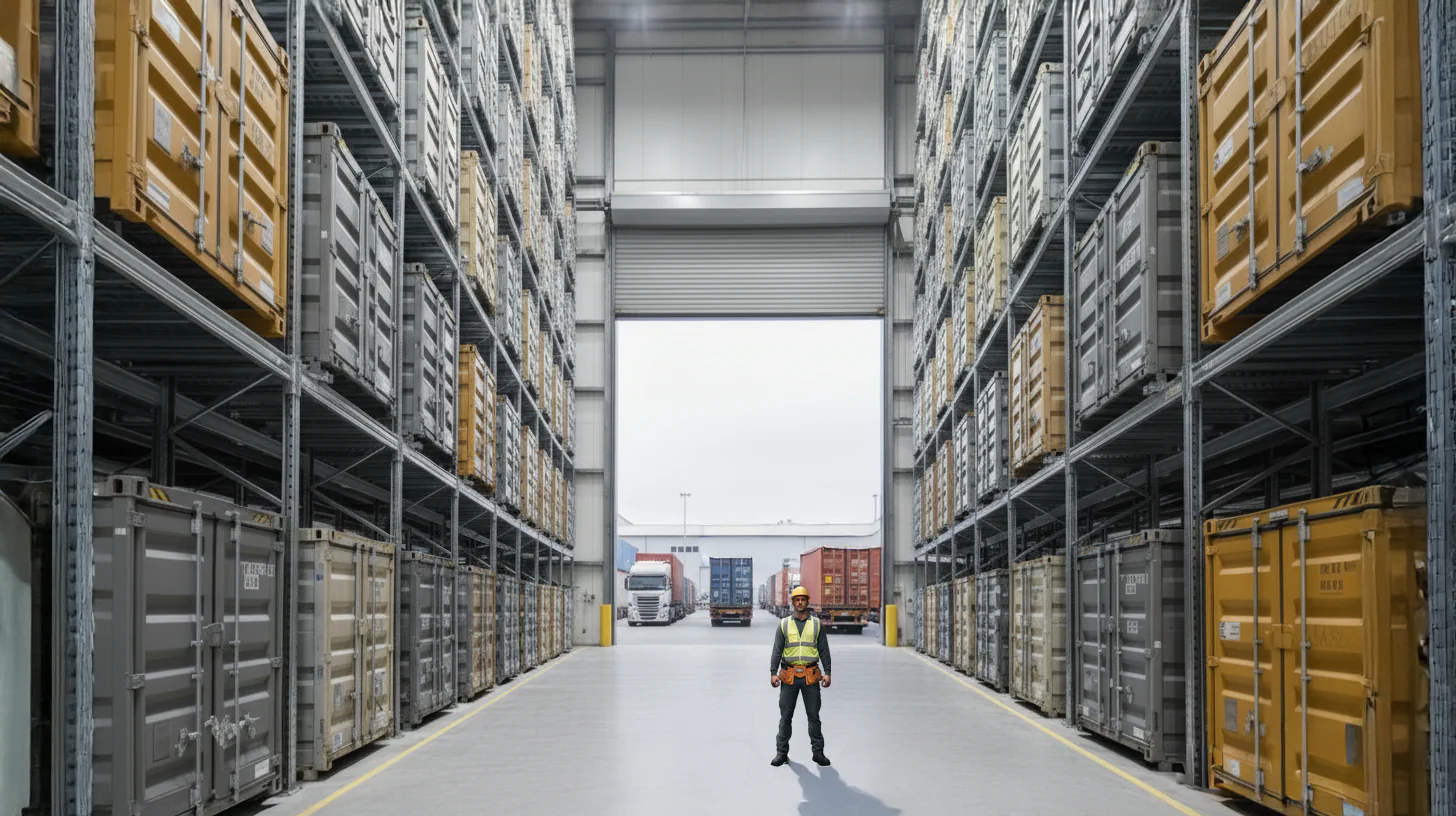
Container high-bay storage systems (HBS) represent a paradigm shift in warehousing. The concept is elegant and solution-oriented: instead of stacking containers horizontally and organizing them in a complex manner around gantry cranes, as has been the practice since 1956, they are stored vertically in stable steel racking structures. This sounds simple, but has fundamental implications for efficiency and space utilization.
A high-bay container warehouse requires only one-third of the floor space of a conventional container warehouse with comparable capacity. This is made possible by two key technical features: firstly, vertical storage at heights of 7 to 18 layers (traditional systems reach 3 to 4 layers), and secondly, a compact geometric arrangement that eliminates transshipment problems. The BOXBAY system in Dubai, for example, stores containers on up to 11 levels with a total height of 50 meters.
The technological heart of the system consists of fully automated storage and retrieval machines that can directly access any container at any time. This eliminates the classic problem of container logistics: reshuffling. In traditional systems, reaching a specific container often requires moving an entire stack – a time-consuming, error-prone, and costly operation. High-bay container warehouses guarantee 100% direct accessibility. An incoming container is automatically assigned to its optimal storage location by AI algorithms that analyze factors such as weight, destination, and estimated pickup time.
This has dramatic effects on key operational figures. A terminal equipped with BOXBAY can increase throughput at the quayside by up to 20 percent because there is no time overhead from reshuffling. At the same time, truck waiting times at the gate are also reduced by 20 percent because every container is immediately available. For the Hamburg Port Authority or the Port of Bremerhaven – critical hubs of North European logistics – this would mean that existing terminals could double their capacity using retrofittable HBS systems without sealing off any new land.
In addition, the system offers significant sustainability advantages. Fully automated, electrically operated storage and retrieval machines are considerably more energy-efficient than diesel-powered gantry cranes. Modern HBS systems are powered by solar panels on the plant roofs, enabling a high degree of energy self-sufficiency.
Suitable for:

What is the hub and spoke logistics model and how does it complement vertical warehousing?
Hub and Spoke is a distribution network concept that has revolutionized traditional point-to-point logistics. The model functions like a bicycle wheel: A central hub acts as a central point of contact, from which spokes radiate out to peripheral warehouses. Instead of each logistics location being directly connected to every other – which would require 45 direct connections for 10 locations – a hub and spoke system only needs 10 connections to the central hub.
The system operates in three phases: In the collection phase, goods are gathered at peripheral spokes and transported to the hub within defined time windows. This enables optimal truck utilization and minimizes empty runs. At the hub, central consolidation takes place – goods are re-sorted according to their destination and optimized into loads. In the distribution phase, new loads are transported to the destination spokes, with each truck efficiently combining several regional destinations.
The operational advantages are considerable: transport costs are significantly reduced through optimized truck utilization and fewer empty miles. Centralized control from the hub allows for better monitoring of all goods flows, greater transparency, and faster responses to changes. The system scales easily – new spokes can be added without redesigning the entire network architecture.
When hub-and-spoke systems are combined with container high-bay warehouses, a synergistic structure emerges: The central hub is developed as a highly automated transshipment and storage center with a vertical racking structure, while the spokes remain as regional distribution centers. This maximizes both capacity and throughput speed. The hub can be extremely compact because the vertical structure operates instead of horizontally, while the spokes remain closer to the customer. This reduces last-mile distances and enables faster regional deliveries.
LTW Solutions

LTW Intralogistics – Engineers of Flow - Image: LTW Intralogistics GmbH
LTW offers its customers not individual components, but integrated complete solutions. Consulting, planning, mechanical and electrotechnical components, control and automation technology, as well as software and service – everything is networked and precisely coordinated.
In-house production of key components is particularly advantageous. This allows for optimal control of quality, supply chains, and interfaces.
LTW stands for reliability, transparency, and collaborative partnership. Loyalty and honesty are firmly anchored in the company's philosophy – a handshake still means something here.
Suitable for:
Stacking instead of spreading out: How vertical warehouses prevent the collapse of supply chains
What role do buffer stocks play in a nearshoring strategy?
Buffer stocks are the invisible safety net that makes nearshoring practical in the first place. They are additional inventories that companies strategically maintain to compensate for fluctuations in demand, transport delays, or unforeseen disruptions. In the context of nearshoring, buffer stocks take on a completely new meaning.
With traditional offshoring from Asia, long, unreliable supply chains are the norm. For example, an automotive supplier used to have to factor in a lead time of 8 to 10 weeks for components from China. Buffer inventories were therefore enormous and costly – a necessary but inconvenient evil. Companies maintained expensive stockpiles to avoid production downtime.
Nearshoring reduces delivery times to 2 to 10 days, thereby decreasing the required buffer size. A German automaker that relocated its suppliers to Eastern Europe was able to reduce its inventory by 30 percent, while delivery times increased by 50 percent. But the economic logic is changing: Instead of one huge, centralized buffer warehouse with all its associated costs and tied-up capital, several smaller, decentralized buffer warehouses are created at strategic network nodes. This enables faster responses to demand fluctuations and reduces the risk of production stoppages due to missing components.
The problem is that these decentralized buffer warehouses also require space – and space is precisely the scarce commodity in European logistics centers. This is where vertical storage solutions come into play again. A vertically structured buffer warehouse requires a third of the space of a traditional system and simultaneously offers faster access times thanks to automation.
Suitable for:

What is dual-use logistics and why is it becoming strategically relevant for companies?
Dual-use logistics is a comprehensive concept of multifunctional infrastructure utilization. It means that logistics facilities are designed to be used simultaneously for civilian economic purposes and for emergency, risk, or crisis scenarios. The concept has deep roots in security policy but is increasingly being implemented as a business model solution for the private sector.
The logic: A warehouse optimized 100 percent for civilian goods is completely unusable in crisis situations. A warehouse built according to dual-use principles can flexibly switch between different usage scenarios. For example, an automated terminal could normally process containers with electronic components, but in a crisis, it could be quickly reconfigured to handle emergency supplies or critical materials for infrastructure restoration. At the same time, the system remains fully economical during normal operation, and the readiness for crises is included "at no cost" as a byproduct of the modern, flexible infrastructure.
Specifically, this means: standardized, modularly expandable infrastructures, automated handling systems that can quickly switch between different container types, and digital management systems that offer real-time transparency across all resources. A modern dual-use terminal can handle heavy military transports (for example, tank transports on rail platforms) just as efficiently as high-frequency civilian container flows. Standardization in combined transport – the integration of rail, road, and water – is crucial in this context.
From the perspective of a private logistics company, this could mean that infrastructure investments are sized to achieve higher utilization rates because usage options become more diverse. A bridge that normally operates at 60 percent capacity can increase its utilization through available alternative uses (emergency transport, rerouting of goods flows when other routes are disrupted), thus improving profitability.
Suitable for:

How are these solution concepts implemented in current practice?
The technological concepts are not theoretical – they are already being implemented in leading ports worldwide. HHLA's Hamburg Container Terminal Altenwerder (CTA) is one of the most modern automated container terminals in the world. The terminal uses fully automated transponder systems to coordinate over 17,000 movement orders per day. Digital twins are tested in computer simulations before process changes are implemented. The result: extreme density combined with optimal safety and throughput.
Hansaport Hamburg, Germany's largest ore and coal port with an annual throughput of 15 million tons, has almost completely automated its operations using 3D laser scanners and intelligent control software. This level of precision was unprecedented in the industry.
On the international stage, the BOXBAY system in Dubai demonstrates how port capacity can be multiplied through vertical container storage. While European ports are still largely testing such systems in the pilot phase, feasibility studies have been completed and technological hurdles overcome. The critical project is a BOXBAY retrofit at a European terminal, which will show how seamlessly the technology integrates into existing infrastructure and whether the projected efficiency gains can be achieved in practice.
How do these concepts combine to form an integrated solution?
The synthesis of these technologies and concepts yields a consistent picture: A modern, resilient supply chain network for the 21st century could be structured as follows:
An international hub-and-spoke network forms the architecture. The central hub, located at a strategic port, is being developed as a fully automated container terminal with a vertical racking system (HBS). This saves land, doubles capacity, and enables extremely high throughput thanks to automation. The hub is being built according to dual-use principles – flexible for both civilian and emergency uses.
The Spokes are regional distribution centers, located closer to customers and production sites. These are also equipped with modern, partially vertical storage solutions – not all of them need to be fully automated at the level of the central hub, but they utilize space vertically and are digitally integrated.
Nearshoring goods flows between the hub and the spokes: Suppliers from Eastern European nearshoring locations deliver to regional spokes within 2-10 days, from where just-in-time deliveries to production sites are made. Buffer warehouses at the spokes are significantly smaller than classic offshoring buffer warehouses, but are strategically positioned for optimal efficiency.
Digital integration across the entire chain: IoT sensors on vehicles and in warehouses provide real-time data on inventory, movements, and operational status. AI systems optimize warehouse space allocation and transport routes, and make automated handling decisions. Blockchain-based documentation ensures the immutable security of critical supply chain data.
This demonstrably reduces supply chain risks. Companies that implement such intelligent, diversified, technology-supported systems achieve 37 percent fewer delivery failures and 43 percent bettersegenaccuracy regarding material availability.
Why is the implementation of these concepts a matter of survival for European industry?
Europe is at a crucial juncture. Industry is stagnating – production potential is more than five percent below what was projected for 2024 in 2019. At the same time, international pressure is mounting: Chinese logistics infrastructure is being modernized with government support, American ports are investing heavily in automation, and global trade uncertainty will be the new normal.
Germany and Europe have a decisive advantage: a central geographical location, established ports and transport routes, and a highly skilled workforce. But this advantage is not guaranteed – it must be defended and expanded through investment and innovation. A shortage of space in key logistics regions would force companies to relocate to suboptimal locations, resulting in longer delivery routes, higher costs, and poorer customer service. This would directly undermine the export capacity and international competitiveness of German and European producers.
The good news: The solutions are not theoretical. Container high-bay warehouses, hub-and-spoke networks, and dual-use infrastructure are real, implementable technologies already in use in ports worldwide. The critical window is now – investment decisions must be made within the next two to three years, and pilot projects must launch in top European ports. Those who fail to invest today will be competing tomorrow in a market where space constraints lead to cost premiums and supply disruptions.
Advice - planning - implementation

Konrad Wolfenstein
I would be happy to serve as your personal advisor.
contact me at wolfenstein ∂ xpert.digital
Just call me on +49 7348 4088 965 (Munich) .
Your container high-bay warehouse and container terminal experts

Container high-bay warehouses and container terminals: The logistical interplay – expert advice and solutions - Creative image: Xpert.Digital
This innovative technology promises to fundamentally change container logistics. Instead of stacking containers horizontally as before, they will be stored vertically in multi-story steel racking structures. This not only allows for a drastic increase in storage capacity within the same area, but also revolutionizes all processes at the container terminal.
More about it here:










