
Europe has been asleep at the wheel – now the middle class is supposed to save the defense
Xpert Pre-Release

Available in 27 languages 📢
Prefer Xpert.Digital on GoogleⓘPublished on: May 20, 2026 / Updated on: May 20, 2026 – Author: Konrad Wolfenstein
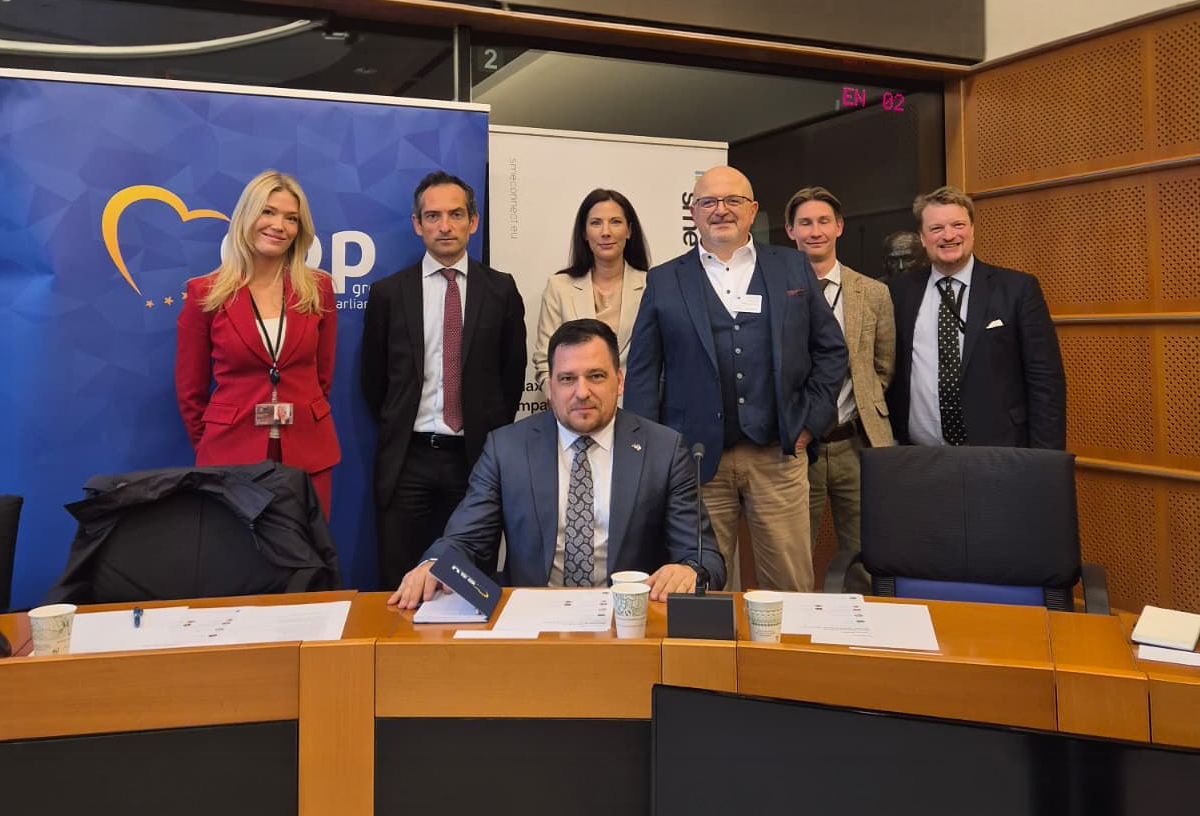
Europe has been asleep at the wheel – now small and medium-sized enterprises (SMEs) are supposed to save the defense – Image: sme connect
Drone warfare as economic warfare – Europe's SMEs on the front lines of a turning point in history
Too slow for the changing times: How EU bureaucracy endangers Europe's security
Europe's arms dilemma: Why billions are flowing to the wrong companies
The European security architecture is facing an epochal shift: On today's battlefields, inexpensive, mass-produced drones have taken the place of multi-million-dollar heavy weapon systems. But while technological and economic reality is already dictated by a new, asymmetric warfare, Europe is lagging behind structurally. Although the continent lacks neither innovative capacity nor highly specialized small and medium-sized enterprises (SMEs), a fragmented internal market, paralyzing approval processes, and a fatal dependence on key Chinese components are severely hindering the European arms transformation. The following article analyzes the relentless cost-benefit analysis of modern conflicts, the failure of traditional procurement processes, and shows what radical steps Brussels must now take to move from a cumbersome peacetime mode to a genuine, resilient defense readiness.
The end of the tank age? A brutal cost-benefit analysis
300-euro drone versus million-euro tanks: The brutal new logic of war
On May 6, 2026, SME Connect, in partnership with European Business Summits, organized a high-level strategic dialogue at the European Parliament entitled “Defending the Future – Drones and European Security”. The event brought together representatives from the defense industry, SME innovators, and EU policymakers to analyze the structural changes that drone technology represents for modern conflict and European security strategy.
"The goal of opening structured access routes for SMEs in defense value chains is today a matter of geopolitical urgency — and logistics is not a secondary matter, but a strategic pillar of defense readiness."
Markus Becker, Head of Business Development, Intralogistics LTW & Co-Chair SME Connect Defense and Security Working Group
The European defense debate is undergoing a structural upheaval unseen since the end of the Cold War. What might sound like a political science discussion in Brussels conference rooms is manifesting itself daily on the Ukrainian battlefields in a merciless military-economic logic: A commercially available FPV drone, assembled from standard Chinese components for a few hundred euros, can destroy armored vehicles worth millions with a high probability of success. When a €3,000 drone destroys a €3 million battle tank, the resulting destructive power fundamentally calls into question all conventional armaments planning.
This asymmetry is neither accidental nor a uniquely Ukrainian approach, but rather the result of a structural technological break. The conflict between Russia and Ukraine is dominated by drones; tens of thousands are produced and consumed every month. Russia extends this calculation to the air defense level: A Russian Shahed drone, costing between €20,000 and €30,000, forces Ukraine to deploy Western IRIS-T or Patriot air defense missiles, which cost between half a million and three million euros per unit. This means that even if Ukraine manages to shoot down every single aggressor, it will lose economically. Whoever becomes insolvent first loses the war – this is the new maxim of modern warfare.
For the European defense industry, which for decades has specialized in highly complex, expensive large-scale systems like the Patriot, Eurofighter, or F-35, this development represents an epistemic turning point. The war in Ukraine has not only demonstrated that drones can replace heavy tanks, but also that the entire procurement philosophy of the Western alliance—expensive, slow, and technologically overwhelming—structurally fails against a wave of mass-produced weapons systems. Defense economist Patrick Rose, formerly chief scientist of the US Navy, succinctly summarized the dilemma: Expensive weapons, little effect against cheap swarms.
300 euros versus 60 million euros: The new economics of armed conflict
At the high-level strategic dialogue “Defending the Future – Drones and European Security,” organized by SME Connect at the European Parliament on May 6, 2026, Czech MEP Tomáš Zdechovský described this phenomenon with remarkably concrete figures: Disposable drones costing between 300 and 400 euros regularly destroy high-value military targets worth between 50 and 80 million euros. The Czech Republic alone is now home to more than 300 drone manufacturers – an industrial ecosystem that would have been unthinkable in this density and speed just three years ago.
This figure is symptomatic of a broader European dynamic. Wherever political will meets the industry's will to survive, capacities are emerging at an impressive pace. The problem, however, is not the existence of these capacities, but their structural integration into a European framework, which is simply lacking. The 27 EU member states effectively maintain 27 separate, largely incompatible defense markets instead of acting as a unified entity. This fragmentation makes Europe weaker, slower, and significantly more expensive than necessary – an assessment now shared by the S&D Group in the European Parliament, as well as by industry representatives and security experts.
The financial dimension of this inefficiency is considerable. Since the start of the war in Ukraine, 78 percent of European arms procurement has been carried out outside the European Union, 63 percent of it in the United States alone. Only 22 percent came from EU producers – a figure that ruthlessly exposes the gap between the political aspiration of strategic autonomy and industrial reality. At the same time, the order books of the eight largest European defense companies grew by 15 percent in 2024, and their combined free cash flows reached a record high of over €8 billion. The money is flowing – but it's flowing to the wrong recipients.
The broken recipe: Ingredients are there, but the cook is missing
Fritz von Stülpnagel, Managing Director of DefenceTech Europe, succinctly summarized the structural dysfunction at the parliamentary event with a culinary metaphor that simultaneously serves as a precise economic analysis: Europe possesses all the necessary ingredients – a high-performing industrial base, first-class AI expertise, excellent engineering knowledge, and a well-trained workforce. However, the recipe that transforms these ingredients into a competitive continental defense product is fundamentally flawed.
The central structural problem lies in the internal fragmentation of the European procurement system. A technology company that has developed an innovative drone component faces bureaucratic processes when attempting to deliver it across an EU internal border, processes that take longer than the actual innovation cycle of the technology itself. Dual-use goods – and almost all defense-related drone components fall into this category – are subject to licensing requirements under the EU Dual-Use Regulation (EU) 2021/821, both for export to third countries and, in certain cases, for intra-European transfers. What was conceived as a sensible non-proliferation instrument ultimately hinders European defense cooperation among allies.
In an environment where the technological reality on the battlefield changes by the week—new drone types, new defense methods, new electronic warfare systems—approval processes that take months are not only inefficient but also dangerous from a security policy perspective. This is not merely an academic problem: Andrey Novakov MEP, a member of the Security and Defence Committee (SEDE), spoke at the parliamentary event about a system whose procurement processes were designed for a world where the threat landscape changes by the decade, not the week. The political imperative, he said, is to move from theoretical discussion to concrete collective action—a plea that clearly illustrates how far the institutional framework lags behind reality.
Who actually manufactures the drone? The power struggle in the supply chain
Anna Ruzickova, CEO of S-Tech Ventures, made an observation at the parliamentary forum whose strategic implications can hardly be overstated: A drone's true competitive advantage lies not in its outer shell, but in its internal systems – the software, the flight controller, the electric motors, the magnets. And it is precisely with regard to these key components that Europe is currently existentially dependent on a single supplier: the People's Republic of China.
China controls an estimated 70 to 80 percent of global drone production. This dominance extends not only to finished systems but also deep into the supply chain: motors, batteries, flight controllers, navigation modules—the critical electronic components without which no modern drone can fly—are overwhelmingly manufactured in China. At the end of 2024, Beijing began systematically restricting the export of these key components, initially in response to US semiconductor sanctions, but in practice with direct repercussions for European and Ukrainian arms production. Chinese manufacturers either significantly reduced or completely halted deliveries of motors, batteries, and control modules.
In January 2026, the situation escalated further: Simultaneous sanctions by the US and China triggered what industry experts describe as a "phase of massive disruption." The FCC expanded its so-called Covered List and, for the first time, prohibited the import of flight controllers, radio transmission systems, navigation modules, motors, and battery management systems from China at the component level. For Europe, this means that the previously pragmatic procurement approach—cheap Chinese components, rapid integration, and a low final price—has become a top-priority strategic security risk.
Anna Ruzickova described the entrepreneurial consequences of this dependency from her own experience: Her company is struggling to establish its own production lines for specialized magnets and motors, but is thwarted by the lack of commitment from European governments to purchase the required quantities. Without government-guaranteed purchase volumes, industrial-scale production is not profitable – and without industrial scale, unit costs cannot become competitive. The result is a classic market failure spiral: Europe's most innovative defense SMEs are forced to export their best technologies to the Middle East or India simply to survive economically.
Germany is attempting to partially address this problem by increasingly importing drones from Taiwan – in the first quarter of 2025, Germany became the second-largest buyer of Taiwanese drones worldwide, just behind Poland. Taiwan produces drones without mainland Chinese suppliers, which is strategically attractive for European partners. However, this does not represent a complete substitution of the Chinese supply chain – Taiwan is an alternative, not a structural solution to Europe's dependence on key Asian components.
The capital market failure: Too little venture capital for too much innovation potential
Guillaume de La Brosse, Head of the Defence Policy and Innovation Units at the European Commission's DG DEFIS, identified a paradox at the parliamentary event that is obvious to any industrial economist: Europe has a surplus of technical talent and intellectual property, but a dramatic shortage of venture capital for its commercialization. This diagnosis is confirmed by market data: While the European defence sector recorded M&A transactions worth $2.3 billion in the first half of 2025 – a 35 percent increase compared to the previous year – the capital is flowing primarily into the consolidation of established large companies, not into the scaling of start-ups.
Rheinmetall acquired Loc Performance Products for $950 million, Safran bought the AI company Preligens for €220 million, and the defense technology company Helsing raised €600 million in a Series D funding round. These transactions demonstrate that capital is available for proven concepts – but precisely the phase between an innovative concept and a proven concept, the critical scaling phase, remains without sufficient venture capital. De La Brosse pointed to a necessary €20 million pilot project as the minimum size required to transition innovative startups from the laboratory phase to mass production.
The European Investment Bank responded to this finding by increasing its defense loan program from €1 billion to €3 billion. Brussels followed up with the AGILE program – a €115 million pilot instrument explicitly aimed at startups and scale-ups. The promise: grants within four months instead of the usual years, full cost financing of up to 100 percent, and a retrospective accounting model that takes into account expenditures up to three months before the application deadline. Twenty to thirty projects are to be supported, with the goal of deploying technologies within the armed forces within one to three years.
Running in parallel is the significantly larger European Defence Industry Programme (EDIP), with a volume of €1.5 billion. EDIP provides over €700 million for increasing the production of defence-related components – including explicitly drone defense systems, missiles, and ammunition. An additional €100 million in equity capital for start-ups and SMEs is provided through the FAST fund (Fund for the Acceleration of the Supply Chain Transformation in Defence). Through the SAFE (Security Action for Europe) security instrument, adopted in May 2025, member states can access low-interest loans totaling €150 billion for joint military procurement. The ReArm Europe programme, approved by the European Council in spring 2025, envisages a total volume of up to €800 billion for European defence investments by 2030.
Hub for Security and Defense - Advice and Information

Hub for Security and Defense - Image: Xpert.Digital
The Security and Defence Hub offers expert advice and up-to-date information to effectively support companies and organizations in strengthening their role in European security and defence policy. Working closely with the SME Connect Defence Working Group, it particularly promotes small and medium-sized enterprises (SMEs) that wish to further develop their innovative capacity and competitiveness in the defence sector. As a central point of contact, the Hub thus creates a crucial bridge between SMEs and European defence strategy.
Related to this:
Logistics instead of glamour: Europe's challenge in the supply chain
The procurement paradox: Who really gets the money?
If the funds are available, the crucial question of distribution arises: Who actually benefits from the European arms offensive? Karen Jensen, Defence Programme Manager at European Business Summits, cited a figure at the parliamentary event that illustrates the structural problem in all its starkness: 70 to 90 percent of all defense contracts are awarded to a small circle of the ten largest established companies. The SMEs, which represent the true driving force of innovation in the drone revolution, receive the remainder – if anything at all.
This concentration has historical roots. For decades, the European arms market was operated as an instrument of national industrial policy: Each major member state had its national champions, which were preferentially funded with national procurement funds. The EU level was structurally subordinate. In 2024, Thales from France was the largest EU company by arms revenue, followed by the Italian company Leonardo. Together, 20 EU-based companies among the top 100 in the global defense industry generated approximately €104 billion in revenue – an impressive figure, but one that says nothing about whether these capacities are suitable for the demands of the modern drone age.
While the European Commission has presented a roadmap with its Defence Readiness Roadmap 2030, which includes the goal of conducting at least 35 percent of defense procurement jointly, and requires member states to reserve at least 10 percent of their defense procurement budgets for emerging and disruptive technologies, these goals are politically ambitious. However, their implementation remains the responsibility of national governments, which tend to favor established domestic defense companies. This structural bias in favor of established players is not a lack of goodwill, but rather an incentive problem: procurement officers face less personal risk when awarding contracts to proven large companies than when supporting unknown startups with unproven systems.
The “Agile” promise: Can Brussels become faster than the war?
The real strategic question behind all these programs is not financial, but procedural: Can the EU bureaucracy even keep pace with the rapid innovation of modern drone technology? The European Defence Fund (EDF), with its total volume of €8 billion for the period 2021 to 2027, is considered a "bureaucratic monster" by industry experts – application procedures that take years stand in stark contrast to a technological field that changes in months. The AGILE program is the explicit institutional admission of this failure.
Four months from application to funding commitment – that would be revolutionary for a system that normally takes years. But even this promise is contingent on institutional implementation. The AGILE instrument still needs to be approved by the European Parliament and the Council, is slated to be operational by early 2027, and the actual technologies are expected to reach the armed forces within one to three years. In a world where the technological reality on the battlefield changes by the week, a timeframe of three to five years between concept and deployment is structurally inadequate.
The European Commission presented its action plan for drone defense in February 2026, which focuses on four priorities: improved defense readiness through technological development and faster industrial production; better drone detection through AI software technologies and 5G networks; more coordinated response through EU drone defense systems; and improved defense readiness through industrial cooperation. In February 2026, Germany, together with France, the United Kingdom, Italy, and Poland, launched the LEAP initiative (Low-Cost Effectors Autonomous Platforms) with the aim of rapidly developing affordable drone defense systems in large numbers. The first subsystem is expected to be operational by the end of 2026, and the complete system by the end of 2027.
Logistics as an underestimated strategic factor
Markus Becker, Head of Business Development at Intralogistics LTW and Co-Chairman of the SME Connect Defence and Security Working Group, brought an aspect to the discussion at the parliamentary event that is regularly neglected in public debates about European defense: Logistics is not a downstream operational detail, but a strategic core component of defense readiness.
This assessment finds strong historical support. Wars are ultimately won by the ability to deliver resources to the battlefield faster, more reliably, and in greater quantities than the enemy. In the modern age of drones, where tens of thousands of systems are consumed monthly, the logistical chain—from component manufacturing and assembly to frontline deployment—is just as crucial to war as the drone technology itself. Ukraine is literally producing and repairing drones in its backyard, at the kitchen table—a sign of extreme logistical improvisation, but not a model for the industrialized warfare that Europe needs.
Becker advocated for dual-use concepts that combine civilian industrial capacities with military requirements – rapid mobilization, secure storage, and protected transport routes. Drones for infrastructure protection and monitoring supply routes are not merely a nice technological extra, but an essential component of a war-ready European logistics system. In its Defence Readiness Roadmap 2030, the EU has explicitly envisioned a comprehensive border defense along its eastern external border with the "Eastern Flank Watch and European Drone Defence Initiative," combining drone and drone defense capabilities, air defense, and coastal protection. The civil-military duality of logistics systems that Becker addressed is the conceptual key to cost efficiency: storage and transport systems that serve the economy in peacetime must be seamlessly activated for military purposes in a crisis.
Related to this:

The China Factor: Geopolitical Dependence as a Security Problem
Behind the technological and financial policy debate lies a fundamental geopolitical question that was explicitly addressed several times at the parliamentary forum: To what extent can Europe, within a system of collective security, be dependent on a potential strategic competitor? MEP Tomáš Zdechovský formulated a clear position on this: The supply chain for European defense drones must be completely independent of China – not as a trade policy statement, but as an operational necessity for the protection of militarily sensitive data.
This demand has concrete technological foundations. Drones equipped with Chinese flight controllers, radio transmission systems, or navigation software potentially transmit data about operational positions, flight routes, and destinations to internal servers—or can be induced to do so. In a system with 500 or 5,000 drones in operation, this would create a strategic information gap that could negate any tactical advantage of one's own systems. This is the core of the security argument against Chinese components in military systems.
The European Commission responded to this finding in its February 2026 Action Plan on Drone Defense by announcing an EU quality label for trustworthy drones and a coordinated risk assessment to protect technological supply chains. A drone security package is intended to revise existing regulations for civilian drones and establish an industry forum for drones and drone defense to promote dialogue. These measures are necessary, but not sufficient: certification systems and quality labels do not solve the underlying production problem. European companies don't need labels for non-Chinese products – they need production lines for non-Chinese components that are economically viable. And that's only viable if governments purchase them.
At the parliamentary event, MEP Andrey Novakov chose an image that vividly illustrates the scale of the problem: the thousands of Chinese packages imported into Europe daily, serving as a metaphor for a production and logistics speed that Europe has yet to even come close to matching. This image is more than just rhetorical flourish – it describes the real competitive gap in mass production that Europe has to overcome.
From peace mode to war readiness: A systemic transformation
The final consensus of the parliamentary event – a collective shift from a spirit of peace to actual readiness for war – marks a turning point that extends far beyond the military dimension. What is being described here is, at its core, a complete reorientation of the European industrial model: away from just-in-time production and global division of labor based on the principle of absolute cost optimization, and towards resilient, redundant, security-oriented production chains that are highly scalable in times of crisis.
This transformation comes at a significant economic cost, which must be honestly acknowledged. European-made electric motors for drones are more expensive than their Chinese counterparts. European magnets cost more than imported goods. Decentralized warehousing with military-grade security certification is more complex than optimized central warehouses operating on a just-in-time basis. However, the macroeconomic benefit of this restructuring lies not in individual company cost optimization, but in the societal insurance premium against strategic blackmail through supply chain disruptions – a lesson Europe has already learned painfully during the COVID-19 pandemic with regard to pharmaceuticals and semiconductors.
The structural incentive question remains open: Who pays this premium, and how is it distributed? The €150 billion SAFE loan scheme creates financing incentives for joint procurement. The EDIP and AGILE programs address the production side. What is missing are binding government purchase guarantees for European components—an instrument that contradicts the logic of free trade but is the only way to counter private-sector investment barriers in the security sector. Without such guarantees, European SMEs will continue to export their best technologies to the Middle East instead of strengthening the European defense chain.
The strategic synthesis: What Europe needs now
Analyzing the parliamentary dialogue and the underlying economic and geopolitical context paints a clear picture of the challenges, but also of the available options. Europe truly possesses all the necessary ingredients: the technical expertise, the industrial ecosystem, the political awareness, and – for the first time in decades – sufficient political will to finance the project. What it needs is a structural breakthrough in addressing four specific obstacles.
First, Europe needs a genuine single defense market without bureaucratic internal tariffs. Intra-European export controls for dual-use goods among allies must be reduced to the absolute minimum necessary for security policy. A component transfer from a Czech drone company to a German arms manufacturer should no longer be more bureaucratically burdensome than an international trade transaction.
Secondly, state purchase guarantees for key European components – in particular electric motors, magnets, flight controllers, and batteries – must be introduced. Without guaranteed sales volumes of an industrially relevant scale, it is impossible to establish a competitive European component manufacturing sector capable of substituting for Chinese imports. The Commission has begun mapping strategic dependencies – the next step must be the mandatory preferential treatment of European sources in procurement.
Thirdly, access to defense contracts for SMEs and start-ups must be structurally guaranteed. The concentration of 70 to 90 percent of contracts in the hands of the ten largest companies is not only a matter of fairness, but also a problem of innovation – because the technological dynamism of the drone age comes from small, agile players, not from large institutional corporations. Tender design, risk sharing, and requirement profiles must be structured in such a way that SMEs can realistically participate.
Fourth – and this is the most important long-term investment – Europe must build a dual-use infrastructure that structurally links industrial logistics capacities with military requirements. Warehouses, transport routes, assembly capacities, and monitoring systems that normally serve the economy must be designed and certified so that they can be activated for military purposes without friction in a crisis. This is the true industrial policy dimension of defense readiness – and it is still systematically underestimated in public discourse.
The message of the Parliamentary Forum of May 6, 2026, is unequivocal: Europe stands at a crossroads where technological backwardness, structural fragmentation, and strategic dependence have combined to form a dangerous mix. The existing political instruments and financial resources are necessary but not sufficient conditions for change. The sufficient condition is the institutional willingness to adapt the pace of bureaucracy to the pace of technology – and that, frankly, is the most difficult task of all.
Consulting - Planning - Implementation

Markus Becker
I would be happy to serve as your personal advisor.
Head of Business Development
Chairman SME Connect Defense Working Group
Consulting - Planning - Implementation
Konrad Wolfenstein
I would be happy to serve as your personal advisor.
me at wolfenstein∂xpert.digital contact
Just call me on +49 7348 4088 965 .





