The illusion of military success: When money alone cannot buy security – Europe's blind spot in defense capability – Image: Xpert.Digital
Fatal logistics gap: Why NATO could be overwhelmed in a crisis
SMEs left in the lurch: The fatal flaw in EU arms policy
Billions are wasted: This is the real reason why Europe's rearmament is failing
Europe is rearming – at least on paper. NATO member states' defense budgets are soaring to record highs, and political awareness of the need for a robust security architecture seems to have returned. But behind the impressive billions in pledges lies an alarming reality: money alone cannot buy security if the industrial base is crumbling. A recent report by GLOBSEC and McKinsey lays bare the stark truth: while billions are flowing, supply chains are collapsing, there is a shortage of up to 200,000 skilled workers, and the very small and medium-sized enterprises (SMEs) that form the backbone of the defense industry are being crushed by a lack of upfront financing. Moreover, perhaps the most crucial component of modern deterrence – military logistics – is being systematically neglected. This article sheds light on Europe's dangerous blind spot in its defense capabilities and demonstrates why fully automated, decentralized, dual-use logistics hubs are now the key to a credible and effective security strategy.
Author: Markus Becker, Chair of the SME Connect Defence Working Group and Head of Business Development at LTW Intralogistics, presented at the GLOBSEC Forum, European Parliament Brussels, 22 June 2026
Europe is rearming – at least on paper. In 2025, for the first time, all NATO members exceeded the two percent target for defense spending as a percentage of gross domestic product. European NATO members increased their defense spending by 20 percent compared to the previous year, reaching a total of approximately 574 billion US dollars. At the Hague NATO summit, a new target was even adopted: five percent of GDP by 2035, of which at least 3.5 percent must be allocated to core defense spending. Based on such figures, one might think that Europe has regained the seriousness regarding security policy that it lost after the end of the Cold War.
The reality is soberingly different. Rising budget figures and actual military delivery capability are worlds apart. The central finding of the joint GLOBSEC and McKinsey report, presented at the GLOBSEC Forum in June 2026, states it bluntly: Europe's defense spending is increasing – but actual delivery capability is not keeping pace. There is a growing gap between political commitments, signed contracts, and equipment actually delivered. This gap is not only relevant from an industrial policy perspective – it is a strategic security risk of the highest order.
Structural bottlenecks: Why money alone is not enough
The analysis by GLOBSEC and McKinsey is based on a survey of 280 companies from the European defense supply chain and 15 structured interviews with industry leaders. The findings fundamentally challenge conventional assumptions about the biggest obstacle to European rearmament. The most acute bottleneck is not funding – it lies in the areas of skilled personnel, equipment, and critical components.
Around half of European defense companies report that more than 40 percent of planned production has not been carried out as intended. Average delivery times now exceed five years, and in some segments even reach six years. This is not a short-term disruption – it is a systemic failure of industrial infrastructure, reflecting decades of neglect. A paradox is clearly evident: the demand is there, the money is there, but the industrial capacity is lacking.
The situation is particularly critical for so-called Tier 2 to Tier 4 suppliers – the medium-sized companies that form the backbone of every arms supply chain. Fewer than 20 percent of these companies receive advance payments from their clients. This means that the smaller firms, which have to do the lion's share of the work for capacity expansion, are forced to pre-finance their expansion themselves. In an environment where capital costs have risen and planning certainty is lacking, this is a structural imposition that simply overwhelms many SMEs. As a result, even well-intentioned political initiatives – from accelerated procurement procedures to EU funding programs – are rendered ineffective by the operational realities faced by thousands of small suppliers.
The skills shortage is a time bomb
Besides the financial imbalances within the supply chain, the shortage of skilled workers represents the most serious structural challenge. According to industry estimates, the European defense industry currently lacks between 150,000 and 200,000 qualified workers – and this gap will widen considerably by the early 2030s. Companies such as Rheinmetall, Airbus, Leonardo, and KNDS are struggling to recruit engineers, software developers, system architects, production technicians, welders, and cybersecurity specialists.
The causes are structural. Decades of underinvestment in defense, driven by the so-called peace dividend, have made the defense industry permanently unattractive to young talent. At the same time, technology-driven civilian and digital companies are competing fiercely for the same skilled professionals. Particularly serious is the fact that replacing a single experienced engineer can take up to ten years. This timeframe makes it clear that short-term job postings or rapid retraining programs will not solve the problem. The European Commission has recognized this need for action and set itself the goal of retraining or upskilling around 600,000 workers for the defense industry by 2030. An independent EU defense academy is to be established – but not before 2028. The gap between ambition and mechanism is the most critical element of this timeline.
Component shortages and the fragility of supply chains
Skilled labor shortages are compounded by material bottlenecks in critical components. Since 2023, China's export restrictions on rare earth elements have strained European defense supply chains, fueling price volatility and extending delivery times. While European companies currently report few acute shortages, the real test will come when production is to be ramped up significantly. The projected 12.7 percent growth in European defense spending in 2025 merely covers the first wave of increased demand – the structural backlog is many times greater.
Many European defense companies pursue a manufacturing model that responds exclusively to specific orders – build-to-order rather than stock production. This approach is economically rational in peacetime because it minimizes financial risks. In a security emergency, however, it proves to be a dangerous design flaw: when governments suddenly order hundreds of tanks or thousands of artillery shells, there is a lack of prefabricated components, functioning production lines, and experienced personnel to fulfill these orders in a timely manner. The tendency toward one-off, on-demand production is not merely a business phenomenon – it is the result of political shortsightedness that for decades favored short-term procurement cycles and ignored long-term investment signals.
Europe's structural competitive deficit vis-à-vis US corporations
Another systemic problem, often underestimated, is the structural economies of scale of European defense companies compared to their American counterparts. While US corporations like Lockheed Martin, Raytheon, and Northrop Grumman operate in an integrated domestic market with uniform procurement standards, reliable long-term contracts, and government pre-financing guarantees, the European defense landscape remains fragmented along national lines. Each country pursues its own procurement policy, favoring national champions and protecting its industrial footprint—even when cross-border cooperation would be more efficient. This national protectionist strategy, combined with risk-averse decision-making and consensus-driven structures, produces precisely the opposite of what is needed in the current security environment.
The European Defence Industry Programme (EDIP), with a total budget of €1.5 billion for the years 2025 to 2027, is a first attempt to overcome this fragmentation. It introduces mechanisms for joint procurement, creates incentives for cooperation across national borders, and provides targeted funding for SMEs and start-ups, including a €100 million fund to accelerate supply chain transformation. EDIP also establishes the FAST mechanism (Fund Accelerating Defence Supply Chains Transformation), which aims to accelerate capacity expansion in small and medium-sized enterprises through blended finance – loans, equity, and guarantees. These instruments are valuable, but modest in relation to the investment needs.
Logistics as a neglected dimension of deterrence
Markus Becker puts it succinctly: Modern deterrence is not based solely on military hardware. The public debate about European defense capabilities focuses almost exclusively on weapons systems: tanks, fighter jets, artillery, drones. What is systematically overlooked is the logistical infrastructure, without which even the most advanced equipment remains ineffective. Modern deterrence is not based solely on military hardware. It relies on resilience, endurance, mobility, rapid deployment capability, and industrial scalability.
The war in Ukraine has demonstrated this dramatically. The ability to supply armed forces with ammunition, spare parts, fuel, and maintenance capabilities over extended periods—so-called sustainment—proves to be just as crucial to the outcome of a war in the long run as the firepower of the weapons themselves. Anyone who follows this line of thought to its logical conclusion arrives at an uncomfortable one: Europe's greatest strategic weakness lies not in the number of its weapons systems, but in the inability to sustainably supply, maintain, and replace these systems. Logistics is combat power. Resilience is deterrence.
This understanding has also taken hold within NATO. The US Army's 21st Theater Sustainment Command emphasizes the central role of pre-positioning and inventory visibility for deterrence on the eastern flank. Without knowing where stockpiles are stored and how quickly they can be moved, the entire deterrence strategy loses its credibility. Pre-positioning and distribution of critical resources are not secondary logistical details—they are the core of strategic war preparation.
Hub for Security and Defense - Advice and Information


Hub for Security and Defense - Image: Xpert.Digital
The Security and Defence Hub offers expert advice and up-to-date information to effectively support companies and organizations in strengthening their role in European security and defence policy. Working closely with the SME Connect Defence Working Group, it particularly promotes small and medium-sized enterprises (SMEs) that wish to further develop their innovative capacity and competitiveness in the defence sector. As a central point of contact, the Hub thus creates a crucial bridge between SMEs and European defence strategy.
Related to this:
Decentralized, automated hubs: Key to European defense resilience
The concept of Rapid Deployment Dual-Use Hubs
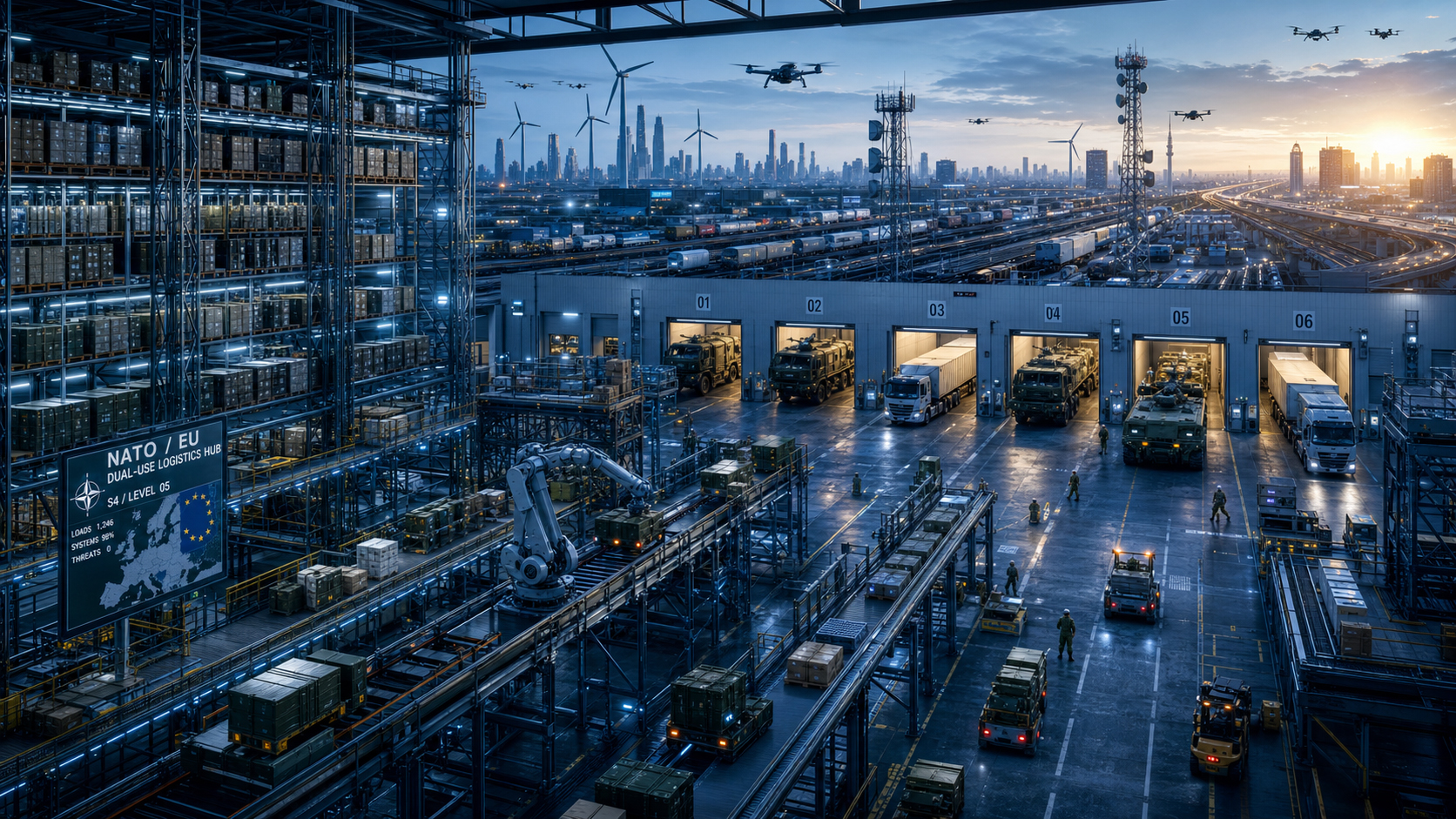
Against this backdrop, a concept that has received too little attention in Europe to date is gaining strategic importance: the network of modular dual-use logistics hubs. The basic idea is as simple as it is compelling. In peacetime, these facilities function as highly efficient industrial logistics centers and civilian supply hubs. In a crisis, they are transformed into military support infrastructure without any structural modifications: sustainment hubs, maintenance facilities, spare parts depots, and ammunition distribution centers.
This dual-use concept is not new – but it lacks consistent European implementation. Previous experience with strategic ports like Rostock, Split, and Rijeka demonstrates how civilian infrastructure can be used for military purposes. The crucial difference of a systematic hub network lies in its predictability, modular standardization, and the proactive integration of automation and cybersecurity technologies. Storage capacities that generate commercial value in peacetime can be converted into military depots within a very short time in an emergency – without compromising this capability through commercial use.
The EDIP has at least taken this idea into account in its framework. According to Article 70 of the EDIP Regulation (EU) 2025/2643, dual-use logistics infrastructure is classified as a matter of overriding public interest, which allows for accelerated approval procedures. This creates a legal and administrative foundation on which an ambitious hub network could be built.
Decentralization and automation as strategic principles
An effective dual-use hub network must be built on two fundamental strategic principles: decentralization and automation. Decentralization reduces vulnerability. A single large depot location is an attractive target for precision weapons, cyberattacks, or acts of sabotage. A network of interconnected, redundant, and protected smaller hubs dramatically increases resilience—even if individual nodes fail, overall capability is maintained.
Automation is not just a business efficiency measure – it is a strategic necessity. Fully automated high-bay warehouses, containerized logistics modules, autonomous inventory management based on artificial intelligence, drone and UGV support infrastructure, and autonomous energy supply reduce dependence on scarce skilled workers. Especially given the rampant shortage of skilled labor in the European defense industry, automation allows for higher throughput with fewer personnel. A high-bay warehouse that normally manages automotive parts or electronic components can use the same software and hardware to manage ammunition pallets or spare parts for combat vehicles in an emergency. The technological basis is identical – the use case is dual.
SMEs as the backbone of the European defense industry
Small and medium-sized enterprises (SMEs) – defined as companies with fewer than 250 employees and an annual turnover of less than €50 million – are regularly treated as secondary players in the European defense debate. This perception is fundamentally wrong. SMEs provide the flexibility, innovative strength, niche technologies, and rapid adaptability that no large corporation can offer to the same extent. They are the backbone of the European Defence Technological and Industrial Base – not its appendage.
The structural barriers facing SMEs are well documented: The European defense market is highly fragmented, diverging national regulations hinder cross-border operations, access to EU research programs is complex, financing is difficult to obtain – especially at the regional level – and qualified specialists are hard to find. Added to this is the aforementioned problem of upfront payments: Those who cannot obtain pre-financing cannot invest. Those who cannot invest cannot scale. Those who cannot scale cease to be suppliers for growing defense needs.
A sustainable solution must break this cycle. Advance payments, consistently passed on throughout the supply chain – not only to Tier 1 prime contractors, but also to Tier 3 and Tier 4 suppliers – are the first and most important step in this direction. EDIP addresses this need, but its implementation must extend far beyond the pilot projects undertaken so far. The economic multiplier effect is clear: Every euro of European NATO arms procurement that remains within Europe generates 1.5 to 1.9 euros in added value within the European defense ecosystem – and this doesn't even take into account the impact on jobs, research and development, and the preservation of industrial capabilities.
Intralogistics as an enabler of military endurance
A specific and often overlooked element of the dual-use concept is the role of highly specialized intralogistics providers. Companies like LTW Intralogistics don't manufacture weapons—they provide storage capacity, material handling, automated warehousing systems, and logistical availability. In the civilian sector, such systems are indispensable in modern distribution centers, e-commerce warehouses, and the automotive industry. In the defense context, they represent a transformative capability.
Automated high-bay warehouses can store enormous quantities of material in vertically compact structures and provide them in the shortest possible time. Integrated material flow control systems – such as those implemented by LTW LIOS MFS – enable precise and rapid order picking, even under high-load conditions. In the context of a military supply operation, this means that ammunition, spare parts, medical supplies, and operating materials can be distributed by automated systems at a speed that far surpasses manual processes. At the same time, automation reduces personnel requirements – a crucial advantage in an environment where skilled workers are scarce and must be deployed elsewhere in an emergency.
The integration of AI-powered inventory management adds another strategic dimension. When autonomous systems monitor inventory levels in real time, predict replenishment needs, and dynamically optimize supply chains, the entire sustainment capacity becomes more responsive and robust. This isn't just a vision of the future—the technological foundation already exists in commercial intralogistics systems. Transferring it to dual-use contexts is a matter of political will and the right investment signals.
The European Resilience and Sustainment Network of the Future
A fully developed European network of rapid deployment dual-use hubs would combine several critical capabilities. Fully automated high-bay warehouses form the core of the storage capacity. Containerized logistics modules allow for rapid capacity expansion without permanent construction work. Drone and UGV support infrastructure prepares the hubs for the demands of modern combined operations. Autonomous power supply through photovoltaics, battery storage, and emergency generators ensures operation even during power outages. Cyber resilience and secure communication—embedded in NIS2 and CER compliance requirements—protect the hubs' IT infrastructure. AI-supported inventory management and secure communication complete the picture of a fully integrated, future-proof logistics infrastructure.
The EU's Military Mobility Action Programme 2.0 (APMM 2.0) aims to transform Europe into a more defensible strategic space capable of rapid response to threats in times of crisis. It promotes synergy between civilian and military infrastructure and creates a framework for a European logistics network that functions as a coherent supply system in an emergency. The Via Carpathia, Rail2Sea connections, and other dual-use transport corridors are strategic building blocks whose military significance is increasingly recognized by EU member states.
The multiplier effect of industrial defense integration
The economic dimension of defense investment deserves separate consideration that extends beyond security policy. The described multiplier effect of €1.5 to €1.9 million in added value per euro invested is not only an argument for geopolitical autonomy – it is an economic policy argument for strengthening domestic industry. Joint European procurement that remains within the EU industrial area is both industrial policy and defense policy.
The EDIP framework stipulates that at least 65 percent of the components in funded projects must originate from the EU or associated countries. This clause is significant from an industrial policy perspective: it creates incentives for the development of European supply chains, reduces dependence on non-European suppliers, and promotes the development of European expertise in sensitive technology areas. Defense investment thus becomes a lever for economic resilience in the broadest sense – from securing raw material sources and strengthening manufacturing capacities to promoting research and development in key technologies.
From political pronouncements to industrial reality
Markus Becker succinctly summarizes the central dilemma of European security policy: Europe does not suffer from a lack of ambition or resources – it suffers from the inability to translate political commitments into industrial output. Accelerating this transformation process requires coordinated measures at multiple levels simultaneously.
Faster procurement processes must dismantle bureaucratic hurdles that currently delay even urgent orders by months or years. The institutional failures identified by a NUPI report as Europe's Achilles' heel—national protectionism, risk aversion, and consensus-driven decision-making—must be overcome through clear political mandates. Advance payments must be consistently passed down the supply chain. Fast-track certification processes for new production technologies and dual-use components must replace the current lengthy certification procedures. And a labor strategy commensurate with the scale of the challenge must go far beyond symbolic measures.
The establishment of a European network of Rapid Deployment Dual-Use Hubs offers a practical and scalable framework for translating political ambitions into operational capabilities. It is a concept that combines economic efficiency with strategic resilience – and thus provides an answer to the deepest structural weakness of European defense capabilities: not a lack of weapons, but the lack of capability to sustainably supply, distribute, and deploy these weapons where and when they are needed.
Europe doesn't just need more production capacity – it needs the ability to maintain, distribute, and quickly relocate that capacity to where it's needed. That's the real strategic challenge. And solving it is a question of industrial will as well as political will.
Consulting - Planning - Implementation

Markus Becker
I would be happy to serve as your personal advisor.
Head of Business Development
Chairman SME Connect Defense Working Group
Consulting - Planning - Implementation
Konrad Wolfenstein
I would be happy to serve as your personal advisor.
You can contact me at wolfenstein∂xpert.digital or
Just call me on +49 7348 4088 965 .