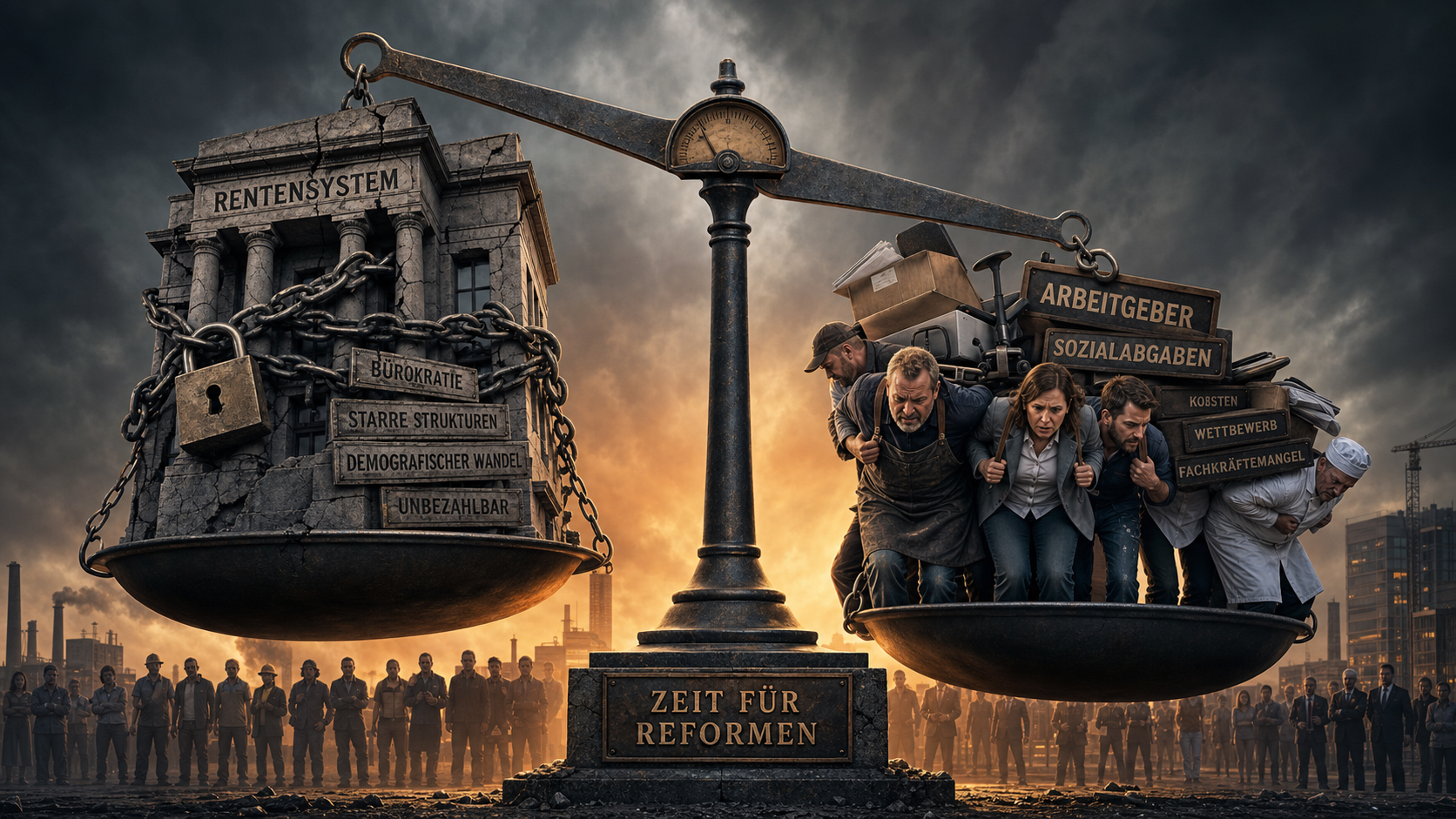
The 50/50 lie: Why higher employer contributions to pensions ultimately affect everyone – Image: Xpert.Digital
Collapse of the social security system? How politicians are jeopardizing Germany's economic competitiveness
Pension illusion exposed: Why more money from companies will not save the system
Costly mistake: How the comfortable pension policy is bleeding the German middle class dry
The debate surrounding the future of the statutory pension insurance system is heating up, and politicians are reflexively resorting to the supposed panacea of the past: those who create jobs should pay more. Higher employer contributions are readily sold to the public as a fair distribution of the burden and a painless redistribution "from top to bottom." But what sounds like a fair deal on paper turns out, upon closer economic examination, to be a fatal fallacy. Instead of confronting historical demographic change and the structural inefficiencies of a pay-as-you-go system that has spiraled out of control, politicians are resorting to convenient, superficial solutions. The following article provides a well-founded analysis of why the accounting separation of employer and employee contributions is, in reality, a fiction, how steadily rising non-wage labor costs are gradually deindustrializing Germany, and why we are jeopardizing the future of the younger generation if we don't finally summon the courage for a genuine, capital-funded structural reform.
The leaky barrel – Why higher employer contributions to pensions send the wrong signal
Adding burdens instead of finally reforming: Political convenience at the expense of substance
The political debate about financing the statutory pension insurance follows a pattern that is astonishing in its simplicity: if the funds are insufficient, those who organize and compensate work should pay in more. Increasing employer contributions sounds like social compensation, like fairness, like the long overdue dipping into the deep pockets of the corporate side. But this narrative misunderstands fundamental economic mechanisms, ignores the system's structural crisis, and treats a symptom with a remedy that will ultimately worsen the underlying problem.
What the contribution rate actually means
Currently, the contribution rate to the general statutory pension insurance is 18.6 percent of the earnings subject to pension insurance contributions, split equally: 9.3 percent each for employees and employers. The contribution assessment ceiling has been €8,450 per month since January 2026. This sounds like a fair 50/50 principle, suggesting symmetry on paper. In reality, however, this symmetry is a fiction.
For a company, there is no real separation between employee and employer contributions. From the company's perspective, total labor costs are the relevant parameter for every personnel decision. Whether the employee receives a gross salary from which taxes and social security contributions are deducted, or whether the employer directly transfers social security contributions to the relevant funds, makes no structural difference from a business perspective. In both cases, these are costs associated with labor, which are weighed against the expected work performance and added value. The formal division into employer and employee contributions is an accounting construct that is politically convenient but has no independent economic basis.
Economists have been confirming this for decades with the concept of wage incidence: If the employer side of social security contributions is increased, companies react in the medium term with corresponding adjustments on the wage side, through slower wage growth, reduced bonuses, or simply by refraining from hiring new employees. The burden is distributed across the value chain instead of remaining concentrated on one side. Anyone who pretends that an additional burden can be concentrated on the employer side without impacting employees, investment, and competitiveness is thinking in terms that exist outside of real economic reality.
The demographic foundation is crumbling – and nobody really wants to touch it
The real problem with the statutory pension insurance system is not a lack of willingness on the part of companies to pay. It is a demographic dilemma of historic proportions, massively exacerbated by decades of political inaction and popular benefit expansions. The pension insurance system operates on a pay-as-you-go basis: those who work today finance today's pensions. This system is sound as long as the ratio of contributors to pensioners remains stable. But that is precisely what it is no longer, and it will continue to deteriorate.
In its April 2026 report to the Federal Government's Pension Commission, the Federal Court of Auditors clearly stated that the statutory pension insurance system faces significant financial challenges, primarily due to demographic changes. Exacerbating the situation are the extensive benefit expansions implemented since 2014, which have resulted in additional expenditures of €180 billion by 2025. The 2025 pension reform package continues this trend: Additional expenditures are projected to reach a total of €500 billion by 2040. These figures speak for themselves: A system expanding on this scale without reforming its demographic foundation is dependent on sustained external funding, which someone must provide.
The forecasts for pension contribution rates are alarming. The contribution rate is expected to remain stable at the current 18.6 percent until 2027. From 2028, an increase to 19.8 percent is anticipated, rising to 20.1 percent by 2030. Forecasts predict a contribution rate of 21.2 percent for 2039. Other scenarios, which fully incorporate the second pension reform package, even project a contribution rate of 22.3 percent by 2035. According to calculations by the IGES Institute, the total social security contribution—the sum of pension, health, long-term care, and unemployment insurance—could rise to 50 percent by 2035.
Even today, Germany ranks among the highest countries internationally in terms of labor costs. According to the Federal Statistical Office, average labor costs in Germany in 2024 amounted to approximately €43.40 per hour worked, which is about 30 percent higher than the EU average of €33.50. In industrial manufacturing, German unit labor costs in 2024 were already 22 percent above the average of 27 industrialized nations. The consequences are already visible: Since mid-2018, German industry has been in a structural recession, and a key driver of this development is precisely these labor costs.
The fallacy of seemingly painless redistribution
When politicians call for increasing employers' contributions to the pension system from 9.3 to a hypothetical 12 or 15 percent, they like to sell it as a cost-free redistribution of wealth from top to bottom. The mechanism sounds deceptively simple: companies make profits, so they should contribute more. But this line of reasoning neglects several fundamental economic relationships which, taken together, produce the exact opposite of the intended effect.
First, the question of margins: Germany's small and medium-sized enterprises (SMEs), which form the backbone of employment, operate with relatively tight margins in many sectors. Cost increases due to rising employer contributions directly impact profitability. Investments are postponed, product development delayed, and new positions left unfilled. The argument that employers could simply pay more is empirically false in parts of the economy: it presupposes an infinitely elastic buffer that doesn't exist in practice. According to a survey by the Association of Family Businesses, a good 87 percent of German family businesses stated that rising social security contributions are a major concern for them. These are not abstract complaints from lobbyists, but signals from the heart of everyday business.
Then there's the question of location: According to recent studies, 70 percent of energy-intensive industrial companies in Germany are considering relocating abroad; 31 percent want to move production to other continents, and 42 percent already prefer to invest in other European countries rather than in Germany. The lack of willingness to reform social security systems to stabilize them is proving to be a significant obstacle to investment, as the German Economic Institute (IW) points out. A further increase in employer contributions would not dampen this trend, but rather accelerate it.
The German Economic Institute (IW) ranked Germany 44th out of 45 countries surveyed regarding cost as a location factor. The Federal Ministry for Economic Affairs and Energy itself states in its 2026 Annual Economic Report that the total burden of taxes and social security contributions on labor is far above the OECD average and negatively impacts work incentives. Anyone who, in this context, seeks a solution in further increasing employer contributions is ignoring their own official assessment.
What is actually burdening the system: Structural inefficiency instead of underfunding
The public debate revolves almost exclusively around the question of who pays in more. The at least equally relevant question of what happens to the paid-in funds and how efficient the system is, is systematically avoided. Yet a dispassionate look at the structure of the pension insurance system reveals some remarkable findings.
In 2023, the statutory pension insurance system received a total of approximately €112.4 billion in federal funding. The general federal subsidy alone amounted to €54.2 billion, supplemented by an additional federal subsidy of €14.6 billion, a further increase of €15.4 billion, and additional funding for child-rearing periods totaling €17.3 billion. The share of federal subsidies in total revenue thus ranges from 22 to 24 percent and is structurally stable. This means that even today, the statutory pension insurance system is not viable without substantial tax funding. It is no longer a purely insurance-based system, but rather a de facto mixed system of contribution-based and tax-based financing.
This hybrid structure wouldn't pose a problem in itself if it were the result of a conscious, well-thought-out system design. However, it isn't. It's the result of years of political decisions that have burdened the system with non-insurance-related benefits without creating a systematic way to offset them. Mothers' pensions I and II, the early retirement option at 63, the basic pension, increased disability and survivor's pensions: all these benefit expansions since 2014 will add up to additional expenditures of €180 billion by 2025. These expenditures don't reflect increased contributions, but rather political decisions made at the expense of current contributors and future generations.
The German Council of Economic Experts already determined in its 2023 annual report that with the retirement of the baby boomer generation in Germany, an acute phase of demographic aging is beginning, making long-term reform imperative. No single reform option is sufficient to solve the financing problems; only a package of measures can combine the strengths of different approaches and avoid social hardship. The options are well-known: increasing contribution rates, reducing benefits, raising the retirement age, expanding tax revenue, and supplementary funded pension schemes. Each of these options burdens certain groups, and none is politically convenient. This is precisely why the most obvious and easiest-to-communicate solution is repeatedly favored: burdening employers.
Our EU and German expertise in business development, sales and marketing


Our EU and German expertise in business development, sales and marketing - Image: Xpert.Digital
Industry focus areas: B2B, digitalization (from AI to XR), mechanical engineering, logistics, renewable energies and industry
More information here:
A thematic hub offering insights and expertise:
- Knowledge platform covering global and regional economies, innovation and industry-specific trends
- A collection of analyses, insights, and background information from our key areas of focus
- A place for expertise and information on current developments in business and technology
- A hub for companies seeking information on markets, digitalization, and industry innovations
Linking life expectancy, strengthening capital shares: The roadmap for sustainable retirement provision
Capital funding as a missed opportunity and a necessary perspective
International comparisons show that countries that adopted a mix of pay-as-you-go and funded pension systems early on are now navigating the demographic challenge much more robustly. Sweden, the Netherlands, Denmark, and Australia have established systems in which a substantial portion of retirement provision is funded and thus decoupled from fluctuations in the potential working-age population.
In Germany, this debate has been conducted with the same ritualistic approach for decades, always ending in the same postponement. In 2022, the Scientific Advisory Board to the Federal Ministry of Finance took up the reform debate on funded pensions and concluded that there are good reasons to reform the existing voluntary Riester pension system and that several arguments support mandatory contributions to a funded system. A broadly diversified investment product with low administrative costs, adhering to the principles of modern portfolio theory, would be the appropriate approach. The Council of Economic Experts additionally proposes an equity-based retirement savings plan that should be more transparent, more widespread, and offer higher returns than the current Riester pensions.
Without reforms, the pension contribution rate would have to rise by another five percentage points by 2060, according to calculations by the German Economic Institute. This increase can be reduced through three measures: linking the retirement age to life expectancy, establishing supplementary funded pension components, and increasing labor force participation, particularly among older workers. None of these measures would impose an additional burden on employers. On the contrary, precisely the willingness to invest that is eroded by rising non-wage labor costs would form the basis for more dynamic economic development, which in turn would stabilize the pension fund through higher contribution revenues.
The value creation cycle as an indivisible whole
The core conceptual problem behind the demand for higher employer contributions is ultimately a misconception about the nature of economic value creation. Companies do not exist as external payment centers outside the social cycle. They are an integral part of a system in which work is compensated, income is generated from it, consumption and tax payments result from income, and economic activity ultimately provides the financial basis for the welfare state.
Adding further strain to this cycle at any point alters the distribution within the system, but it doesn't generate any additional value. Every euro that flows into the pension fund through increased employer contributions is missing somewhere else: in investment capacity, wage growth, pricing, or entrepreneurial risk-taking. The illusion that employer contributions represent an external resource transfer is politically attractive, but economically unsustainable.
The Institute for Macroeconomics and Business Cycle Research of the Hans Böckler Foundation argues that expanding pension financing is possible without slowing economic growth and employment because purchasing power is not lost, but merely redistributed between pensioners, the actively employed, and businesses. This finding is not wrong, but it is too simplistic. Redistribution within a closed system remains redistribution. It does not solve the structural financing problem of an aging society. And it leaves unanswered the question of what behavioral reactions will follow at the corporate and investor levels if the location becomes even less attractive.
What reform would really mean
Anyone seriously interested in a sustainable pension system must address several issues simultaneously. The Federal Court of Auditors recommends a fundamentally new metric for the pension level that realistically reflects the actual benefit level of the pension insurance, instead of relying, as before, on a standard pension that fails to account for the numerous benefit increases of recent years. According to the Federal Court of Auditors, the pre-tax benefit level is simply unsuitable as a benchmark for representing the actual benefit level.
A serious reform would also have to link the retirement age to actual life expectancy. Life expectancy at retirement has risen steadily in recent decades, while the statutory retirement age has only been adjusted moderately despite the reforms of the Schröder era. The Council of Economic Experts and the Federal Court of Auditors see this as a key lever for stabilizing the system's finances. In addition, a credible strategy for a fully funded pension system is needed, one that doesn't fail due to political compromises before it can take effect.
In parallel, the issue of non-insurance-related benefits must be addressed systematically. Benefits financed through the pension insurance system for social policy reasons should be financed entirely from tax revenue to avoid further distorting the contribution structure. This principle is formally recognized in the German system, but has never been consistently implemented in practice.
The real question is: When will the system change begin?
Behind the debate about contribution levels lies a deeper question that is rarely asked openly in the political arena: Is the existing system of pay-as-you-go statutory pension insurance, in its current structure, still suitable for meeting the challenges of the 21st century? The honest answer is: not in its current form.
The system was designed for a different demographic reality. Low birth rates, rising life expectancy, and changing employment histories due to digitalization and globalization present the statutory pension insurance system with financing problems that cannot be solved by simply adjusting contributions. What is lacking is the political courage to make fundamental policy changes: to link contribution duration and pension amount to actual life expectancy and contribution performance, to a serious, capital-funded supplementary component, to transparency regarding the actual system costs, and to be willing to identify and eliminate perverse incentives.
Instead of making these crucial decisions, policymakers are taking the path of least resistance: increasing the burden on those who create jobs and bear risk, thereby masking structural deficiencies in the short term. The result is a system that is increasingly losing credibility, disproportionately burdening younger generations, and weakening Germany's competitive position in a market where rivals are relentless. IW economist Christoph Schröder explicitly warned: Without a reform of the social security systems, Germany will gradually slide into deindustrialization.
The unspoken calculation of the entrepreneurs
Over the past few decades, German businesses have learned to cope with increasing pressures. They have optimized processes, increased productivity, invested in automation, and globalized value chains. All of this occurred in response to rising non-wage labor costs, which made domestic employment relatively more expensive. The underlying logic of these adjustments is clear: if the government permanently drives labor costs above market levels, companies will substitute labor with capital or relocate capital to more favorable markets.
This is not a policy of threats or an attempt at corporate blackmail. It is a fundamental business response. DIHK surveys show that a growing proportion of industrial companies are planning to relocate capacity abroad or reduce domestic production. The energy-intensive industrial companies, 70 percent of which have expressed relocation intentions, exemplify a trend driven by all cost burdens, not just energy prices.
If the share of income tax and social security contributions in total labor costs in Germany is 49 percent, but below 35 percent on average across OECD countries, then this difference is not a reflection of particularly generous social welfare systems, but rather a real competitive disadvantage. The conclusion is not to dismantle social security, but to make it more efficient, targeted, and resilient to demographic changes.
A systemic finding, not ideological polemics
It would be a misunderstanding to read the preceding analysis as a plea against social security or as an apology for capital against labor. It is neither. It is an attempt to conduct a sober economic assessment, which shows that pumping more money into a structurally unreformed system is not an expression of social responsibility, but rather political failure disguised as social justice.
The statutory pension insurance system fulfills an indispensable societal function. It provides security in old age for people who have worked for decades. This goal is non-negotiable. What is negotiable, however, is how this goal can be achieved with the available societal resources without eroding the economic foundation that generates these resources in the first place. A system that overlooks the reduction of administrative redundancies, perverse performance incentives, and structural inefficiencies, and instead repeatedly relies on the same source, is engaging in political resource waste at the expense of future generations.
The question is not whether employers bear social responsibility. They undoubtedly do. The question is whether it is wise, sustainable, and systemically sound to channel this responsibility into an unreformed pay-as-you-go system through rising mandatory contributions. And the answer to this question, if one looks at the data, can only be no.