
A 12 percent increase in pensions in Ukraine: Billions for Kyiv, only a basic pension for us? The bitter truth about Germany's finances
Xpert Pre-Release

Available in 27 languages 📢
Prefer Xpert.Digital on GoogleⓘPublished on: April 26, 2026 / Updated on: April 26, 2026 – Author: Konrad Wolfenstein
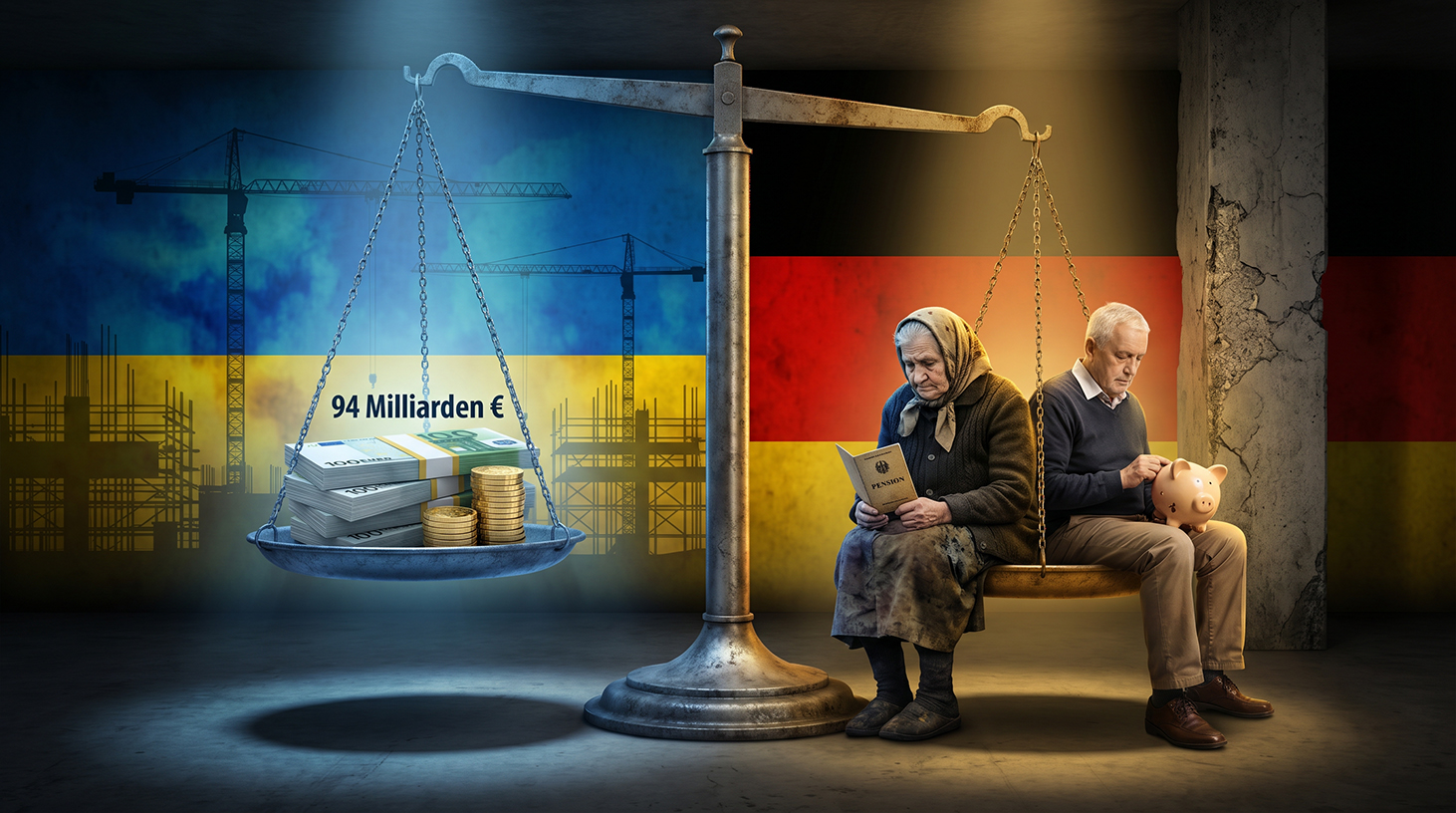
12 percent more pensions in Ukraine: Billions for Kyiv, only a basic pension for us? The bitter truth about Germany's finances – Image: Xpert.Digital
Citizen's income, weapons, pension shock: Who will pay the bill for Germany's historic crisis?
94 billion euros in aid to Ukraine: Will Germany ever get this money back?
Billions for Kyiv, a basic pension for us? The bitter truth about Germany's finances
The news could hardly be more contradictory: While Ukraine, in the midst of an existential war, is raising its pensions by double digits, Chancellor Friedrich Merz is preparing the German population for a historic turning point. The statutory pension, for decades the inviolable core promise of the German welfare state, is to become merely a "basic safety net." At the same time, the federal budget is shouldering historic sums: Almost 94 billion euros in direct and indirect aid are flowing to Kyiv, in addition to tens of billions more for the support of Ukrainian refugees within the domestic basic income system. It's a political constellation that's causing quite a stir and raises a highly sensitive question: Who will ultimately foot the bill for these historic burdens – and will the German taxpayer ever see their money again? A sober analysis of demographic crises, geopolitical obligations, and the bitter truth about social justice.
Who pays, who receives – and who is left behind
Germany's billions, the Ukrainian pension increase, and the quiet end of retirement provision as a promise of life
Ukraine is increasing its pensions by 12.1 percent in the midst of war. Germany, under Chancellor Friedrich Merz, is planning a fundamental overhaul of its own pension system. And caught in the middle is a politically charged question that is rarely answered dispassionately: What will all this cost – and who will ultimately foot the bill?
Pension adjustment in Kyiv: A signal with statistical impact
From March 1, 2026, pensions and insurance benefits for over ten million Ukrainian pensioners will increase by 12.1 percent. Prime Minister Yulia Svyrydenko announced the measure, emphasizing that the increase not only exceeds the current inflation rate but also consistently continues the policy of continuous pension adjustments pursued since 2021. At first glance, a double-digit pension increase in a country at war seems paradoxical. A closer look reveals the entire dilemma of Ukrainian social policy.
The average pension in Ukraine before the increase was the equivalent of around €128 to €133 per month. After the increase, this amounts to almost €145 – a significant nominal increase, but adjusted for purchasing power, still one of the lowest pensions on the European continent. By comparison, the average pension in EU countries is around €1,294 per month. Romania and Bulgaria pay between €450 and €550, Poland and the Czech Republic between €800 and €900. Almost a third of Ukrainian pensioners received only 3,340 UAH before the adjustment – the equivalent of about €69. The 12.1 percent increase is therefore not a sign of prosperity, but rather an attempt to mitigate an acute trend of impoverishment caused by war-induced inflation, economic contraction, and demographic decline.
The direct contrast to the German pension adjustment is striking. In Germany, an increase of 4.24 percent was decided upon for July 1, 2026. This figure sounds modest compared to the Ukrainian 12.1 percent – but it applies to an average pension, which is at a completely different level in Germany. Absolute figures and percentage adjustments must always be read in the context of the starting point. This example shows how easily political narratives can be constructed by comparing percentages in isolation, narratives that do not reflect reality.
Merz and the end of the pension promise as full coverage
On April 22, 2026, Chancellor Friedrich Merz spoke at the annual reception of the German Banking Association and uttered a sentence that was politically and economically explosive: "Statutory pension insurance alone will at best provide basic security for old age. It will no longer be sufficient to secure one's standard of living in the long term." He added that it was necessary to establish "capital-funded elements of occupational and private pension schemes" on a "far greater scale" than before – and no longer on a purely voluntary basis.
The political significance of this statement can hardly be overstated. It marks – at least rhetorically – a turning point in the history of German pension policy. For decades, the statutory pension insurance was marketed as the cornerstone of social security in Germany, a promise that would maintain one's standard of living after a lifetime of work. Merz is breaking this promise – not with a law, but with a single sentence addressed to bankers.
The Chancellor's assessment is factually accurate. The demographic foundation of the pay-as-you-go pension system is eroding: while in 1960 six contributors supported one pensioner, by 2030 this number will have fallen to around two. The contribution rate to the statutory pension insurance has remained stable at 18.6 percent for nine years. The cap, which fixes the pension level at 48 percent until 2031, is costing the federal budget considerable sums. Model calculations show that if the cap were to be extended beyond 2031, the contribution rate would have to rise to as much as 22.9 percent by 2050. This is hardly justifiable from an economic policy perspective.
The German government has already taken initial steps to institutionally anchor this new direction. In January 2026, an independent pension commission was appointed, tasked with presenting concrete reform proposals by the end of the second quarter of 2026. In parallel, the coalition has decided on a successor to the often-criticized Riester pension: those who save up to €360 annually will receive a subsidy of 50 cents for every euro saved. Furthermore, a so-called retirement savings account is to be established as a new, government-subsidized form of saving. The early-start pension, designed to provide retirement savings incentives for school pupils, is also part of the reform package.
What Merz is outlining, however, is more than just a technical adjustment. It's a paradigm shift away from collective security promises and toward individual responsibility. The problem is that personal responsibility presupposes room for maneuver. Those living on a net income just above the subsistence level cannot make substantial provisions for old age. Low-wage earners, those in precarious employment, and people with gaps in their employment histories tend to be left behind by a fully funded system. The pension commission under Federal Labor Minister Hubertus Heil is tasked with examining all reform options – with the explicit exception of raising the retirement age beyond 67.
Germany's financial transfers: What did Ukraine cost?
Germany's aid to Ukraine is historically unprecedented in its scale. According to official figures from the German government, since the start of the Russian invasion on February 24, 2022, Germany has provided or made available approximately €39 billion in bilateral civilian aid and around €55 billion in military support – a total of nearly €94 billion. This makes Germany the largest military supporter of Ukraine in Europe and the second largest donor worldwide after the USA.
These figures require a more nuanced interpretation. The 94 billion euros are not simply transfer payments from the federal budget. In addition to direct payments, they include arms deliveries and military equipment taken from existing Bundeswehr stockpiles, pledged but not yet disbursed funds, and services provided within the framework of EU mechanisms and international organizations. The Kiel Institute for the World Economy, which conducts international comparative analyses of aid to Ukraine, estimated Germany's actual bilateral aid disbursed between January 2022 and August 2025 at over 22 billion euros. This corresponds to approximately 7 percent of the total international aid to Ukraine of 321 billion euros.
The German federal budget for 2026 allocates approximately €11.55 billion for aid to Ukraine – €3 billion more than originally planned. At the EU level, a new €90 billion loan has also been approved, which will be made available to Ukraine in 2026 and 2027. This loan is interest-free for Ukraine. The estimated annual interest costs of €3 billion will be borne by the EU member states – resulting in an annual interest burden of approximately €700 million for Germany.
Will Germany get its money back?
This question is uncomfortable in its directness – and the honest answer is: largely not, at least not in the foreseeable future. The legal and political framework for repayment is complex and fraught with considerable uncertainty.
The EU loan of over €90 billion stipulates that Ukraine will only have to repay it if Russia makes reparations for the damages caused after the war ends. If Russia refuses, frozen Russian state assets held in the EU will be used for repayment. It remains unclear what will happen if Ukraine agrees to a peace agreement that does not include reparations. This scenario is politically quite realistic and would render the automatic repayment mechanism ineffective.
Germany's bilateral military aid – arms deliveries, ammunition, and equipment – is structured entirely as grants and not as repayable loans. To date, Germany has received only around €31 million back from the European Peace Facility – a negligible sum compared to the total amount. Chancellor Merz had hoped that aid to Ukraine could be financed directly through frozen Russian state assets, which would have meant no interest payments. However, this proposal failed to gain a sufficient majority among the EU member states.
Alongside military and financial aid, Germany is also involved in the reconstruction of Ukraine. The German government is working on a "European Flagship Fund for the Reconstruction of Ukraine" to mobilize private funds. These structures are designed to ensure a long-term return of capital – however, whether and to what extent this will occur depends on factors that cannot currently be reliably assessed: the outcome of the war, Ukraine's economic recovery capacity, and the political conditions for a future peace.
The political and economic reality is sobering: Germany is investing in the security of Europe and the stability of a democratic neighbor. This is a geopolitical logic that possesses its own legitimacy. However, it means that the vast majority of German aid to Ukraine must be considered an irreversible fiscal expenditure.
Our EU and German expertise in business development, sales and marketing

Our EU and German expertise in business development, sales and marketing - Image: Xpert.Digital
Industry focus areas: B2B, digitalization (from AI to XR), mechanical engineering, logistics, renewable energies and industry
More information here:
A thematic hub offering insights and expertise:
- Knowledge platform covering global and regional economies, innovation and industry-specific trends
- A collection of analyses, insights, and background information from our key areas of focus
- A place for expertise and information on current developments in business and technology
- A hub for companies seeking information on markets, digitalization, and industry innovations
Solidarity, budget, future: How aid to Ukraine and pension reform interact
Ukrainian war refugees in Germany: Numbers, services, reality
Approximately 1.2 to 1.27 million Ukrainian citizens currently live in Germany, most of whom fled since the start of the war in 2022. As of July 2025, around 657,000 to 672,000 of these individuals received citizen's income support under the German Social Code, Book II (SGB II). This included approximately 484,000 employable individuals and roughly a quarter children.
The receipt of citizen's income by Ukrainian refugees has been the subject of intense political debate since the beginning of the war. The starting point was the decision in 2022 to grant Ukrainian war refugees – unlike other asylum seekers – immediate and full access to the German Social Code, Book II (SGB II), meaning benefits at the Hartz IV or citizen's income level, instead of initially referring them to the significantly lower asylum seeker benefits. This decision was motivated by humanitarian concerns and intended to accelerate integration. In the political discourse, it became one of the most discussed cost factors of the entire refugee policy.
The actual costs are considerable. According to the German government, the federal government spent a total of around €28 billion on refugees and migration in 2024. The assumption of social benefits alone cost around €13 billion, with almost half of that amount going to refugees from Ukraine – this corresponds to roughly €6 to €7 billion in social benefits for Ukrainian refugees in 2024. Citizen's income payments (basic living expenses) for Ukrainian refugees alone are estimated at €1.1 billion per year for 2026 and 2027 – however, these figures are expected to decrease due to the planned change in the legal framework.
From July 1, 2026, Ukrainians who arrived in Germany after April 1, 2025, will no longer receive citizen's income, but only the lower asylum seeker benefits of €441 instead of €563 per month. This affects 83,640 people who entered Germany during this period. The savings for the federal budget are therefore limited, as the vast majority of Ukrainian refugees – around 1.2 million – will continue to receive citizen's income and are not affected by the new regulation. The new regulation explicitly does not apply retroactively: those who have already received citizen's income will not have to repay it.
The core of the criticism: Who has never paid into the German social security system?
The politically charged question of whether Ukrainians who have never paid into German social security should be entitled to receive German social benefits deserves a factual answer that goes beyond simplistic, pub-talk rhetoric. The German basic income is a tax-funded benefit for basic security – conceptually, it is not an insurance benefit acquired through prior contributions. It is, in principle, available to all people in need with legal residency status. The deliberate political decision in 2022 to subject Ukrainian refugees to the German Social Code, Book II (SGB II), meant precisely this: access to this basic income without any prior contributions.
This decision was a political choice, not a legal necessity. It had consequences for the federal budget that were not fully foreseeable at the time of the decision. The expectation that Ukrainians would integrate quickly into the German labor market due to their comparatively high qualifications has only been partially fulfilled. At the beginning of 2025, the rate of Ukrainian refugees receiving social assistance under Book II of the German Social Code (SGB II) was still at 58.8 percent.
Labor market integration is progressing, albeit more slowly than hoped. In November 2024, around 296,000 Ukrainians were employed and subject to social security contributions, representing an employment rate of 31.7 percent. This rate continued to rise until early summer 2025: among Ukrainians aged 20 to 64 who arrived early, the employment rate reached 51 percent. The proportion of Ukrainian employees tripled within two years, by the end of 2024. Nevertheless, in June 2025, the unemployment rate for Ukrainian citizens was still around 39 percent. In spring 2025, of the 535,163 Ukrainians of working age in Germany, approximately 263,610 were employed and subject to social security contributions, while 212,653 were registered as unemployed.
These figures paint a nuanced picture: There is a growing group of Ukrainian workers who pay taxes and social security contributions, thus contributing to the German social security system. At the same time, a large proportion remain dependent on benefits, whether due to childcare responsibilities, language barriers, war trauma, or a lack of recognition of their professional qualifications. The blanket statement that all Ukrainian refugees only take and give nothing ignores the reality of those who actually work and is factually incorrect.
National Economic Accounting: Burdens, Benefits and the Difficult Balance
How can the overall burden on Germany from the war in Ukraine – direct aid and the resulting domestic costs – be roughly summarized? According to current figures from the German government, direct bilateral aid has amounted to approximately €94 billion since 2022. The domestic costs for the reception, care, and integration of Ukrainian refugees since 2022 also add up to a considerable sum. In 2024 alone, the federal government spent around €28 billion on refugees and migration in general. Based on the aforementioned data, the share attributable directly or indirectly to Ukrainian refugees can be roughly estimated at €6 to €8 billion per year – potentially totaling €20 to €30 billion for the entire reception period since 2022.
Adding together direct aid to Ukraine and the domestic costs of its resettlement, the total burden on the German state over four years amounts to hundreds of billions of euros. As previously mentioned, the repayment prospects are very limited. This poses a serious challenge to German fiscal policy – especially given the simultaneous massive increase in defense spending and the significant funding required for pension reform.
However, the economic counter-arguments must not be overlooked. Ukrainian workers have been filling existing gaps in the German labor market for years. According to estimates by the IAB (Institute for Employment Research), well-integrated refugees can make positive fiscal contributions in the medium term. German defense companies benefit from contracts related to aid to Ukraine. Stabilizing Ukraine prevents potentially far more costly scenarios for the European security architecture. These indirect benefits defy simple accounting, but are economically real.
Between solidarity, budget and social justice
The simultaneous implementation of pension adjustments in Ukraine, the German pension reform, and the immense aid provided to Kyiv creates a political tension that is often oversimplified in public debate. The temptation is strong to construct a simplistic narrative: while Germany reduces its pension system to a "basic level," Ukraine increases its pensions and lives off German tax money. This narrative is rhetorically effective—but analytically misleading.
First, the Ukrainian pension increases are not an act of generosity at the expense of others, but a desperate attempt to protect a population with pensions of €130 per month from utter impoverishment. Second, the restructuring of the German pension system is not a result of aid to Ukraine, but a demographic necessity that has been apparent for decades. The expenditures for Ukraine and the structural problems of the German pension insurance system are largely separate causal chains – even if both draw on the same federal budget. Third, the question of repayment is not a moral one, but a contractual and political one: the conditions of the EU loans are transparent, even if they are unsatisfactory from a taxpayer's perspective.
The real problem lies deeper: Germany finds itself in a structural dilemma between the demand for strong social policies, the imperative of foreign policy responsibility, and the limits of its fiscal leeway. The pension reform that Merz intends to initiate is long overdue, regardless of the aid to Ukraine. The costs of accepting Ukrainian refugees are real and substantial – but they are also the politically desired consequence of a humanitarian decision supported by a broad parliamentary majority. And the aid to Ukraine – regardless of whether one considers it sufficient or excessive – is part of a long-term security strategy whose costs are difficult to quantify but equally difficult to ignore.
The public debate gains nothing by falsely linking pension cuts and the billions spent on Ukraine. It does, however, benefit from treating both issues separately with the seriousness they deserve and then considering them together structurally. Because ultimately, in Germany, the same people pay the price: employees, taxpayers, contributors – and eventually, pensioners who will depend on a basic income that, according to Merz himself, will no longer be sufficient to maintain their previous standard of living.





