

The Federal Court of Auditors and the billions on credit: How the federal government is sidelining its most important auditor
Xpert Pre-Release

Available in 27 languages 📢
Prefer Xpert.Digital on GoogleⓘPublished on: May 16, 2026 / Updated on: May 16, 2026 – Author: Konrad Wolfenstein
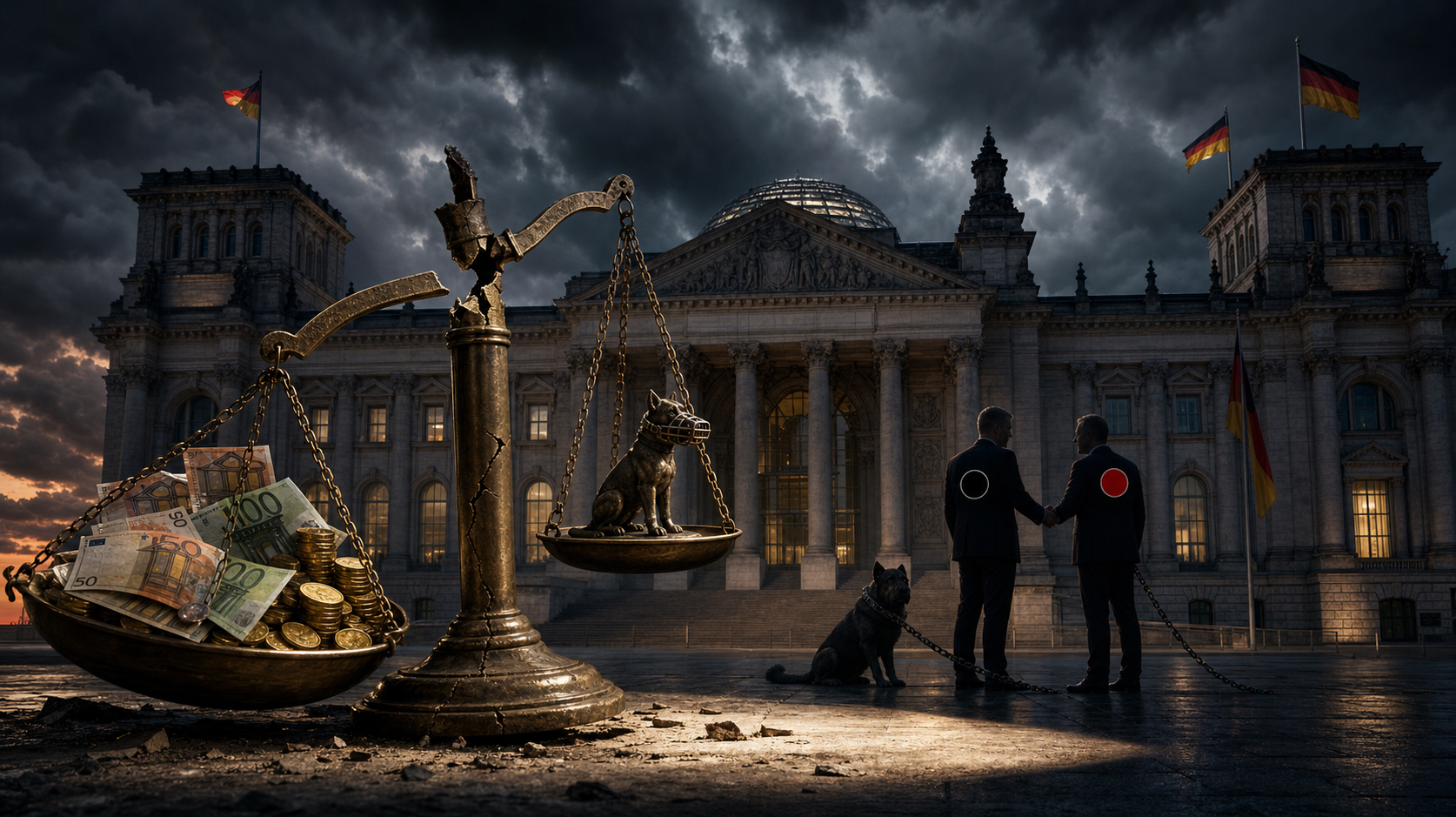
The Federal Court of Auditors and the billions in borrowed money: How the federal government is sidelining its most important auditor – Image: Xpert.Digital
The creeping transformation of the state: Why the Federal Court of Auditors suddenly becomes powerless
Record debts and party cronies: The rigged game with the 2026 federal budget
When the state monitors itself: The quiet end of German financial control
Germany is facing a historic wave of debt – yet precisely at this critical juncture, the institution meant to protect the state from financial excess is being systematically weakened. The Federal Court of Auditors, for decades the independent conscience of German fiscal policy, is increasingly being trampled under the wheels of political interests. While the government shifts gigantic sums of billions into off-budget accounts, the top auditing body's budget is being cut and its leadership filled with politicians loyal to the government. This is an unprecedented process that goes far beyond the usual political maneuvering in Berlin. It is the quiet but consequential transition to a system of "organized irresponsibility," in which democratic oversight threatens to become a mere facade. A profound insight into a risky institutional restructuring that touches the very foundations of our democracy.
Of all times: Why the government is pulling the plug on the Federal Court of Auditors – When the watchdog becomes a lapdog
“Organized irresponsibility”: What’s really behind the restructuring of the Federal Court of Auditors
The Federal Court of Auditors is considered the conscience of German public finances. For over 300 years, an independent auditing institution has overseen the public spending of the German state, and since 1950 this institution has borne the name by which it is known today. But what happens when the very institution meant to protect the state from itself is systematically weakened, politically appointed, and depleted of resources? This question is no longer hypothetical. It has become a pressing contemporary issue for German democracy.
Its historical watchdog function: More than 300 years of independent financial control
As early as 1714, the Prussian King Frederick William I established a General Chamber of Accounts, intended to function as an independent, collegial auditing body separate from the administration. This tradition of independent financial control is not a bureaucratic peculiarity, but a democratic necessity. It arose from the realization that power without checks and balances corrupts and that without external audits, the state inevitably degenerates into a self-serving larder for those in power.
The Federal Court of Auditors is enshrined in Article 114, Paragraph 2 of the Basic Law. It audits the accounts, as well as the efficiency and regularity of the federal government's budget and financial management. Its members enjoy judicial independence, and it is subject only to the law – no other state body can commission it to conduct an audit. The framers of the Basic Law deliberately chose this structure: In the context of the failure of the Weimar Republic and the National Socialist dictatorship, an independent external institution was to be constitutionally guaranteed, one that could permanently protect the still-young democracy from financial mismanagement and imbalance.
What makes this structure so valuable is not primarily its legal form, but its institutional core: The authority of the Federal Court of Auditors rests solely on its credibility as an impartial auditor. It cannot impose sanctions, dismiss ministers, or overturn laws. What it can do—and what historically generated considerable political pressure—is publicly expose misdevelopments, waste, and systemic weaknesses in government. This power is purely moral, democratic. And precisely for this reason, it hangs so precariously by a single thread: institutional independence.
Organized irresponsibility: What the Court of Auditors knows about the state
Before one can understand the current debate surrounding the appointment of the Federal Court of Auditors' leadership and budget cuts, it is essential to understand what this court has reported in recent years. The severity of its reports is not merely a bureaucratic ritual – it reflects the state of German public finances.
As recently as early 2026, outgoing President Kay Scheller delivered a scathing assessment of the German government in a series of statements. He spoke of inefficiency and government failure. Scheller particularly criticized the handling of the federal government's multi-billion-euro special funds: the money was clearly not flowing into investments to the extent that debt-financed programs should. Instead, it was creating leeway in the core budget for consumer spending – a structural perverse incentive that undermines the very purpose of the special funds.
Scheller's assessment of the Federal Office of Bundeswehr Equipment, Information Technology and In-Service Support (BAAINBw) was particularly scathing. He argued that the control mechanisms had, over the years, led to a system of organized irresponsibility. Everyone constantly double-checks their actions – and this collective risk-taking has resulted in a situation where no one truly makes decisions and no one is truly accountable. This term – organized irresponsibility – strikes at the structural core of the modern German administrative state: a system with so many control loops, rounds of coordination, and boundaries of responsibility that, ultimately, no specific person or institution can be held accountable for flawed decisions.
The shadow budget system: When debts should no longer look like debts
The core problem of German public finances, which the Federal Court of Auditors has been identifying with increasing urgency for years, is the systematic transfer of debt into extra-budgetary structures, misleadingly referred to in the public perception as special funds. In a previous report, the Court of Auditors unequivocally clarified that these are not assets, but rather special debts.
The draft budget for 2026, including special funds, projects total expenditures of approximately €630 billion – almost one in three euros of which is financed by borrowing. The core budget will incur debt of around €98 billion. Added to this are loans from the special fund for the German Armed Forces and from the special fund for infrastructure and climate neutrality, bringing the total federal debt to over €180 billion in 2026. The Federal Court of Auditors commented on this in no uncertain terms: anyone planning to finance almost one in three euros with borrowing in 2026 is far from sound financial management.
The scale of this development can hardly be overestimated historically. By 2029, new debt at the federal level alone is projected to reach approximately 850 billion euros – a speed and magnitude unprecedented in the history of the Federal Republic. The architecture of this debt is particularly worrying: by shifting substantial amounts of revenue and expenditure into special funds, the federal budget has been gutted over the years. Parliament – and thus the public – risks losing oversight and, consequently, control. This warning signal comes not from an opposition party, nor from a business association, but from the Federal Court of Auditors itself.
Cuts to the controller's budget: The logic of institutional self-protection
Against this background, a budget decision that became known in the fall of 2025 and initially received little public attention is particularly explosive: The federal government intended to also save money at the Federal Court of Auditors – precisely at the institution that is supposed to audit the swelling state budget.
Scheller himself warned in a letter to budget policymakers in the Bundestag that, as a consequence of across-the-board staff reductions, the Federal Court of Auditors would no longer be able to replace retiring auditors. If the staff cuts continue from 2027 onward, the Federal Court of Auditors would lose an entire audit department during the current legislative period. Currently, the Federal Court of Auditors has approximately 1,000 employees in nine audit departments. By the end of 2026, there will already be fewer auditors in the higher and senior civil service positions.
The absurdity lies in the timing: while the volume of the federal budget to be audited is increasing dramatically—with new special funds, growing defense spending, major IT projects, and increasingly complex infrastructure financing—the very agency tasked with auditing this growing volume is slated for weakening. Scheller himself described this as difficult, given the additional challenges arising in the areas of defense projects, IT security, social security systems, and rail and infrastructure. An audit office that is stripped of resources and personnel while the state it is meant to oversee expands is not a random consequence of austerity measures. It is the institutional logic of a political system that does not desire intensive external scrutiny.
One little-noticed aspect of this process deserves particular attention: The government's draft budget for 2026 had originally exempted the Federal Court of Auditors from the across-the-board staff reductions. This exemption was explicitly justified by the fact that the Federal Ministry of Finance had already acknowledged savings achieved in previous years – with a written assurance from the responsible State Secretary. This exemption was only revoked during the budget reconciliation meeting. A written commitment from the State Secretary – apparently worth little when political expediency demands otherwise.
The personnel carousel: Party membership as a career path to independence
While resources and personnel were being cut, public interest in the spring of 2026 focused on the question of leadership. Kay Scheller, president of the Federal Court of Auditors for twelve years, stepped down as scheduled. CDU member of parliament Ansgar Heveling was elected as his successor – on May 8, 2026, the Bundestag and Bundesrat approved the federal government's proposal.
Heveling, born in 1972, is a lawyer and has been a member of the German Bundestag since 2009. Since 2018, he has served as legal counsel to the CDU/CSU parliamentary group – one of the closest institutional confidants of the parliamentary apparatus under Friedrich Merz. In the Bundestag, he received 415 votes in favor, 139 against, and 44 abstentions. For the position of president of a constitutionally guaranteed, independent auditing authority, this is a logic of appointment that is remarkable in its directness: A sitting coalition member of parliament, who until shortly before his election supported the budgetary policies of the governing coalition, is now to oversee the use of funds by that very government.
The SPD had already filled the vice-presidential post a few weeks earlier. On March 5, 2026, the Bundestag elected Klara Geywitz as the new Vice President of the Federal Court of Auditors. Geywitz, former Federal Minister for Construction from 2021 to 2025, was a long-time SPD member of the Brandenburg state parliament and is considered a close confidante of former Chancellor Olaf Scholz. She took office on March 19, 2026. The official justification for her qualifications is based, among other things, on her previous work as head of an audit department at the Brandenburg State Audit Office – an argument that, upon closer examination, was more the exception than the rule in her long political career.
Historic precedent: For the first time, a sitting member of parliament is at the helm
What elevates this process beyond normal personnel rotations and party-political proportional representation schemes is a historic turning point: With Ansgar Heveling, a sitting member of the Bundestag is taking up the most important federal oversight position for the first time in the history of the Federal Court of Auditors. Previous officeholders at least had a certain temporal and institutional distance from day-to-day politics. Heveling, however, was still fully immersed in the political arena during his nomination and election.
This break is not merely symbolic. While the judicial independence of the members of the Federal Court of Auditors is formally guaranteed, independence is not a purely legal category. It is also an institutional and cultural one. A president who has been socialized for almost two decades as a loyal party soldier inevitably brings with him predispositions, loyalties, and thought patterns that are in structural tension with the critical role of the top financial controller. Party affiliation does not automatically disqualify someone—but for an institution whose entire authority rests on its reputation for independence, even the appearance of political affiliation is a substantial problem.
In April 2026, the Bundestag rejected a bill proposed by the AfD parliamentary group that would have mandated a cooling-off period for former government officials, parliamentary state secretaries, and members of parliament to hold leadership positions at the Federal Court of Auditors. All other parliamentary groups voted against the bill. This rejection is politically noteworthy because the cooling-off period is a widely used instrument internationally and is provided for in many constitutional systems precisely for such cases – regardless of which party introduces the proposal.
Our EU and German expertise in business development, sales and marketing

Our EU and German expertise in business development, sales and marketing - Image: Xpert.Digital
Industry focus areas: B2B, digitalization (from AI to XR), mechanical engineering, logistics, renewable energies and industry
More information here:
A thematic hub offering insights and expertise:
- Knowledge platform covering global and regional economies, innovation and industry-specific trends
- A collection of analyses, insights, and background information from our key areas of focus
- A place for expertise and information on current developments in business and technology
- A hub for companies seeking information on markets, digitalization, and industry innovations
Political appointments and shrinking budgets: When control becomes a facade – How the Federal Court of Auditors is being hollowed out
The pattern behind the individual case: Institutional erosion as a systemic feature
Anyone who dismisses the current process merely as a regrettable but common personnel decision in democracies misunderstands the structural pattern it fits into. The Federal Court of Auditors is not the first independent constitutional body in political Berlin to be filled according to the principle of coalition proportionality. The appointment of the Federal Constitutional Court already follows de facto party-political negotiation processes. The comparison with Stephan Harbarth, who was elected directly from the Bundestag to become Vice President of the Federal Constitutional Court in 2018, is not coincidental: In both cases, an active member of parliament is transferred without a transition period to an office that is constitutionally designed to maintain distance from day-to-day politics.
The result is a creeping but systematic politicization of institutions that, in a functioning democratic system, are effective precisely because of their impartiality. This process follows its own logic: the more power and money circulate in the political system, the stronger the incentive to tame checks and balances that could challenge this power. An inconvenient auditing body is a risk for any government that would rather distribute billions undisturbed than have to publicly justify how it spends them.
The consequences of this institutional erosion are not immediately apparent – and that is precisely what makes it so dangerous. A Federal Court of Auditors with a politically influenced leadership and shrinking auditing capacity will not cease its reporting overnight. But it will – whether consciously or due to structural reasons – soften its harsher language, avoid more uncomfortable audit topics, and send a signal to the public that is hard to miss for external observers, rating agencies, and European partners: This institution is no longer what it claims to be.
The fiscal situation as context: Why an independent audit office is urgently needed right now
It would be one thing if the developments described were taking place in times of balanced budgets and sound fiscal policy. The opposite is true. Germany's fiscal situation is in a historically unprecedented state of expansion and debt financing dynamics, demanding stricter, not weaker, controls.
The draft budget for 2026 projects core budget expenditures of approximately €525 billion, financed in part by net borrowing of nearly €98 billion. This is supplemented by borrowing from the special fund for the German Armed Forces (€25.51 billion) and from the new special fund for infrastructure and climate neutrality (€58.07 billion). The total new federal debt thus amounts to over €180 billion – a figure that is remarkable even considering the constitutional amendment to the debt brake, which was passed in March 2025.
To put this in perspective: Under the old debt rule, only borrowing of around €40 billion would have been permissible. The difference to the actually planned debt is explained by a complex structure of rule exceptions, sectoral exemptions, and special off-budget funds – precisely those constructs that the Federal Court of Auditors has criticized for years as budget-evading institutions that undermine parliamentary budgetary rights. Federal debt interest payments will reach more than €30 billion in 2026, already exceeding the entire federal budget of some sub-sectors. In this fiscal context, a weak, politically domesticated Court of Auditors is not only a democratic problem – it is also an economic policy risk.
Trust as a scarce commodity: What's at stake
The crucial question at the end of such an analysis is not whether Ansgar Heveling or Klara Geywitz are personally of good character. This question is secondary to the institutional debate. The crucial question is systemic in nature: What signal does a state send when it simultaneously fills the institution meant to control it with its own party politicians and subjects it to budget cuts?
Democratic trust is a scarce and asymmetrically distributed commodity: it can be built up over decades but destroyed in a short time. The Federal Court of Auditors has accumulated its institutional capital over generations – through critical reports, uncomfortable expert opinions, and a reputation for speaking uncomfortable truths. This reputation is not an end in itself. It is the prerequisite for its reports to generate political and public pressure, for journalists to take them seriously, for members of parliament to cite them, and for citizens to trust its findings.
If this reputation is damaged – through appointments of government loyalists, through the shrinking of auditing capacities, through the impression that the head of the agency is more of a sinecure for deserving coalition politicians than a constitutionally guaranteed office for independent financial control – then the Court of Auditors loses precisely the effectiveness that democratically justifies its existence. A Court of Auditors that no one believes to be truly independent is no longer the watchdog of public finances. At best, it is a symbol; at worst, a facade.
International Perspective: What other democracies know about budgetary control
Germany is not the only country grappling with questions of the institutional independence of audit offices and budget control authorities. A look at international models reveals how differently democracies address this challenge.
In countries like the Netherlands, Sweden, and Switzerland, strict requirements regarding political neutrality apply to the appointment of top auditors. In many Anglo-Saxon systems—Great Britain, Australia, Canada—the chief auditors (Comptroller and Auditor General) are explicitly elected by parliament and shielded from political influence by the executive branch. The basic principle is universal: the auditing body must be structurally independent from those it audits—not only in the formal sense of judicial independence, but also in the institutional sense of recruitment, resource allocation, and accountability.
The Lima Declaration of the International Organization of Supreme Audit Institutions (INTOSAI), considered a global benchmark for independent budgetary oversight, explicitly requires that supreme audit institutions be adequately funded and staffed to fully perform their duties. Attempts to cut staff at the Federal Court of Auditors while the volume of federal budget audits is experiencing historical growth are in direct contradiction to these international standards. The fact that Germany, a major Western democracy with its own long tradition of fiscal scrutiny, is weakening its own Court of Auditors precisely during a period of fiscal expansion is certainly being noted by critical observers in Brussels, Washington, and elsewhere.
Which would mean a real strengthening
The diagnosis is clear. What remains is the question of possible consequences. A serious strengthening of the Federal Court of Auditors would require several interconnected measures.
First, a formal cooling-off period is needed in the Federal Court of Auditors Act: Anyone who has actively participated in government policy as a member of the Federal Government, Parliamentary State Secretary, or Member of the Bundestag should be barred from heading the agency for a minimum of five to seven years. While the argument that party affiliation doesn't automatically disqualify someone is formally correct, it misses the point. The democratic function of the Court of Auditors depends not only on the actual neutrality of its leadership, but also on its apparent neutrality. Even the appearance of political affiliation damages the institution's authority.
Secondly, the Federal Court of Auditors' resources must not only be protected against the currently planned cuts, but also adjusted to the actual increase in audit volume. Following the logic that an authority with more audits to perform should receive fewer auditors is, at best, incoherent, and at worst, deliberate. Parliament should systematically decouple the Court of Auditors' budget from the executive branch's austerity measures and link it to the volume of audits.
Thirdly, strengthening parliamentary mechanisms for review would be desirable. The reports of the Federal Court of Auditors are not legally binding and do not trigger automatic sanctions. An institutionalized obligation for public parliamentary debate on key Court of Auditors reports – with deadlines for responses from the audited ministries – would significantly increase the political effectiveness of the oversight work.
The real danger: When control becomes simulation
States that begin to domesticate their oversight bodies follow a recognizable pattern—and this pattern is rarely limited to a single institution. The weakening of the Federal Court of Auditors is not an isolated incident. It is part of a broader trend to defuse inconvenient oversight bodies by depriving them of staff, budget, and independent top management. It is the logic of institutional self-immunization by a political class that, with growing fiscal power, also has a growing interest in operating without intensive external scrutiny.
The dangerous aspect is not that this erosion is abrupt and visible. The dangerous aspect is that it occurs slowly, seemingly legitimately, and under the guise of normal personnel decisions and budgetary necessities. The form remains intact – the Federal Court of Auditors continues to exist, publish reports, and hold press conferences. But its institutional core – its actual, structurally secured independence from the power it audits – is gradually hollowed out.
Ultimately, we risk a situation that could be described as a sham of control: an authority that outwardly plays the role of independent financial oversight, but in its actual audits, formulations, and public appearances follows a system of organized favoritism. Such a situation is difficult to prove, difficult to prosecute—and therefore particularly effective as an instrument of political self-immunization. It would be the end of democratic financial control, without its demise ever being officially declared.
Germany is at a crossroads. The decisions of the coming years – regarding the resources allocated to the Federal Court of Auditors, cooling-off periods for political personnel, and the transparent parliamentary handling of audit findings – will determine whether the Federal Court of Auditors remains what its founders intended in 1950: an uncompromisingly independent body for financial control, bound by the law and not by any political party. Or whether it slowly but inexorably transforms into just another cog in the political machine, ultimately only auditing itself.





