
The failure of Lynx Mixed Reality reveals just how dependent Europe really is on American and Chinese hardware
Xpert Pre-Release

Available in 27 languages 📢
Prefer Xpert.Digital on GoogleⓘPublished on: March 31, 2026 / Updated on: March 31, 2026 – Author: Konrad Wolfenstein
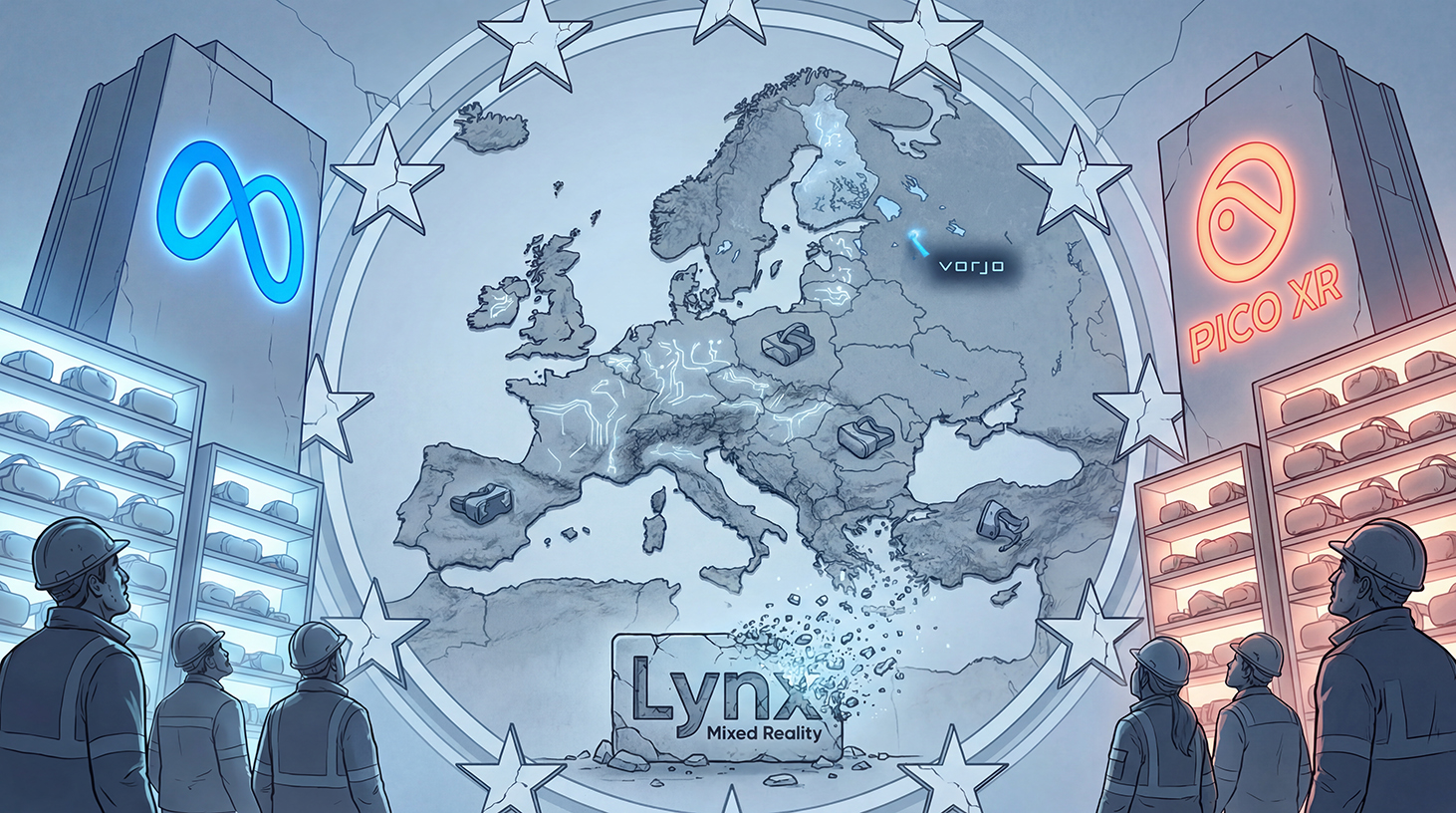
The failure of Lynx Mixed Reality reveals how dependent Europe really is on American and Chinese hardware – Image: Xpert.Digital
Dangerous dependency: Why Europe is losing the battle for XR hardware
After the Lynx insolvency: Has Europe already squandered the future of XR technology?
A billion-dollar market is slipping away: Why Europe simply cannot build its own tech hardware
The court-ordered liquidation of the French startup Lynx Mixed Reality is more than just the tragic end of a promising tech company – it's a resounding wake-up call for the entire European economic area. While Extended Reality (XR) is increasingly becoming an indispensable standard technology in industry, corporate training, and highly complex simulations, Lynx's failure reveals a massive structural problem: Europe has virtually no say in the XR hardware market. Companies wanting to rely on this key technology today are almost entirely dependent on American or Chinese manufacturers like Meta, Apple, or Pico. But this convenient solution comes at a price. It creates a chain of dependencies that not only raises questions about supply stability but also poses a genuine business risk in terms of data protection, data sovereignty, and strategic independence. How did things get to this point? What options remain for Europe now – and how can this dangerous technology gap be closed? An in-depth analysis.
Lynx has been officially insolvent since the summer of 2024; the date of insolvency is stated in French documents as July 22, 2024. Shortly thereafter, a restructuring process was initiated, which ultimately failed, leading the court to order judicial liquidation in March 2026.
Europe and the XR hardware question
Europe's blind spot in the technological age: Who is building the XR hardware of the future?
The court-ordered liquidation of the French start-up Lynx Mixed Reality in March 2026 marks more than just the end of a single company. It is a symptom of a structural problem that Europe has long grappled with and that is now increasingly occupying the industry: The continent possesses hardly any of its own hardware infrastructure for extended reality, and with each failed attempt, the gap widens. Anyone in Europe today who wants to use XR technology for corporate training, simulations, or industrial applications almost inevitably resorts to products manufactured in America or China – thus becoming part of a chain of dependency that is gaining increasing strategic relevance.
The Lynx case: A failure foretold
SL Process, a Paris-based company operating under the brand name Lynx Mixed Reality, was forced into liquidation by the Nanterre Commercial Court on March 4, 2026. The path to this point was long and painful: as the court records show, the company was already de facto insolvent by July 2024. A preliminary restructuring process, initiated in early 2026 to ensure business continuity and explore options for its continuation, failed completely. The court determined that settling the liabilities from the available assets was now "manifestly impossible.".
Lynx had indeed done pioneering work in the European field of XR development. Their first headset, the Lynx-R1, was funded in 2021 via a Kickstarter campaign that garnered around 1,200 backers. But what followed was a series of disappointments: delivery dates were repeatedly postponed, and many backers never received their devices. What was originally planned as a $500 competitor to the Meta Quest gradually became more expensive, rising to $850 and finally $1,300, while the company increasingly shifted its focus to the enterprise market. Shortly before its liquidation in January 2026, CEO Stan Larroque admitted that production had already ceased two years prior and that Lynx had shipped only a few hundred units in total.
The lost opportunity: Lynx-R2 and the Android XR debacle
The timing of the failure is particularly bitter. Just two months before its liquidation, Lynx had enthusiastically presented its new Lynx-R2 model, which boasted an impressive 126-degree horizontal field of view, a Snapdragon XR2 Gen 2 chipset, 16 GB of RAM, and full-color passthrough. The device was slated for release in summer 2026 and targeted both consumers and enterprise customers. It could have been a true milestone for the European XR industry.
But the plan also foundered on an external shock: Google unexpectedly ended its collaboration with Lynx on the Android XR operating system, which was supposed to form the basis of the R2 software. Larroque called this move a "surprising event" in a blog post. Whether this withdrawal ultimately tipped the scales in favor of the final demise is unclear – the financial problems had existed for some time regardless. Lynx attempted to develop its own open-source alternative based on Android 14, LynxOS, but lacked the time and capital. The liquidator will now sell the company's intellectual property – patents, software, and technical know-how – to satisfy creditors. A faint hope remains that a buyer will acquire the technology and continue the project under a different name.
The painful inventory: What Europe still has
If you count the remaining European XR hardware manufacturers, the list becomes alarmingly short. The most prominent and technically compelling example is Varjo from Finland. The company produces high-end XR-4 series headsets designed for demanding applications in simulation, defense, and automotive engineering. The technical specifications are impressive: 4K resolution per eye with mini-LED panels, a pixel density of 51 PPD, 20-megapixel passthrough cameras with a latency of just 22 milliseconds, and an integrated 300-kilopixel LiDAR with 200 Hz eye tracking. For military training facilities and high-precision industrial simulations, there is currently nothing comparable on the market.
The price for this excellence is considerable: The entry-level XR-4 series starts at nearly €4,000, while older models could fetch five-figure sums. This clearly positions Varjo in the high-end institutional segment – suitable for flight simulators, automotive design reviews, or highly specialized defense applications, but by no means for widespread use in corporate training or medical education centers. Furthermore, on January 1, 2026, Varjo discontinued support for its third-generation headset to focus on the XR-4 line – another indication of how dynamic and risky this market segment is.
The ZEISS Group possesses decades of expertise in optical precision, which could undoubtedly be incorporated into high-quality XR headsets. However, the company has chosen to supply components and optics rather than operate as a complete device manufacturer – a strategically understandable decision, but one that offers little benefit to the European ecosystem. The same applies to a number of other European suppliers and specialists: the talent and technological substance are there, but they are failing to integrate them into marketable devices.
🗒️ Xpert.Digital: A pioneer in the field of Extended and Augmented Reality

Finding the right Metaverse agency, planning office, or consulting firm - Image: Xpert.Digital
🗒️ Finding the right Metaverse agency, planning office, or consulting firm – Search and search: Top Ten Tips for Consulting & Planning
More information here:
Who will build Europe's XR champion? Scenarios for sovereignty and security
The hardware oligopoly and its consequences
The European enterprise market for XR training applications is thus de facto served by a handful of non-European manufacturers. Meta from the US dominates with its Quest series and, according to market analyses, at times holds up to 84 percent market share in the standalone headset segment. Apple, with its Vision Pro, positions itself at the upper end of the price spectrum, but due to its closed ecosystem and high costs, it is hardly an option for many enterprise applications. PICO XR, a subsidiary of the Chinese ByteDance Group, has positioned itself as a serious enterprise provider and holds ISO 27001 certification, which at least provides a technical basis for GDPR-compliant operation. HTC from Taiwan has been significantly weakened after abandoning the Vive ecosystem and is increasingly focusing on smartglass applications.
For companies in regulated industries, this dependency poses a real problem. The concern isn't primarily directed at individual manufacturers – it stems from a structural risk: if a provider changes its strategic priorities, adjusts platform fees, or shuts down its ecosystem, customers are at the mercy of this decision. Those who build their training infrastructure on the meta-ecosystem today risk a forced, costly migration tomorrow – precisely what has already become reality for numerous companies with the end of HTC Vive support. Data privacy is just one of several dimensions involved: Other considerations include supply chain continuity, export controls, and platform risk.
Why European technological talent is not enough
The failure of Lynx demonstrates that the problem wasn't a lack of engineering expertise. European engineers and developers were perfectly capable of designing a technically sound product. What was missing was the necessary support from the capital market structure: the willingness of institutional investors to invest in a still-nascent hardware category that requires high upfront costs, complex supply chains, and long product cycles. Stan Larroque himself described the 2024 fundraising environment as "agonizing." European venture capital markets favor software, platforms, and SaaS models with rapidly scalable margins—hardware is perceived as capital-intensive, slow, and risky.
Added to this is the lack of state-run anchor institutions that could create a reliable demand base. In the US, the Department of Defense regularly secures the early market development of advanced technologies through procurement contracts. In China, state capital is channeled strategically into technological fields to build domestic champions. Europe, on the other hand, relies on funding programs like Horizon Europe or the European Innovation Council, which are important but often too slow and too fragmented to generate the capital momentum required for a hardware-focused scale-up phase.
Data sovereignty as a strategic necessity
The debate surrounding European XR hardware is no longer purely technological, but increasingly a legal and geopolitical one. The GDPR obliges companies in Europe to provide clear accountability regarding the processing of personal data – and XR hardware, through eye-tracking, body movement data, spatial environment perception, and biometric patterns, generates an exceptionally sensitive database. Where this data is stored, who has access, and which laws apply are no longer abstract questions.
Meta stores user data on US servers and is subject to the Cloud Act, which grants US authorities access under certain conditions – including to data from European users. PICO XR is subject to Chinese data protection law and is part of the ByteDance group, which is regularly at the center of geopolitical debates. Even if both providers formally claim GDPR compliance, the structural risk of extraterritorial application of law remains. For companies in security-sensitive sectors – defense, medical technology, critical infrastructure, government agencies – this fact alone is reason enough for considerable caution.
Who could fill the gap?
The question of who could take over the role of the European XR hardware champion after Lynx's demise is difficult to answer. Varjo remains the strongest candidate, but operates in a segment deliberately not geared towards mass adoption. Could established European technology companies like Bosch, Siemens, or Ericsson fill the gap? Technologically, it's conceivable, but from a business perspective, it seems unlikely – their diversification strategy focuses on software ecosystems and connectivity, not on hardware end devices. Telecommunication giants like Deutsche Telekom or Orange might be better suited as platform operators to drive device integration, but they too lack vertical integration.
A more realistic approach seems to be one based on industrial policy initiatives. A European XR hardware consortium modeled on Airbus or ASML—funded by public-private partnerships and with clear anchor customers from the public sector—would address structural market failures. The European Commission has demonstrated its willingness to address strategic technology gaps with initiatives such as the European Chips Act. XR hardware would be an equally justifiable objective. The key lies in translating political awareness into structures effective in the capital markets: long-term procurement guarantees, anchor investments from the government, and a regulatory framework that systematically gives European suppliers an advantage in data-sensitive tenders.
Between pragmatism and ambition
In the meantime, European companies will continue to buy American and Chinese hardware—purely out of pragmatism and because no alternative exists. This isn't reprehensible, but it's a decision that should be made with a clear understanding of the associated risks. Anyone developing an enterprise XR strategy today would be well advised to consider platform independence, data portability, and migration scenarios from the outset. Technology decisions made today often bind companies for five to ten years. The Lynx failure should serve as a warning—not a cause for resignation. The technological talent exists in Europe. What's lacking is the institutional courage to consistently fund it.
Your global marketing and business development partner
☑️ Our business language is English or German
☑️ NEW: Correspondence in your native language!

Konrad Wolfenstein
I and my team are happy to be available to you as your personal advisor.
You can contact me by filling out the contact form here or simply call me at +49 7348 4088 965. My email address is : [email protected]
I'm looking forward to our joint project.
☑️ SME support in strategy, consulting, planning and implementation
☑️ Creation or realignment of the digital strategy and digitization
☑️ Expansion and optimization of international sales processes
☑️ Global & Digital B2B trading platforms
☑️ Pioneer Business Development / Marketing / PR / Trade Fairs
🎯🎯🎯 Data-driven B2B industry hub as a quasi-in-house solution

The quasi-in-house solution: How Xpert.Digital closes operational gaps in B2B marketing and sales – Smart Content-Driven Business - Image: Xpert.Digital
Xpert.Digital is a data-driven B2B industry hub led by Konrad Wolfenstein . The company acts as an external, quasi-in-house solution for industrial partners, closing operational gaps in marketing, content, and sales – without requiring additional resources on the client side.
More information here:









